Choose timezone
Your profile timezone:
Theory Canada 18 is the eighteenth in a series of annual conferences organized by the Division of Theoretical Physics (DTP) of the Canadian Association of Physicists (CAP) as a satellite of the CAP Congress.
Théorie Canada 18 est la 18ème conférence de cette série organisée par la Division de Physique Théorique de l'Association Canadienne des Physiciens et Physiciennes comme conférence satellite au congrès annuel.
This year's event will be co-hosted by the Departments of Physics at McGill University and Université de Montréal, in Montreal, Quebec, and will take place on Université de Montréal's MIL campus.
The purpose of the Theory Canada meetings is to bring together Canada’s broad range of theorists working in various areas. The intent is to foster new interdisciplinary collaborations and to provide students with information about the latest developments, through research-level but accessible presentations.
The research areas covered by Theory Canada 18 will be: Mathematical Physics; Quantum Information; Relativity, Gravitation and Cosmology; Strings and Quantum Gravity; Particles and Fields; Nuclear Physics; Condensed Matter Theory.
Upon registration, participants will receive a link allowing them to book a room at Zum Hotel at a frozen rate.
Free transportation will be arranged from Montreal to Ottawa where the CAP meeting will take place, on the afternoon of on the afternoon of Sunday June 21.
All participants are expected to adhere to the code of conduct given below.
You will not be hearing directly from conference services, all communications will be through us. Please do not respond to solicitations for lodging pretending to be connected to the conference: this is a frequently occurring scam with indico events.
Uploading your talk. We strongly recommend that you present your talk via a pdf file, since powerpoint could be problematic in some of the venues. Please upload your file to Indico no later than 1 hour before your session and ideally the night before, so that the files can be copied to the local computer. Go to the contribution list in Indico (not "my contributions"), find your contribution there, and add your file to the presentation materials at the bottom. Contributed talks are 20 minutes including questions; please aim for 15+5.
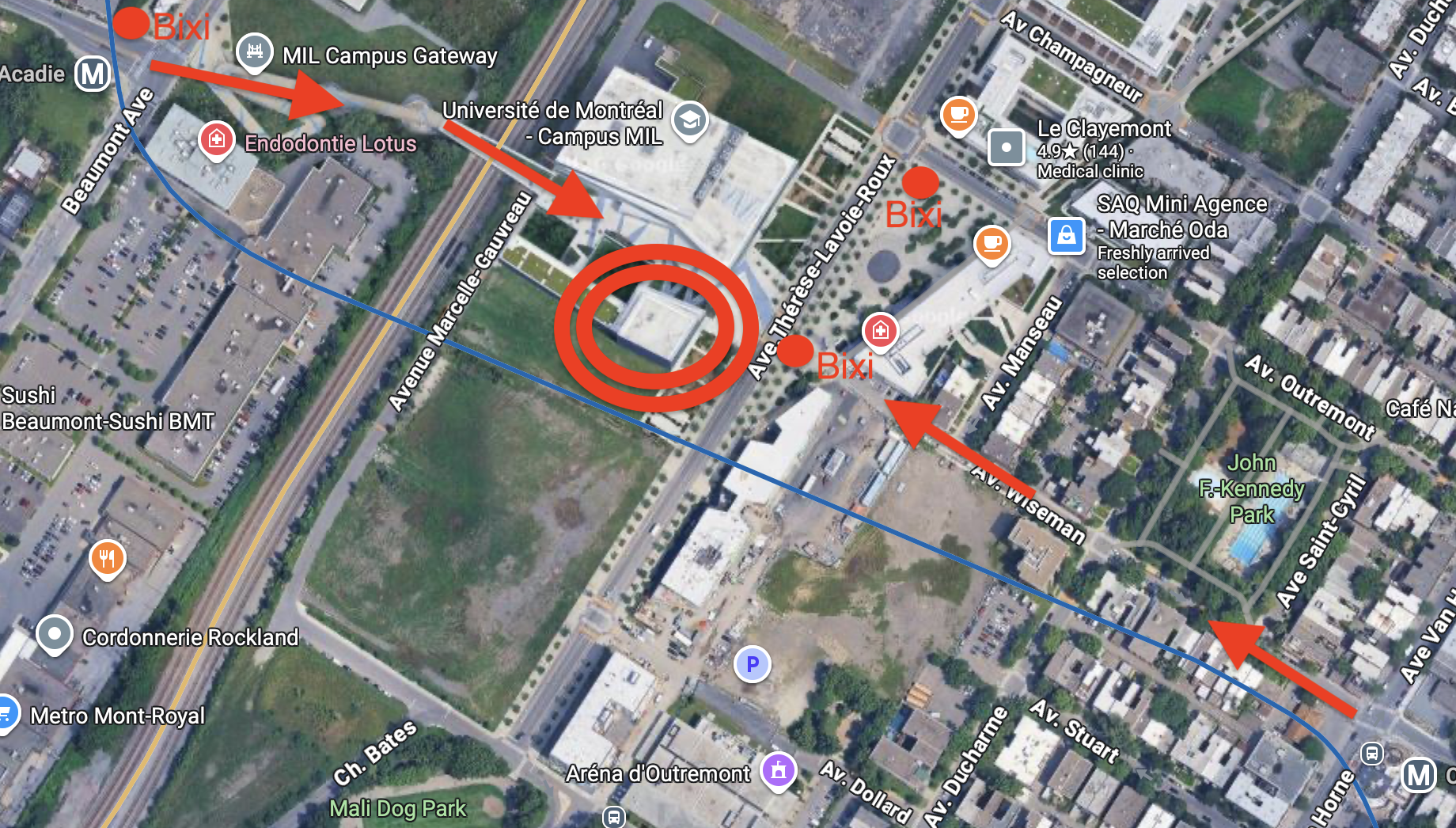
Arrival information. Here is a map of the MIL campus. The Acadie and Outrement metro stations are shown, and the three nearest Bixi stations for those who would like to rent a bike. The Complexe des sciences is at 1375, ave Thérèse-Lavoie-Roux.
The conference will be in the A building (the smaller cube on your left when arriving from Outremont).
General Information. Taxi from P.E. Trudeau airport costs around $45-60 and is the easiest means (or Uber etc which may be cheaper) to reach your hotel. The 747 bus (11.25) leaves every half hour from the airport and takes you to the Lionel-Groulx metro station, which has good connections to most hotels; you should buy your ticket before exiting the airport.
You can purchase a 3-day metro ticket for $21.75 at any metro station, which includes the 747 bus and all other bus lines. A convenient app for planning your route in real time is Transit.
You can also rent a public BIXI bike for individual trips or for a $24 monthly pass. Montreal has a good system of bike lanes. If you plan to bike, be aware that wearing a helmet is legally required when using an electric bike (including the electric Bixis) and is highly recommended for any type of bike. You are encouraged to bring one with you in that case.
The weather forecast is here. For internet access, eduroam is recommended. There is also Université de Montréal guest wifi.
Medical exigencies. You can go to the emergency room at any of the nearby hospitals if necessary. Jewish General, Montreal General, Royal Victoria, Saint Mary's all provide bilingual service. For less urgent problems, private clinics such as RocklandMD and UnionMD are available.
À bientôt - see you soon!
Our universe has many puzzles. For example, we do not fully understand why we live in a four-dimensional universe out of the ten that string theory predicts. Additionally, many observed cosmological features, such as the scale-invariant spectrum of cosmological perturbations on large scales, cannot be explained by standard Big Bang physics alone. In this short presentation, I will discuss a new cosmological scenario, developed as part of my PhD thesis, that may be able to answer some of these questions. In this scenario, we describe our universe using a matrix model related to string theory, namely the BFSS matrix model. Building on numerical hints from a related model, we find evidence for a cosmological scenario in which three emergent spatial dimensions arise, together with a scale-invariant spectrum of cosmological perturbations on large scales. Our analysis leaves many open questions, including the mechanisms underlying emergent space and a more complete description of its properties, to be explored in future work.
It is well known that in the bulk of a background electromagnetic field, photons and gravitons convert into one another. This phenomenon is known as the Gertsenshtein effect. I use this result to examine what happens at a boundary separating a vacuum region from a background electromagnetic field, and I find that up to 34 % of an incoming gravitational wave's energy can get reflected and converted into electromagnetic waves, and vice versa.
Gravitational-wave astronomy has opened a new observational window onto extreme astrophysical phenomena such as black-hole and neutron-star mergers. While current and next-generation interferometric detectors are primarily sensitive to the low-frequency regime, high-frequency gravitational waves (HFGWs) provide a promising probe of physics beyond the Standard Model, since no known conventional astrophysical sources are expected to produce an appreciable signal in this frequency range. In the absence of dedicated HFGW detectors, strongly magnetized objects such as magnetars offer an alternative avenue through the Gertsenshtein effect. In this work, we develop a polarization formalism describing photon–gravitational wave mixing in magnetized environments. We derive the evolution of the photon and gravitational-wave Stokes parameters to all orders in perturbation theory in terms of conversion probabilities and mixing-induced phase shifts, and obtain leading-order analytical expressions for these quantities in two relevant geometries: radially propagating rays and incident rays aligned with the magnetic moment with finite impact parameter. Using these results, we derive analytical lower bounds on the characteristic strain from gravitational waves generated through Gertsenshtein conversion of radially emitted X-rays in magnetar magnetospheres. We also obtain upper bounds on a stochastic gravitational-wave background by requiring that the photon flux produced via inverse Gertsenshtein conversion does not exceed the observed X-ray flux, assuming that the conversion remains approximately isotropic and comparable in magnitude to the magnetic-moment aligned-beam configuration. Applying this framework to the measured X-ray spectra of five magnetars, we derive lower and upper bounds on the characteristic strain in the X-ray frequency range.
Motivated by recent results from the DESI collaboration, we explore two classes of quintessence models that can give rise to crossing of the dark energy equation of state through the “phantom divide” (w=−1). These are models with Lagrangians that involve higher powers of the kinetic energy, or where the dark matter (DM) mass is a function of ϕ. Both have similar features with respect to the reconstructed redshift-dependent w(z): moderate tuning of parameters is required to achieve the desired shape, and it is difficult or impossible for w(z) to continue evolving smoothly as z becomes large. Nevertheless, they give a strong improvement over ΛCDM in fitting the data. We point out that models of coupled dark matter and dark energy that cross the phantom divide are under pressure from constraints on long-range DM forces. They rule out the simplest renormalizable coupling of scalar DM to quintessence, but leave the fermionic case allowed, and exponentially coupled models of either kind of DM are safe from current constraints.
Gaussian Boson Sampling (GBS) is a leading model of sub-universal quantum computation realizable with current photonic technologies. Despite recent experimental progress, the validation of GBS devices remains an open problem. In this talk, I present results on the asymptotic behavior of photon-number cumulants of multimode Gaussian states and discuss how these quantities can be used as experimentally accessible tools for device validation. After a brief overview of the GBS framework, I introduce a matrix-based approach for computing photon-number cumulants of general Gaussian states, drawing on graph-theoretic structures. By averaging these cumulants over Haar-random interferometers, device-specific details are eliminated, allowing their universal asymptotic scaling with the number of modes to be characterized. I conclude by highlighting the role of Haarpy, a Python library developed to automate the Weingarten calculus underlying these results.
We aim to introduce an operational definition of a clock as a physical system and elucidate what
makes a clock quantum in nature. We proceed by introducing an architectural framework for a
clock, which comprises a driver, an oscillator, a frequency reference, a readout, and a stabilizer. We
then apply our framework to three realizations, namely mechanical, atomic, and geometrodynamic
clocks. We address how to quantize the clock, both architecturally and in the three realizations
we present. Our analysis provides a perspective that elucidates the nature of a clock and how to
quantize the clock in a meaningful and consistent way.
We introduce a hybrid quantum-classical neural network whose quantum layer is based on the paradigm of fermionic quantum computing. This model broadens the scope of fermionic machine learning (FermiML) introduced in [arXiv:2404.19032] by extending its applicability to a wider range of learning tasks. Since fermionic quantum circuits are efficiently simulable classically in polynomial time, our work introduces a scalable quantum-inspired benchmark for hybrid quantum machine learning models. We conduct a systematic evaluation of this model on supervised tasks such as classification, evaluating its performance against other hybrid quantum-classical neural networks. Our findings indicate that the proposed model performs competitively across multiple metrics, often outperforming existing architectures. Additionally, in the context of previously proposed hybrid neural networks, we observe that the inclusion of a fully-quantum layer offers no significant benefit to learning on most datasets. In contrast, incorporating fermionic layers tends to enhance accuracy and scalability, suggesting their potential value in hybrid architectures.
I will review several recent developments in the GL theory of superconductors and fermionic superfluids. In superconductors without inversion symmetry, first-order gradient terms known as the Lifshitz invariants appear in the GL functional in the presence of a magnetic field or even without any field, leading to a variety of novel nonuniform stable states. In multiband superconductors, the interband Cooper pairing terms in the GL energy can stabilize time reversal symmetry-breaking states. The FFLO superconductors conduct electric current in a way which is very different from the usual case and, in particular, may exhibit the "superconducting diode" effect, due to the presence of higher-order gradient terms in the GL energy.
Infrared singularities of gapless Goldstone modes preclude magnetic long-range order at finite temperature in conventional two-dimensional systems. We show that this obstruction is avoided on lattices in negatively curved space by considering the spin-$S$ Heisenberg model on regular tilings of the hyperbolic plane. Using spin wave theory, we find that the global symmetry mode is separated from the bulk magnon continuum by a finite spectral gap, eliminating the infrared divergence that destroys order in Euclidean (zero-curvature) two-dimensional space. As a result, local transverse correlations remain short ranged, with a finite correlation length, despite the presence of Goldstone modes associated with the broken $\rm{SU}(2)$ spin-rotation symmetry. Stronger negative curvature is found to suppress quantum fluctuations in bulk thermodynamic quantities, pushing the ordered state toward ``mean-field-like'' behaviour. We further estimate the ordering temperature from the thermal spin wave depletion. These results identify hyperbolic geometry as a mechanism for stabilizing bulk magnetic order at finite temperature in the presence of an exact continuous symmetry.
The concept of bulk-boundary correspondence is essentially that the existence of edge states in topological insulators can be predicted from topological invariants of the bulk. The existing proofs of bulk-boundary correspondence in one dimension are usually not very physically insightful and rely on very involved mathematics. We provide a novel formulation of bulk-boundary correspondence for semi-infinite chains which relies on analytically continuing the Bloch Hamiltonian, $h(k)$ to complex wavenumbers $k$. We show that chiral symmetry results in exceptional points in the (now non-Hermitian) analytically continued $h(k)$ where two eigenstates and eigenvalues coalesce. States arising at those exceptional points are edge states of semi-infinite chains: they satisfy the boundary condition, are normalizable in semi-infinite systems and have real energy. The number of such edge states is adiabatically protected, provided chiral symmetry is not broken. Finally, we derive winding numbers, which can be interpreted as topological invariants, that quantify the number of edge states arising at exceptional points. We compare these winding numbers to the Zak phase and give the quantized Zak phase an alternative interpretation.
Equilibrium quantum metrology is often formulated under assumptions of weak system-bath coupling and thermodynamic limit scaling, which may not be valid for realistic finite-size (FS) quantum devices. Here, we establish how strong coupling (SC) and FS effects jointly modify achievable precision bounds for equilibrium quantum probes. Considering a transverse-field anisotropic XY spin chain coupled to a thermal environment, first utilize we derive a full polaron transform to derive the effective Hamiltonian at equilibrium. Then, using the bare Hamiltonian and the obtained effective Hamiltonian and taking into account the role of FS effects in the calculation of partition function, we derive an analytic expressions for the quantum Fisher information (QFI) for a general parameter for the equilibrium state in weak coupling (WC) and SC regimes, respectively. In contrast to this microscopic approach, we also utilize the Hill's phenomenological nanothermodynamics to calculate an effective QFI expression at SC. Our results, presented for specific cases of magnetometry and thermometry, reveal that considering FS and SC effects lead to substantial and systematic deviations in QFI, even for moderate system sizes, and that commonly used thermodynamic-limit approximations can significantly misestimate precision. This work also highlights the inadequacy of phenomenological approaches in describing the metrological capability and thermodynamic behavior of systems at SC. Our work establishes a consistent framework for evaluating metrological performance of realistic, finite quantum devices operating beyond the weak-coupling paradigm.
In the continued search for dark matter (DM), community interest has extended beyond the standard weakly-interacting-massive-particle paradigm to a richer set of scenarios and detection opportunities. A major focus of upcoming DM searches involves light dark matter (LDM): a class of candidates with masses on the electron to proton scale, characterized by a massive dark photon which mixes kinetically with the regular photon. LDM is often taken to readily interact with regular matter in the early Universe. This scenario yields cosmological predictions for rates of DM interaction or production in today's experiments, with scalar candidates being particularly well-constrained. While the origin of the dark photon's mass is often left unspecified, the inclusion of a dark Higgs as an explicit source of the associated symmetry breaking can significantly affect cosmological predictions for complex scalar DM. Additionally, large dark-sector couplings are generally allowed and often preferred in order to avoid experimental bounds. Such scenarios necessarily result in substantial radiative corrections which are affected significantly by the characteristics of the dark Higgs. We present the effects of such corrections on detection prospects for accelerator-based and direct-detection experiments.
Recent papers have claimed that scalar fields with 4th-order Lagrangians can cancel the cosmological constant of the Standard Model, and that their primordial fluctuations can provide the scale-invariant perturbations needed for the CMB and structure formation, circumventing the need for inflation. We dispute these claims, and point out a number of pathologies associated with such fields.
I will discuss dynamical effects during critical bubble nucleation in thermal first-order phase transitions. These effects arise due to lack of local thermal equilibrium and affect the parameters of the transition including the nucleation rate. I will present a general method of calculating the thermal nucleation rate that accounts both for statistical and dynamical effects. I will also present results from real-time classical lattice simulations elucidating the role of non-perturbative effects in the rate calculation. These results can be important in many areas, from cosmological phase transitions to studies of false vacuum decay in quantum simulators.
We investigate a classically conformal extension of the Standard Model Higgs sector as a solution to the gauge hierarchy problem, in which electroweak symmetry breaking proceeds radiatively via the Gildener–Weinberg mechanism. In the minimal realization, two additional scalars are introduced: the first acquires a vacuum expectation value and mixes with the Standard Model Higgs, while the second stabilizes the scalar potential and serves as a dark matter candidate. We perform a systematic analysis of constraints from collider searches, Higgs signal strength measurements, relic density, and direct detection. We further discuss the possibility that adopting a freeze-in production mechanism, rather than the conventional freeze-out assumption, could reopen a substantial region of parameter space otherwise closed by observational constraints, potentially revealing a new viable window for this class of models.
Minimal hypersurfaces are special because they are extrema of the area functional. They arise in various settings in mathematical physics. An important problem is to study their stability, that is, whether they are actually minima or saddle points (this means the surface can be deformed to one of smaller area). The problem reduces to finding the spectrum of the `stability operator' associated to each minimal surface. In this talk, we will investigate the stability of homogeneous minimal hypersurface in two families of closed Einstein manifolds: the Page space \mathbb{CP}^2 #\overline{\mathbb{CP}^2} , and the Sasaki–Einstein spaces Y^{p,q}. These geometries arise naturally in the study of gravitational instantons and the AdS/CFT correspondence respectively. We will show how to classify such surfaces, derive the spectrum of the associated stability operators, and determine their stability.
In this work, we find numerically static vortex solutions where the scalar and gauge fields have a non-singular profile under Einstein gravity in an AdS3 background. Vortices with different winding numbers n, VEV v and cosmological constant Λ are obtained. These vortices have positive mass and are not BTZ black holes as they have no event horizon. The mass is determined in two ways: by subtracting the numerical values of two separate asymptotic metrics and via an integral that is purely over the matter fields. The mass of the vortex increases as the cosmological constant becomes more negative and this coincides with the core of the vortex becoming smaller (compressed). We then consider the vortex with gravity in asymptotically flat spacetime for different values of the coupling α = 1/(16πG). At the origin, the spacetime has its highest curvature and there is no singularity. It transitions to an asymptotic conical spacetime with angular deficit that increases significantly as α decreases. For comparison, we also consider the vortex without gravity in flat spacetime. For this case, one cannot obtain the mass by the first method (subtracting two metrics) but remarkably, via a limiting procedure, one can obtain an integral mass formula. In the absence of gauge fields, there is a well-known logarithmic divergence in the energy of the vortex. With gravity, we present this divergence in a new light. We show that the metric acquires a logarithmic term which is the 2 + 1 dimensional realization of the Newtonian gravitational potential when General Relativity is supplemented with a scalar field. This opens up novel possibilities which we discuss in the conclusion.
A foundational result of general relativity is that the positive mass theorem. This states that the ADM mass of an asymptotically flat initial data set is non-negative and vanishes if and only if the initial data embeds into Minkowski spacetime. I will discuss some recent work with A. Alaee and M. Khuri on extending this result to toric Riemannian manifolds with non-negative scalar curvature that are asymptotically locally Euclidean (ALE) and asymptotically locally flat (ALF).
In this talk, based on upcoming work with J. Gomis and S. Kannagi, I will discuss an important class of defects in Cern simons theory that implement charge conjugation symmetry. These are monodromy defects and, although some of their properties have been studied in N=4 SYM, we study them for the first time in the context of CS theory. Their quantum dimensions can be computed exactly as twining characters, and are associated with somewhat exotic affine algebras.
If time permits, I will also discuss how the duality between CS theory on S^3 and the topological A model on the resolved conifold geometry also accommodates for these new observables. Being heavy in the ’t Hooft limit, they provide a very non trivial test of the duality, and correspond to some special orientifold projection on the string side.
We study the scattering of identical massive spin-2 particles using S-matrix bootstrap methods. Starting from the most general on-shell cubic and quartic interactions, we impose unitarity, analyticity, crossing symmetry, and improved high-energy behaviour to derive bounds on the cubic couplings and particle spectrum. To organize the polarization dependence, we work with a basis of dual tensor structures rather than individual helicity amplitudes. We derive dispersive sum rules for parity-even cubic interactions with at most two derivatives, imposing the cancellations required for the amplitude to grow no faster than O(E^4) at high energies. As an application, we use these sum rules to bound the coupling of a pair of charge-one massive spin-2 Kaluza–Klein modes to a charge-two massive spin-2 mode, relative to their universal coupling to the massless graviton, as well as the coupling of the Kaluza–Klein modes to a massless scalar.
Topological (quantum) field theories are mathematically rich frameworks that rely on generalized symmetry structures, such as quantum groups in 3d and higher symmetries in 4d, to probe topological properties of manifolds. They also play a central role in quantum gravity. In 2d and 3d, gravity itself is a topological theory, while in 4d, gravitational dynamics can be obtained from suitable constrained or extended topological theories. From this perspective, topological field theories provide a natural backbone for the construction of 4d quantum gravity models. I will discuss several recent developments along these lines.
Primordial black holes (PBHs) provide a unique link between the physics of the early Universe and present-day observations. Formed in the early Universe, PBHs have attracted considerable attention as candidates for dark matter (DM) and as potential sources of gravitational wave (GW) signals.
In this talk, I will review the main mechanisms for PBH formation, their role as DM candidates, and the observational probes used to constrain or detect them. I will then discuss GW signatures of PBHs, focusing on recent work on the stochastic GW background generated by PBHs in the dense cores of dwarf galaxies. In particular, I will compare the contributions from hierarchical binary black hole mergers and close hyperbolic encounters, highlighting their distinct signatures and detectability with current and future observatories, including LISA, DECIGO, the Einstein Telescope, IPTA, and SKA.
We study the impact of Vector-Like Quarks (VLQs) on rare B-decay processes using updated lower mass bounds from LHCb to define a viable VLQ mass window. Combining symbolic and numerical calculations of one-loop effective vertices within and beyond the Standard Model, we evaluate VLQ contributions to rare decay amplitudes. By comparing our results with recent LHCb and Belle II measurements, we constrain the parameter space and identify regions compatible with deviations from Standard Model predictions. Our findings show that updated VLQ mass bounds significantly affect potential New Physics signals in rare decay channels.
Latest measurements of branching ratios, related to hadronic decays of $B$ meson to charm and pseudo-scalar final states ($DP$), showed disagreements with theoretical predictions of QCD factorization. Meanwhile, SU(3) symmetry-breaking was found in recent studies to exceed the Standard Model threshold of 30% (in $B$ decays to two pseudo-scalars). In the light of these results, an analysis of SU(3)-flavour symmetry in $\bar B \to DP$ decays is essential to quantify the degree of the symmetry-breaking and to look for possible 'New Physics'.
To achieve that, we consider both decay channels of $\bar B \to DP$: where $B$ decays to $DP$ and $\bar DP$. We use decay observables: branching ratios, direct and indirect CP asymmetries. We then perform a global fit by computing $\chi^2$, using two approaches: topological diagrams and a group theory approach, using reduced matrix elements (RMEs). The best fit results have shown that a symmetry-breaking of 30% was not sufficient; rather, a breaking of 60% was more likely to explain the data. We then discuss the implications of such a result, in particular what it entails for the value of the CKM angle $\gamma$. We also make valuable predictions for the unmeasured decays based on our best-fit topological amplitudes.
Neutrinoless double-beta ($0\nu\beta\beta$) decay is a key probe of lepton-number violation, the Majorana nature of neutrinos and their absolute mass scale. As upcoming experiments extend half-life sensitivities by up to two orders of magnitude, reliable calculations of nuclear matrix elements (NMEs) are essential to constrain neutrino masses and underlying decay mechanisms. The standard decay mechanism, in which light Majorana neutrinos are exchanged between two decaying neutrons, has been extensively studied within nuclear theory, however short-range contributions described by contact operators in the low-energy effective field theory are less explored. These contributions are crucial for interpreting experimental results in terms of exotic scenarios, such as heavy Majorana neutrinos arising in seesaw mechanisms. We compute short-range NMEs within an ab initio framework, starting from chiral EFT and using the valence-space in-medium similarity renormalization group (VS-IMSRG), a many-body method that maps the full nuclear Hamiltonian to an effective one targeted to the valence-space of the nucleus. Short-range operators exhibit enhanced sensitivity to regularization and similarity renormalization-group evolution compared to long-range light-neutrino exchange operators, motivating a systematic study of different schemes. We find that maintaining consistency between the Hamiltonian and decay operators is critical, as mismatches in regulators and operator evolution (ubiquitous in nuclear theory) can significantly impact results. We also find that operators involving magnetic currents, while formally suppressed in chiral EFT, are enhanced to leading order due to the large isovector magnetic moment of the nucleon and short-range operator structure. Finally, we apply our NMEs to a toy 3+1 sterile-neutrino model to obtain constraints in the heavy sterile-neutrino mixing-mass parameter space.
Feynman diagrams are the ultimate theoretical bait-and-switch. We draw edges that tell us how particles propagate, vertices that show how they interact, and loops that map out where quantum effects enter the picture. The diagrams look so simple and whimsical that you might think even a baby could draw them. But behind those innocent lines hide formidable and highly complex integrals. Definitely not child’s play. Or is it? In this talk, I will review what Feynman diagrams are and how they power modern theoretical particle physics. Then, I will showcase a new software, SubTropica, that, among other things, takes a drawn Feynman diagram and translates it into a rigorous and ready to evaluate mathematical expression with a single click.
The spacetime geometry in a neighborhood of an extremal black hole (its near-horizon geometry) decouples from the exterior region. In Gaussian normal coordinates (GNC), the spacetime metric is completely fixed up to a function, a vector field and a metric on a horizon spatial cross-section. For non-extremal black holes, however, the geometry near the horizon does not decouple. We will explicitly construct the spacetime metric for the Kerr-(AdS) and black ring family of black hole solutions. The objective is to find a general structure for the geometry near the horizon, similar to what we have for extremal cases at least in a up to corrections in the radial direction transverse to the horizon. The work is motivated by studies showing that the `Kerr-CFT correspondence', which asserts that quantum gravity near an extreme black hole is a 2D conformal field theory, can be extended to the non-extreme case.
The initial-boundary value problem in general relativity has been the subject of extensive study. A central issue is the identification of boundary data and conditions on timelike boundaries that ensure well-posedness. In the work presented here, we approach the problem by considering perturbations of a background metric. We seek to disentangle the modes present in these perturbations, distinguishing between physical modes, those associated with gauge freedom, and those arising from constraints. This perspective clarifies how gauge conditions and constraints restrict the admissible boundary data. In particular, it explains why Dirichlet boundary conditions are generally ill posed, helps identify viable alternative choices of boundary data, and specifies the additional conditions required for their numerical implementation.
The quantum field theory for a massless scalar field on a two-dimensional non-singular black hole spacetime gives a non-vanishing probability for a particle to tunnel out of the black hole. The black hole spacetime is non-singular, with an outer and an inner horizon, and the transition amplitude between a one-particle state localized inside the inner horizon, and a one-particle state localized outside the outer horizon is non-zero, including in the case that the regions where the states are localized are causally disconnected.
This paper applies an emergent universal scale independent modified gravity model directly embedded in Einstein’s general relativity theory to solve the Hubble tension problem. The whole paradigm relies on an erfc potential metric whose constant offset can be assimilated to a baryonic dark energy that affects space-time measurements in the surrounding of a massive object. One key feature of this paradigm is the parameter the specific proper length that scales all the surrounding space-time of a given massive object. An observer working with the defined value for the speed of light, as it is normally done in a Mankowski inertial frame of reference, will mask the effect of the constant offset potential in the erfc metric. This results in constant gaps that introduce strong biases in numerous cosmological observations and provide new interpretations of several phenomena as observed from the Sun surrounding.
In the present talk, we focus on the Hubble Tension Problem. When an observer in the solar system is investigating light coming from distant galaxies, the difference between the defined speed of light and its predicted theoretical values is equivalent to a systematic redshift in the measurement of a given reference wavelength. Overall, this Doppler effect leads to Hubble’s Law, predicting a numerical estimate of
H0Doppler= 74.42 km/s Mpc, quite similar to the present accepted value. When the same erfc potential is associated to a source of baryonic dark energy, the Ʌ-CDM model describing the total energy available in the universe predicts a cosmic background value of H0CMB = 67.64 km/s Mpc, similar to the present accepted range of measurements. In other words the discrepancy between the is due to the fact that that has been defined at while is estimated at , the proper length of the universe. This presentation is the tip of an iceberg where numerous well accepted phenomena and challenging cosmological questions can be given a new set of coherent explanations when scrutinized under the eye of an erfc metric
Superintegrable systems provide a natural laboratory in which to study symmetries, hidden structures and exactly solvable quantum models. A classical example is the hydrogen atom: the high degeneracy of its bound-state spectrum is explained by an o(4) symmetry, while the full collection of bound states can be organized using the larger dynamical algebra o(4,2), the Lie algebra of the conformal group of space-time.
I will use this familiar example as motivation for the generic superintegrable system on the two-sphere. For this model, the symmetry algebra is the rank-one Racah algebra. I will explain how it sits inside a larger algebraic structure, namely the rank-two Jacobi algebra, which is the dynamical algebra of the system. This identification gives an algebraic solution of the quantum model and explains the natural appearance of two-variable Jacobi polynomials and univariate Racah polynomials.
Recent Dark Energy Spectroscopic Instrument (DESI) results have garnered attention from the cosmology community due to tension with the $\Lambda$CDM cosmological model when combined with cosmic microwave background (CMB) data. The tension suggests that a new model for dark energy may be warranted. Current alternative models focus mainly on a time-varying component of dark energy due in part to ease of computation from maintaining a homogeneous and isotropic universe. We present the consequences of an inhomogeneous dark energy toy model in the form of a first order phase transition of dark energy, i.e., a bubble of reduced dark energy density. We find that the model predictions of Alcock–Paczynski distortion have features that align strikingly well with the DESI measurements if the dark energy phase transition occurred at roughly a redshift of 1.4, and if the bubble of lower dark energy density has roughly 6\% less dark energy density than the outer cosmology. Despite this striking resemblance, we find that the dark energy bubble is heavily constrained by the CMB to the extent that bubbles in the 1$\sigma$ allowed region of the parameter space would be undetectable in any of the DESI redshift bins, rendering the bubble cosmology indistinguishable from $\Lambda$CDM. Still, the peculiar features in the distance measurements of the dark energy bubble cosmology serve as a suggestive toy model to motivate and inform future work in the currently poorly explored area of spatially varying dynamical dark energy.
I present the Unified Standard Model with Emergent Gravity-Effective Field Theory (USMEG-EFT), demonstrating for the first time a consistent unification of four-dimensional general relativity with the Standard Model within a fully renormalizable effective field theory framework. The approach employs a Lagrange multiplier field that enforces Einstein's equations at the path-integral level, systematically eliminating multi-loop graviton contributions and confining quantum gravity corrections to one loop. The resulting effective action exhibits characteristic logarithmic scale dependence ln(μ/Λ), which we prove mathematically using the Appelquist-Carazzone decoupling theorem establishes four-dimensional general relativity as an effective field theory with finite domain of validity below Λ_grav ~ 10^18 GeV. Three independent theoretical analyses converge on this conclusion: canonical quantization reveals general covariance breakdown in dimensions greater than two, renormalization group analysis demonstrates logarithmic running without UV fixed points, and BRST symmetry analysis shows conditional nilpotency violated above the breakdown scale. The framework predicts exactly two transverse-traceless graviton polarization states—a parameter-free prediction definitively confirmed by LIGO-Virgo-KAGRA gravitational wave observations across dozens of detections, while alternative approaches (string theory, loop quantum gravity, asymptotic safety, Einstein-Cartan theory, and f(R) gravity) generically predict additional polarizations that are experimentally excluded. USMEG-EFT provides systematic integration with Standard Model physics through dimension-six SMEFT operators preserving SU(3) × SU(2) × U(1) gauge symmetries, yielding calculable quantum gravitational signatures including gravitational wave phase corrections and modified high-energy scattering cross-sections. These results resolve the long-standing unification challenge and demonstrate that complete unification is achievable without exotic new symmetries or extra dimensions within an explicitly acknowledged effective theory framework.
We address a correction to A.Buchel and R.Monten's analysis of near-extremal membranes in M-theory. The original authors consider the holographic dual of a $2+1$ dimensional superconformal gauge theory with $U(1)_R \times U(1)_B$ global symmetry. We repeat their analysis of R-charged membranes and identify a mistake; the charge transport is now stable and only the alternative quantization results in axion condensation instabilities.
I will present a model of generalized uncertainty-inspired quantum black hole, both in the static and axisymmetric cases. By comparing the shadow of the axisymmetric version of this black hole to the data from the Event Horizon Telescope, I will set bounds on the quantum parameters of the model. Moreover, We will see that there is an upper bound on this black hole's spin parameter that is smaller than the classical value, due to quantum effects.
In this work, we examine the quantum properties of a Kantowski-Sachs minisuperspace through the lense of Dirac quantization and relational evolution. The relational dynamic is obtained thanks to the use of quantum clocks, which are built from one of the two degrees of freedom of the metric. Gauge-invariant extension of gauge-dependent observables are built relationally with respect to the quantum clocks, and their matrix elements are considered in order to give physical insights about the interior of Black Holes. The observables considered are both the expansion parameter for radial null geodesics and the Kretschmann scalar. In particular, this model shows how both of these quantities are always finite for any instant of quantum and relational time. Therefore, we claim that in a fully quantum and relational model of spacetime, even with the use of the standard Schrodinger continuous representation, the singularity is resolved. Further analysis, involving the computations of the matrix elements of the proper area of 2D-spheres, clearly show that a bounce happens at the singularity, leading to a Black-to-White Hole transition. All these results are obtained without any use of loop variables or polymer quantization, and yet they lead to results that are very similar to the ones obtained in Loop Quantum Cosmology. This model also opens new paths for a connection between the Quantum Reference Frame's framework and Quantum Gravity.
The platforms hosting synthetic quantum matter are known to exhibit a plethora of exotic many-body phenomena. The possibility of engineering different types of interactions and couplings has attracted significant attention, enabling the exploration of a variety of strongly correlated phases that are otherwise difficult to investigate. We are particularly interested in the nuances of unconventional pairing in low-dimensional interacting systems, among other quantum phases of matter [1,2,3]. We have inquired into the emergence of d-wave pairing, along with the formation of d-wave Bose liquids [1,2] and non-Fermi liquids [3], in different setups: trapped ions [1], cold atoms [2], and/or Fermi-Hubbard simulators [3]. Our study examines how these systems can provide new insights into correlated phases of matter. [1] Ring-exchange physics in a chain of three-level ions, Sourav Biswas, E. Rico, and Tobias Grass, Quantum 9, 1683 (2025). [2] Frustrated Bose ladder with extended range density-density interaction, Sourav Biswas, E. Rico, and Tobias Grass, Phys. Rev. B 112, 115122 (2025). [3] Controlled pairing symmetries in a Fermi-Hubbard ladder with band flattening, J. P. Mendonça, Sourav Biswas, M. Dziurawiec, U. Bhattacharya, K. Jachymski, M. Aidelsburger, M. Lewenstein, M. M. Maśka, T. Grass, arXiv:2512.20689 (2025).
Electrostatic control is central to the operation of semiconductor
junctions, but its interplay with band topology remains largely
unexplored. We investigate lateral junctions between two-dimensional
insulating phases with different Chern numbers in a perpendicular
magnetic field. From the electrostatic point of view, the spectral asymmetry of the Chern insulator acts as an intrinsic effective dopant density fixed by topology and tunable by the magnetic field. As a consequence, two regions with different Chern numbers acquire different chemical potentials at charge neutrality, thereby generating an intrinsic built-in potential across the junction. We derive this built-in potential analytically and solve the two-dimensional Poisson equation
self-consistently to obtain the associated charge and potential
profiles. Our results show that Chern-number mismatch can affect
electrostatic equilibrium in two-dimensional junctions, providing a
route to probe topological spectral asymmetry through electrostatic
observables such as junction capacitance.
Recent advances in topological condensed matter physics have highlighted the importance of simple one-dimensional lattice models as building blocks for understanding more complex quantum systems. In particular, the Su–Schrieffer–Heeger (SSH) model has become a paradigmatic example of how topology controls the existence and robustness of eigenstates in low-dimensional systems. However, when the SSH model is generalized to include longer-range hopping beyond nearest neighbours, the structure and number of eigenstates is no longer trivial and remains only partially understood.
A key open question is how the number and nature of eigenstates depend on the coupling parameters when additional links between non-nearest-neighbour sites are introduced, especially in the infinite-chain limit.
In this work, we study a family of generalized SSH models (SSH-N chains) that include hoppings beyond nearest neighbours. Using a combination of analytical methods and numerical simulations, we solve the resulting lattice Hamiltonians by applying Bloch’s theorem and constructing the corresponding band structure and eigenmodes.
We find that the number and type of eigenstates depend sensitively on the geometry of the unit cell and on the values of the coupling parameters. In contrast to the standard SSH model, which supports only a fixed number of edge and bulk states, extended hopping gives rise to new families of solutions, including exponentially localized wave functions in finite systems and additional allowed linear combinations in the bulk.
These results clarify how long-range couplings modify the spectral and topological structure of SSH-type models and provide a systematic framework for engineering new quantum states in one-dimensional lattices, with potential applications to photonic, cold-atom, and molecular lattice systems.
The rigorous Equation of State of any material under external isotropic pressure $P$:
$ \hspace{2.5cm} P =\frac {1}{\beta} \frac {\partial \ln Z}{\partial V}, $
based on the system partition function $Z$, is taught in almost every related textbook.
The Equation of State of crystals under general external stress $\mathbf{S}$ was derived:
$ \hspace{2.5cm} \mathbf{S} \cdot \mathbf{\sigma}_{\mathbf{h}}=-\frac {1}{\beta} \frac {\partial \ln Z}{\partial \mathbf{h}} \ \ \ (\mathbf{h}=\mathbf{a}, \mathbf{b}, \mathbf{c}), $
with respect to the crystal period vectors $\mathbf{h}$, in our recent article:
https://doi.org/10.1140/epjp/s13360-020-01010-6
which has been accessed about 23,000 times.
Here, we also derived the Equation of State of non-crystals under external stress and temperature and studied its relationship with the macroscopic mechanical equilibrium condition of the system. It has been published as the following preprint:
We derive bounds on Wilson coefficients in gravitational effective field theories using fully crossing symmetric dispersion relations. These sum rules naturally isolate finite subsets of low-energy couplings without relying on the forward limit or specific high-energy completions. We validate our method by matching bounds computed previously for scalar scattering with gravity as well as for supergraviton scattering. For graviton scattering we construct crossing symmetric combinations of the maximal-helicity violating amplitude. We also derive new bounds on the coupling of gravitons to a massive spin-4 state at tree level. These results demonstrate the power of crossing symmetric sum rules as a tool in the S-matrix bootstrap.
We present a three-dimensional holographic picture of the pion in which both confinement and chiral symmetry breaking play important roles. We show that the internal transverse and longitudinal light-front QCD dynamics in the pion map onto the IR and UV limits of the scalar field equation of motion in 5-dimensional anti de Sitter spacetime (AdS) deformed by a quadratic dilaton. While conformal symmetry is explicitly broken on the AdS side for transverse dynamics, it is explicitly broken on the QCD side for longitudinal dynamics.
Recently, various authors have studied the vacua of strongly coupled field theories via the introduction of anomaly mediated supersymmetry breaking (AMSB) to supersymmetric (SUSY) gauge theories. This technique is powerful but it is known that in some cases, there is a phase transition as the SUSY-breaking scale crosses the confinement scale. We introduce AMSB to $\mathcal{N}=2$ SQCD (Supersymmetric Quantum Chromo-Dynamics) with massless squarks. Perturbatively, the theory retains $\mathcal{N}=1$ SUSY, and the AMSB terms are equivalent to a supersymmetric mass term for the adjoint chiral multiplet. However, instanton contributions induce a mass splitting which breaks supersymmetry completely. In the IR description, the theory with AMSB is qualitatively similar to its $\mathcal{N}=1$ analog, exhibiting monopole condensation and confinement. However, the dynamics break supersymmetry completely, and the values of the condensates are different from their $\mathcal{N}=1$ analogs. Under physically reasonable assumptions, it can be shown that the vacuum must change to those of the $\mathcal{N}=1$ theory as the SUSY-breaking scale crosses the strong-coupling scale.
The analytic functional approach has revealed fruitful new geometric features in higher-dimensional CFTs (particularly in 3D CFTs) that had not been seen before. We want to discuss its applications to the 3D conformal bootstrap and how it uncovers new structures such as kinks, plateaus, and “volcano”-like features.
We study the two qubit phase space which is very simply a seven sphere. However, the topological seven spheres come in 28 inequivalent differential structures. We study the non-abelian Berry connection on the Kaluza-Klein reduced seven sphere to the four sphere with Yang-Mills fields, to see how the exotic differential structure can affect the two qubit system.
We derive exact critical-temperature bounds for the classical ferromagnetic Ising model on two-dimensional periodic tessellations of the plane. For any such tessellation or lattice, the critical temperature is bounded from a above by a universal number that is solely determined by the largest coordination number on the lattice. Crucially, these bounds are tight in some cases such as the Honeycomb, Square, and Triangular lattices. We prove the bounds using the Feynman--Kac--Ward formalism, confirm their validity for a selection of over two hundred lattices, and construct a two-dimensional lattice with 24-coordinated sites and record high critical temperature.
Experimental data demonstrates that continuous-wave (CW) theories of non-linear optics do not accurately model the optical turbulence (chaos) arising from delayed discrete feedback in nonlinear optical ring cavities (Ikeda, 1979). To accurately predict this onset of optical turbulence within a ring cavity, this study implements a high-performance computational architecture simulating the complex-valued, discrete-time Ikeda map. This map, in comparison, accurately models the behavior within a nonlinear ring cavity. By utilizing a decoupled two-dimensional real-valued mapping, the heavy complex-number computational overhead was eliminated, thus optimizing the algorithm to scan high-dimensional parameter spaces with minimal latency. The current implementation successfully plotted the structural transition from stable periodic orbits to persistent chaos via a period-doubling bifurcation cascade. To produce even better latency benchmarks for larger parameter sweeps, the rendering engine and numerical solvers are actively being translated into modern C++.
After generating the bifurcation data, the chaotic regime was analyzed. Using Jacobian matrix differentiation to compute the Lyapunov exponent for varying values of the reflection coefficient $B$, the exponential trajectory divergence at precise bifurcation thresholds was confirmed mathematically. Additionally, a box-counting algorithm extracted a non-integer fractal dimension of $D\approx1.714$, confirming the self-similar geometry of the resulting strange attractor. Ultimately, the modelling of the discrete map revealed that the period-1 stability limit in the route to optical turbulence was $B_{1}\approx0.322$, which disagrees with R. W. Boyd's theoretical CW threshold of $B_{CW}\approx0.0624$ (Boyd, 2020), as expected. The numerical precision of the iterative architecture was orthogonally validated by calculating the ratio of successive bifurcation intervals, which converged toward the universal Feigenbaum scaling constant with an 84.03% relative agreement.
[1] K. Ikeda, "Multiple-valued stationary state and its instability of the transmitted light by a ring cavity system," Opt. Commun., vol. 30, no. 2, pp. 257-261, 1979.
[2] R. W. Boyd, Nonlinear Optics, 4th ed. Academic Press, 2020.
In linearized gravity there is a long-standing non-uniqueness problem regarding expressing the energy-momentum of the theory. Multiple distinct expressions exist in the literature, and there is not consensus which, if any, is the unique expression for the theory. Determining uniqueness is important as certain calculations require a unique expression. To address this problem, we use Noether’s first theorem to develop a mathematical framework for the general set of Noetherian energy-momentum tensors in linearized gravity. Linearized gravity is necessary because the symmetries (4-parameter Poincaré translation) required for deriving an energy-momentum tensor from Noether’s first theorem are well defined for this theory. Noether’s first theorem provides a systematic method for deriving conservation laws from the symmetries of a given theory. In a previous publication, we developed the general set of energy-momentum tensors in linearized gravity that are derivable from the Noether current; however, it is yet to be determined what subset of these will satisfy the Noether identity off-shell. Determining this subset is the subject of current work on the project, which we discuss in this presentation.
Within the physics literature, there are multiple definitions of the energy-momentum tensor for Lagrangian field theories. The most common expressions are the ``canonical'' Noether formula, Hilbert's definition in terms of metric tensor derivatives, and Belinfante/Rosenfeld's improvement procedure. These definitions are not generally equivalent, but converge to the same result in cases such as the Klein-Gordon Lagrangian. However, alterations of the scalar field Lagrangian can differentiate the results of the different methods. This suggests that the equivalences of some of these definitions are coincidences, emerging from being applied to simple Lagrangians. In this talk, we will discuss results related to general scalar field Lagrangians which depend on first and second derivatives of the fields, and how they can be used to help specify a particular energy-momentum tensor definition. Using methods found in the mathematics literature involving quasi-symmetries and how they affect the calculation of Noether currents, a method is presented that can resolve uniqueness issues when defining said conserved quantities, and is more general as it works in arbitrary coordinate systems and on manifolds with curvature. Additionally, constraints are placed on to what degree tracelessness of an energy-momentum tensor can imply conformal symmetry of the field theory.
The outer-most marginally-outer trapped surface (MOTS) is often used as a quasi-local boundary of a black hole — the apparent horizon. During a black hole merger, the original two apparent horizons ultimately becoming one involves considerations of MOTSs at each time-slice, and strikingly reveals key involvement of self-intersecting MOTSs. Self-intersecting MOTSs have then been numerically found in static (Schwarzschild, Reissner-Nordstrom, 4D Gauss-Bonnet) and stationary (Kerr) black hole interiors, with their analysis grounded in the Anderson-Simon-Mars stability operator.
This talk will review this self-intersecting MOTS program and showcase work done in asymptotically AdS and dS black hole spacetimes. In Schwarzschild-AdS, the interior MOTSs become more `unstable' as the black hole becomes large, going against previously seen interior MOTS stability behavior.
The past two decades have witnessed remarkable advances in our understanding of topological matter. What began as a framework for describing electronic phases of matter has evolved into a powerful organizing principle. Today, topological phenomena are explored not only in electronic materials, but also in photonic, magnonic, acoustic, and even classical systems.
In this talk, I will illustrate how similar topological ideas reappear across seemingly unrelated physical platforms. In one dimension, polyacetylene, superconducting quantum wires, and photonic lattices can all be understood through the Zak phase. In two dimensions, the quantum Hall effect, spin-orbit-coupled quantum wells, and arrays of optical waveguides are connected through the Chern number and related topological invariants. In three dimensions, topological states give rise to surface states that behave as massless and sometimes massive Dirac particles.
The common structures underlying these realizations, teach us about the universality of topology and the power of analogies in physics.
Some of the simplest wormhole solutions involve massless scalar fields that take imaginary values. Massless fields can be interpreted as coupling constants in asymptotically flat or asymptotically AdS gravity theories. We argue that wormhole effects imply an imaginary distance bound, an upper limit for the analytic continuation of the theory to imaginary values of these couplings. In string theory examples, we find explicit effects that render the low-energy theory invalid either before or precisely at this wormhole limit. We argue that the existence of such effects enforcing the distance bound is a general feature of string theories containing wormholes. In some cases, the bounds we discuss coincide with the weak gravity conjecture, and with the Kontsevich-Segal-Witten condition on complex metrics.
We consider rules for modifying holographic tensor networks proposed in two independent contexts: by Akers et al. (CO) to incorporate observers in holographic maps, and by Kaya-Rath-Ritchie (KRR) to derive the Bousso-Penington generalized entanglement wedge proposal. Interestingly, these two sets of tensor network rules are exactly equivalent, KRR = CO. This suggests a more general connection between these Abdalla-Antonini-Iliesiu-Levine (AAIL) inspired observer rules and generalized entanglement wedges. To pursue this connection, we first use KRR’s analogous rules for the gravitational path integral (based on fixed geometry states) to generalize AAIL’s path integral rules to include observers occupying a bulk subregion. Additionally, we leverage the connection in the opposite direction by using the AAIL rules to derive the Bousso-Penington proposal for pointlike bulk regions in JT gravity.
Can short-distance quantum fluctuations leave an imprint at large distances? This question is especially important in gravity, where high-energy physics may influence low-energy observables. In this talk, I will discuss this question using the time delay of light rays in interferometer setups as a concrete observable. I will present the gauge-invariant definition of the time-delay noise and show what this observable tells us about quantum fluctuations of the gravitational field, including both graviton fluctuations and the gravitational response to quantum stress-energy fluctuations.
We propose a kinematical framework in which spacetime geometry is encoded directly in the Heisenberg commutators: the metric becomes an operator extracted from $[\,\hat x^\mu,\hat P_\nu\,]$, and the non-commutativity of translation generators follows from Jacobi closure. The construction naturally yields an operator analogue of metric compatibility and reproduces the familiar torsion/curvature structure once Lorentz generators are included. A worked Friedmann--Robertson--Walker example gives $[\,\hat P_0,\hat P_i\,]\propto H(t)\hat P_i$, making cosmic expansion an explicit source of non-commuting ``translations.'' Time is treated as an observable through a conservative POVM implementation, or as a self-adjoint operator on an enlarged Hilbert space organized by an antiunitary gravitational-conjugation symmetry. We highlight physical interpretations, limiting regimes, and several near-term avenues toward dynamics and phenomenology.
We propose a unifying framework for characterizing pure and mixed state phases of matter across equilibrium, non equilibrium, and metastable regimes. We introduce the concept of locally stable states, defined by the operational property that any local operation (including post selection) can be reversed by a local channel. We prove that local stability is equivalent to a state being short range correlated, defined by the decay of both correlations and conditional mutual information. We demonstrate that these properties are invariant under locally reversible channels, thus defining locally stable phases. Furthermore, we prove that local stability implies both the decay of a family of nonlinear correlators, including the fidelity correlator, and the decay of correlations in the canonical purification, thus bridging the gap between mixed and pure states. Along the way, we establish two results which may be of independent interest: we show that post-selection on locally stable (short range correlated) states can be implemented via local channels and that quantum Markov chains can be characterized by the local computability of nonlinear observables.
Astrophysical environments provide natural laboratories for collective quantum phenomena on scales far beyond those accessible in conventional laboratory experiments. In this talk, I will discuss how large radiatively coupled ensembles in astrophysical media can develop macroscopic coherence and exhibit cooperative radiative behavior, including superradiant and subradiant dynamics. Using Maxwell–Bloch approaches, I will explore how collective emission emerges in open, non-equilibrium systems and how these effects differ from ordinary incoherent radiation or standard maser amplification. I will emphasize the role of coherence, collective decay, and many-body radiative dynamics in producing transient behavior relevant to coherent astrophysical radio phenomena. More broadly, this work connects quantum optics, quantum many-body physics, and astrophysical plasmas, and highlights astronomical systems as a new setting for studying macroscopic quantum behavior in naturally occurring environments.
The eigenstate thermalization hypothesis formally connects time evolution in a quantum system with the micro-canonical ensemble system average in statistical physics. The formal reliance on random matrix theory is discussed, justifying the main statement, and then extended to the case of quantum circuits where the micro-canonical ensemble emerges explicitly without invoking random matrices. Forcing the state to be sufficiently kicked provides a resource to the quantum computer that equally weights all eigenstates. This resource can then be used to solve a wide variety of linear algebra problems in poly-logarithmic time.
This research was undertaken, in part, thanks to funding from the Canada Research Chairs Program (CRC-2021-00257). This work has been supported in part by the Natural Sciences and Engineering Research Council of Canada (NSERC) under grants RGPIN-2023-05510 and DGECR-2023-00026.
Abstract: Ontological models of quantum theory seek to realize quantum theory as a statistical theory over underlying degrees of freedom, whose measurement statistics are described by classical probability theory. Harrigan and Spekkens (2010) proposed a distinction between ontological models in which pure quantum states represent states of reality ($\psi$-ontic) or knowledge about reality ($\psi$-epistemic) depending on whether their associated probability distributions overlap, subsequently formalized into measure-theoretic form by Leifer (2014). In this talk, we examine whether this $\psi$-ontic/epistemic distinction truly captures the intended difference between ontic and epistemic conceptions of pure states, using measure-theoretic probability theory. We consider some mathematical alternatives relating to different notions of non-overlap between probability measures and compare them. We discuss the implications of these results for quantum ontology theorems -- theorems that rule out $\psi$-epistemic readings of pure states under certain assumptions about the ontological model -- such as the Pusey-Barrett-Rudolph Theorem (2012).
Extended Abstract:
Since the inception of quantum theory, there has been much debate over how to understand the theory. In particular, there is no uncontroversial agreement on how to understand the very notion of a quantum state. The idea of a state of a system is not so puzzling in classical physics, from which we inherit two notions. One is that of the state as physical (or ontic), where each state represents a distinct way that a system can be, like the states in classical mechanics. The other is of the state as statistical (or epistemic), where the state is compatible with different ways a system can be, with a probability assigned to each possibility, as the states in classical statistical mechanics. Pure states of quantum theory, however, do not seem to fit either mold straightforwardly. There is no doubt that quantum theory, understood as a framework under which one obtains correct predictions about outcomes of measurements and their probabilities, is empirically successful. But without an agreed-upon understanding of what quantum states represent, one lacks an explanation for this empirical success.
One observes formal similarities between probability theory and quantum theory; quantum theory can be viewed as a non-commutative generalization of classical probability theory. For want of an explanation, some have seeked to understand quantum states analogously to the way we understand classical probabilities. This motivates a statistical conception of quantum states that extends beyond an operational understanding: to take quantum states not just as a tool for calculating probabilities of measurement outcomes, but more fundamentally as representing probabilities of what the system is actually like.
Motivated by these ideas, the framework of ontological models of quantum theory seeks to describe theories that realize quantum theory as a statistical theory over some underlying degrees of freedom, over which the statistics of measurement outcomes are described by classical probability theory. Under this framework, quantum theory is taken to provide operational predictions for observations. Meanwhile, an ontological model posits a description of the same system using the aforementioned underlying degrees of freedom—the ontic state of the system—often taken to describe some underlying reality, which need not be directly empirically accessible to us. The familiar objects of quantum theory, such as the quantum state of the system, then correspond to some probability distribution over the ontic state space of the system. In order for a description of a physical system from an ontological model to be consistent with predictions of quantum theory, the probabilistic predictions of the ontological model should agree with those of quantum theory.
For pure states to be ontic, distinct pure states ought to correspond to different ways the system can be. Insofar as ontic states faithfully describe different ways the system can be, one expects each ontic state be compatible with at most one pure state in a given ontological model, In this case, the probabilities involved in the ontological model arise simply due to lack of knowledge of these underlying degrees of freedom, so quantum pure states need not be understood probabilistically relative to the given ontological model. Harrigan and Spekkens (2010) introduced the notion of an ontological model being $\psi$-ontic to capture this very idea. According to their definition, an ontological model is $\psi$-ontic if no pairs of probability distributions over ontic states corresponding to different pure states overlap, and is $\psi$-epistemic otherwise. This definition subsequently has been sharpened by Leifer (2014) into measure-theoretic form, which involves the vanishing total variation distance between a pair of probability measures each corresponding to distinct pure states.
We consider the question of whether the received $\psi$-ontic/epistemic distinction based on the total variation distance succeeds in capturing the original idea of each ontic state corresponding to at most one pure state, from the perspective of measure theory. Based on our analysis, we conclude that it does not. The key observation is that the standard definition of $\psi$-ontology only requires each pair of probability measures for distinct pure states to be non-overlapping, a notion captured by mutual singularity of probability measures. But it takes a notion of non-overlap for the entire collection of probability measures, called complete singularity, to capture the idea that each ontic state describes a system associated with at most one pure quantum state in an ontological model. As pairwise non-overlap is insufficient to establish this in general, we conclude that $\psi$-ontic models do not adequately capture the notion of reality of pure quantum states.
In light of this observation, we argue that one should be cautious about the purported conclusions of quantum ontology theorems such as the PBR Theorem. With the debate on the ontological status of pure states, previous analyses have focused on the assumptions these theorems impose on the ontological models, such as the Preparation Independence Postulate and its physical relevance. Our work instead questions the foundation of the conclusion of these theorems—whether the criterion of $\psi$-onticity is the correct mathematical characterization of ontological models where pure states are ontic to begin with. If the standard criterion for a $\psi$-ontic model based on the total variation distance is too weak to establish ontic pure quantum states, then these theorems have not established ontic pure states in the given ontological model, even taking for granted the assumptions they impose on the ontological model.