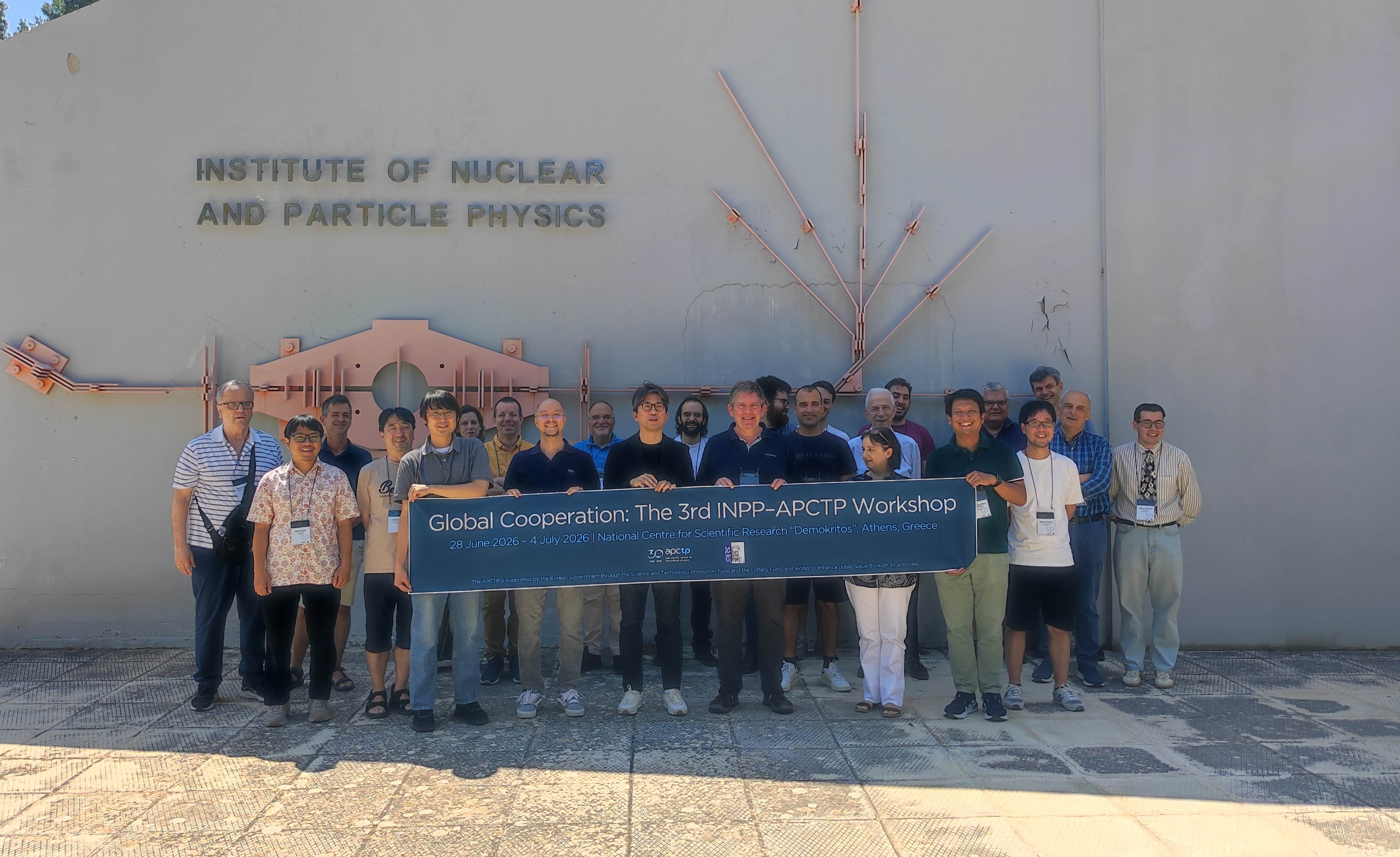
3rd INPP Demokritos-APCTP Workshop

Europe/Athens
Description

The National Centre for Scientific Research (NCSR) “Demokritos” and the Asia-Pacific Center for Theoretical Physics (APCTP) have agreed to launch a cooperation which aims to strengthen the ties between Greece and South Korea in the field of Theoretical Physics.

This is the third meeting between the two Institutes. The meeting will take place at the Institute of Nuclear and Particle Physics (INPP) in Athens on 28 June – 4 July 2026, with speakers from both institutes, along with a number of invited speakers from Europe and the Asia-Pacific region. 28 June is expected to be the arrival day and 4 July the departure day.

The meeting will take place in the Institute of Nuclear and Particle Physics (INPP), seminar room "Themis Paradellis" 

Highlight Speaker

Karl Jakobs (University of Freiburg)


Speakers from INPP and neighboring Institutes

Minos Axenides (INPP)*

Dhimiter Canko (University of Bologna)

Vassilis Constantoudis (INN)

Panagiotis Dimitrakis (IQCQT)

Fotis Farakos (NTUA)

Kostas Filippas (INPP)

Alexandros Kehagias (NTUA)

Emmanuel Floratos (Academy of Athens)

Manuela Kulaxizi (TCD & NKUA)

Costas Papadopoulos (INPP)

Theodoros Papanikolaou (University of Patras)

Georgios Papathanasiou (NKUA)

Mattia Pozzoli (University of Bologna)

Astero Provata (INN)

George Savvidy (INPP)*

Konstantinos Sfetsos (NKUA)

Vassilis Spanos (NKUA)

Aris Spourdalakis (INPP)

Nikolaos Tetradis (NKUA)

Dimitrios Zoakos (University of Patras)

Konstantinos Zoubos (Pretoria & NITheCS)


Speakers from APCTP and neighboring Institutes

Jae-Hyung Jeon (APCTP & POSTECH)

Heribertus Bayu Hartanto (APCTP)

Ki-Seok Kim (POSTECH)

Roni Muslim (APCTP)

Shohei Okawa (APCTP)

Jong-Min Park (APCTP)


*To be confirmed


Organizing Committee

Giuseppe Bevilacqua (INPP)

Jae-Hyung Jeon (APCTP)

Heribertus Bayu Hartanto (APCTP)

Georgios Linardopoulos (SIMIS)

Christos Markou (INPP)

Costas Papadopoulos (INPP)


Registration
Registration to the 3rd INPP Demokritos-APCTP meeting
    • 09:00 19:00
      Arrival day 10h
    • 09:30 09:45
      Arrival and welcome 15m
    • 09:45 10:00
      Opening speech by the INPP Director 15m
      Speaker: Christos Markou
    • 10:00 10:15
      Opening speech by the APCTP Director 15m
      Speaker: Jae-Hyung Jeon (APCTP)
    • 10:15 11:00
      TBA 45m
      Speaker: Emmanouil Floratos (National and Kapodistrian University of Athens (GR))
    • 11:00 11:30
      Coffee break & Group photo 30m
    • 11:30 12:15
      TBA 45m
      Speaker: Jae-Hyung Jeon (APCTP)
    • 12:15 13:00
      TBA 45m
      Speaker: Vassilios Constantoudis (INN)
    • 13:00 14:00
      Lunch break 1h
    • 14:00 14:45
      Chaos or Noise? Identifying the Origin of Irregular Dynamics from Time Series Using Machine Learning 45m

      Many time series observed in nature exhibit irregular and seemingly unpredictable fluctuations. Determining whether such behavior originates from chaotic dynamics or from intrinsic stochastic fluctuations is a longstanding challenge in nonlinear science and time-series analysis. Although a variety of methods have been developed for this purpose, reliable discrimination remains difficult because stochastic processes can often mimic characteristic signatures of chaos. In this talk, I will present a learning-based framework for distinguishing chaotic dynamics from stochastic processes using time-series data. The proposed approach is motivated by the observation that conventional short-term prediction methods can be misled by stochastic processes with strong temporal correlations, which may exhibit apparent predictability despite the absence of an underlying deterministic rule. To overcome this limitation, we introduce a cross-prediction strategy in which the future change of a variable is predicted from its current value. This prediction task requires not only short-term predictability but also the ability to infer the deterministic structure governing the dynamics, providing a more stringent test for chaos. Implemented using reservoir computing, the framework yields a simple quantitative criterion for distinguishing chaos from noise based on the coefficient of determination between true and predicted future changes. Applications to a wide range of synthetic chaotic and stochastic systems reveal a clear separation between the two classes. We further apply the method to several empirical datasets previously analyzed in the literature and obtain classifications largely consistent with existing evidence. These results demonstrate that the proposed approach provides a simple, robust, and broadly applicable tool for distinguishing chaos from noise from time-series observations.

      Speaker: Jong-Min Park (Asia Pacific Center for Theoretical Physics (APCTP))
    • 14:45 15:30
      Adaptive transitions in networks of coupled non-linear oscillators 45m

      Adaptive coupling in networks of interacting nonlinear oscillators has
      gained recent attention due to the many applications
      both in biological and in artificial neural networks, where synaptic
      plasticity or adaptive coupling are considered as key
      factors in the learning processes. In our studies, we apply adaptive
      connectivity rules in exemplary networks consisting
      of leaky-integrate-and-fire (LIF) or FitzHugh-Nagumo (FHN) oscillators.
      For such networks, in the absence of adaptivity
      (i.e., for constant network connectivity), hybrid synchronization
      patterns (solitaries, chimeras and bump states) have
      been observed [1]. When the coupling strengths get modified, influenced
      by the nodal state variables (nodal potentials),
      then the network dynamics undergoes structural transitions crossing
      domains of different complexity/synchrony [2-3].
      Coupling adaptivity (plasticity) may be realized via Hebbian learning
      adjusted by the Oja rule (also called 'forgetting' rule)
      to prevent the network link weights from growing without bounds. The
      resulting adaptive transitions become evident
      when the time scales governing the coupling dynamics are much slower
      than the ones governing the nodal dynamics
      (nodal potentials). Namely, when the coupling time scales are slow, the
      network has the time to realize and demonstrate
      different synchronization regimes before reaching the final steady
      state. The transitions are characterized by abrupt
      changes of the average coupling weights and of the Kuramoto order
      parameter as the network evolves in time [2-3].
      The emergence of adaptive transitions demonstrate how the interplay of
      distinct time scales can profoundly influence
      the evolution and the collective behavior in dynamical systems.

      Literature
      [1] Y. Kuramoto and D. Battogtokh
      Coexistence of Coherence and Incoherence in Nonlocally Coupled Phase
      Oscillators
      Nonlinear Phenomena in Complex Systems 5 380 (2002)
      http://www.j-npcs.org/online/vol2002/v5no4/v5no4p380.pdf

      [2]. A. Provata, G. C. Boulougouris and J. Hizanidis
      Adaptive transitions in FitzHugh-Nagumo networks with Hebb-Oja coupling
      rules
      Journal of Statistical Mechanics: Theory and Experiment, Volume 2026,
      044004 (2026)
      https://doi.org/10.1088/1742-5468/ae5c93

      [3]. A. Provata, G. C. Boulougouris and J. Hizanidis
      Synchronization transitions in spiking networks with adaptive coupling
      Chaos, Solitons & Fractals, Volume 200, 117128 (2025)
      https://doi.org/10.1016/j.chaos.2025.117128

      Speaker: Astero Provata (INN)
    • 15:30 15:50
      Coffee break 20m
    • 15:50 16:20
      TBA 30m
      Speaker: Roni Muslim (APCTP)
    • 16:20 17:00
      Discussions 40m
    • 09:30 10:15
      TBA 45m
      Speaker: Konstadinos Sfetsos (National and Kapodistrian University of Athens (GR))
    • 10:15 11:00
      TBA 45m
      Speaker: Nikolaos Tetradis (National and Kapodistrian University of Athens (GR))
    • 11:00 11:30
      Coffee break 30m
    • 11:30 12:15
      TBA 45m
      Speaker: Alexadros Kehagias
    • 12:15 13:00
      Emergent $\text{AdS}_{d+1}$ Geometry from Functional Renormalization Group in the Massless Critical Limit 45m

      We present a holographic dual description for the O(N) vector model in $d$-dimensional Euclidean space within the functional renormalization group (FRG) framework. By iterating Wilsonian renormalization group transformations, the extra-dimensional scale coordinate is identified as the radial direction of an emergent $(d+1)$-dimensional bulk spacetime. We construct a bidirectional holographic dictionary that maps non-perturbative fluctuations to the emergent bulk metric warping factors. Under the massless critical configuration, the emergent gravitational vacuum reduces to an Anti-de Sitter ($\text{AdS}_{d+1}$) geometry, satisfying the local energy conditions.

      Speaker: Ki Seok Kim (POSTECH)
    • 13:00 14:00
      Lunch break 1h
    • 14:00 14:45
      TBA 45m
      Speaker: Manuela Kulaxizi
    • 14:45 15:30
      TBA 45m
      Speaker: Dimitrios Zoakos
    • 15:30 15:50
      Coffee break 20m
    • 15:50 16:35
      TBA 45m
      Speaker: Fotis Farakos (NTUA)
    • 16:35 17:05
      TBA 30m
      Speaker: Kostas Filippas (NCSR Demokritos, Institute of Nuclear and Particle Physics)
    • 18:30 21:30
      Banquet/Conference dinner 3h
    • 09:30 19:00
      Free day 9h 30m
    • 09:30 10:15
      Two-loop amplitudes for Higgs boson production in association with a bottom-quark pair at the LHC 45m

      I will first review the phenomenological importance of Higgs boson production in association with a bottom-quark pair (Hbb production) at the LHC. I will then discuss the computation of two-loop scattering amplitudes, the principal bottleneck in obtaining NNLO QCD predictions, and their application to cross-section calculations.

      Speaker: Heribertus Bayu Hartanto (Asia Pacific Center for Theoretical Physics (APCTP), Pohang, South Korea)
    • 10:15 11:00
      Automating two-loop amplitude computation with HELAC2LOOP 45m
      Speaker: Konstantinos Papadopoulos
    • 11:00 11:30
      Coffee break 30m
    • 11:30 12:00
      TBA 30m
      Speaker: Aris-George-Baldur Spourdalakis (NSCR Demokritos)
    • 12:00 12:30
      Three-loop Feynman integrals for leading-colour diboson production at hadron colliders 30m

      In this talk, I will present results for planar families of Feynman integrals for a four-point three-loop kinematics, with two non-degenerate external masses. These integrals are necessary to compute the three-loop amplitude for the production of two vector bosons, which are relevant for N3LO QCD corrections to this process. After grouping the integrals into nine integral families, we compute them through differential equations. To this end, for all integral families we construct a basis of pure master integrals, satisfying canonical differential equations. Compared to the two-loop case, this step is more complicated not only because of the larger number of master integrals, but also by the appearance of new square roots in the alphabet. We evaluate the master integrals by solving the differential equations using generalised power series expansions.

      Speaker: Mattia Pozzoli (University of Bologna and INFN)
    • 12:30 13:00
      TBA 30m
      Speaker: Dhimiter Canko (Università di Bologna)
    • 13:00 14:00
      Lunch break 1h
    • 14:00 14:45
      Novel cluster-algebraic letters for 5- and 6-point QCD processes 45m

      By breaking dual conformal invariance, we transform cluster-algebraic predictions for the alphabet of 9-point amplitudes in N=4 super Yang-Mills theory to analogous predictions for 5- and 6-point processes in QCD. We start by obtaining, for the first time, candidate letters for 6-point processes with one massive external leg, and discover that they surprisingly also contain nested square roots. We confirm that our results essentially contain the alphabet of all 1-loop integrals with these kinematics, and in their massless limit also the recently computed alphabet of finite, planar 2-loop amplitudes for 6-point massless QCD processes. In the latter case, we additionally find 162 letters that may appear at higher loops. We similarly produce candidate letters for 5-point 2-mass processes, whose comparison with the literature reveals a nontrivial overlap that also includes new letters.

      Speaker: Georgios Papathanasiou (National and Kapodistrian University of Athens)
    • 14:45 15:30
      TBA 45m
      Speaker: Panagiotis Dimitrakis (IQCQT)
    • 15:30 16:00
      Coffee break 30m
    • 16:00 17:30
      TBA 1h 30m
      Speaker: Karl Jakobs (University of Freiburg (DE))
    • 09:30 10:15
      TBA 45m
      Speaker: Shohei Okawa (APCTP)
    • 10:15 11:00
      TBA 45m
      Speaker: Vassilis Spanos (Department of Physics National and Kapodistrian University of Athens)
    • 11:00 11:30
      Coffee break 30m
    • 11:30 12:15
      TBA 45m
      Speaker: Theodoros Papanikolaou (University of Patras)
    • 12:15 13:00
      TBA 45m
      Speaker: Konstantinos Zoubos
    • 13:00 14:00
      Lunch break 1h
    • 14:00 14:30
      TBA 30m
      Speaker: Giuseppe Bevilacqua (NCSR Demokritos)
    • 09:00 19:00
      Departure day 10h