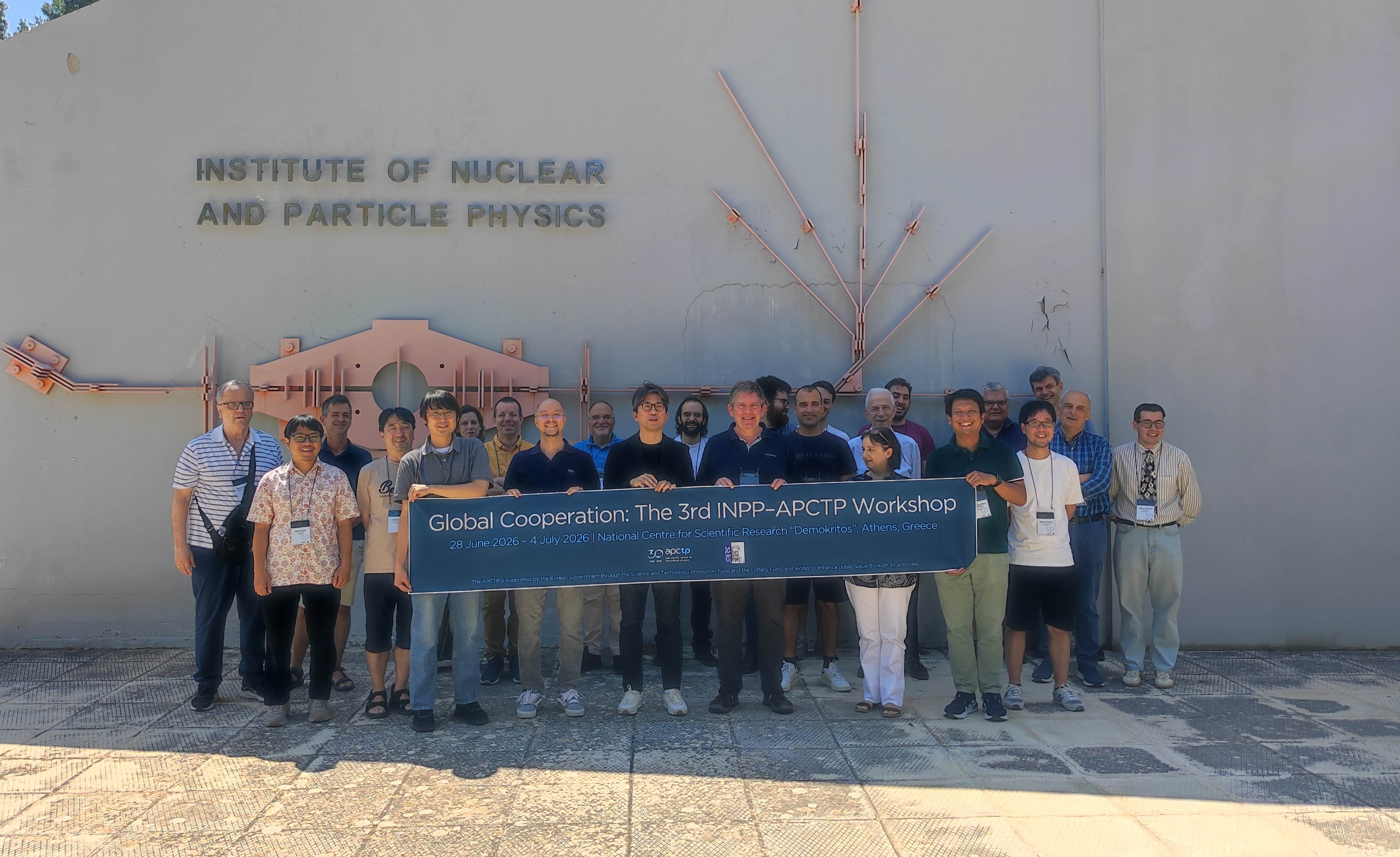
3rd INPP Demokritos-APCTP Workshop

Europe/Athens
Seminar Room "Themis Paradellis" (NCSR "Demokritos")

Seminar Room "Themis Paradellis"

NCSR "Demokritos"

Description

The National Centre for Scientific Research (NCSR) “Demokritos” and the Asia-Pacific Center for Theoretical Physics (APCTP) have agreed to launch a cooperation which aims to strengthen the ties between Greece and South Korea in the field of Theoretical Physics.

This is the third meeting between the two Institutes. The meeting will take place at the Institute of Nuclear and Particle Physics (INPP) in Athens on 28 June – 4 July 2026, with speakers from both institutes, along with a number of invited speakers from Europe and the Asia-Pacific region. 28 June is expected to be the arrival day and 4 July the departure day.

The meeting will take place in the Institute of Nuclear and Particle Physics (INPP), seminar room "Themis Paradellis" 

 

Highlight Speaker

Karl Jakobs (University of Freiburg)


Speakers from APCTP and neighboring Institutes

Jae-Hyung Jeon (APCTP & POSTECH)

Heribertus Bayu Hartanto (APCTP)

Ki-Seok Kim (POSTECH)

Roni Muslim (APCTP)

Shohei Okawa (APCTP)

Jong-Min Park (APCTP)


Speakers from INPP and neighboring Institutes

Minos Axenides (INPP)

Dhimiter Canko (University of Bologna)

Vassilis Constantoudis (INN)

Panagiotis Dimitrakis (IQCQT)

Fotis Farakos (NTUA)

Kostas Filippas (INPP)

Emmanuel Floratos (Academy of Athens)

Alexandros Kehagias (NTUA)

Dimitrios Kosmopoulos (CERN)

Manuela Kulaxizi (TCD & NKUA)

Costas Papadopoulos (INPP)

Theodoros Papanikolaou (University of Patras)

Georgios Papathanasiou (NKUA)

Mattia Pozzoli (University of Bologna)

Astero Provata (INN)

Konstantinos Sfetsos (NKUA)

Vassilis Spanos (NKUA)

Aris Spourdalakis (INPP)

Nikolaos Tetradis (NKUA)

Dimitrios Zoakos (University of Patras)

Konstantinos Zoubos (Pretoria & NITheCS)


Organizing Committee

Giuseppe Bevilacqua (INPP)

Jae-Hyung Jeon (APCTP)

Heribertus Bayu Hartanto (APCTP)

Georgios Linardopoulos (SIMIS)

Christos Markou (INPP)

Costas Papadopoulos (INPP)


Registration
Registration to the 3rd INPP Demokritos-APCTP meeting
    • 09:00
      Arrival day
    • 1
      Welcome
      Speaker: Giuseppe Bevilacqua (NCSR Demokritos)
    • 2
      Opening speech by the INPP Director
      Speaker: Christos Markou
    • 3
      Opening speech by the APCTP Executive Director
      Speaker: Jae-Hyung Jeon (APCTP)
    • 4
      Quantum aspects of Arnol'd cat map lattice field theories

      We construct quantum lattice field theories of coupled Arnol’d cat maps through the method of Weil quantization. The chaotic properties of these quantum dynamical systems are studied, examining important benchmarks of Quantum Chaos,such as Quantum ergodicity, Operator spreading complexity, OTOC, Quantum Mixing and ETH. These lattice quantum field theories are satisfying all the prerequisites of Maximal Quantum Chaos and they are proposed as toy models for the description of the chaotic degrees of freedom of Quantum Black Holes.

      Speaker: Emmanouil Floratos (National and Kapodistrian University of Athens (GR))
    • 11:00
      Coffee break & Group photo
    • 5
      Fickian yet non-Gaussian diffusion in disordered media
      Speaker: Jae-Hyung Jeon (APCTP)
    • 6
      Chaos and complexity in nanotechnology: the challenge of characterizing nanotextured surfaces

      Chaos is traditionally defined as the sensitive dependence on initial conditions in the time evolution of nonlinear dynamical systems—phenomenon that unfold in the time domain. Complexity extends this perspective to spatiotemporal systems with many degrees of freedom, where structures emerge that balance order and randomness in unexpected yet functional combinations. But what happens when we shift our attention solely to the spatial domain? How can the core concepts of chaotic dynamics and complex systems be adapted to characterize and model spatial structures that lie between full order and complete randomness, assuming their form is frozen in time? And what is - if any - the fundamental connection between temporal and spatial complexity?
      In this talk, we review recent work on developing theoretical frameworks and computational tools—rooted in chaos theory and complex systems—for quantifying the spatial complexity of nanostructured and nanotextured surfaces. Our overarching goal is to establish an effective language for describing the complexity of nanoworld geometry and to deepen our understanding of how nanoscale morphology underpins functional behavior. Specifically, we employ concepts such as chaotic mixing, multiscale Shannon entropy, and hierarchical organization, adapted for application to characterizing nanosurface morphologies and their microscopy images.
      Our first approach treats the 2D nanosurface morphology as the phase space of a strongly chaotic map (e.g., the Arnold map), with pixels serving as initial conditions. Iterative application of the map reshuffles pixel positions through the stretching and folding mechanism of chaos, progressively degrading the recognizable morphology and texture. The rate of this degradation provides a quantitative measure of spatial complexity exhibiting maximum values at morphologies between full order and randomness/noise [1].
      The second approach quantifies the information content of nanosurfaces using Shannon entropy. Given the presence of spatial correlations, we compute multiscale Shannon entropy at each pixel through local, scale dependent averaging. The mean multiscale entropy can be used as a measure of surface complexity, reflecting the distance of the morphology from full homogenization [2,3].
      Finally, we examine hierarchical surfaces, widely used in nanotechnology for their excellent multifunctional performance. We present a theoretical framework for defining and classifying hierarchical morphologies, along with a suite of modeling and quantitative characterization tools [4].
      The above methods are compared and critically discussed in the context of their ultimate goal: robust and meaningful nanoscale characterization. They are also applied to both synthesized and experimental surfaces—produced through plasma etching, laser texturing, deposition, and other nanotexturing techniques—to ensure validation and insight derived from real morphological data.

      Keywords: nanotechnology, nanostructures, chaos, Shannon entropy, hierarchical surfaces,
      rough surfaces
      Acknowledgement: This work is supported by the project “plasmAI” of the program “AI-Aware Pathways to Sustainable Semiconductor Process and Manufacturing Technologies”, Intel Corporation & Merck KGaA.

      References
      [1] A Kondi, V Constantoudis, P Sarkiris, K Ellinas, E Gogolides Physical Review E 107 (1), 014206 (2023)
      [2] A Arapis, V Constantoudis, D Kontziampasis, A Milionis, CWE Lam, et al., Materials Today: Proceedings 54, 63-72 (2022)
      [3] A Kondi, V Constantoudis, P Sarkiris, E Gogolides Mathematics 13, 2325 (2025)
      [4] G Papavieros, V Constantoudis, N Vouroutzis and E Gogolides, Nanotechnology 34 (40), 405702
      (2023)

      Speaker: Vassilis Constantoudis (NCSR Demokritos)
    • 13:00
      Lunch break
    • 7
      Chaos or Noise? Identifying the Origin of Irregular Dynamics from Time Series Using Machine Learning

      Many time series observed in nature exhibit irregular and seemingly unpredictable fluctuations. Determining whether such behavior originates from chaotic dynamics or from intrinsic stochastic fluctuations is a longstanding challenge in nonlinear science and time-series analysis. Although a variety of methods have been developed for this purpose, reliable discrimination remains difficult because stochastic processes can often mimic characteristic signatures of chaos. In this talk, I will present a learning-based framework for distinguishing chaotic dynamics from stochastic processes using time-series data. The proposed approach is motivated by the observation that conventional short-term prediction methods can be misled by stochastic processes with strong temporal correlations, which may exhibit apparent predictability despite the absence of an underlying deterministic rule. To overcome this limitation, we introduce a cross-prediction strategy in which the future change of a variable is predicted from its current value. This prediction task requires not only short-term predictability but also the ability to infer the deterministic structure governing the dynamics, providing a more stringent test for chaos. Implemented using reservoir computing, the framework yields a simple quantitative criterion for distinguishing chaos from noise based on the coefficient of determination between true and predicted future changes. Applications to a wide range of synthetic chaotic and stochastic systems reveal a clear separation between the two classes. We further apply the method to several empirical datasets previously analyzed in the literature and obtain classifications largely consistent with existing evidence. These results demonstrate that the proposed approach provides a simple, robust, and broadly applicable tool for distinguishing chaos from noise from time-series observations.

      Speaker: Jong-Min Park (Asia Pacific Center for Theoretical Physics (APCTP))
    • 8
      Adaptive transitions in networks of coupled non-linear oscillators

      Adaptive coupling in networks of interacting nonlinear oscillators has
      gained recent attention due to the many applications
      both in biological and in artificial neural networks, where synaptic
      plasticity or adaptive coupling are considered as key
      factors in the learning processes. In our studies, we apply adaptive
      connectivity rules in exemplary networks consisting
      of leaky-integrate-and-fire (LIF) or FitzHugh-Nagumo (FHN) oscillators.
      For such networks, in the absence of adaptivity
      (i.e., for constant network connectivity), hybrid synchronization
      patterns (solitaries, chimeras and bump states) have
      been observed [1]. When the coupling strengths get modified, influenced
      by the nodal state variables (nodal potentials),
      then the network dynamics undergoes structural transitions crossing
      domains of different complexity/synchrony [2-3].
      Coupling adaptivity (plasticity) may be realized via Hebbian learning
      adjusted by the Oja rule (also called 'forgetting' rule)
      to prevent the network link weights from growing without bounds. The
      resulting adaptive transitions become evident
      when the time scales governing the coupling dynamics are much slower
      than the ones governing the nodal dynamics
      (nodal potentials). Namely, when the coupling time scales are slow, the
      network has the time to realize and demonstrate
      different synchronization regimes before reaching the final steady
      state. The transitions are characterized by abrupt
      changes of the average coupling weights and of the Kuramoto order
      parameter as the network evolves in time [2-3].
      The emergence of adaptive transitions demonstrate how the interplay of
      distinct time scales can profoundly influence
      the evolution and the collective behavior in dynamical systems.

      Literature
      [1] Y. Kuramoto and D. Battogtokh
      Coexistence of Coherence and Incoherence in Nonlocally Coupled Phase
      Oscillators
      Nonlinear Phenomena in Complex Systems 5 380 (2002)
      http://www.j-npcs.org/online/vol2002/v5no4/v5no4p380.pdf

      [2]. A. Provata, G. C. Boulougouris and J. Hizanidis
      Adaptive transitions in FitzHugh-Nagumo networks with Hebb-Oja coupling
      rules
      Journal of Statistical Mechanics: Theory and Experiment, Volume 2026,
      044004 (2026)
      https://doi.org/10.1088/1742-5468/ae5c93

      [3]. A. Provata, G. C. Boulougouris and J. Hizanidis
      Synchronization transitions in spiking networks with adaptive coupling
      Chaos, Solitons & Fractals, Volume 200, 117128 (2025)
      https://doi.org/10.1016/j.chaos.2025.117128

      Speaker: Astero Provata (INN)
    • 15:30
      Coffee break
    • 9
      When Group Size Matters: Collective Ordering and Criticality Beyond Pairwise Interactions

      We study noisy majority-rule dynamics on annealed hypergraphs with random group sizes. Using mean-field theory and Monte Carlo simulations, we show that group-size heterogeneity strongly influences collective ordering, the ordering threshold, and consensus times. Broad and heavy-tailed distributions enhance the effect of rare large-group interactions, making ordered states more robust against noise and potentially accelerating consensus formation. Our results highlight that the full distribution of interaction sizes, rather than only the mean group size, is a key factor in higher-order collective dynamics.

      Speaker: Roni Muslim (Asia Pacific Center for Theoretical Physics)
    • 10
      Dynamical Love Numbers for Black Holes and Beyond from Shell Effective Field Theory

      A key property that shapes the gravitational waveform of binary systems is the tidal deformability of their constituents, quantified by the Love numbers. In modern treatments of the gravitational two-body problem, the binary dynamics are described within an effective field theory (EFT), where Love numbers enter as Wilson coefficients encoding the finite-size response of each object. In this talk, I will introduce Shell Effective Field Theory, a new framework for computing the classical gravitational dynamics of compact objects, with particular emphasis on extracting Love numbers. By combining techniques from quantum field theory with solutions to black-hole perturbation theory, Shell EFT circumvents the loop integrations that constitute the main bottleneck in conventional approaches. I will present new results for dynamical Love numbers of generic compact objects through order $G^9$, corresponding to an eight-loop calculation, and conjecture their all-orders structure in the case of a Schwarzschild black hole.

      Speaker: Dimitrios Kosmopoulos (CERN)
    • 11
      Non-Abelian Magnets: Beyond Spin Magnetism
      Speaker: Konstantinos Sfetsos (National and Kapodistrian University of Athens (GR))
    • 12
      Entanglement in curved spaces

      In the first part I discuss the evolution of entanglement entropy for a massless field within a spherical region in an expanding background. The formalism is applied to the inflationary period and the subsequent era of radiation domination, starting from the Bunch-Davies vacuum. Each field mode evolves towards a squeezed state upon horizon exit during inflation, with additional squeezing when radiation domination sets in. This results in the enhancement of the entanglement entropy. A volume term develops in the radiation dominated era, and becomes the leading contribution to the entropy at late times. In the second part I discuss the form of the entanglement entropy in various gravitational backgrounds (de Sitter and anti-de Sitter space, the Einstein universe) focusing on the structure of the divergences. Universal coefficients are determined for ultraviolet and infrared divergent terms. In the third part I discuss the use of the finite part of the entropy for the calculation of c- and a-functions.

      Speaker: Nikolaos Tetradis (National and Kapodistrian University of Athens (GR))
    • 11:00
      Coffee break
    • 13
      Nonlinear Tails in Black Hole Ringdown

      Black holes gradually settle into their static configuration by emitting gravitational waves, whose amplitude diminish over time according to a power-law decay at fixed spatial locations. I will show that the nonlinear tails in the presence of a quadratic source, which have been recently found to potentially dominate over the linear ones, can be simply derived from the AdS_2 × S^2 spacetime perspective with their amplitudes being related to the Aretakis constants.

      Speaker: Alexadros Kehagias
    • 14
      Emergent $\text{AdS}_{d+1}$ Geometry from Functional Renormalization Group in the Massless Critical Limit

      We present a holographic dual description for the O(N) vector model in $d$-dimensional Euclidean space within the functional renormalization group (FRG) framework. By iterating Wilsonian renormalization group transformations, the extra-dimensional scale coordinate is identified as the radial direction of an emergent $(d+1)$-dimensional bulk spacetime. We construct a bidirectional holographic dictionary that maps non-perturbative fluctuations to the emergent bulk metric warping factors. Under the massless critical configuration, the emergent gravitational vacuum reduces to an Anti-de Sitter ($\text{AdS}_{d+1}$) geometry, satisfying the local energy conditions.

      Speaker: Ki Seok Kim (POSTECH)
    • 13:00
      Lunch break
    • 15
      Black holes and Singularities in CFT thermal 2pt functions

      We discuss the known relation between the phase shift of a particle traversing the black hole geometry and the CFT two point function computed holographically at strong coupling, and use it to explore the behaviour of the CFT thermal correlators in special regimes of the impact parameter space. We see that the correlator develops singularities associated to real and complex geodesics in the bulk.

      Speaker: Manuela Kulaxizi (Trinity College Dublin)
    • 16
      Holography and a codimension-2 defect CFT

      In this talk I will present a new holographic duality between a non-supersymmetric defect conformal field theory & its gravity dual. On the gravity side, the defect is realized by a D5 probe brane that wraps an S^2 subset of the S^5 and carries k units of flux through the S^2. The brane ends on an R^(1,1) subspace of the AdS5 boundary resulting to a codimension-2 defect. On the field theory side, the defect is described by a classical solution whose precise form we determine. We calculate the one-point functions of the energy-momentum tensor and of the chiral primary operators, both at strong and at weak coupling and in an appropriate limit we find compelling agreement between the two results.

      Speaker: Dimitrios Zoakos (University of Patras)
    • 15:30
      Coffee break
    • 17
      SUSY AdS and Scale Separation

      We discuss aspects of scale separation in supersymmetric AdS vacua of string theory focusing on AdS3 vacua with N=1 or N=2 supersymmetry.

      Speaker: Fotis Farakos (NTUA)
    • 18
      The conformal realms of quantum electrodynamics

      We propose a duality between massive theories in 4D flat spacetime and massless ones on $\mathbb{S}^2\times\mathbb{R}$, where Poincare maps to conformal symmetry. As a primary example, we suggest that QED$_4$ with $N$ flavors is dual, at least at the large $N$ limit, to an Abelian Chern-Simons theory coupled to $2N$ massless fermions and an auxiliary scalar field, in a unit-charge monopole background. To test this, we match the spectra of free fermions in magnetic vacua, between $\mathbb{R}^4$ and $\mathbb{S}^2\times\mathbb{R}$, while, for a certain condition between the coupling constants, the QED$_4$ charge $e$ and the Chern-Simons level $k$, we match the anomalous dimensions coming from fermion self-energy diagrams, at leading order in $1/N$. The map implies that 4D massive asymptotic states correspond to distinct conformal cylinders, each being a boundary for an AdS universe. Hence, we suggest that entangled states in $\mathbb{R}^4$ may be viewed as a theory of wormholes between distinct AdS universes.

      Speaker: Kostas Filippas (NCSR Demokritos, Institute of Nuclear and Particle Physics)
    • 19:15
      Banquet/Conference dinner
    • 09:30
      Free day
    • 19
      Two-loop amplitudes for Higgs boson production in association with a bottom-quark pair at the LHC

      I will first review the phenomenological importance of Higgs boson production in association with a bottom-quark pair (Hbb production) at the LHC. I will then discuss the computation of two-loop scattering amplitudes, the principal bottleneck in obtaining NNLO QCD predictions, and their application to cross-section calculations.

      Speaker: Heribertus Bayu Hartanto (Asia Pacific Center for Theoretical Physics (APCTP), Pohang, South Korea)
    • 20
      Automating two-loop amplitude computation with HELAC2LOOP
      Speaker: Konstantinos Papadopoulos
    • 11:00
      Coffee break
    • 21
      Numerical implementation of integrand level reduction

      I will discuss the implementation and numerical aspects of the reduction of two-loop amplitude integrands. After a brief overview of the theoretical framework and two-loop integrand reduction, preliminary numerical results will be presented. Current limitations and ongoing efforts to overcome them will also be discussed.

      Speaker: Aris-George-Baldur Spourdalakis (NSCR Demokritos)
    • 22
      Three-loop Feynman integrals for leading-colour diboson production at hadron colliders

      In this talk, I will present results for planar families of Feynman integrals for a four-point three-loop kinematics, with two non-degenerate external masses. These integrals are necessary to compute the three-loop amplitude for the production of two vector bosons, which are relevant for N3LO QCD corrections to this process. After grouping the integrals into nine integral families, we compute them through differential equations. To this end, for all integral families we construct a basis of pure master integrals, satisfying canonical differential equations. Compared to the two-loop case, this step is more complicated not only because of the larger number of master integrals, but also by the appearance of new square roots in the alphabet. We evaluate the master integrals by solving the differential equations using generalised power series expansions.

      Speaker: Mattia Pozzoli (University of Bologna and INFN)
    • 23
      NNLO QCD corrections to ttW hadron production

      I will present the numerical computation of the two-loop scattering amplitude for the associated hadron production of a top pair and a W boson, in the leading color approximation, which contributes to the virtual part of the NNLO QCD corrections to this process. The amplitude is expressed in terms of a basis of special functions multiplied by kinematic-dependent rational coefficients. The special functions are calculated by means of differential equations, while the rational coefficients are evaluated using finite-field techniques. Within this framework, we evaluate the two-loop finite remainders and obtain results for the NNLO QCD cross section.

      Speaker: Dhimiter Canko (Università di Bologna)
    • 13:00
      Lunch break
    • 24
      Novel cluster-algebraic letters for 5- and 6-point QCD processes

      By breaking dual conformal invariance, we transform cluster-algebraic predictions for the alphabet of 9-point amplitudes in N=4 super Yang-Mills theory to analogous predictions for 5- and 6-point processes in QCD. We start by obtaining, for the first time, candidate letters for 6-point processes with one massive external leg, and discover that they surprisingly also contain nested square roots. We confirm that our results essentially contain the alphabet of all 1-loop integrals with these kinematics, and in their massless limit also the recently computed alphabet of finite, planar 2-loop amplitudes for 6-point massless QCD processes. In the latter case, we additionally find 162 letters that may appear at higher loops. We similarly produce candidate letters for 5-point 2-mass processes, whose comparison with the literature reveals a nontrivial overlap that also includes new letters.

      Speaker: Georgios Papathanasiou (National and Kapodistrian University of Athens)
    • 25
      Exotic spin chains from N=2 Superconformal Field Theory

      In this talk, I will discuss some aspects of the 1-dimensional spin chains that arise in the planar limit of 4d Superconformal theories with a quiver description. These spin chains exhibit various exotic features such as restricted Hilbert spaces and Hamiltonians which are dynamically determined at each site. Correspondingly, understanding their symmetries requires extending standard notions of symmetry based on groups to groupoids and dynamical versions thereof. I will briefly explain these concepts as well as touch upon recent work reformulating these chains in terms of a generalised Temperley-Lieb algebra.

      Speaker: Konstantinos Zoubos (University of Pretoria)
    • 15:30
      Coffee break
    • 26
      Colloquium: Perspectives on the Future of High-Energy Collider Physics

      After the discovery of the Higgs boson at the LHC particle physics has entered a new era. With the successful data taking over the past decade, many properties of this particle have been established. Despite this, important questions remain open and call for experimental exploration. The Higgs field itself is linked to deep structural questions of the Standard Model of particle physics such as flavour, naturalness and the stability of the vacuum. In addition, the nature of the dark matter in the universe and the origin of the matter-antimatter asymmetry remain unknown.
      Over the past year, within the European Strategy for Particle Physics process, the future of European particle physics has been debated, and recommendations have been expressed for the Future Circular Collider (FCC) as the next large flagship collider project at CERN.
      In this colloquium, our present understanding of the profile of the Higgs boson and the importance of its further precise exploration are discussed, together with the potential of future colliders in Higgs boson and other areas of physics. The deliberations in the Strategy process and the rationale for the FCC recommendation are summarized.

      Speaker: Karl Jakobs (University of Freiburg (DE))
    • 27
      Distinguishing Order from Disorder in Information Geometry : Beyond Schrodinger’s Negative Entropy and Brillouin’s Negentropy

      We revisit Schrödinger's riddle of the nature and maintenance of order in an increasingly disordered universe from the perspective of information geometry, the differential geometry of statistical manifolds of probability distributions. This framework provides a hierarchy of distinguishability diagnostics ranging from global relative-entropic measures to local Fisher–Rao metrics and higher-order Amari tensors. Using Gaussian maximum-entropy distributions and non-Gaussian Laplace distributions as paradigmatic examples, we show that states possessing identical negentropy exhibit nontrivial information-geometric distinguishability despite sharing the same disorder deficit. Distinguishability persists both on maximum-entropy manifolds, where negentropy vanishes identically, and on non-Gaussian manifolds characterized by identical nonzero negentropy. These examples show that negentropy quantifies disorder deficit, whereas information geometry quantifies structural differentiation among probability distributions. Information geometry therefore embeds entropy and negentropy within a broader hierarchy of distinguishability diagnostics, providing a higher-resolution framework for characterizing order, disorder, and distinguishable probabilistic structures.

      Speaker: Minos Axenides (National Centre for Scientific Research, "Demokritos")
    • 28
      Flavor of elementary particles and dark matter
      Speaker: Shohei Okawa (APCTP)
    • 11:00
      Coffee break
    • 29
      Freeze-In Dark Matter in the Presence of an Additional Scalar Field

      In this talk, we will discuss the cosmological evolution of freeze-in dark matter models in the presence of an additional scalar component. Such a component can significantly modify the standard freeze-in scenario by altering both the expansion history of the Universe and the entropy evolution, resulting in either a suppression or an enhancement of the final dark matter abundance. As a concrete example, we will present the case of thermally produced gravitino dark matter. For a matter-like equation of state, the additional scalar field can induce substantial entropy production, leading to a significant dilution of the gravitino abundance and consequently allowing considerably larger reheating temperatures than in the standard cosmological scenario. In contrast, for a kination-like equation of state, the gravitino abundance is enhanced, resulting in a lower maximum reheating temperature compatible with the observed dark matter relic density.

      Speaker: Vassilis Spanos (Department of Physics National and Kapodistrian University of Athens)
    • 30
      Primordial black holes and induced gravitational waves

      Primordial black holes (PBHs) can generically form through the collapse of enhanced cosmological perturbations, constituting in some specific mass ranges a viable candidate for dark matter. Interestingly enough, the enhanced cosmological perturbations which collapse to form PBHs as well as the PBH energy density perturbations themselves can produce a stochastic gravitational-wave (GW) background induced by second-order gravitational interactions, which can be detectable in GW observatories. In this talk, after introducing initially the motivation for the physics of PBHs and the associated to them GW signals I will focus ultimately on induced gravitational waves and their possible connection with thermal leptogenesis.

      Speaker: Theodoros Papanikolaou (University of Patras)
    • 13:00
      Lunch break
    • 31
      Hardware for Quantum Emulators and Quantum AI/ML approaches
      Speaker: Panagiotis Dimitrakis (IQCQT, NCSR "Demokritos")
    • 32
      GRASP: Graphene Josephson bolometers for quantum sensing & Dark Matter detection
      Speaker: Antonios Gardikiotis (NCSR "Demokritos")
    • 33
      A NLO study of pp->ttH with decaying tops in SMEFT

      We present the computation of the NLO QCD corrections to the production of a Higgs boson in association with a top-antitop pair (ttH) in the di-lepton decay channel at the LHC, including relevant dimension-6 operators ($O_{t\phi}$, $O_{\phi G}$, $O_{tG}$, $O_{tW}$) from the Standard Model Effective Field Theory. In our study, higher-order corrections and effective operators are consistently included in the production part of the process as well as in top-quark decays. We perform a detailed study of linear, cross, and quadratic contributions and their uncertainties, including renormalisation group effects. All results have been obtained with the newly developed package HELAC-SMEFT.

      Speaker: Giuseppe Bevilacqua (NCSR Demokritos)
    • 09:00
      Departure day