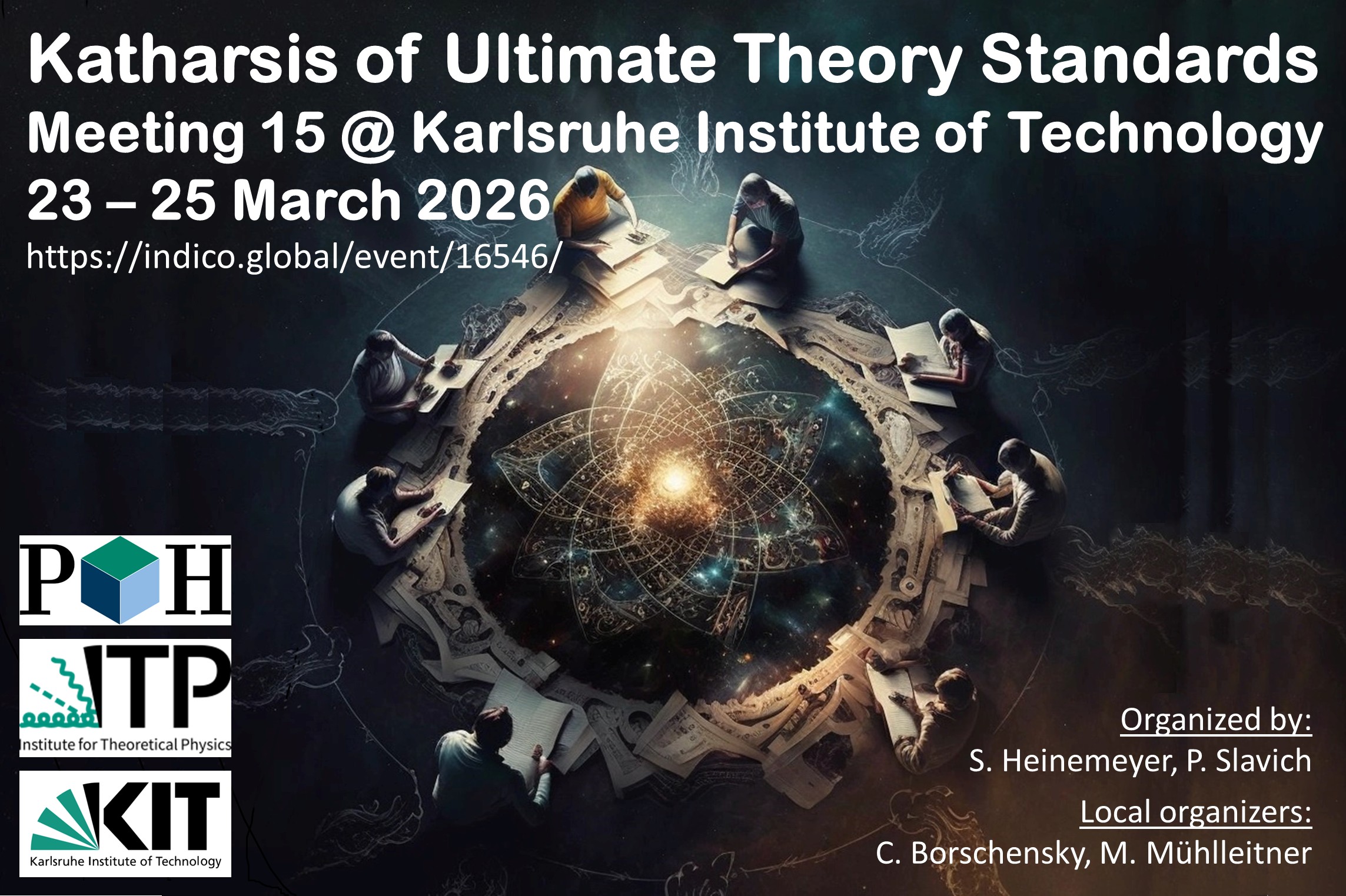
KUTS15 @ KIT

Europe/Berlin
Physics high-rise (30.23), seminar room 6/1 (Karlsruhe Institute of Technology)

Physics high-rise (30.23), seminar room 6/1

Karlsruhe Institute of Technology

Wolfgang-Gaede-Str. 1 76131 Karlsruhe
Description

While precision calculations in the SM are by now very advanced in loop order, renormalization, number of external legs and different mass scales, the analogous calculations in BSM models are much less advanced, and present a range of additional issues, both technical and conceptual. The KUTS initiative is a series of workshops allowing for in-depth discussions of these issues. Launched in 2014 as a forum on Higgs-mass calculations in SUSY models, its scope was subsequently broadened to encompass precision calculations of other Higgs-boson properties – and possibly of other observables in the EW sector, such as the W-boson mass – in both SUSY and non-SUSY BSM models. The most recent previous meetings were held at CERN in 2023, at DESY in 2024, and at Freiburg in 2025.

It is now time for the 15th KUTS meeting, which will take place at the Karlsruhe Institute of Technology from Monday, 23 March to Wednesday, 25 March 2026. Participants are encouraged to present any BSM precision calculation they have been particularly interested in since the last meeting. Some time will also be left aside for further discussions on the aims and boundaries of the KUTS initiative.

The meeting will follow the usual KUTS format: three days (one afternoon, one full day, one morning) in which relatively few talks are presented and discussions proceed freely, without a strict schedule.

Warning: Please beware! Some participants may receive fraudulent emails claiming to be from a company tasked with arranging accommodations for participants. These emails are scams.


Organizing Committee                      

  • C. Borschensky (KIT, LOC) 
  • S. Carlotti (KIT, LOC)
  • M. M. Mühlleitner (KIT, LOC)
  • S. Heinemeyer (IFT/CSIC Madrid)
  • P. Slavich (LPTHE)


Contact to local organisers
Participants
    • 1
      Intro Physics high-rise (30.23), seminar room 6/1

      Physics high-rise (30.23), seminar room 6/1

      Karlsruhe Institute of Technology

      Wolfgang-Gaede-Str. 1 76131 Karlsruhe
      Speakers: Local organisers, Pietro Slavich (LPTHE Paris)
    • 2
      Two-Loop Renormalization in the 2HDM and Applications Physics high-rise (30.23), seminar room 6/1

      Physics high-rise (30.23), seminar room 6/1

      Karlsruhe Institute of Technology

      Wolfgang-Gaede-Str. 1 76131 Karlsruhe
      Speaker: Felix Egle (DESY)
    • 16:15
      Coffee break Physics high-rise (30.23), seminar room 6/2

      Physics high-rise (30.23), seminar room 6/2

      Karlsruhe Institute of Technology

      Wolfgang-Gaede-Str. 1 76131 Karlsruhe
    • 3
      Precision predictions of partial decay widths in the general Two-Higgs-Doublet Model Physics high-rise (30.23), seminar room 6/1

      Physics high-rise (30.23), seminar room 6/1

      Karlsruhe Institute of Technology

      Wolfgang-Gaede-Str. 1 76131 Karlsruhe

      The Standard Model (SM) of particle physics has achieved remarkable success in describing a broad spectrum of experimentally observed phenomena in particle physics with high precision. However, there are still some phenomena that lie beyond its description, such as the existence of dark matter, the matter-antimatter asymmetry of the universe, and the origin of neutrino masses. Several extensions to the SM have been proposed to account for these phenomena. Among them, the general Two-Higgs-Doublet Model (THDM) provides a framework with a rich phenomenology. It comprises the symmetry-constrained THDM scenarios as special limits, and enables the study of new sources of CP violation, Higgs-mediated flavor violation, generalized Yukawa structures, and the impact of complex parameters in both the potential and the Yukawa sector. In this talk, I will present next-to-leading-order (NLO) predictions of partial decay widths of the Higgs boson within the general THDM. I will focus on Higgs-boson decays into fermions and on exploring renormalization conditions, including on-shell and MS renormalization conditions, together with different tadpole treatments, in order to establish criteria that can point to a good choice of renormalization schemes for some extensions of the SM.

      Speaker: Jose Angel Hernandez Cuevas (Universität Freiburg)
    • 4
      Revisiting the Higgs-mass calculation in the scale-invariant THDM Physics high-rise (30.23), seminar room 6/1

      Physics high-rise (30.23), seminar room 6/1

      Karlsruhe Institute of Technology

      Wolfgang-Gaede-Str. 1 76131 Karlsruhe

      2602.17643

      Speaker: Pietro Slavich (LPTHE Paris)
    • 5
      Two-Loop Pole-Mass Matching in the CP-Violating NMSSM Physics high-rise (30.23), seminar room 6/1

      Physics high-rise (30.23), seminar room 6/1

      Karlsruhe Institute of Technology

      Wolfgang-Gaede-Str. 1 76131 Karlsruhe
      Speakers: Martin Gabelmann (U. Freiburg), Martin Gabelmann (DESY)
    • 10:30
      Coffee break Physics high-rise (30.23), seminar room 6/2

      Physics high-rise (30.23), seminar room 6/2

      Karlsruhe Institute of Technology

      Wolfgang-Gaede-Str. 1 76131 Karlsruhe
    • 6
      On-shell Renormalisation of Vector-like Lepton Models Physics high-rise (30.23), seminar room 6/1

      Physics high-rise (30.23), seminar room 6/1

      Karlsruhe Institute of Technology

      Wolfgang-Gaede-Str. 1 76131 Karlsruhe

      Vector-like leptons are a special class of SM extensions with strong impact on the tree-level mass generation, the lepton--Higgs interaction as well as precision observables like g-2 or CLFV decays, and therefore nicely complement studies of EW BSM scenarios with extended Higgs sectors. The strong LO correlations motivate the inclusion of higher order corrections which, however, come with several complications related to the structure of the enlarged lepton mass matrix and the resulting mixing. I present a renormalisation scheme with on-shell conditions for the lepton masses that addresses these issues and discuss subtleties regarding the RGEs and redundancies in the Lagrangian parameters. Phenomenological results on Higgs physics and low-energy lepton physics can also be presented.

      Speaker: Kilian Möhling (IKTP TU Dresden)
    • 7
      Sensitivity to New Physics in Higgs Observables Physics high-rise (30.23), seminar room 6/1

      Physics high-rise (30.23), seminar room 6/1

      Karlsruhe Institute of Technology

      Wolfgang-Gaede-Str. 1 76131 Karlsruhe

      Precision measurements of Higgs interactions provide one of the most powerful avenues to probe physics beyond the Standard Model (SM). In this talk, I will present automated one-loop calculations of the Higgs trilinear self-coupling and the $hZZ$ coupling within the Two Higgs Doublet Model (THDM) framework. This analysis is particularly relevant in view of future experimental facilities, where percent-level precision will make loop effects indispensable. It clarifies the interplay between different Higgs observables and identifies which measurements offer the strongest sensitivity to new physics effects.

      Speaker: Kateryna Radchenko Serdula (IFT)
    • 13:00
      Lunch
    • 8
      Renormalisation of Chiral Gauge Theories with Non-Anticommuting $\gamma_5$ at the Multi-Loop Level Physics high-rise (30.23), seminar room 6/1

      Physics high-rise (30.23), seminar room 6/1

      Karlsruhe Institute of Technology

      Wolfgang-Gaede-Str. 1 76131 Karlsruhe

      The computation of high-precision electroweak observables is of growing importance to meet the stringent requirements of current and future experiments and to probe physics beyond the Standard Model (SM). Such computations inevitably encounter the $\gamma_5$-problem. The Breitenlohner-Maison/'t~Hooft-Veltman (BMHV) scheme provides the only known framework for treating $\gamma_5$ in dimensional regularisation (DReg) that is rigorously established to all orders. In this talk, I review the BMHV scheme along with the complications arising from the regularisation-induced breaking of BRST invariance and report on recent progress in the systematic renormalisation of chiral gauge theories within this framework. First, the multi-loop application of the BMHV scheme to an Abelian chiral gauge theory is presented up to the 4-loop level. Second, I discuss the BMHV renormalisation of the SM, including a complete 1-loop analysis, the implications of evanescent gauge interactions, and initial steps towards the 2-loop renormalisation.

      Speaker: Dr Matthias Weisswange (DESY)
    • 9
      Infrared divergences and the choice of regularization Physics high-rise (30.23), seminar room 6/1

      Physics high-rise (30.23), seminar room 6/1

      Karlsruhe Institute of Technology

      Wolfgang-Gaede-Str. 1 76131 Karlsruhe

      We discuss the treatment of infrared divergences when computing observables in the MSbar scheme, using the decay of Higgs to qqbar as an example.

      Speaker: Dr Wojciech Kotlarski (National Centre for Nuclear Research)
    • 17:00
      Coffee break Physics high-rise (30.23), seminar room 6/2

      Physics high-rise (30.23), seminar room 6/2

      Karlsruhe Institute of Technology

      Physics high-rise (30.23), seminar room 6/2
    • 10
      NLO Calculation of the Process $h \to f \bar{f}$ in the Decoupling Renormalization Scheme Physics high-rise (30.23), seminar room 6/1

      Physics high-rise (30.23), seminar room 6/1

      Karlsruhe Institute of Technology

      Wolfgang-Gaede-Str. 1 76131 Karlsruhe

      We propose a decoupling renormalization scheme for use in the calculation of Higgs decays in BSM models, including models with extended Higgs sector, at NLO order. The calculation is implemented withing the FlexibleSUSY spectrum-generator generator. The current status of the work will be presented including a discussion of the decoupling limit, various subtleties of the scheme’s definition like the mixing angle renormalization and first numerical results.

      Speakers: Johannes Wünsche (TU Dresden, IKTP), Jonas Lang (National Center for Nuclear Research Poland)
    • 19:30
      Dinner at Hoepfner Burghof Haid-und-Neu-Straße 18, 76131 Karlsruhe

      Haid-und-Neu-Straße 18, 76131 Karlsruhe

      Google Maps link: https://maps.app.goo.gl/kGa7wFTJ1Aij4zZ67

    • 11
      EWPOs, effective potential and vacuum stability Physics high-rise (30.23), seminar room 6/1

      Physics high-rise (30.23), seminar room 6/1

      Karlsruhe Institute of Technology

      Wolfgang-Gaede-Str. 1 76131 Karlsruhe
      Speaker: Georg Ralf Weiglein (Deutsches Elektronen-Synchrotron (DE))
    • 12
      Discussion and Closing Physics high-rise (30.23), seminar room 6/1

      Physics high-rise (30.23), seminar room 6/1

      Karlsruhe Institute of Technology

      Wolfgang-Gaede-Str. 1 76131 Karlsruhe