Cavity-enhanced spectroscopy in the deep cryogenic regime new hydrogen technologies for quantum sensing

20 May 2026, 14:30
30m
Festsaal (ÖAW)

Festsaal

ÖAW

Doktor-Ignaz-Seipel-Platz 2, 1010 Vienna
Talk Session 11

Speaker

Mr Dariusz Kierski (Nicolaus Copernicus University in Torun, Poland)

Description

We demonstrate the first cavity-enhanced spectrometer fully operating in a deep cryogenic regime down to 4 K. Not only the sample but the entire cavity, including the mirrors and cavity length actuator [1], is uniformly cooled down ensuring the thermodynamic equilibrium of the gas sample. The setup is designed in a way that efficiently attenuates both external vibrations and those originating from the cryocooler itself ensuring stable operation of the optical cavity. High tunability of the wavelength is achieved by implementation of an optical parametric oscillator (OPO) pumped by the 1064 nm CW seed laser amplified to 10 W. This instrument opens the way to a variety of fundamental and practical applications [2].
We demonstrate a high-resolution CRDS measurement of the S(0) 1-0 line in molecular hydrogen. Our approach allows for carrying out measurements at thermal equilibrium in the lowest temperature to date, being able to obtain clear spectra in temperatures below 5 K. Our result improves the previous best measurement of this line by three orders of magnitude. The deviation of our measurement from the most recent theoretical value is as small as 88 kHz [3]. With a total theoretical combined uncertainty of 380 kHz this corresponds to validating the quantum theory for molecules at the tenth significant digit.
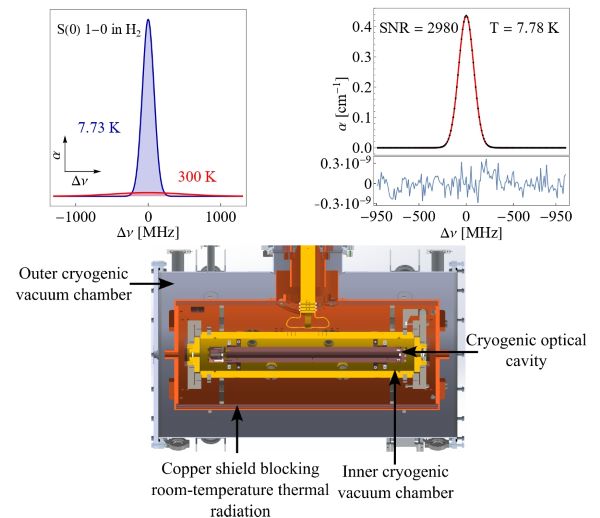
A comparison of the S(0) 1-0 line in molecular hydrogen at 300 K and 7.73 K is shown in the upper left corner, demonstrating the benefit of operating in cryogenic temperatures regime. A representative scan collected is shown in the upper right corner. The bottom panel showcases the design of the cavity operating in a vacuum chamber and capable of cooling all of its optical elements to temperature as low as 4 K.

References:
1. M. Słowiński et. al., Rev. Sci. Instrum. 93, 115003 (2022)
2. K. Stankiewicz et. al., Cavity-enhanced spectroscopy in the deep cryogenic regime for quantum sensing and metrology, Nature Physics (accepted: 30.01.2026)
3. K. Pachucki & J. Komasa, J. Chem. Theory Comput. 21, 12664–12673 (2025)

Author

Mr Kamil Stankiewicz (Nicolaus Copernicus University in Torun)

Co-authors

Prof. Agata Cygan (Nicolaus Copernicus University in Torun, Poland) Mr Bogdan Bednarski (Nicolaus Copernicus University in Torun, Poland) Prof. Daniel Lisak (Nicolaus Copernicus University in Torun, Poland) Mr Dariusz Kierski (Nicolaus Copernicus University in Torun, Poland) Dr Grzegorz Kowzan (Nicolaus Copernicus University in Torun, Poland) Dr Hubert Jóźwiak (Nicolaus Copernicus University in Torun, Poland) Mr Kamil Sołtys (Nicolaus Copernicus University in Torun, Poland) Mr Marcin Makowski (Nicolaus Copernicus University in Torun, Poland) Prof. Mariusz Piwiński (Nicolaus Copernicus University in Torun, Poland) Dr Mateusz Narożnik (Nicolaus Copernicus University in Torun, Poland) Dr Michał Słowiński (Nicolaus Copernicus University in Torun, Poland) Dr Nikodem Stolarczyk (Nicolaus Copernicus University in Torun, Poland) Prof. Piotr Masłowski (Nicolaus Copernicus University in Torun, Poland) Prof. Piotr Wcisło (Nicolaus Copernicus University in Torun, Poland) Dr Szymon Wójtewicz (Nicolaus Copernicus University in Torun, Poland)

Presentation materials

There are no materials yet.