Choose timezone
Your profile timezone:
The 13th edition of this biennial conference series will be held in Vienna from 18th to 22nd of May 2026.
The conference is hosted by the Marietta Blau Institute for Particle Physics of the Austrian Academy of Sciences.
News: The program can now be found on Indico under Timetable. Additional information for presenters of talks or posters are also found under Presenter Information.
We present measurements of the cyclotron frequency ratios $^{4}$He$^{+}$/D$_{2}^{+}$, $^{4}$He$^{+}$/H$_{2}$D$^{+}$, and $^{4}$He$^{+}$/$^{12}$C$^{3+}$ using a cryogenic Penning ion trap [1,2]. Our results clearly differentiate between an earlier measurement of the mass of $^{4}$He by the University of Washington [3] and a more recent measurement by the LIONTRAP collaboration [4] in favor of the latter. From the $^{4}$He$^{+}$/$^{12}$C$^{3+}$ ratio we obtain an atomic mass of $^{4}$He at 9 x 10$^{-12}$ fractional uncertainty. This result, combined with a sufficiently precise future measurement of the ratio of electron spin-flip frequency to cyclotron frequency of $^{4}$He$^{+}$, will yield a value for the electron atomic mass with uncertainty of ~1 x 10$^{-11}$. Further, the consistency of the 3 ratios and the LIONTRAP result adds validation to all of the more recent measurements of the masses of the long-lived isotopes of hydrogen and helium.
[1] M. Medina Restrepo, M. Fernandez Davila, C. A. Navarro, and E. G. Myers, Phys. Rev. A 112, L040801 (2025).
[2] M. Fernandez Davila, M. Medina Restrepo, C. A. Navarro, and E. G. Myers, submitted to Physical Review Letters.
[3] R. S. Van Dyck, Jr., D. B. Pinegar, S. Van Liew, S. L. Zafonte, Int. J. Mass Spectrom. 251, 231 (2006).
[4] S. Sasidharan, O. Bezrodnova, S. Rau, W. Quint, S. Sturm, and K. Blaum, Phys. Rev. Lett. 131, 093201 (2023).
This work was supported by the National Science Foundation under Grant No. 2409083.
strong text
The pronounced imbalance between matter and antimatter in the universe motivates high precision comparisons of fundamental properties of matter–antimatter conjugates. At CERN’s Antiproton Decelerator, the BASE collaboration performs such tests using cryogenic Penning traps. We have achieved the most precise proton–antiproton charge to mass ratio comparison to date, with a fractional uncertainty of 16 parts per trillion [1], and conducted the first direct high precision measurement of the antiproton magnetic moment with 1.5 ppb accuracy [2]. Combined with our proton magnetic moment measurement [3], these results improve magnetic moment–based CPT tests by more than a factor of 3000. In parallel, we are implementing new techniques for sympathetic cooling of antiprotons [4] and developing quantum logic–inspired spectroscopy methods [5]. We are also constructing the transportable antiproton trap BASE STEP to move precision antiproton measurements from CERN to dedicated laboratory space at Heinrich Heine University Düsseldorf [6]. In this talk, I will introduce the scientific context, report on the status of the first antiproton transport and discuss the progress towards an improved measurement of the antiproton magnetic moment using single particle methods in combination with phase sensitive cyclotron frequency detection to reach even higher precision. By making use of the recently demonstrated high coherence time of the antiproton spin [7], the goal is to do a coherent measurement on a single antiproton to improve the current best precision by at least two orders of magnitude.
[1] M. J. Borchert et al., Nature 601, 35 (2022).
[2] C. Smorra et al., Nature 550, 371 (2017).
[3] G. Schneider et al., Science 358, 1081 (2017).
[4] M. A. Bohman et al. Nature 596, 514 (2021).
[5] J. M. Cornejo et al., New J. Phys. 23 073045 (2022).
[6] M. Leonhardt et al., Nature 641, 871 (2026).
[7] B. M. Latacz et al., Nature 644, 64 (2026).
Muonium and positronium, the $e^-\mu^+$ and $e^-e^+$ bound systems, are described almost completely within quantum electrodynamics. Their energy levels can be calculated to high precision, and these systems are also subject to high precision measurements. Recent developments include intense experimental work on muonium by the MuSEUM collaboration at J-PARC and the MuMASS collaboration at PSI, along with measurements of the positronium fine structure by the Cassidy group at UCL and the positronium 1S-2S interval at ETH Zurich. In order to match the uncertainties of projected experimental results the calculation of additional higher order corrections will need to done.
In this talk I will describe progress on a calculation of a set of radiative-recoil corrections to the energy levels of muonium and positronium at order $\alpha^7$. These are terms involving two-loop radiative corrections to the exchange of two photons between the bound fermions, one-loop radiative corrections to the exchange of three photons between the bound fermions, and the exchange of four photons between the bound fermions. Integration by parts identities have been used to reduce the problem to the calculation of a (relatively) few ``master integrals''. The three-loop master integrals with up to eight photon and fermion propagators are now being evaluated using recently developed techniques. This talk will give a report on the progress of this work.
Positronium and muonium, as purely leptonic atoms without internal structure, provide ideal systems for precision tests of quantum electrodynamics (QED) and searches for new physics [1].
We report a new measurement of the positronium $1^3S_1 \to 2^3S_1$ transition frequency using two-photon continuous-wave laser spectroscopy, $\nu = 1233607224.1(6.0)\ \mathrm{MHz}$ [2].
Our result agrees with the previous 2.6 ppb determination [3] and with state-of-the-art QED calculations at order $\mathcal{O}(\alpha^7 \ln^2(1/\alpha))$, which predict $1233607222.12(58)\ \mathrm{MHz}$ [1].
Combining the two experimental results gives $1233607218.1(2.8)\ \mathrm{MHz}$, reducing the tension with QED to about $1.4\sigma$.
We also present a semi-analytical lineshape model including finite lifetime effects, photoionization, and AC Stark shifts. The model agrees with detailed simulations and experimental data and is directly applicable to other unstable systems such as muonium.
In parallel, we report progress toward an improved continuous-wave measurement of the muonium $1S \to 2S$ transition[4]. A high-power UV laser system delivering intracavity powers above $40~$W has demonstrated stable multi-day operation, and background rates are below one event per day. Commissioning measurements with hydrogen validate the excitation and detection scheme. The setup is ready for a first CW measurement of this transition.
We will also discuss future prospects using a Ramsey-Doppler excitation scheme for next-generation positronium and muonium experiments [5].
[1] G. S. Adkins et al., Phys. Rep. 975, 1 (2022).
[2] L. de Sousa Borges et al., Phys. Rev. A (2026, in press).
[3] M. S. Fee et al., Phys. Rev. Lett. 70, 1397 (1993).
[4] N. Zhadnov et al., Optics Express 31 (2023).
[5] E. Javary et al., Eur. Phys. J. D 79, 15 (2025).
Muonium is a bound state of a positive muon and an electron. Precise measurements of the muonium hyperfine structure (HFS) provide a stringent test of quantum electrodynamics (QED), whose theoretical predictions are calculated with extremely high precision [1]. In the field of precision muon physics, there is ongoing discussion regarding the hadronic vacuum polarization contribution to the muon anomalous magnetic moment, $g-2$. A further improvement in the determination of the muonium HFS has attracted attention as a possible key to resolving this puzzle [2]. The Muonium Spectroscopy Experiment Using Microwave (MuSEUM) aims to improve the precision of the muonium HFS measurement by an order of magnitude compared to previous experiments.
The measurement principle of the muonium HFS is as follows. A 100% polarized muon beam is injected into krypton gas to produce muonium atoms. Microwave radiation is applied using a microwave cavity, and the resonance frequency is determined from a frequency scan, in which the number of decay positrons is measured at each microwave frequency. In high magnetic field measurements, two transition frequencies among the four Zeeman-split energy levels are measured. We have developed a magnetic field measurement system using an NMR probe with a precision of 15 ppb, as well as monitoring systems for magnetic field stability, krypton gas pressure, temperature, and microwave power. Estimation of systematic uncertainties associated with these parameters is also in progress.
Since 2025, MuSEUM has started test measurements in a high magnetic field at the J-PARC H-line. We have successfully observed resonance signals corresponding to the two transition frequencies. In addition, the dependence of the resonance peak on krypton gas pressure has been observed. Currently, we are performing a detailed analysis of these data and estimating the statistical uncertainty achievable in the final result. In this presentation, we report on the current status of the MuSEUM experiment.
[1] P. J. Mohr, D. B. Newell, B. N. Taylor, and E. Tiesinga, Rev. Mod. Phys. 97 025002 (2025).
[2] L. D. Luzio, A. Keshavarzi, A. Masiero, and P. paradisi, Phys. Rev. Lett. 134, 011902 (2025).
True muonium (µ⁺µ⁻), the purely leptonic bound state of a muon and an antimuon, is a unique atomic system that has not yet been observed experimentally. Together with positronium (e⁺e⁻) and muonium (µ⁺e⁻), it provides a clean laboratory for tests of bound-state quantum electrodynamics, while uniquely probing a regime characterized by a large reduced mass, extreme compactness, and short intrinsic time scales. These features enhance sensitivity to higher-order radiative corrections and potential new interactions in the muon sector.
We present the results of a feasibility study of low-energy true muonium photoproduction using photons with energies just above the 211 MeV threshold. Near-threshold production enables the formation of true muonium with low kinetic energy, opening the possibility for spectroscopic studies of its intrinsic properties. We discuss expected production rates, dominant background processes, and experimental requirements on the photon source, and assess the prospects of existing and emerging high-intensity photon facilities.
Among the >3000 isotopes, Thorium-229 provides the lowest-energy nuclear first excited state, a so-called isomer state. This isomer state at 8.4 eV is the only nuclear state accessible to laser manipulation and spectroscopy. It’s long >10 minutes lifetimes with a connected narrow transition linewidth, combined with the intrinsic robustness of nuclear transitions, makes it an exciting candidate for a “nuclear clock”.
The talk will report on recent developments in this field, triggered by the first laser excitation of Thorium-229 in 2023. We will report on a prototype solid-state variant of a nuclear clock, optical Mössbauer spectroscopy, CW laser absorption spectroscopy, and first constraints on ultralight dark matter models.
The first low-energy nuclear excited state of thorium-229 has gained an increasing interest since direct laser excitation have been demonstrated [1] and quickly confirmed in various solid-state experiments. This unique transition of the thorium isotope offers many applications, including a highly accurate nuclear clock, and a new testbed for physics beyond the standard model
Still, one challenging key ingredient for a high-accuracy nuclear clock is a Hz-scale, narrow-linewidth laser source for the resonance wavelength of 148.4 nm. Different concepts for such a light source like high-harmonic generation of a femtosecond laser frequency-comb, four-wave mixing in gases or metallic vapors, or all-solid-state approach are under development.
Here, we report the development of an all-solid-state CW laser system for the Th-229 nuclear transition, based on three sequential SHG steps starting from a diode laser at 1187 nm. The frequency doubling of laser radiation at 297 nm is obtained by using random quasi-phase matching in strontium tetraborate (SBO) [2]. The resulting power spectral density is comparable to that of previous laser nuclear excitation experiments [1]. We will discuss the prospects for the nuclear excitation in Th-229 doped crystals using this source.
[1] J. Tiedau, M. Okhapkin, K. Zhang, et al., Phys. Rev. Lett. 132, 182501 (2024).
[2] P. Trabs, F. Noack, A. S. Aleksandrovsky, et al., Opt. Lett. 41, 618 (2016).
Since at least the first laser excitations of the $^{229}$Th nucleus in 2024, $^{229}$Th nuclear clocks is the talk of the town [1-3]. In the HiThor project an alternative scenario for $^{229}$Th studies is pursued that is based on $^{229}$Th$^{q+}$ ions in their highest charge states (q»1). Key to the HiThor programm is H-like $^{229}$Th$^{89+}$ that exhibits an effect termed nuclear hyperfine mixing (NHM). In $^{229}$Th$^{89+}$ and other highly charged $^{229}$Th-ions with unpaired valence electrons strong magentic fields due to the electrons at the site of the nucleus lead to hyperfine interaction (HFI). In addition to the common hyperfine splitting (HFS), in $^{229}$Th$^{89+}$ the HFI mixes the $F=2$ states of ground and nuclear metastable state, introduces a further small energy shift but most noteworthy broadens the nuclear decay width by more than five orders of magnitude, from about 45 mins down to a few ten milliseconds. Due this broader width the probaility for laser excitation is accordingly enhenced and enables VUV-laser spectrosocpy also with small samples or even single ions using present VUV-laser technology. NHM can thus be seen as a key technology to develop nuclear clocks with very „simple“ electronic configurations and, ultimately, to pave the road towards a no-electron nuclear clock consiting solely of the nucleus itself, $^{229}$Th$^{90+}$.
In the presentation, the status of the project and the roadmap towards the realization of HiThor at the ESR / HITRAP complex at the GSI-Helmholtzzentrum für Schwerionenforschung in Darmstadt, Germany is discussed.
Acknowledgement: This project has received funding from the European Research Council (ERC) under the European Union’s Horizon 2020 research and innovation programme (Grant agreement No. 101142155).
[1] J. Tiedau,et al, , Phys. Rev. Lett. 132, 182501 (2024).
[2] R. Elwell, et al., Phys. Rev. Lett. 133, 013201 (2024).
[3] C. Zhang, et al., Nature 633, 63 (2024).
[4] S. Wycech and J. Zylicz, Act. Phys. Pol. B 24, 637 (1993).
[5] F. F. Karpeshin, et al., Phys. Rev. C 57, 3085 (1998).
[6] V. M. Shabaev, et al., Phys. Rev. Lett. 128, 043001 (2022).
The bound-electron $𝑔$-factor in heavy highly charged ions can be measured with high precision. However, due to uncalculated two-loop QED binding corrections, the theoretical uncertainty in this regime is orders of magnitude larger than the experimental uncertainty. This was also highlighted in a recent collaborative project, where the comparison of bound-electron $𝑔$-factors in hydrogenlike tin found an excellent agreement between experiment and theory [1].
In our new work, we report a significant improvement of the theoretical uncertainty of the bound-electron $g$-factor in hydrogenlike ions in the high-$Z$ regime, through the complete calculation of QED Feynman diagrams with two self-energy loops (the so-called SESE correction). In this work, we take into account the electron-nucleus interaction exactly [2].
In our previous work, we had presented first partial results for the SESE correction and demonstrated that our calculations are consistent with established free-electron results [3].
Our completed SESE calculation [2] will be highly relevant for improved tests of QED in planned near-future experiments with heavy hydrogenlike ions, e.g. ALPHATRAP at MPIK and ARTEMIS at GSI. Furthermore, our results are relevant for the direct determination of nuclear parameters from bound-electron $g$-factor measurements in heavy ions, the determination of fundamental constants as well as enhanced searches for New Physics.
[1] J. Morgner, B. Tu, C. M. König, et al., Nature 622, 53 (2023)
[2] B. Sikora, V. A. Yerokhin, C. H. Keitel and Z. Harman, Phys. Rev. Lett. 134, 123001 (2025)
[3] B. Sikora, V. A. Yerokhin, N. S. Oreshkina, et al., Phys. Rev. Res. 2, 012002(R) (2020).
Atomic systems offer a plethora of fundamental and functional properties and therefore are of importance to several key implications. Some examples where atoms and ions can serve as important probes include, atomic clocks [1], parity and time-reversal violations [2, 3], and the search for the variations in the fundamental constants [4]. Atomic systems, however, form a many-body complex system for which the exact solution is nontrivial. This poses a serious challenge in the theoretical investigations of the properties of these systems. In this context, relativistic coupled-cluster (RCC) theory is one of the most reliable many-body theories for structure and properties calculations for atoms and ions.
In our group at IIT Delhi, we have developed RCC based theories for the properties calculations of closed-shell [5], one-valence [6, 7] and two-valence [8, 9] atomic systems. These theories are implemented as sophisticated parallel FORTRAN programs [10]. The methods and codes we have developed are robust and can compute a plethora of properties, such as excitation energies, transition
amplitudes and oscillator strengths, hyperfine splitting constants and energies, dipole polarizabilities, parity and time-reversal violating amplitudes, etc., in different types of atoms and ions. Our calculations also incorporate the corrections from relativistic and QED effects to improve the accuracies of results.
In this talk, I shall present our recent studies of highly charged ions (HCIs). We study the clock transition related properties for HCIs as optical atomic clock candidates and assess their sensitivity to probe the variation in the fine structure constant. In addition, we also examine the prospects of HCIs for exploring parity non-conservation (PNC) effects. HCIs are considered to be promising candidate for these applications due to their relatively simpler structures and their strong immunity to the environmental perturbations. To investigate their sensitivity to the variation of fine structure constant, we have studied three systems, Cf17+, Cm15+ and Bk16+ , and found that these ions exhibit exceptionally large sensitivity coefficients compared to existing optical clock candidates. Further, we have explored PNC effects in Li like HCIs and observed a significant enhancement arising from the strong overlap of electronic wavefunctions with the nucleus. These results show that HCIs are promising systems for precision measurements and tests of fundamental symmetries.
[1] Andrew D. Ludlow, Martin M. Boyd, and Jun Ye, Rev. Mod. Phys. 87, 637 (2015).
[2] C. S. Wood et al., Science 275, 1759 (1997).
[3] W. C. Griffith, et al., Phys. Rev. Lett. 102, 101601 (2009).
[4] S. G. Karshenboim and E. Peik, Astrophysics, Clocks and Fundamental Constants, Lecture Notes in Physics (Springer, New York, 2010).
[5] Ravi Kumar, S. Chattopadhyay, D. Angom, and B. K. Mani, Phys. Rev. A 101, 012503 (2020)
[6] Ravi Kumar, D. Angom, and B. K. Mani, Phys. Rev. A. 106, 032801 (2022).
[7] Suraj Pandey, Ravi Kumar, D. Angom, and B. K. Mani, Phys. Rev. A 112, 032811 (2025).
[8] Ravi Kumar, S. Chattopadhyay, D. Angom, and B. K. Mani, Phys. Rev. A. 103, 022801 (2021).
[9] Palki Gakkhar, Ravi Kumar, D. Angom, and B. K. Mani, Phys. Rev. A 110, 013119 (2024)
[10] B. K. Mani, S. Chattopadhyay, and D. Angom, Comp. Phys. Comm. 213, 136 (2017).
Precision measurements in simple atomic systems offer powerful probes for physics beyond the Standard Model. One promising approach is based on high-precision measurements of the bound-electron g factor in hydrogen-like ions. The exchange of a hypothetical scalar boson would produce a small additional contribution to the ground-state g factor. By calculating this effect and comparing it with experimental results, constraints on new scalar interactions can be derived. To enhance sensitivity, we employ nuclide shifts—differences between isotopes with different proton or neutron numbers—which help isolate potential new-physics contributions [1]. Combining existing measurements for several ions with current theoretical precision allows constraints on the electron–proton coupling strength that largely improve present limits from atomic data.
A complementary method investigates possible spin-dependent forces mediated by axion-like particles or other hypothetical pseudoscalar and vector bosons. Such particles could slightly modify the hyperfine splitting in ions through interactions with electrons and nucleons [2]. Hyperfine splittings in hydrogen- and lithium-like charge states are particularly sensitive to this effect. By forming normalized differences between these splittings, uncertainties related to nuclear structure can be strongly suppressed, enabling more precise tests. Existing measurements in Be-9 already provide competitive bounds for boson masses above 100~keV, confirming or improving present constraints on pseudoscalar couplings by up to a factor of two depending on the nuclear model. Future measurements in Cs-133 ions could further enhance the discovery reach by factors of about 2–2.5 for pseudoscalar interactions and by an order of magnitude for new vector bosons.
[1] M. Moretti, C. H. Keitel, and Z. Harman, Phys. Rev. Lett. 136, 011803 (2026)
[2] C. Quint, F. Heiße, J. Jaeckel, L. Leimenstoll, C. H. Keitel, and Z. Harman, Phys. Rev. Lett., in print; arXiv:2506.03274
The $g$ factor of the bound electron in few-electron highly charged ions is a highly sensitive probe for new physics and its measurement allows to test the predictions of quantum electrodynamics (QED) in the extremely strong electric field of the nucleus. Studying these simple atomic systems allows to examine bound-state QED and even nuclear effects to high accuracy. ALPHATRAP [1] is a cryogenic Penning-trap apparatus for high-precision $g$-factor measurements. By confining single ions in ultra-stable electromagnetic fields, the $g$-factor can be determined at the sub-ppb level [2].
Here, I will present the results of recent $g$-factor measurements at ALPHATRAP as well as the future plans on an even more precise measurement on $^{12}$C$^{5+}$ and $^{14}$C$^{5+}$.
[1] S. Sturm, et al. Eur. Phys. J. Spec. Top. 227, 1425-1491 (2019).
[2] J. Morgner, et al. Nature 622, 53–57 (2023).
The lowest-energy Thorium-229 isomeric state at 148.3 nm can be used to build a worlds-first nuclear clock. The transition is also sensitive to variations of the fine-structure constant and may be used to search for dark matter.
This poster presents the ongoing experimental progress towards building and optimizing a continuous-wave laser system at 148.38 nm and its use in high-precision fluoresence & absorption measurements of Thorium-229.
Muonium is an exotic atom consisting of a positive muon and an electron. As it comprises two leptons, it lacks contributions from hadronic interactions or corrections due to the finite size of the nucleus, while still resembling hydrogen in its theoretical simplicity. Therefore, comparing measured and calculated energy levels in muonium provides a clean test of QED. Here, I report a new microwave spectroscopy measurement of the $2^2S_{1/2}-2^2P_{3/2}$ transition in Muonium using a waveguide optimized in the range of 8-11 GHz [1]. The measured value agrees with the calculated value and improves upon the previous measurement by a factor of 5. I will also present the design of the second-generation waveguide system that harbors lower reflections and a simpler field.
[1] P Blumer, et al. arXiv:2509.04674
Precision spectroscopy of atomic hydrogen provides a uniquely clean test of bound-state quantum electrodynamics due to its simple electronic structure. While spectroscopy of trapped atomic samples can significantly enhance precision, trapping hydrogen in optical potentials has not been realized yet. Existing approaches rely on magnetic trapping, which introduce substantial Zeeman shifts and limit spectroscopic accuracy. Furthermore standard laser-cooling techniques are difficult to apply to atomic hydrogen due to its small mass as well as the comparatively large transition energies involving the ground state. We pursue an alternative approach based on recoil-assisted loading into an optical dipole trap. In combination with the magic wavelength near 515 nm for the 1S–2S transition, this enables Doppler-free spectroscopy without requiring ultracold temperatures, opening the pathway towards precision measurements in an optically trapped hydrogen system. At the Max Planck Institute of Quantum Optics, we currently develop the experimental infrastructure enabling controlled interrogation of the 1S–2S two-photon transition at 243 nm. We further analyze relevant systematic effects, including residual Doppler contributions, Zeeman shifts, and intensity-dependent perturbations, outline strategies for their control within the current setup and give an estimation on their contribution. These developments establish the experimental foundation for precision spectroscopy of optically trapped hydrogen and represent a step towards a computable atomic clock, directly linked to fundamental constants such as the Rydberg constant, with potential implications for future redefinitions of the SI second or search for new physics beyond the Standard Model [1,2].
Spectroscopists have been interested in the low-lying electronically excited states of $\text{He}_2$ (the lowest being $^3\Sigma_\text{u}^+$, denoted as "a") and their cation (ground state $^2\Sigma_\text{u}^+$, denoted as "X") for decades. These excited states are strongly bound compared to the $^1\Sigma_\text{g}^+$ ground state and, therefore, have much richer rovibrational spectra. The accuracy of the experiment has improved drastically over the years for this system$^{1,2}$, the uncertainty of measured rotational intervals or vibrational spacings being on the order of $\sim10^{-4} \, \text{cm}^{-1}$ or even less. At the same time, theoretical predictions lag behind in many respects. While there are recent computations for the rotational-vibrational levels of the cation$^3$, only older results are available for $\text{He}_2 \ \text{a}$, which show a non-negligible discrepancy with experiment.
I present the joint effort of our group$^{4,5,6,7}$ towards the accurate computation of rovibrational and fine-structure levels of $\text{He}_2 \ \text{a}$, and improved computations for $\text{He}_2^+ \ \text{X}$. Using an explicitly correlated Gaussian basis representation, we computed variationally the non-relativistic Born-Oppenheimer potential energy curves (PEC). Along each PEC, diagonal Born-Oppenheimer correction and non-adiabatic mass corrections$^8$ were computed, as well as accurate leading-order relativistic and quantum-electrodynamical (QED) corrections using regularization techniques$^{9,10,11,4}$; higher-order QED corrections and nuclear finite size effects were approximately taken into account. Accurate rotational-vibrational energies were found by solving the Schrödinger equation of the nuclei with the corrected PEC. In the case of $\text{He}_2 \ \text{a}$, the magnetic dipole interaction gives rise to zero-field splitting and the fine-structure splitting of rotational energy levels. This splitting was also obtained by computing the relativistic and QED couplings between the $M_S=-1,0,+1$ components of the $\text{He}_2 \ \text{a}$ state.
Our work improves significantly on previous theoretical results for the rotational intervals, as well as the vibrational spacings. When QED corrections are properly taken into account, the computed fine-structure intervals are in similarly excellent agreement with available experimental data$^{12}$.
References
In the last decade, the experimental determination of the transition frequencies of Molecular Hydrogen Ions (MHIs) has improved significantly, reaching a level of precision that surpasses theoretical predictions. These advances play a crucial role in the determination of fundamental constants (e.g., $m_p/m_e$) and the testing of the Standard Model [1]. However, they also highlight the need for more accurate theoretical calculations. The main source of uncertainty in theoretical predictions arises from the evaluation of the fully relativistic one-loop self-energy correction [2].
This QED correction involves the Dirac Green function of the bound electron, which can be obtained by numerically solving the two-centre Dirac equation in a finite basis set. Our team has previously developed an approach that relies on exponential basis functions [3]. Here, we explore the Finite Element Method (FEM) using a B-Spline basis set, combined with arbitrary precision arithmetic. B-splines are often used for the calculation of QED corrections (see e.g., [4, 5, 6]). This basis has several interesting properties, such as forming a complete and orthogonal basis set, providing a potentially more accurate description of continuum states, and the possibility to adapt the grid to suit systems with different nuclear charges $Z$. The two-centre Dirac equation is constructed using the Dual Kinetic Balance (DKB) approach, which provides a symmetric description of both positive- and negative-energy states, entering the Dirac Green function. This method has been shown to improve the convergence of QED calculations in hydrogenic systems [5].
This approach is expected to contribute to an accurate description of the numerical Green function, which is an important step towards calculating the one-loop self-energy correction in a fully relativistic framework.
References :
[1] J.-Ph. Karr, S. Schiller, V. I. Korobov, and S. Alighanbari. Determination of a set of fundamental constants from molecular hydrogen ion spectroscopy: A modeling study. Phys. Rev. A, 112:022809, Aug 2025. doi:10.1103/jz54-7f7b.
[2] Vladimir I. Korobov and J.-Ph. Karr. Rovibrational spin-averaged transitions in the hydrogen molecular ions. Phys. Rev. A, 104:032806, Sep 2021. doi:10.1103/PhysRevA.104.032806.
[3] Hugo D. Nogueira and Jean-Philippe Karr. High-precision solution of the Dirac equation for the hydrogen molecular ion using a basis-set expansion. Physical Review A, 107(4):042817, April 2023. doi:10.1103/PhysRevA.107.042817.
[4] Steven A. Blundell and Neal J. Snyderman. Basis-set approach to calculating the radiative self-energy in highly ionized atoms. Physical Review A, 44(3):R1427–R1430, August 1991. doi:10.1103/PhysRevA.44.R1427.
[5] V. M. Shabaev, I. I. Tupitsyn, V. A. Yerokhin, G. Plunien, and G. Soff. Dual Kinetic Balance Approach to Basis-Set Expansions for the Dirac Equation. Physical Review Letters, 93(13):130405, September 2004. doi:10.1103/PhysRevLett.93.130405.
[6] A. N. Artemyev and A. Surzhykov. Quantum Electrodynamical Corrections to Energy Levels of Diatomic Quasimolecules. Physical Review Letters, 114(24):243004, June 2015. doi:10.1103/PhysRevLett.114.243004
LSym is a new cryogenic Penning trap experiment that intends to test the
symmetry of matter and antimatter in the lepton sector. By measuring the coherent difference of their spin precession, the experiment will test for differences in mass, charge and g-factor of the positron and electron to achieve the most precise test for a hypothetical CPT violation for leptons so far. In the experiment we detect the particles motional frequencies via image current detectors. To further cool the trapped positron to its ground state of motion, the trap assembly is cooled to about 300 mK, where the trap cavity
is largely depleted from black-body photons around the cyclotron frequency of
140 GHz. In this poster our developments towards setting up our experiment
as well as our recent milestones will be illustrated.
Uncertainty of the quantum electrodynamics theoretical prediction for the hyperfine splitting in the ground state of muonium is considered. It is compared with the respective discussion in the two most recent CODATA adjustments of the fundamental physical constants.
We evaluate the hadronic vacuum polarization corrections to the Lamb shift and hyperfine splitting of $1S$ and $2S$ energy levels in ordinary and muonic hydrogen as well as ${}^3\mathrm{He}^+$ ions. Despite the smallness of these corrections, their precise knowledge is very important in view of the high experimental precision achieved in measurements of the spectra of both ordinary and muonic atoms and ions. While our results for the Lamb shift are consistent with the literature, the hyperfine splitting contributions significantly differ from the previous evaluations. Our updated evaluation of the hadronic vacuum polarization effects is especially important in view of the upcoming experiments designed to measure the hyperfine splitting of the $1S$ state in muonic hydrogen with a high precision, to be carried out by the CREMA and FAMU collaborations.
Recent developments have seen the application of finite Gaussian basis sets to the $\alpha(Z\alpha)^{n\geq3}$ vacuum polarization. The energy shift for $s$ and $p$ electron states have been tabulated and their convergence investigated. In this work, we extend this problem to the multi-electron case. Hartee-Fock potentials obtained self-consistently are used to treat the vacuum polarization for lithium-like systems and are found to be in good agreement with comparable results in the literature. The results presented in this work demonstrate the use of Gaussian basis sets for atomic potentials whose Green's functions expressions cannot be simply obtained via analytic or numerical methods.
Low-energy beams of positive muons, at tens of keV and below, allow for experiments in the field of fundamental particle physics, such as the search for the muon electric dipole moment [1], exotic atoms physics with muonium spectroscopy and gravitational experiments [2] and numerous material science applications thanks to muon-spin resonance (muSR) technique [3]. Current sources of muons suffer from large spatial and momentum spread, with transverse size on the ~cm scale, which limits the precision of previously mentioned experiments. The challenge of improving the beam quality stems from the relatively short lifetime of muons (~$2.2 \mu s$).
At Paul Scherrer Institute (PSI) we are developing a novel concept of phase-space cooling of positive muon beams (muCool), based on buffer gas cooling technique [4]. Muons of a few MeV are stopped in the cryogenic helium gas target with vertical density gradient, placed in the homogenous magnetic field combined with complex electric field. Engineering of the collisional frequency with helium atoms and guiding muons drift direction inside the gas target leads to transverse and longitudinal compression of the muon beam to the sub-mm size and cooling to a few eV energy [5]. Consequently muons are extracted from the helium gas target to the vacuum via windowless orifice, demonstrating the feasibility of generating low-energy and high-brightness beams of positive muons. Future steps will involve extraction out of the strong magnetic field and re-acceleration to keV energies to provide novel high quality muon beams to experiments. Tunable energy range at the acceleration stage, together with future High Intensity Muon Beam (HIMB) upgrades of the CHRISP facility at PSI [6], will pave a pathway to new generation precision measurements and development of new imaging technologies.
[1] A. Adelmann et al., Search for a muon EDM using the frozen-spin technique (2021), 2102.08838.
[2] A. Soter and A. Knecht, Development of a cold atomic muonium beam for next generation atomic physics and gravity experiments, SciPost Phys. Proc. p. 031 (2021), doi:10.21468/SciPostPhysProc.5.031.
[3] A. Yaouanc and P. de Réotier, Muon Spin Rotation, Relaxation, and Resonance: Applications to Condensed Matter, International Series of Monographs on Physics. OUP Oxford, ISBN 9780199596478 (2011).
[4] D. Taqqu, Compression and extraction of stopped muons, Phys. Rev. Lett. 97, 194801 (2006), doi:10.1103/PhysRevLett.97.194801.
[5] A. Antogniniet al., Phase space compression of a positive muon beam in two spatial dimensions, SciPost Phys. Core 8, 071 (2025), doi: 10.21468/SciPostPhysCore.8.4.071
[6] M. Aiba, A. Amato, A. Antognini, S. Ban, N. Berger, L. Caminada, R. Chislett, P. Crivelli, A. Crivellin, G. D. Maso, S. Davidson, M. Hoferichter et al., Science Case for the new High-Intensity Muon Beams HIMB at PSI (2021), 2111.05788.
If a sufficiently slow beam of particles is incident upon a curved surface with a small grazing angle, so called whispering gallery states (WGS) will form. The WGS are quasi-stable quantum states, arising from the effect of the centrifugal force and mirror surface potentials experienced by the particles. Interference patterns generated by WGS have already been measured with cold neutrons at the Institute Laue-Langevin. Measurements with neutrons and other species of neutral particles can be used as a very sensitive tool to set constrains on short range surface interactions. They can furthermore be applied to measure shifts caused by external interactions, which can be used to measure the gravitational constant for matter and antimatter alike. We report on the design and construction of a WGS-spectrometer at the Marietta Blau Institute (MBI) in Vienna. Using a cold hydrogen beam and a silica mirror, this measurement will not only be a demonstration of multiple quantum reflections of atoms from a Casimir-Polder surface potential, but will also pave the road for future precision measurements, using WGS to constrain short range surface interactions on atomic hydrogen.
Hyperfine structure measurements on antihydrogen can provide sensitive tests of CPT invariance. The ASACUSA collaboration proposed such experiments on a beam of antihydrogen at the antiproton decelerator of CERN. We benchmark spectroscopy methods and equipment in supporting matter experiments. Beyond the relevance for antihydrogen these measurements can put new as well as improved constraints on specific coefficients of the so-called standard model extension (SME). Thereby CPT and Lorentz invariance are tested even without comparison to antihydrogen. We have constructed an atomic beam setup for Rabi spectroscopy and performed such measurements on hydrogen at CERN and on deuterium at the Laboratoire Aimé Cotton, Université Paris-Saclay. We obtain constraints, e.g., on the SME non-relativistic (NR) anisotropic proton coefficients $\mathcal{T}^\text{NR, Sun}_{p_{010}}$ by hydrogen and at higher fermion momentum power ($k=2,4$) on $\mathcal{T}^\text{NR, Sun}_{p_{k11}}$ by deuterium, both on the order of $10-20~\text{GeV}$. Determinations of the zero-field hyperfine splitting give agreement with literature (i.e. maser measurements) and the achieved levels of precision around $1~\text{Hz}$ for both atoms present the best values obtained by in-beam spectroscopy in each case.
The hydrogen anion H$^-$ is the lightest stable anion and its bound states and resonances are well studied, but magnetic shielding has not been computed to comparable precision. Due to the planned comparison of the bare antiproton to H$^-$ in a Penning trap, we study the magnetic shielding of H$^-$ using nonrelativistic quantum electrodynamics theory (NRQED). We compute the nonrelativistic shielding (of order $\alpha^2$), as well as finite nuclear mass ($\mathcal{O}({m}/{M_n})$), relativistic ($\mathcal{O}(\alpha^4)$), and partial QED ($\mathcal{O}(\alpha^5)$) corrections. We find that the finite nuclear mass correction is the most significant correction to shielding in H$^-$, contributing about $0.1\%$ of the total shielding – more than twice the relativistic correction. Our final result for the shielding constant has a nine-parts-per-trillion accuracy and paves the way for a direct antiproton-to-proton magnetic moment comparison.
The simplest, algebraic quantum-electrodynamical corrections due to the double-negative energy subspace and instantaneous interactions are computed to the no-pair energy of two-spin-1/2-fermion systems$^1$. Numerical results are reported for two-electron atoms with a clamped nucleus and positronium-like genuine two-particle systems. The Bethe-Salpeter equation provides the theoretical framework, and numerical methods have been developed for its equal-time time-slice.$^{2-10}$ In practice, it requires solving a sixteen-component eigenvalue equation with a two-particle Dirac Hamiltonian, including the appropriate interaction. The double-pair corrections can either be included in the interaction part of the eigenvalue equation or treated as a perturbation to the no-pair Hamiltonian. The numerical results have an $\alpha$ fine-structure constant dependence that is in excellent agreement with the known $\alpha^3 E_\mathrm{h}$-order double-pair correction of non-relativistic quantum electrodynamics.
References
$\hspace{0.0cm}[$1$]$ P. Jeszenszki and E. Mátyus, Phys. Rev. A 113, 012807 (2025).
$\hspace{0.2cm}[$2$]$ E. Mátyus, D. Ferenc, P. Jeszenszki, and Á. Margócsy ACS Phys. Chem Au 3, 222 (2023).
$\hspace{0.2cm}[$3$]$ P. Jeszenszki, D. Ferenc, and E. Mátyus J. Chem. Phys 154, 224110 (2021).
$\hspace{0.2cm}[$4$]$ P. Jeszenszki, D. Ferenc, and E. Mátyus J. Chem. Phys 156, 084111 (2022).
$\hspace{0.2cm}[$5$]$ D. Ferenc, P. Jeszenszki, and E. Mátyus J. Chem. Phys 157, 094113 (2022).
$\hspace{0.2cm}[$6$]$ D. Ferenc and E. Mátyus Phys. Rev. A 107, 052803 (2023).
$\hspace{0.2cm}[$7$]$ P. Jeszenszki and E. Mátyus J. Chem. Phys. 158, 054104 (2023).
$\hspace{0.2cm}[$8$]$ Á. Margócsy and E. Mátyus J. Chem. Phys. 160, 204103 (2024).
$\hspace{0.2cm}[$9$]$ P. Hollósy, P. Jeszenszki, and E. Mátyus J. Chem. Theory Comput. 20, 5122 (2024).
$[$10$]$ Á. Nonn, Á. Margócsy, and E. Mátyus J. Chem. Theory Comput. 20, 4385 (2024)
Precision measurements to study strong-field Bound-State Quantum Electrodynamics (BSQED) involve systems that remain largely unexplored, and thus requires the use of new detection techniques. One paradigm lies in the spectroscopy of transitions between Rydberg states of exotic atoms [1].
The antiProtonic Atom X-ray spectroscopy (PAX) experiment aims to study such transitions in mid to high-Z antiprotonic atoms with novel x-ray/gamma microcalorimeter techniques [2]. Using an array of Transition Edge Sensors (TES) thermally coupled to an absorbing pixel, intrinsic resolutions (FWHM) of 50 eV at 100 keV can be achieved [3]. The PAX project applies this method for the first time with an antimatter beam, which presents a new experimental frontier.
Due to the high sensitivity of these detectors and their non-linearity, constructing a complete systematic calibration accounting for environment-related drifts in an antimatter environment is challenging. To address the experimental needs regarding detector response and event crosstalk characterization, we present a simulation-based approach as a possible path toward this goal. We recently started the development of a electro-thermal simulation featuring the full detector geometry to reproduce the measured data. I will show its implementation streamlined with a GEANT4 simulation that includes full event reconstruction from antiproton annihilation to induced TES signals.
[1] - N. Paul, et al., “Testing Quantum Electrodynamics with Exotic Atoms,” in Phys. Rev. Lett., vol. 126, no. 17, p. 173001, 2021.
[2] - G. Baptista, et al., “Towards Precision Spectroscopy of Antiprotonic Atoms for Probing Strong-field QED,” in Proceedings of International Conference on Exotic Atoms and Related Topics and Conference on Low Energy Antiprotons — PoS(EXA-LEAP2024). Austrian Academy of Sciences, Vienna.: Sissa Medialab, p. 085, 2025.
[3] - J. N. Ullom and D. A. Bennett, “Review of superconducting transition-edge sensors for x-ray and gamma-ray spectroscopy”, in Superconductor Science and Technology, vol. 28, no. 8, p.084003, 2015
Relativistic, quantum electrodynamics, as well as non-adiabatic corrections and couplings, are computed for the $\text{b}\ ^3\Pi_\text{g}$ and $\text{c}\ ^3\Sigma_\text{g}^+$ electronic states of the helium dimer. The underlying Born-Oppenheimer potential energy curves are converged to 1 ppm ($1:10^6$) relative precision using a variational explicitly correlated Gaussian approach. The quantum nuclear motion is computed over the 9-(12-)dimensional $\text{b}\ ^3\Pi_\text{g}$-$\text{c}\ ^3\Sigma_\text{g}^+$ (and $\text{B}\ ^1\Pi_\text{g}$-$\text{C}\ ^1\Sigma_\text{g}^+$) electronic-spin subspace coupled by non-adiabatic and relativistic (magnetic) interactions. The electron's anomalous magnetic moment is also included; its effect is expected to be visible in high-resolution experiments. The computed rovibrational intervals and fine-structure splittings, spanning over several orders of magnitude in energy, are found to be in remarkable agreement with available high-resolution spectroscopy data. Fine-structure splittings are also predicted for the $\text{c}\ ^3\Sigma_\text{g}^+$ levels, which have not been fully resolved experimentally, yet.
J. Chem. Phys. 163, 081102 (2025); doi: 10.1063/5.0288277
We determine from the available experimental data the cross section of muon transfer to molecular oxygen at low energies with account of the oxygen molecule structure. Building on an earlier work, the results highlight the role of the molecular structure effects and significantly improve the agreement with theoretical calculations of the muon transfer rate. An efficient computational model of the kinetics of processes involving muonic hydrogen atoms in gaseous mixture of H$_2$ and O$_2$ is developed and analyzed. The model is applied in the description of the FAMU experiment for the measurement of the hyperfine splitting in muonic hydrogen and the Zemach radius of the proton.
Antihydrogen, the bound state of a positron and an antiproton, is a uniquely powerful system for precision tests of fundamental symmetries between matter and antimatter. The ALPHA collaboration synthesises antihydrogen by merging cold positron and antiproton plasmas. The positron temperature limits the number of trapped antihydrogen atoms, thereby constraining the data-taking rate and increasing statistical uncertainties in precision measurements.
We report a major advance using sympathetic cooling of positrons with laser-cooled Be$^+$ ions, reducing temperatures below 10 K, a factor of two colder than with previous methods. When synthesising antihydrogen with this colder positron plasma, the trapping rate increased by an order of magnitude, allowing the accumulation of over 15,000 atoms in under seven hours. Extending this technique to the ALPHA-g apparatus yielded a factor of 20 improvement in antihydrogen production, enabling more precise and efficient measurements of the interaction between gravity and antihydrogen.
This paradigm-shifting technique enhanced precision measurements at ALPHA, such as the 1s-2s transition in antihydrogen, strengthening comparisons with hydrogen and allowing for more sensitive tests of matter-antimatter symmetry.
The PAX experiment is a new effort to improve the study of x ray transitions in antiprotonic atoms for testing Bound State QED (BSQED) [1,2]. By selecting transitions between circular Rydberg states, where the bound antiproton resides orders of magnitude closer to the nucleus than an electron, whilst avoiding any nuclear overlap with its wavefunction, the dominant uncertainties that limit the accuracy of measurements in HCI are neutralized. Employing novel microcalorimeter detector technologies, namely Transition Edge Sensors (TES) [3], PAX aims at testing BSQED by measuring these transitions at levels of accuracy up to two orders of magnitude greater than previous efforts with Germanium detectors [4].
We present the latest measurements from PAX's 2025 and 2026 test-beamtimes at CERN, where the energies of x-ray transitions in the 50-150 keV range in antiprotonic Silicon and Zirconium were determined at eV-level accuracies. We discuss the necessary data processing steps to tackle the charged-particle induced background and correct for the detector's dynamic response to beam-prompt events.
[1] - N. Paul, et al., “Testing Quantum Electrodynamics with Exotic Atoms,” in Phys. Rev. Lett., vol. 126, no. 17, p. 173001, 2021.
[2] - G. Baptista, et al., “Towards Precision Spectroscopy of Antiprotonic Atoms for Probing Strong-field QED,” in Proceedings of International Conference on Exotic Atoms and Related Topics and Conference on Low Energy Antiprotons — PoS(EXA-LEAP2024). Austrian Academy of Sciences, Vienna.: Sissa Medialab, p. 085, 2025.
[3] - J. N. Ullom and D. A. Bennett, “Review of superconducting transition-edge sensors for x-ray and gamma-ray spectroscopy”, in Superconductor Science and Technology, vol. 28, no. 8, p.084003, 2015
[4] - P. Roberson et al.,"Strong interaction and mass measurements using antiprotonic atoms" in Phys. Rev. C, vol. 16, p. 1945, 1977.
Our recent measurement of the 2S–6P transition frequency in atomic hydrogen [1] achieves a precision of 0.7 parts per trillion, enabling a Standard Model (SM) test at a level comparable to the electron anomalous magnetic moment (g−2) [2] and representing the most precise test to date of bound-state quantum electrodynamics (QED) to 0.5 parts per million. This poster presents our ongoing efforts to extend this precision to the 2S–6P transition in deuterium, highlighting key theoretical differences arising from nuclear effects. I further discuss the unique sensitivity of hydrogen and deuterium to weakly interacting keV-scale bosons [3,4], offering a unique new physics probe in this regime. Looking ahead, an upgrade our hydrogen apparatus is proposed to access circular Rydberg transitions in the terahertz (THz) domain [5]. With only a single, limited prior attempt for these transitions [6], our upgraded setup promises significant advantages, paving the way for further SM tests using sub-Hz laser-based THz spectroscopy.
[1] L. Maisenbacher, V. Wirthl et al., Nature 650 (2026)
[2] X. Fan et al., PRL 130 (2023)
[3] S. Karshenboim, PRL 104 (2010)
[4] R. Potvliege, PRA 108 (2023)
[5] U. Jentschura and D. Yost, PRA 108 (2023)
[6] J. De Vries, PhD thesis, MIT (2001)
Precision atomic spectroscopy provides a sensitive probe of physics beyond the Standard Model. A recently reported theory-experiment discrepancy in the ionization energy of metastable helium has motivated the hypothesis of a new boson mediating exotic electron-electron interactions. Using a model-independent sign-consistency analysis of the induced energy shifts, we show that the sign requirement alone excludes vector-vector and pseudoscalar-pseudoscalar interactions as possible explanations of the anomaly. Incorporating existing constraints together with improved limits obtained here further excludes axial-vector scenarios. Within the single-boson framework considered in this work, only a narrowly constrained scalar-mediated interaction remains viable. The remaining parameter space could be probed, for example, by modest improvements in the determination of the electron gyromagnetic ratio.
In hydrogen isotopic mixtures, stopped muons form tightly bound exotic molecules in which nuclear fusion proceeds rapidly, as the muon’s large mass enhances Coulomb barrier penetration between the nuclei. Following fusion, the muon is typically released and can repeat the process until it decays or becomes stuck to a final-state helium nucleus, with over 100 fusions per muon having been observed under select experimental conditions. Notably, previous measurements of muon-catalyzed deuterium-tritium fusion exhibit significant discrepancies across measured alpha-sticking probability values, and additionally the density-dependence of the cycling rate is poorly described by theory. Lying at the intersection of nuclear, particle, and atomic physics, muon-catalyzed fusion has recently received renewed experimental and theoretical interest along with new consideration of its technological potential. The MuFusE experiment is investigating the kinetics of muon-catalyzed fusion under extended thermodynamic conditions achieved with a custom-designed diamond-anvil cell beam target capable of compressing hydrogen mixtures up to 1 GPa and heating the mixture to more than 400 K. The experiment is instrumented with an array of neutron, muon, and decay-electron detectors to observe the products from the process, measure fusion cycling rates, and determine muon loss probabilities. Additionally, an optical diagnostic system monitors the gas conditions in situ. This talk will present an overview of the MuFusE experiment’s status and progress along with supporting theoretical work, and our observations of muon-catalyzed deuterium-deuterium and deuterium-tritium fusion at novel thermodynamic conditions achieved during our beam campaigns to date at the Paul Scherrer Institute.
Deviations from the exact value 1, of the electron orbital g-factor g_L, are determined from the measured g_J ratios of some states of the noble gas atoms He, Ne and Ar. The calculated values are compared with those previously found from the ratio of the Lande g-factors measured on the atoms of In, Ga and Na. The anomalies obtained from some of the rare gas atoms are, at least, one order of magnitude higher, in absolute value, than those from the one-valence-electron atoms. Configuration interactions and perturbations are considered for the atomic states analyzed and are found to be negligible. Thus, the electron’s orbital g-factor appears significantly anomalous. The implications for QED and the structure of the electron are discussed.
Light two-body systems such as hydrogen, muonic hydrogen, or muonium are the most viable candidates for tests of the Standard Model of fundamental interactions at low energies. It is because these simple systems allow for highly accurate theoretical predictions. Therefore, from the comparison of theory with precise experimental data we are able to search for new physics and to determine values of fundamental constants such as the electron mass, the nuclear magnetic moments, and nuclear charge radii. In the framework of Nonrelativistic QED (NRQED), the nonrelativistic energy of these systems can be obtained by analytically solving the Schrodinger equation, and relativistic and QED corrections can be obtained perturbatively in powers of the fine structure constant $\alpha$ and the nuclear charge $Z$ with exact dependence on the ratio of masses of the orbiting particle to the nucleus.
Two-body antiprotonic atoms are exotic systems where the nucleus is orbited by an antiproton. These systems are interesting candidates for QED tests [1] and for exploring possible new physics, such as a long-range interaction between hadrons. In general, for heavy antiprotonic atoms one cannot use the NRQED since $Z\alpha$ is no longer a small parameter and the expansion of energy levels does not converge well. On the other hand, one also cannot use Dirac equation because the mass ratio of the orbiting particle and nucleus is not a small parameter. However, in the case of highly excited circular states, it can be shown that the NRQED expansion parameter is $Z\alpha/n$ where $n$ is the principal quantum number, and the NRQED series thus converges rapidly. In our work [2] we demonstrated the usability of this approach by calculating the energy levels for various two-body antiprotonic atoms, which are being considered for measurements by the PAX collaboration [1]. By including the vacuum polarization contribution in the Schrodinger equation and solving it numerically, we obtained the most accurate theoretical predictions for these systems which are valid for an arbitrary ratio of masses of the orbiting particle and the nucleus. Moreover, we show that the comparison of theory and experimental data can potentially be used for very accurate determination of nuclear charge radii. Our code can be further extended to muonic atoms [3] and can account for hyperfine interaction.
[1] G. Baptista, S. Rathi, M. Roosa, Q. Senetaire, J. Sommerfeldt, T. Azuma, D. Becker, F. Butin, O. Eizenberg, J. Fowler et al., PoS EXA-LEAP2024, 085 (2025).
[2] V. Patkóš and K. Pachucki, Phys. Rev. A 112, 052808 (2025).
[3] B. Ohayon, A. Abeln, S. Bara, T. E. Cocolios, O. Eizenberg, A. Fleischmann, L. Gastaldo, C. Godinho, M. Heines, D. Hengstler et al., Physics 6, 206 (2024)
Compact exotic atoms involve replacing one or more electrons with negative exotic particles, such as muons or antiprotons. Contact-full transitions, i.e., those that involve an "s" state, are useful for measuring nuclear radii and QCD contact terms. On the other hand, contact-free transitions allow for comparisons of experiment and theory largely free from difficult-to-calculate nuclear effects. Such comparisons enable to test QED at extreme fields and to competitively search for new physics mediated by bosons of mass larger than an MeV.
The relevant transitions primarily emit photons with energies in the range of 5 to 200 keV, where conventional detection techniques fall short. Here, I will discuss how cryogenic microcalorimeters, novel quantum-sensing detectors for particle energies, are enabling the next generation of experiments beyond the state of the art. I will focus on promising prospects with hadronic atoms [1] and show preliminary results from the QUARTET collaboration of a high-resolution measurement of a contact-free transition in muonic oxygen.
[1] H Liu, BO, O Shtaif & Y Soreq, PRL 135, 131803 (2025)
Nuclear root-mean-square are fundamental benchmarks bridging various fields of physics. They serves as indispensable input parameters for nuclear-, atomic-, and molecular-physics calculations. Reliable rms radii are crucial for precision tests of quantum electrodynamics, for the determination of fundamental constants, and for many searches for physics beyond the Standard Model. There are two main methods to determine absolute nuclear radii: electron scattering and muonic atom spectroscopy. The results of both, together with combined analyses, are tabulated for further use. In my talk, I will tell about the long-standing fine-structure anomaly in muonic atoms, present the most recent advances in the determination of nuclear radii from muonic atom spectroscopy and will discuss the most typical underlying problems with the current values.
Energy levels of QED bound states, which depend on a number of independent mass parameters, can be calculated as matrix elements of the QED energy-momentum trace. As an example of such system we consider muonic hydrogen. The leading one-loop corrections to its energy levels depend on the electron and muon masses. These corrections are calculated as matrix elements of the energy-momentum trace. Respective one-loop trace diagrams are different from the standard Lamb shift
diagrams. We explain analytically and diagrammatically why two different sets of diagrams lead to the same results. Similar relationships should also hold beyond the one-loop approximation.
∗ Email
Precision spectroscopy measurements on calculable systems are widely used to perform tests of theory, but also for determinations of fundamental constants, nuclear charge radii, and as a probe of physics beyond the standard model. We will present spectroscopy in ultracold $^3$He and $^4$He, on the 2 $^3$S$_1$ – 2 $^1$S$_0$ transition at 1557 nm.
Our latest measurement have been performed on a Bose-Einstein condensate of $^4$He trapped in a magic-wavelength optical dipole trap, leading the highest spectroscopic accuracy until now for helium of 48 Hz. For this purpose we developed methods to observe and subsequently suppress systematic Doppler shifts from the BEC oscillating in the optical trap, and we referenced the experiment via a White Rabbit link to a remote hydrogen maser at the Dutch Metrology Institute (VSL).
Combined with our previous measurement in $^3$He [1] we determine an improved isotope shift, and using recent theory [2], we derive a charge radius squared difference between the alpha and helion particle with unprecedented accuracy [3]. Our new result is consistent with other recent determinations (see [1-5]) and confirms that the QED theory discrepancy seen in excited states of helium [5] is not apparent in the isotope shift.
[1] Y. Van der Werf et al., Science 388, 850-853(2025)
[2] K. Pachucki et al., Phys. Rev. A 113, 012824 (2026)
[3] K. Steinebach et al., arXiv:2601.19444 (2026)
[4] K. Schuhmann et al., Science 388, 854-858 (2025)
[5] G. Clausen and F. Merkt, Phys. Rev. Lett. 134, 223001 (2025)
Precision spectroscopy of few-electron systems, such as hydrogen and helium, has significantly advanced modern physics. By comparing high-precision spectroscopy measurements in these simple atomic systems with theoretical calculations, we can test quantum electrodynamics (QED), determine fundamental physical constants, and impose constraints on physics beyond the Standard Model. Over the past decade, our group has performed precision spectroscopy measurements of the $2^3P$ fine structure and the $2^3S−2^3P$ transition in $^4\mathrm{He}$ [1,2]. Subsequently, we upgraded our beam apparatus by incorporating a zeeman slower, enabling the production of a metastable helium beam with tunable velocities [3]. Additionally, we enhanced the detection scheme by switching between counter-propagating traveling waves, rather than using a standing wave for spectroscopy [4]. These advancements enabled us to uncover the influence of the postselection effect on precision spectroscopy [5]. This effect can introduce deviations exceeding 20 times the statistical uncertainty, and we validated this finding through both theory and simulations [6]. Combining our results with the existing $^3\mathrm{He}$ result, we obtained an isotope shift of 1.0733(21) $\mathrm{fm}^2$. Unfortunately, the postselection effect also impacted the $^3\mathrm{He}$ measurement, prompting us to refine the detection method accordingly. Validation of this detection scheme and further spectroscopy of $^3\mathrm{He}$ are currently underway.
[1] X. Zheng, Y. R. Sun, J. -J. Chen, W. Jiang, K. Pachucki and S. -M. Hu, Phys. Rev. Lett. 118, 063001 (2017).
[2] X. Zheng, Y. R. Sun, J. -J. Chen, W. Jiang, K. Pachucki and S. -M. Hu, Phys. Rev. Lett. 119, 263002 (2017).
[3] J. -J. Chen, Y. R. Sun, J. -L. Wen and S. -M. Hu, Phys. Rev. A 101, 053824 (2020).
[4] J. -L. Wen, J. -D. Tang, J. -F. Dong, X. -J. Du, S. -M. Hu and Y. R. Sun, Phys. Rev. A 107, 042811 (2023).
[5] J. -L. Wen, J. -D. Tang, Y. -N. Lv, Y. R. Sun, C. -L. Zou, J. -F. Dong, and S. -M. Hu, Sci. Adv. 11, eadu9796 (2025).
[6] J. -D. Tang, J. -L. Wen, J. -F. Dong, Y. R. Sun, Y. -N. Lv and S. -M. Hu, Phys. Rev. A 112, 052814 (2025).
High-precision measurements of transition frequencies to the $P$-states of helium [1] for principal quantum number $n$ as high as 102 have confirmed a 9$\sigma$ disagreement between theory and experiment for the ionization energy of the $1s2s\;^3S_1$ state. However, traditional theoretical methods of calculation fail in this range of high $n$ for comparison. This paper presents high precision variational calculations in Hylleraas coordinates for all singlet and triplet $P$-states of helium up to $n = 35$ with a uniform accuracy of 1 part in $10^{22}$ for the nonrelativistic energy [2]. Mass polarization, relativistic and quantum electrodynamic effects are included to achieve a final accuracy of $\pm$1 kHz or better for the ionization energy of the Rydberg states of $^4$He in the range $24\le n \le 35$. The results are combined with 11 transition frequency measurements of Clausen et al. [1] to obtain complementary measurements of the ionization energy of the $1s2s\;^3S_1$ state that do not depend on quantum defect extrapolations to the series limit. The result from the triplet spectrum yields an ionization energy of 1152\,842\,742.728(6) MHz, which agrees with but is larger than the experimental value by 14 $\pm$17 kHz. However, it confirms a much larger 9$\sigma$ discrepancy of $0.468\pm0.055$ MHz with the theoretical ionization energy of Patk\'o\v{s} et al. [3]. The results provide a test of the quantum defect extrapolation method at the level of $\pm$17 kHz, and insights into the validity of the quantum defect method. A combined $1/n$ expansion and quantum defect analysis yields theoretical values that cover the full range of measurements up to $n=102$.\newline
[1] G. Clausen et al.\ Phys.\ Rev. A {\bf 111}, 012817 (2025).\newline
[2] G. W. F. Drake et al. Phys.\ Rev.\ A {\bf 113}, 012810 (2026).\newline
[3] Patk\'o\v{s} et al.\ Phys.\ Rev.\ A {\bf 103}, 042809 (2021).
We discuss, on behalf of the ALPHA collaboration, studies of some systematic effects on the 1S-2S spectroscopy on trapped and laser-cooled antihydrogen atoms through the use of a quasi-analytical lineshape [1]. This work is part of the preparation of a manuscript soon to be submitted by the ALPHA collaboration that should significantly improve the measurement of this transition frequency over the previous measurement[2] at 2 parts in $10^{12}$. We also discuss future prospects for a direct comparison between trapped samples of hydrogen and antihydrogen[3].
[1] Levi O. A. Azevedo and Claudio Lenz Cesar, Quasianalytical line shape for the 1𝑆−2𝑆 laser spectroscopy of antihydrogen and hydrogen, Phys. Rev. A 111, 012807 (2025); https://doi.org/10.1103/PhysRevA.111.012807
[2] M. Ahmadi, B. X. R. Alves, et al., [ALPHA Collab.], Characterization of the 1S–2S transition in antihydrogen, Nature volume 557, pages 71–75 (2018); https://www.nature.com/articles/s41586-018-0017-2
[3] C. L. Cesar, A sensitive detection method for high resolution spectroscopy of trapped antihydrogen, hydrogen and other trapped species, J. Phys. B: At., Mol. Opt. Phys. 49, 074001 (2016); https://iopscience.iop.org/article/10.1088/0953-4075/49/7/074001
The imbalance of observed antimatter in the Universe remains an open problem in modern physics. Simple anti-atomic systems provide unique platforms to test the fundamental symmetries that predict equal amounts of matter and antimatter. Antihydrogen is an attractive candidate owing to its simple composition and the extensive study of its matter counterpart. The ALPHA (Antihydrogen Laser PHysics Apparatus) collaboration produces and magnetically traps neutral antihydrogen for experimental investigation. To date, ALPHA has performed spectroscopy of the 1S-2S transition [1] and ground-state hyperfine splitting [2], demonstrated laser cooling of antihydrogen [3], and measured gravity’s effect on antimatter [4]. The spectroscopic studies test Charge–Parity–Time (CPT) symmetry, while gravitational measurements probe the Weak Equivalence Principle (WEP). More stringent tests can be achieved through reduced systematic uncertainties, new diagnostic tools (particularly for sub-millikelvin populations), and benchmarking of simulations used to interpret spectroscopic line shapes or extract fundamental physics parameters. Central to these goals is understanding trapped anti-atom energy distributions and dynamics.
Here we present a technique, novel to anti-atom studies, that selectively probes antihydrogen in an energy-dependent manner. Anti-atoms are exposed to microwave radiation resonant with a positron spin flip transition to an untrappable state, leading to ejection and annihilation on the surrounding apparatus. Since the frequency required to induce the transition is a roughly linear function of the magnetic field, it can be tuned to eject the subset of anti-atoms with sufficient energy to reach the resonant field region. The described technique has been used to perform the first experimental study of energy exchange between motional degrees of freedom in magnetically trapped anti-atoms. This study directly benchmarks intriguing simulation predictions about the dynamics of trapped antihydrogen [5], which impact many ALPHA experiments. Furthermore, the energy-dependent ejection technique enables truncation of energy distributions, which can be used to reduce mean energies or to characterize populations beyond the photon recoil limit of laser-induced ejection with time-of-flight detection [3]. The energy-selective positron spin flip method therefore provides a powerful tool to benchmark simulations, reduce systematic uncertainties, and increase precision in future antihydrogen measurements, enabling more stringent tests of CPT symmetry and the WEP.
[1] Baker, C.J. et al., Nat. Phys. 21, 201-207 (2025).
[2] Ahmadi, M. et al., Nature 548, 66-69 (2017).
[3] Baker, C.J. et al., Nature 592, 35-42 (2021).
[4] Anderson, E.K. et al., Nature 621, 716-722 (2023).
[5] Zhong, A. et al., New J. Phys. 20, 053003 (2018).
Comparisons of hydrogen to antihydrogen provide an excellent test of CPT symmetry, particularly in identifying any symmetry breaking between matter and antimatter. The energy levels of atomic hydrogen are some of the most precisely characterised quantities in nature, the challenge therefore lies in measuring the properties of antihydrogen to the same level of precision to make a meaningful comparison.
The ASACUSA experiment, based at the Antiproton Decelerator facility at CERN, aims to measure the ground state hyperfine structure of antihydrogen for this purpose [1]. The initial target is 10 ppm precision using a Rabi type microwave excitation, the apparatus of which has been built for a polarized antihydrogen beam of velocity <1500 m/s [2]. The use of a beam removes the antihydrogen from the high magnetic fields (~2 T) required in the antihydrogen production process [3], which are a major source of systematic error.
The ASACUSA antihydrogen beam is produced by slowly merging cold antiproton and positron plasmas over a 120 s period, during which antihydrogen is formed by three-body recombination. The beam has an intensity of up to 320 antihydrogen per 15 minute production cycle, the highest antihydrogen beam intensity achieved. I will present the key properties of the antihydrogen beam, including velocity and principle quantum number distribution, and show the current status of the ASACUSA experiment.
[1] E. Widmann, et al., NIM B 214, 31-34 (2009).
[2] C. Malbrunot et al., NIM A 935, 110-120 (2019).
[3] The ALPHA Collaboration, Nat. Comm. 8 (2017).
The origin of matter-antimatter asymmetry is one of the big unanswered questions in modern physics. Various experiments look for an explanation of this asymmetry by searching for CPT symmetry violations and by testing the Weak Equivalence Principle with antimatter. The GBAR (Gravitational Behaviour of Antihydrogen at Rest) experiment at CERN seeks to measure the gravitational acceleration of antimatter with precision better than 1% using ultracold antihydrogen atoms. To obtain ultracold antihydrogen atoms, a multi-step process is used: first, antihydrogen ions are formed and sympathetically cooled using Be$^+$ ions. Afterwards, the extra positron is photo-detached from cooled antihydrogen ions to obtain ultracold antihydrogen atoms with temperatures on the order of 10 $\mathrm{\mu K}$.
Currently, the GBAR experiment is working towards the first-ever synthesis of the antihydrogen ions using the following scheme: first, antiprotons ($\mathrm{\bar{p}}$) and positronium (Ps = e$^+$ e$^-$) are mixed in the so-called reaction cavity to obtain (hot) antihydrogen atoms ($\mathrm{\bar{H}}$). These $\mathrm{\bar{H}}$ atoms then undergo a second charge exchange with Ps, producing $\mathrm{\bar{H}^+}$ ions.
The first step, the production of (hot) $\mathrm{\bar{H}}$ atoms, has been achieved for the first time in 2022, and at the end of 2024, we have improved the production rate of $\mathrm{\bar{H}}$ by an order of magnitude. The increased rate and better control of systematic effects enabled the measurement of the charge exchange cross section of the first reaction at 4 and 6 keV antiproton energies. This cross section was measured only once previously with protons at energies between 11 and 15 keV. Last year, GBAR also performed measurements of the cross section for the second charge-exchange reaction, but with an energy-tunable pulsed hydrogen beam obtained from photo-neutralisation of $\mathrm{H^-}$ provided by ELENA. In this talk, we will report on the results of these cross section measurements, and the current status and future plans of the experiment.
Muonic helium is an exotic, hydrogen-like atom formed when a negative muon replaces one of the two electrons in an ordinary helium atom. Its ground-state hyperfine structure (HFS), arising from the interaction between the magnetic moments of the negative muon and the remaining electron, is very similar to muonium HFS but inverted. The same microwave magnetic resonance technique used to measure muonium HFS can be applied to precisely determine muonic helium HFS and the negative muon magnetic moment and mass [1]. The world's most intense pulsed negative muon beam at the J-PARC Muon Science Facility (MUSE) enables a more precise determination of the muonic helium HFS, which will be beneficial to test and improve the QED theory of the three-body atomic system and test CPT invariance by comparing the magnetic moments and masses of positive and negative muons (second-generation leptons).
Improved measurements of muonic helium HFS at zero magnetic field have already been obtained at MUSE D-line [2]. Since 2025, the MuSEUM collaboration started test measurements of muonium HFS in a high magnetic field at MUSE H-line. In high magnetic field measurements, two transition frequencies among the four Zeeman-split energy levels are measured, and the corresponding resonance curves have already been observed [3]. Muonic helium HFS measurements at high field are now in preparation and will follow shortly. Using ten times more muon beam intensity than at the D-line, and with decay electrons being more focused on the detector due to the high magnetic field, we aim at improving the accuracy of previous measurements done 40 years ago [4], nearly a hundred times.
In addition, to drastically improve measurement precision potentially by tenfold, a new method using Spin-Exchange Optical Pumping (SEOP) [5] is also being investigated. This technique aims to restore the negative muon polarization lost in the muon cascade process in helium. The first laser repolarization experiments for this approach were recently completed.
We will present an overview of these new muonic helium HFS measurements and the latest results.
[1] V. W. Hughes and G. zu Putlitz, in Quantum Electro-dynamics, ed. T. Kinoshita (World Scientific, Singapore, 1990), pp. 822–904.
[2] P. Strasser et al., Phys. Lett. 131, 253003 (2023).
[3] S. Nishimura, this conference.
[4] C. J. Gardner et al., Phys. Rev. Lett. 48, 1168 (1982).
[5] A. S. Barton et al., Phys. Rev. Lett. 70, 758 (1993).
At the J-PARC muon facility (MUSE), we have launched a new project to precisely measure muon properties, such as magnetic moment, mass, and lifetime, by confining muons in a Penning trap.
In our experiment, high-intensity pulsed muons are slowed down before entering a Penning trap. Ultra-slow positive muons can be generated efficiently by laser ionization of thermal muonium. In a Penning trap, a $\pi$/2 pulse is applied to make muon spin orthogonal to the magnetic field and induce Larmor precession. From the time spectrum of muon decay, we can measure the magnetic moment of muon as well as the muon lifetime. In addition, if we measure the position of muon decay, muon mass can be estimated from cyclotron frequency.
We have already succeeded in trapping negative muons at MUSE H-line with a prototype setup. We aim at measuring the lifetime of negative muons confined in vacuum with better precision than the previous experiment [1]. Furthermore, we are investigating new techniques to slow down negative muons more efficiently, which is a key technique that improves muon trap efficiency, which would lead to antimuonium production. An overview of our project and the latest results will be presented.
[1] G. Bardin, et al., Phys Lett. 137B, 135 (1984).
The importance of accurately taking into account the energy level shifts due to the blackbody radiation (BBR) in high precision spectroscopy is well known. The work in this area tends to focus on the BBR shift of the ground state and low excited states in view of the needs of current and forthcoming experiments. An early and notable exception is Farley and Wing's calculation of the BBR shift of a number of states and their discussion of the accuracy of the dipole approximation in this context [1]. In particular, they argued that retardation is likely to be significant at temperatures approximately equal or greater than $\alpha m c^2/3 k_{\rm B} n^2$, where $n$ is the principal quantum number of the state, $m$ is the mass of the electron and $k_{\rm B}$ is Boltzmann constant. It has recently been pointed out that a diamagnetic shift proportional to $(k_{\rm B}T)^4/c^5$ may also be significant for sufficiently high Rydberg states, at least at the 1~Hz level at room temperature [2,3]. We re-examine the high-temperature high-$n$ limit of the theory in the present work. We focus on the BBR shift of Rydberg states of hydrogen. We calculate the necessary matrix elements using Sturmian bases [4], estimate the relativistic contributions without retardation using the Breit Hamiltonian, and calculate the electric-, paramagnetic- and diamagnetic- multipole contributions in the Power-Zienau-Wooley gauge. Overall, we confirm that retardation and non-dipole shifts indeed become important at the temperature found by Farley and Wing, and in fact dominate the BBR shift at about 2.5 times that temperatures. We also find that the diamagnetic shift found in Refs. [2] and [3] needs to be corrected by additional contributions of the same order in $(k_{\rm B}T)^4/c^5$.
[1] J. W. Farley and W. H. Wing, Phys. Rev. A {\bf 23}, 2397 (1981)
[2] K. Beloy et al, Phys. Rev. A {\bf 111}, 062819 (2025)
[3] J. J. Lopez-Rodriguez et al, Phys. Rev. A {\bf 112}, 052807 (2025)
[4] M. P. A. Jones, R. M. Potvliege and M. Spannowsky, Phys. Rev. Res. {\bf 2}, 013244 (2020)
Although theoretical studies predict the existence of more than thirty positronium compounds [1], experimental observation remains limited to the simplest systems, positronium hydride (PsH) [2] and deuteride (PsD) [3]. Ps compounds are relevant in multiple fields, including many-body quantum calculations [1], materials studies [3], and antihydrogen ion formation [4], but the lack of experimental results means calculations are unvalidated. We report a renewed experimental effort to search for and characterise these molecules, such as PsH, PsO and PsF, by measuring their binding energy with a precision of approximately 50 meV.
To this end, we have constructed a dedicated positron beamline based on a $^{22}$Na source, a Surko buffer-gas positron trap, and a 1 amu resolution time-of-flight mass spectrometer. The trap produces positron bunches characterised by a narrow energy spread of 59 ± 1 meV. Positronium compounds are formed via collisions between the positron beam and an effusive gas-jet target e$^+$ + AB 🡪 A$^+$ + PsB, employing a methodology analogous to that used in Ref. [2]. The ion produced in the collision is identified in a time-of-flight mass spectrometer using a microchannel plate detector (MCP), its appearance below the threshold for Ps production indicating if the Ps compound is made.
We present the first measurements within this experiment and compare them to the theoretical models available.
[1] X. Cheng et al., Phys. Rev. A 85, 012503 (2012).
[2] D. M. Schrader et al., Phys. Rev. Lett. 69, 57 (1992).
[3] M. A. Monge et al, J. Radioanalytical and Nuclear Chem. 211, 23-29 (1996)
[4] J. Taylor et al., Phys. Rev. A 109, 052816 (2025)
We present experimental results on loading a large Ioffe-Pritchard trap with atomic hydrogen gas at temperatures around 100 mK. Dissociation of molecular hydrogen is performed in a cryogenic RF dissociator operating below 1 K. We demostrate that atomic fluxes close to atoms/s are obtained with the average RF power in the dissociator of several mW. We propose modifications of this source for operation with heavier hydrogen isotopes: deuterium and tritium. In the latter case, the T gas exiting from the dissociator will be cooled by the buffer gas of He or He and transported to the magetic trap with a dedicated magnetic guide. Magnetic field of 1-2 T at the walls of the guide will prevent collisions of atoms with the walls of the guide covered by superfluid helium film and suppress recombination.
Precision spectroscopy of simple atomic systems requires increasingly accurate theoretical predictions to match the growing precision of experimental measurements. In this work, a significantly improved theory of the muonic hydrogen hyperfine splitting (HFS) is presented in anticipation of upcoming high-precision measurements. The main achievement is the rigorous calculation of some finite nuclear mass (recoil) corrections of order $Z\alpha^{2}E_{F}$ to the hyperfine splitting in hydrogenic systems with focus on radiative corrections.
Positronium, as a purely leptonic bound state, provides a unique laboratory for precision tests of bound-state QED. Among its measurable observables, the ortho-positronium decay rate plays a central role. Second-order corrections have been calculated, leading to a theoretical prediction at the 1 ppm level [1]. In contrast, the most precise experimental results remain two orders of magnitude less accurate [2][3], limited by both systematic and statistical uncertainties. At ETH Zurich we are developing a new precision experiment to measure the ortho-positronium decay rate in vacuum, combining and refining established techniques. A key improvement is a novel method to determine and subtract the time-dependent pick-off contribution arising from interactions with the cavity walls, which induces two-photon decays prior to the intrinsic three-photon vacuum decay. This approach relies on a PET-like detector with high spatial granularity and excellent timing and energy resolution. In addition, a dedicated confinement cavity has been designed and tested to retain ortho-positronium within a region of uniform detection efficiency, which is expected to reduce systematic uncertainties related to extrapolation procedures by at least one order of magnitude. Together with our positron beam and a dedicated tagging system, the experiment is expected to achieve the statistics required for a measurement below 10 ppm. We will present the experimental concept, validation of the methodology, preliminary results, and the current status of the setup.
References
[1] G. S. Adkins et al, Annals of Physics 295, 136–193 (2002).
[2] R.S.Vallery et al, Phys. Rev. Lett. 90, 203402 (2003).
[3] Y. Kataoka et al, Physics Letters B, 219-223 (2009).
Among nuclear isomers spanning keV to MeV energies, ^{229m}Th is exceptional: its excitation energy of 8.4 eV and radiative lifetime of ~10^3 s make it the lowest-known nuclear excited state. This unique system offers an intrinsic narrow transition with high insensitivity to external electromagnetic fields, establishing ^{229m}Th as the premier candidate for a nuclear optical clock. Such a nuclear clock promises enhanced sensitivity for investigating fundamental physics, including searches for dark matter, a fifth force, and temporal variations in the fine-structure constant, while enabling studies of electron-nucleus coupling via electron bridge processes. Beyond the popular solidstate approaches, trapped triply charged ^{229}Th ions ( ^{229}Th^{3+} ) provide a viable pathway for developing an ionic nuclear clock. This platform offers unprecedented suppression of systematic shifts, potentially reaching accuracies approaching 1×10^{-19} . We present a modified LIT TOF-MS optimized for enhanced Th^{3+} ion loading and detection. A phase-locked RF/HV switch incorporating zero-crossing triggering and a programmable time delay is a key upgrade to minimize RF phase-dependent jitter and enable unambiguous identification of Th ^{3+} ions. To enhance the purity, yield, and lifetime of trapped Th^{3+} ions, the ion loading parameters including ion trap settings (RF amplitude, endcap voltages, loading time), laser ablation pulse energy, helium partial pressure, and ion storage time are optimized. These advances extend trapping lifetimes of Th^{3+} ions to several hundred seconds, an order-of-magnitude improvement over our previous work. Additionally, the reaction rate coefficient of Th^{3+} ions with helium-borne contaminants is measured. Finally, single-pulse ablation of mixed Sr-Th nitrate targets enables direct co-loading of Th^{3+} and ^{88}Sr^{+} ions, with subsequent laser cooling forming multi-component Coulomb crystals for fluorescence detection and laser spectroscopy of Th^{3+} ions.
Positronium (Ps), the bound state of an electron and its antiparticle, the positron, is one of the simplest atomic systems suitable for rigorous tests of fundamental physics. Specifically, more precise experimental measurements and theoretical calculations of the 1S–2S interval of ortho-Ps hold the potential to discover indications of new physics beyond the Standard Model. Currently, a calculation of 0.6 ppb[1, 2] and a measurement of 3.2 ppb[3] have been reported for this transition, showing a discrepancy of almost 2 sigma. An order-of-magnitude improvement in experimental precision is crucial to examine this discrepancy. Furthermore, achieving a 0.1-ppb precision may enable the observation of an annual shift in the transition frequency due to the gravitational effect of the sun on antimatter[4]. Recently, significant experimental efforts have been devoted to pursuing better precision and accuracy in this transition, utilizing sophisticated continuous-wave (CW) and pulsed laser technologies, alongside the proposal and demonstration of novel methods such as Doppler-free Ramsey spectroscopy and detection via Rydberg states [5, 6, 7]. These highlight the urgent need to overcome existing experimental limitations.
Deceleration of Ps atoms is the key to improving the precision of 1S–2S spectroscopy, as the thermal motion of this ultralight atom (with a mass of only two electrons) has been the primary limitation for precision. To overcome this constraint, our group has developed a laser cooling technique using a chirped pulse train, where the instantaneous frequency is linearly swept to follow the deceleration of Ps. We have recently reported[8] the world's first successful laser cooling of Ps using this method. In this presentation, we discuss how laser cooling reduces key systematic uncertainties in 1S–2S spectroscopy, specifically: (1) the second-order Doppler shift, (2) transit-time broadening, and (3) the AC Stark shift. We also present the specific design of the light source for two-photon Doppler-free spectroscopy on cooled Ps and report on the current status of the experiment.
[1] K. Pachucki and S. G. Karshenboim, Phys. Rev. A 60, 2792 (1999).
[2] K. Melnikov and A. Yelkhovsky, Phys. Lett. B 458, 143 (1999).
[3] M. S. Fee et al., Phys. Rev. Lett. 70, 1397 (1993).
[4] P. Crivelli, D. A. Cooke, and S. Friedreich, Int. J. Mod. Phys. Conf. Ser. 30, 1460257 (2014).
[5] L. de Sousa Borges et al., arXiv:2512.16018 (2025).
[6] M. W. Heiss et al., Phys. Rev. A 111, 012810 (2025).
[7] E. Javary et al., Eur. Phys. J. D 79, 15 (2025).
[8] K. Shu et al., Nature 633, 793 (2024).
Optical atomic clocks represent the state of the art in time and frequency metrology, achieving unprecedented levels of precision and stability by exploiting ultra-narrow optical transitions in atoms [1]. With demonstrated fractional uncertainties approaching the $10^{-18}$ level and beyond, optical clocks now surpass microwave standards and play an essential role in the redefinition of the SI second [2], as well as in precision tests of fundamental physics [3] and frequency-ratio measurements. The continued pursuit of improved clock performance has therefore driven the exploration of atomic species that offer reduced sensitivity to systematic effects. In this context, neutral mercury (Hg) optical lattice clocks have emerged as promising candidates for next-generation optical frequency standards due to their intrinsically small blackbody radiation shift and favorable atomic structure [4]. Compared to widely studied systems such as strontium and ytterbium, Hg exhibits a significantly reduced sensitivity to thermal radiation at room temperature, thereby suppressing one of the dominant systematic frequency shifts. The availability of both fermionic and bosonic isotopes further enhances the appeal of Hg for precision clock studies. In fermionic isotopes, the $^1S_{0} - {^3P_{0}}$ clock transition is enabled through a hyperfine induced electric dipole (E1) channel, whereas in bosonic isotopes, where hyperfine interactions are absent, the transition proceeds via a weak E1–M1 two-photon mechanism. These distinct excitation pathways provide complementary opportunities to investigate isotope dependent effects and to test the accuracy of relativistic many-body theories.
In this work, we present a comprehensive theoretical investigation of clock transition related properties of neutral Hg isotopes using an all-particle multireference Fock-space relativistic coupled-cluster (FSRCC) theory [5,6]. We calculate excitation energies of low-lying electronic states, electric dipole (E1) and magnetic dipole (M1) transition amplitudes, hyperfine structure reduced matrix elements, and isotope shift parameters relevant to the $^1S_{0} - ^3P_{0}$ clock transition in both fermionic and bosonic Hg isotopes. Using these atomic parameters, we compute the lifetimes of the metastable clock states and determine the ground-state static electric dipole polarizability using the perturbed relativistic coupled-cluster (PRCC) theory [7,8]. To improve the accuracy of our results further, we incorporate relativistic and quantum electrodynamical (QED) corections, along with higher-order electron correlation effects through perturbative triple excitations. Our results provide essential theoretical input for reducing systematic uncertainties and guide ongoing experiments toward the realization and improvement of neutral mercury optical lattice clocks.
References:
[1] A. D. Ludlow et al., Rev. Mod. Phys. 87, 637–701 (2015).
[2] F. Riehle, Comptes Rendus Physique 16, 506 (2015).
[3] V. A. Dzuba, V. V. Flambaum and S. Schiller, Phys. Rev. A 98, 022501 (2018).
[4] L. Yi et al., Phys. Rev. Lett. 106, 073005 (2011).
[5] B. K. Mani, S. Chattopadhyay and D. Angom, Comp. Phys. Commu. 213, 136 (2017).
[6] P. Gakkhar, Ravi Kumar, D. Angom and B. K. Mani, Phys. Rev. A 110, 013119 (2024).
[7] R. Kumar, S. Chattopadhyay, D. Angom, and B. K. Mani, Phys. Rev. A 101, 012503 (2020).
[8] R. Kumar, D. Angom, and B. K. Mani, Phys. Rev. A 106, 032801 (2022).
The precise measurement of the 1s–2s transition in hydrogen serves as a cornerstone for testing quantum electrodynamics (QED) in simple atomic systems [1]. Extending such measurements to other hydrogen-like systems, such as He$^+$, probes higher-order QED corrections scaling with the atomic number $Z$ and reveals nuclear structure contributions beyond hydrogen. Despite its scientific interest, the 1s-2s transition in He$^+$ has never been measured before due to the demanding requirements of coherent XUV excitation. For this purpose, we have constructed an XUV frequency comb at 60.8 nm based on a cavity-enhanced high-harmonic generation system seeded by an ultra-stable, high-power infrared frequency comb, and a radio-frequency ion trap that stores He$^+$ ion crystals sympathetically cooled with Be$^+$ [2]. In this poster, we report on our current efforts to synchronize and overlap counter-propagating XUV pulses at the trapped He$^+$ ions, which is essential for Doppler-free and recoil-free spectroscopy. For this, we plan to employ Raman spectroscopy in Be$^+$, using counter-propagating pulses generated from our high-power infrared frequency comb. Additionally, we explore a counterintuitive carrier revival effect [3], where long ion chains allow the excitation of strong carrier transitions, even when the strong recoil from XUV photons is not cancelled and the Lamb–Dicke regime is not reached for a single ion.
[1] T. Udem, Nature Phys 14, 632 (2018)
[2] J. Moreno et al., Eur. Phys. J. D 77, 67 (2023)
[3] F. Egli et al., in preparation (2026)
The LEMING experiment aims to measure the free fall of muonium (Mu) atoms to learn about the gravitational interaction of second generation leptonic antimatter. This measurement can only be carried out by a precise atomic beam interferometer. A novel Mu source based on superfluid helium allows us to produce a horizontal beam of the required quality. We are developing a prototype to demonstrate muonium interferometry for the first time. It works in the near field (Talbot) regime, and is optimized for Mu transmission and contrast. The device must operate in the cryogenic environment (T<200 mK) of the experiment. This poster presents the most recent developments in construction and test-bench validation of the interferometer, and the calibration concept based on soft X-rays.
Muonium, a purely leptonic system of an anti-muon and an electron, is a promising candidate to probe physics beyond the standard model and bound-state QED. The Mu-MASS collaboration has a broad spectroscopy program, including a rich microwave program, and long-term aims to measure the 1S-2S transition in the muonium atom to several orders of magnitude beyond the current state of the art.
This poster on the 1S-2S experiment describes recent updates to the system, such as the incorporation of a new fiber amplifier, an active beam stabilization system, improved background suppression, and further work on increasing stability and UV power in an enhancement cavity. With these upgrades, the laser system can deliver more than 45 W of 244 nm light in the cavity. Furthermore, the poster presents extensive commissioning of the experiment, including a full campaign with hydrogen to validate the experimental scheme.
Antiproton–nucleus annihilation at rest is a complex process that is not yet fully described by existing models, particularly due to the scarcity of experimental data on production of heavy nuclear fragments, which has led to a limited understanding of final state interactions (FSI). New measurements are therefore essential to validate models of the annihilation dynamics and to clarify how the primary mesons interact with the nuclear medium.
In this work, antiproton annihilations at rest in thin solid targets are studied at the AEgIS facility at CERN. The multiplicity, energy, and angular distributions of the emitted particles are measured using a system of Timepix4 detectors, providing access to the characteristics of the annihilation products and their evolution with the nuclear mass. These observables enable a systematic investigation of FSI effects and their impact on particle production and yields.
A reconstruction algorithm has been developed to determine the three-dimensional annihilation vertex from particle tracks in single-plane detectors. In contrast to conventional multi-layer tracking approaches in high-energy physics, this method achieves vertex reconstruction using a single detection layer, allowing a clean selection of annihilation events in the target. Preliminary results will be presented and discussed.
The ground-state hyperfine splitting in muonic hydrogen provides direct sensitivity to the proton Zemach radius, reflecting the combined effects of its spatial charge and magnetic moment distributions. Despite its fundamental importance, the hyperfine spin-flip transition has not yet been observed, owing to its extremely small excitation probability and the weak de-excitation energy underlying the measurement, making its experimental investigation particularly challenging. The FAMU experiment aims to achieve this goal by inducing the spin-flip transition with a pulsed mid-infrared laser in a cryogenic muonic-hydrogen target doped with a small fraction of oxygen. The hyperfine structure, if excited by the laser beam, should produce a measurable variation of the characteristic X-ray emission spectrum of muonic oxygen, which thus may provide a distinct and measurable signal of the transition. The laser system combines a 1064 nm Nd:YAG laser with a tunable Cr:forsterite laser centered at 1262 nm through difference-frequency generation in a BaGa₄Se₇ nonlinear crystal. An active control system ensures a frequency stability of 15 MHz (2.3 pm) over a 24-hour period. The resulting radiation at 6780 nm features a linewidth of about 100 MHz (15 pm) and a maximum pulse energy of more than 5 mJ. Six measurement campaigns have been conducted at the ISIS Muon Source at the Rutherford Appleton Laboratory (UK). The laser system operated continuously for more than 10 consecutive days in each campaign, showing its reliability and capability for precision hyperfine spectroscopy. These results represent a crucial step toward the first direct observation of the muonic hydrogen hyperfine transition.
Due to its simple structure, the Hydrogen atom is a powerful platform for precision tests of fundamental physics, more explicitly quantum electrodynamics (QED). The energy levels in atomic Hydrogen can be calculated up to a high degree of precision and can be written as:
$E_{n,l,j}=hc\mathbf{R_y}\left(-\frac{1}{n^2}+f_{n,l,j}(\alpha,\frac{m_e}{m_p},...)+\delta_{l,0}\frac{C_{NS}}{n^3}{\mathbf{r_p}}^2\right)$,
where $f_{n,l,j}$ is the QED series expansion in the fine structure constant $\alpha$, containing various corrections to the leading Bohr-level term. The last term describes the contribution due to the finite size effect, i.e. the fact that the proton in the atom core is not a point-like particle but has a charge distribution with the RMS charge radius $r_p$ to which the S-states ($l = 0$) are sensitive to, due to their finite spatial overlap of the wave function with the atom core. As other required parameters, such as $\alpha$ or the electron to proton mass ratio $m_e/m_p$ can be determined very accurately by other experiments in atom interferometers and Penning traps, $R_y$ and $r_p$ remain to be ascertained by spectroscopy [1]. Thus, two transition measurements in hydrogen are required to fix $R_y$ and $r_p$ and more to check for consistency. Contributing to that quest, the 1S-3S experiment at MPQ in Garching delivered its first result in 2020 with a fractional uncertainty of 10$^{-13}$ [2]. The measurement result differs by 2.1 standard deviations from the value obtained by colleagues at the Laboratoire Kastler Brossel in Paris [3]. Since then, several ideas for improvements of the experimental setup towards a lower uncertainty measurement have been devised and implemented. The main modification concerns the spectroscopy laser, a mode-locked titanium-sapphire laser $820 \;\text{nm}$ with a pulse duration $\tau \approx 1.2 \;\text{ps}$ and a repetition rate of $f_{rep}\approx160 \;\text{MHz}$, that has been constructed from scratch to fit the requirements of the experiment.
In this poster, an overview of the 1S-3S experiment at MPQ is given, together with an outlook on the improvements expected from the new laser system, as well as other modifications that are currently being planned.
References:
[1] E. Tiesinga, P. J. Mohr, D. B. Newell, and B. N. Taylor: CODATA recommended values of the fundamental physical constants:
2018, Journal of Physical and Chemical Reference Data, 50(3): 033105, sep 2021
[2] A. Grinin, A. Matveev, D. C. Yost, L. Maisenbacher, V. Wirthl, R. Pohl, T. W. Hänsch, and T. Udem: Two-photon frequency
comb spectroscopy of atomic hydrogen, Science, 370(6520): 1061–1066, nov 2020
[3] H. Fleurbaey, S. Galtier, S. Thomas, M. Bonnaud, L. Julien, F. Biraben, F. Nez, M. Abgrall, and J. Guéna: New measurement
of the 1S-3S transition frequency of hydrogen: Contribution to the proton charge radius puzzle, Physical Review Letters,
120(18): 183001, may 2018
The equal-time Bethe–Salpeter (Salpeter–Sucher) relativistic QED wave equation is used to describe two-spin-1/2-fermion systems, e.g., positronium-like systems or two-electron atoms and molecules. The equation containing only the instantaneous part of the interaction is the with-pair Dirac–Coulomb(–Breit) equation (wpDC(B)), which includes the double-pair correction to the no-pair DC(B) Hamiltonian (npDC(B)). The npDC(B) energy can be converged within ppb to ppt relative precision using an explicitly correlated Gaussian basis set approach$^{1,2}$. While the DC(B) equations are eigenvalue equations, the non-instantaneous retardation and further QED corrections to the interaction are accounted for within a complicated, total-energy-dependent operator in the Salpeter–Sucher equation$^3$. Including, e.g., the single-transverse-photon exchange (T), irreducible crossed-Coulomb ($\text{C}\times\text{C}$), or radiative irreducible interaction kernels through this term renders the wave equation non-linear in energy.
Therefore, a novel perturbative approach$^{4,5}$ is under development for treating these contributions, using the npDC(B) results as high-precision correlated relativistic reference energies and wave functions. Our results are not limited to the lowest $Z$ nuclear charge number values and include a partial resummation in $Z\alpha$. The numerical results are extensively tested (wherever possible) with respect to the known fine-structure constant orders, $\alpha^n$, of the non-relativistic QED (nrQED) scheme (and related precision spectroscopy experiments). The newest result is the contribution of the retardation effect ($\text{T}-\text{B}$) in the single-photon exchange interaction to the BO electronic energy of the 1 $^1S_0$ (ground) and 2 $^1S_0$ states of the helium atom.
$^1$Jeszenszki, P., Ferenc, D. and Mátyus, E. 2022 J. Chem. Phys., 156, 084111
$^2$Ferenc, D., Jeszenszki, P. and Mátyus, E. 2022 J. Chem. Phys., 157, 094113
$^3$Mátyus, E., Ferenc, D., Jeszenszki, P. and Margócsy, Á. 2023 ACS Phys. Chem. Au, 3, 222
$^4$Nonn, Á., Margócsy, Á. and Mátyus, E. 2024 J. Chem. Theory Comput., 20, 4385
$^5$Margócsy, Á. and Mátyus, E. 2024 J. Chem. Phys., 160, 204103
As purely leptonic atoms lacking internal structure, positronium constitutes an ideal system for high-precision tests of bound state quantum electrodynamics (QED) and search for new physics [1]. We report our results on the $\text{1}^\text{3}\text{S}_\text{1} \to \text{2}^\text{3}\text{S}_\text{1}$ interval in positronium, measured via two-photon optical spectroscopy using a continuous-wave laser. Our measurement with an uncertainty of 6 MHz (4.9 ppb) [3] is consistent with the most precise measurement reported to date (2.6 ppb) [2]. Combining these two results reduces the tension with the theory at the $1.4\sigma$ level. With ongoing upgrades of the experimental setup, we expect to improve the measurement in the near future, aiming for a precision of 500 kHz ($\sim$0.4 ppb) to match the theoretical one (0.47 ppb) [1].
Additionally, we will present a semi-analytical model that we have developed to characterise the lineshape of the $\text{1}^\text{3}\text{S}_\text{1} \to \text{2}^\text{3}\text{S}_\text{1}$ interval in positronium. This model builds upon previous theoretical frameworks applied to stable atomic systems [4,5] and demonstrates excellent agreement with Monte Carlo simulations and experimental validations [2]. This approach serves as a valuable tool for optimising experimental parameters and provides deeper theoretical insights without requiring extensive computational resources.
Finally, we present future long-term directions for positronium spectroscopy, particularly the implementation of a novel Ramsey-Doppler spectroscopy scheme [6]. This innovative technique has the potential to outperform current state-of-the-art by at least two orders of magnitude.
References
[1] G. S. Adkins, D. B. Cassidy, and J. Pérez-Ríos, Phys. Rept. 975, 1 (2022).
[2] L. d. S. Borges, E. Thorpe-Woods, E. Javary, and P. Crivelli, Precision continuous-wave laser measurement of the $\text{1}^\text{3}\text{S}_\text{1} \to \text{2}^\text{3}\text{S}_\text{1}$ interval in positronium (2025).
[3] M. S. Fee, A. P. Mills, S. Chu, E. D. Shaw, K. Danzmann, R. J. Chichester, and D. M. Zuckerman, Phys.Rev. Lett. 70, 1397 (1993).
[4] L. O. A. Azevedo and C. L. Cesar, Phys. Rev. A 111, 012807 (2025).
[5] R. A. Gustafson and F. Robicheaux, Journal of Physics B: Atomic, Molecular and Optical Physics 54,185001 (2021).
[6] E. Javary, E. Thorpe-Woods, I. Cortinovis, M. Mähring, L. de Sousa Borges, and P. Crivelli, The European Physical Journal D 79, 10.1140/epjd/s10053-025-00960-9 (2025).
The hydrogen atom has emerged as an ideal candidate for precision measurements of fundamental constants, since its energy levels can be calculated with high accuracy owing to its simple structure. Spectroscopy of two transitions of hydrogen provides a means to determine the precise values of the Rydberg constant $R_{\infty}$ and the proton charge radius $r_p$, and further comparison with other transitions proves to be a test for QED theory itself [1]. One of the most vital requirements for such precision experiments is a stable source of atomic hydrogen and a method for precisely quantifying its population. In this poster, we provide an overview of the methods to characterise our atomic hydrogen beam in the 1S-3S Two-Photon Direct Frequency Comb Spectroscopy Experiment for hydrogen at MPQ [2]. This includes Optical Emission spectroscopy of the hydrogen plasma, which dissociates molecular hydrogen to atomic hydrogen in our experiment. The atomic and molecular hydrogen populations in the plasma are estimated from their respective optical emissions, i.e., Balmer lines and Fulcher bands [3] [4], and their dependence on various experimental parameters is systematically analysed. In addition, a Calorimetric Wire Detector is being developed for in situ detection of atomic hydrogen with minimal disturbance to the beam. This detector quantifies the degree of dissociation by measuring the change in resistance of a very thin wire due to the heat released from the recombination of atomic hydrogen on its surface [5]. We present preliminary results on detecting atomic hydrogen using the wire detector's resistance signal.
References:
[1] P. J. Mohr, E. Tiesinga, D. B. Newell, and B. N. Taylor, Codata internationally recom-
mended 2022 values of the fundamental physical constants (2024).
[2] A. Grinin, A. Matveev, D. C. Yost, L. Maisenbacher, V. Wirthl, R. Pohl, T. W. Hänsch, and T. Udem, Science 370, 1061 (2020).
[3] U. Fantz, Plasma Sources Science and Technology 15, S137 (2006).
[4] J.-J. Dang, K.-J. Chung, and Y. S. Hwang, Review of Scientific Instruments 87, 053503 (2016).
[5] D. Brenner, Review of Scientific Instruments 40, 1234 (1969).
This work collects the spin-dependent leading-order relativistic and quantum-electrodynamical corrections for the electronic structure of atoms and molecules within the non-relativistic quantum electrodynamics.$^1$ We report the computation of perturbative corrections using an explicitly correlated Gaussian basis set, which allows high-precision computations for few-electron systems. In addition to numerical tests for triplet $\mathrm{Be}$, triplet $\mathrm{H}_2$, and triplet $\mathrm{H}_3^+$ states and comparison with no-pair Dirac-Coulomb-Breit Hamiltonian energies,$^{2}$ numerical results are reported for electronically excited states of the triplet helium dimer, $\mathrm{He}_2$, for which the present implementation delivers high-precision magnetic coupling curves necessary for a quantitative understanding of the fine structure of its high-resolution rovibronic spectrum.$^{3-4}$
References
$[$1$]$ Jeszenszki, Hollósy, Margócsy, Mátyus, ACS Phys. Chem. Au 5, 618 (2025)
$[$2$]$ D. Ferenc, P. Jeszenszki, and E. Mátyus J. Chem. Phys 157, 094113 (2022).
$[$3$]$ Á. Margócsy, B. Rácsai, P. Jeszenszki, and E. Mátyus, J. Chem. Theory Comput. 22, 2405 (2026)
$[$4$]$ B. Rácsai, P. Jeszenszki, Á. Margócsy, and E. Mátyus, J. Chem. Phys. 163, 081102 (2025)
This work is part of the international GRASIAN collaboration (https://grasian.ue). One goal of this collaboration is to demonstrate the existence of Gravitational Quantum States (GQSs) of Hydrogen atoms, using a cryogenic Hydrogen beam and an atomic mirror and absorber setup, located at Marietta Blau Institute. GQSs settle when particles are trapped in a triangular potential well made, on the bottom side of an infinite barrier of potential, and on the upper side of gravitational potential energy. The existence of such quantum states has been experimentally demonstrated for neutrons [1] and remains to be observed for Hydrogen.
Due to Heisenberg time-energy inequality, we show that observation time in current setup is not sufficient in order to resolve higher levels of the GQSs. The current 6K source which has corresponding velocities following a Maxwell-Boltzmann distribution with a peak around 400 m/s [2,3], does not allow this resolution.
As a response, the development of a Zeeman decelerator for the Hydrogen atoms taking advantage of their paramagnetic properties, is being made by our team (LKB) in Paris, in partnership with the Laboratoire Aimé Cotton (Orsay, France), with the group of D. Comparat, R. Mathevet from the LNCMI (Laboratoire National des Champs Magnétiques Intenses, Toulouse, France), and the MBI (Vienna, Austria) with the group of E. Widmann.
This poster deals with the physical principle behind the Zeeman decelerator [4,5], as well as the experimental development and numerical work that have been done in this direction.
[1] V. Nesvizhevsky et al., Quantum states of neutrons in the Earth’s gravitational field, Nature 415, 297 (2002)
[2] C. Killian et al., GRASIAN: towards the first demonstration of gravitational quantum states of atoms with a cryogenic hydrogen beam, The European Physical Journal D volume 77, Article number: 50 (2023)
[3] C. Killian et al., GRASIAN: Shaping and characterization of the cold hydrogen and deuterium beams for the forthcoming first demonstration of gravitational quantum states of atoms (2024)
[4] P. Jansen, F. Merkt, Manipulating beams of paramagnetic atoms and molecules using inhomogeneous magnetic fields, Elsevier (2020)
[5] T. Cremers, N. Janssen, E. Sweers, S. Y.T. van de Meeraker, Design and construction of a multistage Zeeman decelerator for crossed molecular beams scattering experiments, Rev. Sci. Instrum. 90 (2019)
In recent years, molecules have emerged as valuable precision metrology platforms for probing symmetry violations in fundamental physics. Heavy dipolar molecular species such as barium monofluoride (BaF) are particularly attractive, as their sensitivity to potential new physics is greatly enhanced, while remaining relatively simple to control due to their favorable molecular structure. Owing to the availability of several isotopologues, BaF in particular enables comple mentary tests of symmetry-breaking phenomena, including the search for the electron’s electric dipole moment and nuclear parity-violating effects. By per forming these measurements with various different isotopologues, it is also possible to use isotope shifts to partially sidestep the theory uncertainties arising
from nuclear physics calculations and to decouple some of the P- and T-odd
parameters being tested. To this end, we are developing an apparatus capable of precise control of these molecules, with the aim of performing trap-based measurements. In this apparatus, BaF molecules are produced in a cryogenic buffer-gas cell and subsequently laser-cooled to reduce the divergence of the molecular beam, significantly increasing the number of molecules that can be captured in a future magneto-optical trap (MOT). I will be presenting our latest developments towards such precision measurements, including isotopologue separation [1], spectroscopy [2], and the first laser cooling of fermionic 137BaF [3], which - with its 112 hyperfine levels - required the development of novel techniques for the cooling laser system [4].
[1] F. Kogel, T. Garg, M. Rockenhäuser, S. A. Morales-Ramírez, and T. Langen, New Journal of Physics, vol. 27, no. 1, p. 013 001, Jan. 2025.
[2] F. Kogel et al., Phys. Rev. A, vol. 112, p. 042 807, 4 Oct. 2025.
[3] F. Kogel, T. Garg, M. Rockenhäuser, and T. Langen, Phys. Rev. Res.,
vol. 7, p. L022041, 2 May 2025.
[4] F. Kogel, T. Garg, M. Rockenhäuser, S. A. Morales-Ramírez, and T. Langen, New Journal of Physics, vol. 27, no. 5, p. 055 001, May 2025.
This work is concerned with two(many)-spin-1/2-fermion relativistic quantum mechanics and it is about the construction of one-particle projectors and potentially, one-particle propagators, necessary for quantum-electrodynamics (QED) corrections, using an inherently two(many)-particle, `explicitly correlated' basis representation, necessary for good numerical convergence of the results.
It is demonstrated that a faithful representation of the one-particle operators, which appear in intermediate but essential computational steps, can be constructed over a many-particle basis set by accounting for the full Hilbert space, beyond the physically relevant anti-symmetric subspace.
Applications of this development can be foreseen
for the computation of quantum-electrodynamics corrections for a correlated relativistic reference state
and for high-precision relativistic computations of medium-to-high $Z$ helium-like systems, for which other two-particle projection techniques are unreliable.
References
From the observation of oscillations, neutrinos are known to have a mass.
However, it remains an open question as to how large that mass is. One
way of determining the neutrino mass is the investigation of weak decay
kinematics. Especially suited is the beta decay of tritium, mainly due to its simple structure, high activity, and comparatively low endpoint value.
KATRIN, the Karlsruhe Tritium Neutrino Experiment, measures the imprint of the neutrino mass on the endpoint region of the tritium beta-decay spectrum. KATRIN sets the most stringent upper limit on the neutrino mass, at a value of below 0.45 eV (90 % CL), and its final sensitivity will be below 0.3 eV.
One important cross-check of the KATRIN measurement results is the comparison of the measured beta spectrum endpoint with the helium-3–tritium mass difference determined in Penning trap measurements. This comparison is currently limited by the literature values of the krypton-83m transition energies. Those can be improved by employing a novel method of determining the transition energies at KATRIN, which leverages the existence of conversion electrons from the direct transition.
To improve neutrino mass sensitivities beyond KATRIN, future experiments will require improvements in detector technology. This is currently being investigated using techniques such as time-of-flight methods and quantum sensors. Once significant advancements in this area are made, however, the molecular tritium source will become a limiting factor. An atomic tritium source will therefore be needed.
Such an atomic source can be implemented by trapping mK-cold atoms in a magnetic field. Within the Karlsruhe Mainz Atomic Tritium Experiment (KAMATE), the production and cooling of tritium atoms is being studied.
The poster will present the current KATRIN results, the novel method
to determine the krypton-83m transition energies, and provide an overview of the ongoing efforts for the development of an atomic tritium source within KAMATE and beyond.
Precision measurements on calculable systems are widely used for tests of QED and probes for physics beyond the standard model. In our experiment we perform high precision spectroscopy on the $2\,^3S_1 – 2\,^1S_0$ transition at 1557 nm in ultracold $^3$He and $^4$He.
On this transition we recently performed the most accurate frequency measurement (48 Hz) in helium, using a Bose-Einstein condensate of $^4$He trapped in a magic wavelength optical dipole trap. To achieve the accuracy, we developed methods to observe and subsequently suppress systematic Doppler shifts from the BEC oscillating in the optical trap, and we referenced the experiment via a White Rabbit link to a remote hydrogen maser at VSL.
Combined with our previous measurement in $^3$He [1], and recent theory [2], we can determine the squared charge radius difference between the alpha and helion particle with unprecedented accuracy. Our result [2] is consistent with recent other determinations and confirms that the QED theory discrepancy seen in excited states of helium [4] is not apparent in the isotope shift.
[1]: Science 388, 850-853(2025)
[2]: Phys. Rev. A 113, 012824 (2026)
[3]: arXiv: 2601.19444 (2026)
[4]: Phys. Rev. Lett. 134, 223001 (2025)
$H_2^+$ is the simplest stable molecule, and its structure can be calculated ab initio with high precision using quantum electrodynamics. By comparing the calculations with experimental data, fundamental constants can be determined, and the validity of the theory itself can be tested. However, challenging properties such as high reactivity, low mass, and the absence of rovibrational dipole transitions have thus far strongly limited spectroscopic studies of $H_2^+$.
We trap a single $H_2^+$ molecule together with a single beryllium ion using a cryogenic Paul trap, achieving trapping lifetimes of 11 h and ground-state cooling of the shared axial motion [1]. With this platform, we have implemented quantum logic spectroscopy of $H_2^+$. The $H_2^+$ molecule is produced in a chosen rovibrational state using resonance-enhanced multiphoton ionization [2]. We use quantum-logic operations between the molecule and the beryllium ion for the preparation of single hyperfine states and non-destructive state readout [3].
I will present progress towards high precision spectroscopy of rotational and rovibrational transitions, detailing the construction of a telecom-wavelength laser system and quantum logic spectroscopy schemes for the targeted transitions. Rotational and rovibrational spectroscopy of single $H_2^+$ molecular ions could provide a more accurate determination of fundamental constants such as the proton-to-electron mass ratio and an optical molecular clock based on the simplest molecule in nature.
[1] Nick Schwegler et al., Phys. Rev. Lett 131, 133003 (2023).
[2] Ho June Kim et al., arXiv:2509.03625 (2025).
[3] David Holzapfel et al., Phys. Rev. X 15, 031009 (2025).
In muonic atoms, a single muon replaces all of the atomic electrons, resulting in a 2-body system whose hydrogen-like theory is very well understood. The large muon mass of 200 times the electron mass results in a 200^3 = 10 million fold improved sensitivity of muonic-atom energy levels to nuclear structure.
Using laser spectroscopy, we have investigated the charge radii of Z=1 and 2 (H to 4He). Next we will determine the magnetic "Zemach" radius of the proton.
Within the QUARTET Collaboration at PSI, we will measure Z=3 to 10 (Li to Ne) and beyond by means of X-ray spectroscopy with metallic magnetic calorimeters (MMCs), a new x-ray detector technology with vastly improved energy resolution.
A novel target concept allows x-ray spectroscopy of radioactive atoms. I will report on some recent measurements with a Ge detector array.
Light two-body systems such as hydrogen, muonic hydrogen, or muonium are the most viable candidates for tests of the Standard Model of fundamental interactions at low energies. It is because these simple systems allow for highly accurate theoretical predictions. Therefore, from the comparison of theory with precise experimental data we are able to search for new physics and to determine values of fundamental constants such as the electron mass, the nuclear magnetic moments, and nuclear charge radii. In the framework of Nonrelativistic QED (NRQED), the nonrelativistic energy of these systems can be obtained by analytically solving the Schrodinger equation, and relativistic and QED corrections can be obtained perturbatively in powers of the fine structure constant $\alpha$ and the nuclear charge $Z$ with exact dependence on the ratio of masses of the orbiting particle to the nucleus.
Two-body antiprotonic atoms are exotic systems where the nucleus is orbited by an antiproton. These systems are interesting candidates for QED tests [1] and for exploring possible new physics, such as a long-range interaction between hadrons. In general, for heavy antiprotonic atoms one cannot use the NRQED since $Z\alpha$ is no longer a small parameter and the expansion of energy levels does not converge well. On the other hand, one also cannot use Dirac equation because the mass ratio of the orbiting particle and nucleus is not a small parameter. However, in the case of highly excited circular states, it can be shown that the NRQED expansion parameter is $Z\alpha/n$ where $n$ is the principal quantum number, and the NRQED series thus converges rapidly. In our work [2] we demonstrated the usability of this approach by calculating the energy levels for various two-body antiprotonic atoms, which are being considered for measurements by the PAX collaboration [1]. By including the vacuum polarization contribution in the Schrodinger equation and solving it numerically, we obtained the most accurate theoretical predictions for these systems which are valid for an arbitrary ratio of masses of the orbiting particle and the nucleus. Moreover, we show that the comparison of theory and experimental data can potentially be used for very accurate determination of nuclear charge radii. Our code can be further extended to muonic atoms [3] and can account for hyperfine interaction.
[1] G. Baptista, S. Rathi, M. Roosa, Q. Senetaire, J. Sommerfeldt, T. Azuma, D. Becker, F. Butin, O. Eizenberg, J. Fowler et al., PoS EXA-LEAP2024, 085 (2025).
[2] V. Patkóš and K. Pachucki, Phys. Rev. A 112, 052808 (2025).
[3] B. Ohayon, A. Abeln, S. Bara, T. E. Cocolios, O. Eizenberg, A. Fleischmann, L. Gastaldo, C. Godinho, M. Heines, D. Hengstler et al., Physics 6, 206 (2024)
From dark matter and dark energy, to neutrino oscillations and the lack of antimatter in the universe, there is growing evidence that the Standard Model is incomplete. Tests of Quantum Electrodynamics (QED) with few-electron systems offer a promising avenue for looking for new physics, as QED is the best understood quantum field theory and extremely precise predictions can be obtained for few-electron systems. Unfortunately, despite decades of effort, QED is poorly tested in the regime of strong coulomb fields, precisely the region where new exotic physics may be most visible. I will present a new paradigm for probing higher-order QED effects using spectroscopy of Rydberg states in exotic atoms, where orders of magnitude stronger field strengths can be achieved while nuclear uncertainties may be neglected [1]. Such tests are now possible due to the advent of quantum sensing microcalorimeter x-ray detectors [2] and new facilities providing low-energy intense beams of exotic particles for precision physics. First measurements have been successfully conducted at J-PARC with muonic atoms [3], but antiprotonic atoms offer the highest sensitivity to strong-field QED. I will present an overview of the PAX project, a new experiment for antiprotonic atom x-ray spectroscopy with a large-area transition edge sensor (TES) x-ray detector at the ELENA facility at CERN [4]. I will show the first results from the test-beam measurements for PAX conducted in 2025 and 2026, show the first experimental spectra for antiprotonic atoms obtained with a TES detector, and discuss the next steps to improve the precision of the technique. Finally, I will present the preparations for the QED physics campaign that will be conducted within the ASACUSA collaboration, and briefly discuss long-term synergies with nuclear and new physics searches [5].
1] N. Paul et al, Physical Review Letters 126, 173001 (2021).
[2] J. Ullom and D. Bennett, Superconductor Science and Technology 28, 8 (2015).
[3] T. Okumura et al, Physical Review Letters 30, 173001 (2023).
[4] G. Baptista et al, Proceedings of Science 480, EXA-LEAP 2024 (2025).
[5] H. Liu et al, Phys. Rev. Lett. 135, 131803 (2025).
A low energy particle confined by a horizontal reflective surface and gravity settles in gravitationally bound quantum states. These gravitational quantum states (GQS) were so far only observed with neutrons. However, the existence of GQS is predicted also for atoms.
The GRASIAN collaboration pursues the first observation of GQS of atoms, using a cryogenic hydrogen (H) beam. This endeavor is motivated by the higher densities, which can be expected from H compared to neutrons, the easier access, the fact, that GQS were never observed with atoms and the accessibility to hypothetical shortrange interactions. In addition to enabling gravitational quantum spectroscopy, such a cryogenic hydrogen beam with very low vertical velocity components - a few cm/s, can be used for precision optical and microwave spectroscopy.
A major difference between atoms and neutrons is their interaction with surfaces. While neutrons are reflected from the averaged neutron optical potential of the individual nuclei of the surface, atoms undergo quantum reflection (QR) from the attractive Casimir-Polder (CP) potential. This phenomenon only occurs at very low particle energies. In fact, incident velocities in the order of ∼ 10 cm/s are required. Experimentally, QR has been observed for H atoms reflected from liquid helium surfaces, as well as for heavier atoms reflected from various solid surfaces. QR of atomic H from a solid surface has not been demonstrated before.
We report on our recent measurement results on the first observation of quantum reflection of atomic hydrogen from a silicon mirror surface.
We discuss small shifts in the interference patterns of gravitational and whispering gallery quantum states that can be observed with neutrons, atoms, antiatoms, muonium, positronium, and other
particles. A gravitational shift of interference patterns of neutron gravitational and whispering-gallery states can be easily observed with cold, very cold, or ultracold neutrons. The developed methods can be used for observing/searching for other shifts in fundamental neutron physics experiments, for instance, for measuring the gravitational constant or constraining the neutron electric charge. A series of such measurements will be made with neutrons at the PF1B/PF2/D17 facilities
at the ILL. A peculiar feature of analogous atomic (anti-atomic) experiments is the much smaller effective critical energies of the materials of mirrors for (anti)atoms. We evaluated parameters that make a measurement of the hydrogen and antihydrogen whispering-gallery states and their gravitational shifts feasible. A series of such measurements will be made with hydrogen and deuterium atoms by the GRASIAN collaboration in Vienna and Turku. Such a measurement with antihydrogen atoms may be of interest for the GBAR experiment, the ASACUSA experiment, which is producing a beam of slow antihydrogen atoms, and other experiments at CERN, which study the gravitational properties of antimatter. Quantum reflection of muonium and positronium from material surfaces opens the possibility of observing whispering-galley states, although such measurements remain experimentally challenging. Because of small masses of muonium and positronium, the effective critical energies of the mirror materials are much higher for them than the effective critical energies for hydrogen and other atoms. The observation of gravitational shifts of such states is particularly demanding because of the extremely short lifetimes of these systems. Measurements of whispering gallery states with all these atoms and particles yield precise and detailed information on the quantum reflection properties of materials, providing valuable input for both fundamental and surface studies.
The LEMING experiment aims to measure the gravitational interaction of muonium (Mu = μ⁺ + e⁻) and to perform next-generation laser spectroscopy. A high-intensity, subthermal vacuum muonium beam is produced via muon conversion in a thin layer of superfluid helium. This novel source enables sub-nanometer-sensitive measurements of muonium displacement due to gravitational acceleration and, potentially, for sub-kHz laser spectroscopy. Here we present recent developments of the experimental setup, including the generation of horizontal muonium beam in a microfluidic source integrated with the first grating, the prototype interferometer and high-resolution cryogenic Si detectors. Details of their construction, characterization, and performance validation are discussed.
The hydrogen molecule (H$_2$), as the smallest molecule, is the benchmark system for testing quantum electrodynamics calculations in molecular systems. In particular the values of the dissociation and ionization energies, linked to each other via a thermodynamic cycle, have been a target to compare theory with the most advanced experiments. Since the advent of quantum mechanics many orders of magnitude have been gained on both sides [1]. The Zurich-Amsterdam collaboration has made great progress in the past two decades gaining some two orders of magnitude in accuracy [2,3]. These results are in perfect agreement with state-of-the-art computations [4]. We will report a further improved experimental value of the ionization and dissociation limits at an accuracy of about 200 kHz [5].
A second target is the vibrational splitting, measured via a (2-0) overtone quadrupole transition for which an accurate value was reported [6]. In the latter studies it was found that in the saturation experiments of a very weak transition only a single recoil component is obtained. Recent trapping experiments show that indeed only a blue-shifted recoil component is observed, yielding an unambiguous value for the zero-recoil quantum vibrational level separation in the H$_2$ molecule at 8 kHz accuracy [7].
[1] D. Sprecher, Ch. Jungen, W. Ubachs, F. Merkt, Faraday Disc. 150, 51-70 (2011).
[2] J. Liu, E.J. Salumbides, U. Hollenstein, J.C.J. Koelemeij, K.S.E. Eikema, W. Ubachs, F. Merkt, J. Chem. Phys. 130, 174306 (2009).
[3] N. Hoelsch, M. Beyer, E.J. Salumbides, K.S.E. Eikema, W. Ubachs, C. Jungen, F. Merkt, Phys. Rev. Lett. 122, 103002 (2019).
[4] M. Puchalski, J. Komasa, P. Czachorowski, and K. Pachucki, Phys. Rev. Lett. 122, 103003 (2019).
[5] I. Doran, C. Roth, M. Beyer, W. Ubachs, K.S.E. Eikema, F. Merkt, et al., to be published (2026).
[6] F.M.J. Cozijn, M.L. Diouf, W. Ubachs, Phys. Rev. Lett. 131, 073001 (2023).
[7] W. Ubachs, F.M.J. Cozijn, M.L. Diouf, C. Lauzin, H. Jozwiak, P. Wcislo, Phys. Rev. Lett. 135, 223201 (2025).
We demonstrate the first cavity-enhanced spectrometer fully operating in a deep cryogenic regime down to 4 K. Not only the sample but the entire cavity, including the mirrors and cavity length actuator [1], is uniformly cooled down ensuring the thermodynamic equilibrium of the gas sample. The setup is designed in a way that efficiently attenuates both external vibrations and those originating from the cryocooler itself ensuring stable operation of the optical cavity. High tunability of the wavelength is achieved by implementation of an optical parametric oscillator (OPO) pumped by the 1064 nm CW seed laser amplified to 10 W. This instrument opens the way to a variety of fundamental and practical applications [2].
We demonstrate a high-resolution CRDS measurement of the S(0) 1-0 line in molecular hydrogen. Our approach allows for carrying out measurements at thermal equilibrium in the lowest temperature to date, being able to obtain clear spectra in temperatures below 5 K. Our result improves the previous best measurement of this line by three orders of magnitude. The deviation of our measurement from the most recent theoretical value is as small as 88 kHz [3]. With a total theoretical combined uncertainty of 380 kHz this corresponds to validating the quantum theory for molecules at the tenth significant digit.
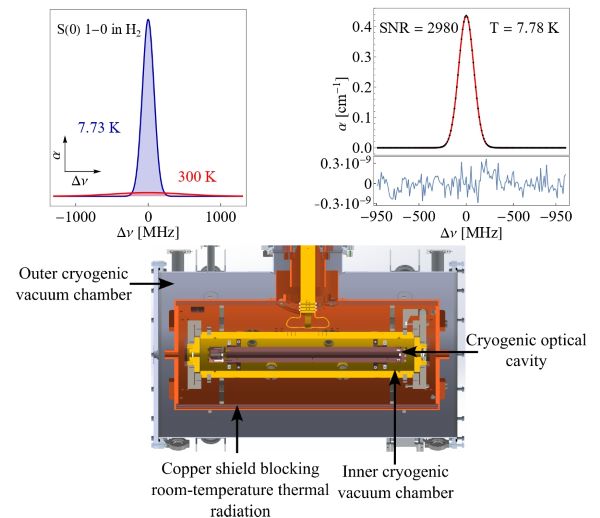
References:
1. M. Słowiński et. al., Rev. Sci. Instrum. 93, 115003 (2022)
2. K. Stankiewicz et. al., Cavity-enhanced spectroscopy in the deep cryogenic regime for quantum sensing and metrology, Nature Physics (accepted: 30.01.2026)
3. K. Pachucki & J. Komasa, J. Chem. Theory Comput. 21, 12664–12673 (2025)
Due to its simplicity, H$_2$ constitutes a perfect tool for testing fundamental physics: testing quantum electrodynamics, determining fundamental constants, or searching for new physics beyond the Standard Model. H$_2$ has a huge advantage over the other simple calculable systems of having a set of a few hundred ultralong living rovibrational states, which implies the ultimate limit for testing fundamental physics with H$_2$ at a relative accuracy level of 10$^{-24}$. The present experiments are far from this limit. I will present our so far results of an ongoing project aimed at trapping cold H$_2$. We develop an ultra-strong optical dipole trap. The time-dependent potential is going to recapture the coldest fraction of the cryogenic H$_2$ cloud. We develop a new type of cryogenic effusive valve to prepare a cryogenic H$_2$ sample.
[1] H Jóźwiak, P Wcisło, Scientific Reports 12, 14529 (2022)
[2] H Jóźwiak, TV Tscherbul, P Wcisło, J. Chem. Phys. 160, 094304 (2024)
[3] K. Stankiewicz, …, P. Wcisło, Nat. Phys. (2026, accepted) arxiv.org/abs/2502.12703
The HAMP-vQED project, funded by an ERC advanced grant, aims to set new standards for highly accurate calculations of molecular properties. This includes exploring the possible role of QED-effects on properties that explore the electronic density in the vicinity of nuclei, such as the parameters of NMR and Mössbauer spectroscopies. A first line of attack has been the inclusion of effective QED-potentials in molecular calculations 1. A second, more ambitious approach is to include such effects through an effective QED-Hamiltonian. A first step in this direction involves the calculation of one-loop vacuum polarization [2,3] and electron self-energy 4 for one-electron atoms. We have imposed as constraint to work in the finite Gaussian basis sets widely used in quantum chemistry, also because we believe they can facilitate the extension of such calculations into the molecular domain. Somewhat to our surprise, our results can compete with the accuracy of conventional methods based on Green's functions.
1 Ayaki Sunaga, Maen Salman and Trond Saue, J. Chem. Phys. 157 (2022) 164101
2 Maen Salman and Trond Saue, Phys. Rev. A 108 (2023) 012808
3 Ryan Benazzouk, Maen Salman, Trond Saue,arXiv:2512.16569
4 Dávid Ferenc, Maen Salman and Trond Saue, Physical Review A 111 (2025) L040802
The fine-structure constant $\alpha$ can be determined with high precision through measurements of the ratio $h/m$ between the Planck constant and the atomic mass using atom interferometry. Our latest determination of $\alpha$ has achieved a relative uncertainty of $8.1\times 10^{-11}$, establishing recoil measurements as a cornerstone of precision metrology and tests of the Standard Model. However, discrepancies between the only independent determinations of $\alpha$ based on atom interferometry underscore the need for a refined understanding of related systematic effects.
Our recent work focuses on the study of systematic effects due to the laser beam profile. To extract the ratio $h/m$ from the recol velocity $\vec{v}_r = \hbar\vec{k}$, we must accurately determine the wave vector as perceived by the atoms in the vacuum chamber.
We demonstrate a novel method to map the spatial distribution of the wave vectors in situ using a Bose–Einstein condensate (BEC) as a localized probe. Due to its small spatial extent, the BEC samples the optical field with high resolution. By translating the condensate across the laser beam and performing recoil-sensitive atom interferometry at each position, we reconstruct a two-dimensional map of both the local intensity and the associated dispersion of $\vec{k}$. This approach, combined with numerical simulations, provides a powerful tool for evaluating one of the dominant systematic effects in recoil-based measurements of $h/m$ and $\alpha$.
Accurate energy intervals in light open-shell atoms remain a stringent test for both precision spectroscopy and ab initio electronic-structure theory. One of the most persistent benchmarks is neutral boron: the separation between the ground $^2P^o$ state and the lowest $^4P^e$ quartet, together with the quartet fine structure, has resisted definitive theoretical--experimental reconciliation for decades. In this work we report high-precision all-particle calculations using massive explicitly correlated Gaussian expansions and include leading relativistic and quantum-electrodynamics contributions through order $\alpha^4$. We determine the $^2P^o \rightarrow ^4P^e$ excitation energy in $^{11}$B as 28967.65(7) cm$^{-1}$, achieving sub-0.1 cm$^{-1}$ accuracy and resolving the long-standing ambiguity in this interval. Beyond the gross separation, we predict the fine-structure splittings within the $^4P^e$ manifold, providing a concrete target pattern for future spectroscopic searches for a state that has thus far largely eluded observation. These results remove a key remaining uncertainty in the boron spectrum and establish a new benchmark for quantifying electron correlation and relativistic/QED effects in few-electron, open-shell atomic systems.
Exotic atoms constitute a unique platform to explore fundamental interactions and symmetries. In particular, kaonic atoms are a great tool to investigate quantum electrodynamics in extreme electromagnetic fields. While conventionally exploited to investigate low-energy QCD through hadronic shifts and widths, kaonic atoms also offer a unique opportunity to probe bound-state QED (BSQED) in a previously unexplored regime. Owing to the large kaon mass, the Bohr radius is drastically reduced compared to ordinary atoms, generating electric fields at the kaon orbit that approach or exceed the critical scale associated with the Schwinger limit.
The recent measurement of Kaonic Fluorine and Neon X-ray transitions performed by SIDDHARTA-2 at Laboratori Nazionali di Frascati opens the possibility of testing strong-field QED (SFQED) effects in a strong Coulomb field, enabling precision studies of higher-order vacuum polarization and radiative corrections in the strong-field regime, where the validity of the perturbative approach begins to fail.
By measuring transition energies in light and medium-Z kaonic atoms with sub-eV precision and comparing them with advanced BSQED calculations, SIDDHARTA-2 achieves sensitivity to possible deviations from perturbative predictions. This contribution presents the recent Kaonic Fluorine and Neon results, and the prospects for probing Strong Field QED physics effects in the vicinity of the Schwinger limit using kaonic atoms as unique exotic atoms laboratories.
Molecular hydrogen ions (MHIs) represent a class of bound quantum systems with significant potential for advancing our knowledge in multiple scientific domains, including the determination of fundamental constants, test of quantum physics, and the search for new interparticle forces. Furthermore, the comparison of transitions in MHIs and their antimatter counterparts provides an opportunity for novel tests of CPT invariance [1].
We have recently measured for the first time a Doppler-free rovibrational transition in a homonuclear MHI. Specifically, we studied an electric-quadrupole (E2) overtone rovibrational transition in H$_2^+$ [2]. We achieved an experimental fractional uncertainty of $8\times10^{-12}$. Our measured frequency is in agreement with the theoretical prediction. From the theoretical and experimental result, we deduced a value of the proton-to-electron mass ratio, which is in agreement with the CODATA 2022 value.
The already achieved experimental uncertainty stimulates us to consider seriously the vision of performing the spectroscopy with much higher accuracy first on H$_2^+$ and later on anti-H$_2^+$.
Myers [3] proposed performing laser vibrational spectroscopy of H$_2^+$ in a Penning trap with non-destructive read-out via the continuous Stern-Gerlach effect. This approach has recently been demonstrated in the ALPHATRAP facility (MPI-Kernphysik, Heidelberg) for the related molecular ion HD$^+$ [4,5].
We performed an extensive analysis of this proposal, and derived estimates for the achievable accuracy of the test [6]. We find that a comparison of the vibrational frequencies at a fractional level of $1\times10^{-17}$ is a realistic prospect, using technology that is mostly already available, particularly in the BASE-QLEDS trap [4,5,7,8].
We also analyzed complementary CPT invariance tests, namely those of the g-factor of the bound electron/positron via electron-spin-resonance spectroscopy and of the magnetic moment of the proton/antiproton via radiofrequency spectroscopy.
Acknowledgments: The work of S. S. performed under a grant of Deutsche Forschungsgemeinschaft includes a collaboration with S. Sturm and K. Blaum and their team on spectroscopy of HD$^+$ in ALPHATRAP. Joint discussions about spectroscopy in ALPHATRAP have been helpful.
The work of S. S. was performed under grant Schi 431/29-1 of Deutsche Forschungsgemeinschaft (DFG) and from both the DFG and the state of North-Rhine-Westphalia (Grant Nos. INST-208/774-1 FUGG and INST-208/796-1 FUGG). The work of S. S. and D. B. was also supported by the European Research Council (ERC) under the European Union’s Horizon 2020 research and innovation program (Grant Agreement No. 786306, “PREMOL”). J. M. C. acknowledges the grant “RYC2023-042535-I” funded by MICIU/AEI/10.13039/501100011033 and by “ESF+”.
The hydrogen molecular ion H$_2^+$ is the simplest stable molecule, and its structure can be calculated ab initio with high precision using quantum electrodynamics. By comparing the calculations with experimental data, fundamental constants can be determined, and the validity of the theory itself can be tested. However, challenging properties such as high reactivity, low mass, and the absence of rovibrational dipole transitions have thus far limited spectroscopic studies of H$_2^+$.
We trap a single H$_2^+$ molecule together with a single beryllium ion using a cryogenic Paul trap, achieving trapping lifetimes of 11 h and ground-state cooling of the shared axial motion [1]. With this platform, we have implemented quantum logic spectroscopy of H$_2^+$ [2]. The H$_2^+$ molecule is produced in a chosen rovibrational state using resonance-enhanced multiphoton ionization [3]. We use quantum-logic operations between the molecule and the beryllium ion for the preparation of single hyperfine states and non-destructive state readout. In the lowest rovibrational state of ortho-H$_2^+$ (rotation $L = 1$, vibration $ν = 0$), we achieve a combined state-preparation and readout fidelity of 66.5(8)%. We demonstrate Rabi flopping on several hyperfine transitions using stimulated Raman transitions and microwaves. Utilizing a magnetic-field-insensitive hyperfine transition driven with a microwave, we observe sub-Hz linewidths and statistical uncertainties in the mHz range.
We are now performing a systematic measurement of the hyperfine structure, which will provide a stringent test of state-of-the-art molecular theory and enable us to place an improved bound on a possible tensor force between the two constituent protons of the H$_2^+$ molecule [4].
Our results pave the way for high-precision rovibrational spectroscopy of single H$_2^+$ molecules, which would enable tests of quantum electrodynamics, metrology of fundamental constants such as the proton-electron mass ratio, and the implementation of an optical molecular clock based on the simplest molecule in nature.
[1] N. Schwegler et al., Phys. Rev. Lett. 131, 133003 (2023)
[2] D. Holzapfel et al., Phys. Rev. X 15, 031009 (2025)
[3] H. J. Kim et al., arXiv:2509.03625 (2025)
[4] N. F. Ramsey, Physica 96A, 285 (1979)
Since 1967, time has been defined through atomic transition frequencies, establishing atomic clocks as fundamental tools for science and technology. More recently, optical atomic clocks have surpassed historical atomic microwave clocks, reaching uncertainties close to 10⁻¹⁸ and enabling both applied and fundamental investigations. At this level of performance, atomic clocks serve as sensitive probes for a wide range of applications, such as chronometric geodesy, tests of General Relativity, searches for physics beyond the Standard Model, and the prospective redefinition of the SI second [1]. In addition, frequency ratio measurements would provide powerful tools to constrain possible variations of fundamental constants, such as the fine-structure constant α and the proton-to-electron mass ratio [2].
Among neutral atoms, mercury offers several attractive features for an optical lattice clock, including a low sensitivity to blackbody radiation—16 times lower than ytterbium and 30 times lower than strontium—and a relatively high vapor pressure at room temperature. To date, only the fermionic isotope ¹⁹⁹Hg has been used in mercury clocks. However, the limited lifetime of its excited state constrains the performance achievable with the next generation of ultrastable lasers. In contrast, bosonic isotopes offer a way to overcome this limitation, as they allow for much longer interrogation times, with the normally forbidden ¹S₀–³P₀ transition made accessible through a quenching scheme using a strong external magnetic field [3].
Here, we present the first ¹⁹⁸Hg optical lattice clock and its comparison with a local state-of-the-art ⁸⁷Sr optical lattice clock. This clock is estimated to operate with a relative frequency stability already as low as 6 × 10⁻¹⁶/√(τ/s), and the 198Hg/87Sr optical frequency ratio determined for the first time with a preliminary total relative systematic uncertainty of 6.9 × 10⁻¹⁶ [4]. With this magnetically induced transition, both the quadratic Zeeman shift (QZS) and the probe light shift (PLS) play indeed a significant role in the total uncertainty budget. Careful calibration and optimized experimental conditions can reduce the QZS uncertainty below the 10⁻¹⁷ level, whereas the PLS remains a major limitation under our current experimental setup. We are now working on implementing hyper-Ramsey interrogation [5] to suppress the PLS uncertainty to lower levels. Future steps will focus on further improving the clock stability by employing repumping techniques for normalized detection and achieving lower atomic temperatures through a sideband cooling scheme.
[1] W. F. McGrew et al, Nature, 564, 87 (2018). A. D. Ludlow et al, Rev. Mod. Phys., 87, 637 (2015). S. Bize, Comptes Rendus Physique, 20, 153 (2019).
[2] Uzan J.P., Living Rev. Relativ. 14 (2011) 2.
[3] A. V. Taichenachev et al, Phys. Rev. Lett., 96, 083001 (2006).
[4] C. Zyskind, et al., arXiv:2512.04920 (2025).
[5] V. I. Yudin, et al., Phys. Rev. A 82, 011804(R) (2010).
The precise measurement of the 1s–2s transition in hydrogen serves as a cornerstone for testing quantum electrodynamics (QED) in simple atomic systems [1]. Extending such measurements to other hydrogen-like systems such as He$^+$ probes higher-order QED corrections scaling with the atomic number $Z$ and reveals nuclear structure contributions beyond hydrogen. Despite its scientific interest, the 1s–2s transition in He$^+$ has never been measured before due to the demanding requirements of coherent XUV excitation. For this purpose, we have constructed an XUV frequency comb at 60.8 nm based on a cavity enhanced high-harmonic generation system seeded by an ultra-stable high-power infrared frequency comb, and a radio frequency ion trap that stores He$^+$ ion crystals sympathetically cooled with Be$^+$ [2]. We report on our novel non-collinear resonator for the generation of XUV light [3] and on our current efforts to synchronize and overlap counter-propagating XUV pulses at the trapped He$^+$ ions, essential for Doppler-free and recoil-free spectroscopy. Additionally, we explore a carrier-revival effect where strong carrier transitions could be excited in long linear ion chains, even when the strong recoil from XUV photons is not cancelled and the Lamb–Dicke regime is not reached for a single ion [4].
[1] T. Udem Nature Phys 14, 632 (2018)
[2] J. Moreno et al. Eur. Phys. J. D 77, 67 (2023)
[3] S. H. Wissenberg et al. Phys. Rev. Res. 7, 023071 (2025)
[4] F. Egli et al. in preparation (2026)
Over the past few decades, advancements in optical atomic clocks have enabled measurements of time and frequency with unprecedented stability and systematic uncertainty [1,2]. Precision frequency comparisons between macroscopically separated clocks have applications in geodesy [3], probing variations in fundamental constants, and in dark matter searches [4]. Frequency comparisons between independent clock systems are limited by the standard quantum limit (SQL). In contrast, a set of N entangled atomic clocks can achieve a $\sqrt{N}$ stability improvement to surpass the SQL and approach the Heisenberg limit - the ultimate precision possible in quantum theory.
We previously demonstrated this enhancement in a network of two \ion{Sr}{88} clocks [5] on the 674 nm $5S_{1/2} \leftrightarrow 4D_{5/2}$ quadrupole transition using Ramsey spectroscopy, whose stability was mainly limited by the short probe duration of 20~ms due to magnetic field fluctuations. We are now setting up the next generation of the experiment wherein we map the remote Sr-Sr entanglement onto two $^{43}$Ca$^+$ ions. The 729 nm $^{43}$Ca$^+$ $\vert 4S_{1/2}, F=4, m_F=4 \rangle \leftrightarrow \vert 3D_{5/2}, F=4, m_F=3 \rangle$ optical clock transition is field-insensitive at 4.96 G, enabling probe durations at the excited state lifetime limit of $\sim$ 1 s (comparable to the start-of-the-art clocks [1]) and thus improve our stability.
We will present progress towards these clock experiments, including the setup of a 729 nm laser system locked to a high finesse cavity, as well as fibre noise cancellation on a 20~m fibre. We will further present some theoretical work on quantum metrology with Dicke states in the presence of spontaneous decay in larger networks of clocks.
[1] M. C. Marshall et al., Phys. Rev. Lett. 135, 033201 (2025).
[2] E. Oelker et al., Nature Photonics 13, 714–719 (2019).
[3] T. E. Mehlstaubler et al., Reports on Progress in Physics 81, 064401 (2018).
[4] M. S. Safronova et al., Rev. Mod. Phys. 90, 025008 (2018).
[5] B. C. Nichol et al., Nature 609, 689–694 (2022)
The finite nuclear mass $(Z\,\alpha)^2\,m/M\,E_F$ correction to the hyperfine splitting in hydrogenic systems are calculated using
a combined relativistic heavy particle and nonrelativistic quantum electrodynamics. Obtained results are in disagreement with previous calculations
by Bodwin and Yennie [Phys. Rev. D {\bf 37}, 498 (1988)].
The comparison of improved theoretical predictions with the corresponding measurements in hydrogen reveals $5\sigma$ discrepancy,
what may indicate problems with the proton structure corrections.
I reexamine theory predictions of the ground-state hyperfine splitting in muonic hydrogen. A particular focus will be on proton finite-size and polarizability contributions. The common $(Z \alpha)^5$ finite-size contributions are extended up to and including $(Z \alpha)^6$. Their reanalysis based on electron-proton scattering data is presented, discussing limitations
of the scattering data and in the finite-size expansion. Furthermore, radiative corrections to the finite-size contribution from electron vacuum polarization are presented. Evaluations of the $(Z \alpha)^5$ polarizability contribution in a data-driven dispersive framework [1] and a model-independent prediction in baryon chiral perturbation theory [2] are contrasted.
[1] D. Ruth, K. Slifer, J. P. Chen, C. E. Carlson, F. Hagelstein, V. Pascalutsa, A. Deur, S. Kuhn, M. Ripani and X.~Zheng, et al., Phys. Lett. B 859 (2024), 139116.
[2] F. Hagelstein, V. Lensky and V. Pascalutsa, Eur. Phys. J. C 83 (2023) no. 8, 762.
In view of ongoing hyperfine-structure measurements by FAMU and CREMA, we investigate relativistic recoil corrections in muonic hydrogen. We particularly emphasize on relativistic contributions involving vacuum polarization and finite-size effects (see e.g., Ref. [1]), refining the theoretical description to align with the precision of current experiments.
[1]. A.Antognini, F.Hagelstein and V.~Pascalutsa, “The proton structure in and out of muonic hydrogen,” Ann. Rev. Nucl. Part. Sci. 72 (2022), 389
Muonic hydrogen ($\mu p$) consists of a negatively charged muon bound to a proton. The large mass of the muon makes the energy levels of this atomic system sensitive to the finite size effects of the proton. The CREMA collaboration aims to measure the 1S hyperfine splitting in muonic hydrogen to $1\,$ppm relative uncertainity. This measurement can be used to determine the proton structure contribution to about $100\,$ppm and also be compared with the measurement of the same transition in hydrogen.
The experiment is designed to be carried out at PSI, Switzerland. It features a cryogenic hydrogen target, high-energy mid-infrared laser system, multipass-toroidal enhancement cell and a novel detection scheme. I will give an overview of the experimental scheme and report on its current status.
Diatomic molecular hydrogen ions (MHI) such as H$_2^+$ and HD$^{+}$ are simple, single-electron systems with properties that can be calculated to high precision by ab initio theory. Comparison to precision experiments then enables stringent tests of the Standard Model and high-precision determinations of fundamental constants. Laser spectrosocopy of rovibrational transitions has now been demonstrated in both HD$^+$ [1-2] and in H$_2^+$ [3] using strings of MHI trapped in Coulomb crystals of laser cooled Be$^{+}$ ions while quantum state control of single ions has been achieved using the techniques of quantum logic spectroscopy [4]. Here, we present the results of a measurement campaign using single HD$^{+}$ ions in the Alphatrap cryogenic Penning trap [5]. The highly isolated cryogenic environment combined with image-current-based state-detection methods allows us to quickly prepare and detect ions in pure quantum states without the use of auxiliary ions. This, in turn, allowed us to perform a high-resolution determination of the ground state hyperfine structure including a comparison of the experimentally determined bound electron $g$-factor to a recent theoretical prediction with a relatively uncertainty of $2\times10^{-10}$ [6]. Recently, we have also performed laser spectroscopy of the $(v,L) = (0,0) \rightarrow (5,1)$ rovibrational transition and have achieved sub-kHz resonance linewidths that allow us to determine the transition frequency with a statistical uncertainty of less than 100 Hz, corresponding to a relative precision well below 1 ppt.
[1] S. Patra et al. Science 369, 1238 (2020).
[2] S. Alighanbari et al. Nature 581, 152 (2020).
[3] S. Alighanbari et al. Nature 644, 69 (2025).
[4] D. Holzapfel et al. Phys. Rev. X 15, 031009 (2025).
[5] Sturm, S. et al. Eur. Phys. J. Spec. Top. 227, 1425-1491 (2019).
[6] C. König et al. Phys. Rev. Lett. 134, 163001 (2025).
[7] C. König et al. Phys. Rev. Lett. accepted (2026).
In the last few years, spectroscopy of molecular hydrogen ions (MHI) contributed for the first time in the adjustment of fundamental constants and in establishing bounds on beyond-standard-model interactions. Ongoing improvements and diversification of experimental methods require advancing further the theoretical description of MHIs. One way in which this may be achieved consists in combining results from nonrelativistic and relativistic QED approaches.
This was done to improve the calculation of the bound-electron $g$-factor [1], which was recently measured for the HD$^+$ rovibrational ground state in a single-ion Penning-trap experiment [2].
Regarding the energy levels, the NRQED approach is used to calculate $m\alpha^6$-order relativistic and relativistic-recoil corrections within a full (nonadiabatic) description of the three-body system [3-4]. On the other hand, the relativistic approach is a way forward for the calculation of the one-loop self-energy correction, which is currently the largest source of uncertainty, and where recent progress was achieved in the hydrogen-like atom case [5-6].
Results and perspectives in these two areas of theory will be discussed.
[1] O. Kullie, H.D. Nogueira, J.-Ph. Karr, Phys. Rev. A 112, 052813 (2025).
[2] C.M. König et al., arXiv:2602.20750, Phys. Rev. Lett., to appear.
[3] V.I. Korobov, Phys. Rev. A 112, 022808 and 022813 (2025).
[4] V.I. Korobov, J.-Ph. Karr, Z.-X. Zhong, Mol. Phys. e2563023 (2025).
[5] V.A. Yerokhin, Z. Harman, C.H. Keitel, Phys. Rev. A 111, 012802 (2025).
[6] D. Ferenc, M. Salman, T. Saue, Phys. Rev. A 111, L040802 (2025).
The largest source of uncertainty in the theory of spin-averaged rovibrational transitions in hydrogen molecular ions arises from uncalculated higher-order ($m\alpha^{8+}$) corrections to the one-loop self-energy [1]. These terms are extremely challenging to evaluate via the standard $Z\alpha$ expansion, therefore—similarly to the case of the hydrogen atom [2]—a numerical all-order approach is desirable. It was recently demonstrated that Gaussian basis sets are suitable for the evaluation of the self-energy for hydrogenlike ions [3], which is a significant step towards molecular calculations. In this contribution I will present a method for the high-precision solution of the Dirac equation in the Coulomb field of the two nuclei using a Gaussian basis set [4], and show that the necessary ingredients to the evaluation of the self-energy via the many-potential expansion can be readily obtained in this framework for the molecular case. The challenges that arise for low nuclear charges in the many-potential expansion approach will also be addressed.
[1] V. I. Korobov and J-Ph. Karr, Phys. Rev. A 104, 032806 (2021).
[2] U. Jentschura, P. J. Mohr, and G. Soff, Phys. Rev. Lett. 82, 53 (1999).
[3] D. Ferenc, M. Salman, and T. Saue, Phys. Rev. A 111, L040802 (2025).
[4] D. Ferenc and T. Saue, in preparation (2026).
Cold molecules exhibit significant potential in many applications, including precision measurement, quantum metrology, and fundamental physics. Although a few specific types of molecules have been successfully laser-cooled by selecting electronic transitions with appropriate Franck-Condon factors, laser deceleration of general molecules still poses significant challenges. In order to explore the possibility of molecular deceleration, we propose a method via the vibrational coherent bichromatic force (V-BCF). The bichromatic force, utilizing a pair of well-controlled counterpropagating laser beams with respect to frequency and phase, produces a significant coherent force related to the momentum transfer process of stimulated radiation rather than spontaneous radiation, which relies on the inherent characteristics of the system. Compared with the conventional BCF that operates through molecular electronic states, the V-BCF scheme based on the fundamental vibrational transitions benefits from the ultralow relaxation rate, undergoing continuous absorption-stimulated radiation cycles without interruptions caused by spontaneous radiation. This continuity in the Bloch evolution means a significant net momentum transfer that enables the molecular deceleration. Take the vibrational transition R(0) (00011)–(000021) of $^{13}CO_{2}$ as a demonstration, we calculated the V-BCF and found a time-averaged maximum deceleration of $-1.46×10^5~m/s^2$ with the velocity capture range $Δv_c$ of about $130~m/s$. The result indicated that it was possible to decelerate $^{13}CO_{2}$ with V-BCF. Based on the study we propose that molecules, as long as they have a sufficiently large fundamental vibration transition dipole moment or sufficiently large laser power at the fundamental vibrational band, can be decelerated by the V-BCF scheme. The universal method to decelerate and manipulate the molecule provides an opportunity for precision spectroscopy of molecules and more applications where slow and cold molecules are needed.
The MUon Scattering Experiment (MUSE) at the Paul Scherrer Institute (PSI) is designed to address the "proton radius puzzle" through high-precision measurements of elastic lepton-proton scattering. By utilizing a mixed secondary beam in the $\pi$M1 channel, MUSE performs simultaneous measurements of electron-proton ($e^{\pm}p$), muon-proton ($\mu^{\pm}p$), and pion-proton ($\pi^{\pm}p$) scattering. This multi-lepton approach, covering a low-momentum transfer range of $Q^2 \approx 0.002$ to $0.08$ GeV$^2$, enables a direct test of lepton universality and a determination of the proton charge radius with reduced systematic uncertainties, while the dual-polarity measurements are necessary for two-photon exchange corrections.
In this talk, I will present the current status of the MUSE experiment, the expected sensitivity, and the data analysis, focusing on techniques developed to minimize systematic bias in the extraction of the charge radius. These include high-granularity detector calibration and alignment of the tracking systems, optimized event selection for reaction identification, and data-driven corrections for detector efficiencies, geometric acceptance, and multiple scattering. Furthermore, I will discuss the treatment of radiative effects, which differ significantly between electrons and muons. These efforts are critical for reaching the sub-percent precision required to constrain potential new physics or conventional explanations of the proton radius discrepancy.
I report on recent advances in ab initio QED theory of the 2pj-2s transition energies in Li-like ions and present the most accurate calculations to date for the Li isoelectronic sequence with Z >= 10 [1]. Improved convergence of the calculations was achieved by employing the extended Furry picture, which includes the screening potential nonperturbatively, in addition to the nuclear binding potential. The QED screening effects, the QED electron-structure effects with one and two photon exchanges, and the nuclear recoil effect were calculated rigorously, while higher-order electron-structure and QED screening effects were accounted for by approximate methods. The resulting theoretical predictions improve upon the best previous QED calculations and surpass the accuracy of most existing experimental results.
The achieved accuracy of our QED predictions for Li-like enables the determination of absolute nuclear charge radii through comparison of experimental and theoretical transition energies. I present [2] a proof-of-principle determination of the nuclear charge radii of 208Pb and 209Bi isotopes based on the available experimental data [3-5]. By incorporating constraints derived from electron-scattering data, I demonstrate that the extracted radii are independent of the assumed model of the nuclear charge distribution. Their accuracy is currently limited by experimental precision and, to some extent, by the unknown higher-order QED effects, which contrasts with the muonic-atom determinations limited by the nuclear theory.
[1] V. A. Yerokhin, Z. Harman, and C. H. Keitel, Phys. Rev. A 112, 042801 (2025).
[2] V. A. Yerokhin and B. Ohayon, Phys. Rev. A 113, 012804 (2026).
[3] C. Brandau et al., Phys. Rev. Lett. 91, 073202 (2003).
[4] X. Zhang et al., Phys. Rev. A 78, 032504 (2008).
[5] P. Beiersdorfer et al., Phys. Rev. Lett. 80, 3022 (1998).
The bound system of a deuteron and its antiparticle (deuteronium) appears to be an almost ideal candidate for the study of higher-order corrections to the electromagnetic interactions of spin-1 particles. As shown in the preprints arXiv:2506.15974 and arXiv:2602.04743 (accepted for publication in Physical Review Research and Physical Review D), the fine and hyperfine structure of deuteronium give access to interesting interconnections of spin-dependent effects, angular mixing, and scalar as well as tensor polarizabilities. The bound system is essentially stable and could be explored at a future antideuteron beam facility. Due to the extreme field strengths commensurate with the small generalized Bohr radius, the deuteronium system is a good candidate for the detection of small residual dark-photon interactions coupling to neutrons (and their antiparticles).
Quantum electrodynamics (QED) forms the basis for all other quantum field theories, upon which the Standard Model (SM) of particle physics is constructed. Because of the hydrogen atom's simplicity, its energy levels can be precisely calculated from bound-state QED and compared with experiment. Such a comparison between theory and experiment is linked to the determination of fundamental constants that enter the theory as parameters. Only if there are more independent measurements than parameters can the theory be tested. For hydrogen, the theory test concerns the Rydberg constant and the proton radius. This requires at least two different transition-frequency measurements to determine them, and more measurements to test the theory. Here, we report on our recently published 2S-6P transition frequency measurement [1], which can be combined with the 1S-2S measurement [2] and the muonic proton radius [3,4]. We thereby test the SM prediction to 0.7 parts per trillion, which is comparable to the SM test with the anomalous magnetic moment (g-2) [5]. The bound-state QED corrections are tested to 0.5 parts per million, the most precise test to date.
[1] L. Maisenbacher, V. Wirthl et al., Nature 650 (2026)
[2] C. G. Parthey et al., PRL 107 (2011)
[3] R. Pohl et al., Nature 466 (2010)
[4] A. Antognini et al., Science 339 (2013)
[5] X. Fan et al., PRL 130 (2023)
The hyperfine interaction between the nuclear moments and electronic charge and current distributions occurs naturally for all atoms and ions with non-zero nuclear spin, $I\neq 0$. While the hyperfine splitting of most ionic levels usually remain (very) small, this coupling of the nuclear and electronic degrees of freedom can significantly modify the lifetime of isomeric and electronic states. This applies especially, if symmetry-forbidden transitions in the pure nuclear and/or electronic system becomes allowed due to this interaction. These (so-called) hyperfine-induced transitions have been discussed, and partly obscured, by various names in the literature, including hyperfine-quenched, nuclear hyperfine mixed
or electronic-bridge processes.
Here, we shall introduce a systematic notation to classify these transitions alone in terms of their nuclear and/or electronic subsystems, while keeping their multipole character visible. It supports the evaluation of transition rates, lifetimes, and photon angular distributions and clarifies the conditions, under which the nuclear, electronic, or the mixed nuclear \&{} electronic multipole transition dominate. Well-known examples include the hyperfine-induced electronic-dipole (E1) decay of the $2s2p\;\: ^3P_{0,2}$ levels of beryllium like ions, the nuclear E1 transition in $^{235}$U ions and the nuclear-clock magnetic-dipole (M1) transition in $^{229}$Th ions as well as several other decay modes in nuclear and atomic physics [1]. Our systematic approach will support high-precision spectroscopy and the search for alternative clock transitions or for physics beyond the Standard Model.
[1] Wang W, Fritzsche S and Li Y 2025 PRA 112, 022811
We calculate parity-violation-induced E1 amplitudes for the $1s\rightarrow 2s$ and $1s^2 2s\rightarrow 1s^2 3s$ transitions in H- and Li-like ions of $^{40}$Ca, $^{48}$Ca, and $^{208}$Pb; neutron skin effects and nuclear uncertainties are included for each nucleus. We consider spin-independent weak-interaction contribution of the $Z^0$ boson described by standard model, as well as the effects of a hypothetical new $Z'$ boson of varying mass. We conclude that the neutron-skin corrections in the $^{40,48}$Ca isotope pair can be mostly neglected when considering $Z'$ boson effects, which is an advantage for the search for new parity-violating physics. On the other hand, both the neutron skin effect and the sensitivity to hypothetical $Z'$ interactions in $^{208}$Pb is shown to be significant.
Beryllium ions (9Be+) serve as a four-body system with a closed electronic shell and a single valence electron, offering advantages for both theoretical and experimental research. Theoretically, their energy level structure can be accurately calculated using high-precision quantum electrodynamics (QED) methods. Experimentally, laser cooling enables the preparation of ultracold Coulomb crystals, providing an ideal platform for high-precision quantum state manipulation and spectroscopic measurements.
Direct measurements of the ground-state magnetically insensitive hyperfine transition |F=2, mF=0→F=1, mF=0> of 9Be+ ions have been performed using microwave-driven state transfer. The 9Be+ ions are confined and laser-cooled in a linear Paul trap, forming a Coulomb crystal. The transition frequencies have been measured over a magnetic field range of ±0.5 mT centered at zero magnetic field, and the acquired data were fitted accounting for the high-order Zeeman effect. The hyperfine constant A is determined to be −625.008840(35) MHz, achieving a relative precision of 5.6E-8.Combining this with theoretical calculations, the Zemach radius of the beryllium nucleus was derived as 4.03(5) fm.