Since the historic first detection in September 2015, gravitational wave observations have become routine, with the LIGO-Virgo-KAGRA network now detecting approximately one black hole merger every three days and having captured around 300 events to date. The future promises even more: next-generation detectors like the Einstein Telescope and Cosmic Explorer are expected to detect hundreds of thousands to millions of compact binary coalescences per year. These observations enable tests of fundamental physics in strong-gravity regimes, insights into the nature of compact objects and the evolution of stars, probes of cosmological evolution, and opens the possibility of multi-messenger astrophysics.
Join us for the 4th Gravitational Wave School in Chile (January 11-15), continuing a proud tradition of training a new generation of latin-american scientists in this growing and exciting research field. This time, the event will be followed by the international conference Gravitational Waves at the Fin del Mundo (January 18-22), inviting world-leading experts in strong-field gravitational physics and astrophysics.
These events will be held at Universidad Central in La Serena, Chile. La Serena is a charming seaside, in a region renowned for its pisco production and tropical papayas. Most importantly, La Serena serves as the gateway to some of the world's most important astronomical facilities, including Vera C. Rubin Observatory, Cerro Tololo, Gemini, Las Campanas, and La Silla—making it the perfect location to explore the future of gravitational wave astrophysics.
A related conference on GW instrumentation will be held one week later in Santiago, Chile. For more information, visit Q-Sensing LATAM 2027.
4th Gravitational Wave School: Lecturers
- Thomas Sotiriou (University of Nottingham)
- Katerina Chatzioannou (Caltech)
- Alessandra Corsi (Johns Hopkins University)
- Pablo Marchant (Ghent University)
- Carla Hermann (University of Chile) & Enzo Tapia (Nikhef)
Gravitational Waves at the Fin del Mundo: Invited Speakers
- Odylio Aguiar (National Institute for Space Research INPE)
- Max Bañados (Catholic University of Chile)
- *Clécio R. Bom (Brazilian Center for Physics Research)
- Vitor Cardoso (Niels Bohr Institute)
- Cecilia Chirenti (University of Maryland)
- Katy Clough (Queen Mary University of London)
- Anuradha Gupta (University of Mississippi)
- Natalia Korsakova (Université Côte d’Azur)
- Luis Lehner (Perimeter Institute)
- Caio Macedo (Federal University of Pará)
- Michela Mapelli (University of Heidelberg)
- Antonella Palmese (Carnegie Mellon University)
- Nicolás Yunes (University of Illinois Urbana-Champaign)
*To be confirmed
Security Notice: Phishing Emails
We have been informed that fraudulent emails are circulating, impersonating Gravitational Waves at the Fin del Mundo and offering "full sponsorship" (registration, airfare, hotel, transportation) in exchange for completing a form that requests credit card details, supposedly "for verification purposes only."
This is not an official communication from the conference. The organizers will never ask for credit card, banking, or payment details by email.
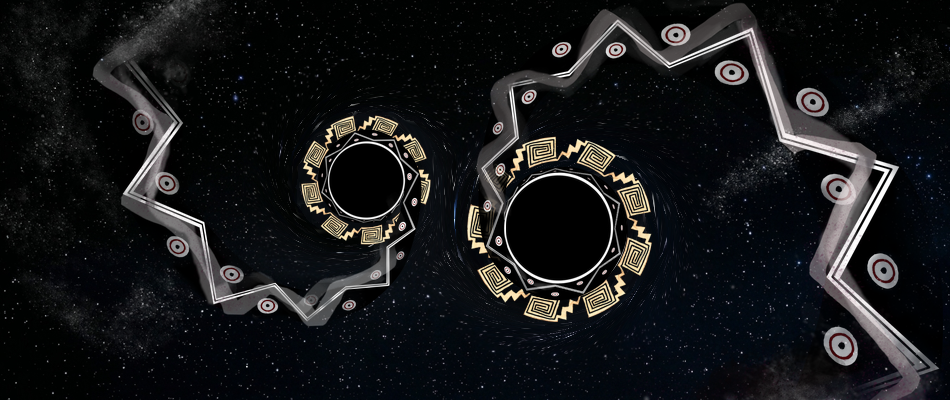
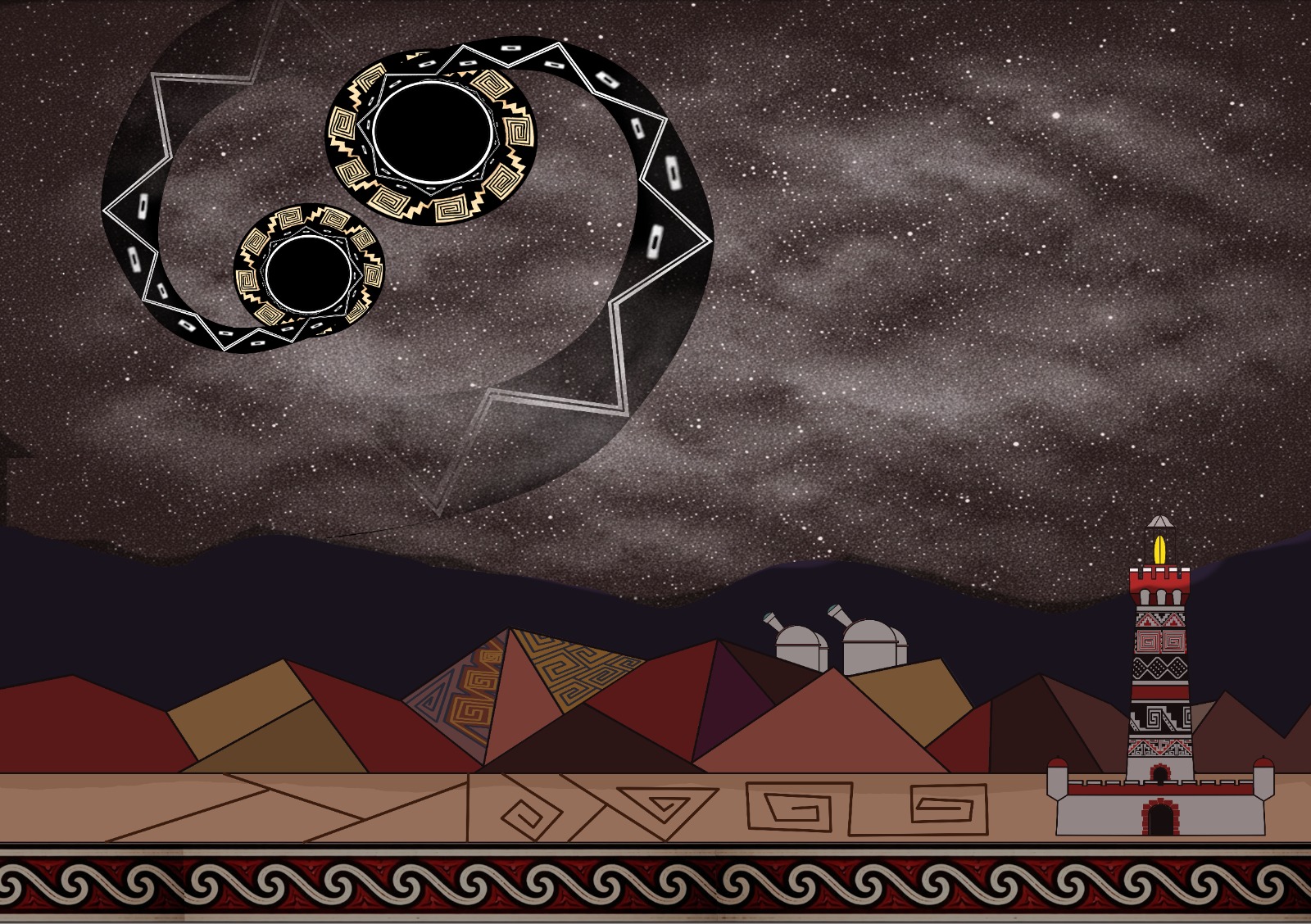
The drawings for this conference have been realised by Claudia Carreño and Riccardo Moretti. They have been inspired by the art of the Diaguita people, the indigenous population of the area around La Serena. The iconography of Diaguita art includes human figures, animals and religious symbols. These images are closely linked to the worldview and beliefs of the Diaguita culture, which valued the connection with nature and the spiritual world. Diaguita designs are made up of complex geometric shapes, such as rhombuses, zigzags, triangles and circles, which combine to create unique and varied patterns. These patterns are characterized by the use of bright and contrasting colors, such as red, black and white. These colors are used to highlight shapes and to create visual effects.
This event is supported by the Gravity Theory Trust and Gemini-ANID project #32250026.