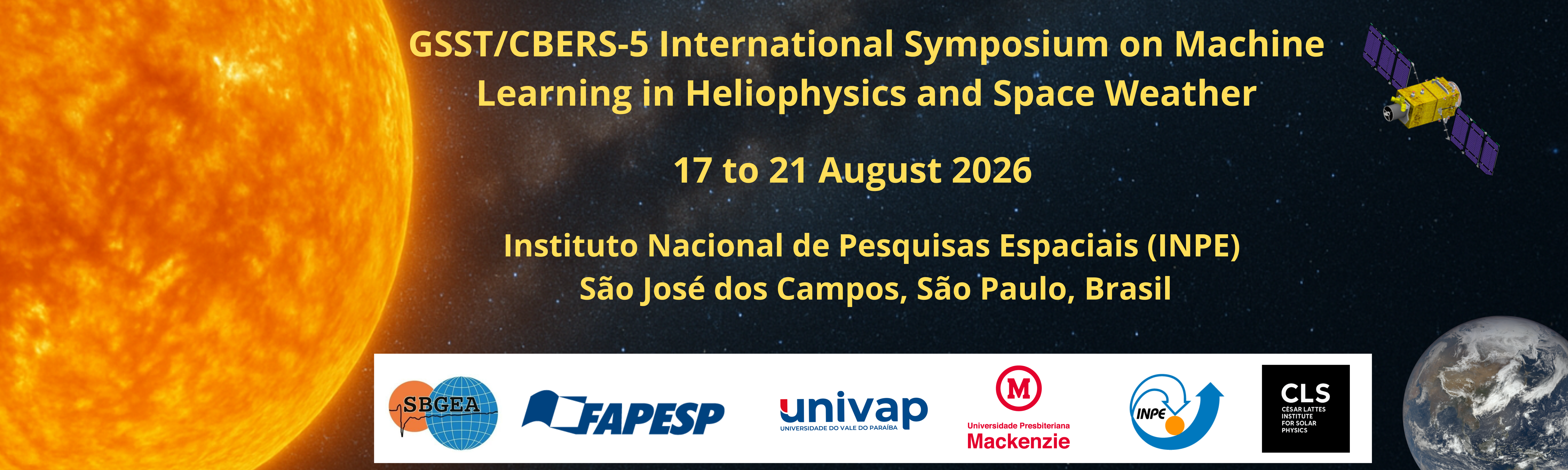
The GSST/CBERS-5 International Symposium on Machine Learning in Heliophysics and Space Weather will bring together researchers, engineers, and data scientists working at the interface of artificial intelligence and solar–terrestrial physics.
This focused symposium aims to explore how Machine Learning (ML) and Computer Vision (CV) techniques can enhance our understanding of heliophysical processes and improve predictive capabilities in space weather and space climate. Discussions will emphasize scientific and technological opportunities within the frameworks of the Galileo Solar Space Telescope (GSST) and the China–Brazil Earth Resources Satellite-5 (CBERS-5) missions, fostering collaborative efforts across Brazilian and international scientific communities.
While the primary emphasis is on heliophysics and space weather, contributions addressing applications of Machine Learning in Astrophysics and Earth Sciences are also strongly encouraged. Particular attention will be given to enabling technologies that underpin next-generation observational capabilities, including advanced instrumentation, high-performance computing, data assimilation frameworks, photonics and optical systems, remote sensing platforms, and autonomous space-based systems. Contributions involving large-scale data analysis, modeling, predictive methodologies, and sensor development are especially welcome.
The event is organized by the National Institute for Space Research (INPE), the University of Vale do Paraíba (UNIVAP), and Mackenzie Presbyterian University, with the support of the Brazilian Society of Space Geophysics and Aeronomy (SBGEA).
The organization of this symposium builds directly on discussions held during the 11th Annual BRICS Astronomy Working Group (BAWG) Workshop*, where ongoing and planned solar and space-weather observation missions were examined, including the Galileo Solar Space Telescope (GSST, Brazil), Aditya-L1 (India), the Chinese Solar Polar Orbit Observatory (China), and CBERS-5 (China/Brazil). These discussions underscored the importance of coordinated international efforts and advanced data-driven approaches for the next generation of heliophysics and space-weather research.
*The 11th Annual BRICS Astronomy Working Group (BAWG) Workshop was financed, in part, by the São Paulo Research Foundation (FAPESP), Brasil. Process Number #2025/17984-0.
Topics to be Covered
-
Computer Vision and Machine Learning applications in heliophysics
-
Solar magnetism and magnetic-field inference
-
Solar activity: flares, CMEs, and energetic particles
-
Solar wind dynamics and heliospheric structures
-
Space weather monitoring and forecast
-
Physics-Informed Neural Networks
-
Research-to-Operations processes augmented by AI and CV
Format and Participation
The symposium will feature invited talks, contributed oral presentations, and discussion sessions. Participation from both academia and operational space-weather centers is encouraged to bridge research and applications.
Important Dates
-
11 February 2026: Submission of abstract for oral and poster sessions opens/ Call for forecast application opens/ Submission of applications for financial support opens
-
30 March 2026: Deadline for abstract submission / Call for space weather forecast application closes
-
30 April 2026: Notification of abstract acceptance
-
23 March 2026: Deadline for financial support application
-
29 May 2026: Deadline for early registration (participants awarded financial support)
-
17–21 August 2026: Conference
-
31 December 2026: Paper submission deadline
Registration & Abstracts
-
Registration is open at https://indico.global/e/gsstAI
-
Conference fees: US$ 250
-
Submission of applications for financial support opens (The organization will provide limited financial support to cover the conference fees).
Organizing Committee
LOC
- Luis Eduardo Vieira (Chair;INPE)
- José Marchezi (Chair; INPE)
- Franciele Carlesso (Chair; INPE)
- Alisson Dal Lago (INPE)
- Daniele Medeiros (INPE)
- Hadassa Raquel Peixoto Jácome (INPE)
- Adriany Barbosa (INPE)
- Ivana Yoshie Sumida (INPE)
- Paulo Jauer (INPE)
- Marcos Vinicius Silveira (INPE)
- Letícia Rocha Silva Ferreira (INPE)
SOC
- Luis Eduardo Vieira (Chair;INPE)
- José Marchezi (Chair; INPE)
- Alisson Dal Lago (INPE)
- Joaquim Costa (INPE)
- Ligia Alves da Silva (INPE)
- Laysa Resende (INPE)
- Livia Ribeiro Alves (INPE)
- Jean Carlo Santos (INPE)
- Marlos Rockenbach (INPE)
- Paulo Simões (Mackenzie)
- N.L. Vijaykumar (INPE)
- Alan Prestes (UNIVAP)
Venue and Dates
The event will take place at INPE – National Institute for Space Research, São José dos Campos, Brazil, during the second week of August 2026 (August 17–21, 2026).
Sponsors
Interested in sponsoring? Contact the organization at solarAI2026@inpe.br
Indico.global provided the peer-review platform and infrastructure free of charge.