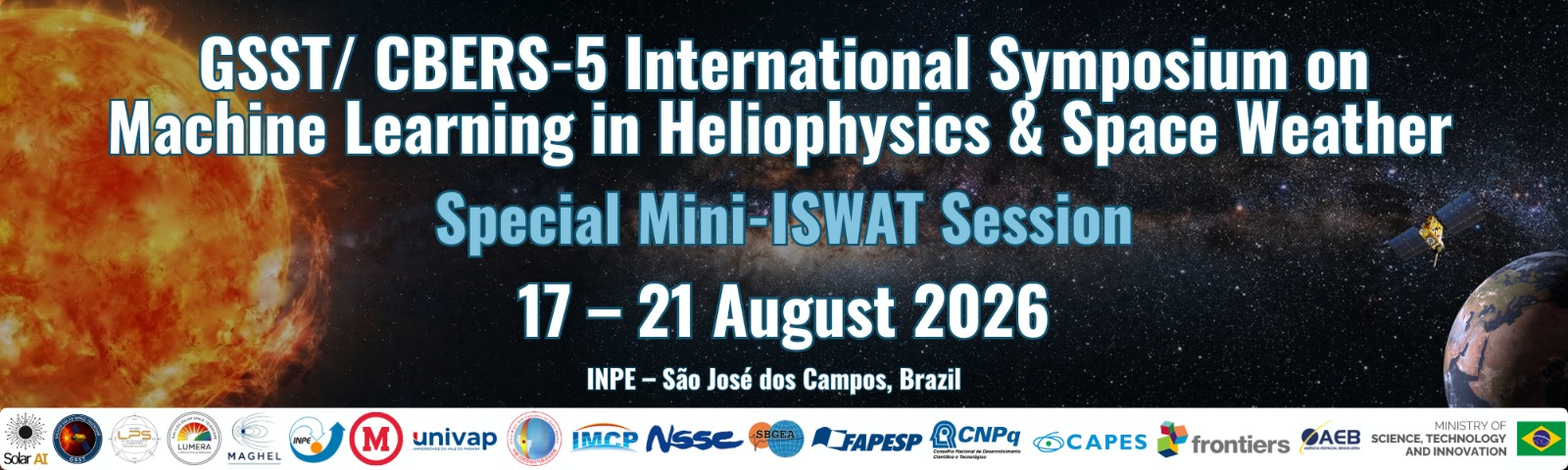
The scientific program is structured around two complementary track groups designed to foster dialogue between fundamental research, enabling technologies, and operational space weather services.
The Machine Learning & Artificial Intelligence track group constitutes the core of the meeting and brings together contributions spanning heliophysics, space weather, astrophysics, and Earth sciences. Sessions address the application of advanced AI and data-driven methodologies to large-scale observational datasets, predictive modeling, and physical system understanding. The program also highlights enabling technologies that support next-generation scientific capabilities, including advanced instrumentation, autonomous observing platforms, remote sensing systems, and high-performance computing and data assimilation frameworks.
Complementing the scientific sessions, the Space Weather Briefing track group hosts the Live Daily Space Weather Briefing, providing real-time assessments of solar and geospace conditions throughout the event. These operational sessions integrate observations, models, and forecasts to discuss ongoing activity and short-term outlooks, fostering interaction between research and operational communities while demonstrating current monitoring and forecasting capabilities.
Together, these track groups create an integrated program that connects methodological innovation, technological development, and operational application in support of advancing heliophysics and space weather science.
-
Machine Learning and AI
-
Heliophysics & Space Weather
HLPThis track focuses on fundamental and applied research addressing the coupled Sun–heliosphere–magnetosphere–ionosphere–thermosphere system and the physical processes that drive space weather variability. Contributions are invited on solar activity, solar wind dynamics, interplanetary transients, magnetospheric physics, aeronomy, radiation belts, geomagnetic disturbances, ionospheric irregularities, and upper atmospheric coupling. Observational studies, theoretical investigations, and physics-based modeling efforts are all welcome, including multi-instrument and multi-scale analyses aimed at advancing the understanding of solar–terrestrial interactions and their impacts on near-Earth space.
-
Space Weather Forecasting & Operations
SWOThis track addresses advances in space weather monitoring, prediction, and operational services. Topics include real-time data pipelines, forecasting methodologies, early warning systems, geomagnetic storm prediction, radiation environment nowcasting, ionospheric forecasting, and operational risk assessment for technological infrastructure. Contributions related to impacts on satellites, navigation systems, communications, aviation, power grids, and pipelines are encouraged, as well as decision-support tools, forecast validation, and user-driven service development bridging research and operations.
-
Machine Learning in Space, Earth & Atmospheric Sciences
MLSThis track welcomes applications of machine learning and artificial intelligence across heliophysics, astrophysics, Earth system sciences, and upper atmospheric physics. Relevant topics include event detection and classification, time-series prediction, surrogate modeling, physics-informed AI, anomaly detection, data mining, and uncertainty quantification. Contributions may address solar eruptions, geomagnetic activity, radiation belt dynamics, ionospheric and thermospheric variability, magnetosphere–ionosphere–thermosphere coupling, atmospheric waves and tides, space weather impacts, and climate datasets, as well as astrophysical surveys. Studies focusing on the dynamics of the upper atmosphere, including the ionosphere, thermosphere, and mesosphere, and their coupling to geospace processes are particularly encouraged. Emphasis is placed on scalable, interpretable, and operationally relevant ML approaches that advance scientific discovery and predictive capability across geospace and atmospheric domains.
-
Instrumentation & Observational Systems
IOSThis track focuses on the development, calibration, and deployment of advanced instrumentation for space and ground-based observations. Topics include magnetometers, particle and plasma detectors, radio and wave instruments, optical and UV imagers, spectrographs, and multi-sensor platforms. Contributions on instrument design, miniaturization, environmental testing, calibration methodologies, and mission integration are encouraged, as well as innovative measurement techniques enabling next-generation heliophysics and geospace observations.
-
Autonomous Platforms & Remote Sensing
APSThis track explores autonomous and distributed observing systems for space and Earth environments. Topics include CubeSats, nanosatellites, satellite constellations, robotic observatories, onboard autonomy, edge computing, and intelligent payload operations. Contributions are also invited on remote sensing platforms such as optical, photonic, LiDAR, and hyperspectral systems, including applications in heliophysics, geospace monitoring, and Earth observation. Emphasis is placed on mission concepts, technology demonstrators, and autonomous data acquisition strategies that expand observational capabilities.
-
HPC, Data Assimilation & Big Data Analytics
HPCThis track addresses the computational and data infrastructure enabling modern space and Earth science research. Topics include high-performance computing architectures, GPU and cloud computing, scalable simulation frameworks, digital twins, and physics-based numerical modeling. Contributions on data assimilation, data fusion, large-scale database management, predictive analytics, and real-time processing pipelines are encouraged. Work leveraging big data methodologies to improve forecasting accuracy, model validation, and system-level understanding is particularly welcome.
-
-
Space Weather Briefing
This track is dedicated to the live daily space weather briefings conducted throughout the event. The sessions will provide real-time assessments of solar, interplanetary, and geospace conditions, integrating multi-instrument observations and operational model outputs.
Briefings will cover recent solar activity (including flares, CMEs, and coronal holes), solar wind conditions, IMF variability, geomagnetic activity, radiation environment status, and ionospheric disturbances. Presenters will discuss ongoing events, current alerts, and short-term forecasts, highlighting potential impacts on technological systems such as satellites, GNSS, communications, aviation, and power infrastructure.
The sessions are designed to foster dialogue between researchers and operational centers, demonstrate forecasting workflows, and showcase monitoring capabilities, data products, and visualization tools. Emphasis will be placed on interpretation of observations, forecast confidence, and emerging risks over the coming hours to days.
-
Live Daily Space Weather Briefing
SWB
-