Getting to Rio de Janeiro
The main Rio de Janeiro airport is Tom Jobim International airport (GIG), also known as Galeão, which connects Rio de Janeiro to many international and domestic destinations. It is located about 20 km from the workshop venue.
The second and smaller airport is Santos Dumont airport (SDU), located near the city centre and 8 km from the workshop venue. It mostly serves domestic flights.
Both airports offer travel options by taxi and Uber, as well as more limited public transportation options. We recommend taking a registered taxi from the company stalls inside the terminal, or Uber.
Visa
Nationals of some countries may need a Brazilian entry visa. We can provide an invitation letter for a registered participant upon request. Before making travel arrangements please check with a Brazilian Consulate about all entry requirements. The Brazilian foreign office has practical visa information in this page, and you can find a list here (updated on 10 September 2025) of the visa requirements and exemptions by nationality.
Accommodation
Rio de Janeiro is one of the biggest and most crowded cities in South America. It can get very busy specially during festivals and holidays. Even though September is not considered high season, it is wise to plan your stay in advance. There are lots of options ranging from bed and Breakfast, hostels, apart hotels and conventional hotels. For more information visit the official webpage of Rio de Janeiro (click here).
The event does not provide an official hotel. However, we have compiled a list of recommended options located near CBPF:
Recommended hotels in the beach area Leme/Copacabana/Ipanema:
4 STARS
- Novotel Rio de Janeiro Leme
R. Gustavo Sampaio, 320 - Leme, Rio de Janeiro - RJ, 22010-010
Contact: +55 (21) 3545-5300
- Windsor Excelsior Hotel
Av. Atlântica, 1800 - Copacabana, Rio de Janeiro - RJ, 22021-001
Contact: +55 (21) 2195-580
3 STARS
- Augusto's Rio Copa Hotel
Av. Princesa Isabel, 370 - Copacabana, Rio de Janeiro - RJ, 22011-010
Contact: +55 (21) 2546-9500
- Hotel Rio Lancaster
Av. Atlântica, 1470 - Copacabana, Rio de Janeiro - RJ, 22021-000
Contact: +55 (21) 2169-8300
- Hotel Atlântico Praia
Av. Atlântica, 1456 - Copacabana, Rio de Janeiro - RJ, 22021-000
Contact: +55 (21) 2543-4123
- Hotel Vermont Ipanema
R. Visc. de Pirajá, 254 - Ipanema, Rio de Janeiro - RJ, 22410-000
Contact: +55 (21) 3202-5500
- Windsor Copa Hotel
Av. Nossa Sra. de Copacabana, 335 - Copacabana, Rio de Janeiro - RJ, 22020-002
Contact: +55 (21) 2195-5300
- Ipanema Inn
R. Maria Quitéria, 27 - Ipanema, Rio de Janeiro - RJ, 22410-040
Contact: +55 (21) 2529-1000
Recommended hotels in Botafogo/Flamengo:
4 STARS
- Novotel RJ Praia de Botafogo
Praia de Botafogo, 330 - Botafogo, Rio de Janeiro - RJ, 22250-040
Contact: +55 (21) 2187-9999
3 STARS
- Ibis Rio de Janeiro Botafogo
R. Paulino Fernandes, 39 - Loja A - Botafogo, Rio de Janeiro - RJ, 22270-050
Contact: +55 (21) 3515-2999
- Ibis Styles Rio de Janeiro Botafogo
R. São Clemente, 30 - Botafogo, Rio de Janeiro - RJ, 22260-000
Contact: +55 (21) 3166-9240
- Ibis Budget RJ Botafogo
Praça Joia Valansi, 24 - Botafogo, Rio de Janeiro - RJ, 22250-200
- Mengo Palace hotel - Flamengo
Rua Correia Dutra, 31 - Flamengo, Rio de Janeiro - RJ, 22210-050
- Petit Hotel Rio - Flamengo
Rua Artur Bernardes, 39 - Flamengo, Rio de Janeiro - RJ, 22220-070
Alternatively, If you prefer to stay at a walking distance from CBPF (15 min walk), you may find a range of apartments to rent in Urca, which is a quieter neighbourhood. The only hotel in this more residential part of town is by the Sugarloaf mountain:
- Hotelinho da Urca
R. Mal. Cantuária, 10 - Urca, Rio de Janeiro - RJ, 22291-060
Contact: +55 (21) 3449-886
The options listed here are by no means complete. Several online services such as Booking or Airbnb may help you to find accommodation in the area. There are apartments and hostels at a low price for the whole week. If you choose Airbnb, we recommend:
- Checking recent reviews carefully, especially regarding cleanliness, safety, and communication with the host
- Preferring listings with high ratings and multiple reviews
- Verifying the exact location and proximity to main streets or transport options
- Avoiding very isolated areas if you are not familiar with the city
If you need any further advice, don't hesitate to contact us at cosmicrhythmscbpf@gmail.com
Currency
The Brazilian currency is the REAL. Its sign is R$ and its ISO code is BRL. It is subdivided into 100 centavos (cents).
Getting around
The easiest, safest and rather inexpensive way of getting around is by taxi or Uber. Taxis are abundant (yellow cars), easy to flag down and have a standard meter rate. Uber tends to be cheaper and is also very abundant.
There is ample public transport in the South Zone, however it is harder to navigate without speaking Portuguese. There are a few metro lines (you can pay by contactless credit card at the entrance), but they don't connect directly to the workshop venue. There are also numerous bus lines (you can pay in cash to the driver) and a few tram lines. For further information and maps of public transport, see the Rio mobility page. If you want to use public transport, you can plan your journey with the Moovit app.
We don't recommend renting a car for moving around the city, as the traffic is heavy and chaotic, and finding a parking spot is difficult.
Tourist information
You can find tourist information on the Riotur webpage (available in English, Spanish and Portuguese), as well as the visit.rio webpage (available in English, Spanish, French, German, Chinese and Portuguese).
Get in touch if you have any questions.
Rio de Janeiro
The city of Rio de Janeiro is situated at 22°54’23” latitude south and 43°10121” longitude west, in the municipality of the same name; it is the capital of the State of Rio de Janeiro and part of the Southeastern Region of Brazil. The city’s physical features are products of the mountain range (Serra do Mar), covered by the Mata Atlântica forest. They are characterised by marked contrasts: mountains and sea, forests and beaches, stone walls rising abruptly from extended lowlands, all forming the landscape of rare beauty that has made Rio famous all over the world as the Wonderful City. The topographic diversity of Rio includes the vegetation. Forests cover hillsides and remaining species of the Atlantic Forest (Mata Atlântica) are preserved in the Tijuca National Park (Parque Nacional da Tijuca).
Climate
Rio de Janeiro is located on the Atlantic coast of Brazil and has a hot and humid, tropical climate. In September, the winter weather is rather sunny and less wet, with typical temperatures between 20°C and 27°C (still comfortable for going to the beach).
If you plan on walking around town or the beaches, we recommend using sunscreen. If you plan on hiking or visiting nature parks (there are several inside the city), we also recommend using a mosquito repellent.
Electrical outlets
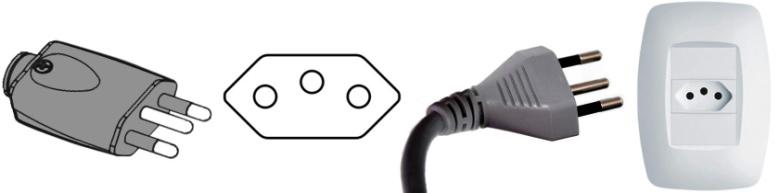
Electrical power in Rio de Janeiro is mainly 110V / 60 Hz AC. Some hotels may also provide other standards such as 220 V. The outlets use type N plugs (used in Brazil and South Africa), which have 3 pins arranged in a triangle.