Speaker
Description
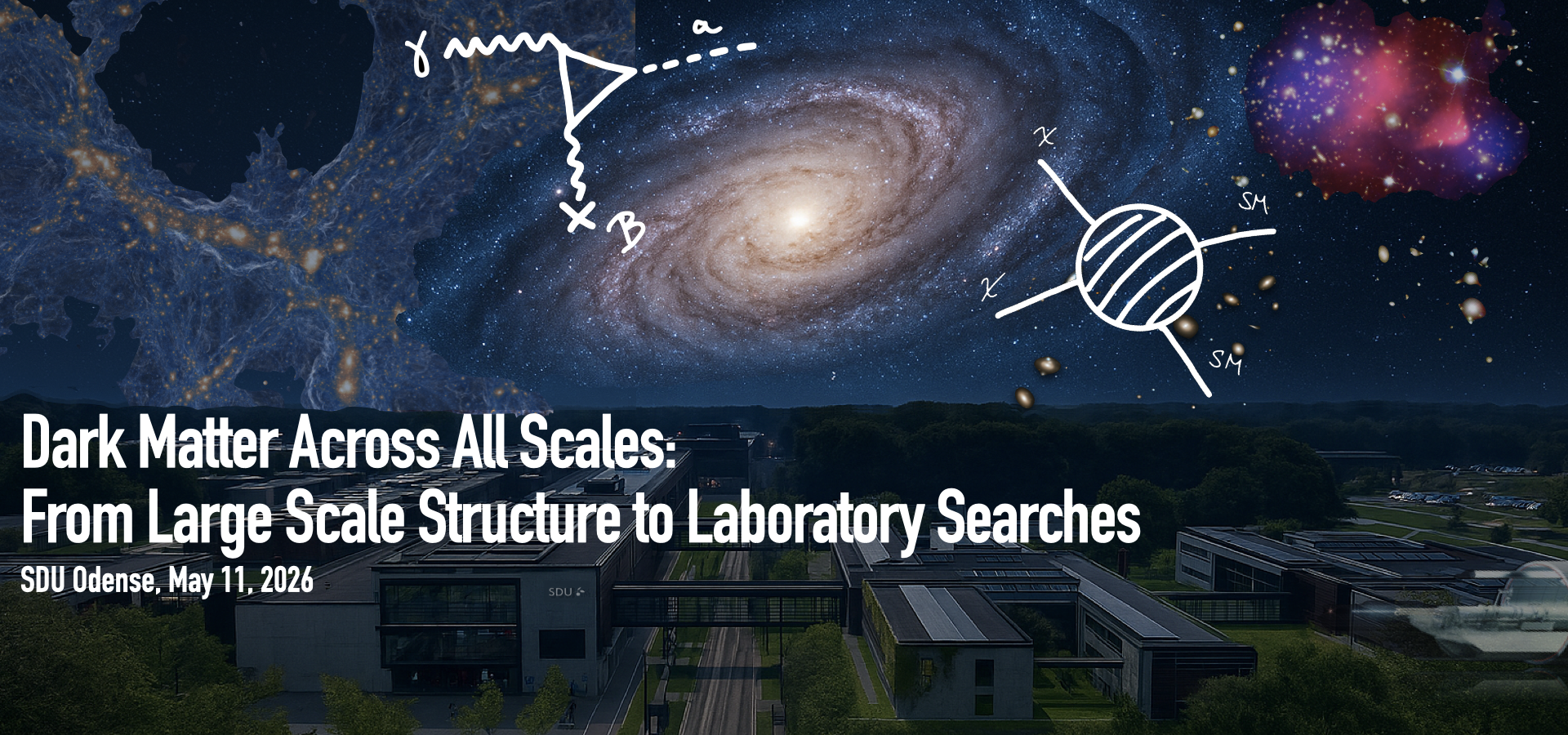
High- and very-high-energy gamma rays from distant extragalactic sources are severely attenuated due to interactions with the extragalactic background light (EBL). This effect could be partially alleviated by introducing Axion-like particles (ALPs), a beyond-Standard Model dark matter candidate that allows for photon-to-ALP oscillations in astrophysical magnetic fields. These oscillations would allow photons to convert into light ALPs in the intergalactic magnetic field and propagate freely towards our galaxy, where they can then reconvert back into detectable photons, producing characteristic high-energy spectral upturns for each source. The search for these upturns offers a way to constrain the allowed parameter space of ALP models while studying gamma-ray propagation over cosmological distances.
We analyze the intrinsic spectra of a large sample of extragalactic gamma-ray sources using observations from both the Fermi-LAT and H.E.S.S. instruments. A statistical search is performed for spectral upturns by introducing spectral break features in the intrinsic source models and comparing them to simulated ALP-induced signatures. This framework enables tests of the photon-ALP oscillation hypothesis and places further constraints on the relevant ALP parameter space and its impact on gamma-ray propagation over cosmological distances.