


SCAM ALERT: There are scammers contacting participants about 'conference booking', they are not legitimate. Please be careful. We are taking the participant list private to avoid more such emails.
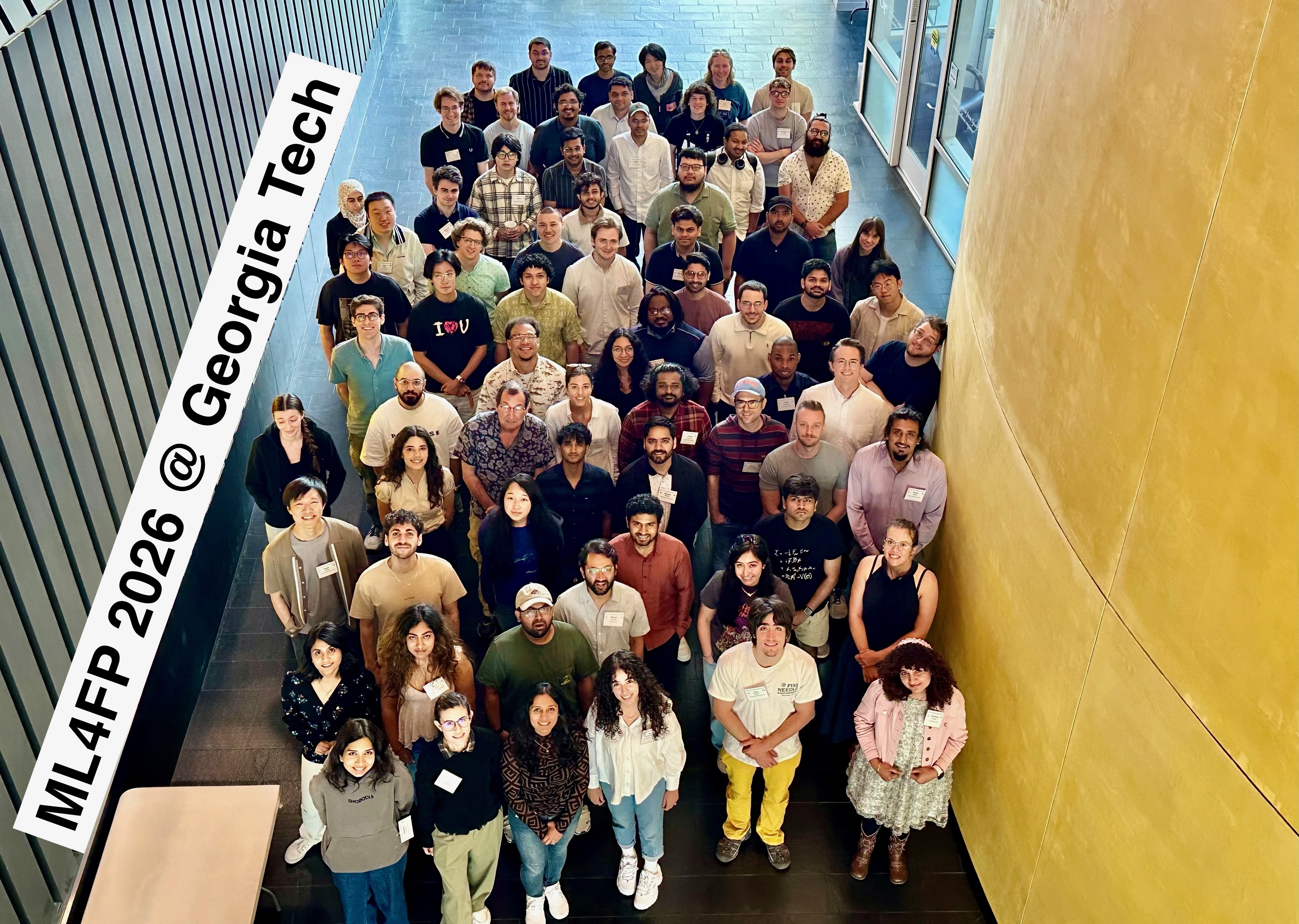
The Machine Learning for Fundamental Physics School (ML4FP) 2026 will be held at the Georgia Institute of Technology from June 1 to June 5, 2026. The event is organized with support from Oak Ridge National Laboratory (ORNL), the National Energy Research Scientific Computing Center (NERSC) and the School of Physics at Georgia Tech.
Spend a week in Atlanta learning a wide range of machine learning methods for solving problems in fundamental physics. The school places a strong emphasis on hands-on examples inspired by applications in experimental particle physics and nuclear physics.
Previous iterations of the school include ML4FP 2025, ML4FP 2024, the US ATLAS ML Training Program 2023, and the US ATLAS ML Training Program 2022.
The US ATLAS ATC program supports domestic travel and accommodation for US ATLAS early career researchers. Additional funding from the DOE / ORNL supports domestic travel for other early career researchers. These participants will be offered lodging in Georgia Tech students apartments located in Midtown Atlanta.
Application and registration details:
Application for the school can be made through this website (Registration tab on the left panel). Early career researchers requesting support for travel and accommodation will be required to ask their advisors to fill a very short form in support of their interest and availability to attend the school. There is no fee to apply for the school.
The payment details will be provided to selected applicants. The registration fee for in-person participation is USD 40. For remote participants who request GPU resources during ML4FP tutorial hours, the registration fee is USD 10. The selection process will take into account the relevance of a candidate's background, interests, and preparedness, and the balance of participants between experiments and research domains. Beyond that, the spots will be filled on a first-come, first-served basis.
Application deadline: April 3rd 2026
Update: Acceptances and payment information have now been sent out to selected applicants!
There are limited spots for in-person participation, so apply soon!
Program overview:
Tentative topics:
- Introduction to ML
- Introduction to standard open-source ML packages
- Overview of ML in particle physics
- Overview of network architectures
- Generative models
- Anomaly detection
- Neural simulation-based Inference
- Uncertainty quantification
- Differentiable programming
- Efficient deployment of neural networks
Career Panel:
Ben Brubaker: Science journalist at Quanta
Mariel Pettee: Academic faculty at UW Madison
Rachel Smith: AI Specialist at Xanadu
Jake Daughhetee: Scientist at Oak Ridge National Laboratory
Computing Resources:
Participants will be provided training accounts at NERSC and access to GPUs.
Networking:
Past schools have led to new research collaborations. This year's school will be another opportunity for young ML enthusiasts to connect with veteran ML experts in HEP.
Tutorial GitHub:
 https://github.com/ml4fp/2026-gatech
all the tutorial materials (except the experiment-specific sessions) will be publicly available here

Zoom Link: https://cern.zoom.us/j/67952636019?pwd=2kJrGrq0bWACxzIck6bVtDd65IaVDC.1
We use the same link for the main sessions every day. For the experiment-specific parallels see their respective timetable entries.

Join the slack workspace to discuss and ask questions about the tutorials, particularly for the remote participants.
Organizing team:
Aishik Ghosh (Georgia Tech) [Chair]
Yifan Chen (SLAC, Stanford) [Neutrino Liaison]
Elham E Khoda (UBC)
Dennis Noll (SLAC, Stanford) [ATLAS Liaison]
Melissa Quinnan (UCSD) [CMS Liaison]
Steering Committee:
Sascha Diefenbacher (Heidelberg)
Steven Farrell (NERSC/LBNL)
Aishik Ghosh (Georgia Tech)
Shih-Chieh Hsu (UW)
Elham E Khoda (UBC)
Benjamin Nachman (SLAC, Stanford)
Daniel Whiteson (UCI)
Our Partners: