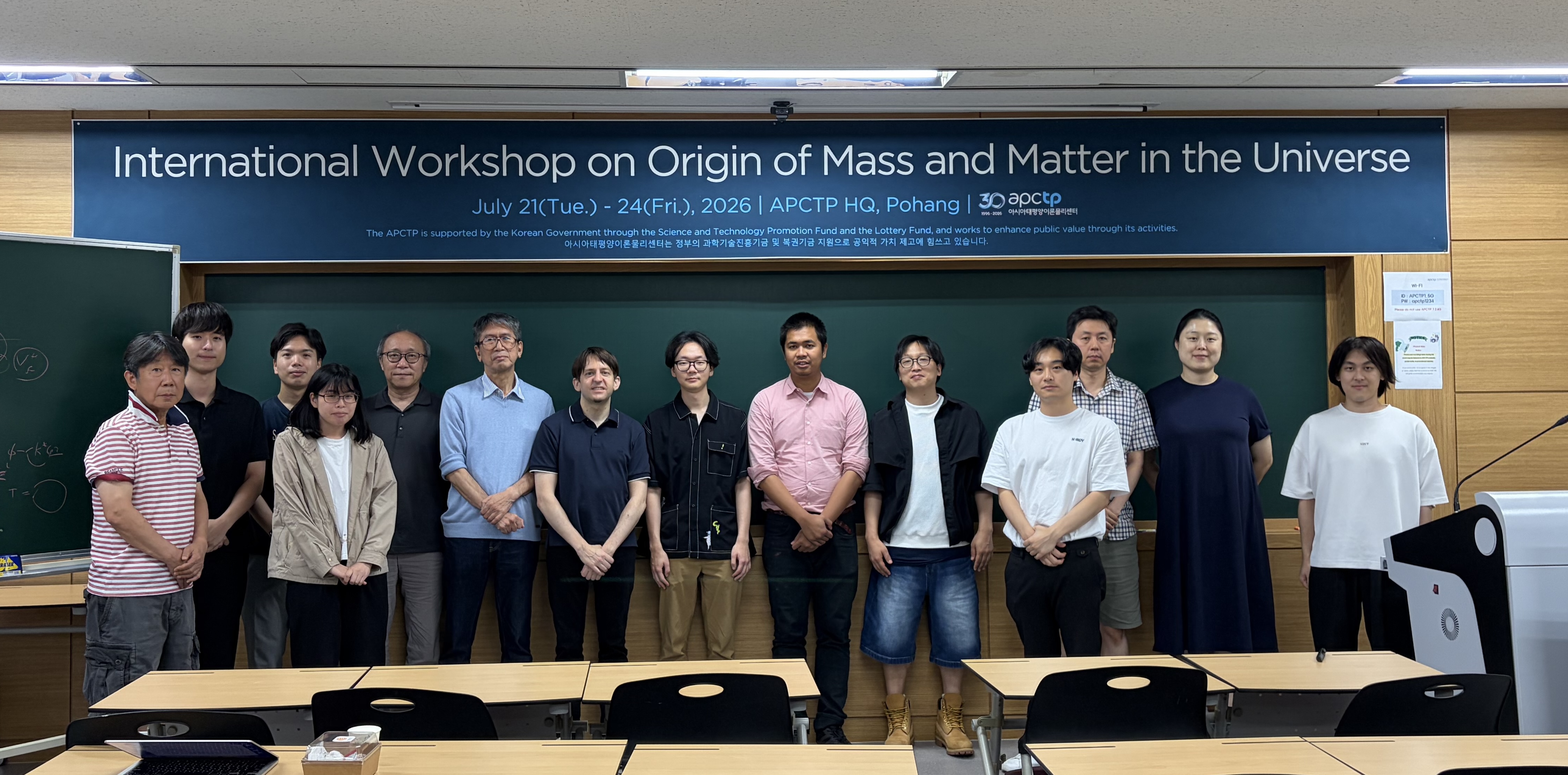
Quantum Chromodynamics (QCD) is the fundamental theory of the strong interaction, governing the dynamics of quarks and gluons and giving rise to hadrons and atomic nuclei. One of its most profound consequences is the dynamical generation of mass: more than 90% of the proton and neutron masses—and thus most of the visible mass in the Universe—originate from nonperturbative QCD dynamics associated with spontaneous chiral symmetry breaking. Understanding how these masses and hadronic structures emerge from QCD remains a central challenge in modern nuclear and particle physics.
While hadrons already exhibit rich and complex properties in free space, even more intriguing phenomena emerge under extreme conditions such as high density and/or temperature, encountered in nuclei, relativistic heavy-ion collisions, and the cores of compact stars. In such environments, QCD predicts a partial restoration of chiral symmetry, leading to significant modifications of hadron properties in medium. This workshop aims to explore both the fundamental structure of hadrons in free space and their behavior in nuclear and hot/dense matter, addressing key theoretical and experimental developments relevant to ongoing and planned programs at major international facilities, including JLab, RHIC, J-PARC, FAIR, CERN, and BESIII.
Preceding workshop: https://indico.global/event/18062/