
Speaker
Description
Quantum machine learning (QML) has the potential to revolutionise artificial intelligence, but its realisation is limited by the fragility of Noisy Intermediate Scale Quantum (NISQ) devices. Although quantum error correction (QEC) is expected to enable fault-tolerant QML, its substantial qubit overhead motivates the search for alternative strategies suitable for near-term hardware.
Previous research indicates that if we can eliminate errors from entangling gates, QML models are trainable, even if single-qubit rotation gates remain noisy (1). We build upon this work by investigating whether optimal quantum control can sufficiently protect entangling gates from noise and thereby preserve QML model trainability.
We design optimal pulse schedules for CNOT gates using GRadient Ascend Pulse Engineering (GRAPE; 2) and evaluate their performance in simulated superconducting qubit systems. We find that coherent noise, such as exchange-coupling errors, significantly reduces the fidelity of CNOT gates implemented using pulse schedules optimised for noiseless environments. However, when pulse schedules are optimised in the presence of coherent noise, the resulting gate fidelity is improved across most error values.
In preliminary simulations where these CNOT pulse schedules are integrated into simple Variational Quantum Classifiers (VQCs), we find that pulse schedules optimised in the presence of coherent noise enable better VQC training performance than those optimised in noiseless environments (Figure 1).
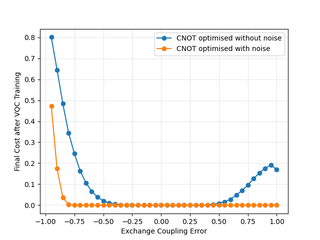
These findings suggest that optimal quantum control can mitigate coherent errors and improve VQC performance in noisy conditions without additional qubit overhead. Future work will involve deploying noise-aware pulse schedules on superconducting quantum hardware to experimentally evaluate the effectiveness of optimal quantum control as a strategy for improving QML performance on NISQ devices.
[1] Kang et al., 2026, Quantum Sci. Technol. 11 015021.
[2] Khaneja et al., 2025, J.Magn.Reson., 172(2):296–305.
| I am the presenting author | Yes |
|---|