Choose timezone
Your profile timezone:
The Australian Institute of Physics Congress 2026
26th Australian Institute of Physics Congress 2026 co-locating with the Australian and New Zealand Conference on Optics and Photonics
Monday, 7 December - Friday, 11 December 2026
Sydney
On behalf of the Australian Institute of Physics (AIP), it gives us great pleasure to invite you to participate in the 26th AIP Congress, to be held at the University of Sydney from 7-11 December, 2026. This year, we are delighted to co-locate with the Australian and New Zealand Conference on Optics and Photonics (ANZCOP), while also featuring the Conference on Optoelectronic and Microelectronic Materials and Devices (COMMAD) as a dedicated topical track.
The AIP Congress is a premier biennial forum that brings together the Australian physics community and attracts delegates from across the globe. The 2026 Congress, hosted by the University of Sydney, will feature invited plenary talks alongside a diverse program of parallel and focus sessions. Together, these will span the full breadth of academic and industrial physics, with up to 20 distinct streams.
This site is used to manage abstract submissions. For registrations and further information, please visit the Congress website.
Note: Please use the eduGAIN portal at https://indico.global/login/edugain/ if you are experiencing issues creating an Indico account.
Cosmic-ray muons are produced in the atmosphere, and their flux at ground level depends on atmospheric conditions such as temperature and pressure. This makes ground-level muon measurements a potential source of information about the state of the atmosphere, presenting a unique opportunity for improvements to weather forecasting.
Simulation work by collaborators William Luszczak and Joseph Chan at Ohio State University has shown that ground-level muon flux measurements can be used as an additional input to standard weather models, leading to reductions in forecast error over a large effective atmospheric volume. At the FM Lab in the School of Physics at the University of Sydney, we are constructing a low-cost, remotely operable muon detector based on plastic scintillators and silicon photomultipliers to collect data that can be incorporated into existing weather models.
Networks of such detectors could first be deployed across Sydney, then across Australia, and eventually anywhere in the world. They would provide a new atmospheric data stream, improving weather forecast accuracy, particularly in rural and remote regions where conventional atmospheric measurements are sparse.
This use of muon detectors would give particle physics the pleasure of directly improving everyday life.
Most ~1-10 GeV hadronic cosmic rays accelerated in star-forming galaxies will eventually escape the relatively dense ISM gas and leak into the circumgalactic medium (CGM). What happens to them thereafter and do they do anything important in this low density environment? I will show that these CRs are, in fact, important: using a new semi-analytic model we have developed over the last few years I will show that CRs, accumulated over the last few Gyr of star formation, contribute non-negligibly to the pressure (gradient) in the CGM of L* galaxies like the Milky Way. I will further demonstrate that the same CR population is important in maintaining the temperature of the CGM via streaming heating. Finally, I will show that the isotropic gamma-ray flux measured by Fermi receives a non-negligible contribution from hadronic emission of CRs in the CGM of all galaxies on our lightcone. IGRB measurements therefore constrain the parameters governing transport of ~1-10 GeV CRs in the CGM.
DarkSide-20k is a dark matter direct detection experiment operating a dual-phase liquid argon time projection chamber (TPC) at the Laboratori Nazionali del Gran Sasso (LNGS). To reach its design sensitivity, the experiment requires a cosmogenic background contribution of less than 0.01 events over a 200 ton-year exposure. This strict requirement needs precise characterization of prompt fast neutrons induced by high-energy atmospheric muons. Simulating this background is computationally challenging due to the thick rock overburden and the low probability of the photo-nuclear interactions required to generate penetrating neutrons.
In this work, we present a Monte Carlo simulation pipeline coupling the MUon inTensity codE (MUTE) with FLUKA. Using the high-resolution mountain topography of LNGS Hall C, MUTE calculates the surface-to-underground muon transport, preserving stochastic radiative energy losses. To interface these kinematics with FLUKA, we constructed a planar-weighted, joint 3D Cumulative Distribution Function (CDF) of the muon energy, zenith, and azimuthal angles. FLUKA samples this correlated phase space on-the-fly via a binary search algorithm. To improve computational efficiency, variance reduction techniques—including electromagnetic energy cutoffs and interaction length biasing—were applied in the rock overburden to accelerate fast neutron production while maintaining physical accuracy.
By simulating a live-time equivalent to several decades, we track the correlated energy depositions of cosmogenic events across the inner and outer veto systems. We evaluate the survival rate of isolated 1–2 MeV neutrons reaching the fiducial volume of TPC to estimate the prompt cosmogenic background budget for DarkSide-20k and assess the efficiency of the active veto strategy.
Photomultiplier Tubes (PMTs) are central to the SABRE South experiment’s
ability to detect rare, low-energy events, such as potential dark matter interac-
tions in ultra-pure NaI(Tl) crystals. To correctly interpret what the detector
sees, we need simulations that faithfully reproduce how our PMTs respond to
real signals. This work presents the comparison of the simulated PMT wave-
forms from our custom simulation framework with actual SABRE South PMT
data.
Key properties such as gain, dark rate, timing response, and afterpulsing are
studied in PMT tests to build a clear picture of how the PMTs behave under
real experimental conditions. Alongside this, we develop and refine simulated
PMT waveforms that aim to capture the key physical and electronic effects
shaping the signal. The measured values of the above mentioned properties of
the PMTs are implemented in the simulations and hence the simulated PMT
model is developed to mimic an actual PMT response. By comparing these
simulations directly with data, discrepancies are identified and used to refine
the simulation framework. This iterative process helps to improve the accuracy
of the detector response simulation, which is crucial for reliable event recon-
struction and background rejection.
The major output from this work will be a realistic PMT response simula-
tion framework tailored to SABRE South, built on detailed characterisation of
PMT performance from calibration and background runs. Our goal is to bridge
the gap between simulation and data, so we can confidently interpret the signals
SABRE South observes.
SABRE South is a rare-event physics experiment designed to test the long-standing annual modulation signal reported by the DAMA/LIBRA experiment. Both experiments use ultra-pure NaI(Tl) crystals operated in low-background detector environments. Unlike DAMA/LIBRA, SABRE South features an active liquid scintillator veto system surrounding the crystals, instrumented with photomultiplier tubes (PMTs). The veto system is designed not only to reject background events, but also to provide information on the particles responsible for them.
This contribution focuses on simulation and data analysis of the optical calibration of the SABRE South active veto PMTs. Reliable optical calibration of the veto PMTs is important for monitoring gain and timing stability, understanding the detector response, and supporting particle-identification studies. To support this, simulation and analysis tools are being developed to model, compare, and validate optical calibration procedures for the veto system. Geant4 simulations and Python/ROOT analysis tools will be used to model optical photon transport, PMT response, trigger-related effects, and the expected structure of recorded calibration data.
Measured calibration data will then be compared directly with simulated expectations, allowing the calibration procedure to be refined before application to the SABRE South system at the Stawell Underground Physics Laboratory. The expected outcome is a robust optical calibration and monitoring framework to support SABRE South commissioning, improve long-term detector stability, and reduce instrumental uncertainties relevant to the dark matter annual modulation search.
Optical fibres are attractive sensing platforms for harsh environments, but their ultimate operating temperature is set by the stability of both the glass and the laser-written structure. Femtosecond laser direct writing offers a unique route to locally engineer the refractive index and microstructure of optical glasses and fibres, enabling compact photonic devices and fibre sensors for harsh environments. Among the laser-induced modifications, porous nanogratings (Type II) are particularly attractive because of their strong birefringence and remarkable thermal stability, and can be exploited in femtosecond-written fibre Bragg gratings for sensing at elevated temperatures (typ.>800°C).
This talk will examine how far such laser-written functions can be pushed toward extreme-temperature operation. Building on a comparative study of more than 30 optical glasses and fibres, we will discuss the respective roles of laser parameters, nanostructure morphology and, especially, glass composition. For conventional Type II structures, thermal erasure is largely governed by the temperature-dependent viscosity of the host glass and can be rationalized through the evolution of laser-induced nanopores. However, several refractory compositions depart strongly from this simple picture.
In particular, Al-rich aluminosilicate glasses can retain a useful refractive-index contrast above 1400 °C, associated with laser-induced phase separation, nanocrystallization and chemical migration. More recent results extend this materials approach to non-conventional oxycarbide glasses. SiOC already exceeds high-purity silica in thermal stability while preserving a Type-II-like optical response, whereas SiAlOC shows strong birefringence and enhanced resistance to thermal erasure, opening questions about the nature and stabilization of the laser-written nanophase.
These results illustrate how combining femtosecond laser processing with composition-engineered, fibre-compatible glasses may provide a route beyond the intrinsic thermal limits of conventional silica for high-temperature photonic sensing.
Deterministic control of light propagation through complex scattering media has enabled applications including optical communications, metrology, nonlinear optics, and, most notably, multimode fibre microscopy and imaging. Central to these applications is the generation of high-fidelity optical fields at the distal facet of the fibre using wavefront shaping elements such as liquid crystal spatial light modulators (SLMs). SLMs have recently gained renewed interest owing to their higher-diffraction efficiency compared to digital micromirror devices.
In this work, we introduce and develop a CGH algorithm for sampled operators based on gradient descent optimisation using Wirtinger calculus. We present a systematic comparison of our algorithm with heuristic error-reduction methods such as the Yang-Gu algorithm. Using experimentally measured transmission matrices, we evaluate each approach’s ability to generate arbitrary complex optical fields through multimode fibres and compare their convergence and reconstruction fidelity.
We show that appropriate hologram optimisation improves projected-field fidelity by more than 10%, corresponding to an approximately 50% reduction in normalised mean-squared error relative to conventional phase conjugation. Analysis of TM eigenmodes provides new insight into the fundamental limits of field projection through fibre systems, while simulations show excellent agreement with experiment across all algorithms. We further demonstrate the equivalence of the Yang–Gu algorithm and gradient descent for TM-based complex field generation. These results establish optimisation-based CGH as an effective framework for high-fidelity wavefront shaping through multimode fibres, enabling advanced imaging modalities including stimulated emission depletion, and light-sheet microscopy, while also supporting arbitrary beam synthesis, such as natural images, for holographic display and projection systems.
Inertial fusion energy (IFE) seeks to generate power through the repeated thermonuclear burn of small deuterium–tritium (DT) targets compressed and heated by intense, pulsed drivers. In laser-driven IFE, nanosecond pulses delivering megajoule-scale energy must ultimately operate at several shots per second with high wall-plug efficiency, precise pulse shaping, broad spectral bandwidth, excellent irradiation uniformity, and sufficient durability for power plant operation. Laser technologies proposed for IFE include frequency-converted diode-pumped solid-state lasers and various excimer lasers.
Although inertial confinement fusion energy breakeven has been experimentally demonstrated using an indirect-drive approach, this architecture is unlikely to provide a practical route to commercially viable IFE. Its inherently low laser-to-fuel coupling efficiency, combined with the extreme complexity of manufacturing precision hohlraum target assemblies, creates barriers that are difficult to reconcile with economic power production. Direct drive presents its own challenges, including stability, symmetry, and target-fabrication issues that require resolution. However, these appear to be engineering and physics problems to mitigate, rather than intrinsically prohibitive limitations.
In this report, we focus on the direct-drive implosions of relatively large DT targets that would allow one to increase the fuel burn fraction, ultimately reducing the target production costs per output energy unit. Optimised laser pulse shapes and target designs are presented depending on the available laser pulse energy. Optimisation has been done using radiation-hydrodynamics simulations.
Further reduction of a target cost could be achieved by using advanced fusion fuels that do not require low-temperature cryogenics and rely on a lower amount of expensive tritium. Ignition of such targets is shown to be challenging but possible with further development of the laser technologies. Technical and economical laser requirements for efficient and commercially reliable burning of pure DT and advanced fuels are discussed.
This research is funded by the ARC Linkage Grant No LP220100061.
Spectroscopy of gasses is a key detection technique for identifying both the type and concentration of gas. Gas absorption lines are typically on the order of ~1 GHz (8 pm) wide, and so detecting these reliably requires precision optical instrumentation. Recent progress in hollow-core optical fibers (HCFs), which present the lowest-loss waveguides for light propagation at attenuations below 0.1 dB/km, has brought gas absorption features into optical communications research. Here, a ~GHz wide gas absorption feature can have an outsized impact on optical signals, since it is not resolved by common digital signal processing techniques. To fully exploit these ultralow-loss fibers for ultrahigh-capacity transmission, new digital signal processing techniques are required to resolve and counter gas absorption features, while also providing information on their wavelength locations and shapes.
We investigate performance degradation due to gas absorption with a) single-carrier modulation, where each message occupies the full signal bandwidth, and b) multi-carrier modulation, where the signal bandwidth is divided into multiple subcarriers carrying independent messages. Current optical fiber communication systems typically favour single-carrier modulation because of its simpler implementation and stronger tolerance to fiber non-linearities. For HCF transmission, multi-carrier systems may offer an advantage as fiber non-linearities are minimized and the impact of gas absorption can be contained to subcarriers around the absorption frequency.
To experimentally validate this advantage, we emulate HCF with conventional optical fibers and gas cells. We show a performance gap between single-carrier and multi-carrier systems at different absorption depths. Moreover, we can infer the location, depth, and width of the dips during the digital processing of signals even if the transmitter has no knowledge of the absorption dips. This shows that new tools developed for optical communications systems may also provide a mass-producible technique for tomography of gas lines, enabling a new generation of environmental monitoring systems.
In contrast to conventional semiconductors, two-dimensional transition metal dichalcogenide (TMD) monolayers allow both permanent as well as tunable control of their band structure. For instance, alloying or inducing strain during growth [1,2] can permanently alter their direct, energy-degenerate band gaps at the ±K valleys of the Brillouin zone. While this approach leads to substantial shifts of several 100 meV, it lacks the possibility for active control.
Therefore, dynamic, all-optical methods have recently gained attention due to their ability to induce changes to the band structure on ultrafast timescales. This approach involves perturbing the TMD system with an oscillating driving field to create a modified nonequilibrium state.
Here, we demonstrate the influence of ultrafast coherent effects, in particular the intensity-dependent optical Stark (OS) and Bloch-Siegert (BS) shifts, on the band structure of a tungsten diselenide (WSe$_{\mathrm{2}}$) monolayer. In particular, we identify two regimes in which OS and BS shifts induce either a symmetric or an asymmetric modulation of the ±K valleys depending on the pump polarization. A circularly polarized pump leads to an asymmetric bandgap opening in ±K, breaking time-reversal symmetry (TRS). We probe this valley imbalance by polarization-resolved second-harmonic (SH) measurements as the altered symmetry also influences the nonlinear susceptibility tensor by changing the effective point group from D$_{\mathrm{3h}}$ to C$_{\mathrm{3h}}$ [3]. In contrast, a linearly polarized pump field leads to a symmetric shift in ±K, preserving TRS and tensor structure but inducing a blue-shift of the excitonic resonance. We observe this as modulated SH signal depending on the pump detuning and intensity [4]. Our experimental data are fully explained by an analytical model based on the semiconductor-Bloch equations, which allows us to estimate transition dipole moment, dephasing time, and the induced bandgap modulation.
$\small{\mathrm{[1]~S.~Susarla~\textit{et}~\textit{al.},\mathrm{~Adv.~Mater.}~\textbf{29},~\mathrm{35},~\mathrm{1702457} ~(2017).}}$
$\small{\mathrm{[2]~M.~Zeng~\textit{et}~\textit{al.},\mathrm{~Nat.~Mater.}~\textbf{19},~\mathrm{528\text{-}533} ~(2020).}}$
$\small{\mathrm{[3]~P.~Herrmann~\textit{et}~\textit{al.},\mathrm{~Nat.~Photon.}~\textbf{19},~\mathrm{300\text{-}306} ~(2025).}}$
$\small{\mathrm{[4]~S.~Klimmer~\textit{et}~\textit{al.},\mathrm{~Adv.~Opt.~Mater.}~\textbf{14},~\mathrm{5},~\mathrm{e03236} ~(2026).}}$
Portable optical-frequency atomic clocks have reached a maturity level that allows them to be used outside of a laboratory setting. Specifically, portable optical clocks have been demonstrated in sea trials [1], in urban deployments [2], and clock sub-systems have even been operated on-orbit [3]. Portable optical clocks will be integral in advancing fundamental physics including tests of General Relativity; conducting novel geoscience using chronometric geodesy; enhancing national security through secure remote synchronization; and likely form the backbone of next-generation global navigation satellite systems [4].
However, many of the above-mentioned applications require timescale comparison with a precision better than the stability of the clocks. Where this involves moving optical clocks, this can only be achieved using Doppler-compensated free-space optical frequency transfer [6].
Here we report work from June 2026, on the timescale comparison between two clocks on a helicopter; and over a point-to-point, free-space link between a stationary clock and one carried on a moving platform. The two portable optical clocks used for this work are capable of achieving stabilities of 1.5×10⁻¹⁴ per √τ, reaching 3×10⁻¹⁵ at 100s of integration [1]. This is accomplished in a 25kg, 3U package, with 100W power draw. The optical-frequency transfer system (1U package) has a stability of 4×10⁻¹⁸ at 1s and 4×10⁻¹⁸ at 100s, as demonstrated over a 2.4km free-space link [7]. The active optical terminals used in this work have a mass of 4.7kg, a 10.9L volume, and a 43W power draw. All systems are portable and field-deployable in additional novel scenarios.
[1] Hilton, Nat.Commun. 15, 6063 (2025)
[2] Takamoto, Nat.Photonics 14, 411 (2020)
[3] Xia, Rev.Sci.Instrum. 96, 093201 (2025)
[4] Dix-Matthews, Nat.Commun. 12, 515 (2021)
[5] Dix-Matthews, Nat.Commun. 12, 515 (2021)
[6] McSorley, Phys.Rev.Appl. 23, L021003 (2025)
[7] Gozzard, Phys.Rev.Lett. 128, 020801 (2022)
Superconducting circuits are a leading platform for quantum computing due to their strong coupling to microwave photons, highly customizable design, and long coherence times. The fluxonium qubit in particular has recently shown promise, demonstrating millisecond coherence and high anharmonicity, leading to impressive single and two-qubit control fidelity. However, further improvement in qubit performance is still necessary to achieve quantum utility. Most superconducting qubits are limited by dielectric loss, energy relaxation due to microscopic two level systems (TLS) that lie within the qubit material interfaces. Fluxonium are not an exception, although due to its lower frequency operation and inclusion of a shunting superinductance, the distribution of sources of dielectric loss within different parts of the circuit has been poorly understood.
In this work, we study the geometric scaling of fluxonium qubit coherence by systematically varying the surface participation ratio across multiple qubits with the same Hamiltonian parameters, in order to isolate the loss contribution of the capacitor pads from the rest of the circuit. This offers a direct path toward material engineering and understanding defect dynamics for solid-state quantum platforms.
Qudit systems are promising for quantum information processing by harnessing a larger Hilbert space. In atomic systems, qudits can naturally be encoded in the Zeeman sublevels of hyperfine manifolds. However, universal control of such hyperfine qudits is challenging due to spectral crowding of transitions within the Zeeman manifold. A potential solution uses quantum optimal control of RF-driven SU(2) rotations with engineered nonlinearities [1]. However, this approach becomes challenging for small Zeeman splittings and for single-ion addressing. Laser-based schemes are a promising alternative to overcome such challenges [2,3], but have yet to encorporate optimal control which could improve experimental complexity and gate fidelity.
Here, we investigate SU(d) optimal control of laser-driven Zeeman qudits. We consider a two-photon stimulated Raman transition with numerically optimised phase-modulations which gives universal control despite spectrally unresolved qudit transitions. As a concrete example, we apply our control scheme to a d = 15 qudit encoded in the F = 7 hyperfine manifold of a trapped Lutetium ion, and illustrate arbitrary qudit state preparation with fidelities exceeding 0.99 under realistic experimental parameters. Our protocol is broadly applicable to other atomic systems.
[1] Omanakuttan, Sivaprasad, Anupam Mitra, Michael J. Martin, and Ivan H. Deutsch. 2021. “Quantum Optimal Control of Ten-Level Nuclear Spin Qudits in Sr 87.” Physical Review A 104(6): L060401. doi:10.1103/PhysRevA.104.L060401.
[2] Ahmed, H. 2025. “Coherent Control Over the High-Dimensional Space of the Nuclear Spin of Alkaline-Earth Atoms.” PRX Quantum 6(2). doi:10.1103/PRXQuantum.6.020352.
[3] Gregory, Gabriel J., Evan R. Ritchie, Alex Quinn, Sean Brudney, David J. Wineland, David T. C. Allcock, and Jameson O’Reilly. 2026. “Four- and Six-Photon Stimulated Raman Transitions for Coherent Qubit and Qudit Operations.” doi:10.48550/arXiv.2602.18567.
Photon addition and subtraction are essential non-Gaussian processes in quantum optics, where conventional methods rely on the use of linear optics and number-resolving detection often suffer from low success probability. Here, we introduce the concept of dynamic stimulated emission, whereby a quantum emitter undergoes stimulated emission with a time-dependent coupling. We show that, for both two- and three-level emitters, the scattering dynamics mimic that of a single-mode Jaynes-Cummings interaction. This Jaynes-Cummings-like process can be used to deterministically add or subtract a photon while preserving a single propagating optical mode, a feature that is highly attractive for photonic quantum information processing. We provide semi-analytic solutions to this problem for Fock states, enabling deterministic and unconditional single-photon subtraction and addition with fidelity F > 0.996. Our semi-analytic solutions are provided for both dynamically coupled two-level systems and for three-level systems whose dynamical coupling is controlled by a coherent laser drive.
Moving beyond individual Fock states, we further showcase the ability to subtract and add single photons to photon-number superposition states. We show that Schr\"odinger cat states can be prepared from squeezed vacuum input via cascaded subtraction or cascaded addition. Finally, we show that our photon-addition process can be used to add a photon to any squeezed and displaced state with high success probability and fidelity F > 0.99, thereby potentially converting quantum emitters from single-photon sources to sources of single-photon-added Gaussian states without the need for inline squeezing. Our protocols provide a path towards integrating quantum emitters to construct efficient sources of single-mode non-Gaussian light beyond single photons. Arxiv reference for the paper: arXiv:2512.09711
Quantum factoring is one of the most promising applications of quantum computing with practical real-world implications. Since its discovery by Peter Shor, researchers have reduced the memory requirements and optimised the gate counts of arithmetic subroutines for its implementation. Several notable advancements over the past year have brought the the memory cost of factoring a 2048 bit RSA integer below a million physical qubits. These resource estimates have since been used to predict the future risk quantum computers pose to classical cryptosystems.
While these quantum resource estimates are end-to-end, they still contain approximations and assumptions pertaining to the compatibility of algorithmic implementations and hardware capabilities. In this work, we bridge the gap between theory and practice by building an end-to-end fully-executable software package for quantum factoring. We demonstrate the power and flexibility of our design by explicitly implementing the complete Gidney-Ekerå’s 2019 algorithm decomposing down to basic gate sets. As a result, we can quantify the difference in resource costs to validate assumptions made in the original paper.
A key step used in previous resource estimates of Shor's algorithm in the literature has been a hand crafted fault-tolerant estimation, including register layout, T-state factory choices as well as bounding the cost of data packing and routing in the device. We move to a completely automated system using the Rottnest quantum compiler and cost the full execution on a fault-tolerant monolithic surface code architecture. This execution explicitly tracks every operation that must be performed including routing overheads, idling of unused memory, T-state generation and buffering. Our work assists both algorithm developers and hardware designers to diagnose bottlenecks and improve upon implementations of quantum algorithms.
Conventional computing architectures rely on deterministic bits, ensuring consistent and repeatable operations. This paradigm can however be inefficient when modelling systems in which randomness plays a fundamental role. In contrast, probabilistic bits (P-bits), which fluctuate between binary states according to a controllable probability distribution, provide an attractive alternative for probabilistic computing and stochastic algorithms.
Here, we experimentally demonstrate a novel platform for all-optical P-bit generation based on polarization symmetry breaking in an externally driven passive Kerr resonator. Information is encoded in the polarization state of ultrashort pulses circulating in an optical fibre ring. The resonator is operated in a symmetry-protected regime where a roundtrip-to-roundtrip polarization flip cancels system asymmetries, producing a natively unbiased probability distribution. This distribution can then be very finely and reproducibly biased by injecting a weak phase-modulated optical field that is orthogonally polarized to the driving.
In our experiments, the resonator simultaneously holds 124 optical pulses, each representing an independent P-bit. Once the bias is established, the ensemble is sampled from a binomial distribution with a desired success likelihood every time the driving laser frequency is swept across resonance, enabling the generation of arbitrarily long P-bit sequences. Measurements show that the probability of obtaining a binary value of 1 follows an ideal sigmoidal dependence on the applied phase modulation amplitude, demonstrating that the circulating optical pulses can function as all-optical stochastic binary neurons. We further demonstrate experimental control over the sigmoid response through the bias optical power, down to fewer than three photons per bias pulse. This sensitivity, enabled by the symmetry protection, provides precise tuning of the generated P-bit distribution.
These experimental results establish a scalable photonic probabilistic computing platform based entirely on standard telecommunications components, offering compatibility with existing optical technologies while enabling straightforward scaling through higher repetition rates or longer resonators.
The non-Hermitian skin effect is one of the most remarkable topological features of non-conservative physics. It causes a macroscopic accumulation of states at the boundaries of a confined system, opening new ways for controlling waves in photonic, mechanical, and other non-Hermitian systems. This effect has recently been observed in nonlinear bosonic experiments with Bose-Einstein condensates of exciton polaritons [1] and ultracold quantum gases [2]. The underlying physics is captured by a mean-field Hamiltonian with a trapping potential and an imaginary gauge field. While prior work has examined the effect of the imaginary gauge field term on the condensate itself, the collective excitations on top of the condensate remained unexplored. Here, we develop a new theory for the Bogoliubov excitations in a non-Hermitian framework and systematically study their spectrum across different interaction regimes. By analysing the position expectation values, we find that while the repulsive interactions counter the localisation of the condensate due to the skin effect, the excitations remain strongly affected by the imaginary gauge field. As a consequence, in the presence of harmonic confinement, we predict a strong shift in the dipole oscillation frequency, which can be observed in experiments. This is in contrast to Hermitian systems, where this frequency is fixed by the trap frequency.
[1] Yow-Ming (Robin) Hu, M. Kròl, D. A. Smirnova, L. A. Smirnov, B. R. Fabricante, K. Winkler, M. Kamp, C. Schneider, S. Höfling, T. C. H. Liew, A. G. Truscott, E. A. Ostrovskaya, and E. Estrecho, arXiv preprint arXiv:2512.10146 (2025).
[2] J. Tao, E. D. Mercado-Gutierrez, M. Zhao, and I. B. Spielman, Phys. Rev. Lett. 136, 113401 (2026).
Non-Hermitian and topological photonics have jointly sparked recent interest in the manifestation of spectral degeneracies and polarisation defects for radiation control. Here we study several types of non-Hermitian metaphotonic structures that support both topological singularities in polarisation fields, such as C-points (points of purely circular polarisation), and spectral singularities, such as exceptional points (branch points of the complex-valued spectrum), together with Fermi arcs connecting pairs of exceptional points. One example of such open photonic systems is a membrane metasurface with broken vertical symmetry (e.g. due to tilted slits or holes). We put forward a minimal two-band coupled-mode generalised model and demonstrate theoretically how polarisation and spectral singularities in non-Hermitian photonic systems are intrinsically intertwined. Starting from a perturbative expansion around exceptional points, we develop an effective theoretical framework that captures both the evolution of the eigenvalue splitting and the associated far-field polarisation structures. We show that the polarisation field develops nontrivial C-point textures whose trajectories can be traced in parameter space.
Using a feasible membrane metasurface design with conical holes, we further elucidate the formation of unidirectional guided-mode resonances with full radiation suppression towards one out-of-plane direction, which arises from the merging of C-points in the vicinity of a Fermi arc. Our theoretical description is supported by detailed numerical simulations, and it provides a unified picture of topological singularities with a hierarchy of perturbation scales in which exceptional points, Fermi arcs, and C-points emerge as distinct topological facets of a single underlying non-Hermitian photonic framework. We will also discuss its applications to generating highly directional, rainbow-free, vectorially polarised radiation at selected output angles.
Nonlinear mappings lie at the core of modern machine learning models, underpinning their success in highly complex tasks. In optical neural networks (ONNs), nonlinearities are traditionally generated through higher-order light–matter interactions, commonly by encoding information in the electric field and measuring the response of specific optical materials. However, nonlinear encoding can also be achieved through the recurrent linear modulation of a probe beam using a spatial light modulator (SLM), relying solely on the geometry of the optical setup.
This form of nonlinearity, referred to as structural nonlinearity, has previously been explored in the training of ONNs for image-based tasks using an integrating sphere and a digital micromirror device (DMD). Nevertheless, such systems are highly sensitive to environmental conditions, which limits their scalability. In addition, precisely engineering a desired nonlinear transformation in these platforms remains a practical challenge.
In this work, we propose a controllable optical arrangement capable of simultaneously generating linear and nonlinear optical mappings via structural nonlinearity to address the challenge of training physical machine learning models. We demonstrate the advantage of this nonlinear encoding by training optical reservoir models for chaotic time series forecasting, significantly enhancing model performance in both short- and long-term predictions. This method contributes toward simple-to-implement optical nonlinear functions, advancing the development of physical optical neural networks.
Probabilistic computing aims to leverage randomness to solve difficult computational problems more efficiently than conventional methods. Photonic systems are particularly attractive owing to their ultrafast speeds, inherent parallelism, and access to quantum-limited noise sources. Existing photonic approaches have demonstrated applications ranging from random-number generation to Ising machine optimization, highlighting the versatility of nonlinear optical systems for probabilistic information processing.
Here we present a versatile platform for photonic computing based on polarization symmetry breaking in a nonlinear Kerr resonator. We drive our optical resonator with a 10GHz repetition rate pulsed laser source, allowing many picosecond duration pulses to recirculate at each roundtrip. With a slight change of driving frequency, each intracavity pulse undergoes polarization symmetry breaking, leading to an unbiased, random selection of one of two possible states. By encoding spin states in polarization with intensity-based readout, our platform eliminates the complex phase stabilization required by many existing implementations.
With no applied feedback, the system acts as an all-optical random-number generator seeded by vacuum fluctuations. By introducing a controllable bias, the same platform can also realize probabilistic bits (p-bits) with tuneable output statistics. We then show how an FPGA-based measurement-feedback system enables programmable spin Hamiltonians, allowing networks of p-bits to implement an optical Ising machine for combinatorial optimization. We will also discuss how the platform may naturally extend to higher dimensional systems, enabling vector spin solvers based on XY and Heisenberg spin systems.
Coronal Mass Ejections are predicted to play an important role in planetary atmospheric erosion, especially for planets that are close to their host star. However, this conclusion remains controversial because, despite decades of searches, there has not been an unambiguous detection of a CME from a star beyond our Sun. A clear signature of a CME is a type II radio burst, which is emitted from the shock wave produced as the CME travels through the stellar corona into interplanetary space.
In this talk, I will present the first detection of a stellar Type II radio burst, originating from the early M dwarf StKM 1-1262 (Callingham et al., Nature, 2025). I will show how the burst constrains the CME shock properties and the coronal environment of a low-mass star, and discuss the implications for space weather and atmospheric loss for a hypothetical planet in the star’s habitable zone. I will conclude with new radio-burst discoveries from our ongoing wide-field survey of the northern sky, opening a path toward population-level constraints on stellar CMEs.
Stars like the Sun exhibit winds that are driven by thermal pressure, though the mechanism that provides the thermal energy remains unresolved. The energisation process is inherently dynamic, and leaves its fingerprints in fluctuations in the wind. At the Sun, the release of hot, dense plasma from closed magnetic field regions has been proposed as an explanation for compositions in certain solar wind streams, and a source of energy to explain observed temperatures in the open field. In this talk I will present some results of theoretical and computational modelling of this process, its contribution to energising the corona, and opportunities for testing the models against observations.
Time domain radio astronomy will be revolutionised by the Square Kilometre Array. The capability to image the sky repeatedly, over many frequencies and timescales, will allow us to explore and understand dynamic phenomena in a way that has not been previously possible. These phenomena range from events at cosmological distances, such as gamma-ray bursts and fast radio bursts, to much more local events, such as massive flares from stars in our Galactic neighbourhood. In each case, rapidly varying emission gives us insights into physics of extreme environments.
In the past decade, there have been great strides forward as we prepare for the SKA. We have seen the field of radio transients evolve from targeted observations of individual objects; to archival searches; to dedicated surveys on SKA pathfinder and precursor instruments. We have already seen new discoveries, such as the emerging class of long-period transients (highly variable, highly polarized objects that vary on timescales of seconds to hours).
In this talk I will review the history of radio transient surveys, and the evolution of the field to the current time. I will discuss the physical mechanisms that drive radio variability, and what we have learned from the major surveys that have been conducted on SKA pathfinder instruments. In particular I will share some of the highlights from the ASKAP Variables and Slow Transients Survey. I will also identify some of the lessons learned from these surveys (both scientific and technical), and some of the challenges we face in scaling up our current approaches for the Square Kilometre Array.
My talk is based on our recently published paper: “The Dawes Review 13: A New Look at The Dynamic Radio Sky”.
I will present the discovery and characterisation of a novel, gravitationally-accreting white dwarf binary system, identified through optical spectroscopy and radio-wavelength observations. This system displays a short orbital period of ~1.3 hours, determined from Doppler shifts in Balmer emission lines, and exhibits unique radio emission characteristics.
We observed periodic bursts of elliptically polarised radio emission - displaying frequency drift and intermittency - aligned with the orbital period. As well as coincident UV emission and orbitally modulated X-ray emission.
This system occupies a crucial evolutionary space, bridging cataclysmic variables and long-period transients, with an orbital period shorter than other known long-period transient associated with white dwarfs. The radio emission's high brightness temperature and elliptical polarisation necessitates a coherent mechanism. We find the observations can be explained by a relativistic electron cyclotron maser operating within the magnetic field lines connecting the white dwarf and its low-mass stellar companion.
Our analysis allows us to probe the system's magnetic field structure and plasma transfer dynamics. I will discuss the implications of these findings for understanding the emission mechanisms of long-period transients and the evolutionary pathways of close white dwarf binaries.
Moiré superlattices — the long-wavelength patterns that emerge when atomically thin crystals are stacked with a small twist or lattice mismatch — have become a versatile means of reshaping the electronic structure of two-dimensional materials. Yet the physics accessible in these systems is largely dictated by the geometries of the constituent crystals, restricting the design space to what stacking allows.
Here, we show that a self-assembled molecular overlayer can act as an independent superlattice potential on graphene. We fabricate a graphene/hexagonal boron nitride (hBN) heterostructure and deposit an ordered layer of organic molecules on top, producing two coexisting moiré superlattice perturbations: one from the hBN substrate below, one from the molecular layer above.
Using low-temperature, gate-dependent scanning tunnelling spectroscopy, we compare the graphene/hBN electronic structure before and after molecular self-assembly. The molecular layer leaves graphene’s primary Dirac point essentially unchanged, indicating little net charge transfer, but shifts electronic states associated with the graphene/hBN superlattice by approximately 70 meV towards charge neutrality.
To interpret these observations, we develop a two-potential continuum model incorporating both the hBN and molecular superlattices. The molecular contribution is consistent with a predominantly scalar moiré potential with a characteristic strength of 200–250 meV, around twenty times larger than the scalar component associated with hBN. Our results establish molecular self-assembly as a flexible complement to twist-angle engineering and open a route towards chemistry-tuneable moiré superlattices.
The macroscopic presentation of ordered phases in strongly correlated materials such as superconductivity and charge density waves (CDW) are intricately linked to the interactions within and between the various elementary excitations. Ultrafast spectroscopy with temperature and fluence control is a powerful technique for disentangling these interactions.
1T-TiSe$_2$ is a CDW system which undergoes a structural phase transition below ~200 K leading to a periodic lattice distortion (PLD) and modulation in charge density. The Brillouin zone folds, new phonons appear, and the separation between the top of the valence band and the bottom of the conduction band increases, referred to as the CDW gap.
We measured 1T-TiSe$_2$ using multidimensional coherent spectroscopy (MDCS), a phase sensitive pump-probe technique. Using the four-wave mixing signal amplitude we explored the electron population and the coherent phonon dynamics across the photoinduced phase transition. The energy transfer within the material after the laser pulse was modelled using a 3 temperature models, where the hot electrons relax via multiple phonon systems. Consistent with previous results, as the fluence increased 3 regions were observed: i) where the CDW and PLD are present, ii) where the CDW has disappeared and the electron-phonon interaction is weakening and iii) where the PLD had also melted.
Resolving the phase of the MDCS signal revealed the dynamics of the CDW gap, which shifted in energy and included coherent oscillations. Good agreement was found between the experimental results and the order parameter in a time dependent Ginzburg-Landau model.
Disentangling the population, coherent phonon, and gap dynamics is critical to developing more detailed and complete models of this complex system where interactions play a key role in the macroscopic properties. Through measurements of 1T-TiSe$_2$ and other similar strongly correlated materials we hope to consolidate an understanding of this difficult but intriguing class of materials.
New classes of molecular magnetic materials have emerged from developments in on-surface synthesis. The continued development, profound understanding, and potential application of these materials require precise characterization of their magnetic properties. In recent years, scanning probe microscopy (SPM) using nickelocene-functionalized probes have emerged as a new atomic-scale magnetic characterization tool. Here, we conduct SPM measurements with nickelocene to characterize several nanographene isomers on Au(111). We show that scanning tunnelling spectra acquired with nickelocene-decorated tips produce unique fingerprints for different molecules, which allow for precise determination of the molecule’s magnetic ground state, and discrimination between near-degenerate states. We also show that this technique can be used to map the molecule’s spin density at the atomic scale. This method expands the already outstanding imaging capabilities of SPM, providing a new lens through which to study low-dimensional magnetic systems with unprecedented spatial resolution.
We consider the behavior of a small density of mobile impurities (polarons) immersed in a quantum gas, a generic scenario that can be realized in cold atomic gases, liquid helium mixtures, and doped semiconductors. We present a unified theoretical framework for understanding polaron quasiparticles beyond the single-impurity limit, and we identify two key factors that control the polaron-polaron interactions: (i) the statistics of the impurities, including whether or not they are degenerate, and (ii) the constraints on the medium response, i.e., whether the medium density or chemical potential is held fixed. By constructing wave functions for two bosonic, fermionic, or distinguishable impurities immersed in a Bose or Fermi gas, we derive rigorous results for the polaron interactions in the limit of weak impurity-medium coupling. We furthermore obtain an exact relationship between the polaron interactions at fixed medium density and at fixed chemical potential, a result which is valid for arbitrary interaction strength. Our work provides an important guide for understanding experiments, and it acts as a starting point for future strong-coupling theories of polaron interactions that capture all of the effects identified in this work.
The vibrational density of states (VDOS), g(ω), is a fundamental property governing the specific heat and thermal transport of materials. For more than a century, the Debye model has provided the foundation for understanding lattice vibrations in bulk crystalline solids, predicting a low-energy scaling of g(ω) ∝ ω².
In liquids, however, stable phonon modes are replaced by instantaneous normal modes (INMs) arising from intrinsically anharmonic atomic interactions. Unlike the Debye behaviour, theory predicts a linear low-energy scaling, g(ω) ∝ ω, for liquids. Using inelastic neutron scattering, we experimentally confirmed this prediction in diverse liquid systems, including water, liquid metals, and polymer liquids, providing direct evidence for a universal vibrational law beyond the Debye model [1,2].
A different departure from Debye behaviour emerges under nanoscale confinement. Measurements of the VDOS of amorphous ice confined within graphene oxide membranes reveal a crossover from the Debye ω² scaling to an ω³ dependence at low energies. Molecular dynamics simulations reproduce the experimental observations, while theoretical analysis attributes the ω³ scaling to geometric constraints on the momentum phase space imposed by confinement along one spatial dimension [3].
These results demonstrate that the low-energy vibrational spectrum is governed not only by atomic interactions but also by phase state and dimensionality. Together, they establish universal scaling laws that extend the classical Debye framework and provide new insights into the vibrational dynamics of condensed matter.
[1] A. Zaccone and M. Baggioli, Proc. Natl. Acad. Sci, USA 118, e2022303118 (2021).
[2] C. Stamper et al., J. Phys. Chem. Lett. 13, 3105 (2022).
[3] Y. Yu, et. al, Nature Communications, 13, 3649, (2022).
The formation of new superheavy elements (atomic number Z > 103) is one of the major achievement of nuclear physics. The exceptionally rare outcome of two nuclei colliding and forming a new compound nucleus faces strong competition from orders-of-magnitude more likely processes, including quasifission. Quasifission involves the reseparation of the the system into two fragments after capture, but prior to compound nucleus formation.
There is no fundamental model that can predict the suppression of compound nucleus formation (and hence superheavy element formation) due to quasifission, and so we must rely on empirical observations to determine the optimal reaction for forming new superheavy elements beyond element 118.
In superheavy element synthesis reactions, there is a long-observed quasifission mass yield peak near 208Pb, initially attributed to the doubly-magic nature of 208Pb diverting the evolution of the system from the formation of a compound nucleus.
However, an alternate explanation attributes the peak at 208Pb to a decrease in yield of two-body quasifission outcomes heavier than 208Pb due to the high probability that these heavy fragments will fission, producing a net three-body outcome called “sequential fission”. The missing yield produces an anomalous peak near 208Pb when only two fragments are measured.
In this talk I present the results of the first direct measurement of the three-body reaction outcomes of 50Ti with 238U, 244Pu, 248Cm, and 249Cf (forming elements 114--120) at the Heavy Ion Accelerator Facility at the Australian National University. I will discuss the identification of three-body sequential fission events. When combined with the two-body quasifission outcomes there is no evidence of increased yield at 208Pb. This overturns decades of (mis)-understanding of quasifission dynamics, enabling new insights into the processes of mass and kinetic-energy equilibration during superheavy element formation.
The formation of superheavy elements (atomic number Z $\geq$ 104) presents a valuable opportunity to expand our understanding of fundamental quantum and nuclear physics. At accelerator facilities, superheavy elements are synthesised by colliding two heavy ions with sufficient energy to overcome their mutual Coulomb repulsion. These nuclei may then undergo fusion (equilibrating in mass, energy, and charge) to form a compound nucleus that de-excites via fission, or, extremely rarely, by evaporating neutrons to form a superheavy element. The formation of a compound nucleus faces extreme competition from quasifission, where the system reseparates before it is able to fully equilibrate. Quasifission suppresses the probability of compound formation, $P_\mathrm{CN}$, by orders of magnitude.
To maximise our chance of discovering new superheavy elements beyond oganesson (Z = 118), we need to determine new formation reactions that maximise $P_\mathrm{CN}$. However, large variation between theoretical models means that we must rely on measuring $P_\mathrm{CN}$ experimentally, requiring us to disentangle the strongly overlapping quasifission and fusion-fission outcomes.
In this talk, I will present the results of a measurement of $^{54}$Cr + $^{208}$Pb, forming the superheavy $^{262}$Sg, performed at the Heavy Ion Accelerator Facility at the Australian National University. We have developed a novel technique to extract $P_\mathrm{CN}$ by simultaneously fitting the two-dimensional mass-energy distributions of quasifission and fusion-fission fragments. This method is more sensitive than existing techniques, allowing us to determine $P_\mathrm{CN}$ with a higher degree of precision than previous work. This becomes increasingly important when we move towards synthesis reactions for new superheavy elements, where fusion becomes even less likely.
Experimental measurements of nuclear fusion have long indicated a fundamental problem with theoretical models of fusion. Measured capture cross-sections for heavy-ion collisions at energies well above and well below the barrier are systematically smaller than model calculations. This may have a dynamical origin: exchange of nucleons and the loss of kinetic energy outside the barrier separation, prior to capture, leading to reduced cross-sections.
Current models of fusion model absorption (irreversible energy dissipation) through an incoming-wave boundary condition or imaginary potential located inside the barrier. Couplings to few-nucleon transfer channels are found to be important in selected cases, otherwise nuclei are assumed to fuse essentially unchanged.
Here, we seek to address the following question: is the state of the system at the barrier separation consistent with conventional models of fusion, that assume the nuclei are essentially unchanged prior to capture?
Measurements of reflected flux in reactions of $^{32}$S,$^{40}$Ca + $^{208}$Pb were performed at a series of below-barrier energies using the PRISMA spectrometer. The isotopically identified reflected flux reveals that the onset of energy dissipation occurs outside the fusion barrier. By the time the barrier radius is reached, the reflected flux highly fragmented into many nuclide pairs with high excitation energies, lowering their energy with respect to the fusion barrier, and broadening the barrier distribution. This provides a pathway that explains the observed above-barrier fusion hindrance and is critically neglected in barrier passing models.
A leading challenge of nuclear-structure research is to understand the properties of nuclides with extreme isospin. Experiments at radioactive-ion-beam facilities, such as the Facility for Rare Isotope Beams in the US, may answer key questions that address diverse topics including fundamental nuclear physics, stellar nucleosynthesis and nuclear applications. The study of shapes in atomic nuclei has been a major focus ever since the observation of large electric quadrupole moments in the first half of the 20th century, and much effort has been devoted to experimentally establish regions of triaxial or oblate deformation. The neutron-rich Mo-Ru-Pd ($Z=42$ - 46) nuclides, which exhibit filling of the neutron $vh_{11/2}$ and proton $\pi g_{9/2}$ orbitals and an abundance of low-energy 2$_{2}^{+}$ states, have been observed to lie in one such region [1-4]. We performed an experiment with the Facility for Rare Isotope Beams Decay Station initiator (FDSi) to study the structure and decay properties of these nuclides.
Over 100 different nuclides have been identified in a preliminary analysis of the data. The FDSi coming online (e.g, [5-7]) is an exciting development in the community as it is an assembly of cutting-edge clovers, particle detectors, ultra fast-timing capabilities, and a neutron time-of-flight array. First $2_1^+$ lifetime measurements and key spectroscopic data for $^{114}$Ru and $^{116}$Ru will be presented and interpreted in terms of the generalised triaxial rotor model (GTRM). Performance of the FDSi and fast-timing methods will also be discussed. Evidence of triaxiality in $^{114}$Ru and $^{116}$Ru could indicate a lowering of the ground-state masses in the neutron-rich Mo-Ru-Pd region [8], which would directly impact the r-process of stellar nucleosynthesis.
References
[1] 10.1016/j.physletb.2017.01.031
[2] 10.1016/j.nuclphysa.2013.10.002
[3] 10.1016/j.physletb.2017.01.072
[4] 10.1140/epja/i2018-12426-5
[5] 10.1103/PhysRevLett.132.152503
[6] 10.1103/PhysRevLett.130.242501
[7] 10.1103/PhysRevLett.129.212501
[8] 10.1016/j.adt.2008.05.002
Until recently, many deformed nuclei have been considered to have excitations described by the collective model of Bohr and Mottelson. However, the interpretation that some states have a collective vibrational character has been challenged to the point that it is necessary to ask whether or not two-phonon excitations exist among the low-energy states of atomic nuclei. In particular, experimental evidence for the characteristic $K^π=0^+,4^+$ two-γ-phonon doublet remains limited.
In the rare-earth region, a $K^π=2^+$ band-head state is commonly observed and can be identified as the single-phonon γ excitation; however, only a small number of candidates for two-phonon γ-vibrational states have been identified. This scarcity, together with the increasing prominence of alternative interpretations for low-lying $K^π=0^+$ states such as shape coexistence and rotations around a triaxial ground state, motivates a re-evaluation of proposed two-phonon assignments and the applicability of the vibrational model in deformed nuclei.
Dysprosium-162 (Z = 66) is one such nucleus, in which states at 1535keV and 2181keV have been interpreted as members of a split $K^π=4^+$ two-phonon γ-vibration configuration. Coulomb excitation provides a sensitive
probe of these structures, selectively populating states via electromagnetic interactions and enabling the extraction of transition strengths. In this work, results from Coulomb-excitation of 162Dy using an 16O beam at the Heavy Ion Accelerator Facility (HIAF) at the Australian National University are presented. This study forms part of a broader experimental program aimed at probing 162Dy with higher-Z beams to enable multi-step Coulomb excitation and direct population of states of interest.
In parallel, the development of a new particle-detector array for the CAESAR system at HIAF is underway. This upgrade is designed to improve particle identification and angular coverage, thereby enhancing the capabilities for future Coulomb-excitation measurements at ANU, with initial experiments planned for later this year.
Trends in nuclear excited-state observables along isotopic or isotonic chains can reveal changing nuclear shell structure and emerging physics away from stability. Nuclear magnetic moments, or g factors, are an important observable for challenging nuclear shell-model predictions due to their sensitivity to the ratio between broken proton and neutron pairs and their orbital occupation. However, to make meaningful comparisons one must have precise and accurate data. Measurements of g factors on states with sub-nanosecond lifetimes are challenging due to the kilotesla-magnitude magnetic fields required to induce a measurable interaction. Historically, an ion-solid interaction known as the transient field (TF) has been utilised. However, a first-principles description of how this field arises is elusive. Therefore, empirical parametrisations have been used to calibrate its strength. These parametrisations may inflate uncertainty up to 15% for otherwise precise measurements (<5%). Alternatively, relative measurements can be made to states with known g factors, i.e. to longer-lived states in neighbouring isotopes obtained using an alternative technique. However, these may be imprecise, and/or introduce complications such as static-field contributions. An alternative, the recoil-in-vacuum (RIV) technique, utilises the hyperfine fields present in ions recoiling into vacuum. These fields can be calculated precisely from first principles using atomic-structure theory. When used in a time-differential manner this technique shows promise to yield precise, calibration-independent results. This is achieved by modelling the net hyperfine interaction arising from the atomic states present across a single or multiple ionic species in the measurement. These results can be used to reduce the uncertainty in existing TF measurements by improving the precision of data points in the empirical calibration or scaling relative measurements directly. With the improved precision, shell-model calculations can be more critically evaluated.
Atomic clocks provide precise timing signals critical to modern infrastructure including Communication networks, power infrastructure, and positioning, navigation and timing (PNT) services such as the Global Navigation Satellite System (GNSS). While these clocks have traditionally used microwaves to drive atomic transitions, recent research efforts have utilised lasers due to the promise of higher potential performance. This next generation of optical atomic clocks must balance performance, system complexity, and Size, Weight, and Power consumption, as well as component cost (SWaP-C) to be competitive replacements for their older microwave counterparts.
The two-photon 5S$_{1/2}$ $\rightarrow$ 5D$_{5/2}$ transition in rubidium-87 is a promising clock candidate, with the transition easily accessible by frequency doubling well-developed and robust telecommunications-band fibre lasers in a simple Doppler-free configuration. In particular, the dual-colour excitation method, utilising both 776nm and 780nm light, provides an extra degree of freedom in the detuning from the intermediate 5P$_{3/2}$ state, providing resonant enhancement of the atomic transition rates compared to the commonly seen dual 778nm photon excitation scheme. However, the decreased intermediate state detuning of ~1.5GHz compared to the single-colour excitation scheme’s ~1THz comes at the cost of increased light shift contributions to frequency instability in the clock when considering similar optical powers.
A comprehensive understanding of the 5S$_{1/2}$ $\rightarrow$ 5D$_{5/2}$ transition is therefore required to extract the full potential of the dual-colour scheme. Here, we present our developments informing the next generation of miniaturised, deployable dual-colour two-photon rubidium optical atomic clocks. We will discuss the leading long-term performance rubidium two-photon optical atomic clock, its fully autonomous performance at field trials, and commercialisation progress. Miniaturisation efforts including the exploration of heterogeneously integrated photonic integrated circuit (PIC) lasers, PICs, and Micro-Electro-Mechanical Systems (MEMS) rubidium cells will be discussed, as well as experimental and theoretical explorations on the effects of light shifts on clock performance.
We present an atomtronic toolbox to study quantum transport phenomena and quantum scattering problems using Bose-Einstein condensates (BECs) in spatially and temporally modulated optical potentials. We have recently applied this apparatus to investigating atomic Josephson junctions.
Our platform can apply an arbitrary optical potential to a BEC, using a two-axis acousto-optical deflector and a digital micromirror device. To investigate atomtronic superconducting Josephson junctions, we form a tube-shaped BEC and introduce a movable repulsive barrier into the tube. The velocity of the barrier through the condensate and the chemical potential difference across the barrier are analogous to current and voltage, respectively. With an appropriate combination of AC and DC driving, the current-voltage curve of the device shows discrete Shapiro steps [1], that have previously been demonstrated in solid-state superconductors, and form the Josephson voltage standard. We investigate the microscopic origins of this behaviour by imaging density modulations in the condensate and comparing to numerical simulations. We demonstrate that Shapiro steps in our quantum gas platform are directly connected to phonon emission and vortex dynamics.
Additionally, we are developing a novel method for introducing an ultra-narrow barrier into the condensate. The “dark-state barrier” can achieve sub-wavelength widths using a pair of resonant Raman beams, with differing transverse modes, projected onto the atoms through an in-vacuum objective lens. The narrower barrier will allow for investigation of tunnelling phenomena, including probing the transition from weak-link transport to the tunnelling regime.
[1] E. Bernhart et al. Science 390, 1130-1133 (2025)
Coherent heterodyne detection methods present an opportunity for improved sensitivity in quantum sensing. Four wave mixing is a commonly used spectroscopic technique, with limited previous applications in magnetometry.
Using alkali vapour in a double lambda configuration we perform four wave mixing over the hyperfine states. By beating the probe and generated conjugate beams together at a high bandwidth photodetector, the magnetic field can be measured from the beat frequency.
The technique is viable for all alkali atoms, however we demonstrate it with sodium vapour, using a rhodamine 590 dye laser. Sodium presents challenges with high absorption and low atomic density, but was readily available in our lab.
The coherent heterodyne measurement is estimated to have a sensitivity of around 1$\textup{pT}/\sqrt{\textup{Hz}}$.
Quantum sensors utilizing atomic vapours can enable passive, GPS-free navigation through their exquisitely sensitive and stable measurements of inertial quantities and magnetic fields. These quantum measurements make bounded position-fixing possible in environments where GPS is unavailable or untrusted —irrespective of mission duration or distance travelled— through map matching against existing gravitational and magnetic anomaly maps. However, the real-world operation of these devices is challenging due to the effects of external interference, platform noise and SWaP (size, weight and power) constraints. Q-CTRL is developing both hardware and software to make quantum sensors functional on real-world dynamic platforms. Our approach trades complex mechanical systems for software-enabled control solutions, resulting in strapdown quantum inertial and magnetic sensors with robustness to platform-induced noise, few moving mechanical parts, low-SWaP, low maintenance, and high reliability. This differentiates our technology from competitors and solves the key challenges in quantum-enabled navigation without GNSS.
Here, we report on world-first demonstrations of quantum-enabled navigation that utilize Q-CTRL’s in-house-developed quantum sensors. We will show results pertaining to two categories of quantum-enabled navigation: airborne magnetic-anomaly navigation (MagNav) and maritime gravity-anomaly navigation (GravNav). For airborne MagNav, we have undertaken >100 hours of flight trials under a wide range of flight conditions (e.g. different altitudes, banking manoeuvres, magnetic environments), where we show that Q-CTRL’s real-time, in-flight MagNav system robustly achieves average bounded positioning of 50-250m and required navigation performance (RNP) of 0.3NM. For maritime GravNav, during surface vessel trials in Sea State 4 conditions, we demonstrate 1NM bounded positioning (RMS) over an 8 hour (80NM) trajectory in the open sea.
Our demonstrations show that quantum sensing can deliver useful performance and achieve new positioning capabilities in real-world dynamic environments where operation is typically degraded, and offer a multimodal navigation approach utilising both magnetic and gravitational signals to perform bounded position fixing without GNSS.
Despite decades of indisputable success, the Standard Model (SM) of particle physics is known to be incomplete. Indeed, explaining the observed matter-antimatter asymmetry in the Universe, given equal generation of both during the Big Bang, remains one of the most pressing problems in theoretical physics. While the SM contains a source of charge-parity (CP) violation within the quark mixing Cabibbo-Kobayashi-Maskawa matrix, the magnitude of this contribution is insufficient to adequately account for the origin of this asymmetry. This provides strong motivation to search for additional sources of CP violation that may arise in SM extensions. A low energy “table-top” approach is to measure the permanent electric dipole moments of fundamental particles within atoms and molecules, the existence of which requires time-reversal (and hence CP) symmetry violation. The current upper bound for the free electron EDM (eEDM) obtained from the JILA HfF$^+$ experiment places constraints on supersymmetric, technicolour, left right symmetric and multi-Higgs theories at energy scales inaccessible with even the largest colliders presently in use. By offering several advantages in the suppression of systematic effects, polyatomic molecules provide a platform for next-generation precision measurements capable of probing new physics at the PeV scale.
A recent proposal by the NL-eEDM collaboration has identified barium monohydroxide (BaOH) as a promising candidate for future experiments. Given that barium containing molecules are expected to lie in the optical regime, the relative simplicity associated with cooling and trapping has the potential to compensate for any potential loss of sensitivity compared to molecules containing heavier elements.
Accurate electronic structure theory is essential for constructing effective Hamiltonians that describe the rotational, vibrational, fine and hyperfine structure of complex molecules. In this work, we present recent advances in the theoretical characterisation of BaOH and discuss the potential implications for the planning, execution, and interpretation of next-generation eEDM measurements.
Altermagnetism, a recently established class of magnetic order, combines key features of ferromagnetism and Néel antiferromagnetism, leading to unconventional spin splitting without net magnetization. Building on our previous works [PRB 112, 184501 (2025); PRB 113, 024518 (2026); arXiv:2603.12897] on unconventional superconductivity in single-band treatment, we here investigate the crucial role of sublattice degrees of freedom in generating exotic pairing states in two-dimensional altermagnetic systems.
We consider zero-momentum, static superconducting order parameters $Δ_{a\alpha, b\beta}(\mathbf{k})$ where the sublattice (a,b) and spin ($\alpha$, $\beta$) indices are treated on equal footing. The presence of two sublattices qualitatively enriches the pairing structure: by viewing the sublattice index as a pseudospin degree of freedom, its interplay with the physical spin expands the pairing space to 16 distinct channels, in contrast to the four channels available in single-band systems.
This enlarged pairing manifold naturally supports a wide range of unconventional superconducting phenomena. In particular, it provides a unified framework for understanding field-induced superconductivity and pairing transitions, reminiscent of those observed in uranium-based ferromagnetic superconductors [Science 309, 1343 (2005); Nat. Phys. 15, 1250 (2019)] and CeRh$_2$As$_2$ [Science 373, 1012 (2021)], as well as η-pairing recently reported in monolayer FeSe [PRL 136, 066502 (2026)].
Quantum geometry quantifies how the single-particle Bloch wavefunction changes in phase and amplitude across the Brillouin Zone. In multi-orbital systems where bands have strongly mixed orbital composition, quantum geometry plays a vital role in determining the ground state and low-energy properties of interacting electronic systems. In this work, we show that Mott metal-insulator transitions, as well as transitions between different magnetic orders within the Mott insulating phase, can be driven by the quantum geometry of the underlying Bloch band, thereby providing a mechanism complementary to conventional bandwidth-tuned Mott transitions. By studying the Kane-Mele-Hubbard model using exact diagonalization, we demonstrate that in in half-filled and topologically-trivial bands, quantum geometric properties of the Bloch states alone can act as a tuning knob for Mott metal-to-insulator and affect the competition between ferromagnetism and antiferromagnetism. We show that both transitions may be heuristically understood via non-local Coulomb scattering in a basis of exponentially localized Wannier functions. These results highlight the role of quantum geometry beyond topological settings as a governing principle for conventional Mott and magnetic physics in multi-orbital and moiré materials.
We theoretically investigate pair correlations of spinless fermions in an extended Hubbard chain with attractive nearest neighbor and dipolar interactions. We predict a quantum phase transition between a phase-separated (or droplet) phase and a quasicondensate of $p$-wave Cooper pairs and calculate the critical value of the interaction strength and exponent of quasi-long range order. For the case of nearest neighbor interactions, we prove that the ground state possesses off-diagonal long-range order at the critical point as well as a finite pair-condensate fraction in the thermodynamic limit. Condensate precursors remain for finite systems in the vicinity of the quantum phase transition. Using scattering theory we establish a direct mapping of the model at the critical interaction strength to the fermionic Tonks-Girardeau model and thus to the non-interacting Bose gas in the low-density and low-energy limit. We demonstrate how the pair correlations can be detected by measuring the momentum-space density-density correlation function in experiments with ultracold dipolar atoms or molecules.
Antiferromagnetic materials constitute an important topic of contemporary condensed matter research and their use encompasses modern spintronics, data storage, etc. Importantly, layered antiferromagnetic copper(II) oxides constitute parent compounds of high-Tc superconductors and superconductivity is achieved via chemical or physical doping to these materials. Oxocuprates(II) feature very strong magnetic superexchange between metal centers with superexchange constants reaching up to ca. 250 meV for one-dimensional Sr2CuO3. Here, we will discuss analogous silver(II) systems with fluoride rather than oxide ligands required for their stability [1]. Fluoroargentates(II) will be shown to exhibit even stronger magnetic superexchange than oxocuprates(II) [2], with experimentally confirmed J values of ca. 300 meV, and a prospect for further increase of this key parameter to beyond 450 meV [3]. Consequences of these findings for a possibility to achieve magnetic-glue-driven room-temperature superconductivity at ambient pressure in two-dimensional systems [4,5] will be discussed in this contribution.
[1] W. Grochala, NATURE MATER 5(7): 513-514 2006
[2] T. Jaron and W. Grochala, PHYS STAT SOL RRL 2(2): 71-73 2008.
[3] K. Kuder and W. Grochala, submitted 2026.
[4] J. Gawraczynski et al., PNAS 116(5): 1495-1500 2019.
[5] A. Grzelak et al., PHYS REV MATER 4(8): 084405 2020.
Complex systems exhibit macroscopic behaviors that emerge from the coordinated interactions of their individual components. Understanding the microscopic origins of these emergent properties remains a significant challenge, especially in less-understood systems, due to the absence of a generalized framework for identifying the governing degrees of freedom. The multiscale complexity formalism, developed to address this challenge, consists of a set of information-theoretic indices designed to identify the scales at which collective behaviors emerge. In this article, we evaluate one such index, the complexity profile, by applying it to the two-dimensional Ising model with finite-range interactions. In particular, we show that the complexity profile captures the transition between the disordered and ordered phases by detecting the emergence of multiscale structure exclusively in the critical region, and therefore offering insights into the formation of magnetic domains from an information-theoretic perspective. Additionally, we show that the pairwise complexity exhibits a maximum in the disordered phase that remains bounded in the thermodynamic limit. These results highlight the potential of the multiscale complexity formalism to probe emergent behaviors and detect hidden features of critical phenomena in interacting systems beyond the classical characterization of correlations.
Energy density functional (EDF) methods provide one of the most powerful approaches for describing nuclei across the nuclear chart, but conventional functionals typically require many phenomenological parameters fitted to finite-nucleus data. We present a systematic investigation of a Skyrme quark–meson coupling (SQMC) energy density functional derived from the quark–meson coupling (QMC) model, which incorporates the internal quark structure of the nucleon and significantly reduces the number of adjustable parameters.
The SQMC functional is benchmarked against the widely used SLy4d Skyrme parameterisation through calculations of binding energies, two-nucleon separation energies, charge radii, and quadrupole deformations for even–even nuclei across the nuclear chart. Despite being constrained primarily by infinite nuclear matter properties, SQMC provides a level of agreement with experimental data comparable to, and in some cases better than, SLy4d. In particular, it achieves improved reproduction of charge radii and competitive accuracy for binding and separation energies while employing substantially fewer free parameters.
We also examine the isovector dependence of the spin–orbit interaction, which emerges naturally within the QMC framework from relativistic and finite-size effects rather than requiring phenomenological adjustment. The resulting spin–orbit functional exhibits a strong isovector component, similar to that obtained in modern optimised EDFs, with important implications for the structure of neutron-rich nuclei relevant to the r-process.
These results demonstrate that incorporating quark-level physics into nuclear energy density functionals offers a promising route towards more predictive and microscopically constrained descriptions of nuclear structure.
The pion is the lightest hadron in nature, and yet constraining key aspects of its internal structure has been the subject of much theoretical and experimental attention, and remains a challenge. Of specific phenomenological interest is the electromagnetic form factor of the pion whose behavior across a range of momentum transfers, $Q^2$, will help probe the transition between the perturbative and non-perturbative regimes of QCD. While the form factor of the pion has been well determined at low $Q^2$, experiments measuring large $Q^2$ are planned, motivating improved theoretical calculations. These calculations, however, have traditionally presented significant numerical challenges, as signal-to-noise ratios decrease significantly at large $Q^2$. We implement techniques such as momentum smearing and all-mode averaging with some modifications to improve signal-to-noise in our calculations and overcome these numerical challenges. We present the latest calculations from the QCDSF collaboration of the pion form factor at large momentum transfer from lattice QCD, a first principles non-perturbative approach to the problem.
Precision measurements of superallowed nuclear β decays provide an important test of the Standard Model through the determination of $V_{ud}$. Interpreting these measurements requires an accurate understanding of the effects of the strong interaction on electroweak radiative corrections at low momentum transfer. In this regime, perturbative methods are no longer applicable, motivating first-principles numerical simulations of quantum chromodynamics using lattice QCD. One quantity relevant to these radiative corrections is the first Nachtmann moment of the parity-violating structure function $F_3^{\gamma Z}$, which we can determine using the Feynman-Hellmann method. Our calculations are performed for nucleon and pion states, providing valuable theoretical input towards reducing hadronic uncertainties in precision determinations of $V_{ud}$.
The strong interaction binds quarks together to form hadrons such as the proton and neutron, as well as heavier states containing strange or charm quarks. Charm baryon spectroscopy has seen renewed interest following LHCb’s 2026 observations confirming the doubly charmed $\Xi_{cc}^+$ mass and making the first-ever observation of the $\Omega_{cc}^+$, completing the SU(4) multiplet of ground-state spin-1/2 baryons. At low energies, hadron properties cannot be determined using analytic or perturbative approaches to quantum chromodynamics (QCD). Instead, we utilise a first-principles numerical approach to QCD known as lattice QCD, providing the theoretical predictions necessary to complement LHCb’s active charm physics programme. We study the properties of low-lying spin-0 mesons and spin-1/2 baryons containing up, down, strange, and charm quarks, and look at how strong isospin breaking and state mixing affect hadron masses and decay rates.
Nuclear fission, wherein one nucleus splits into two fragments, is one of the most complex processes in nuclear physics.
The fissioning nucleus can be visualised as a series of nuclear shape evolution following a trajectory on the topography of the potential energy surface.
Various fission outcomes arise starting from the same compact configuration, due to features on the multidimensional potential energy surface.
These bifurcation of fission paths manifest as different structures on the fission fragment mass distribution, giving complex dependencies as a function of fissioning nuclei species and excitation energy.
The fission of actinides and the competition between different fission modes in this region of the nuclear chart are well studied, however the nature and moment along the fission path where different fission outcomes are determined are currently under debate.
To understand the nature of bifurcations and the underlying shell effects in fission, we developed a technique to investigate how the fission mass distributions vary with excitation energy of the fissioning system.
Transfer-induced fission in (d,p) reactions with $^{232}$Th, $^{235}$U, $^{238}$U, $^{244}$Pu, $^{243}$Am, $^{248}$Cm targets have been measured at the Heavy Ion Accelerator Facility at the Australian National University.
In these reactions, the incident deuteron transfers a neutron to the target nucleus, inducing fission at a range of excitation energies beginning just above the fission barrier.
Measurement of the coincident proton energies that triggered fission allows precise reconstruction of the excitation energy of the fissioning system.
This was achieved by merging two existing detector systems: multi-wire proportional counters that detect binary fission fragments and $\Delta$E-E silicon detectors that detect and characterise the outgoing proton.
In this talk, I introduce the analysis methods developed to extract fission modes by integrating data from two detector arrays and present the excitation energy dependence of shell-driven fission modes and angular anisotropies, across the actinides.
The surface code is a promising route towards large-scale quantum computing, requiring only nearest-neighbour gates amenable to superconducting hardware. However, surface codes incur large qubit overheads. Novel quantum low-density parity check (qLDPC) codes promise to reduce overheads but require long-range connections that are difficult to achieve on superconducting platforms. Here, we introduce "Vine Codes" - qLDPC codes that are implementable on a planar square grid through nearest-neighbour, two-qubit gates native to superconducting platforms (iSWAP and CZ). Our approach generalises "Directional Codes" recently introduced by Gehér et. al. (2025) which are constrained to a torus. In contrast, vine codes have open boundary conditions constructed with the aid of routing qubits. We perform extensive numeric searches and find promising candidate vine codes, e.g. [[121,4,6]], [[221,6,7]], and [[234,9,6]] codes. We verify the circuit distances and show that data and measure qubits required can be reduced by up to ~28% relative to the surface code at a circuit distance of 7. Even including routing qubits, vine codes require fewer total qubits than the surface code (e.g. ~18% reduction at circuit distance 10) and benefits are expected to increase at higher distances. We perform circuit-level noise simulations to demonstrate that under a realistic noise model and at a near-term noise rate of $10^{−3}$, vine codes can perform better than the surface code while using fewer qubits. We give an exhaustive list of all unique vine codes up to stabiliser-weight 9. We additionally introduce "Flip-Vine Codes" which possess single-qubit transversal Clifford gates useful for fault-tolerant logic and magic state cultivation. We furthermore construct examples of generalised open boundaries for vine codes that go beyond the familiar X/Z boundaries of the surface and tile codes.
Quantum error correction promises a practical pathway to fault-tolerant quantum computing; however, typical error-correcting codes, such as the surface code, suffer from asymptotically vanishing code rates and high resource overheads. Quantum low-density parity-check (QLDPC) codes have emerged as promising candidates to overcome these limitations. However, designing high-performance QLDPC codes remains challenging. In this work, we produce a diverse ensemble of quasi-cyclic symmetric lifted-product (LP-QLDPC) codes by randomly selecting seed matrices and lifting parameters, and employ the Belief Propagation with Ordered Statistics Decoding (BP+OSD) algorithm to analyze the distance of these generated codes. For codes with 825 physical qubits encoding 45 and 53 logical qubits, we demonstrate that code distances of 20 to 24 can be achieved with a 40% frequency, reaching an upper bound of 24. Furthermore, for 1122 physical qubits encoding 148 and 160 logical qubits, distances of 16 to 18 can be achieved with a 32.3% frequency. Our findings demonstrate that a wide variety of large-distance LP-QLDPC codes can be efficiently constructed through randomized parameter selection. Because these randomly generated codes exhibit diverse parity-check matrix structures, they offer flexible design choices tailored to the specific connectivity of distinct hardware platforms such as photonics and neutral atom systems. Ultimately, our results can guide future experimental efforts in selecting and implementing optimal, hardware-efficient codes for scalable quantum processors.
Quantum computers have the potential to deliver extraordinary computational power by harnessing unique quantum phenomena such as superposition and entanglement. However, quantum systems are very susceptible to noise, and scalable quantum computers will likely require mechanisms to systematically and reliably detect and correct errors during computations. To tackle this bottleneck, a wide variety of quantum error protocols involving the encoding of quantum information into physical systems have been proposed. While widely studied error correcting codes, such as the surface code, offer excellent protection and a relatively straightforward physical implementation due to nearest-neighbour connectivity, they do not scale with the system size; even as the number of physical qubits on a device is increased, the amount of logical quantum information they encode stays constant. Recently, there has been an increasing amount of research investigating more efficient alternatives for quantum error correction, most notably the class of quantum low-density parity check (qLDPC) codes. Among these, quantum Tanner codes, a family of quantum error-correcting codes based on group structures and products of classical codes, stands out due to its excellent scaling properties, low resource overheads, and efficient decoding. In this work (arxiv:2508.05095), we construct explicit instances of quantum Tanner codes of experimentally relevant sizes and evaluate their error-correcting performance in the presence of hardware-inspired noise. We find that their performance approaches that of leading quantum-error correcting codes on similar scales while, in some cases, incurring a significantly reduced overhead cost in terms of physical resources required per logical qubit. This work represents a step towards the physical implementation of cost-efficient, effective, and scalable quantum error-correcting codes.
We present new methods for efficiently implementing quantum low-density parity-check (qLDPC) codes on hardware-constrained two-dimensional architectures. Our focus is on square-lattice devices with nearest-neighbour connectivity, motivated by physically realistic superconducting and silicon-based quantum processors. While qLDPC codes promise improved asymptotic performance compared with surface codes, their practical implementation is limited by non-local stabiliser measurements and the routing overhead required on geometrically local hardware. We address this problem by developing qubit allocation, routing, and swapping strategies, as well as novel scheduling strategies that map qLDPC syndrome-extraction circuits onto realistic lattice layouts.
We study both deterministic constructions and heuristic optimisation methods for the underlying swapping problem, aiming to reduce circuit depth, congestion, and the number of additional operations required for stabiliser measurement. These methods allow us to directly compare the established surface-code architectures with leading qLDPC candidates, including promising bivariate bicycle codes such as the Gross code, under comparable physical-resource and connectivity constraints. Our results indicate that, even under strict nearest-neighbour constraints, carefully optimised scheduling can significantly reduce the overhead associated with qLDPC syndrome extraction and can reveal regimes where qLDPC codes provide a practical, circuit-level advantage over surface-code-based approaches.
We further investigate extensions beyond the square lattice. In near-future architectures with limited long-distance connectivity, we find substantially improved routing performance, suggesting that even modest hardware enhancements can unlock more of the potential of qLDPC codes. We also consider triangular and other alternative lattice connectivity, where the increased local coordination enables more efficient scheduling and further reductions in circuit overhead. Overall, our work provides a hardware-aware pathway toward implementing qLDPC codes on realistic near-term quantum devices and clarifies the architectural features most relevant for achieving a practical advantage over surface codes.
Quantum computers will require quantum error-correcting codes. Bivariate Bicycle (BB) codes, a family of qLDPC codes, provide higher encoding rates than planar alternatives such as the surface code. This comes at the cost of requiring some long-range (beyond nearest-neighbour) qubit connections.
Current simulations of BB codes assume long-range connections are equally as costly as nearest-neighbour connections, not accounting for the penalty paid in qubit transport or lower-fidelity long-range couplers, or they assume best-case component-level fidelities (such as a 99.99% fidelity two-qubit gate in ion traps [2510.17286]) which have not yet been demonstrated in a larger quantum computer (where fidelities might only be 99.5% [2606.06455]). While early studies of error-correcting codes rely on simulations such as these, hardware-specific simulations can be more informative, particularly when considering real-world applications.
We present a blueprint and perform realistic simulations for an ion-trap quantum memory designed to distribute 128 logical Bell pairs, ahead of time, for use in a 128-bit quantum authentication token. Our design utilises the long lifetimes of ion traps and is an extension of Quantinuum’s ion-trap quantum computer, Helios. We simulated our design’s performance using the experimental benchmarks of Helios. This included qubit leakage, for which our simulations showed the best mitigation strategy was leakage repumping [1912.13131], and qubit loss, which we mitigated with ‘beacon qubits’ [2604.19481]. For small codes, such as a found [[60, 4, 8]] BB5 code, our simulations correspond to if it had been run on Helios itself with leakage repumping. For larger codes, such as a found [[378, 16, 18]] code that had an equal logical error rate to the [[360, 12, ≤24]] BB code despite encoding 4 more logical qubits, our simulations correspond to our proposed design that can be used to preserve enough logical Bell pairs for a 128-bit authentication token.
Quantum computation must be performed in a fault-tolerant manner to be useful in practice. Recent progress has established quantum error-correcting codes with sparse connectivity requirements and constant qubit overhead suitable for quantum memory. However, existing schemes that include fault-tolerant logical measurement on such quantum memories do not always achieve low qubit overhead. Here we present a low-overhead method to implement fault-tolerant logical measurement on a quantum error-correcting code by treating the logical operator as a physical symmetry and gauging it so that it is enforced by a product of local symmetries. The gauging measurement procedure introduces a high degree of flexibility that can be exploited to achieve a qubit overhead that is linear in the weight of the operator being measured up to a polylogarithmic factor. This flexibility also allows the procedure to be adapted to arbitrary quantum codes. Our results provide a more efficient approach to performing fault-tolerant quantum computation, making it more tractable for near-term implementation.
Rare-earth quantum memories could fulfil several roles in future quantum networks, including long-lived memories and quantum light sources for repeaters, high-capacity cache memories for quantum computers, and interconnects for heterogeneous quantum processors. These applications demand memory efficiencies above 90%, fidelities exceeding 99.9%, storage capacities of more than 1000 modes, and data rates beyond 1 MHz. While recent demonstrations have achieved fidelities above 99% and steadily improving efficiencies, further progress is increasingly limited by the simplicity of the models used to guide experiments.
Semiclassical Maxwell–Bloch models accurately describe light–matter interactions in rare-earth crystals, but those commonly used were adapted from atomic gas systems and neglect important solid-state effects. In particular, they ignore crystalline birefringence and, in erbium systems, the mixed electric–magnetic nature of the optical transition dipole moment. These omissions are known to limit quantitative accuracy, but we show they also lead to qualitatively incorrect predictions [1]. Most importantly, conventional models completely fail to describe the interaction of polarised light with the crystal, forcing existing quantum-memory protocols to ignore the polarisation degree of freedom.
Here we use an extended Maxwell–Bloch framework that incorporates birefringence and the mixed moment to investigate the storage and retrieval of polarised light in rare-earth quantum memories. We show how the mixed-parity dipole moment can be exploited, explain the poor performance observed in some previous memory demonstrations, and identify protocol modifications that enable storage of polarisation qubits. We further demonstrate how polarisation can be used to enhance memory efficiency and functionality.
A quantum memory using the extremely long-lived coherence time of the rare-earths, offers a unique way to overcome the photon loss of traditional transmission methods [1]. By storing large numbers of photonic modes, transporting the memory to the destination, and reading out the states with high efficiency, such a quantum hard-drive has applications in quantum communication and fundamental science.
There are many challenges to be overcome to implement a useful quantum hard-drive. We explore one limitation: the effect that stress, arising from vibration or acceleration, will have when the memory is moved. In this talk we discuss measurements of the piezo-spectroscopic stress tensor of $\textrm{Er}^{3+}:\textrm{Y}_{2}\textrm{SiO}_{5}$.
We use a method similar to that described by Seidlin et. al. [2,3], whereby a narrow spectral feature is prepared using optical pumping and its shift is observed as a function of weight resting on the sample. This method allows both high frequency resolution as well as a well calibrated source of strain on the sample. We will discuss the modifications to [2,3] that allow operation at <1 K in a closed cycle cryostat. Shifts of 35 ± 2 kHz/kPa have been observed, being relatively low compared to other rare-earths. This small response indicates Er:YSO is a suitable material for future quantum hard-drive implementations.
[1] J. Bland-Hawthorn, et al., “Quantum memories and the double-slit experiment: implications for astronomical interferometry,” J. Opt. Soc. Am. B, 38, 7, 2021.
[2] S. Zhang, et al., “Inhomogeneous response of an ion ensemble from mechanical stress,” Phys. Rev. Research, 2, 1, 013306, 2020.
[3] N. Galland, et al., “Mechanical Tunability of an Ultranarrow Spectral Feature of a Rare-Earth-Doped Crystal via Uniaxial Stress,” Phys. Rev. Applied, 13, 4, 044022, 2020.
Most proposals for quantum networking rely on quantum memories to overcome photon loss and improve the success rate of entanglement distribution. Ensembles of rare-earth ions in solids have been extensively studied as promising candidates for quantum memories. Erbium ions implanted in silicon are a particularly attractive platform because of their excellent optical and electron spin coherence properties, emission in the telecom C-band, compatibility with mature silicon nanofabrication, and the low density of magnetic spins in silicon [1].
Here, we investigate erbium ions implanted in silicon nanostructures for ensemble-based quantum memory applications. We perform photoluminescence excitation spectroscopy of erbium in silicon nanopillars to study how proximity to surfaces affects erbium sites in silicon. We find that annealing within a nanostructure leads to the formation of different erbium sites compared with bulk silicon. We have also fabricated fibre-coupled optical waveguides in erbium-implanted silicon. These waveguides are integrated with electrodes, enabling studies of erbium-ion Stark shifts and potentially providing a route towards electrical control of an atomic-frequency-comb-based quantum memory.
References:
[1] Berkman, I.R., Lyasota, A., de Boo, G.G. et al. Long optical and electron spin coherence times for erbium ions in silicon. npj Quantum Inf 11, 66 (2025). https://doi.org/10.1038/s41534-025-01008-x
Erbium-doped solid-state crystals have emerged as a promising platform for quantum memories in quantum networks and quantum technologies, due to the telecom compatible 1.5 µm transition. In recent years, excellent performance has been achieved in these systems: efficiencies up to 80%, storage of 70 temporal modes [1], and hyperfine coherence times of 3 seconds in a bulk crystal [2]. However, these memories still fall short of the requirements for commercial applications (efficiency > 90% [3], MHz data rates [1]) and suffer from free-space coupling losses. The current performance is reaching the limits of simple free-space experiment geometries. Cavity-enhanced memories have been shown to exceed free-space performance, theoretically allowing unity efficiency.
We have developed a cavity-enhanced memory based on a fibre ring cavity incorporating a fibre-coupled bulk 167Er:Y2SiO5 crystal. Cavity coupling is controlled using an electro-optic variable coupler, which allows fully programmable optical feedback to the crystal. Cavity stability is achieved using low-loss in-fibre phase and polarisation controllers. This design is constructed with commercially available telecom fibre-optic components, using a simple architecture to achieve efficient optical coupling, and memory performance, without the need for bespoke fabrication.
Here we present the first cavity-enhanced solid-state memory with dynamic optical feedback. Preliminary results show improved efficiencies over the free-space experiment with substantially improved optical coupling.
References
[1] J. Stuart, arXiv:2409.12503
[2] J. Lang, in preparation.
[3] W. Tittel 2010, 10.1002/lpor.200810056.
The field of hybrid optical-microwave technology is advancing rapidly, driven by goals such as integrating telecom wavelength optical fibre networks with superconducting circuit-based quantum technology. We present a new protocol for generating entanglement between microwave and optical modes, with an inbuilt quantum memory. The protocol is a hybrid extension of Rephased Amplified Spontaneous Emission (RASE) [1-3].
Hybrid RASE first creates entanglement between a photonic mode (e.g. generated by collective spontaneous emission from a cavity-coupled optical transition) and an atomic ensemble. The atomic coherence is then mapped to a long-lived nuclear spin transition before being rephased on another atomic transition to generate a second photonic mode (e.g. in the microwave regime).
We analyse the performance of the protocol after solving the time-dependent Heisenberg-Langevin equations using input-output theory [4]. The protocol is particularly well suited to erbium ensembles in crystals, which exhibit narrow transitions at both microwave and optical frequencies, and long nuclear-spin coherence times [5]. We will describe the theoretical framework to optimise the time-separated, hybrid two-mode squeezed state toward efficient, high bandwidth, and high rate entanglement generation. The impact of atomic dephasing and inhomogeneity will be presented, along with a comparison to hybrid two-mode squeezing generated by direct three wave mixing.
We will also discuss our initial steps toward realising this protocol experimentally, through the development of on-chip superconducting resonators for coupling to ensembles of erbium electron spins.
[1] L. A. Williamson et al., New. J. Phys., 16, 073046 (2014)
[2] K. R. Ferguson et al., Phys. Rev. Lett., 117, 020501 (2016)
[3] J. Stuart et al., arXiv:2409.12503 (2024)
[4] C. W. Gardiner et al., Phys. Rev. A, 31, 3761 (1985)
[5] M. Rančić et al., Nat. Phys., 14, 50-54 (2017)
Nitrogen-vacancy (NV) centres in diamond are prominent quantum defects that have attracted significant interest for sensing applications, particularly room-temperature magnetometry. Their optical and spin properties, with excitation at ~532 nm and emission spanning 600–800 nm, make them well suited for integration into optical systems. Embedding NV-diamonds within optical fibres enables compact, robust photonic platforms capable of remote operation in challenging environments, including liquid immersion and other inaccessible locations.
Several fabrication strategies have been developed to integrate NV-diamonds into glass fibres, each presenting distinct advantages and trade-offs in optical performance and device functionality. Direct incorporation into the molten glass during fibre fabrication produces a uniform distribution of diamonds throughout the fibre, enabling distributed sensing but limiting spatial selectivity. Interface doping, in which glass preforms or rods are dip-coated with an ethanol-based NV-diamond suspension prior to fibre drawing, confines the diamonds to the fibre core, improving overlap with the guided optical mode and enhancing collection efficiency. Splice doping, achieved by attaching diamonds to a fibre end-face before fusion splicing, creates highly localized sensing regions suitable for point measurements. Together, these approaches demonstrate the balance between fabrication complexity, optical coupling, and spatial resolution in the design of NV-diamond fibre devices.
The sensing functionality of these fibres is realised using techniques such as optically detected magnetic resonance (ODMR), which exploits the spin-dependent optical response of the NV centre. Under green optical excitation, resonant microwaves drive transitions from the ms = 0 ground state to the magnetically split ms = ±1 states. The resulting increase in non-radiative decay reduces the NV photoluminescence, enabling precise measurement of the local magnetic field. By combining established fibre fabrication methods with the unique quantum-optical properties of NV centres, fibre-integrated NV-diamond devices provide a versatile platform for both localized and distributed magnetometry.
Passive daytime radiative cooling structures can reach sub-ambient temperatures under direct sunlight by reflecting solar radiation while emitting heat through the atmospheric transparency window. Amidst rising global temperatures and the urgent need to slash greenhouse emissions, radiative cooling offers a promising sustainable complement to conventional cooling. Although designs are advancing rapidly, existing performance bounds remain too loose to indicate how close these designs sit to their fundamental limits. Tighter bounds are required because they reveal where substantial improvements remain and identify when a design has reached its constrained global optimum.
Any solar radiation absorbed by a radiative cooler heats the structure, counteracting the cooling. Minimizing solar absorption is therefore essential. Here, we consider a design region shielding an uncontrollable structure from an incident plane wave. The system consists of a top layer, within which material may be structured freely, shielding a bottom layer that cannot be altered. Each layer is specified by its thickness and relative permittivity. For this configuration, we derive bounds on the minimum achievable absorption. A bound is a rigorous performance limit that holds for every possible structure within the design region, implying that no geometry or material distribution, however intricate, can absorb less.
The bounds are obtained by optimizing directly over the electromagnetic currents induced in the design region rather than over specific geometries. The currents are constrained by conservation of real and reactive power.
The bounds are applied to both finite and infinite periodic structures, the latter greatly reducing the computational cost of evaluating large-scale structures. Our results demonstrate the importance of the constraints, with each added constraint significantly tightening the bounds. Future work will enforce causality to tighten the bounds over broad frequency ranges.
Metallic surfaces can support charge density waves, quasi-particles known as surface plasmon polaritons (SPPs). When the physical extent of the metal is in the nanoscale regime, i.e., < 100 nm, the SPPs are physically confined and nanoparticle supports collective oscillations known as localized surface plasmon resonances (LSPRs). Such nanostructures can localize and manipulate electromagnetic fields in dimensions smaller than the optical diffraction limit. Studying these subwavelength phenomena is challenging because optical characterization methods do not provide a broad wavelength excitation source and cannot spatially resolve subwavelength plasmonic modes.
Cathodoluminescence (CL) in the scanning electron microscope (SEM) or scanning/transmission electron microscope (S/TEM) is a powerful tool for characterizing the properties of metallic nanoparticles at their true length scale. Here the fast electrons act as broad wavelength, localized nanoscale excitation source. The emitted CL probes the radiative component of the optical or electromagnetic local density of states (LDOS) projected along the electron beam direction. CL spectroscopy gives insight into many aspects of the emitted light with nanoscale spatial resolution, for example, position, direction, wavelength and polarization.
In this work, we use CL in the SEM to characterize chemically-synthesized gold nanotriangles with varying size from 100 nm to a few micrometres in diameter and 80 nm thickness on SiN substrate. We performed spectrally resolved CL mapping using a Delmic SPARC CL system on a Nova Nanosem 450 (30 keV, 1.2 nA). Using spectral decomposition, we found the nature of LSPRs in gold nanotriangles are highly size-dependent. The current work demonstrates CL spectroscopy can excite LSPRs with high spatial resolution for complete characterization of individual plasmonic nanostructures to engineer them for light harvesting and sensing applications.
[1] A. C. Y. Liu et al, Small 2023, 19, 2207747.
[2] A. D. Mayevsky… A. M. Funston et al, Optics Express 2018, 26, 23426-23435.
Undesired backscattering induced by spatial disorder, such as fabrication imperfections and material-composition fluctuations, is a central limitation in reciprocal optical waveguides, which serve as fundamental building blocks of a broad range of classical and quantum photonic systems. Suppressing spatial-disorder-induced backscattering in waveguides has therefore been a longstanding goal in photonics. In recent decades, topological photonic waveguides have emerged as a leading paradigm for robust light transport and were widely regarded as a potential general solution to this problem by offering topologically protected propagation against arbitrary disorder [1]. However, many topological photonic platforms have subsequently been shown to remain vulnerable to backscattering induced by realistic structural disorder [2].
In this presentation, we prove that universal disorder-immune light transport is fundamentally impossible in reciprocal waveguides, irrespective of whether the waveguide is topologically trivial or nontrivial. Building on this proof, we discuss several waveguide systems, in which we propose design principles that can suppress reflection from several common types of disorder, even when the detailed shape and position of the perturbation remain partially arbitrary. We demonstrate this principle by designing reciprocal waveguides in which backscattering from the targeted class of spatial disorder is strongly suppressed, as verified by full-wave simulations.
Taken together, these results clarify the physical origin of the vulnerability of topological protection and the fundamental limitations of robust light transport in reciprocal waveguides. Within these reciprocity-imposed constraints, we introduce a set of waveguide design principles for selectively suppressing backscattering from spatial disorder with partial arbitrariness.
The authors acknowledge the funding support from AFOSR-AOARD under grant number FA2386-23-1-4051 (A.S.).
[1] Ozawa et al., Rev. Mod. Phys. 91, 015006 (2019).
[2] Rosiek et al., Nat. Photonics 17, 386–392 (2023).
High-quality terahertz resonators are key enablers of enhanced light–matter interaction in the terahertz domain. This enhancement underpins improved sensitivity and reduced detection limits in sensing and spectroscopy, as well as more efficient nonlinear mixing between optical and terahertz signals for telecommunications. However, the design of high‑Q terahertz resonators remains largely dependent on numerical optimisation, often limited by uncertainties in material parameters and fabrication-induced deviations that are difficult to quantify.
Here, we introduce a near-field imaging technique that enables direct experimental characterisation of high‑Q terahertz resonators, providing access to their unperturbed spatial field distribution and effective refractive index. The approach combines a fibre‑coupled photoconductive antenna with a continuous‑wave terahertz spectrometer offering MHz spectral resolution, together with Hilbert transform-based data analysis to reconstruct complex field profiles. Subsequently, a 2D Fourier transform is performed to map the data into momentum space, allowing direct extraction of the effective refractive index of the structure. To the best of our knowledge, no existing near-field imaging technique offers this combination of capabilities.
We validate the method using two systems: a single-mode step-index waveguide for proof-of-concept demonstration, which we then extend to a high‑Q silicon terahertz disc microresonator. In both cases, excellent agreement with numerical simulations is achieved. Notably, the results demonstrate that the near‑field probe does not measurably perturb the resonator mode, confirming the technique’s non-invasive nature. Furthermore, this work highlights a novel application of Hilbert transform analysis in terahertz near-field imaging.
This work establishes a robust and quantitative experimental framework for validating and refining terahertz resonator designs, reducing reliance on purely numerical approaches and accelerating the development of high‑performance terahertz devices for sensing, spectroscopy, and communication technologies.
Space telescopes consisting of multiple formation flying satellites are of growing interest to the astronomical instrumentation community, since they enable effective telescope apertures beyond what is physically feasible on Earth. Recently, successful deployment of the GRACE mission laser-ranging instrument and technical
developments for the LISA gravitational wave mission have demonstrated significant progress in space-compatible optical interferometric technologies. However, multi-satellite telescopes have stringent positioning requirements which have not been met by current ranging capabilities [1]. These metrology requirements have been a major technological barrier for previous space interferometry missions such as SIM, TPF-I and Darwin. They continue to be a challenge for current missions such as LIFE, a European-led mission aimed at developing a formation flying nulling interferometer capable of imaging terrestrial exoplanets [2].
The Pyxis/SEIRIOS interferometer is a technology demonstrator aimed at validating formation flying fringe tracking for the LIFE mission [3,4]. The inter-satellite metrology subsystem is a major component of this instrument, combining optical and RF phase detection techniques with pseudo-random code phase detection. Utilising these techniques in tandem allows us to overcome measurement range limitations while maintaining sub-wavelength distance measurement over interferometric path lengths up to 100 m, within a single system.
We present recent developments on system characterisation and prototyping progress for the Pyxis/SEIRIOS metrology subsystem. We focus on further reductions of the instrumental noise floor through cross-talk, cyclic error mitigation and the path towards space-qualified implementation.
[1] Monnier, John D., arXiv preprint arXiv:1907.09583 (2019).
[2] Quanz, Sascha P., Marcel Ottiger, E. Fontanet, Jens Kammerer, Franziska Menti, Felix Dannert, A. Gheorghe et al, Astronomy \& Astrophysics 664 (2022): A21.
[3] Hansen, Jonah T. et al, Journal of Astronomical Telescopes, Instruments, and Systems 9, no. 4 (2023): 045001-045001.
[4] Ikari, Satoshi, Hirotaka Kondo, and Shinichi Nakasuka, 35th Annual Small Satellite Conference (2021).
The performance of soft contact lenses is strongly linked to their hydration dynamics; however, non-contact measurement of hydration in thin hydrated materials remains challenging. Terahertz time-domain spectroscopy (THz-TDS) is highly sensitive to the dielectric relaxation of water, making it a promising tool for probing hydration-dependent changes in soft polymeric materials. However, quantitative interpretation of reflected THz signals from thin hydrated layers is complicated by overlapping internal reflections, frequency-dependent complex permittivity, and unknown thickness.
We present a modular inverse THz reflection framework that simultaneously retrieves the thickness and frequency-dependent permittivity of a single dielectric layer, with specific application to commercial soft contact lenses. The model treats the lens as an absorbing dielectric layer in reflection geometry and simulates the reflected THz waveform using a forward model based on a chosen permittivity description. This simulated waveform is then compared with THz reflection measurements acquired from soft contact lenses during drying. An inverse optimisation procedure is used to recover the thickness and permittivity response that best reproduces the measured THz waveforms. The framework is modular, allowing different dielectric models to be incorporated, including Debye-type relaxations and effective-medium approximations for hydrated polymer systems.
The method is applied to soft contact lenses under controlled hydration conditions, where changes in the retrieved permittivity are used to track water-related dielectric behaviour during drying. Retrieved permittivity changes showed a systematic decrease in water-related dielectric response as the lenses dried. By separating geometric thickness effects from changes in the material permittivity response, the approach provides a pathway for quantifying hydration dynamics in a manner that is difficult to achieve using direct spectral-ratio analysis alone. These results demonstrate the potential of inverse THz reflection modelling as a non-contact tool for characterising thin hydrated materials, with future applications in commercial contact lens evaluation, ocular surface assessment, and other hydration-sensitive polymer systems.
Recent spaceflight missions such as NASA's Artemis program have heralded a renewed interest in lunar scientific research and exploration. To facilitate these activities, near-future lunar missions will require several times more bandwidth than is currently provided by traditional radio frequency (RF) communications. Free space optical communications (FSOC) presents itself as a viable alternative, which is capable of multi-gigabit data transfer rates over cislunar space. NASA's 2013 Lunar Laser Communication Demonstration (LLCD) and 2026 Optical to Orion (O2O) missions have demonstrated the feasibility of FSOC for lunar missions. These missions have demonstrated the clear advantages optical communications can provide to cutting-edge lunar research, including simultaneous downlink of several high-definition live video feeds.
This study proposes a Modular Optical Cislunar High-speed (MOCHi) network of satellite platforms throughout cislunar space to support the next generation of high-bandwidth communications systems. This network aims to provide the backbone of optical communications in cislunar space, facilitating high-speed lunar communications for research and commercial applications. Simulations are conducted and compared to historical FSOC missions to verify the feasibility and performance that a cislunar relay network would provide for optical communications. Further simulations are conducted to examine the extent to which transmission through the Earth's atmospheric channel adversely impacts optical fibre coupling efficiency for downlink and uplink cases. This enables detailed link budgets to be constructed for each node in the relay network, and for specific end-to-end cases. Contact plans are hence outlined to optimise the network for specific goals and applications. Hybrid FSOC/RF solutions are considered for small platforms such as lunar rovers to extend support to all wireless lunar communications demands.
The GRACE-Continuity mission (a joint U.S.-German partnership) is expected to launch in 2028 and will continue the legacy of the GRACE missions by providing critical measurements of Earth mass change over time. The spacecraft use interferometry to sense the changes in satellite separation, which can be used to infer the local gravity field. This science data underpins knowledge of large-scale mass transport, and particularly global movement of water and ice.
GRACE-C will rely on a laser ranging instrument as the primary instrument used to sense the spacecraft separation. This necessitates the inclusion of a Scale Factor measurement to provide a correction for any changes in the laser frequency over the 5 year mission lifetime.
The Scale Factor Unit (SFU) uses a nested phase modulation scheme to track changes to the optical cavity free spectral range which can be related to the laser absolute frequency by the cavity mode number (nu = N x FSR). The mission demands laser frequency knowledge to 25 ppb at 1064nm, with performance of better than 5ppb demonstrated.
This talk will discuss the progress towards the development of a flight ready Scale Factor Unit, including long-term performance of the technique as well as a discussion of key errors and limitations including spurious etalons, residual amplitude modulation and calibration errors.
Nuclear architecture is increasingly recognised as an important regulator of DNA target search. We have developed fluorescence microscopy approaches based on fluorescence fluctuation spectroscopy to quantify how molecules move through the complex DNA networks of living cell nuclei. These methods provide the spatiotemporal resolution needed to map how genome organisation shapes nuclear transport and multi-protein complex formation. Using this approach, we discovered that dynamic rearrangements of DNA generate a chromatin network that facilitates transcription factor (TF) recruitment to target sites. We are now extending these measurements to determine how TFs use protein–protein interactions to enhance the efficiency of DNA target search. By extracting spatiotemporal correlation functions directly from live-cell microscopy time series, we can resolve molecular movement from local diffusion to long-range nuclear transport, while distinguishing changes associated with oligomerisation and complex formation using spectrally distinct fluorescent ligands. The approach is compatible with single-, dual- and triple-channel confocal laser scanning microscopy (CLSM) and enables quantitative analysis of how TF stoichiometry regulates DNA target search and gene expression. Together, these studies position genome organisation as a dynamic roadmap that guides DNA-binding proteins through the nucleus and helps maintain genome function
Quantum imaging with undetected photons (QIUP) enables image formation using photons that are never directly measured, decoupling illumination and detection wavelengths. Indistinguishable photon-pair generation pathways interfere coherently, enabling information carried by the undetected mid-infrared idler field to be transferred to the detected near-infrared signal field via phase- and amplitude-sensitive nonlinear interference. However, most demonstrations operate in the low-gain spontaneous parametric down-conversion regime, where limited photon flux restricts sensitivity, speed, and performance in lossy environments. Here, we demonstrate high-gain quantum imaging with undetected photons using a pulsed SU(1,1) nonlinear interferometer.
Using a 100 fs, 50 MHz pulsed pump source at 1040 nm with 4 W average power we generate idler light at 3200 nm which probes a sample while detecting signal light at 1540 nm , achieving parametric gains up to 7 and, after interferometer balancing, interference visibilities approaching $80\%$. We implement raster-scan imaging with a spatial resolution of $4~\mu$m. Measurements are performed on structured samples fabricated on $0.4~\text{mm}$ glass substrates and coated with a $7~\mu$m polymethyl methacrylate (PMMA) layer exhibiting C--H vibrational absorption in the $\sim 3~\mu$m region. Realistic loss conditions are emulated by imaging through an OD 1 neutral-density filter.
The results demonstrate a strong advantage of high-gain operation under high attenuation. In the low-gain regime, visibility falls to nearly zero for samples behind the OD 1 filter, preventing reliable imaging. In contrast, the high-gain system maintains visibilities of $13$--$16\%$ and resolves $\sim 3\%$ visibility changes induced by the PMMA layer. These results demonstrate enhanced robustness and sensitivity under loss, extending QIUP beyond the low-gain regime and establishing high-gain SU(1,1) interferometry as a promising platform for practical quantum imaging in lossy environments.
Label-free optical microscopy employs nondestructive approaches to visualize biomedical samples. It utilizes endogenous intrinsic signals rather than specific exogenous markers or genetic modifications, which may perturb the natural biological processes, dynamics, and responses of live cells. A major challenge in optical microscopy of live cells is achieving affordable, label-free, three-dimensional (3D), and fully quantitative measurements that provide high-resolution morphological and content-based mapping of dynamic cell populations at the single-cell level. The extent of spatial and quantitative molecular information that can be extracted by label-free techniques, encompassing not only structural but also content-based data, represents a significant advantage over conventional imaging methods. Off-axis interferometric multiplexing enables the simultaneous capture of several complex wavefronts, each encoded with a distinct interference fringe orientation, using a single camera exposure. This capability gives rise to numerous applications, particularly for imaging dynamic biomedical samples. These include field-of-view multiplexing, depth-of-field multiplexing, angular perspective multiplexing for tomographic phase microscopy in 3D refractive index imaging, multi-wavelength multiplexing for phase unwrapping or spectroscopy, super-resolution interferometric imaging with a synthetic aperture, imaging of ultrafast events, measurement of the Jones matrix and sample birefringence, and the simultaneous acquisition of multiple fluorescence microscopy channels alongside quantitative phase profiles. Each of these techniques opens new opportunities for applying wide-field interferometry to efficiently measure complex biological dynamics. One application that can particularly benefit from interferometric multiplexing is label-free imaging flow cytometry, which holds significant potential for medical diagnosis due to its ability to analyze large numbers of biological cells in flow from samples obtained from body fluids. I will present our recent results in 3D label-free interferometric imaging flow cytometry for liquid biopsies, featuring real-time cell analysis and sorting capabilities for cancer monitoring, blood analysis, and sperm selection for in vitro fertilization.
Surface enhanced Raman spectroscopy (SERS) is a promising method for accessing the wealth of information carried by extracellular vesicles (EVs). However, ensuring analyte adsorption onto the enhancing nanostructure and concentration in local electromagnetic hot-spots is a critical aspect of a functional SERS device. The exact deposition dynamics are largely governed by substrate wettability, which itself is determined by: nanostructure geometry, material properties, and post-fabrication treatment. For nanostructured surfaces, the most pertinent wetting states are the well documented Wenzel and Cassie-Baxter regimes. Precise control of these properties can yield vastly improved Raman signal enhancement. For example, hybrid-wetting surfaces exploit a wettability differential to trap molecules in hot-spot regions, and fully superhydrophobic surfaces reduce the substrate analyte contact area, thus, spatially confining said analyte after evaporation.
To our knowledge, this study is the first to investigate the interplay between nanostructure wettability and SERS enhancement for a complex biological analyte on laser induced periodic surface structures (LIPSS). LIPSS are fabricated and functionalized for use as SERS devices as described in our previous publication. EVs from a choriocarcinoma cell line (JEG-3) are then stained with Aco-600™ (Acoerela) fluorescent dye and deposited onto the substrate. A Nikon Eclipse 80i fluorescence microscope allows for ‘in-situ’ imaging of stained EVs on the LIPSS nanostructure. By correlating these images with contact angle measurements and other microscopy techniques, we aim at determining the relationship between LIPSS morphology, substrate wettability, and EV deposition location. It is hoped that these deposition mechanisms can then be correlated to the maximum achievable SERS enhancement of EVs. Ultimately, this investigation aims to improve reliability and reduce the detection limit of EVs using our nano-plasmonic sensor which is being developed as a non-invasive method for determining the health of human embryo during in-vitro fertilisation (IVF) treatment
In-vitro cell studies are fast becoming the preferred technique for developing pharmaceuticals, patient specific cell therapies and fundamental biological understandings, avoiding invasive and expensive animal models. To meet the demand for in-vitro models, there is an increasing need for cell culture platforms that support multimodal characterisation, combining optical imaging with electrical stimulation and readout to provide a comprehensive understanding of cellular behaviour and response.
Plasma enhanced chemical vapour deposition (PECVD) has been demonstrated as a biofunctionalisation technique, producing a-C:N:H thin-film coated surfaces that support strong biomolecular adhesion and facilitate long term and complex in-vitro cell growth. More recently, we have demonstrated the scalable, maskless and custom patterning of electrically conductive regions using PECVD a-C:N:H film precursors via laser induced graphitisation techniques. The combined dry synthesis approach forms a rapid fabrication strategy that produces transparent, micro-scale electrodes across a biofunctional surface, well suited for in-vitro studies.
Here we present the recent results in the development of a stand alone dry synthesis platform for enhanced in-vitro studies using the combination of plasma synthesis and laser modification strategies. The influence of key fabrication parameters on the structural, electrical, and morphological properties of the resulting surfaces is examined using a range of complementary characterisation techniques. Demonstrations across multiple cell culture applications highlight the versatility of the approach, and the integration of these processes into a complete multimodal device platform is discussed.
Recent astronomical detections of sulphur-bearing carbon-chain molecules, including HCSCN and HCSCCH, in cold interstellar environments have renewed interest in the gas-phase chemistry responsible for their formation. Despite their astrophysical relevance, the underlying reaction mechanisms and product branching remain poorly constrained, limiting the reliability of chemical models of sulphur chemistry in molecular clouds.
In this work, we present a detailed theoretical investigation of two barrierless radical–molecule reactions involving thioformaldehyde,
\mathrm{CN + H_2CS}
and
\mathrm{CCH + H_2CS},
as possible formation routes to HCSCN and HCSCCH, respectively. The potential energy surfaces were explored using high-level electronic structure calculations, with particular attention to the entrance region, the competition between multiple addition channels, and the subsequent evolution of the intermediate complexes toward product formation or alternative dissociation pathways.
For both systems, several low-energy entrance configurations are identified, leading to distinct reactive wells and competing product channels. These features highlight the importance of accurately describing long-range capture and channel-specific branching at low temperatures. Rate coefficients and product distributions are then evaluated within a master-equation/RRKM framework over temperatures relevant to cold interstellar clouds. The calculations provide mechanistic insight into how structural orientation at capture and internal rearrangement within the energized complexes influence the relative efficiencies of the HCSCN and HCSCCH formation pathways.
The present results offer new molecular-level constraints for astrochemical networks involving sulphur-bearing species and address the broader issue of predicting branching ratios in barrierless reactions under low-temperature interstellar conditions.
The semi-classical molecular convergent close-coupling (SC-MCCC) approach has been applied to proton collisions with molecular hydrogen in the ground electronic and vibrational state. Cross sections for electron loss and electron capture agree well with the experimental data in the intermediate energy range where coupling between electronic reaction channels is strong and previously available calculations produce inconsistent results. Results for elastic scattering and total excitation are compared with effective one-electron coupled-channel calculations, showing that accurate target structure makes an important difference to these cross sections at intermediate energies. The excitation cross sections are calculated using both the fixed-nuclei and adiabatic-nuclei approximations for transitions from the $X\,^1\Sigma^+_{\rm g}$ state to the $B\,^1\Sigma^+_{\rm u}$, $B'\,^1\Sigma^+_{\rm u}$, $B''\,^1\Sigma^+_{\rm u}$, $EF\,^1\Sigma^+_{\rm g}$, $GK\,^1\Sigma^+_{\rm g}$, $H\,^1\Sigma^+_{\rm g}$, $C\,^1\Pi_{\rm u}$, $D\,^1\Pi_{\rm u}$, $D'\,^1\Pi_{\rm u}$, $I\,^1\Pi_{\rm g}$, and $J\,^1\Delta_{\rm g}$ states for proton energies from $1$ to $5000$ keV. We find significant differences between the present ab initio calculations and the equivelocity scaled electron scattering data that is currently used for collisional-radiative modelling. Furthermore, the adiabatic-nuclei calculations enable us to resolve the final vibrational level after excitation, producing a complete set of cross sections for excitation of ground-state molecular hydrogen for all electronic states up to $n=3$, where $n$ is the united-atoms-limit principle quantum number.
Collisions between ions and atoms are found in a wide range of environments, including planetary atmospheres, fusion plasmas, and hadron therapy for cancer treatment. To model and analyse these environments, accurate cross sections are required for a range of atomic processes, including ionisation and excitation. Calculating these cross sections is particularly challenging for collisions with multi-electron atoms, as the electronic wave functions are not known analytically.
The convergent close-coupling (CCC) method for collisions between positrons and light atoms combines wave functions generated using the multi-configurational Hartree Fock method with Laguerre-based pseudostates to model atomic processes. This method has been shown to produce accurate cross sections for a variety of targets. However, for an ionic projectile, a fully quantum-mechanical method is not practical or necessary for collision energies greater than 1 keV, where the inelastic cross sections are most significant. Instead, the semi-classical method can be used to simplify the scattering problem. We have adapted the general and scalable semi-classical scattering equation solver developed for collisions with diatomic molecules, to the general atomic structure code used for light projectiles.
As the first step, we apply our new suite of codes to the proton-oxygen system, for impact energies in the keV to MeV range. This particular collision system has applications in auroral modelling due to the prevalence of atomic oxygen in the upper atmosphere, and as a molecular constituent through independent-atom approaches. Previous calculations approximated the field generated by the many electrons in the target using model potentials. However, the present method provides a substantially more accurate description of the oxygen atom's electronic structure and therefore a more detailed depiction of the underlying physics.
Magnetic field effects (MFEs) and magnetic isotope effects (MIEs) have been proposed as potential modulator of adenosine triphosphate (ATP) synthesis via a transient spin dependent intermediate due to coupling between adenosine diphosphate (ADP) and a free ion. The hypothesis originally advanced by Buchachenko et al.[1] has motivated significant theoretical and experimental interest; however, independent confirmation of these phenomena is limited and is a subject of ongoing debate[2,3]. Here, we investigate the microscopic conditions under which magnetic sensitivity may emerge in spin-sensitive chemistry in the ATP synthesis model[4]. Using a quantum dynamical framework motivated by phonon-assisted quantum chemistry, we examine the role of spin-orbit-mediated and hyperfine-mediated spin mixing. Our results indicate that phonon-mediated contributions dominate spin evolution under biologically relevant parameter regimes, leading to field-dependent modulation of spin populations. In particular, we identify regimes of orientation-independent (5 mT) and orientation-dependent (50 mT) field strengths which facilitate enhanced spin evolution. This does not result in any significant MFE, but a clear MIE is observed when incorporating vibronic contributions, increasing ATP synthesis yields by up to 45% with respect to downstream radical pair population kinetics. These findings define microscopic constraints under which magnetic sensitivity may arise in ATP synthesis and provide a mechanistic framework that refines the previously proposed model, offering testable signatures of magnetosensitvity in enzymatic systems.
[1] Buchachenko, Kuznetsov, & Arkhangel’sky; Doklady Biochemistry
and Biophysics, 2004; 396, 1-6, 197–199.
[2] Crotty, Silkstone, Poddar, Ranson, Prina-Mello, Wilson, & Coey;
Proceedings of the National Academy of Sciences, 2011; 109, 5,
1437-1442.
[3] Hore; Proceedings of the National Academy of Sciences, 2012; 109, 5,
1357–1358.
[4] Manian, Paz, Raza, & Yu; ChemRXIV:10.26434/chemrxiv.15000458/v1.
Achieving Bose-Einstein condensation (BEC) of metastable helium-4 (⁴He*) requires tight final confinement to raise phase-space density during evaporation. This is commonly supplied by bi-planar quadrupole-Ioffe or quadrupole-Ioffe magnetic traps, but their coils restrict optical access for flexible beam geometries [1-3]. A tunable blue-detuned optical box or semi-box with weak magnetic confinement could provide optical compression while preserving access [4].
We present a size-tunable blue-detuned optical ring/box trap for ultracold ⁴He. Axicon-generated conical wavefronts [5] are relayed by an electronically tunable-lens zoom system. Transfer-matrix and angular-spectrum simulations maintain a sharp ring at the atoms during zooming and evaluate the intensity profile. The design enables about five-fold zooming of a millimetre-scale ring with ~50 μm radial width. We also model dilute-gas compression ramps, including the time-dependent repulsive potential and photon-scattering recoil heating near 1082.7 nm, about +160 GHz blue-detuned from the ⁴He 2³S₁ → 2³P₂ transition.
Experimentally, we demonstrate 10 ms optical zooming, reducing the in-vacuum ring diameter from ~2.5 mm to 0.5 mm while narrowing the fitted radial width from ~100 μm to 40 μm. Residual near-resonant light is the main heating constraint: distributed-feedback-laser amplified spontaneous emission, even ~40 dB below the carrier, can shorten the ⁴He* lifetime in the trap from ~1 s to ~10 ms. This motivates an atomic resonance filter, consistent with blue-detuned dysprosium BEC traps [6].
References
[1] C. Gross and I. Bloch, Science 357, 995-1001 (2017).
[2] S. Inouye et al., Science 285, 571-574 (1999).
[3] N. Navon, R. P. Smith, and Z. Hadzibabic, Nature Physics 17, 1334-1341 (2021).
[4] R. Grimm, M. Weidemuller, and Y. B. Ovchinnikov, Adv. At. Mol. Opt. Phys. 42, 95-170 (2000).
[5] A. P. Hansen, Master's thesis, Aarhus University (2021).
[6] N. Preti et al., Phys. Rev. A 110, 023307 (2024).
Organic heterocyclic inhibitors reduce iron corrosion primarily through adsorption at the metal interface; however, the influence of molecular isomerism on adsorption selectivity across different Fe surfaces remains insufficiently understood. In this work,
density functional theory (DFT) calculations are employed to investigate the adsorption behaviour of two thiophene–pyridine–1,3,4-oxadiazole (MTPO) isomers, MTPO-2 and MTPO-3, on Fe(100) and Fe(110)
surfaces.
Preliminary results reveal a distinct surface-dependent adsorption preference between the two inhibitors. MTPO-2, previously identified as the thermodynamically more stable isomer, exhibits stronger interaction with Fe(100), whereas MTPO-3 shows comparatively favourable adsorption on Fe(110). Optimised adsorption geometries indicate that both inhibitors adopt near-parallel orientations on the Fe surfaces while displaying different extents of surface-induced structural adaptation.
Electronic structure analysis suggests that adsorption is governed primarily by interactions involving the oxadiazole–pyridine region, which acts as the dominant anchoring domain. Local electronic perturbation and charge redistribution at the interface indicate the presence of donor–acceptor interactions that contribute to surface-
specific adsorption behaviour. The results suggest that adsorption selectivity may arise from local electronic matching between molecular adsorption domains and surface
reactivity. This study provides molecular-level insight into the role of isomerism in corrosion inhibition and establishes a framework for rational inhibitor design through surface-selective adsorption. Ongoing work will further expand the electronic and interfacial analyses to evaluate the corrosion protection potential of MTPO isomers across reactive iron surfaces.
The global effort to develop quantum computers is driving the search for scalable methods to manufacture quantum chips and qubits. One promising pathway is to adapt the mature and highly scalable silicon manufacturing processes that underpin modern electronics, enabling quantum chips to be fabricated alongside conventional computer chips. This approach has generated substantial research interest across several silicon-based qubit modalities.
Hole spins in silicon quantum dots are emerging as a highly promising qubit platform. Their appeal lies in strong intrinsic spin-orbit coupling, which enables fast, coherent, and fully electrical spin control. However, spin-orbit coupling is challenging to optimize experimentally because it enables multiple spin-driving mechanisms while also increasing susceptibility to charge noise. In this work [1], we perform a systematic study of spin control mechanisms in a silicon hole quantum dot. Using the g-matrix formalism, we disentangle the contributions from different spin-driving mechanisms and identify regions where the spins are less sensitive to charge noise. These results improve our understanding of spin driving in an industrially relevant architecture and help establish operating conditions for rapid and coherent manipulation of hole qubits.
[1] - Aaquib Shamim, Scott D. Liles, et al. "Electrical driving of hole spin states in planar silicon MOS device by g-matrix modulation." arXiv preprint arXiv:2603.02746 (2026).
Persistent spectral-holeburning is ubiquitous in optical spectroscopy, where it’s exploited for a myriad of applications in both classical and quantum signal processing, including laser stabilisation [1], real-time wideband spectral analysis [2], and quantum memory [3].
Prior to our work, however, spectral-holes in the microwave domain had only been observed to last microseconds or less [4, 5]. Here I present the key findings of our recent Nature Communications publication [6], detailing spectroscopic measurements of long-lived microwave spectral holes in an erbium doped crystal of calcium-tungstate (Er:CaWO4). These results were achieved by pumping the electron-spin transition of Er3+ using microwave tones at 7.8GHz, with nuclear spin states of neighbouring W-183 atoms serving as the auxiliary levels. The lifetime of the observed holes rises steeply as the sample temperature is decreased, exceeding a week at 10mK.
Our results demonstrate that rare-earth doped crystals at millikelvin temperatures could open new avenues in microwave signal processing applications and non-linear microwave light-matter interactions.
[1] S. Cook, T. Rosenband and D. R. Leibrandt, Phys. Rev. Lett. 114, 253902, (2015)
[2] Berger, P. et al. J. Lightw. Technol. 34, 4658–4663, (2016)
[3] Lago-Rivera, D., Grandi, S., Rakonjac, J. V., Seri, A. & de Riedmatten, H. Nature 594, 37–40, (2021).
[4] S. Putz, A. Angerer, D. O. Krimer, R. Glattauer et al., Nature Photon. 11, 36–39, (2017)
[5] P. Schosseler, Th. Wacker & A. Schweiger, Chem. Phys. Lett. 224, 319-324, (1994)
[6] Z. Wang, S. Lin, M. Le Dantec, M. Rančić, et al., Nat. Commun. 16, 9032, (2025)
Nitrogen-vacancy (NV) centres in diamond can be used to detect radiofrequency (RF) signals through coupling of the RF magnetic field with the NV spins, combined with optical readout of the spin state. The sensitivity of such RF detectors has so far been mainly studied in terms of magnetic field sensitivity, which is relevant when the RF signal is generated by a near-field source. However, for applications where the RF input is delivered externally, a more relevant quantity is the sensitivity in terms of the input RF power. Here we theoretically analyse the power sensitivity of NV-based RF detectors as a function of the RF-spin interface geometry. We derive scaling laws of the power sensitivity for both slope-detection and variance-detection RF sensing protocols, and for various noise regimes. We find that, in most scenarios, the power sensitivity scales inversely with the characteristic physical dimension of the RF-spin interface, for instance the width of a coplanar waveguide or the diameter of a loop antenna. In other words, the smaller the structure and the probed NV volume, the better the power sensitivity, which is contrary to the case of magnetic field sensitivity. Lastly, we numerically estimate that photon shot noise limited sensitivities of $10^{-20}$ W Hz$^{-1}$ (slope) and $10^{-12}$ W Hz$^{-1/2}$ (variance) are achievable. This work lays the groundwork for further optimisation of NV-based RF detectors.
Recent experimental results have shown Au nanoparticles (NP) in liquid Ga (liq-Ga) are excellent photocatalysts for benzyl alcohol conversion to benzaldehyde. When the Au NPs are placed in liq-Ga they develop an ultra-thin amorphous-GaOx (a-GaOx) skin/film which is expected to play an important role in the photoreaction. Therefore, understanding the reaction mechanism requires atomic level modelling of the a-GaOx film and it’s Au interface. Using molecular dynamics in LAMMPS [1] with a machine-learned potential [2] and the melt-quench process, we model stoichiometric a-GaO1.5 and non-stoichiometric a-GaO1.1 systems. The electronic properties such as the band alignment are studied using Density Functional Theory as implemented in CP2K [3] with a non-local exchange-correlation functional. Further modelling of O2 adsorption on a-GaOx is performed in VASP [4]. These models provide new insight into how hot electron injection from localised surface plasmon modes on the Au NP could facilitate a charge cycling mechanism between the Au-GaOx and liq-Ga layers and the benzyl alcohol conversion reaction is activated through superoxide anion creation near the GaOx film.
[1] Thompson, A. P. et. al. LAMMPS - a Flexible Simulation Tool for Particle-Based Materials Modeling at the Atomic, Meso, and Continuum Scales. Comput. Phys. Commun., 271, 108171 (2022)
[2] Zhao, J. et al. Complex Ga2O3 polymorphs explored by accurate and general-purpose machine-learning interatomic potentials. npj Comput. Mater. 9, 159 (2023)
[3] Kühne, T. D. et. al. CP2K: An Electronic Structure and Molecular Dynamics Software Package - Quickstep: Efficient and Accurate Electronic Structure Calculations. J. Chem. Phys. 2020, 152 (19), 194103.
[4] G. Kresse and J. Hafner, Phys. Rev. B 47 , 558 (1993); ibid. 49 , 14 251 (1994)., G. Kresse and J. Furthmuller, Comput. Mat. Sci. 6, 15 (1996)., G. Kresse and J. Furthmuller, Phys. Rev. B 54 , 11 169 (1996).
Communicating quantum information beyond the order of metres requires minimally-lossy avenues of transmission. Optical fibres - internationally deployed as a backbone of modern, classical telecommunications - present the opportunity for such quantum information to be photonically networked with astonishingly low losses capable of reaching -0.091 dB/km within the telecommunications C-band (1530-1565 nm). Trivalent erbium ions (Er$^{3+}$) in solid-state crystals are promising candidates for scalable quantum networks, owing to their uniquely convenient transition properties. Er$^{3+}$ can exhibit near C-band ground state ($^4$I$_{15/2}$ $\to^4$I $_{13/2}$) transitions that capitalise on the low losses of fibre-based communication, independent of its host material. Indeed, light matter interfaces based on erbium ions are among the leading systems for fibre-based quantum communication networks (Uysal et. al., 2025).
In this paper we present the spectroscopic investigation of CaF$_2$ as a test bed of studying the engineering of implanted Er$^{3+}$ for light matter interfaces. The work was enabled by a home-built cryogenic confocal optical microscope. In CaF$_2$, C$_{3v}$ oxygen-compensated centres were able to be locally and controllably created by co-implantation of Er$^{3+}$ with O$^{2+}$ ions, followed by thermal annealing. These processes rendered sub-GHz inhomogeneous linewidths and 23 ms excited state lifetimes. Along with previous bulk studies (Moull et. al., 2024; Newman, 2025), this shows that centres with favourable properties for quantum networks can be engineered and spatially controlled. Importantly, an implantation depth of 2 $\mu$m is sufficient to enable coupling these engineered centres to high quality factor whispering mode gallery resonators for cavity coupled devices. We will discuss the consequences of this work for rare-earth devices in general and the prospects for transferring these technique to low nuclear-spin hosts.
Starting at the quark level it has proven possible to build a remarkably accurate description of even-even nuclei across the periodic table, with very few parameters compared with other approaches, starting at the quark level. We will present recent results on the structure of superheavy nuclei as well as results of the extension of the model to neutron stars. The latter may include the effects of exotic hadrons as well as dark matter.
Theoretical descriptions of heavy-ion nuclear fusion remain largely phenomenological, often exploiting complex-valued potentials to absorb flux and associating the deficit in the norm of outgoing waves with fusion observables. This makes it challenging to simultaneously and consistently describe related reaction outcomes, such as exchange of nucleons at large distances prevalent in super-heavy element formation reactions [1]. We discuss our recent efforts towards formulating physically motivated alternative approaches to modelling fusion that naturally account for effects inaccessible or artificially imposed in present theories.
Fusion occurs on much larger timescales than quasi-elastic scattering. Webber [2] attempted to simulate this effect within the time-dependent coupled channels framework, using many couplings at short distances to trap flux for long periods, mimicking formation of a fused system. The norm of the wave function at short distances indicated that this indeed leads to temporal separation from the (fast) scattered flux. However, these calculations were unable to energy-resolve the wave packet and a more complete theoretical treatment is required to calculate the $S$-matrix and scattering observables.
This work provides a rigorous description and a numerically convenient method to apply the wave packet time-correlation function formulation of the $S$-matrix with time-independent Hamiltonians [3], that include the long-range Coulomb potential [4]. Illustrative numerical examples show excellent agreement with the static solver FRESCO. While the $S$-matrix can be obtained using static methods in such cases, we emphasise potential numerical advantages of using wave packet propagation. We highlight how the time-correlation function can be a useful tool for the time-separated analysis underpinning Webber’s approach to modelling fusion, while retaining a direct link to the $S$-matrix required to obtain observables.
[1] K.J. Cook, et. al. Nat.Commun.14,7988 (2023). [2] M. Webber. Honours thesis, Australian National University (2025). [3] D.J. Tannor and D.E. Weeks. J.Chem.Phys.98,3884 (1993). [4] A.S. Tejas and E.C. Simpson. EPJ.Web.Conf.368,00023 (2026).
Exchange of two neutrinos and other light fermions generates a parity-violating dispersion interaction between electrons and quarks. Although the long-range part of this interaction scales as $G_F/r^5$, its highly singular short-distance behaviour produces a correction of order $G_F^2 M_Z^2\sim \alpha G_F$, comparable to standard electroweak radiative corrections. This makes the effect relevant for precision tests of the Standard Model in atomic parity violation and low-energy electron scattering.
We calculate the effective short-distance parity-violating potential generated by fermion-loop diagrams and express its contribution as a correction to the nuclear weak charge. Including loops of neutrinos, charged leptons, and quarks lighter than the $Z$ boson gives an effective fermion-loop enhancement, leading to a correction of approximately −0.8% to weak charges in medium and heavy atoms. In cesium, this correction is larger than the present experimental uncertainty and shifts the Standard Model prediction into agreement with the measured parity-violating amplitude, removing the existing $2\sigma$ discrepancy. The corresponding extracted weak mixing angle becomes
$$
\sin^2θ_W=0.2375(19)
$$
at $q^2\approx 0$, consistent with the Standard Model value.
The same mechanism gives a larger relative correction, about 3%, to the proton weak charge, relevant for parity-violating electron–proton scattering. We also discuss implications for searches for new physics, including improved limits on an additional $Z'$ boson and a low-energy constraint on the Peskin–Takeuchi oblique parameter, $S=−0.32(53)$. These results show that dispersion parity-violating interactions must be included in future high-precision analyses of atomic parity violation and low-energy electroweak observables.
In order to explore key problems in particle physics such as hadron spectroscopy, confinement and dynamical mass generation, we require a non-perturbative approach to describing our particle interactions. In quantum field theory, this is tantamount to understanding the full non-perturbative structure of the fermion and photon propagators, which in turn requires knowledge of the fermion-photon vertex. Moreover, these fully determined functions would require a consistent solution at all orders of the infinite tower of Schwinger-Dyson equations, thus it is often the case that some approximation, or truncation, is required. Here, we intend to build a vertex structure that is consistent up to next-to-leading order. By introducing an ansatz into the massless fermion and photon Schwinger-Dyson equations, and demanding multiplicative renormalisability, we constrain this vertex structure at both the non-perturbative and order-by-order levels. Furthermore, we enforce a correct small-coupling limit to be in accordance with 2-loop perturbative calculations. We subsequently find a set of consistent vertex structures, as well as the next-to-leading order structures of the massless fermion and photon propagators.
I will discuss a generic, intrinsically topological phenomenon that arises in systems supporting transitions between distinct topological states, together with the corresponding fermionic zero modes. In particular, I will argue for the formation of a condensate of composite fermion operators that spontaneously breaks an anomalous symmetry. The phase of the condensate gives rise to a collective, propagating particle state, which is predicted to exist in the electroweak sector of the Standard Model, in the simplest supersymmetric extensions of General Relativity, and in condensed matter systems such as Weyl semimetals.
Partially based on: G. Dvali, A. Kobakhidze and O. Sakhelashvili, Phys. Rev. D 110, no.8, 8 (2024); Phys. Rev. D 111, no.11, 11 (2025) and Phys. Rev. D 112, no.9, 093006 (2025).
General Relativity (GR) is the classical interpretation of gravitational interaction. Equivalently, GR can be represented as an effective field theory (EFT) of the non-trivial self-interacting theory of a massless spin-2 particle. The Planck mass sets the high-energy cutoff, which is where we expect to see the effects of quantum gravity. Various modifications to gravity significantly lower the cutoff energy by increasing the scaling of tree-level amplitudes. For instance, standard massive gravity has scaling ~ s^5 / (m^8 x (M_Pl)^2), whereas the de Rham-Gabadadze-Tolley (dRGT) model of massive gravity ameliorates this with a lower scaling ~ s^3 / (m^4 x (M_Pl)^2), where s is the Mandelstam centre-of-momentum energy squared. A compactified five-dimensional theory of gravity both preserves the scaling behaviour of general relativity and generates an infinite tower of massive spin-2 fields. These properties arise from the spontaneous breaking of diffeomorphism invariance, leaving residual symmetries that preserve the 5D scaling in the 4D EFT.
This presentation investigates the surprising properties found in the scattering amplitudes of massive spin-2 Kaluza-Klein modes and analyses their origins in the hidden symmetries inherent to the compactified five-dimensional gravity framework. We will also briefly discuss an extension in which an intermediate brane is placed in the 5D bulk, along with the resulting amplitude properties
Machine learning and quantum physics are two of the most transformative fields of science and technology. Their interaction is a rapidyl evolving field of research. Here, we introduce Quantum Optical Reservoir Computing (QORC)—a photonic accelerator for classical ML—in which a boson‑sampling interferometer acts as a fixed, high‑dimensional nonlinear quantum reservoir [1], enabling quantum‑enhanced feature transformation with minimal training overhead.
In QORC, input images are first compressed using principal component analysis. The first M components—matching the number of utilised modes—are then encoded into phases of an integrated photonic circuit. Finally, an N-photon input is processed by the chip via multi-photon interference and measured by bucket detectors. The resulting photon patterns form quantum fingerprints that are fed to a simple classical linear classifier. The interferometer remains fully untrained, preserving the simplicity and scalability of reservoir computing while providing strong nonlinear separability.
We benchmark QORC on handwritten-digit and biomedical image datasets, comparing our scheme to classical baselines and small shallow neural networks [2]. We numerically study configurations with N=1-5 photons in M=12/20/24 modes, and experimentally implement N=3, M=12 on a real-world photonic quantum processing unit. We demonstrate consistent advantages across data efficiency, accuracy, robustness to photon imperfections—e.g. indistinguishability—severe class imbalances and sparse data, and real‑device performance. The improvement in data efficiency is especially noteworthy: QORC achieves classical linear‑classifier performance while using roughly twenty times less data in training. Crucially, we demonstrate the acceleration and scalability of our scheme on photonic quantum hardware, providing experimental validation that boson-sampling-enhanced learning yields real performance gains on actual devices.
These results demonstrate that quantum photonic processors can accelerate practical ML workloads today [2]. Scaling photonic platforms, improved sampling, and applying QORC to temporal tasks represent natural directions for extending quantum reservoir computing.
[1]. Sakurai et al, Optica Quantum 3, 238 (2025)
[2]. Rambach et al., arXiv:2512.08318 (2025)
We propose a hardware efficient quantum residual neural network that implements non-unitary operations using ancilla qubits to allow for the same expressivity but significantly lower depth than traditional unitary quantum machine learning. In contrast to previous implementations of residual connections, our architecture avoids post-selection to ensure minimal measurement overhead. In order to show the working of our model, we report its application to image classification tasks by training it for MNIST, CIFAR, and SARFish datasets, achieving accuracies of 99% and 80% for binary and multi-class classifications, respectively. These accuracies are comparable to previously achieved from the standard variational models, however our model requires 10x fewer gates making it better suited for resource constraint near-term quantum processors. In addition to high accuracies, the proposed architecture also demonstrates adversarial robustness which is another desirable parameter for quantum machine learning models. Overall our architecture offers a new pathway for developing accurate, robust, trainable and hardware efficient quantum machine learning models as well as exploring non-unitarity for quantum machine learning.
Quantum machine learning (QML) has the potential to revolutionise artificial intelligence, but its realisation is limited by the fragility of Noisy Intermediate Scale Quantum (NISQ) devices. Although quantum error correction (QEC) is expected to enable fault-tolerant QML, its substantial qubit overhead motivates the search for alternative strategies suitable for near-term hardware.
Previous research indicates that if we can eliminate errors from entangling gates, QML models are trainable, even if single-qubit rotation gates remain noisy (1). We build upon this work by investigating whether optimal quantum control can sufficiently protect entangling gates from noise and thereby preserve QML model trainability.
We design optimal pulse schedules for CNOT gates using GRadient Ascend Pulse Engineering (GRAPE; 2) and evaluate their performance in simulated superconducting qubit systems. We find that coherent noise, such as exchange-coupling errors, significantly reduces the fidelity of CNOT gates implemented using pulse schedules optimised for noiseless environments. However, when pulse schedules are optimised in the presence of coherent noise, the resulting gate fidelity is improved across most error values.
In preliminary simulations where these CNOT pulse schedules are integrated into simple Variational Quantum Classifiers (VQCs), we find that pulse schedules optimised in the presence of coherent noise enable better VQC training performance than those optimised in noiseless environments (Figure 1).
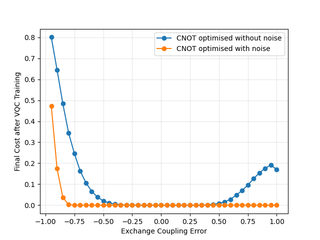
These findings suggest that optimal quantum control can mitigate coherent errors and improve VQC performance in noisy conditions without additional qubit overhead. Future work will involve deploying noise-aware pulse schedules on superconducting quantum hardware to experimentally evaluate the effectiveness of optimal quantum control as a strategy for improving QML performance on NISQ devices.
[1] Kang et al., 2026, Quantum Sci. Technol. 11 015021.
[2] Khaneja et al., 2025, J.Magn.Reson., 172(2):296–305.
While learning theory provides a framework for inferring unknown models from data, quantum inference tasks, such as state discrimination and parameter estimation, face unique constraints imposed by statistical limits and the fundamental laws of quantum mechanics. A central challenge is determining how efficiently information can be extracted from limited quantum resources.
In this work, we address a fundamental continuous-variable learning problem involving a single bosonic mode. We aim to learn an unknown displacement distribution, characterized by its probability density, $p(x)$, and corresponding characteristic function, $\lambda_\beta$. Using $N$ independent uses of the displacement channel, our objective is to construct an estimator, $\hat{\lambda}_\beta$, that bounds the additive error to $\epsilon$ over the interval $\beta \leq \beta_0$ with high confidence, $1-\delta$. This formulation naturally captures the sample complexity required to learn an unknown continuous-variable process from measurement data.
To expose the fundamental limits of this problem, we recast it as a binary hypothesis testing task and compare the performance of vacuum and squeezed-vacuum probes. Crucially, we reveal an exponential separation in the displacement parameter, $\beta_0$, regarding the minimum number of samples required to reliably distinguish the hypotheses. Our results prove that substantial improvements in learning efficiency arise solely from the choice of a non-classical probe state. This establishes squeezing as a powerful, independent resource for quantum learning, demonstrating that significant quantum advantages are achievable even in single-mode settings without entanglement.
Errors in current quantum computers significantly limit the practicality and scalability of quantum algorithms, as noise accumulates in deep circuits and degrades quantum information. Although quantum error correction (QEC) offers a path toward fault-tolerant computation, the substantial spacetime overhead of existing protocols limits their feasibility on near-term devices. Building on recent work in partial QEC for quantum machine learning (QML), where error correction is applied selectively to entangling two-qubit gates, this project investigates an alternative strategy in which QEC is instead targeted toward non-Clifford operations. This direction is motivated by the high overhead typically associated with fault-tolerant non-Clifford gate implementations. We test whether selectively protecting non-Clifford resources can improve QML accuracy and trainability while reducing overhead relative to more uniform error-correction schemes. Using representative QML models and realistic noise channels, including depolarising and decoherence-based noise, we evaluate the resulting performance-resource trade-offs and aim to identify which gate families most strongly contribute to noise-induced degradation in QML.
Quantum error correction provides a path to fault-tolerant quantum computation, even in the presence of noisy hardware. However, it comes at the cost of a large overhead; many physical qubits are required to encode a single, error-corrected logical qubit. Fortunately, this overhead may be mitigated by using hardware with structured noise. In particular, erasure errors — that is, detected loss or leakage of the physical qubits — can be corrected much more efficiently than bit-flip or phase-flip errors. However, the ability to engineer erasure errors in superconducting qubits has previously come at the cost of additional hardware requirements, namely, the need for multi-mode circuits to encode a physical qubit. In this work, we describe a hardware-efficient erasure qubit encoded in a single-mode superconducting circuit. We show that fluxonium (a particular kind of superconducting circuit) can utilised as an erasure qubit, without additional hardware. We describe how the parameters of the superconducting circuit may be chosen to make detectable leakage the predominant error. We also describe methods of control and measurement.
Superconducting quantum processors have been established to explore quantum physics [1] and some made accessible to the general public [2]. However, their operation of this large-scale quantum processor prevents the users from full control (e.g. pulse-level control of the processors). Furthermore, their queuing system and charging plan [3] make it difficult to run experiment that requires long characterisation and fast iterations. Therefore, the National Quantum Computing Testbed (NQCT) facility has been devoted to developing Australian superconducting quantum processors to address these issues. As an initial step, we are developing the operation and robust fabrication of small-scale 5-qubit processors with high-quality qubits.
A core unit in our superconducting processor is high-coherence-time transmon qubit. In this talk, we will present how we manufacture transmon qubits by improving the fabrication and the electromagnetic circuit design. We focus on a circuit comprised of Niobium and Aluminium. We achieve a 0.5 millisecond relaxation time (T1) and 0.2 millisecond coherence time (T2).
[1] Google Quantum AI , “Magic state cultivation on a superconducting quantum processor”, arXiv:2512.13908.
[2] IBM Quantum Platform, https://quantum.cloud.ibm.com/.
[3] Accessing the product of IBM Q computer, https://www.ibm.com/quantum/products.
Superconducting quantum technologies have emerged as a leading platform for quantum computing and quantum sensing over the past three decades. A key enabling component in these systems is the quantum-limited amplifier (QLA), which is essential for high-fidelity qubit readout and has also found important applications in areas such as dark matter detection [1]. State-of-the-art QLAs are predominantly based on Josephson junctions, offering excellent noise performance but suffering from low saturation power, and incompatibility with elevated temperatures and magnetic fields [2]. These limitations present a significant challenge to the use of QLAs in applications beyond quantum computing.
In this talk, I will present our progress towards Josephson-junction-free quantum amplifiers based on the intrinsic kinetic inductance nonlinearity of NbTiN superconducting thin films [3]. In particular, I will discuss the development of wafer-scale engineered kinetic-inductance travelling-wave parametric amplifiers (KITWPAs) using a multilayer architecture in which the signal and ground planes are separated by a dielectric layer. This design significantly reduces the likelihood of fabrication-induced defects, providing a robust and scalable platform for KITWPA implementation. We have established a complete end-to-end fabrication process for these multilayer devices and have experimentally demonstrated gains of up to 16 dB over more than 2 GHz of bandwidth.
These results demonstrate a promising route towards scalable kinetic-inductance parametric amplifiers offering broadband gain, high dynamic range, and compatibility with higher magnetic fields and operating temperatures, addressing a key constraint in the broader deployment of superconducting QLAs.
[1] J. Aumentado, IEEE Microwave Magazine 21(8), 45–59 (2020)
[2] C. Macklin et al., Science 350, 307–310 (2015)
[3] B. H. Eom et al., Nature Physics 8, 623–627 (2012).
Multiple leading quantum computing technology platforms are based on microwave-frequency qubits embedded in superconducting electronic circuits. Due to loss and decoherence constraints, these systems require cryogenic environments and electromagnetic shielding to suppress unwanted electromagnetic interactions, blackbody radiation, quasiparticle interactions and spurious modes that can degrade coherence or introduce experimental interference (Corcoles et.al, Nat.Commun 6:6979, 2015)
Device and on-chip circuit design has been studied extensively to improve device performance, with significant advances achieved, e.g. in circuit QED systems, through using novel device geometries and novel materials to reduce system losses and enhance qubit coherence (Place et.al, Nat.Commun 12:1779, 2021), or deep substrate etching to reduce dielectric loss (Bruno et.al Appl. Phys. Lett. 106:182601, 2015). As these technologies have begun reaching industry scales, attention has also turned to the optimisation of device packaging (Krayzman et.al, Appl.Phys.Lett 124:204001, 2024). As qubits have improved, it is now becoming more likely for device or processor performance to be limited by packaging constraints (Huang et.al, PRXQuantum.2.020306, 2021).
In this work, we investigate the influence of packaging design on a device's microwave environment in relation to spurious electromagnetic modes that can contribute to decoherence and control errors by coupling qubits to the environment and each other. We show that careful device-package co-design is essential, as the common practice of simulating devices and packaging in isolation fails to correctly describe the electromagnetic mode environment, which it turns out can depend sensitively on the combined device-package geometry, including on often-overlooked features of device circuitry. For example, we show how spurious mode frequencies and spatial distributions are strongly affected by manufacturing tolerances and how grounding of device circuits is implemented. We evaluate packaging design strategies for suppressing unwanted modes and study the minimum modifications required to eliminate modes from frequency ranges of interest.
This session will be open to all members of the public.
Multifrequency terahertz (THz) waves with high spectral purity are of pivotal importance to advanced spectroscopy, imaging, and telecommunications. Traditional approaches for producing multifrequency THz waves and THz frequency combs rely on complex setups or sophisticated device structures and are usually limited in bandwidth and efficiency, especially at the spectral range between 0.5 and 1.5 THz. In this work, we use self-injection-locking technique to frequency-lock two chipscale semiconductor lasers to a lithium niobate whispering-gallery-mode microresonator to generate low-noise optical emissions. In contrast to the conventional continuous-wave mode, one of the self-injection-locked lasers is operated in a gain-switching regime by laser current modulation, creating coherent pulses with a repetition rate that is equal to the free-spectral range of the microresonator. By photomixing the two lasers on a photoconductive antenna, we generate a THz frequency comb with 13 comb teeth and a repetition rate of approximately 11 GHz, covering the spectral range from 0.92 to 1.06 THz. Compared with commercial multichannel laser systems, the demonstrated microresonator-based dual-laser system is highly tunable in the THz-range frequency difference and exhibits a high spectral purity and significantly reduced frequency instabilities. With the low-cost components and the prospect of further miniaturization, the self-injection-locked dual-laser source may greatly advance the industrial applications of multichannel THz waves as well as the development of cost-effective THz frequency combs. As a proof-of-principle demonstration, an interferometer-based ranging experiment is carried out, showing the improved measurement resolution by adopting the self-injection-locked gain-switched lasers. Further performance improvement by domain-wall engineering the lithium niobate microresonator is proposed and then demonstrated.
The chemical properties of microcalcifications within the body have been shown to provide a keen insight into the disease state of various cancers.[1] In their invasive form, these microcalcifications exist predominantly as the common calcium phosphate mineral hydroxyapatite. Being a biomineral, these apatites readily incorporate amounts of common biological ions which also have been shown in the literature to be key markers of disease state.[2] Current clinical techniques are dominated by X-Ray imaging which are incapable of resolving chemical information. Consequently, lab-based analysis is required to achieve a diagnosis. However, only around 20% of microcalcificaitons analysed turn out to be malignant, giving justification for the exploration of alternative diagnosis techniques.[3]
Low-wavenumber Raman spectroscopy is a rapid and non-destructive technique that has a evolving track record in the analysis of both minerals and biological materials. This technique is highly suited to probe the long-range intermolecular lattice modes of materials that are prevalent in repeating structures such as hydroxyapatite.[4] Given that the coordination of the rather heavy Calcium cations plays a key role in dictating these lattice modes, low-wavenumber Raman spectroscopy should be especially sensitive to the presence of substituting ions.
In this work, a set of synthetic substituted apatites, dictated by a design of experiments approach are analysed by both low-wavenumber and traditional Raman spectroscopy with insight given to the spectral changes due to substitution. Complementary THz IR data, collected at the Australian synchrotron is also leveraged with DFT calculations utilised to determine the most likely substitution mechanisms in each sample.
1 Gosling, S. et al. Journal of Mammary Gland Biology and Neoplasia 24 (2019).
2 Scott, R. et al. Scientific Reports 7, 136 (2017).
3 Evans, et al.Clinical Radiology 54, 644-646 (1999).
4 Kirkham, J. et al. Crystal Growth & Design 23, 5748-5761 (2023).
Hybrid mode-selective photonic lanterns (HMS-PLs) are an emerging astrophotonic technology that enable simultaneous mode-selective light injection and wavefront sensing. Unlike conventional photonic lanterns, HMS-PLs selectively couple the fundamental LP01 mode from a multimode input into a dedicated single-mode output, while higher-order modes are distributed among the remaining outputs for wavefront sensing. This makes HMS-PLs attractive for astronomical instrumentation, where efficient coupling of diffraction-limited light and low-order wavefront sensing are critical.
We present the characterisation of prototype six-core HMS-PLs being developed for Seidr, part of the Asgard Suite for the Very Large Telescope Interferometer. A key challenge for deploying HMS-PLs in closed-loop adaptive optics systems is determining the lantern transformation between the multimode input and single-mode outputs, particularly in situ at a telescope where direct field measurements are impractical.
To address this, we investigate complementary characterisation techniques. Off-axis digital holography is used as a laboratory validation tool to reconstruct the complex modal fields emerging from the lantern outputs and verify device performance. In contrast, high-dimensional Stokes measurements and machine-learning approaches are explored as practical in-situ methods that recover the lantern transformation using only output intensity measurements. The Stokes approach enables reconstruction of the lantern transmission matrix, while neural networks learn the transformation directly from measured single-mode powers.
Using these methods, we investigate wavefront correction strategies based solely on HMS-PL output powers. Several neural network architectures are compared against one another and against transmission-matrix-based reconstruction from the high-dimensional Stokes method for estimating the incident wavefront and generating correction signals for an upstream deformable mirror. These results demonstrate the potential of HMS-PLs as compact, integrated devices for simultaneous wavefront sensing and mode-selective injection in future high-contrast astronomical instrumentation.
We simulate how modulating the properties of the centre core within a photonic lantern (PL) can greatly affect the mode selectivity of LP modes. Such knowledge can allow for the fabrication of a 2-in-1 monolothic device: a phase-preserving focal-plane wavefront sensor and an optimised science fibre. The novel variation, where a single mode is coupled into a chosen output fibre (and is suppressed elsewhere) that rejects all other modes is known as the Hybrid Mode Selective PL (HMS-PL). The preferential coupling of fibre modes that have considerable overlap with that of a corrected wavefront enables the optimisation of starlight injection into a single fibre while interpreting power in other fibres being due to atmospheric turbulence.
We used the finite beam propagation (BeamPROP) algorithm and finite element method (FemSIM) to effectively simulate the propagation of supported LP modes throughout the PL. By incorporating Gaussian Process Regression, we sample a range of values adopted by the central core within the PL and measured the performance against a perfect HMS-PL Loss Function. Using this range of samples and performance we estimate the underlying probability distribution function of this Loss Function using Kernel Density Estimators. This Bayesian inference allowed us to visualise any co-dependencies between parameters, and allows the prediction of the maximum likelihood estimate (MLE) to achieve hybrid-mode selectivity. We checked the desired hybrid mode selectivity of this MLE by calculating the ratio of LP01 power coupling into the central core against the surrounding cores. From this, we conclude with a set of values that will likely result in the first HMS-PL, along with the knowledge of how these parameters vary with respect to each other.
In this study, we have fabricated an oval-tube antiresonant HCF with an outer diameter of 4.56 mm × 5.25 mm with different lengths using a 3D printing method for D-band operation. The proposed design employs a non-uniform cladding to shift resonance frequencies and spatially distribute leakage, resulting in lower loss and a broader low-loss transmission window without altering the overall fiber outer diameter. We have numerically and experimentally validated the use of a thin metallic layer in increasing the signal strength, which strongly confines the signal at antiresonance frequencies. In this study, Topas was used as the dielectric material, and aluminum foil was used as the metallic layer for D-band operation. The measured loss in window 3 is lower than the loss in windows 1 and 2, because with the increase in frequency, the Dcore/λ ratio increases as well. The lowest measured loss of the designed fiber was 25.6 dB/m at 0.145 THz, whereas the corresponding simulated loss was 6.6 dB/m. The discrepancies between the measured and simulated loss are primarily attributed to structural deformations of the fiber end faces. We have numerically analysed the impact of structural deformations and observed that they shift the transmission windows and introduce unexpected resonances in the regions of interest. The designed fiber exhibits the smallest dimensions and normalized core size (Dcore/λ = 1.91 @0.145 THz) among recently reported 3D-printed hollow-core fibers operating in the sub-THz regime, while maintaining competitive loss performance. In the next phase of this work, we will fabricate the non-uniform cladding oval-tube antiresonant HCF using an extrusion method. By shifting to extrusion, we aim to fabricate longer fiber lengths free from 3D-printing limits while simultaneously improving surface smoothness and reducing structural deformation.
Following a decade of success through LIGO and Virgo’s observations of compact binary coalescences, gravitational wave astronomy is now widely recognized as a key tool in our continued efforts to understand the Universe and our place within it.
Far from resting on their laurels though, the gravitational wave community is forging ahead with major plans for the future. The proposed “ultimate terrestrial gravitational wave detector facility” Cosmic Explorer scales up the laser interferometer to an unprecedented 40km, matching the detector arms to the gravitational wavelengths of interest to fully optimize the observatory's scientific potential.
Meanwhile, the Advanced LIGO detectors continue to operate as frequency-dependent squeezed vacuum-enhanced dual recycled Fabry-Perot Michelson interferometers, circulating hundreds of kilowatts of laser power in their 4km long ultra-high vacuum arms to measure the vastly subatomic effects of passing gravitational waves.
This talk will survey the current state-of-the-art ground-based gravitational wave detector facilities, and their planned near-term upgrades. After motivating the next-generation Cosmic Explorer concept with a discussion of its major science targets, I will describe some of the unique technical challenges it faces, including a focus on the ongoing optical design of Cosmic Explorer’s 40 km-scale laser interferometer.
Passive Kerr frequency combs generated within coherently driven cavities have been shown to have huge application potential, ranging from spectroscopy to ultra-fast imaging. While the generation of high-quality Kerr combs in the near-infrared is easily achievable, the same cannot be said for visible and near-visible Kerr comb generation. Due to the strong normal dispersion of nearly all materials at shorter wavelengths, generating broadband Kerr combs at near-visible and visible wavelengths remains problematic.
In this work, we demonstrate near-visible broadband Kerr frequency comb generation at 770 nm in a synchronously driven tapered fibre Fabry–Pérot (TFFP) resonator. By incorporating a micron-diameter tapered silica fibre section into a fibre cavity, we exploit geometric dispersion engineering to overcome the strong normal material dispersion that typically limits broadband Kerr comb generation at short wavelengths. Moreover, the micron-diameter taper at the centre of our resonator simultaneously enhances the optical Kerr nonlinearity through strong mode confinement, reducing the power threshold for nonlinear structure formation to levels typically seen within microresonators. By varying the length of untapered fibre within our TFFP resonators, we can tailor the average cavity dispersion from anomalous to near-zero and normal regimes around a pump wavelength of 770 nm. This enables the generation of a diverse range of coherent, phase-locked nonlinear states within a single platform, including anomalous-dispersion cavity solitons, zero-dispersion solitons, switching-wave frequency combs, and Raman solitons. Furthermore, the near-visible zero-dispersion and Raman solitons generated within this work exhibit spectral bandwidths exceeding 16 THz, representing the broadest phase-locked Kerr-generated structures reported in the near-visible regime to date.
These results establish tapered fibre Fabry–Pérot resonators as a versatile and highly controllable platform for near-visible coherent frequency comb generation, and provide a promising route towards future passive Kerr soliton generation in the visible spectrum.
Spectrographs used for exoplanet characterisation often rely on highly stable Fabry-Perot interferometers for real time calibration. Designers of Fabry-Perot calibration systems commonly use modified Airy functions to model changes to mirror coatings, surface irregularities, and other sources of phase shift to identify and characterise sources of mode drift. Physical calibration systems have multiple sources of aberrations and non-ideal component structure causing etalon modes to change in shape, phase shift and vary in total transmission. This makes analytical etalon modelling and analysis limited in precision. This project utilises a physical optics propagation system to numerically determine the combined impact of aberrations both inside and outside of an etalon cavity. System aberration sources are categorised into external cavity, interacting and non-interacting internal cavity phase shift sources to optimise simulation completion speed. The impact of input beam shape, aperture, intensity and uniformity are accounted for within input and propagation spatial grids. Height maps are calculated for both simulated and experimentally measured mirror surfaces to account for surface roughness, surface figure and curvature. These height maps are then used to determine the phase shift due to optical path difference for light propagating within an etalon cavity. The Transfer Matrix Method (TMM) based PyEtalon Python package is utilised to determine each etalon mirror’s complex Fresnel coefficients, allowing for internal reflections and transmission to be calculated at each round trip for light propagating within a cavity. The developed system has been utilised to simulate the impact of coating, surface and beam aberrations on etalon mode shape, phase and transmission. HPF, HARPS, MaroonX and other etalon based calibration system mirror designs have been evaluated with this tool set. The developed Graphical User Interface (GUI) and Python package will enable other research teams to examine the impact of system aberrations in their own etalon calibration system designs.
Optical frequency combs generated in driven passive cavities are generally associated with cavity solitons, arising from the balance of gain and loss and of Kerr nonlinearity and anomalous quadratic dispersion [1]. Their formation is successfully described by the Lugiato–Lefever equation (LLE) [2]. Cavity solitons often organize into soliton crystals (SCs), ordered arrays of closely spaced cavity solitons filling the cavity [1]. SC formation is commonly attributed to strong oscillatory soliton tails induced by mechanisms such as avoided mode crossings or higher-order dispersion [3]. However, in the absence of these mechanisms the oscillatory tails are strongly damped, becoming pronounced only within a small region of parameter space [4]. Under these conditions, SC formation would therefore be expected to be challenging.
However, we show that SCs can form over a wide region of the parameter space of the standard LLE. Combining dynamical simulations and stability analysis of its solutions, we find that when multiple cavity solitons coexist, their mutual repulsion drives them toward an equally spaced arrangement, leading to a perfect soliton crystal. As the pump power increases, the relaxation time toward an equispaced configuration tends to infinity, allowing non-equispaced soliton arrangements to persist as imperfect crystals. For a fixed number of solitons, we investigate the stability of the corresponding perfect crystal as the inter-soliton distance is varied. Below a critical separation, the crystal becomes unstable through the merger of neighbouring solitons, reducing the crystal order.
Our results provide new insight into soliton-crystals and explain their formation in systems such as fiber cavities and microresonators with weak mode crossings.
[1] Pasquazi et al., Physics Reports 729, 1–81 (2018).
[2] Coen et al., Opt. Lett. 38, 1790–1792 (2013).
[3] Wang et al., Optica 4, 855–863 (2017).
[4] Parra-Rivas et al., Eur. Phys. J. D 71, 198 (2017).
Single-longitudinal-mode (SLM) Raman lasers are emerging as promising light sources that combine very low frequency noise with the potential for watt-level output powers, making them attractive for quantum applications. Previous Raman systems from our group have demonstrated intrinsic linewidths down to the hertz level, with measurements limited by instrument noise. However, such non-monolithic cavity systems can be susceptible to noise from vibrations, air currents, and dust, and can also suffer from mode hopping. Here, we demonstrate the first room-temperature continuous-wave monolithic free-space Raman laser, based on YVO₄. The 1064 nm pump is actively locked to the doubly resonant cavity using the Pound–Drever–Hall technique, generating Stokes emission at 1174 nm. The Raman lasing threshold is 1.7 W, and the laser maintains mode-hop-free SLM operation for more than 7 h. The Stokes intrinsic linewidth is measured to be ∼100 Hz, corresponding to a four-order-of-magnitude reduction in the pump frequency noise. The monolithic cavity is largely insensitive to vibrational noise and air currents, and is therefore a key step towards developing Raman lasers with hertz-level integrated linewidths. Numerical modelling suggests that, by optimising the pump cavity, scaling to higher pump powers, and using a sub-MHz-linewidth pump laser, this platform could enable sub-Hz intrinsic linewidths and low relative-intensity-noise and frequency-noise levels suitable for quantum gate operations, while supporting watt-level output powers. Furthermore, a reduction in the integrated linewidth from ~6 MHz to ~160 kHz is observed.
The nitrogen-vacancy (NV) center in diamond exists in different charge states with distinct photoluminescence properties, which are sensitive to the nanoscale electrochemical environment. Hence, the NV charge state is emerging as a powerful all-optical platform for nanoscale sensing and imaging. Although significant progress has been made in engineering near-surface NV centers in bulk diamond, controlling the NV charge state in fluorescent nanodiamonds (FNDs) has proven challenging, limiting the sensitivity and reliability of FND-based charge state sensing.
This presentation will highlight recent progress in developing fluorescent nanodiamonds as a reliable and versatile platform for sensing ion concentrations and voltages in 2D and 3D. We demonstrate reliable, reversible switching between the fluorescent NV0 and non-fluorescent NV+ charge states in sub-30 nm FNDs via surface oxidation and hydrogenation, respectively, for single particles and particle powder.[1] In aqueous electrochemical cells, we demonstrate voltage and ion concentration imaging based on the NV charge state in self-assembled FND layers on transparent substrates. Applied voltages reliably modulate the FND PL with a sensitivity of up to 16 mV Hz-1/2. Importantly, FND PL is also modulated by local changes in salt concentration with a sensitivity of up to 1.8% per millimolar NaCl, enabling all-optical imaging of ion concentration gradients at the microscale.[1]
Furthermore, our recent progress in the fabrication and characterisation of scalable 2D and 3D nanodiamond-based quantum sensing substrates for magnetic imaging,[2, 3] electric-field sensing,[4] and magnetic noise detection[5] will be summarised. Our results represent a significant step toward realizing fast, stable, and scalable nanoscale sensing and imagaing technologies with sub-micrometer spatial resolution based on fluorescent nanodiamonds.
References
[1] P. Voorhoeve, H. Abe, T. Ohshima, Q. Sun, A. Quigley, R. Kapsa, N. Dontschuk, P. Reineck, Ion Concentration and Voltage Imaging with Fluorescent Nanodiamonds, arXiv:2602.13975 (2026).
Fault-tolerant quantum computers have the potential to enable predictive simulations of strongly correlated materials beyond the capabilities of classical computation. However, connecting realistic electronic structure calculations to concrete fault-tolerant resource estimates remains an open challenge. In this work, we present an end-to-end workflow that bridges this gap, beginning with ab initio calculations and culminating in explicitly compiled quantum circuits for fault-tolerant simulation.
Starting from the crystal structure of a given material, we construct material-specific, second-quantized Wannier Hamiltonians with screened electron-electron interactions using Quantum ESPRESSO, Wannier90, and RESPACK. These electronic Hamiltonians are mapped to qubit representations and utilized to generate explicit, fully compiled circuits for both qubitized Quantum Phase Estimation (QPE) and Quantum Singular Value Transformation (QSVT)-based time evolution. Rather than relying solely on asymptotic complexity estimates, our approach synthesizes the underlying quantum circuits directly, enabling a precise analysis of logical qubit requirements, T-gate counts, and circuit depth for a target architecture.
Our workflow establishes a rigorous bridge between first-principles condensed matter modeling and fault-tolerant quantum algorithm design, providing a practical framework for assessing the true feasibility of quantum simulation for realistic materials.
Potassium-39 has several broad Feshbach resonances that enable the interatomic interaction to be precisely tuned over a wide range of values. In recent years the |1, -1> Feshbach resonance at 33.6 G has been widely used to create 39K BECs because of its convenience, especially in experiments conducted in space.
We have found that the position of the 33.6 G Feshbach resonance can shift by as much as +7.5 G for 39K atoms confined in a 1063.9 nm crossed optical dipole trap (ODT) at temperatures up to around 35 uK and trap depths around 136 uK [1]. This is an order of magnitude larger than the estimated temperature-induced shift. When the atoms are evaporatively cooled to lower temperatures, the shift of the Feshbach resonance approaches zero at zero trap depth. We show that the large observed shift originates from a large differential ac-Stark shift between the incoming pair of 39K atoms and the associated Feshbach molecule in the oscillating electric field of the ODT, which in turn originates from a large dynamic polarizability of the weakly-bound Feshbach molecule. Similarly large shifts occur for the |1, +1>+|1, 0> resonance at 39.9 G, but not for other Feshbach resonances studied.
The dynamic polarizabilities of the Feshbach molecules extracted from the measured shifts are four to seven times larger than the sum of the polarizabilities of the two incoming 39K atoms, which represents the usual polarizability for weakly bound Feshbach molecules. The large polarizabilities are attributed to a near-coincidence between the frequency of the 1063.9 nm ODT laser and the frequency of an electronic transition from the last rovibrational level of the lowest a3Eu+ potential to a rovibrational level of the excited b3Eg+ potential of K2.
In equity markets, many risks do not arise from individual stocks in isolation, but from shared price movements, high return correlations, similar sector exposures, and comparable sensitivities to common risk factors. Stock clustering can help reveal latent groups of equities that may react similarly to market shocks, enabling investors to detect hidden risk concentrations, assess whether a portfolio is overly exposed to a single market structure, and support more disciplined allocation decisions. Conventional methods such as k-means and DBSCAN remain useful benchmarks; however, their performance may depend on assumptions that are not always consistent with equity-market data. In particular, k-means can be less reliable under non-convex structures or ambiguous boundaries, while density-based methods may be affected by neighbourhood-parameter selection and uneven density distributions.
In this work, a Gaussian Boson Sampling (GBS)-based clustering algorithm is proposed to uncover latent correlation structures in the stock market. The study constructs a weighted graph using stock return correlations, volatility features, and sector attributes, where nodes represent individual equities and edge weights quantify market similarity between assets. After the graph is embedded into a GBS photonic chip, the resulting photon sampling distribution naturally tends to select dense subgraphs corresponding to highly connected asset groups. Through repeated sampling, density filtering, and classical post-processing, candidate asset groups are extracted, leading to economically interpretable stock clusters with similar co-movement patterns and risk exposures.
The results show that the proposed method achieves higher silhouette and weighted density scores than DBSCAN, while its intra–inter cluster cohesion is higher than that of k-means. This approach may be applied to risk dispersion, dynamic asset allocation, sector rotation analysis, and systemic risk monitoring, offering a feasible technical pathway for deploying integrated photonic quantum technologies in quantitative finance.
The Quantum Approximate Optimisation Algorithm (QAOA) tackles combinatorial optimisation problems by encoding their solutions into the ground state of an Ising Hamiltonian prepared by a $p$-level parameterised circuit, with the angles tuned classically. Parameter optimisation is widely regarded as a central bottleneck, and worst-case results showing that training QAOA is NP-hard are often read as evidence that even the shallowest circuits are hard to tune. We argue that this picture does not capture the practically relevant regime. Focusing on QAOA at $p=1$ (QAOA$_1$), we show that tuning the two angles $(\gamma, \beta)$ for weighted Ising models is not a black-box search but a structured signal-processing problem. We prove that the QAOA$_1$ expectation value is a partial Fourier series in $\gamma$ whose frequencies are determined explicitly by the problem's couplings and fields, giving instance-wise bandwidth bounds and, via the Nyquist--Shannon theorem, the sampling resolution needed to avoid the aliasing that causes coarse-grid searches to return spurious optima as the landscape's oscillation rate grows with problem size, density, and weight. We then eliminate the mixer angle analytically, computing $\beta^*(\gamma)$ in closed form to reduce the search to one dimension, and apply a subdivision algorithm that locates the globally optimal $\gamma$ in polynomial time with a certificate of optimality when the weights are commensurable and bounded. The residual hardness is thus confined to pathological instances---those with incommensurable or exponentially scaling weights---rather than arbitrary Ising Hamiltonians. For regular weighted graphs, we further prove the conventional wisdom that the globally optimal $\gamma^* \in \mathbb{R}^+$ concentrates near zero and coincides with the first local optimum, giving a rigorous account of small-angle initialisation and allowing gradient descent to replace exhaustive line searches. Validated within Recursive QAOA (RQAOA) on weighted Erdos-Renyi instances of 128 and 256 qubits, our method consistently outperforms both coarsely optimised RQAOA and semidefinite programming.
Artificial neural networks increasingly rely on large-scale tensor operations that dominate inference latency and energy consumption. Photonic computing offers a promising route toward high-speed acceleration by performing linear algebra directly in the optical domain. Here, we present an integrated, reconfigurable photonic tensor processor for deep neural network inference. The system implements an all-optical intensity-based crossbar architecture in which input vectors and matrix weights are encoded using electro-absorption modulators, while accumulated optical outputs are detected by integrated photodiodes. Since tensor operations are executed by optical propagation through the crossbar, the full operation can be completed within a single clock cycle. This single-cycle computing provides a direct path toward ultra-low-latency inference.
Fabricated in a silicon photonics platform, the processor is driven by a packaged self-injection-locked microcomb that supplies all required optical carriers from a single source. The photonic chip is embedded in a rack-mounted electro-optic system with high-speed electronic input/output and a PyTorch-compatible software interface. Pretrained neural networks are mapped to the photonic hardware through calibration routines that compensate device nonlinearities, inter-channel crosstalk, and wavelength-dependent responses. In addition, hardware-aware fine-tuning adapts the networks to the measured analog noise characteristics of the processor. By incorporating realistic weight and output noise during training, the models become robust against finite precision, stochastic fluctuations, and residual systematic errors inherent to analog computation.
We demonstrate convolutional neural network inference on MNIST and CIFAR-10, achieving 98.1% and 72.0% classification accuracy, respectively. Finally, we give a realistic outlook on system improvements, including reduced optical loss, more stable packaging, larger tensor cores, improved electronic control, and automated calibration. Together with a more integrated electro-optic test bench and simplified interfacing, these steps provide a practical path toward scalable, low-latency optical AI accelerators.
Meyer, L. et al., Nat Commun 17, 3396 (2026). https://doi.org/10.1038/s41467-026-71599-2
The rapidly increasing data-intensive AI workloads and large-scale data centers are driving a fundamental shift toward energy-efficient, scalable, and compact computational hardware design. Neuromorphic computing addresses this need by integrating neurobiological principles with physical hardware to enable fast, low-power, and low-latency processing.
Photonic platform is well-suited for neuromorphic hardware, offering parallel, high-speed, and low-energy data processing with sub-nanosecond latency married with inherently broad optical bandwidth. Integrating phase-change materials (PCMs) into nanophotonic devices enables a unique on-chip system for neuromorphic architectures.
We developed an on-chip hybrid photonic artificial synapse based on reconfigurable broadband nanophotonic switch with an integrated PCM (Ge2Sb2Te5 (GST)) memory unit assisted with tailored nanocrystalline graphene microheaters. One of key element of our nanophotonic device (full in-house fabrication yield >95%) is the specially-engineered, transparent, and cavity-compatible 2D nanocrystalline graphene microheaters in contrast to the standard absorptive metallic electrodes.
We experimentally demonstrated dual-mode short- and long-term synaptic plasticity triggered optically (via evanescent coupling) as well as electrically (via microheaters), presenting coexistence volatile and non-volatile memory dynamics of the developed artificial synapse on-chip, achieving optical weight contrasts up to 75% and 50%, respectively. Crucially, further we achieved hybrid switching of PCM enabling reconfiguration of synaptic weight through both optical and electrical stimuli in a synergistic manner.
Importantly, we experimentally realized an unsupervised learning rule with unique bio-plausible feature of our photonic artificial synapse, enabled by, hybrid PCM switching dynamics governed directly by the intrinsic device physics — a behavior of photonic synapse demonstrated, to the best of our knowledge, for the first time.
The established on-chip bio-realistic hybrid photonic synapse exhibits dual-mode plasticity with reconfigurable and continuously tunable weights. It inherently supports an unsupervised learning rule with bio-plausible unique self-limiting mechanism, enabling stable weight adaptation. The multifunctionality of developed synapse paves the way for scalable photonic neuromorphic networks.
Artificial intelligence is increasingly deployed in safety-critical settings, from medical diagnosis to autonomous systems, where models must not only make accurate predictions but also recognize when their predictions are uncertain. However, conventional neural networks are largely deterministic and cannot reliably distinguish uncertainty caused by noisy or ambiguous inputs from uncertainty caused by inputs outside their training distribution. Bayesian neural networks provide a principled route to uncertainty-aware AI by treating model parameters as probability distributions, but their use is limited by the need for many stochastic forward passes and costly pseudo-random number generation on digital hardware.
In this talk, we present a photonic Bayesian machine that performs probabilistic neural-network inference by harnessing the intrinsic randomness of chaotic light. The system encodes stochastic weights in the spectrum of a broadband optical entropy source and computes probabilistic convolutions using dispersion-based photonic processing. Integrated with a 1.28 Tbit/s digital interface and a PyTorch-compatible workflow, the machine executes probabilistic convolutions in 37.5 ps, offloading the sampling-intensive operations of Bayesian neural networks to the optical domain.
We demonstrate the approach on image-classification tasks that require both prediction and uncertainty reasoning. In blood-cell microscopy, the system classifies known cell types while detecting erythroblast images excluded from training as out-of-domain. We further benchmark uncertainty disentanglement using MNIST, Ambiguous-MNIST, and Fashion-MNIST, showing that the system separates aleatoric uncertainty arising from ambiguous inputs from epistemic uncertainty arising from unfamiliar inputs. These results establish photonic hardware as a promising route toward low-latency, uncertainty-aware AI for real-time and safety-critical applications.
I will discuss a protocol for implementing a concatenated code with reduced check weight, via gauging out qubits in the homological product code. Along the way I will touch upon the unproven conjecture regarding the distance of the homological product code, how this protocol can be viewed as a generalised fault complex of a product of CSS code with a non-repetition classical code, the relationship of this proposal to Litinski's Blocklets, and generalising the fault complex formalism to subsystem codes.
Optogenetics has transformed neuroscience by enabling optical control and readout of neuronal activity in vivo with high spatial and temporal precision, opening powerful approaches to dissecting neural circuits and to developing neuroprosthetics and therapies for neurological disorders. Neural probes employ conventionally an optically delivered stimulation, commonly via a grating coupler or micro-LED, while the recording is performed electrically. All-optical approaches to both stimulation and recording offer a complementary route to neuronal control and interrogation, with several distinct advantages like improved scalability, simplified routing for high-density interfaces, enhanced biocompatibility, and the absence of electrical noise and Joule heating. Crucially, optical readout can discriminate spectrally distinct fluorescent reporters, allowing simultaneous interrogation of multiple genetically defined neuronal populations.
Here we present an integrated silicon nitride (Si3N4) photonic platform for efficient optical stimulation of opsin-functionalised neurons. Light couplers were inverse-designed to provide broadband, polarisation-insensitive operation at the specific excitation wavelength and tailored optical field distributions that maximise light delivery to individual neurons. The devices tested by a widefield fluorescence microscope to enable simultaneous optical stimulation and functional imaging of human pluripotent stem cells (h-iPSCs) differentiated in cortical neurons.
These results establish inverse-designed integrated photonics as a promising platform for high-density, multiplexed neurophotonic interfaces, and demonstrate the potential of on-chip photonics for scalable all-optical neural stimulation, functional circuit mapping, and future therapeutic neurotechnology.
The realization of next-generation gravitational wave observatories demands a radical departure from current low-frequency sensitivity limits. To extend the cosmological horizon of ground-based networks, detectors must be shielded from intense low-frequency seismic activity and localized gravitational fluctuations. This talk will review the engineering strategies and instrumentation milestones designed to achieve sub-10 Hz sensitivity within the current GW network, highlighting the design of architectures for future detectors. The presentation will also briefly examine how site selection—from deep underground facilities to ultra-quiet surface locations—interact with active noise-subtraction techniques. These technical developments are critical for ensuring that the global network of future detectors can continuously test general relativity up to the cosmological horizon.
After two black holes merge, the final black hole emits a ringdown signal composed of quasi-normal modes whose frequencies and decay times are set by its mass and spin. Measuring these modes tests general relativity in the strong-field regime, as the theory predicts a specific relationship between them.
Such tests rely on calibration, the conversion of the detector's raw output into physical strain, which carries small amplitude and phase uncertainties. We show that neglecting these uncertainties systematically biases the recovered mass and spin, and can reproduce the signature of a deviation from general relativity even when none is present.
We present a calibration-aware ringdown analysis that accounts for these uncertainties directly. Applied to simulated signals with injected miscalibration, it recovers the true mass and spin where a standard analysis fails, preventing spurious detections of deviations from GR. We are now extending it to observed events and preparing it for use within the LIGO–Virgo–KAGRA ringdown analysis.
The Torsion Pendulum Dual Oscillator (TorPeDO) experiment [1] aims to directly detect Newtonian noise, a fundamental limit to the low-frequency sensitivity of future terrestrial gravitational-wave detectors. TorPeDO employs a four-stage seismic isolation chain comprising an inverted pendulum, a vertical geometric anti-spring (GAS) filter, an intermediate mass, and a penultimate mass from which the transducer is suspended [2]. Achieving thermal-noise-limited sensitivity requires many orders of magnitude of seismic isolation. Active control of the soft plant dynamics supresses ground motion across the 10mHz-10Hz frequency band of interest.
Moving beyond single-input single-output (SISO) servo controllers, we present a multi-input multi-output (MIMO) state-space controller which simultaneously utilizes all sensors and actuators on the inverted pendulum. This controller is synthesized with the intent of minimizing the transfer of ground motion into the differential yaw of the TorPeDO transducer. We also present the latest status of an expanded controller incorporating sensors and actuators on every stage of the suspension chain.
[1] Chua et al, Appl. Phys. Lett. 122, 201102 (2023)
[2] P.W.F. Forsyth, PhD Thesis, ANU (2022)
In large optical systems, such as the Laser Interferometric Gravitational-wave Observatory (LIGO) [1], active seismic isolation is used to reduce the optical platform motion. However, inter-platform motion presents a significant noise challenge to the low frequency sensitivity of these instruments. Suspension platform interferometry (SPI) [2] provides a potential solution via the measurement of the relative displacement and tilt between platforms, that then allows for motion stabilization using the platform actuators. Such work is critical towards realizing the sensitivity goals of the future global gravitational wave (GW) detector network.
The LIGO SPI Pathfinder project has installed a SPI pathfinder system between two seismic platforms of LIGO. This project, a collaboration of hardware deliverables and expertise from the ANU Centre for Gravitational Astrophysics, LIGO Hanford Observatory, Stanford University and Embry-Riddle Aeronautical University, represents one of the final Technical Readiness Level stages for deployment of the generalised SPI technique in future Observing Runs. We will present the LIGO SPI Pathfinder system design, installation and commissioning in LIGO, as well as the latest characterisation results.
[1] E. Capote et al, PRD 111, 062002 (2025)
[2] S. M. Koehlenbeck et. al, Sci. Rep 13 2388 (2023)
Newtonian noise, or gravitational fluctuations from local moving mass, is a low Fourier frequency noise source that will limit next-generation ground-based gravitational-wave detectors. At the Australian National University, we are developing an opto-mechanical torsion pendulum sensor for direct detection of Newtonian noise, consisting of two suspended orthogonal pendulums that rotate differentially in response to local gravity fluctuations [1]. This sensor concept also offers potential applications in earthquake early-warning [2] and, with minor design modifications, may enable searches for certain classes of dark-matter interactions [3].
The sensor has undergone significant upgrades, including the implementation of a multi-stage seismic isolation suspension and operation within a vacuum environment to reduce environmental impacts. The sensor’s optical readout system has also been improved with active laser frequency noise stabilization [4] and opto-mechanical damping to suppress suspension resonance coupling. We will present the latest status of the upgraded sensor, including latest sensor characterisation and measurement results.
[1] Chua et al, Appl. Phys. Lett. 122, 201102 (2023)
[2] Chua et al, in preparation (2026)
[3] Qin et al, in preparation (2026)
[4] Kulur Ramamohan et al, Opt. Express, 32(22) (2024)
Globular clusters (GCs) provide complementary tracers of the assembly history and dynamics of spiral galaxies. While GC systems in elliptical galaxies have been studied extensively, dynamical studies of the GC systems of spirals beyond the Local Group remain limited. In this talk, I will present results from the GECKOS survey, focusing on 19 Milky Way-mass edge-on galaxies. Using deep MUSE integral-field spectroscopy together with photometric and spectroscopic analysis, we identify 307 GCs and derive their systemic dynamics. I will compare the rotational velocity and velocity dispersion of GC systems with those of the host stellar components. In addition, I will use these measurements to place the Milky Way in the broader context, including spiral and elliptical galaxy GC systems, enabling one of the first comparisons of GC kinematics across Milky Way-mass spiral galaxies. This comparison reveals surprising diversity among spiral GC systems.
Over the past decades, spatially resolved spectroscopic studies have confirmed that galaxies come in two broad dynamical families: fast vs. slow rotators. Slow rotators are on average older, more likely to have higher stellar masses and typically found in denser environments. With age and stellar mass being the strongest predictors of galaxy spin, the diminishing influence of environment has recently been put into question.
To help explain observational trends and ascertain the role of nurture in galaxy spin, we turn to causal inference using a Bayesian mixture model applied to 3 hydrodynamical cosmological simulations (EAGLE, Magneticum and Illustris-TNG100). In this talk, I will show that the effect and mechanism of influence of environment on galaxy spin is model-dependent. The statistical framework shows promising delineating power to help detangle the possible impact and mechanism of influence of environment on galaxy spin, providing new observational constrain for model specifications in hydrodynamical cosmological simulations.
The LIGO, Virgo, and KAGRA (LVK) collaborations have announced the detection of over 260 binary black hole signals. Each one encodes information about the masses and spins of merging black holes. In this talk, I describe several highlights from this black-hole haul. First, using the loudest event, GW250114, we experimentally verified Hawking’s famous area law, which predicts that the surface area of a merger remnant black hole must exceed the sum of the areas of its parent black holes. Second, we observed a gap in the distribution of black-hole masses, from which we can learn about the nuclear physics of pair instability supernovae. Finally, the discovery of distinctive clusters in the space of binary black-hole parameters suggests the presence of multiple sub-populations––each shaped by different binary physics.
Since the first detection of gravitational wave (GW) emission from coalescences between black holes and neutron stars, we have only observed one confirmed multi-messenger detection: GW170817. This single event showed the promise GWs and multi-messenger astrophysics have to reveal new information about the physics of matter at densities unachievable in terrestrial laboratories. GW170817 also showed that GWs offer new opportunities to resolve the Hubble tension, an outstanding problem in cosmology in which different methods of measuring the expansion rate of the Universe cannot be reconciled. Every decision we make about the design and location of gravitational wave detectors constructed over the next decade must prioritise capturing more events like GW170817 if we are to realise the potential of GWs as a messenger.
Two factors limit the discovery potential of a detector network: sensitivity and sky localisation. Detector sensitivity is primarily dictated by the experimental equipment and governs how far into the Universe our detector can observe. Sky localisation, the ability to pinpoint GW sources on the sky, is most affected by the number of non-redundant inter-detector baselines in a global GW detector network.
We discuss the development of a series of figures of merit motivated by multi-messenger astrophysics. These that allow detector designs and global network configurations to be benchmarked in cost-benefit analyses. We will show that maximising the scientific potential of gravitational waves as a messenger requires a detector in Australia, and discuss the current efforts underway to make an Australian detector a reality. In particular, we demonstrate how a detector network consisting of a Cosmic Explorer design detector in the US, Einstein Telescope in Europe, and a detector with comparable sensitivity to the LIGO O5 detectors in Australia can enable groundbreaking insights into cosmology - measuring the Hubble constant to <10% - and the physics of extreme matter.
The relativistic Fock-space coupled cluster (FS-RCC) method is among the most powerful and elegant multireference tools for the ab initio treatment of open-shell heavy element systems. Yet in its standard valence-universal form, it is largely confined to low Fock-space sectors, and its reach into genuinely multivalence, quasi-degenerate structures is limited by intruder states, and by the missing amplitude relaxation imposed by the subsystem embedding condition. This contribution presents a coordinated program of developments designed to overcome these limitations and extend benchmark-quality relativistic coupled-cluster theory across the entire periodic table.
Four complementary directions are discussed. First, the extension of FS-RCC to high Fock-space sectors, giving a balanced description of systems with several valence particles or holes, combined with an intermediate Hamiltonian that tames the intruder-state problem. Second, a mixed-sector coupled cluster formulation that treats, on an equal and size-extensive footing, several sectors sharing the same total electron number, removing asymmetries among near-degenerate states of differing valence character. Third, the adaptation of the internally contracted multireference coupled cluster (ic-MRCC) method to the relativistic four-component domain; retaining the strengths of the Fock-space ansatz while relaxing its most restrictive constraints, it offers a robust route to complicated quasi-degenerate states of d-, f-, and superheavy-element compounds. Fourth, a double Fock-space coupled cluster construction, in which a doubled set of Fock-space subsectors extended for bosonic degrees of freedom enables a simultaneous and flexible treatment of QED effects, pushing electronic structure calculations toward the Lorentz-invariance limit.
The formal connections among these approaches, their relative merits, and efficient implementation strategies — including compact virtual natural orbitals and tensor-decomposition techniques for cost control — are analyzed. Perspectives on combining these developments with high-order excitations, QED corrections, and analytical property evaluation are outlined, aiming to achieve a unified, systematically improvable relativistic multireference coupled cluster framework for benchmark electronic structure calculations.
The vibrational excitation of molecular hydrogen (H$_2$) by low-energy electrons is one of the most fundamental reactions in atomic and molecular physics, playing a key role in the chemistry of the interstellar medium and studies of fusion plasmas. Crossed-beam experiments and electron swarm measurements have long been used to determine scattering cross sections for vibrational excitation, but the two methods produce conflicting results, a disagreement that has persisted for more than five decades and remains unsolved. Theoretical treatments have historically relied on approximations tailored to specific processes, such as separating the direct and resonant pathways or employing model polarization potentials, with no single method accurately describing all vibrational transitions. The absence of benchmark-quality calculations, combined with decades-long disagreements between experimental methods, means that even for this simple problem there are no definitive cross-section data, leaving the reliability of theoretical approaches applied to more complex molecules uncertain and without quantified error bounds. Here we present ab initio calculations of low-energy vibrational excitation in H$_2$ that treat electronic and vibrational motion on equal footing, providing a unified description of direct and resonant scattering across all vibrational transitions. The results are in stark contrast to previous theoretical estimates for many vibrational transitions, revealing systematic differences in both magnitude and energy dependence. At the same time, they provide strong confirmation of the swarm-derived cross sections, unlike previously-accepted calculations that favoured the beam data. This reversal of the long-standing situation shifts attention away from the swarm data and back onto the interpretation of the crossed-beam measurements. By providing accurate and self-consistent cross sections for vibrational excitation of H$_2$, the present calculations will enable more reliable modelling of low-temperature plasmas and interstellar clouds.
Searches for Beyond Standard Model physics in molecular systems have become an increasingly active area of research in recent decades. CP-violating interactions and hyperfine parameters are both sensitive to the behaviour of the electronic wavefunction in the nuclear region. Consequently, precise measurements and accurate calculations of molecular hyperfine structure provide an important benchmark for assessing the reliability of CP-violating interaction calculations.
To date, no experimental measurement of the magnetic hyperfine constant exists for the H 3Δ1 state of ThO – the first electronic excited state. In this talk, I present calculations of the magnetic hyperfine constants of ThO for multiple states using coupled-cluster methods implemented in DIRAC. These results are intended to guide a future nuclear Schiff moment search using ThO at Michigan State University.
The high-precision study of atomic systems can be applied in many practical and theoretical settings, from the development of state-of-the-art atomic and nuclear clocks to fundamental tests of the Standard Model (SM). Tests of the SM, in particular, are typically strongest in heavy and relativistic atomic systems where very weak, parity-violating effects described by the SM or extensions thereof are enhanced. To extract evidence of such weak manifestations of new physics requires a very accurate understanding of how the SM acts insides atoms. Therefore, having methods that accurately model relativistic and many-body effects in such systems is necessary to extract very small deviations from SM physics. Approximation methods that attempt to account for electron interactions at low orders of perturbation theory or in an order-by-order expansion suffer from poor convergence. Many modern atomic structure calculations are therefore carried out with the use of very accurate techniques that sum certain perturbative effects to all orders in perturbation theory. In this talk I will provide an overview of some of the most widely used all-orders methods, and discuss the differences and strengths of each. I will also discuss new results that extend and combine certain aspects of these different methods to include a larger subset of many-body effects.
Polarization and correlation effects in molecular photodynamics are intimately tied to the coupled motion of electrons and nuclei. Understanding these interactions on their natural femtosecond timescales requires measurements that resolve both electronic structure and nuclear configuration simultaneously. Here, we present a complete imaging study of the UV-initiated dissociation of $\text{Br}_2$ using a femtosecond pump-probe scheme combined with COLTRIMS-based electron–ion coincidence detection [1]. Using 400 nm pump and 800 nm probe pulses, we track the time-resolved evolution of molecular fragmentation through both electronic and structural observables, providing a direct, molecular-frame view of how electron correlation, orbital coherence, and ionic polarization influence dissociation dynamics at the few-femtosecond scale.The 400 nm excitation populates the dissociative $C$-state of $\text{Br}_2$, launching a neutral dissociation process [2]. A delayed 800 nm probe pulse ionizes the evolving fragments, allowing us to correlate the kinetic energy release with photoelectron momentum distributions. The use of COLTRIMS enables full 3D momentum imaging, revealing ionization dynamics and internuclear distance evolution with sub-cycle temporal resolution [3].Measured photoelectron distributions exhibit striking delay-dependent features—angular asymmetries, ATI ring modulation, and high-momentum enhancements—that encode coherence and polarization effects. These features reflect the progressive change in parent ion polarizability and the transition from multi-center to single-center scattering regimes. Our semiclassical two-step model and TDDFT simulations confirm that tunnel ionization probes a superposition of molecular and atomic polarization channels. We find a $\sim 50$ fs temporal offset between electronic orbital reconfiguration and structural dissociation, indicating that electron dynamics precede and drive nuclear rearrangement. These results emphasize the necessity of molecular-frame coincidence measurements to determine true reaction timescales in correlated systems.References[1] T. Wang et al., in preparation.[2] W. Li et al., PNAS 107, 20219 (2010).[3] J. Ullrich et al., Rep. Prog. Phys. 66, 1463 (2003).
A thermoradiative diode (TRD) is a low-bandgap optoelectronic device that generates power through thermal emission to a colder environment. Its operation can be explained with a simple detailed balance model, where in an ideal device, current is given by the difference between emitted and absorbed photons. When more photons are emitted than absorbed from the cold environment, the device generates a photocurrent; when no current is extracted, a reverse bias develops across the diode [1]. This is the inverse of photovoltaic operation, where current flows due to higher absorption and a forward bias develops at open circuit.
In terrestrial power generation applications, a TRD can use the warm Earth as a hot reservoir and emit infrared radiation to the cold night sky. In the limit where the diode emits from a 300K Earth directly into 3K outer space, a power density of 54.8 W.m$^{-2}$ could be generated by an ideal, very low bandgap device. In more realistic terrestrial applications, the diode’s bandgap should be chosen to target the higher-transparency atmospheric window from 0.09-0.16 eV. Previous work captured the variable transmissivity of this window using effective sky temperatures, but accurate assessment of the potential power output must consider the spectral shape of the atmospheric downwelling radiation. Here, accurate radiative transfer modelling of the downwelling radiation is used to evaluate a TRD’s performance under nine representative atmospheric conditions. Under these conditions, an ideal device yields power densities between 0.34 and 6.5 W.m$^{−2}$, with optimal bandgaps near 0.094 eV. Accounting for stronger non-radiative processes at lower bandgaps, we also map the trade-off between a bandgap in the main atmospheric window and a higher bandgap in a secondary window with a better radiative efficiency [2].
[1] Nielsen et al., Nature Photonics, Nov. 2024, doi: 10.1038/s41566-024-01537-5.
[2] Harrison et al., iScience, Dec. 2024, doi: 10.1016/j.isci.2024.111346.
The high radiative efficiencies and strong absorption coefficients of van der Waals materials position them well for optoelectronic power generation via radiative exchange. These materials have been investigated for use in photovoltaic solar cells, however, their use in infrared thermoradiative and thermophotovoltaic applications remains unexplored. In this study, we fabricate a black phosphorus ($bP$)/molybdenum disulfide ($MoS_2$) van der Waals heterojunction diode and use it in both thermoradiative and thermophotovoltaic operation modes. The diode is formed by stacking exfoliated $bP$ and $MoS_2$ flakes on an $Au$/$Al_2O_3$ back-cavity. Open circuit voltage and short circuit current measurements taken as a function of temperature difference $\Delta T$ between the device and its environment, where $\Delta T = 0$ corresponds to both being at approximately room temperature ($\sim300~\mathrm{K}$), show the device can effectively generate power in both thermophotovoltaic and thermoradiative regimes. A net power density of $\sim80 ~\mathrm{nW}~\mathrm{m}^{-2}$ is achieved at $\Delta T = -50~\mathrm{K}$ (thermoradiative), and $>100 ~\mathrm{\mu W}~\mathrm{m}^{-2}$ at $\Delta T = 100~\mathrm{K}$ (thermophotovoltaic). This represents the first demonstration of thermoradiative power generation using van der Waals materials. Optoelectronic modelling further indicates that the performance is primarily limited by optical out-coupling and internal quantum efficiency. By addressing these losses, the short circuit current density could be increased by up to three orders of magnitude, corresponding to an approximately six orders of magnitude increase in power density.
Graphene's excellent optoelectronic properties have been exploited to achieve sensitive broadband photodetection via the hot-electron photothermoelectric effect. We propose that the same effect could be utilised for mid-infrared thermoradiative energy harvesting with high internal quantum efficiency in graphene.
As a step towards this goal, we have fabricated a high-quality graphene pn-junction on hexagonal boron nitride. We demonstrate a novel two-frequency technique to measure the thermopower response of our graphene pn-junctions: thermopower was measured by heating with alternating current (Joule heating) at frequency $\omega$ and the thermopower response probed at $2\omega$. The temperature response from Joule heating was modelled, and the thermopower was thereby inferred. Its dependence on carrier density showed good agreement with graphene transport theories, but a peak thermopower of around 24 μV/K was lower than previously reported for similar graphene devices. We seek to improve on this by using four terminal sensing to overcome contact resistance and by using a cryostat to vary the junction’s temperature.
I will discuss our latest work to create efficient graphene thermoelectric generators, and couple them to mid-infrared resonant nanostructures fabricated in silicon carbide to achieve mid-infrared thermoradiative devices for nighttime radiative energy harvesting.
Negative luminescence is the symmetric process to electroluminescence, the mechanism by which light-emitting diodes (LEDs) produce light, wherein the mid-infrared (MIR) semiconductor photodiode emit less radiation under reverse bias than it would at equilibrium. Here, we demonstrate the use of negative luminescence for a new covert communications method in which photon emission is rapidly electrically modulated both above and below the level of a passive blackbody at the emitter temperature through the balance of negative and electro luminescence. The time-averaged emission can be designed to be identical to the thermal background, realizing communications with zero optical signature for detectors with bandwidth lower than the modulation frequency. Using thermoradiative diodes, we demonstrate data rates up to at least 100 kbps and modulation rates above 1 MHz. Future prospects of this technology and its development will be further discussed.
Passive radiative cooling has emerged as an effective photonic strategy for sub-ambient thermal regulation by simultaneously minimizing solar absorption and enhancing thermal emission within the atmospheric window. However, developing scalable, mechanically robust, and manufacturable radiative cooling textiles remains a significant challenge.
In this work, we report a scalable surface photonic engineering strategy that transforms commodity polyethylene terephthalate (PET) textiles into multifunctional radiative cooling materials through plasma activation followed by the in situ formation of a conformal nanocellulose coating on the fiber surface.
The resulting hierarchical architecture creates a disordered photonic scattering medium that substantially enhances multiple light scattering and broadband solar reflection across the UV–visible–near-infrared region. Consequently, the modified textiles exhibit a high average solar reflectance of approximately 80%. Simultaneously, the conformal nanocellulose layer significantly increases the intrinsic mid-infrared emissivity of PET, yielding an emissivity of up to 97% within the atmospheric window and thereby promoting efficient radiative heat dissipation.
In addition, the hydrophilic nanocellulose network facilitates moisture transport, providing enhanced moisture management while maintaining the mechanical integrity and washing durability of the PET textiles.
Unlike particle-filled composites and fiber-blending approaches, this surface-confined photonic design eliminates embedded scatterers, simplifies processing, and can be readily integrated into existing textile manufacturing processes.
This work establishes a general interfacial photonic engineering strategy for converting commodity polymers into multifunctional disordered photonic materials and provides a scalable route toward durable and wearable passive radiative cooling textiles.
The velocity distribution of cold dark matter within galaxies is expected to exhibit ultra-fine-grained substructure as a result of the many foldings of an initially smooth phase-space sheet under gravity. The innumerable folds of this sheet in the inner regions of a galactic halo would appear on solar-system scales like an extremely large number of spatially overlapping streams of dark matter particles. Some of these streams may also receive amplified densities if dark matter undergoes enhanced clustering in the early Universe, as is the case for axions in the post-inflationary scenario. This ultra-fine-grained dark matter substructure is usually considered irrelevant and undetectable for most direct detection experiments, but for axion haloscopes, this may not be the case. We develop and explore several plausible models for the degree of fine-grained axion dark matter substructure so as to evaluate its impact on the detectability of axions. We find that not only is this substructure detectable in haloscope experiments, but that it may enhance the detectability of the axion if data is analysed with a high-enough frequency resolution. This conclusion motivates ongoing high-resolution analyses of axion data by haloscope collaborations, which have the potential to reveal evidence of the QCD axion even if their nominal experimental sensitivity does not reach the required level under the Standard Halo Model assumption.
Accurate calculations of ionisation cross-sections are essential for constraining dark matter–electron interactions, neutrino scattering, and precision Standard Model and beyond-Standard Model (BSM) physics.
We present a generalised framework for computing ionisation cross-sections for scattering and absorption processes, fully incorporating relativistic effects and avoiding the use of the dipole approximation, which is not valid for scattering and breaks down for certain absorption processes. This approach is applicable to a broad class of models, including dark matter and relativistic particles such as neutrinos, and accommodates general interaction structures, including vector, axial-vector, scalar, pseudoscalar couplings, and their interference. We calculate relativistic atomic ionisation form factors for xenon and argon across an energy range spanning eV to MeV. These form factors provide essential input for the interpretation of dark matter direct-detection experiments, neutrino scattering measurements, and searches for exotic interactions, enabling model-independent constraints to be placed on a wide class of relativistic and non-relativistic new physics scenarios.
The QCD axion remains one of the most compelling dark matter candidates, offering a simultaneous solution to the Strong CP problem and the nature of dark matter. Axion haloscopes search for this particle through its resonant conversion into microwave photons in a strong magnetic field, but most mature experimental sensitivity has so far been concentrated at GHz frequencies. The lower-frequency region around a few hundred MHz, corresponding to axion masses in the sub-to-few μeV range, remains comparatively under-explored because it requires large volume, high quality factor resonators with experimentally viable coupling, mode control, and low noise readout.
In this work, we report the design, construction, commissioning, and first pathfinder search using a prototype low-frequency axion haloscope operating in the 450-460 MHz range, corresponding to axion masses of approximately 1.86-1.90 μeV. The prototype is a one-fifth linear-scale version of our planned full-scale detector, developed as a pathfinding platform to validate the detector design, readout chain, data acquisition strategy, and analysis framework before scaling to the final experiment. The detector is basically a re-entrant cavity optimized for low-frequency operation, with full electromagnetic and readout characterization.
Using data collected with the prototype detector, we perform a pathfinding axion search across the 450-460 MHz band and derive experimental sensitivity limits in this experimentally unexplored mass range. The analysis demonstrates that low-frequency haloscope searches can be experimentally feasible with a compact prototype platform while achieving meaningful sensitivity to axion dark matter. These results provide an experimentally validated foundation for the next stage of the program: a full-scale detector with enhanced sensitivity and broader frequency coverage, targeting the 100-500 MHz range. By demonstrating both the performance of the prototype and the scalability of the detector concept, this work establishes a practical route towards probing inaccessible regions of low-mass axion dark matter parameter space.
One of the greatest mysteries in modern physics is the nature of dark matter, which makes up most of the matter in the universe but has never been directly observed. Among the most intriguing candidates are ultralight bosons, hypothetical particles predicted in many extensions of the Standard Model of particle physics. These particles would interact extremely weakly with ordinary matter, making them nearly impossible to detect in terrestrial experiments. Remarkably, black holes offer a unique laboratory to search for such particles.
If ultralight bosons exist, they can extract rotational energy from a spinning black hole through the process of superradiance, forming a boson cloud around the black hole. This phenomenon gives rise to two complementary observational signatures that can be explored using gravitational-wave observations. The boson cloud can emit long-duration gravitational waves, while the extraction of angular momentum spins the black hole down, leaving characteristic imprints on the spins of merging black holes.
In this talk, I will present two complementary approaches for probing ultralight bosons with gravitational-wave observations from the LIGO–Virgo–KAGRA detector network. The first is a directed search for long-duration gravitational-wave signals from vector boson clouds surrounding newly formed merger-remnant black holes. The second uses measurements of the spins of black holes in binary mergers to constrain both scalar and vector bosons through the absence of superradiance-induced spin-down. Together, these methods provide independent and complementary probes of the same underlying physics: one searches directly for gravitational-wave emission from boson clouds, while the other uses the observed properties of black holes to test for the effects of superradiance.
This work highlights the potential of gravitational-wave astronomy as a powerful tool for exploring physics beyond the Standard Model, opening new avenues for searching for dark matter candidates and other fundamental particles that are difficult to access through conventional laboratory experiments.
LUX-ZEPLIN (LZ) is a dark matter direct detection experiment located at the Sanford Underground Research Facility in Lead, South Dakota. At the heart of the detector is a dual-phase time projection chamber containing 7~tonnes of active liquid xenon. With a combined exposure of 4.2~tonne-years from the first two science campaigns, LZ has placed the most stringent limits on spin-independent WIMP-nucleon cross section for WIMP masses above $5~\textrm{GeV}/\textrm{c}^{2}$, reaching $2.2 \times 10^{-48}~\textrm{cm}^{2}$ for a $40~\textrm{GeV}/\textrm{c}^{2}$ WIMP mass.
LZ has also provided the first $>3~\sigma$ evidence of coherent elastic neutrino-nucleus scattering from $^{8}B$ solar neutrinos. Most recently, LZ searched an extended nuclear-recoil energy window for effective field theory and inelastic dark matter models, observing one event consistent with a nuclear recoil energy of $248 \pm 23 (stat) \pm 23 (sys)~\textrm{keV}$ in a region with low expected background. In this talk, I will give an overview of the LZ experiment, discuss its status, and report on its latest results in the search for dark matter and other rare phenomena.
Recent Belle II results
The Belle II experiment at the SuperKEKB collider provides a unique environment for probing physics beyond the Standard Model through both direct dark sector searches and precision tests of lepton flavour universality (LFU). We present recent results on searches for light dark sector mediators, exploiting Belle II's clean collision environment, hermetic detector and dedicated low-multiplicity triggers to access final states that are inaccessible at hadron colliders. We also report on tests of LFU in semileptonic B-meson decays, where persistent tensions with Standard Model predictions motivate improved measurements. The complementarity of these searches with the broader flavour and dark matter programmes is discussed, including connections to the matter-antimatter asymmetry of the universe. We outline the prospects for these analyses with the increasing Belle II dataset and the role of Australian researchers in these efforts.
The study of $CP$ violation is vital in unlocking new insights into the observed dominance of matter over antimatter in our universe. Electroweak penguin decays like $\bar{B}^0 \rightarrow \bar{K}^{*0} \mu^+\mu^-$ are of particular importance in this pursuit, as they are highly sensitive to $CP$ violation and/or new physics effects. To this end we performed a search for $CP$ violation in the $\bar{B}^0 \rightarrow \bar{K}^{*0} \mu^+\mu^-$ decay using 8.4fb$^{-1}$ of proton-proton collision data collected by the LHCb experiment during Run 1 and Run 2. By leveraging the full angular distribution of this decay, we are able to probe for $CP$-violating effects in both the vector and axial-vector contributions to the flavour-changing neutral-current process. The complex Wilson coefficients that quantify these different contributions in Weak Effective Theory are determined through an unbinned maximum-likelihood fit to the angular observables, incorporating nonlocal hadronic amplitudes across the full dimuon mass spectrum. The precision of the $CP$-violation observables is improved by an order of magnitude relative to previous measurements, with the imaginary parts of the Wilson coefficients now determined more precisely than the real parts. No significant $CP$ violation is observed, and the results are consistent with Standard Model.
We examine a new tool utilising Graph Neural Networks (GNNs) for particle reconstruction, to enable investigation of rare and physically interesting $B$-meson decays. Belle II is an experiment at the SuperKEKB asymmetric electron-positron collider at KEK in Japan, that studies large numbers of pairs of $B$ mesons produced at the Upsilon(4S) resonance. These $B$ mesons decay in a multitude of ways, and can be used to search for new physics. By fully reconstructing and tagging one of the $B$ mesons, we gain insight into the kinematics and properties of the other $B$, providing a powerful method of suppressing backgrounds. The graph-based Full Event interpretation (graFEI) is an innovative alternative to the currently used tagging tool in Belle II, the Full Event Interpretation (FEI). By using GNNs, the graFEI can in principle provide access to the full spectrum of potential tagging $B$ decays. We demonstrate the graFEI’s capabilities in comparison with the traditional FEI, when tested on benchmark signal $B$ meson decays, showcasing the improvement in efficiency and background rejection that it can provide, and its potential as a useful upgrade for the Belle II analysis program.
The LHCb (Large Hadron Collider beauty) experiment is one of the four main detectors at CERN's LHC, distinguished by its forward geometry and precision tracking, which make it especially well-suited to studying the production of heavy hadrons containing charm and beauty quarks. The large mass of these heavy (charm and beauty) quarks, means they must be created in hard interactions during the proton-proton (pp) collision. By probing heavy-flavour production, we can study the underlying QCD dynamics of those hard interactions. A particularly distinctive probe is the doubly-charmed baryon $\Xi_{cc}^{++}$ (quark content ccu), which is unusual in that two charm quarks must be produced and then combine into a single hadron. Using LHCb data collected in the Run 2 and Run 3 data-taking periods, a preliminary measurement of $\Xi_{cc}^{++}$ production is performed as a function of event multiplicity (a proxy for how "busy" the pp collision was), allowing us to investigate how two charm quarks coalesce into a $\Xi_{cc}^{++}$ baryon, and in doing so gain indirect insight into the partonic activity of the proton.
Solitons are universal nonlinear excitations that appear in settings as varied as optics, water waves, quantum gases and superfluids [1]. While reduced models of soliton dynamics are well established, their validity and dynamical behaviour in strongly nonlinear regimes with frequent interactions remain largely unexplored experimentally. Progress has been constrained by the difficulty of simultaneously achieving precise control of dispersion and nonlinearity, together with the temporal and spatial resolution required for dynamical observations.
In this presentation, I will present the first realisation of acoustic solitary waves in integrated phononic waveguides. Using low-loss silicon nitride membrane waveguides, our platform exploits the interplay between waveguide dispersion and mechanical Kerr nonlinearity to generate `dark' solitons that persist over metre-scale propagation distances. The slow phonon velocity allows direct imaging of hundreds of dark soliton collisions---two orders of magnitude more than have previously been accessible, as well as soliton fission and the melting of a soliton crystal. Furthermore, the unprecedented dynamical resolution allows us to verify two long-predicted aspects of dark soliton behaviour: the existence of a collisional phase shift and two depth-dependent, topologically distinct collision regimes. Spontaneous solitary-wave formation from noisy backgrounds reveals the emergence of quantized phase slips (manifesting as spatiotemporal acoustic vortices) in a one-dimensional medium described by the nonlinear Schrodinger equation (NLSE).
These results not only illuminate fundamental nonlinear energy transport processes, but also show a path towards acoustic versions of soliton-enabled technologies such as frequency combs and mode-locked lasers, as well as low-power information processing.
[1] see e.g. Reeves, M. T. et al. Nonlinear wave dynamics on a chip. Science 390, 371–376 (2025).
[2] Hirsch, T. M. F. et al. Solitary waves in a phononic integrated circuit. Preprint at https://doi.org/10.48550/arXiv.2603.22898 (2026).
The quantum state of a levitated nanoparticle can be achieved by cooling the center-of-mass motion to
the ground-state. Delocalizing this state to increase position uncertainty to a scale comparable to the particle's
physical size is yet to be realized. Expansion protocols for this are limited primarily by decoherence due to
photon recoil, dephasing and shot-to-shot noise. This suggests expansion methods should be developed for so-
called dark, non-optical, potentials and run on platforms that are resilient to stray fields and mechanical
instabilities. We develop a dynamic shuttling protocol that emulates a wide double-well dark potential to
engineer both squeezing and non-Gaussian dynamics of the quantum state of a levitated nanoparticle. The
desired static potential is decomposed into an equivalent potential due to a system of electrodes driven by time-
dependent signals. Applying the signals to the system of electrodes produces time-dynamic shuttling that
matches the phase-space evolution, depicted in the figure below. This numerical method can determine time-
dependent signals to drive the effective dynamics of many types of static potentials, providing control over the
trajectory's time-of-flight and displacement independent of the particle's mass and charge. For example, the
pseudopotential of a Point Paul trap is one half of a double-well potential but any trajectory displacing the
particle from the potential null to explore the anharmonicities introduces increasing micromotion. Our dynamic
shuttling protocol can exactly replicate the desired double-well potential evolution without introducing the
micromotion inherent to the RF-driven potential. This provides adaptability around experimental hardware
limitations to engineer the desired amount of squeezing and non-gaussian dynamics produced. We then test
this protocol with the thermal state of a silica nanoparticle. Our work demonstrates advancement towards
preparing macroscopic quantum spatial superpositions.
Levitated optomechanics provides a promising platform for precision sensing and quantum experiments with massive mesoscopic objects. The performance of optically levitated nanoparticle systems is ultimately governed by the light–matter interaction. Increasing the strength of this interaction leads to higher trap stiffness and improved measurement efficiency, the latter being particularly important for measurement-based quantum control.
Here, we demonstrate ultra-stiff optical trapping of silica nanoparticles in vacuum using a deep parabolic mirror, which generates strong optical field gradients at focus. We measure record-high centre-of-mass oscillation frequencies in the megahertz range across all three translational degrees of freedom. Building on structured-light approaches, we further investigate radially polarised vortex beams as a route to tailoring the focal optical potential and enhancing trapping efficiency.
Together, these results place our levitodynamical system in a high-frequency regime favourable for motional quantum ground-state cooling by increasing the oscillator energy scale and shifting mechanical resonances away from dominant low-frequency technical noise. As a result, these findings extend the capabilities of levitated sensors by relaxing the conditions for ground-state cooling and enabling faster readout.
The discovery of nuclear electric resonance in a single 123Sb nucleus in silicon [1] was accompanied by a detailed, quantitative understanding of the coupling between the nuclear quadrupole moment and lattice strain. With this knowledge, it is possible to design an experiment where the nuclear spin is coherently controlled using a resonant acoustic drive, i.e. nuclear acoustic resonance (NAR) [2]. We also present a more advanced spin-mechanical device where the dynamical strain induced at the clamping point of a resonating nanoscale cantilever is used to drive single-nucleus NAR, and illustrate a method of electrically detecting the resonant frequency of the nanocantilever. Taken to the extreme, this design could be adapted to demonstrate the strong coupling between a single nuclear spin and a single phonon in a mechanical resonator, with exciting ramifications in foundational experiments on quantum mechanics.
[1] S. Asaad et al., Nature 579, 205 (2020)
[2] L. A. O’Neill et al., Appl. Phys. Lett. 119, 174001 (2021)
The nitrogen-vacancy (NV) centre in diamond provides a robust platform for quantum experiments owing to the long spin coherence time of the triplet state in the NV- charge state. Nanodiamonds that host a single NV centre offer a feasible platform to demonstrate a macroscopic quantum superposition state, which possesses applications in inertial sensing and precision tests of physics. However, this demands isolation from gas collisions and mechanical and thermal noise, which can be achieved through levitation of the nanodiamond under vacuum.
We discuss progress towards detecting single-spin torques by monitoring the motion of a levitated nanodiamond. Using a Paul trap constructed from a hairpin-shaped length of tungsten wire, we load microdiamonds at atmospheric pressure. Then, after pumping the chamber to below 1 mbar, we can spectrally resolve the levitated particle’s motional modes using laser light scattered from the particle. We can then derive a cooling signal from this scattering signal to suppress thermal, librational and motional noise. This approach has been shown to stabilise NDs and other nanoparticles in ion traps at vacuum exceeding 10-8 mbar. Further, we are investigating the optimisation of Paul trap electrode geometries through direct Langevin equation simulations of a charged microdiamond. With this, we can anticipate geometries that provide greater trap stability at a given electrode voltage. If we can cool librational modes to the mK regime, their contributions to the scattered signal become negligible compared to the tiny perturbations imposed on the particle’s orientation through the controlled flips of the single NV spin.
Optical tweezers also provide a pathway to motional cooling. Using diamond-silica core-shell nanoparticles, radiative cooling can effectively offset laser absorption under vacuum, preventing graphitisation of the core. These all-optical traps can similarly be cooled using electrodes and scattered signal from the trapping laser.
Simulations of chemical dynamics are a powerful means for understanding chemistry. However, classical computers struggle to simulate many chemical processes, especially non-adiabatic ones, where the Born-Oppenheimer approximation breaks down. Quantum computers could simulate quantum-chemical dynamics more efficiently than classical computers, but there is currently no complete quantum algorithm for calculating dynamical observables to within a known error. Here, we develop an efficient, end-to-end quantum algorithm for simulating chemical dynamics that avoids all uncontrolled approximations (including the Born-Oppenheimer approximation) and whose error is bounded subject to mild assumptions. To do so, we treat the nuclei and the electrons on an equal footing and simulate the full molecular wavefunction on a momentum-space grid in first quantization, including all algorithmic steps: initial-state preparation, time evolution using qubitization, and measurement of chemical observables such as reaction yields and rates. Our work gives the first algorithm for quantum simulation of chemistry whose end-to-end complexity achieves sublinear scaling in the size of the grid. We achieve this by developing an exponentially faster method for initial-state-preparation. Photochemistry is a likely early application of our algorithm and we estimate resources required for end-to-end simulations of non-adiabatic dynamics of atmospherically important molecules. Classically intractable photochemical computations could be performed using resources comparable to those required for other chemical applications of quantum computing.
Simulating how quantum systems evolve in time is one of the most promising applications of quantum computers, spanning chemistry, materials science, and fundamental physics. The original and still one of the most efficient tools for this is the product formula. It approximates the time-evolution operator as a sequence of simpler exponentials that map directly to quantum gates. For structured fermionic and lattice Hamiltonians, its asymptotic scaling rivals and sometimes beats qubitization and quantum signal processing. The open challenge is reaching that promise at the lowest practical cost. Higher-order product formulae reduce the total simulation cost by enabling larger time steps for a given error tolerance, a critical advantage for early fault-tolerant quantum devices.
For decades, the dominant approach constructed higher-order formulae as products of the symmetric Trotter formula, coupling the coefficients of each exponential and restricting the achievable accuracy. We drop this constraint, allowing fully independent coefficients, and combine it with a processing technique that lowers per-step cost for long time simulation: a short, repeated core does most of the work, while a one-time correction at the start and end cancels the leftover error. We search this enlarged space by solving the simultaneous non-linear equations from random initializations, then refine the best candidates with optimization techniques like Nelder-Mead simplex and CMA-ES.
We optimize the eigenvalue-error constant- the error that dominates long simulations and governs energy and phase estimation. Our 4th-order formula achieves nearly 5× lower error constant, cutting total circuit complexity by 43%. At 6th order we obtain an order-of-magnitude error reduction, cutting circuit complexity by 33%. At 8th order, our processed formula surpasses the best previously reported processed result and is, to our knowledge, the first to use independent coefficients at this order. We expect these formulae to provide the fastest product-formula approach in any realistic simulation regime.
Simulating the quantum properties of molecules and materials is a leading application for quantum computing, with the primary task being the estimation of ground-state energies. Recent advances leverage spectral amplification, a technique that encodes an operator with amplified eigenvalues relative to the system Hamiltonian. By expressing the Hamiltonian as a sum of squares and block-encoding it using oblivious amplitude amplification, we obtain an operator with eigenphases $\phi_k = \arccos(2(E_k+\beta)/\lambda - 1)$, parameterised by an offset $\beta$ and scaling factor $\lambda$. The nonlinearity of the arccosine function near zero translates to highly accurate estimation of the Hamiltonian's eigenvalues, $E_k$.
We previously applied this technique to second-quantised molecular simulations, where qubits encode the occupation of fixed orbitals, reducing the gate complexity for the benchmark FeMoco cluster by over an order of magnitude. However, simulating periodic solid-state materials requires very different methods. It is most effectively treated in first quantisation using a plane-wave basis, where quantum registers instead encode the momenta of individual electrons. In this work, we extend spectral amplification to the quantum simulation of materials.
We present a highly efficient method for expressing the first-quantised plane-wave Hamiltonian as a sum of squares. This formulation yields an asymptotic gate complexity of $\mathcal{O}\left(\eta^2\Delta^{-1.5}+\eta^{2.5}\Delta^{-1}\right)$ for estimating the ground-state energy, demonstrating a significant improvement over the prior state-of-the-art complexity of $\mathcal{O}\left(\eta^2\Delta^{-2}+\eta^3\Delta^{-1}\right)$, where $\eta$ is the number of electrons and $\Delta$ is the simulation grid spacing. Furthermore, we compile explicit gate counts for a range of benchmark material systems. We demonstrate substantial resource reductions across the board, achieving up to a 44-fold speedup for the largest system considered. These algorithmic improvements significantly lower the barrier to achieving practical quantum advantage in solid-state physics.
Fast simulation algorithms for large systems of correlated electrons will revolutionise our predictive capabilities for chemical phenomena and is perhaps the most compelling promise of fault-tolerant quantum computers. Moreover, a suite of common electronic behaviour, including superconductivity and magnetism, is captured by the Hubbard model, which describes electron interactions on a lattice. Consequently, formulating efficient quantum simulations of Hubbard Hamiltonians has been a long-standing research imperative.
Simulation efficiency is strongly dependent on the chosen representation of the Hamiltonian when it is encoded on the quantum computer. In a technique called spectral amplification, we encode the square root of a positive Hamiltonian to magnify its spectrum near zero, yielding improved efficiency in low energy regimes. Of course, preparing positive representations of Hamiltonians and computing matrix square roots a priori entails large computational overheads, but since electronic structures like the Hubbard Hamiltonian are polynomials in fermionic operators, they are amenable to sum of squares representations. Specifically, for a sufficiently large constant $\beta > 0$, the shifted Hamiltonian, $\hat{H} + \beta I$, can be decomposed as a sum of squares of low degree polynomials. If the SOS is simple, then its square root can be efficiently encoded. If $\beta$ is small, then the low energy spectrum of the SOS is close to zero. When both objectives are achieved simultaneously, spectral amplification yields a net reduction in the cost of simulation at low spectra.
We present an SOS representation of the Hubbard Hamiltonian which, when paired with spectral amplification, improves simulation efficiency by a factor of 2 to 4, with the exact amount depending on the model's hopping amplitude and on-site interaction strength. While these results further the applicability of fault tolerant quantum computers for chemical simulations, an open question is whether alternative SOS representations can achieve asymptotic scaling improvements.
Accurate computation of chemical energies is a challenging problem for classical computers, that quantum computers are expected to be able to accelerate. While the argument for advantage in the fault-tolerant regime is relatively clear, the required circuit depths are well beyond current hardware capabilities. Recently, focus on near-term techniques has shifted to quantum-centric supercomputing techniques. In particular, sample-based quantum diagonalisation methods have been gaining traction due to their resilience to hardware noise and the fact that they do not require optimisation of circuit parameters. However, to achieve precision results on difficult chemical, huge sample sets in the tens to hundreds of millions are needed and techniques to extend the sample subspace without placing additional burden on the quantum processor are required. We have modified the sample-based approach with a Lanczos-cluster expansion framework that includes contributions from beyond the subspace sampled from the quantum hardware. This results in orders of magnitude improvement in the number of samples needed to achieve a given accuracy, which we demonstrate for molecular nitrogen using 52 qubits (and 5 ancillas) on IBM quantum hardware. Unlike other methods that expand the subspace - such as ext-SQD, TrimSQD or HI-VQE - the Lanczos-cluster framework is applied after the diagonalisation is performed and so can be integrated trivially with these methods to further improve the sample-efficiency.
P-wave magnetism has recently emerged as a distinct form of magnetic order characterized by odd-parity spin splitting in momentum space, providing a new platform for spintronics. [1,2] In this talk, I will discuss microscopic mechanisms for realizing p-wave magnetism and their consequences for electronic responses.
First, I will introduce an interacting microscopic model in which a commensurate p-wave magnetic state emerges spontaneously [3]. Starting from a Hubbard model, we derive an effective spin Hamiltonian and show that the p-wave state is classically degenerate with competing noncoplanar configurations. Quantum fluctuations lift this degeneracy through an order-by-disorder mechanism and select the p-wave magnet as the ground state. The resulting electronic structure exhibits a finite current-induced spin accumulation via the Edelstein effect. I will then discuss an alternative route based on van der Waals heterostructures, where higher-order interlayer magnetic interactions stabilize an orthogonal p-wave configuration whose spin response can be controlled electrically [4]. Together, these results demonstrate complementary routes toward spontaneous and controllable p-wave magnetism and highlight its potential for spintronic applications.
[1] C. Song et al., Nature Reviews Materials 10, 473–485 (2025).
[2] X. Wang et al., Nature Reviews Physics 8, 452–467 (2026).
[3] G. Sim and S. Rachel, Phys. Rev. Lett. 137, 026503 (2026)
[4] H. Kim, C. B. Bark, S. Pak, G. Sim, and M. J. Park, Phys. Rev. B 114, 074427 (2026)
Niobium has emerged as one of the most promising materials for superconducting quantum circuits. However, the coherence time of superconducting qubits is mainly limited by internal loss mechanisms such as two-level system, particularly at device interfaces. To further reduce these losses, thermal annealing is expected to improve the Nb/air interface by diminishing the surface native oxide. Despite extensive studies in 3D cavities, its effect on coplanar waveguide (CPW) resonators remains unclear. In this work, we report two competing mechanisms that dominate the internal loss in Nb CPW resonators. We employed synchrotron-based spectroscopy techniques and microwave measurements to identify thermal-induced changes in the crystal structure and chemistry of high-performance Nb resonators. By identifying these competing mechanisms, we explain a contradictory observation in our Nb resonators, where one case exhibits improved internal quality factors Qint exceeding an average of two million at the single-photon regime whereas the other exhibits significant reduction of Qint. Our findings highlight a key factor for further improving superconducting quantum circuits.
High-fluence pulsed laser deposition expands the accessible growth window for 50 nm-thick YBa2Cu3O7−δ (YBCO) films grown on (100) SrTiO3 (STO) substrates. By employing elevated laser fluence, high-quality films are obtained across a broad 40 mm target-to-substrate distance (TSD) range, substantially relaxing the growth constraints typically associated with thin YBCO film fabrication. Remarkably, minimal variations in surface morphology, c-axis lattice parameter, and superconducting properties are observed across the entire TSD range. Notably, the resulting films exhibit smoother, more homogeneous surfaces while retaining critical temperatures and critical current densities comparable to those of thicker films grown at corresponding TSDs under otherwise identical deposition conditions [13]. These findings demonstrate that high-fluence growth substantially broadens the high quality growth window of 50 nm thick YBCO thin-films, enabling reproducible superconducting performance across a broad range. This approach offers a scalable route toward next-generation electronic and quantum technologies without requiring complex growth strategies, engineered defect landscapes, or additional fabrication techniques.
Superconducting RF cavities operating in magnetic fields require low loss surface coatings that maintain high performance under cryogenic conditions. These systems are relevant to a range of applications, including accelerator technology, quantum devices, and axion dark matter searches. A key challenge is the development of reliable fabrication routes and a consistent evaluation framework for superconducting coatings across different material platforms.
This work develops multiple thin film deposition routes. Pulsed DC reactive magnetron sputtered NbTiN thin films are used as a mature experimental platform, while REBCO based thin films are pursued in parallel as a higher performance candidate system.
NbTiN is deposited using pulsed DC reactive magnetron sputtering, while REBCO is sputtered using a combination of RF and DC magnetron sputtering. The sputtering parameter space is systematically explored to identify a stable deposition window, with emphasis placed on optimising the deposition parameters to determine film quality and superconducting behaviour.
A multi modal characterisation strategy is employed, combining X-ray diffraction (XRD), energy dispersive X-ray spectroscopy (EDS), atomic force microscopy (AFM), optical profilometry, and four point probe measurements. Together, these techniques provide a coupled framework linking deposition conditions to structural, compositional, morphological properties, enabling systematic process refinement.
Final evaluation is done through cryogenic measurements in a dilution refrigerator. Superconducting behaviour is confirmed around 5 K for NbTiN. High magnetic field testing will be completed prior to presentation.
Overall, this work establishes a methodology for the fabrication and evaluation of superconducting coatings for RF cavities in magnetic fields, developed across both NbTiN thin films and REBCO based coated conductor systems. NbTiN serves as the initial experimental platform due to its greater process maturity, while REBCO is pursued in parallel as a higher performance candidate for future low loss superconducting devices in precision measurement and dark matter detection applications.
Lightning has long been considered a powerful energy source for prebiotic chemistry on the early Earth. Recent studies show that lightning-induced plasma electrochemistry can activate inert starting materials, such as a prebiotic atmosphere, water, and rocks, into more reactive chemical feedstocks relevant to the origin of life.\textsuperscript{1} Inspired by this scenario, we explore the ability of lightning-like spark discharge to transform abundant sedimentary minerals into structurally modified nanoparticles that may have acted as catalysts or reactive surfaces for prebiotic synthesis.
Here, carbonate mineral slurries, including $\mathrm{MgCO_3}$, $\mathrm{FeCO_3}$, $\mathrm{ZnCO_3}$, and $\mathrm{MnCO_3}$, containing different $\mathrm{NaCl}$ concentrations were treated using high-voltage spark discharge at air--liquid--solid interfaces. The resulting changes in particle structure were examined using dynamic light scattering (DLS), UV--Vis spectroscopy, X-ray diffraction (XRD), and scanning electron microscopy (SEM). Plasma-induced radical electrochemistry can change the hydrodynamic particle size distribution; many samples showed a particle-size reduction of more than $50\%$, and in some cases the particle diameter decreased to below $100~\mathrm{nm}$. This process is strongly influenced by salinity levels. These results suggest that localized heating, reactive radical species, interfacial reactions, and ionic strength collectively influence mineral particle restructuring processes.
This work establishes plasma electrochemistry as a platform for turning naturally abundant carbonate minerals into functional nanomaterials under mild slurry-phase conditions. Beyond its relevance to early-Earth mineral activation and the chemical origin of life, this approach also points toward new sustainable strategies for electrified production of functional materials from abundant geological resources, such as air, water, and rocks, without relying on conventional high-temperature or resource-intensive synthetic routes.
Reference
(1) Jiang, H. J.; Underwood, T. C.; Bell, J. G.; Whitesides, G. M.; et al. Mimicking Lightning-Induced Electrochemistry on the Early Earth. Proc. Natl. Acad. Sci. 2024, 121 (32), e2400819121.
Quantitative phase imaging is the measurement of spatially varying phase distributions induced by scattering from a sample, permitting the observation of transparent objects and metrology. Conventional approaches to quantitative phase imaging systems typically involve bulky optical components and large propagation distances. The expanded functionality provided by metasurface optical components, called meta-optics, provide avenues for miniaturising such systems [1].
In this talk, we present different meta-optical realisations of quantitative phase imaging. In particular, we discuss metasurface filters with angle-dependent transmission that modify the Fourier components of an optical field. To obtain all the necessary information to recover the quantitative phase, multiple images with unique information content are required. To obtain such images efficiently, our metasurfaces employ multiplexing of distinct angle-dependent responses onto different degrees of freedom of light. Here we report on two strategies. In the first approach, a metasurface with multiplexed asymmetric transmission responses about normal incidence was achieved using photonic spin-orbit coupling into spectrally-selective guided mode resonances [2]. Circular polarisation multiplexing and wavelength multiplexing were employed to obtain phase gradient contrast along orthogonal directions which then entered into a noniterative phase retrieval algorithm to obtain the quantitative phase. In the second approach, a photonic crystal slab metasurface with dispersive polarisation-dependent Fano resonances was employed to generate polarisation-multiplexed multi-directional phase gradient contrast. Using oblique illumination with a broadband 750 nm LED as the light source, a polarisation-sensitive camera captures the necessary images for phase retrieval in a single shot. Recent results will be discussed.
[1] N. Priscilla, S. Sulejman, A. Roberts, and L. Wesemann, “New Avenues for Phase Imaging: Optical Metasurfaces,” ACS Photonics 11 (2024): 2843-2859, https://doi.org/10.1021/acsphotonics.4c00359.
[2] H. Wang, S. Ma, S. Sulejman, et al., “Wavelength and Polarization Multiplexed Nonlocal Metasurface for Quantitative Phase Microscopy,” Nanophotonics (2026): e70190, https://doi.org/10.1002/nap2.70190.
Polarimetric imaging reveals optical information inaccessible to conventional intensity-only imaging by resolving the polarization state of light, thereby providing an additional degree of freedom for advanced imaging and sensing. However, conventional polarimetric imaging systems typically require time-sequential acquisition [1] or cascaded bulk optical components [2], limiting their suitability in compact and real-time imaging platforms.
Although metasurface-based polarimetric devices have recently advanced optical integration, existing implementations often suffer from narrow operating bandwidths [3,4] or depend on multi-sectional polarization-analysis architectures [5], which constrain light collection and degrade imaging quality. These limitations make single-shot, full-colour, high-fidelity polarization imaging particularly challenging.
Here, we demonstrate the use of the disordered mosaic metasurface platform [6] for full-colour single-shot polarimetric imaging across the visible spectrum. Spatially disordered polarization-sensitive meta-pixels are engineered within a shared aperture to simultaneously encode polarization-distinctive grating functions onto multiple polarization channels, achieving accurate Stokes-parameter reconstruction in the primary RGB bands. Our compact, metasurface-integrated polarization cameras offer a promising route toward transformative advances in label-free biomedical imaging, surface metrology, and remote sensing.
Reference
Rapid growth of AI leads to an increasing demand for computational systems capable of processing large datasets. As AI workloads become large, conventional computing architectures face challenges with energy consumption and scalability. Photonic reservoir computing offers an attractive solution for certain machine learning tasks by exploiting the intrinsic dynamics of physical systems. While recent studies have demonstrated the suitability of multimode optical fibers for data processing, the influence of fiber geometry on computational performance remains unknown.
Here, we present an investigation of performance of multimode fiber-based photonic reservoir computing utilising graded-index and step-index fibers. Numerical simulations using (3+1)D beam propagation were performed for two benchmark tasks: A spiral dataset with moderate noise was employed to study the role of nonlinearity on classification performance while a subset of COVID-19 Radiography Database served as a binary image-classification benchmark.
The results reveal that graded-index fibers reach optimal performance at lower input powers compared to step-index fibers, indicating stronger nonlinear interactions. Classification accuracies >99% were obtained for spiral benchmark task showing the effectiveness of nonlinear multimode fiber dynamics. From singular value decomposition analysis of the generated feature spaces, the effective rank and spectral entropy were calculated for the COVID-19 dataset to quantify the dimensionality and information distribution of the reservoir outputs. Under similar conditions, step-index fibers generate feature spaces with substantially larger effective dimensionality and higher entropy due to stronger modal mixing. The increase in effective rank is correlated with improved classification performance, suggesting that enhanced feature-space expansion increases computation performance.
These results demonstrate that fibre geometry is an important design parameter for photonic reservoir computing as it fundamentally affects the balance between nonlinear feature generation and class separability, leading to different optimal operating regimes in graded-index and step-index multimode fibres. This understanding opens new opportunities in the development of efficient photonic machine-learning platforms.
We present an improved continuous phase-shifting digital holography method for micro-object imaging based on a dual-reference configuration. The proposed technique extends continuous phase-shifting holography [1] and follows the general Fourier-transform spectrometry principle underlying hyperspectral holography [2].
In the proposed scheme, a diffraction grating generates two first diffraction orders, which serve as reference waves, while the zero diffraction order illuminates the object. During acquisition, the grating is translated, producing continuous phase modulation and enabling the recording of a sequence of interferograms. It is shown that the fundamental modulation frequency carries information about the complex field of the object, whereas the second harmonic contains information about the modulation phase itself.
In post-processing, the phase trajectory ϕ(t) is extracted from the second harmonic component and used to correct the interferometric signal at the fundamental frequency. This correction compensates for nonuniform phase shifts, mechanical instability, and environmental perturbations without requiring active feedback control or a separate phase-monitoring channel. The method is also considered for recording dynamic micro-objects whose intrinsic phase varies slowly compared with the imposed modulation, allowing object dynamics to be separated from the phase-shifting trajectory.
As a result, the corrected holographic signal demonstrates improved coherence and stronger spectral localization, enabling more reliable recovery of the complex object field under non-ideal experimental conditions.
[1] Sergey G. Kalenkov, Georgy S. Kalenkov, and Alexander E. Shtanko, "Continuous phase-shifting holography," J. Opt. Soc. Am. A 37, 39-44 (2020)
[2] S. G. Kalenkov, G. S. Kalenkov, and A. E. Shtanko, "Hyperspectral holography: an alternative application of the Fourier transform spectrometer," J. Opt. Soc. Am. B 34, B49-B55 (2017)
Visible fiber lasers are attracting increasing research attention due to their potential applications in biophotonics, display systems, laser processing, etc. [1]. Among available glass hosts, silica offers unmatched mechanical robustness, chemical durability, and technological maturity, making it particularly attractive for deployment outside the laboratory. Despite these advantages, visible silica fiber lasers remain scarce, with reported output powers only recently surpassing the 100-mW milestone [2]. Their development has been hindered by photodarkening (PD), a degradation of the host glass transmission that remains poorly understood and continues to limit laser performance.
The first red silica fiber laser was demonstrated nearly four decades ago using a Samarium-doped germanosilicate fiber. Pumped by a 488 nm Argon laser, the device exhibited significant output degradation within the first 20 minutes of operation [3][4]. No silica fiber lasers in this spectral region have been reported since that pioneering work.
In this study, we approached red laser operation in silica fibers using an alumino-phosphosilicate (APS) glass composition initially designed to mitigate photodarkening. We further investigate the influence of pump wavelength and show that 488 nm excitation induces substantially less photodarkening than 405 nm excitation [5]. The combination of APS glass and optimized pumping enables red laser generation, demonstrating partial viability of this approach for overcoming the PD limitations. Finally, we propose a potential mechanism responsible for photodarkening in APS glass fibers under 405/488 nm excitation.
References
[1] Fujimoto, Yasushi, et al., Progress in Quantum Electronics 37.4 (2013): 185-214.
[2] Lee, Jinho, et al., Optics Letters 50.4 (2025): 1148-1151.
[3] Farries, M. C., P. R. Morkel, and J. E. Townsend, Electronics Letters 24.11 (1988): 709-711.
[4] Cheng, Yu, et al., Conference on Lasers and Electro-Optics/Pacific Rim. Optica Publishing Group, 2009.
[5] Ososkov, Yan, Jinho Lee, and Stuart D. Jackson, Optical Materials Express 14.9 (2024): 2148-2160.
Pulsed gallium nitride (GaN) semiconductor lasers offer a compact, robust, and cost-effective source for underwater LiDAR (Light detection and ranging), with applications in object detection, property measurement, optical sensing, environmental monitoring, and defence [1,2]. Practical deployment, however, requires sufficient pulse energies to overcome absorption and scattering, especially when operating in turbid waters or high background illumination (daytime).
We report a micro-joule-class nanosecond GaN semiconductor laser source, spectrally centred around 460 nm. This wavelength was deliberately selected to minimise optical absorption in clear water and therefore improve underwater depth penetration. The power-scaled source was validated through a sequence of field trials, from a controlled 50 m swimming pool to open-ocean testing aboard CSIRO’s Research Vessel (RV) Investigator. Across these trials, the LiDAR system demonstrated object detection and depth resolved elastic, Raman, and fluorescence backscatter in depths beyond 80 m. The compact semiconductor architecture of this laser source provides a practical advantage over conventional bulky solid-state sources for deployable underwater sensing applications.
These results show that micro-joule scale GaN semiconductor lasers can serve as practical devices for compact underwater optical sensing systems. The demonstrated increase in pulse energy, combined with field validation in realistic marine environments, provides a pathway toward deployable blue-laser platforms for underwater profiling, target detection, and environmental monitoring.
References
[1] Kitzler, O., Li, Z., Taylor, C. J., Dawes, J. M., Pask, H. M., Downes, J. E., & Spence, D. J. ”Ocean LiDAR using gallium nitride laser excitation for determining subsurface water temperature.” In Ocean Sensing and Monitoring XVII (Vol. 13482, p. 52). SPIE (2025).
[2] Kitzler, O., Taylor, C. J., Li, Z., Dawes, J. M., Pask, H. M., Spence, D. J., & Downes, J. E. ”Photon counting marine LiDAR using blue laser diode excitation.” Optics Express, 32(26), 45969-45977 (2024).
Diamond particles containing nitrogen-vacancy (NV) centers enable fiber-based magnetic field sensing by allowing optical excitation and collection of NV fluorescence within an optical fiber. Tellurite glass is a promising host for NV-diamond particles because its refractive index (~2.0) is closer to that of diamond (~2.4) than most oxide and fluoride glasses, thereby reducing scattering at the glass-diamond interface. However, propagation loss remains a major limitation for diamond-doped fibers, with contributions arising from multiple fabrication and material related mechanisms.
In this work, tellurite fibers were fabricated to investigate the contributions of voids from incomplete glass fusion, diamond incorporation and refractive index contrast between host glass and diamond or voids on propagation loss. Propagation losses of an undoped tellurite fiber and a diamond-doped tellurite fiber with identical glass composition and fiber geometry were compared to quantify the additional loss introduced by diamond particles. An unstructured tellurite fiber fabricated from the same glass composition was used to estimate the contribution from void formation associated with the fiber fabrication process. In addition, a diamond-doped silicate glass fiber was investigated to uncover the influence of host glass refractive index on scattering loss by comparing the low-index silicate glass (n ≈ 1.6) with high-index tellurite glass (n ≈ 2.0).
The results show that void formation, diamond incorporation and host glass refractive index each make distinct contributions to propagation loss. Increasing the refractive index mismatch between the host glass and diamond particles results in higher scattering loss, while voids introduced during fiber fabrication contribute significantly to attenuation independently of the doped particles. Separating these loss mechanisms provides a clearer understanding of the factors limiting the performance of diamond-doped optical fibers and establishes a framework for developing lower-loss fibers for NV-based quantum sensing.
Wavelength modulation spectroscopy (WMS), employing a 1654-nm tunable diode laser and an annular polygon-reflector multi-pass optical cell, has been developed to study enteric emissions of methane (a key greenhouse gas) from ruminant livestock. This molecule-specific technique can quantitatively measure sub-parts-per-million concentrations of methane in ambient air at atmospheric pressure. A pulsed solenoid valve has been used to simulate such animal emissions in the laboratory. This approach demonstrates the feasibility of implementing WMS to time-resolve individual simulated eructations of methane in cattle breath [1]. This approach is the precursor to subsequent field-ready instruments. The bulky laboratory-based WMS system has been replaced by more compact, rugged instruments with miniaturised digital electronics, customised software, and remote online instrument control and data transmission. One such WMS unit has been installed in an open-circuit respiration chamber operated by the Ruminant Research Group at the University of New England (Armidale, NSW), where time-resolved eructation patterns from individual cattle can be continuously recorded [2]. Ongoing research, supported by the Cooperative Research Centre for Zero Net Emissions from Agriculture (ZNE-Ag CRC) [3], will study methane-reduction measures such as in-paddock cattle-feed additives and mid-infrared analysis of dairy-cow milk.
[1] B. J. Orr, Y. He, and J. Hill, “Time-resolved measurement of simulated methane emissions from livestock, using wavelength modulation spectroscopy,” submitted to Applied Optics (2026).
[2] Y. He, B. J. Orr, F. Cowley, et al., “Measurement of methane emissions from ruminant livestock in a rural respiration chamber,” manuscript in preparation (2026).
[3] https://zneagcrc.com.au
Optical frequency combs (OFCs) are broadband coherent light sources composed of tens to thousands of equally spaced narrow spectral lines that have revolutionised many optical metrology tasks. OFCs have been demonstrated using a soliton circulating in an externally driven passive Kerr resonator. Standard cavity solitons are produced in optical cavities with anomalous dispersion and are spectrally pinned to the wavelength of their pump field. Recent work leveraging stimulated Raman scattering, group velocity dispersion (GVD) and desynchronised pulsed driving has produced ultrashort solitons whose centre wavelength is displaced significantly from that of the pump [1]. However, to produce these solitons, desynchronisation must be set so that the soliton is phase-matched with the pump, tightly restricting both the usable range of desynchronisation values and the achievable range of soliton centre wavelengths.
In this work, we first find a family of wavelength-displaced solitons which do not require phase matching, enabling a wider range of desynchronisation values to be used, allowing us to control the repetition rate of our solitons, and therefore the line spacing of the corresponding frequency comb. Because of GVD, changing the repetition rate also changes the soliton centre wavelength. Further, we find that by suppressing the solitons which form in the anomalous dispersion region with careful loss engineering of our cavity, we are also able to produce stable optical structures in the normal dispersion regime. The optical spectrum of these normal-dispersion combs is much flatter than the equivalent soliton combs, which may be desirable for tasks like precision spectroscopy. As with our non-phase-locked solitons, these normal dispersion structures do not require phase matching, and so their repetition rate and centre wavelength can readily be tuned.
Reference
[1] Z. Li et al., “Ultrashort dissipative Raman solitons in Kerr resonators driven with phase-coherent optical pulses,” Nature Photonics, vol. 18, pp. 46–53, 2022.
Optical frequency combs generated in driven passive microresonators are central to applications in spectroscopy, metrology, and communications, and are promising for on-chip integration [1]. These microcombs often take the form of soliton crystals (SCs), ordered ensembles of ultrashort pulses known as cavity solitons [1,2]. In microresonators, SC formation is usually enabled by avoided mode crossings (AMXs), spectrally localized perturbations of the resonator dispersion [2]. Despite the central role of AMXs in SC formation, their precise influence and the underlying physical mechanisms remain poorly understood. Existing studies are largely experimental, with theoretical investigations mainly focused on reproducing specific experiments through numerical simulations [2,3].
Here, we develop such an understanding through a comprehensive theoretical framework based on the Lugiato-Lefever equation, modified to include the effect of an AMX [4]. Combining dynamical simulations with a stability analysis of the stationary solutions, we identify the different physical mechanisms through which AMXs promote SC formation. We show that an AMX can: (i) stabilize soliton-crystal states that are unstable in its absence; (ii) modify the periodicity of the pattern solutions through a pinning mechanism, enabling them to act as seeds for soliton-crystal states that would not form without the AMX; (iii) reshape the modulation-instability gain spectrum, leading to the emergence patterns that are not supported in the absence of the AMX. Finally, we provide a practical recipe for selectively generating perfect or imperfect soliton crystals by controlling the AMX’s spectral position and strength. Because these states are desirable for different applications, this capability maximizes their practical impact.
[1] A. Pasquazi et al., Physics Reports 729, 1–81 (2018).
[2] D. C. Cole et al., Nat. Photonics 11, 671–676 (2017).
[3] M. Karpov et al., Nat. Phys. 15, 1071–1077 (2019).
[4] C. Silvestri et al., arXiv:2606.03202 (2026).
External injection into mode-locked laser using continuous-wave (CW) or coherent pulsed lasers has become one of the most widely adopted approaches for generating phase-locked optical pulses. Existing techniques typically rely on injecting CW beams close to the central frequency of the mode-locked pulses. The resulted phase-locking is generally limited to the local spectral components of the pulse, without substantially modifying its overall characteristics.
In contrast to the previous injection mode-locking approach, we propose in this work a fundamentally different approach by injecting a continuous-wave laser at the frequency of the dispersive wave emitted within a fibre mode-locked laser. By exploiting dispersion management in a fibre cavity at telecommunication band, we will first generate the dispersive waves at controllable frequencies using commercially available optical fibres of different dispersion profiles and achieve mode-locking using a SESAM. Specifically, the mode-locked pulses will be generated in the anomalous dispersion regime, while emitting the dispersive wave into the normal-dispersion regime. The experimental platform will be built using telecommunications components, with the cavity designed to have an average zero-dispersion wavelength of approximately 1560 nm, enabling our later injection of a tunable CW laser within the C-band in the normal dispersion regime.
The control of the dispersive wave emission frequency in this fibre mode-locked laser will establish a versatile dispersion-managed laser platform for future investigations on the nonlinear dynamics of injection mode-locking.
Fractional derivatives, particularly fractional Laplacian operators, have attracted growing interest across physics, mathematics, and engineering [1]. In nonlinear optics, they provide a route to generalize the conventional nonlinear Schrödinger equation by replacing the conventional quadratic dispersion with a fractional, nonlocal dispersion law, described by the operator {(-\nabla^2)}^{\alpha/2}. Although fractional optical systems have enabled new forms of soliton dynamics, experimental demonstrations have so far been limited to a few dispersion orders [2,3].
Here, we report the observation of optical soliton-like pulses formed through the interplay between Kerr nonlinearity and a low-order fractional-dispersion regime with α=0.7. In contrast to the α=1 case, for which the spectrum exhibits a kink [3] for α=0.7 both the dispersion relation and the soliton exhibit a cusp. We generate these solitons using an intracavity programmable pulse shaper, which enables the required fractional spectral phase response to be imposed while compensating the quadratic and third-order dispersion in the laser cavity [4]. The cusp feature is observed in the measured optical spectrum and is in good agreement with numerical solutions of the generalized nonlinear Schrödinger equation.
The retrieved pulses decay algebraically in time unlike the exponential decay of conventional solitons, indicating the strongly nonlocal nature of the low-order fractional-dispersion regime with α=0.7. The measured time-bandwidth product is as small as 0.017, in reasonable agreement with the theoretical value of 0.007. These findings provide compelling evidence that the observed pulses belong to a distinct class of low-order fractional soliton-like states.
Predictive plasma modelling depends critically on the quality of the underlying atomic and molecular physics data: scattering cross sections, attachment and ionisation thresholds, dissociation energetics, fragment stabilities, and reaction pathways. This is especially important for electronegative dielectric gases, where small errors in molecular energetics can propagate into large uncertainties in plasma composition, swarm transport, insulation strength, and post-arc recovery behaviour.
This presentation will describe recent progress toward a more systematic first-principles data pipeline for incorporating state-of-the-art molecular physics into plasma models. The work is motivated by sulphur hexafluoride, SF₆, a technologically important but high-global-warming-potential dielectric gas, and by the need to assess lower-impact replacement candidates. Recent quantum chemical calculations are being used to examine electron attachment, fragmentation energetics, and thermochemical consistency across SF₆ and related dielectric molecules, providing more physically constrained plasma-chemical models as a foundation for computational search of potential SF₆ replacements.
A second strand of the work reviews the emerging role of quantum algorithms in future scattering calculations. While fault-tolerant quantum computing is not yet a practical replacement for established close-coupling, R-matrix, or many-body scattering methods, recent algorithmic developments suggest possible long-term routes for treating strongly correlated molecular targets, resonance structure, and high-dimensional electronic dynamics. The immediate focus of this review is to identify where quantum algorithms may eventually reduce bottlenecks in generating reliable electron-molecule collision data, and where classical methods remain the appropriate benchmark.
Together, these activities form part of a broader programme aimed at improving the traceability, physical consistency, and predictive value of plasma modelling for energy, environmental, and industrial technologies.
For the rare-gases, the inelastic momentum transfer (IMT) cross-sections associated with electron-impact excitation and ionisation have not been studied extensively to date, although they are expected to play an important role in modelling electron transport in plasmas with improved accuracy. These cross-sections remain unavailable in most international databases. They are particularly important for characterising the behaviour of energetic plasma electrons (E=10-1000eV) generated in fast transient pulsed discharges. For plasma modelling purposes, the IMT cross-section is required to be defined as a smooth, continuous function of the electron energy starting at the excitation/ionisation thresholds, and this task is dependent on the availability of fully differential cross-sections (DCS). The requisite DCS’s for excitation have been calculated using the relativistic distorted wave (RDW) method which was originally developed in [1] and then applied to the excitation of the 6s[1/2]1 and 6s[3/2]1 states of Xenon between 30-80eV. The method was subsequently used to treat excitation processes in Argon, Krypton and Xenon up to 500eV. A modified version of the RDW method has been used here which allows for the ground and excited state wavefunctions to be determined in separate multi-configuration Dirac-Fock calculations, thereby giving a more accurate representation of both atomic states. The numerics of this new code have been modified so that it can accommodate incident energies greater than 2000eV (up to 5000eV), and incident electron orbital angular momentum greater than 100 au. The DCS’s from the RDW calculations will be directly compared to existing experimental and theoretical DCS data sets for selected electron energies up to E=500eV. Finally, state-specific IMT cross-sections for both helium and argon will be presented and compared to experimentally derived values, where available from the literature.
[1] T. Zuo, R.P. McEachran, A.D. Stauffer, J. Phys. B, 24 2853 (1991) and 25 3393 (1992)
Cathodic arcs are a powerful technique for depositing a wide range of thin films, from diamond-like carbon to refractory materials such as tantalum. The University of Sydney’s filtered cathodic arc (SPArc) thin-film deposition system is driven by a high-current pulse that ejects material from cathode spots as they move across the cathode surface. The resulting highly ionized arc plasma is guided through a curved magnetic filter and directed onto a substrate, where energetic ions deposit to tailor thin films for a range of materials.
A key feature of the SPArc is the retrograde motion of the cathode spots—their movement in a direction opposite to that expected from the Lorentz force. The cathode consists of a 50 mm diameter disk of the material to be deposited with a trigger pin at its centre. A high-voltage trigger pulse initiates several cathode spots near a trigger pin, after which the current-carrying spots separate and move across the cathode surface due to retrograde motion. Ideally, the spots reach the cathode edge as the pulse terminates, producing near-uniform erosion of the cathode. This erosion pattern maximizes cathode utilization and minimizes downtime associated with cathode replacement.
Understanding the trajectories of the cathode spots for different cathode materials is therefore essential for optimizing SPArc operation. In this study, high-speed photography was used to characterize spot trajectories on carbon (C), aluminium (Al), copper (Cu), and titanium (Ti) cathodes. For Al and Ti, the spots move to the cathode edge in a manner consistent with a simple model developed to describe their motion. In contrast, Cu spots exhibit a tendency to “stick” before reaching the cathode edge. For the C cathode, the spots remain localized near the trigger pin, indicating markedly different behaviour from that observed for the metallic cathodes.
Transmission geometry X-ray tubes are popular devices used in portable and specialised X-ray spectroscopy applications due to their small size and effectiveness at low power. However, purpose-built models for predicting their X-ray emission remain absent from the literature. Scientists requiring accurate transmission geometry X-ray tube models are currently limited to imprecise alternatives. Typical alternatives are specialised for modelling reflection geometry X-ray tubes which produce significantly different X-ray spectra.
This work uses Geant4, a Monte Carlo particle tracking toolkit, to simulate X-ray emission from transmission geometry X-ray tubes, and validates the use of alternative electron ionisation cross section values to improve predictive accuracy. Specifically, cross sections calculated via the distorted-wave Born approximation (DWBA) are used to replace Geant4's native plane-wave Born approximation (PWBA), which is shown to be insufficient for accurately modelling X-ray emission. Use of PWBA calculated cross sections is inadequate to model characteristic X-ray production at X-ray tube voltages close to characteristic radiation excitation edges. Simulations with PWBA cross sections show characteristic radiation intensity to be a factor of 3 less intense compared to experimental measurements.
Geant4 simulations of silver, tungsten, and gold anode tubes are benchmarked against experimental measurements from commercial X-ray tubes, demonstrating that updated cross sections are necessary for accurate characteristic emission modelling. The DWBA cross section use in Geant4 is further validated through comparison of rhodium anode X-ray tube emission as a function of solid angle against identical simulations. Typical average absolute percentage deviation values of simulated X-ray tube emission compared to experimental measurements range from 3 – 10 %. These results establish Geant4 as a reliable and accurate tool for transmission geometry X-ray tube modelling, with positive implications for instrument design and source characterisation in X-ray based spectroscopy techniques.
We present the status and plans of The Oscillating Resonant Group AxioN (ORGAN) Collaboration, which develops microwave cavity axion haloscopes to search for dark matter. ORGAN is a nation wide collaboration, with the main experiment hosted at The University of Western Australia.
Axions are a leading dark matter candidate. Axion haloscopes are a class of experiments which search for axion dark matter using electromagnetic resonant cavities submerged in magnetic fields.
The main ORGAN Experiment is a high mass haloscope (~60-200 micro-eV) broken down into various phases, having commenced data-taking in 2021. Phase 1 recently concluded, excluding ALP Cogenesis models of dark matter in the relevant mass ranges along with scalar dark matter and dark photon limits. Phase 2 is in research and development, expected to commence in late 2026 and achieve deeper sensitivity. Active avenues of research and development for ORGAN Phase 2 include novel high frequency cavity design, superconducting materials, and single photon counting – we will report on the status of R&D in these areas.
ORGAN-Q is a pathfinder experiment (~25 micro-eV), designed as a testbed for various techniques to be integrated into the main ORGAN Experiment in Phase 2, such as quantum enhances amplification, and other improvements. The first ORGAN-Q run concluded in 2024, and we are currently in preparation for the next run which plans to implement various design improvements, including squeezed state receiving.
ORGAN-Low Frequency is a lower-mass experiment designed to utilise an MRI magnet, and novel re-entrant cavities to push into the low frequency regime, and search for different models of dark matter. It completed its path-finding run in 2026, and is currently in development for full-scale deployment.
We will summarize each experiment in terms of the relevant experimental details, current status, run plans, and projected reach.
Coherent muon to electron conversion is a charged lepton flavour violating process that provides an exceptionally clear signature for new physics searches beyond the Standard Model. The COMET experiment at J-PARC in Tōkai, Japan, will search for this transition with a world leading single event sensitivity of $3×10^{−15}$ in Phase-I, scaling to $1×10^{−17}$ for Phase-II. The experiment utilises the world’s most intense pulsed muon beam to capture muons in aluminium targets, searching for a monoenergetic 105 MeV/c electron signature distinct from the standard decay in orbit background. Any such observation of the high momentum electron will be unambiguous evidence of physics beyond the Standard Model.
The primary physics detector for Phase-I is the Cylindrical Detector (CyDet) system, consisting of a cylindrical drift chamber (CDC) and a cylindrical trigger hodoscope (CTH). The CTH detector provides the primary trigger for high momentum electrons and provides critical timing information. A CTH time resolution of better than 1 ns is essential for the precision required in the CDC momentum reconstruction. This talk will provide an overview of the CTH detector design and report on the recent progress made in the detector preparation leading up to the final construction before COMET Phase-I data taking begins.
The coherent muon to electron transition (COMET) experiment is searching for evidence of new physics via direct muon to electron decays in muonic aluminium, aiming to reach a sensitivity of $3\times10^{-15}$ in Phase-I and $1\times10^{-17}$ in Phase-II, a factor 10000 improvement. The detector system for Phase-I, currently under construction at the J-PARC facility in Japan, is comprised of a cylindrical drift chamber (CDC) and cylindrical trigger hodoscope (CTH), which provide $<200\,\mathrm{keV/c}$ momentum and $<1\,\mathrm{ns}$ timing resolution respectively to identify this process. In order to achieve this goal, the radiation exposure and background trigger rate in the CTH detector needs to be understood and minimised, particularly for the scintillator counters and optical fibres for the CTH which are inside the high radiation environment. High radiation exposure can reduce the light yield of these counters and fibres substantially across the data collection period, and we use ICEDUST, the simulation and analysis toolkit for COMET, to measure these effects. In this talk, I will discuss the implementation of updated and realistic optical fibre geometries and new radiation shielding geometry and material options to minimise the radiation dosage. This allowed for measurements and optimisation of the neutron fluence and total ionisation dose experienced by the scintillator counters and optical fibres in the CTH. Additionally, we combined this study with improvements in our detector response simulation to measure the realistic background trigger rate, ensuring that our detector meets its operational requirements and achieves the physics goal of Phase-I.
Developing high bandwidth portable quantum sensors is of significant importance for both terrestrial and satellite communications. The nitrogen vacancy center in diamond is a popular quantum sensing platform for its relative simplicity and wide range of acceptable operating conditions, but suffers from a limited instantaneous bandwidth due to the narrow MHz-scale linewidth of the magnetic resonance. In this work, we present a magnetic quantum sensing scheme in diamond utilizing heterodyne mixing with strong optical and microwave driving, expanding the kHz-scale bandwidth of previous heterodyne demonstrations and achieving MHz-scale instantaneous bandwidth with a sensitivity of 548 pT/√Hz in a diamond volume of 2.5×10⁻⁴ mm3 containing 2×10¹¹ NV centres. We then demonstrate expansion of the sensing bandwidth by employing a strong magnetic gradient and code-division multiplexing of the heterodyne signal using individually modulated microwave control fields. This bandwidth expansion scheme broadens the FWHM bandwidth of the diamond sensor by well over an order of magnitude to 48 MHz, with which we achieve a peak sensitivity of 8.5 nT/√Hz.
Non-linearity gives the capability to generate new frequencies of signals. Most commonly, the non-linear voltage-current relationship of a diode is used to perform radio-frequency mixing, where the sum, difference and harmonics of the frequencies of input electronic signals are obtained. Frequency mixing is a fundamental tool used in communications and sensing technology, both for receivers and sources where it is used for mod/demodulation and frequency up/down-conversion.
Similar non-linear behaviour can be found in the optical spin-resonance of the nitrogen-vacancy (NV) centre in diamond. By applying multiple magnetic fields to the NV centre, frequency products and harmonics of the input signals can be seen as modulations of its optical fluorescence. This process works with both resonant (GHz) and non-resonant signals (< MHz). This process works continuously (CW) and is also phase coherent. Frequency mixing allows for significant enhancements in sensitivity, phase detection, frequency precision, bandwidth and measurement duration. It also allows for signals to be mixed down or up to more convenient frequencies for detection.
I will provide an overview of how we apply these techniques to experiments in our lab. Including magnetometry with an instantaneous bandwidth exceeding 1 GHz, polarisation sensing vector magnetometry and zero-field vector magnetometry. Additionally, I'll discuss our engineering efforts to make compact devices, including custom machined optics and magnetic circuits to build high performance low SWAP technology.
Nitrogen-vacancy (NV) centres in diamond are key enablers of room-temperature quantum sensing and computing technologies already targeted for commercialisation by startups around the world (e.g., Quantum Brilliance, Phasor Quantum, Qnami). These technologies face two universal challenges: weak optical input and output spin-readout signals at nanoscale dimensions, and noise that degrades signal quality and contrast.
Utilising an open quantum theoretical framework verified against existing measurements, we recently predicted that both the brightness and visibility of NV magnetometry signals can be enhanced by orders of magnitude via plasmonic control [1]. Several-fold enhancements in brightness and time-domain contrast, together with shorter readout times, are predicted for NV-based spin qubits. Such improvements hold promise for advancing emerging room-temperature quantum technologies reliant on optical interrogation, including sub-cellular-scale magnetometry and qubit readout.
These enhancements occur in specific NV-plasmonic configurations, necessitating computational identification of viable parameter spaces prior to experiment and device design aimed at harnessing them. Our theory equips the community with a tool for such plasmonic engineering.
To complement this, we computationally investigate how nanodiamond size, NV depth, dipole orientation, and surrounding refractive index shape optical excitation, emission, and far-field brightness [2]. This provides design guidance for NV devices in nanoscale settings.
Finally, to progress towards addressing the complementary problem of noise, we are developing an interactive Python toolkit for fitting Markovian and readout-noise models to experimental NV spin-readout data, including magnetometry and relaxometry.
Together, these efforts provide a pathway towards engineering both signal and noise in practical diamond quantum devices.
References:
Magnetic-field sensing provides a non-invasive way to probe currents, spins and magnetic materials. Quantum magnetic sensors are attractive for this task because atomic-scale spin systems can convert weak magnetic field changes into optical signals with high spatial resolution. A central challenge is that conventional optically detected spin sensors often rely on small fluorescence-contrast changes, so their sensitivity can be limited by photon shot noise, collection efficiency, spin contrast and the practical trade-off between sensor volume and spatial resolution.
Laser-threshold magnetometry (LTM) offers a route to amplify weak spin-dependent optical changes in which the spin-dependent absorption or gain is embedded in an optical cavity operated close to threshold, where a small change in spin population can produce a large change in laser output. LTM for Spin-1 defect platforms [1-3] LTM has already been studied. Many spin-1/2 defects also respond strongly to magnetic fields, for example carbon impurities in hBN [4-5]. How LTM can be used with these spin-1/2 systems remains largely unexplored.
Here we show rate-equation models for LTM using both spin-1/2 and spin-1 quantum sensors. The models connect microwave-driven spin dynamics, optical cycling, shelving pathways and cavity photon number. In the present idealized seeded-cavity calculations, rate-engineered spin-1 designs reach sensitivities at the tens of fT Hz-1/2 level, while optimized spin-1/2 designs reach the few-hundred-fT Hz-1/2 level. These results suggest that LTM can broaden the design space for solid-state quantum magnetometers beyond established NV systems and provide guidance for emerging hBN, molecular and semiconductor spin sensors.
References
[1] J. Jan et al, New Journal of Physics 18, 013015 (2016).
[2] F. Schall et al, arXiv:2509.05204.
[3] S. Q. Lim et al, arXiv:2604.18937.
[4] N. Mendelson et al., Nature Materials, 20, 321 (2021).
[5] I. Robertson et al., Nature Physics 21, 1981 (2025).
Predicting a stochastic process requires memory, and the minimal memory that a model needs — its statistical complexity — can be reduced by using quantum rather than classical states. We focus on a concrete operational task: the decoding of convolutional codes over noisy channels. The theoretically optimal decoder tracks a continuous belief state, making its exact classical model infinite-dimensional, with its statistical complexity diverging as the precision increases. Here, we show that by realizing belief states as non-orthogonal quantum states, we can bound the statistical complexity of the quantum machine, and that the model distortion can be exponentially suppressed. We further show that the same decoder admits a low-qubit quantum realization, and provide a construction method for the corresponding quantum transducer. Under the assumption that the process is contractive, which holds for any decodable code, we show that the error from this truncation is also upper-bounded by a constant over long streams.
To an observer with limited memory, even highly structured processes can appear random. This points to a fundamental interplay between randomness and temporal correlations present in a complex system's behavior. In characterizing this interplay, it is crucial to evaluate how much of a system's behavior is irreducibly random, and the minimum memory cost to simulate it perfectly. Classically, the former is quantified by the entropy rate which measures the rate of information production, while the latter is bounded by the excess entropy which captures the information shared between the past and future. Together, these metrics govern optimal performance across diverse fields—from predicting complex systems, to extracting thermodynamic work, and even classifying systems along the spectrum between order and chaos.
We anticipate these relations to carry over to the quantum regime, where such questions are increasingly important to understand. Real-world quantum devices inevitably leak information into their environments and function as open, and often non-Markovian, system. When temporal correlations are mistaken for noise in such systems, consequences can be severe. For example, the inability to control multi-time non-Markovian noise represents a critical bottleneck in scaling fault-tolerant quantum computers. Thus there are abundant opportunities in improving quantum technologies by identifying and exploiting such hidden structures. These scenarios face the core questions: is that noise irreducible or superficial---can it in fact be revealed as hidden structure with sufficient resources?
Here, we answer these questions by formalizing the quantum entropy rate and excess entropy of quantum stochastic processes. We show their physical significance through a lower bound on the memory cost any recurrent quantum circuit must incur to correctly model the process. Importantly, the quantum excess entropy, which is shown to be equal to the QMI between the past and future, is derived by accumulating the total superficial randomness beyond the quantum entropy rate.
Stochastic processes are everywhere -- weather, financial markets, traffic -- and simulating them faithfully requires sufficient memory of past observations to predict future behaviour. For processes with a long historical dependence, the memory requirement grows with complexity posing a hard barrier for classical simulators. Quantum simulators offer an alternative through encoding memory in quantum states. States with overlapping future statistics can share memory resources rather than occupying orthogonal dimensions. A quantum simulator can handle more complex processes within the same memory dimension as a classical one. For certain process classes this advantage is unbounded – classical memory grows without limit as process complexity increases, while the quantum memory dimension remains fixed.
So far, experimental realisation of this quantum advantage has been practically limited by an exponential increase in resources with the process complexity. Here, we propose and demonstrate a new experimental architecture that utilizes an optical switch to loop photons through a single simulation gate. This enables any simulation complexity without introducing any new optical elements, opening the door to demonstrating larger quantum advantages, limited only by noise and experimental losses. We demonstrate this approach in an optical quantum simulator where memory is encoded onto the polarisation qubit of a single photon, and the stochastic process is implemented with a reconfigurable two-qubit unitary gate using a displaced Sagnac interferometer.
We demonstrate the quantum advantage by sampling output statistics for multiple processes of increasing complexity. Comparing against the optimal classical simulator restricted to the same memory dimension via Kullback-Leibler divergence rate, we show that where the optimal classical simulator accuracy degrades, our platform provides faithful statistics regardless of complexity. This work establishes a scalable photonic platform for quantum simulation of stochastic processes, paving the way towards quantum simulators capable of tackling processes whose memory requirements place them entirely beyond classical reach.
The rapidly growing energy demands of AI have driven renewed interest in alternative approaches to computation. One alternative is physical neural networks (PNNs) in which inference and potentially training is performed directly by physical processes. Stochastic PNNs use stochasticity for computation, which is either classical (thermal) or quantum in nature. This stochasticity can dominate in low-energy systems and therefore we should account for its limitations and opportunities.
Conventional backpropagation-based training is not well-suited to PNNs because it typically requires global knowledge of the network dynamics and access to differentiable models of the physical transformations. Hence we consider backpropagation-free training using the model-free forward-forward algorithm [1], applied to a stochastic PNN consisting of layers of alternating fixed nonlinear physical activations and trainable linear transformations [2]. We present a mathematical condition for trainability and demonstrate benchmark vowel and handwritten digit classification results using spin chains to provide nonlinear physical activations.
Physics-aware training is a variant of backpropagation based using a physical forward pass and a digital backward pass. Stochastic physics-aware training is a generalization of physics-aware training that applies in the case where the neuron outputs are stochastic and therefore non-differentiable with respect to system parameters. We introduce and analyse physical stochastic neurons driven by single-photon sources [3]. This system is analysed using a Fock state master equation approach. We demonstrate high simulated test accuracy for the handwritten digit classification task with stochastic physics-aware training [4]. We then extend this notion to realising Temporal Convolutional Network architectures with trains of single-photon inputs.
[1] Momeni, A., et al. Science, 382(6676), 1297–1303 (2023).
[2] Kumara, S., et al (in preparation).
[3] Ma, SY., et al. Nat Commun 16, 359 (2025).
[4] Dou, T., et al. arXiv:2604.10861 (2026).
Stimulated Brillouin scattering enables narrow-linewidth, GHz-centered photonic filtering, making it a key building block for integrated microwave photonics. Accessing radio-frequency bands beyond 15 GHz with SBS requires high frequency shifts and high gain coefficients, a combination that yet remains a challenge. Existing integrated platforms face a fundamental trade-off between Brillouin frequency shift and gain coefficient: chalcogenide waveguides deliver high gain coefficients but are constrained to lower frequencies, while silicon nitride and silicon oxynitride access higher frequencies at the cost of much weaker gain. Silicon-on-insulator offers both high Brillouin frequency shifts and gain coefficients, but is hampered by two-photon absorption. Additionally, none of these platforms natively combine high frequency shifts, strong gain, and second-order nonlinearity, the combination required for fully integrated, multifunctional microwave photonic processors.
In this work, we demonstrate that suspended Z-cut TFLN waveguides support a rich spectrum of confined acoustic modes that provide both high Brillouin frequency shifts and high gain coefficients. We observe a phonon mode at 16.8 GHz with a gain coefficient of 23.8 (mW)⁻¹, nearly doubling the highest Brillouin shifts previously reported in TFLN, and among the largest gain coefficients reported at such high shifts in any integrated Brillouin platform. We further validate these results using Brillouin microspectroscopy on nanoscale TFLN waveguides for the first time, finding good agreement between backward stimulated and spontaneous Brillouin scattering measurements.
This work presents the first experimental demonstration of confined high-frequency acoustic modes in TFLN waveguides. The Brillouin shifts demonstrated here cover new microwave bands, including the Ku-band (12–18 GHz) and K-band (18-26.5 GHz), and approach the millimeter-wave regime, opening on-chip filtering for satellite, 5G/6G, and radar systems at frequencies previously inaccessible to integrated Brillouin platforms. Our results unlock TFLN as a compelling material platform for scalable microwave photonics, with future applications spanning communication, sensing, and information processing.
Brillouin microwave photonic (MWP) filters harness stimulated Brillouin scattering to frequency-selectively manipulate the amplitude of microwave signals in the optical domain, realising either a passband or notch response. A high-performance Brillouin MWP filter requires a low-phase-noise laser, high-bandwidth modulators, a high-gain Brillouin nonlinear medium, and high-bandwidth photodetectors. Ultimately, these components must be integrated on a single chip to reduce size, weight, and power. Thin-film lithium niobate on insulator (LNOI) has become a popular material for electro-optic modulators owing to its large electro-optic coefficient, which enables high-bandwidth, linear, and low-loss modulation. Although Brillouin gain has been demonstrated on this platform via surface-acoustic-wave-mediated scattering, the net gain remains below 10 dB, limiting bandpass-filter performance. By contrast, chalcogenide glass (ChG)—particularly arsenic trisulfide (As₂S₃)—has recently shown a net gain of nearly 50 dB.
In this work, we combine LNOI and ChG to simultaneously achieve a low half-wave-voltage–length product (2.24 V·cm), high modulation bandwidth, and high Brillouin gain with MHz-scale RF linewidths on a single platform. An As₂S₃ vertical taper is overlaid onto a silicon-nitride (SiNx)-loaded LNOI platform by shadow-mask deposition, transitioning light between platforms at 1 dB interface loss. The SiNx interlayer enables an etchless strip-loaded LNOI waveguide while preserving Brillouin nonlinearity, yielding an experimental gain coefficient of 270 m⁻¹W⁻¹. While initial results demonstrate a Brillouin bandpass filter tunable over 10 GHz with only a 2 dB extinction ratio due to high fibre-chip coupling loss (8 dB/facet), our model predicts 30 dB raw gain in a 20 cm ChG waveguide at 25 dBm pump power. Further incorporating an over- or under-coupled ring resonator would enable a versatile, low-power Brillouin passband and notch filter, as well as opening opportunities for other Brillouin MWP devices such as optoelectronic oscillators, true-time delay, and light storage.
Optical parametric amplifiers/oscillators can produce squeezed light, which has reduced noise in one quadrature at the expense of increased noise in the other and shows promise in optical sensors and many quantum applications. However, highly squeezed light is difficult to measure due to contributions from a plethora of noise sources. In this talk, we quantify fundamental noise limits on squeezing measurements, providing a practical framework for designing and evaluating future integrated squeezed-light systems.
We discuss this noise model in the context of ongoing experimental work on generating and detecting squeezed light on-chip with an SU(1,1) interferometer on the thin-film lithium niobate platform. A second optical parametric amplifier, placed after the initial squeezer, provides a loss-tolerant means of detecting the squeezing.
Brillouin dynamic gratings (BDGs) provide a versatile mechanism for realizing reconfigurable narrowband optical filtering through optoacoustic interactions. While BDGs have been extensively studied in optical fibres, systematic investigations in integrated photonic platforms remain limited. Here, we demonstrate strong BDGs in low-loss heterogeneous As$_2$S$_3$–Ge:SiO$_2$ waveguides and present, to our knowledge, the first systematic study of BDG reflection and bandwidth characteristics in this platform.
The BDGs are generated via stimulated Brillouin scattering using two counter-propagating transverse-electric pump waves, while a transverse-magnetic probe interrogates the induced acoustic grating. Measurements were performed in waveguides with lengths of 3 cm, 20 cm, and 40 cm. We observe wavelength-selective reflections with peak reflectivities of up to 6.5%, demonstrating efficient light-sound interactions in heterogeneous chalcogenide devices.
The measured reflection spectra are analysed using coupled-mode-equation (CME) modelling incorporating optical attenuation and a spatially varying coupling coefficient. Excellent agreement between experiment and theory is obtained using a coupled-mode model that employs an exponential grating-strength profile. Furthermore, the measured reflection bandwidth decreases systematically with increasing waveguide length, exhibiting the expected inverse-length scaling, $\mathrm{FWHM}\propto 1/L$, with linewidths reducing from 14.9 GHz for a 3 cm device to 1.56 GHz for a 40 cm device.

Figure 1: a) Measured BDG reflection spectrum for the 20 cm device with coupled-mode-equation (CME) fit, showing a peak reflectivity of 6.46%. (b) BDG bandwidth as a function of inverse waveguide length, confirming the expected scaling $\mathrm{FWHM}\propto 1/L$ (R² = 0.997).
These results establish heterogeneous chalcogenide waveguides as a promising platform for compact, reconfigurable and highly selective optical filtering, with applications in integrated microwave photonics and programmable photonic signal processing.
We present the simulation, fabrication, and experimental demonstration of on-chip stimulated Brillouin scattering (SBS) in InGaP-on-SiO₂ waveguides operang near 1550 nm. Brillouin scattering is a third-order nonlinear interaction between optical and acoustic waves that produces narrow linewidth microwave signals through the Brillouin gain process, desired for applications such as narrow-linewidth lasers, microwave photonic filters and sensors.
InGaP is a single-crystalline material that benefits from high second- and third-order optical nonlinearities, a wide bandgap of 1.9 eV that avoids two-photon absorption at 1550 nm wavelength, a high refractive index of 3.11, and relatively low acoustic velocity compared to SiO₂. These properes support long phonon lifeme, ensure efficient acousto-optic coupling, and provide simultaneous optical and acoustic confinement. This makes the InGaP-on-SiO₂ a promising platform for SBS.
We perform Numerical simulations using the finite-element NumBAT tool to evaluate backward intra-modal SBS using counter-propagating pump and probe optical waves at 1550 nm. Here, we assume both optical fields are coupled to fundamental TE mode of the waveguide and find the mechanical mode with maximum Brillouin gain coefficient at microwave frequency of 9.339 GHz, with 80% transverse and 20% longitudinal acoustic displacements.
We fabricate the waveguides through wafer-scale bonding of a 250 nm InGaP layer onto an oxidized silicon substrate, followed by substrate removal, electron-beam lithography and dry etching.
We demonstrate experimental backward SBS in a 49.8 mm long, 1000 nm wide InGaP waveguide with at 9.346 GHz with an ultra-narrow linewidth of 5.2 MHz. This corresponds to mechanical quality factor of 1797.3. Additional measurements on micro-ring resonators fabricated on the same platform, showed intrinsic optical quality factors ranging 1.1×10⁵ to 4.2×10⁵ for waveguide widths of 500 nm to 1300 nm. The corresponding propagation loss ranges from 6.7 dB/cm to 1.4 dB/cm.
This work paves the way for future Brillouin-enabled photonic devices on III-V-on-insulator systems.
Lasers are ubiquitous in our daily lives from industry, communication to medicine. The scale of lasers has also shrunk down to micron and nanoscales. As the scale of laser become smaller, the functions of lasers have also been redefined by transforming living biologicals into micro- and nanoscale lasers, so called living lasers. Such tiny lasers could therefore be used to detect or monitor critical chemical or physical signals in living cells or human body with distinctive sensitivity and intensity. In this talk, I will introduce the recent development of biological lasers and showcase how this interdisciplinary technology bridges laser physics and biology to tackle biomedical problems. In the first part, the talk will be focused on its application in detecting cancer and neurological diseases. In the second part, I will introduce how tiny lasers can be transformed with intelligent functions for information encoding and healthcare. This will cover applications including sensing at multiscale of biology, imaging in tissues, tracking and monitoring, as well as biomedical devices. Finally, discussion and outlook will be made on the strategies to pioneer novel on-chip and wearable laser devices for future medical diagnosis and bio-intelligent technology.
High-resolution optical imaging in biological tissues is fundamentally limited by photon scattering, which reduces interrogation depth and degrades spatial resolution and absorption-based contrast. Existing scatter-rejection techniques often require complex instrumentation or compromise imaging performance. This study investigates numerical aperture (NA) gating, based on spatial-angular restriction, as a simple and cost-effective approach for enhancing optical interrogation in highly scattering media.
NA gating restricts the collection angle, suppressing photons exiting at larger scattering angles while preferentially detecting ballistic and weakly scattered (“snake”) photons that retain directional and spatial information. Related scatter-rejection methods include angular filtering using Angular Filter Arrays, Angular Domain Imaging, aperture restriction, and 2f/4f optical configurations [1,2]; temporal gating of early-arriving photons [3]; and polarization and confocal filtering approaches [4,5].
Here, NA gating was investigated in multilayered scattering tissues employing low-NA fiberoptic plates and aperture/iris restrictions [6]. Photon trajectory tracking enabled quantitative assessment of the relationship between angular acceptance and interrogation depth.
The results demonstrate that restricted-angle detection can increase interrogation depth by up to an order of magnitude in highly scattering environments. However, suppression of the diffuse photon background may require illumination intensities one to two orders of magnitude higher, potentially increasing thermal loading. Temperature monitoring and cooling strategies should therefore be considered for biomedical applications.
The approach is being translated toward real-time in vivo imaging of skin microcirculation and may be combined with optical clearing, fluorescence imaging, photoacoustic imaging, and optical coherence tomography to further improve imaging depth and contrast.
REFERENCES
[1] F. Vasefi et al., Opt. Express, 16, 21492–21504, 2008.
[2] Y.-M. Wang et al., Opt. Express, 12, 1157–1168, 2004.
[3] E. M. Hillman et al., Phys. Med. Biol., 46, 1117–1130, 2001.
[4] M. Sormaz et al., Opt. Express, 18, 23746–23755, 2010.
[5] S. P. Schilders et al., Appl. Opt., 37, 5320–5326, 1998.
Two-photon light-sheet fluorescence microscopy (2P-LSFM) enables rapid volumetric imaging with excellent optical sectioning and deep tissue penetration. Most 2P-LSFM systems use excitation sources at ~80 MHz; however, given the finite fluorescence lifetime of common fluorophores, lower repetition rates may improve signal generation by concentrating the same average power into fewer, higher-energy pulses. This strategy can increase signal-to-noise ratio (SNR) while reducing average power delivered to the sample [1], although gains may be limited by saturation and nonlinear photodamage [2].
To investigate this trade-off, we developed a 2P-LSFM platform incorporating two co-aligned femtosecond laser sources at 920 nm: a conventional 80 MHz oscillator (Chameleon Vision-S) and a tunable low-repetition-rate laser operating from 100 kHz to 2 MHz (Cronus-3P, Light Conversion), enabling direct comparison of excitation efficiency across a largely unexplored low-repetition-rate regime. Fluorescent microspheres served as a controlled imaging target to quantify SNR as a function of excitation power and repetition rate.
We found that repetition rates between 500 kHz and 2 MHz achieved equivalent SNR to conventional 80 MHz excitation while requiring up to four-fold lower average power at the sample. This reflects enhanced signal efficiency per unit delivered energy and a corresponding reduction in thermal loading. Complementary photobleaching measurements further characterised the relationship between excitation conditions and photostability, guiding optimisation of long-term imaging experiments. Ongoing studies extend this analysis to live biological specimens to assess photodamage and viability under low-repetition-rate excitation.
These findings demonstrate that laser repetition rate is a critical, underutilised parameter for optimising 2P-LSFM performance. By balancing signal generation against photobleaching and photodamage, low-repetition-rate excitation offers a practical route to improving imaging efficiency while preserving sample integrity. Implications for next-generation multiphoton light-sheet systems, including large field-of-view Bessel-beam implementations, will be discussed.
References
Gasparoli FM, et al. OSA Continuum. 2020;3:2935.
Maioli V, et al. Biomedical Optics Express. 2020;11:6012.
Optical coherence tomography (OCT) has been widely utilised for biomedical imaging since its early clinical use for retinal microstructural imaging[1]. It has subsequently become a versatile to a broad range of applications, such as cardiology and oncology[2]. This widespread adoption is largely due to OCT’s ability to provide non-invasive, depth-resolved images of tissue structures. However, a major challenge for OCT beyond ophthalmology is its shallow imaging depth in turbid tissue, typically limited to approximately 1-2 mm due to non-ballistic scattering. Multiple scattered photons are not usefully collected at greater depths the detectability of signals in deep tissue[3].
To address this limitation, free-space optical approaches such as Dual-axis OCT and Spatial Offset - OCT have been explored using spatially separated illumination and collection paths[3,4]. These geometric configurations allow for the preferential detection of multiple scattered photons thereby to improve contrast in deeper tissue regions. However, the large size and alignment sensitivity of free-space systems make them difficult to integrate into compact fibre-based systems. This represents a significant barrier for intravascular and endoscopic imaging. In this study, we adapt and implement the off-axis illumination–collection concept into a fibre-based probe. This could provide a compact and mechanically stable approach for depth-enhanced OCT imaging, more suitable for clinical translation. The proposed probe implements a two-fibre architecture using a miniaturised 3D-printed lens integrated on the fibre facets, building on earlier work with single-fibre 3D-printed probes[5,6]. As shown in Figure 1, we have fabricated several fibre-based probes with this design, characterised their performance, and performed proof_of_principal imaging experiments to demonstrate the feasibility of the approach.
Acknowledgement: Benjamin Isaac Melville, Andrea Toulouse, and Bozhe Li. Funded by NHMRC grants (2022337 and 2008462), Australia-Germany Joint Research Co-operation Scheme (UA-DAAD) and the Deutsche Forschungsgemeinschaft (DFG, German Research Foundation, Project number 418911744).

Understanding protein structure is essential for elucidating disease mechanisms such as cancer, Alzheimer's disease, and type II diabetes. Among these proteins, the tumor suppressor p53 is particularly critical: its inactivation or mutation occurs in approximately 50% of human cancers. Functioning as a tetramer, p53 regulates DNA repair, cell-cycle arrest, and apoptosis—processes that maintain genomic stability and prevent uncontrolled proliferation. However, upon mutation, p53 can misfold and aggregate, forming amyloid-like structures that may cause loss-of-function or gain-of-toxic-function phenotypes. Despite over 30 years of research, the mechanisms of p53 aggregation and the organization of secondary structures within aggregates remain unclear, largely due to the lack of label-free techniques capable of probing these structural features in real time.
To advance therapeutics and fundamental understanding, the nonlinear optical tools coherent and incoherent Second Harmonic Generation (SHG) were employed to probe the structural properties of p53 aggregates. Coherent and incoherent SHG generate signals exclusively from non-centrosymmetric media, making them sensitive to the ordered β-sheet structures within p53 aggregates. This inherent selectivity arises from photon scattering by anisotropic molecular assemblies, enabling direct, label-free readout of structural order without external perturbation. Therefore, while coherent SHG provides macroscopic information on the assembly of protein aggregates, incoherent SHG offers complementary insights into individual protein aggregate, revealing the heterogeneity within the population.
We will present coherent SHG measurements that quantify the extent of β-sheet aggregation in elongated fibrils (exhibiting higher anisotropy), alongside incoherent SHG signatures that allow us to detect signals from tangled oligomers (characterized by low anisotropy). We will show how these combined measurements enable a dynamic, label-free, and structurally sensitive study of p53 aggregates. These observational techniques have the potential to improve understanding of the relationship between p53 conformation, molecular interactions, and biological function.
Degenerate optical parametric oscillators (DOPOs) based on Kerr nonlinear microresonators have emerged as a promising platform for applications ranging from squeezed-light generation to photonic computing [1–3]. While significant progress has been made in understanding their steady-state operation, their nonlinear dynamical behaviour remains comparatively unexplored.
Here, we theoretically and experimentally investigate the nonlinear dynamics of a dual-pumped $χ^{(3)}$ DOPO implemented in a silicon nitride microring resonator. By independently controlling the detuning of two continuous-wave pumps, we map the system response across a broad operating parameter space. Distinct monostable, reentrant, and oscillatory regimes are identified and reproduced using coupled nonlinear mode equations.
Analytical steady-state solutions and stability analysis reveal that specific unstable branches undergo Hopf bifurcations, driving the system into self-sustained Kerr oscillations [4]. Numerical simulations predict oscillation frequencies of approximately 45 MHz that can be continuously tuned through pump detuning and optical power. Experimental measurements confirm the existence of these oscillatory states, with oscillation frequencies near 51 MHz and excellent agreement with theoretical predictions.
Beyond identifying the origin of these instabilities, we demonstrate controlled excitation and suppression of oscillatory behaviour through pump-frequency tuning. These results establish a comprehensive picture of the nonlinear dynamical landscape of integrated DOPOs and provide practical guidance for their stable operation in both classical and quantum photonic applications. Furthermore, the observed tunable oscillatory states suggest a route towards integrated microwave and RF photonic signal generation. A detailed account of the underlying nonlinear dynamics, including oscillatory and chaotic regimes, is presented in Ref. [5].
References:
[1] Okawachi et al., Opt. Lett. 40, 5267–5270 (2015);
[2] Tomazio et al., ACS Photonics 12, 227–235 (2025);
[3] Marandi et al., Opt. Express 20, 19322–19330 (2012);
[4] Mazo-Vásquez et al., arXiv:2512.14168 (2025);
[5] Trinchão et al., arXiv:2605.18690 (2026).
Power scaling of fibre lasers and amplifiers whilst maintaining excellent beam quality is important for defence, micro-machining, wind lidar, and scientific discoveries. Single spatial fibre mode systems are reaching limits of power-scaling due to limitations imposed by thermal and non-linear effects; the dominant effect for narrow linewidth light being stimulated Brillouin scattering. Entering the multimode fibre regime can reduce these nonlinear limitations by spreading power out spatially and across many spatial modes at the cost of a poor beam quality speckle output. Wavefront shaping techniques using a spatial light modulator on the input of an amplifier can reshape this output speckle to dramatically improve the beam quality. The aim is to maximise the amount of power in a diffraction-limited spot, thereby reducing the background speckle intensity.
Wavefront shaping in passive systems with phase-only modulation and single polarisation control has shown strong promise, achieving upwards of 70% of power in a focussed spot. This work utilises the same premise to shape the 1550 nm seed laser in a master oscillator fibre amplifier configuration but has struggled to achieve focussing efficiencies beyond 30%. To diagnose this discrepancy, the system is analysed in the passive regime by replacing the 1550 nm seed with a 1645 nm seed, which is not absorbed in the gain medium. This can be accomplished without any major alterations to the setup, thus enabling a direct comparison between the linear and nonlinear regimes. Preliminary results already demonstrate focussing efficiencies exceeding 50% in the passive configuration, possibly suggesting that the nonlinear gain strongly influences the wavefront shaping process.
Fibre-based frequency references offer a robust and cost-effective alternative to cavity-stabilised lasers for precision interferometry, including for space-based laser interferometer links. However, the long fibre coils used in these systems are highly sensitive to temperature fluctuations, necessitating effective thermal isolation. We have designed a multi-layer in-vacuum thermal shield to meet the thermal attenuation requirements of GRACE-like missions. However, the residual temperature fluctuations within the shield fall below the resolution of conventional thermistor probes.
To address this, we leverage the temperature sensitivity of the fibre coil itself to characterise the thermal shield's attenuation performance under heater excitation. A heterodyne Mach-Zehnder interferometer measures temperature-induced phase shifts in a 1 km fibre coil with a measured optical gain of 55 rad/mK. This fibre-optic sensing approach enables high-sensitivity temperature measurement without the use of separate electronic sensors and the parasitic thermal paths introduced by electrical wiring.
We developed an analytic cascaded RC thermal circuit model to predict the shield’s thermal response. Preliminary in-air measurements using a thermistor showed excellent agreement with this model, but the data became dominated by the thermistor’s own parasitic thermal short. We have now integrated the full fibre-optic system and characterisation measurements are ongoing to determine the effective precision, retaining the thermistor as a benchmark. Our goal is to remove the thermistor and its thermal short, relying solely on the fibre coil for temperature monitoring. This self-sensing approach will enable experimental verification of the shield's attenuation performance across the mission-relevant frequency band of 0.1mHz to 100mHz.
The propagation of optical pulses approaching the single-cycle limit requires mathematical models that extend beyond the slowly varying envelope approximation. While the Short Pulse Equation (SPE) provides an integrable model for the real-valued electric field of ultra-short pulses, the Complex Short Pulse Equation (CSPE) generalizes this framework to the analytic signal associated with the real field, enabling the simultaneous description of amplitude and phase dynamics. Although the integrability of the CSPE in [1] remains an open question, it admits a rich family of exact solutions [2], making it an attractive model for the theoretical study of few-cycle pulse propagation in nonlinear optical fibers.
In this contribution, we investigate the limiting behavior of bright and dark soliton solutions of the CSPE, with particular emphasis on the shortest physically admissible optical pulses. Using the exact parametric representation of the CSPE solitons, we analyze the transition from smooth localized pulses to cusped and loop-like structures. We discuss how these limiting solutions establish the fundamental lower bound on pulse duration.
Special attention is given to the spectral signatures of the shortest bright and dark CSPE solitons. Their spectra are interpreted in the context of the limiting solitons investigated in [1], where it was shown that the shortest physically realizable optical solitons exhibit characteristic spectral features that differ fundamentally from those predicted by conventional envelope models. We demonstrate that the CSPE provides a natural framework for describing these limiting pulse configurations and discuss the similarities and differences between the shortest bright- and dark-soliton states. These results further establish the CSPE as a canonical model for exploring the mathematical and physical limits of ultra-short pulse propagation beyond the slowly varying envelope approximation.
[1] Sh. Amiranashvili et al, Optics Express 22, 30251–30256 (2014)
[2] H. Mao, Theoretical and Mathematical Physics, 227(1):645–657, (2026)
Wavefront shaping is a powerful tool in modern photonics, enabling precise control over how light propagates through free space and complex media. Conventionally this control comes from a single phase plane displayed on a spatial light modulator (SLM), yet one plane cannot realise the many-to-many mappings that tasks such as mode sorting, optical routing, and arbitrary basis changes require. Multi-plane light converters (MPLCs) overcome this limit by cascading several diffractive phase planes separated by free-space propagation, most often by bouncing a beam repeatedly across different regions of a single SLM. As light diffracts and re-interferes between planes, an MPLC can implement transformations across large sets of spatial modes.
The usual route to building an MPLC is to optimise a digital model of the system and then transfer the resulting phase masks to the experiment. This offline strategy is sensitive to alignment: small misalignments in the early planes cascade through.
Here we demonstrate an MPLC that instead configures itself directly in the experiment[1]. Building on a fast-switching MEMS SLM that updates holograms at kilohertz rates, together with a bespoke optimisation algorithm, our platform tests millions of configurations and converges within minutes rather than the hours demanded by conventional modulators.
The method needs no digital representation of either the optical system or the input fields; it exploits only the mutual orthogonality of the input and target mode sets. We use it to reshape unknown orthogonal speckle fields simultaneously into distinct higher-order Hermite–Gaussian and Laguerre–Gaussian modes with high fidelity. Since the optimisation happens in situ, the converter compensates for misalignment, aberrations, and environmental drift. This removes a barrier to deploying high-dimensional diffractive processors for classical and quantum communications, optical computing, and imaging.
1. A. Rocha, J.C., et al. Self-configuring high-speed multi-plane light conversion. Nat Commun 17, 73 (2026). https://doi.org/10.1038/s41467-025-66798-2
Surface-emitting semiconductor lasers provide a highly adaptable, compact and integrable light source for a range of rapidly growing applications, spanning consumer devices, data-centre interconnects, 3D sensing, and the automotive and robotics industries. Vertical-cavity surface-emitting lasers (VCSELs) are the most mature devices in this category, achieving surface emission through single-mode cavity dimensions and distributed reflectors. However, their small emission apertures typically produce large divergence angles exceeding 20°. As an emerging alternative, photonic-crystal surface-emitting lasers (PCSELs) exploit band-edge modes with selective in-plane feedback to achieve vertically emitting, single-mode lasing over large cavity volumes, with far-field divergence angles below 0.3°. These devices, however, generally require complex cavity architectures both to ensure adequate coupling between the structured photonic crystal and the active region and to maintain single-mode operation at the large aperture sizes needed for low divergence.
Recent advances in metasurface optics have enabled alternative surface-emitting laser concepts based on periodic subwavelength resonators. Brillouin-zone folding grants access to high-Q guided resonances by folding otherwise non-radiative slab modes into the radiation continuum, enabling single-mode surface emission in planar structures without conventional vertical cavities or otherwise complex cavity designs.
Here for the first time, we demonstrate a Brillouin zone-folded guided-mode resonance semiconductor metasurface laser operating within the Telcom C-band. We experimentally verify ultra-low femtosecond-pumped threshold and Γ-point surface-normal emission with beam divergence below 5°. The device utilizes a directly patterned InP/InGaAs multi-quantum-well metasurface transferred onto sapphire. This configuration allows for convenient back-side optical pumping combined with ultra-low threshold, and narrow normal emission while maintaining a highly simplified cavity structure.
Metasurfaces offer unprecedented control over light-matter interactions at the nanoscale and have emerged as a promising platform for nonlinear and quantum photonic applications [1]. Particularly, metasurfaces optimised for spontaneous parametric down-conversion (SPDC) serve as compact and highly customisable sources of entangled photon pairs [2]. However, it remains challenging to identify metasurfaces that achieve desired quantum properties due to the large design space and high computational cost of numerical simulations required by numerical optimisation.
In this work, we investigate two complementary inverse design approaches for optimising SPDC metasurfaces: topology optimisation and shape optimisation. First, we build on an existing topology-optimisation gradient-based framework using adjoint methods [3] to explore broad design spaces and identify suitable metasurfaces. By efficiently computing gradients for a large number of design variables, adjoint optimisation provides high-performance structures beyond conventional intuition-driven design. Second, we develop a machine-learning-assisted shape-optimisation framework for the rapid design of parameterised metasurfaces. The differentiable surrogate framework provides a foundation for gradient-based optimisation and accelerates design-space exploration, offering a scalable approach for future inverse-design studies. So far, we have created patterns for unidirectional SPDC outperforming the thin film of the same thickness and material by 20 times in brightness while ensuring near-maximal polarisation entanglement between the signal and idler states.
These two approaches show how topology optimisation and shape optimisation can complement each other in the inverse design of quantum metasurfaces: topology optimisation to discover novel device architectures and machine-learning-assisted shape optimisation to rapidly refine designs while reducing computational cost. This work contributes to advanced computational design methods for next-generation quantum photonic devices and integrated entangled photon sources.
References
[1] A. H. Dorrah and F. Capasso, Science 376, 367 (2022).
[2] J. Ma et al., Science Advances 11, eadu4133 (2025).
[3] N. Li, J. Zhang, D. N. Neshev, and A. A. Sukhorukov, Nanophotonics, 137 (2024).
Ultraviolet metasurfaces offer powerful opportunities for compact optical systems, including holography, imaging, display, and biosensing. However, their practical implementation remains challenging because UV metasurfaces require deeply subwavelength, high-aspect-ratio nanostructures as well as materials with high refractive indices and low optical loss in the ultraviolet region. Nanoimprint lithography provides a promising route toward scalable and cost-effective metasurface fabrication, but conventional imprint resins typically suffer from low refractive indices, limiting optical efficiency.
Here, we present a high-refractive-index zirconium dioxide nanocomposite platform for manufacturing ultraviolet metaholograms through nanoimprint lithography. We systematically investigate the effects of ZrO₂ nanoparticle concentration and solvent selection on pattern transfer fidelity and optical performance. By varying the nanoparticle loading from 20 to 90 wt%, we identify 80 wt% ZrO₂ as an optimal concentration that provides both a high effective refractive index and reliable nanostructure replication. We further compare several solvent systems and show that solvent–PDMS interactions, including swelling and surface roughness modification, critically influence transfer fidelity. At a wavelength of 325 nm, metaholograms fabricated using 80 wt% ZrO₂ nanocomposites achieve conversion efficiencies of 62.3% with MIBK, 61.5% with acetone, and 51.4% with MEK. These results demonstrate that tailored high-index nanocomposites can enable high-fidelity, high-throughput fabrication of UV metasurfaces, providing a practical pathway toward scalable ultraviolet flat optics.
Optical skyrmions are topological structures that have attracted significant interest due to their robustness and versatility across a wide range of optical platforms. In quantum optics, they have emerged as a promising resource for robust quantum information encoding. However, existing methods for generating optical skyrmions typically rely on bulky optical systems and are generally limited to producing states characterised by a single topological invariant. Here, we demonstrate the generation of non-local quantum topologies using a compact platform based on a single J-plate metasurface, leveraging recent advances in spin–orbit coupling metasurface engineering. By engineering the metasurface design, we generate six hybrid quantum states spanning six distinct topological classes. We further extend the functionality of the metasurface by interfacing it with high-dimensional orbital angular momentum (OAM) entanglement. This enables the creation of multidimensional quantum states containing multiple coexisting topological structures embedded within a single quantum state and revealed only through measurement of the entangled subsystem. Experimentally, we validate this concept by measuring three distinct topological states arising from a single metasurface-generated entangled state. These measurements demonstrate that different non-local topological structures can be selectively accessed through projective measurements, consistent with prior work on robustness and measurement-dependent topological observables in structured photonic systems. This provides a compact and scalable route to topology-enabled quantum state engineering. Our results establish Metasurfaces as versatile generators of non-local quantum topologies and highlight their potential for integration into miniaturised photonic platforms for high-dimensional quantum communication, quantum information processing, and topological quantum photonics.
Black-hole horizons, the "surfaces of no return", lie at the intersection of general relativity and quantum theory, but they are extremely difficult to probe observationally. In this talk, I will present our analysis of GW250114, the loudest binary black-hole signal observed so far, and report observational evidence for a "direct wave" component associated with the newly formed black-hole horizon. This signal carries imprints linked to two fundamental horizon properties: rotation frequency and surface gravity. The measured properties of this component are consistent with theoretical predictions for a Kerr black hole. The result opens a new observational channel to directly measure frame-dragging effects in black-hole ergospheres and explore near-horizon physics in dynamical, strong-gravity regimes through gravitational waves.
A physical black hole is a light-trapping region whose apparent horizon forms in finite time for a distant observer, irrespective of whether an event horizon exists. Recent work shows that, if such objects form, their near-horizon geometry is not merely a dynamical version of the Schwarzschild or Kerr picture: it has unusual structural properties and features that differ substantially from eternal black holes.
The central problem is whether these differences are observationally relevant. We take first steps towards its solution by developing effective near-horizon and interpolating descriptions suitable for computing signatures such as light rings and quasinormal modes. In addition, cosmological embedding provides a sharp test: hypothetical physical black holes do not couple to the large-scale structure of the Universe. Together, these results begin to translate the finite-time formation requirement into observational signatures and broader tests of the standard black-hole paradigm.
D. R. Terno, Apparent horizon as a membrane, Phys. Rev. D 113, 124019 (2026).
S. Maharana, F. Simovic, I. Soranidis, and D. R. Terno, Padé metrics for black hole perturbations and light rings, Phys. Rev. D 111, 104063 (2025).
P. K. Dahal, S. Maharana, F. Simovic, I. Soranidis, and D. R. Terno, Black holes as spherically-symmetric horizon-bound objects, Phys. Rev. D 110, 044032 (2024)
Whether gravity must be quantized remains one of the biggest open problems in fundamental physics. Classical-quantum hybrid theories have recently attracted attention as a possible framework in which gravity is treated classically yet interacts consistently with quantum matter. Schemes based on completely positive dynamics satisfy most formal consistency requirements and enable a systematic treatment of quantum backreaction, but they also invite the question of whether the hybrid description is fundamental or instead an effective sector of a larger quantum theory. In this talk, I will demonstrate that classical-quantum gravity based on completely positive dynamics admits an embedding into a fully quantum theory on an enlarged Hilbert space. As a complementary illustration, I will consider a qubit interacting with a classical particle and show that the corresponding hybrid system violates angular momentum conservation despite rotational symmetry of the underlying equations of motion. This provides an explicit example of a fully closed, rotationally invariant classical-quantum system with completely positive dynamics that violates a conservation law.
In general relativity, the dynamics of spinning particles is governed by the Mathisson–Papapetrou–Dixon equations, which are most commonly applied to massive bodies, but the framework also works in the massless case. Such massless versions naturally arise, for example, in the description of energy centroids of high-frequency wave packets. In this work, we consider massless spinning particles in spacetimes with hidden symmetries and we derive the generalized conservation laws associated with conformal Killing–Yano tensors. We then show that the spin Hall equations, a particular case of the Mathisson–Papapetrou–Dixon equations restricted to massless particles with longitudinal angular momentum, are completely integrable in a large class of type D spacetimes. Additionally, we also show that for massive spinning particles, the generalized Carter constant associated with Killing–Yano tensors is conserved independently of the choice of spin supplementary condition.
According to Einstein’s general theory of relativity, photons—though massless—are influenced by gravitational fields because gravity acts not as a force in the Newtonian sense but as a manifestation of spacetime curvature. In this framework, a photon follows a null geodesic, meaning its path bends when passing near massive objects due to the warping of spacetime. This leads to several key phenomena: gravitational lensing, where light from distant sources is deflected and magnified by intervening mass distributions; gravitational redshift, in which photons climbing out of a gravitational potential well lose energy and are observed at longer wavelengths; and Shapiro time delay, where light signals take slightly longer to travel past a massive body than they would in flat spacetime. These effects have been experimentally confirmed in contexts ranging from Eddington’s 1919 eclipse observations to modern high-precision measurements with radio signals and space telescopes, and they remain essential tools for probing both astrophysical structures and the fundamental nature of gravity. Here we further explore the interactions between photons and gravitational fields beyond above mentioned effects predicted by the general theory of relativity. By utilising the laboratory-based experiments, we show the dependence of the speed of light on the gravitational fields and also demonstrate another source for generating redshift under the influence of the earth gravity.
Collisions between ultracold quantum gases provide a fertile ground for generating nonclassical correlations, entanglement, and momentum-space analogues of optical quantum states using massive particles. Such phenomena have been studied extensively in bosonic systems, in particular in collisions of metastable $^4$He$^\ast$ Bose--Einstein condensates. These studies led to some of the foundational experiments in quantum-atom optics, including demonstrations of the atomic analogues of the Hanbury Brown--Twiss effect, the Hong--Ou--Mandel effect, violation of the classical Cauchy--Schwarz inequality with matter waves, and demonstrations of Bell correlations between momentum-entangled $^4$He$^\ast$ atoms.
Related phenomena involving mixed Bose--Fermi gases have, however, remained largely unexplored and are becoming the focus of next-generation collision experiments. Here, we present a theoretical study of collisions between Bose and Fermi gases of metastable helium, motivated by the recent dual-species experiments with $^4$He$^\ast$ and $^3$He$^\ast$.
The unique combination of Bose and Fermi quantum statistics, together with single-atom-resolved detection available in metastable-helium experiments, enables direct access to atom--atom correlation functions and momentum-space entanglement. We develop a microscopic description of Bose--Fermi collisions and analyse the resulting Bose--Bose, Fermi--Fermi, and Bose--Fermi correlations.
Our results predict characteristic signatures of the Bose--Fermi collisional halo and cross-species correlations that have no analogue in purely bosonic or purely fermionic collision systems. These correlations provide a pathway towards the generation of entangled states involving atoms of different masses and quantum statistics, opening new opportunities for fundamental tests of quantum mechanics, including Bell tests with entangled atoms of different masses, quantum tests of the weak equivalence principle, and potential probes of quantum gravity involving entanglement between massive particles.
We study the canonical problem of a Fermi gas interacting with a weakly repulsive Bose-Einstein condensate at zero temperature. To explore the quantum phases across the full range of boson-fermion interactions, we construct a versatile variational ansatz that incorporates pair correlations and correctly captures the different polaron limits. Remarkably, we find that self-bound quantum droplets can exist in the strongly interacting regime, preempting the formation of boson-fermion dimers, when the Fermi pressure is balanced by the resonant boson-fermion attraction. This scenario can be achieved in experimentally available Bose-Fermi mixtures for a range of boson-fermion mass ratios in the vicinity of equal masses. We furthermore show that a larger fermion density instead yields phase separation between a Bose-Fermi mixture and excess fermions, as well as behavior reminiscent of a liquid-gas critical point. Our results suggest that first-order quantum phase transitions play a crucial role in the phase diagram of Bose-Fermi mixtures.
This talk will cover recent developments in "ensemblisation" - in which fundamental theory is used to extend formal and practical density functional theory (DFT) to excited states and finite temperatures. The talk will focus on key theory results, but will also discuss practical advances enabled therefrom that improve simulation of excited states and open quantum systems. It will introduce low-cost yet accurate approaches for simulating electronic matter at finite temperature that can be carried out in existing simulation codes.
We theoretically consider periodically driven Bose-Einstein condensates whose scattering length is modulated sinusoidally. In experiments, such superfluids have been observed to develop Faraday waves [1] and pattern forming dynamics [2,3]. However, due to the absence of dissipative restoring forces, these systems rapidly transition to quantum turbulence. By introducing a phenomenological viscous damping to the Hamiltonian, we are able to stabilize the exponentially growing sub-harmonic Faraday instability, observing driven-dissipative steady states. For one-dimensional systems we have measured the Faraday instability threshold as a function of the driving frequency, finding agreement with classical fluid dynamics in the high frequency limit. For low driving frequencies, quantum confinement dominates the onset of Faraday waves. For two-dimensional systems the pattern forming dynamics is much richer with observed steady state patterns ranging from square and triangular lattices to quasi-crystalline patterns strongly influenced by the boundary interactions. Interestingly, the viscous term that enables the emergence of these steady-states is closely connected to analogue gravity and Fisher information and these intriquing connections are the subjects of ongoing investigations.
[1] P. Engels, C. Atherton, and M. A. Hoefer, Observation of Faraday Waves in a Bose-Einstein Condensate, Physical Review Letters 98, 095301 (2007).
[2] Z. Zhang, K.-X. Yao, L. Feng, J. Hu & C. Chin,Pattern formation in a driven Bose–Einstein condensate, Nature Physics 16, 652 (2020).
[3] N. Liebster, M. Sparn, E. Kath, J. Duchene, H. Strobel & M.K. Oberthaler, Supersolid-like sound modes in a driven quantum gas, Nature Physics 21, 1064(2025).
Solitons—self-reinforcing wave packets that propagate without dispersing—occupy a distinctive place in physics because they arise from a delicate balance between nonlinearity and dispersion, allowing them to behave like stable, particle-like excitations even as they carry topological or phase information through a medium. First identified in shallow water waves and later found in optical fibers, plasmas, and superfluids, solitons have become a unifying concept linking nonlinear wave dynamics across disciplines. In quantum gases, spinor Bose-Einstein condensates (sBECs) provide a particularly rich platform for studying solitons, since their multicomponent order parameter supports topological defects—such as flow-defect solitons (FDSs)—that have no analogue in scalar systems and offer insight into fundamental questions of symmetry breaking, superfluid dynamics, and defect formation.
This chapter demonstrates novel techniques for creating topological defects in the easy-plane phase (EPP) of an sBEC. We develop the theory of phase imprinting using magic-wavelength light in the EPP, showing that the transverse spin angle can be spatially sculpted to generate FDSs in one and two dimensions. We then introduce a calibration method that measures the imprinted spin angle by treating the DMD-sculpted light as an effective fictitious magnetic field, precisely characterized via a Ramsey sequence. Using this protocol, we imprint a type-I FDS and verify it by comparing the measured transverse spin profile to theoretical predictions. We further propose a novel scheme for creating a type-II FDS using localized microwave pulses that advance half the m_F = 0 condensate by π, seeding its formation.
A numerical toolkit for solving the three-component Gross-Pitaevskii equation governing sBECs is presented and benchmarked against theory, including ground-state evolution in a 1D box trap. We simulate both FDS types beyond the exactly solvable regime, finding excellent agreement with theoretical predictions, and propose an experimentally feasible soliton collider to probe their collision dynamics.
The Bell test framework provides one of the clearest and most rigorous demonstrations of quantum nonlocality. While Bell non-locality tests have been extensively demonstrated with photons, experimental realisations with massive particles have been explored significantly less, due to the challenges with generating, manipulating, and independently measuring entangled matter-wave states. In this work, we demonstrate a violation of the Clauser–Horne–Shimony–Holt (CHSH) Bell inequality using momentum-entangled pairs of ultracold metastable helium atoms generated via spontaneous s-wave collisions between a Bose–Einstein condensates of metastable helium atoms. These collisions produce a double-halo scattering geometry that realizes a Bell state through a superposition of two indistinguishable pair-production pathways. To enable independent measurement settings for the two particles, we use a novel method involving a dual-resonant Bragg transition that imprints a different phase on two distinct momentum classes within the halo. This provides a coherent, independently tunable phase control of the spatially separated atoms. Using a Rarity-Tapster type matter-wave interferometer, we directly observe two-particle interference and measure a Bell parameter of S=2.52±0.17, demonstrating nonlocal correlations between atoms. This demonstration of non-locality with massive particles could be extended to investigate phenomena such as quantum gravity.
Artificial electronic crystals provide a route to engineering both band structure and electron interactions in a highly controllable solid-state system [1]. We realise such crystals by imposing a nanoscale periodic electrostatic potential on a high-mobility two-dimensional electron gas in an ultrashallow GaAs quantum well. The strength of the periodic potential can be continuously controlled by gate voltage, allowing the electronic dispersion to be transformed within a single device from nearly free-electron bands to graphene-like and kagome-like band structures [2].
Magnetotransport measurements directly reveal this reconstruction of the electronic spectrum. As the chemical potential is swept through the artificial bands, reversals of the low-field Hall response track changes in Fermi-surface topology and show good agreement with calculated band structures. At strong modulation, the artificial kagome lattice hosts a narrow electronic band arising from destructive interference of electron wavefunctions. The suppression of kinetic energy in this flat-band regime enhances the relative importance of electron-electron interactions and provides favourable conditions for the emergence of correlated electronic phases [3]. At half filling of the kagome flat band, we observe the emergence of a correlated insulating state unique to the kagome regime. The observed state is consistent with a loop-current Wigner insulator arising from long-range Coulomb interactions and the delocalisation of electrons between neighbouring unoccupied lattice sites.
The ability to continuously tune the band structure and access flat bands through electrical gating within a single device provides a new route to investigating interaction-driven collective quantum states in designer electronic lattices.
References
[1] M. Polini et al., Nature Nanotechnology 8, 625 (2013).
[2] D. Q. Wang et al., Nature Physics (2026).
[3] J.-X. Yin, B. Lian and M. Z. Hasan, Nature 612, 647 (2022).
Over the last few decades, topological insulators have emerged as an important class of materials for quantum technologies, offering robust conducting surface states with potential applications in low-energy field-effect transistors and heterogeneous catalysis.$^{1-3}$ Recent studies of two-dimensional (2D) materials known as transition metal dichalcogenides (TMDs) have identified topological insulating states in 1T’ MX$_2$ monolayers (M = Mo, W; X = S, Se, Te),$^{4,5}$ which have been proposed for application in low-energy transistors allowing switching via a topological phase transition.
However, the difficulty in synthesising these high-energy phases has prompted the development of a new TMD allotrope based on the experimental observation that square-octagon grain boundaries significantly influence the transport and optical properties of MoS$_2$ monolayers.$^6$ By introducing these boundaries as line defects into the hexagonal ground state of a TMD, a stable phase is obtained, which undergoes a semiconductor-topological insulator phase transition under roughly 5% equi-biaxial tensile strain.$^7$
In this work, we investigate the effect of these line defects in Janus-type TMD monolayers in which the two chalcogen faces of the layer are elementally distinct, such as MoSSe. Using density functional theory, we evaluate the relaxed atomic structures, relative thermodynamic stability, and strain-dependent electronic properties of defective Janus monolayers. Localized Wannier-function models are subsequently constructed to investigate the possible topological characteristics of strain-induced insulating phases, determine the $\mathbb{Z}_2$ topological invariant through Wilson-loop analysis, and identify edge-state signatures.
This study aims to establish whether square–octagon line defects offer a viable strategy for engineering topological phases in Janus dichalcogenide monolayers and to clarify how broken out-of-plane symmetry influences the electronic response of defective 2D materials.
1 Nadeem 2021 https://doi.org/10.1021/acs.nanolett.1c00378
2 Li 2019 https://doi.org/10.1016/j.nanoen.2019.01.007
3 Chen 2011 https://doi.org/10.1103/PhysRevLett.107.056804
4 Tang 2017 https://doi.org/10.1038/nphys4174
5 Qian 2014 https://doi.org/10.1126/science.1256815
6 van der Zande 2013 https://doi.org/10.1038/nmat3633
7 Li 2017 https://doi.org/10.1039/C6NR07851F
Climate change has become one of the most pressing environmental challenges worldwide. The carbon dioxide reduction reaction (CO2RR), which converts CO2 into value-added chemicals using renewable energy, is considered a promising strategy for carbon recycling and sustainable energy development. However, the high thermodynamic stability and chemical inertness of CO2 make its adsorption and activation difficult. Recently, topological materials have attracted considerable attention owing to their unique electronic structures, protected topological states, and abundant electronic states near the Fermi level. These characteristics are expected to facilitate interfacial charge transfer and strengthen the interaction between catalyst surfaces and reactant molecules, thereby enhancing catalytic performance. Nevertheless, the role of topological electronic properties in the activation of CO2 remains largely unexplored1.
In this work, first-principles calculations based on density functional theory (DFT), including spin–orbit coupling (SOC), were performed to investigate the adsorption and activation behaviour of CO2 on monolayer BaCu, a topological material. By systematically analysing the adsorption configurations and electronic interactions between CO2 and the BaCu surface, the influence of topological electronic states on CO2 activation was explored. The results demonstrate that monolayer BaCu can effectively adsorb and activate CO2 molecules, providing favourable conditions for the subsequent conversion of CO2 to CO. The possible involvement of topological electronic states in the interfacial charge-transfer process was further examined by analysing the electronic structure near the Fermi level before and after CO2 adsorption. This analysis provides insight into whether the topological features of BaCu may contribute to CO2 activation and whether they can be maintained upon molecular adsorption. This study highlights the potential advantages of topological materials for CO2 activation and provides theoretical guidance for the development of topological catalysts.
In this work we explore the possibilities of creating an artificially synthesised topological insulator (TI) with a flat-band quasiparticle spectrum for realising new emergent superconductivity physics, either in the form of the unconventional bulk superconductivity [1] or by interfacing the TI with a conventional superconductor. The TI is synthesised using an engineered semiconductor superlattice (SL) of InAs/GaInSb [2].
Theoretical modelling of the E(kx, ky, kz) band structure is performed using 8-band k•p method to determine the design parameters of InAs/GaInSb SLs, corresponding to the material phases of conventional semiconductor, zero-gap semimetal, and inverted-band topological insulator. We also obtain the constant energy surfaces at different levels of chemical potentials (Fermi energy) and evaluate expected topological states that can be created in these material phases.
The TI candidate structure is based on InAs/Ga0.69In0.31Sb SL with an engineered bulk energy gap of 15-20 meV. It has been fabricated by molecular beam epitaxy (MBE) on GaSb (100) substrate. When optimised, this growth technique preserves the rotational symmetries of the crystal lattice along the growth direction and ensures that the topological states existing between the TI bulk material and interfacial layers or vacuum are topologically protected.
We also report on magnetoresistance (Rxx) and Hall resistance (Rxy) measurements of this structure, demonstrating metallic-like temperature dependence of the resistivity below T<30K, non-saturating Rxx, and Shubnikov–de Haas magneto-oscillations of multiple quasiparticle species attributed to the bulk and surface states.
[1] G. Goldstein, C.Aron, and C Chamon, “Band edge superconductivity”, Phys. Rev. B 92, 020504 (2015)
[2] M. Patrashin, N. Sekine, K. Akahane, A. Kasamatsu and I. Hosako, “Dirac semimetal states in engineered zero-gap InAs/GaInSb superlattices”, Physica Status Solidi B 256(6), 1800726 (2019)
[3] M. Patrashin, K. Akahane, N. Sekine, I. Hosako, “Molecular beam epitaxy of strained-layer InAs/GaInSb superlattices for long-wavelength photodetectors”, J. Cryst. Growth 477, 86–90 (2017)
The Josephson junction is the fundamental building block of superconducting circuits. Although critically important, its manufacture has proved highly variable, resulting in large distributions of circuit parameters due to the stochastic nature of the deposition process and material disorder. The recent discovery of the alternating bias-assisted annealing method has reintroduced interest in the area, as it provides a post fabrication treatment which reduces variability. Applying this treatment reduces the initially distribution of resistances observed across a wafer into a well-defined and narrower distribution.
Despite this improvement, many questions still remain including what exact mechanisms or defects these annealing methods are optimizing. In this work we investigate how deposition species, temperature, sputtering, multiple grains, and different surfaces affect the transport properties of a Josephson junction. We explore these through an in-house deposition software package that interfaces to the Large-scale Atomic/Molecular Massively Parallel Simulator (LAMMPS), allowing for greater control in the distributions describing the deposited atoms. Using this approach, we can explore options for process optimisation that can then be tested experimentally.
We develop a general theory of high-harmonic generation (HHG) in solid-state systems, based on a weak-correlation expansion of photonic and matter degrees of freedom. Unlike standard HHG theories, which treat light-matter dynamics through the Schr¨odinger equation, our approach employs density-matrix evolution, naturally capturing the mixed-state character of both the field and the matter - a critical aspect for describing complex solid-state band structures. We show explicitly that the properties of the emitted fields are governed by the quantum statistics and quantum geometry of the underlying solid. Taking the Su-Schrieffer-Heeger (SSH) model in a one-sided optical cavity as a paradigmatic example and considering the dual regime, we demonstrate that in the topological phase a system exhibits a stronger HHG response and stronger quantum-light signatures than in the trivial phase. Furthermore, we show that cavity-matter interaction gives rise to squeezed high-harmonic quantum light, whose properties are directly imprinted by the current-current fluctuations in the material system. Crucially, the observed squeezing does not rely on a separate quartic Kerr mechanism. In the mesoscopic regime, the genuine quantum Kerr term is higher order in light-matter coupling strength and negligible, while the relevant non-classical effect is governed by current-current fluctuations encoded in the complex susceptibility of the material. This work establishes a direct link between band topology and photon statistics, opening new avenues for topology-sensitive quantum light generation and photon statistics based spectroscopy of solid-state systems.
We present a method for producing an array of fifty two ion-sensitive PEDOT:PSS organic electrochemical transistors on a glass coverslip, each featuring an integrated fluoropolymer microwell sealed with lipid bilayer into which membrane proteins can be inserted for simultaneous electrical and fluorescence microscopy studies. To demonstrate capability, we fill the microwells with an inner phosphate assay buffer solution containing 20$\mu$M Alexa-488 dye and 50mM KCl, seal the microwells with lipid bilayer using an aqueous-organic-aqueous liquid exchange technique, and then fill the common flow-cell volume above the sealed microwells with a dye-free outer phosphate assay buffer containing 100mM KCl. We insert $\alpha$-hemolysin, which embeds into the lipid bilayer forming a heptameric pore with diameter ~2.6nm. The pore allows K$^{+}$ ions to diffuse into the microwell and Alexa-488 dye molecules to diffuse out of the microwell producing a corresponding drop in transistor conductance and microwell fluorescence intensity, respectively. These two signals occur at different timescales, consistent with the known size difference between K$^{+}$ ions and Alexa-488 molecules. Our approach to fabricating microwell arrays with PEDOT:PSS OECTs incorporated into the bottom of selected microwells distributed in the array is both scalable and versatile, opening a path to studies using larger arrays and with other membrane proteins embedded in the lipid bilayer sealing the microwells.
Impact ionization plays a central role in avalanche multiplication, electrical breakdown and high-field carrier transport in semiconductor devices. However, accurate prediction of impact-ionization behaviour typically requires computationally intensive first-principles calculations involving wavefunction overlap integrals, dielectric screening and high-dimensional Brillouin-zone integrations. These requirements have largely limited the application of impact-ionization modelling to small numbers of materials and hindered its use in large-scale materials discovery.
We present a computationally tractable framework for predicting impact-ionization characteristics using only publicly available electronic structure data from the Materials Project database. The framework comprises a hierarchy of physics-based proxies, including kinematic threshold optimisation, phase-space models, phase-space evaluation using reconstructed Brillouin-zone manifolds, and physically motivated scattering proxies incorporating momentum-transfer-dependent matrix elements. Together, these approaches progressively recover key aspects of impact-ionization physics while avoiding explicit wavefunction calculations.
Benchmark calculations on representative semiconductor materials demonstrate how impact-ionization thresholds, accessible phase space and scattering descriptors evolve across the hierarchy of models. The results reveal a clear distinction between the minimum kinematically allowed impact-ionization threshold and the energy at which significant impact-ionization phase space becomes available, highlighting the important role of Brillouin-zone topology in avalanche processes.
By leveraging pre-computed electronic structure databases, the proposed framework enables scalable screening of semiconductor materials for avalanche photodiodes, radiation detectors and high-field electronic devices. The methodology provides a practical pathway for incorporating impact-ionization descriptors into data-driven semiconductor materials discovery workflows while substantially reducing the computational cost associated with conventional first-principles approaches.
The discovery of optically driven magnetization control has revolutionized spintronics, introducing a ground breaking scientific paradigm that harnesses light-induced strain to manipulate magnetic order. This contactless and energy-efficient approach utilizes photostriction light induced strain generated in ferroelectric materials through the combined effects of the bulk photovoltaic response and inverse piezoelectricity. The light-driven ferroelectric manipulation stands out as a promising yet underexplored avenue. Recently, PbTiO₃-based compounds, particularly PMN-PT (Pb(Mg₁/₃Nb₂/₃)O₃–PbTiO₃), have gained attention due to their exceptional piezoelectric and electromechanical properties. PMN-PT exhibits photo-strictive behavior, making it a promising candidate for optically controlled domain engineering. Figure 1 shows photo induced strain in the PMN-PT lattice via X-ray diffraction. In FM/PMN-PT heterostructures, light illumination induces non-thermal strain in PMN-PT, which is mechanically transferred to the adjacent FM magneto strictive layer (e.g., Fe, Ni, or Co), resulting in modulation of magnetic anisotropy, domain configuration, or net magnetization. As research advances, FM/PMN-PT heterostructures are emerging as versatile platforms for optically tunable magnetoelectric devices, with significant potential in low-power spintronics, adaptive logic, and high-speed optomagnetic memory systems
The study of rare particle interactions is fertile ground in the search for beyond-Standard-Model physics. Experimental searches of this nature are extremely challenging, typically operating for years to measure a very small sample of signal events. It is therefore imperative to employ detection technologies that extract as much information as possible, to maximise the scientific value of the signal and aid background rejection. Directional detectors offer unparalleled event information by recording the 3D topology of particle events. The CYGNUS-Oz collaboration is currently developing gas time projection chambers that are capable of servicing our final goal of a large directional rare-event experiment.
In this talk, I will outline the physics case for directional detection, including its well-known ability in WIMP dark matter searches to overcome the neutrino fog, as well opportunities in neutrino physics and other areas. Emphasis will be placed on the performance requirements for the detection technology, and the current state-of-the-art. I will then give an overview of how the CYGNUS-Oz research and development activities are addressing these experimental challenges, and our progress towards a prototype detection module for a future large experiment.
The SABRE South experiment at the Stawell Underground Physics Laboratory (SUPL) is preparing to become Australia's first deep-underground dark matter direct-detection experiment, using an array of ultra-pure NaI(Tl) crystals to test the annual modulation signal reported by DAMA/LIBRA. We present the status of detector assembly and commissioning, from the integration of the liquid scintillator veto and its surrounding shielding through to the installation of the crystal detector modules at SUPL. We also report a measurement of the cosmic-ray muon flux at the laboratory, an important input for characterising cosmogenic backgrounds and validating the shielding and veto design. These results mark the transition from construction to operation and set the stage for first physics data taking. We outline the remaining steps toward full commissioning and the role of the Australian groups in the experiment.
The SABRE South experiment at the Stawell Underground Physics Laboratory (SUPL) is preparing to deploy an array of ultra-pure NaI(Tl) crystals to test the annual modulation signal reported by DAMA/LIBRA. We present first results from bare crystal measurements underground, a critical milestone as production of the final SABRE South crystals is now underway. A >6.5 kg prototype crystal grown under final production conditions but from standard-grade powder validates the detector setup and analysis chain, while two ~0.5 kg crystals grown from high-purity (Astrograde) powder with different surface treatments, mechanical and chemical polishing, deliver the first bare crystal radiopurity results for SABRE South. These measurements are cross-checked against a Geant4 simulation framework and feed directly into background models, with results informing surface treatment decisions for the crystals now in production. We also report on ongoing efforts to measure nuclear recoil quenching factors with neutron sources and to characterise NaI(Tl) scintillation non-proportionality and gamma quenching, using data and simulations in combination to provide reliable inputs to the Monte Carlo framework and the low-energy signal interpretation.
The SABRE South experiment at the Stawell Underground Physics Laboratory (SUPL) will soon become Australia’s first deep-underground direct-detection dark matter experiment. In preparation for commissioning and data taking, a suite of software tools has been developed to support detector simulation and data analysis.
This work presents the software frameworks underpinning SABRE South’s physics programme. SABREMC is a GEANT4-based Monte Carlo simulation package that simulates particle interactions and optical processes in the detector geometry. FASST models scintillation and parametric optical transport in the detector subsystems, whilst DOOM simulates the final digitised PMT readout waveforms. Pyrate provides a framework for online and offline waveform processing and analysis.
Together, these tools form an end-to-end simulation and analysis pipeline that enables detector characterisation, sensitivity studies, and analysis development. This software ecosystem has been instrumental in evaluating the expected performance and physics reach of SABRE South prior to deployment, providing a realistic representation of detector behaviour from particle interaction to reconstructed waveform.
Weakly-Interacting Massive Particles (WIMPs) remain one of the leading candidates for dark matter. One aspect of the search for such particles is direct detection, where terrestrial detectors aim to observe or constrain interactions between WIMPs and nuclei. This requires the application of a nuclear structure model in order to effectively predict the potential nuclear responses to WIMP interactions. To date, this has been achieved using the nuclear shell model. However, for heavily deformed nuclei far from magic numbers, mean-field models of nuclear structure are often more suitable. This approach however requires the development and application of beyond-mean-field methods of projection on nuclear angular momentum and particle number in order to account for spin-dependent nuclear responses and the effects of nucleon pairing. We present here our new work in this area, applied to nuclei commonly used in direct detection.
Quantum linear system solvers are a central primitive in quantum algorithms, with applications ranging from differential equations to optimization, machine learning, and scientific computing. Several recent algorithms achieve the same optimal asymptotic query complexity, scaling as $O(\kappa \log(1/\epsilon))$, where $\kappa$ is the condition number and $\epsilon$ is the target precision. However, asymptotic scaling alone does not determine practical performance. Constant factors, implementation assumptions, post-processing costs, and available problem information can significantly affect which solver is preferable.
In this work, we provide a detailed numerical constant-factor analysis of two optimal quantum linear system solvers: the discrete-adiabatic quantum-walk method and the recently proposed Shortcut method. We benchmark both approaches on random linear systems, including non-Hermitian, positive-definite, dense, and sparse instances, and compare their performance across condition numbers and target precisions. A central distinction is between the idealized case in which the norm of the solution is known and the more practical case in which this norm is unknown and must be handled by the algorithm.
A key component of our comparison is the inclusion of the filtering stage required to reduce the state-preparation error to the final target solution error. We compare the kernel-projection filtering procedure used in the Shortcut method with the filtering procedure used in the quantum-walk approach, applying a consistent filtering-cost convention when estimating total complexity. This gives a fairer comparison and shows that the filtering analysis can improve effective cost estimates for the Shortcut method.
Our results show that the practical advantage is regime-dependent. In the idealized known-norm setting, the Shortcut method can achieve lower costs, particularly for non-Hermitian systems. In the realistic unknown-norm setting, however, the discrete-adiabatic quantum-walk solver gives the lower overall cost. These findings demonstrate that constant-factor analysis and realistic algorithmic assumptions are essential for assessing optimal quantum linear system solvers beyond big-O scaling.
Quantum computers offer the prospect of exponential speedups for solving large linear systems. Quantum linear systems algorithms (QLSAs) prepare a quantum state encoding the solution of a linear system $Ax = b$, but many practical applications also require the norm of the solution. For example, when modelling fluid flow by discretising the governing equations, the solution vector encodes the velocity field at each grid point, and its norm captures the overall magnitude of the flow, a physically meaningful quantity that is not recoverable from the normalised quantum state alone.
Recently, an optimally scaling QLSA called the shortcut method has been discovered (Dalzell, 2024, arXiv:2406.12086). It entails solving a linear system in which approximate norm estimation arises as a natural intermediate step, rather than being treated as a separate post-processing task. We present a norm-estimation protocol that expands on this work. Our method produces an estimate of the norm to any desired accuracy with high-probability guarantees, with complexity scaling as $\mathcal{O}(\kappa \log(1/\epsilon)/\epsilon)$, which is optimal in both condition number $\kappa$ and the desired precision $\epsilon$ up to logarithmic factors.
The protocol proceeds in two stages. First, an adaptive amplitude estimation procedure is used to obtain a coarse estimate of the norm at low query cost, guided by an information-theoretic criterion: at each round, circuit parameters are chosen to maximise the expected information gain given prior measurements. This coarse estimate is then used to encode the true norm in an amplitude that is highly sensitive to the remaining uncertainty. In the second stage, amplitude estimation with a discrete prolate spheroidal sequence (DPSS) window function is applied to this well-conditioned amplitude, yielding a precise estimate with high-probability guarantees.
In numerical approaches to solving differential equations on a lattice, a representation of the derivative operator that correctly matches the continuum behaviour of momentum up to the band limit must be non-local. We present the construction of efficient linear-combination-of-unitaries ($\mathrm{LCU}$)-based block-encodings for the first-order derivative and Laplacian operators in the non-local (N=2^n)-dimensional SLAC representation. We use state-preparation techniques designed for smoothly decaying functions to prepare the dense $\mathrm{LCU}$ amplitudes with high success probability and low gate cost. Furthermore, we demonstrate how Shannon wavelet transforms can be applied to these block-encodings to obtain multiscale representations of the SLAC derivative operators. We then show how to apply a diagonal preconditioner that reduces the condition number of these matrices in the multiscale wavelet basis to a small constant. This enables the solution of a large class of partial differential equations (PDEs) with SLAC-discretised derivative operators on a finite lattice using the quantum linear solving algorithm ($\mathrm{QLSA}$). For a $d$-dimensional PDE, after projection away from the nullspace, the resulting quantum linear-system algorithm has overall gate complexity $\mathcal{O}(dn^3\alpha^{(k)}\log(1/\varepsilon))$, where $\alpha^{(k)}$ is the subnormalisation factor of the order-$k$ SLAC block-encoding and $\varepsilon$ denotes the algorithmic approximation error.
Preparing complex quantum states on noisy intermediate-scale quantum (NISQ) devices remains a fundamental challenge. Variational quantum algorithms (VQAs) provide a flexible framework for this task. However, their optimization often suffers from the barren plateau phenomenon, where gradients vanish exponentially as the system size increases. This has motivated two common classes of variational ansätze: problem-specific ansätze and hardware-efficient ansätze (HEAs). Problem-specific ansätze improve trainability by exploiting prior knowledge of the target state, while HEAs are designed to satisfy hardware constraints and remain broadly applicable. As a result, current approaches face a trade-off between trainability and expressivity, which remains a central challenge for NISQ.
Existing VQAs generally treat quantum states as generic vectors in Hilbert space without exploiting their underlying structure. In this work, we construct a tensor-network-inspired variational quantum circuit by translating matrix product state (MPS) representations into an ancilla-assisted parameterized quantum circuit architecture. We compare this architecture with conventional HEAs for quantum state preparation. We expect the resulting architecture to exploit the compact, low-rank structure of MPS. For target states admitting efficient MPS representations, this yields a compact variational parameterization with $\mathcal{O}(4nr^2)$ parameters within a general variational optimization framework. The proposed construction is also inherently probabilistic, introducing a design feature whose influence on optimization remains largely unexplored.
Preliminary numerical results indicate that the proposed MPS-inspired architecture exhibits improved trainability over conventional HEAs for several state-preparation tasks under comparable resource constraints. We observe more favorable optimization behavior and reduced susceptibility to barren plateau effects while achieving comparable state-preparation performance. These findings suggest that tensor-network-inspired circuit architectures provide a more stable optimization landscape for suitable problem classes. More generally, our comparison suggests that such architectures offer a promising middle ground between highly specialized problem-driven ansätze and generic HEAs, providing a new perspective for designing trainable, resource-efficient quantum algorithms for near-term quantum hardware.
Circuit depth is a fundamental computational resource. In quantum computing, it serves as a direct proxy for the computational execution time before noise and decoherence dominate. A central question in (quantum) computation is whether increasing circuit depth strictly unlocks greater computational power. While crucial for designing scalable architectures, proving such a hierarchy unconditioned on unproven assumptions has remained a major open challenge.
In this work, we present an unconditional depth hierarchy theorem for shallow quantum circuits (circuit class $\mathsf{QNC}^0$), which is the first of its kind in quantum computation. For any depth $d \ge 12$, we construct a family of two-round interactive problems that no depth-$(d-1)$ quantum circuit can solve with near-perfect success, regardless of gate set, size, or ancillas. In contrast, we construct simple quantum circuits of depth just slightly larger than $d$ to solve these problems perfectly. Crucially, these problems are inherently quantum: all classical circuits of sublogarithmic depth fail them entirely, yielding a robust hierarchy of unconditional quantum advantage. To achieve this, we introduce a framework combining unitary synthesis and group-theoretic techniques to analyse how depth constrains a circuit’s ability to generate fine-grained nonlocal correlations.
Beyond the complexity-theoretic breakthrough, our findings offer immediate practical utility for experimental physics:
1. Coherence Benchmarking: Because depth maps to synchronous timesteps, this hierarchy provides a rigorous, classically verifiable benchmark for a device's effective coherence time.
2. Resource Tracking: The framework links depth certification to the scaling of non-Clifford resources—the core ingredient for universal quantum computation.
With a calibrated noise robustness analysis, this verification protocol is highly compatible with noisy intermediate-scale quantum (NISQ) and early fault-tolerant devices. We anticipate our work shall provide an explicit, hardware-accessible route towards establishing universal quantum advantages.
Manuscript reference: https://arxiv.org/abs/2606.16425
Distributing entanglement is pivotal for sharing quantum information over long distances via entanglement swapping protocols, enabling applications in communication, metrology, and computing. Entanglement swapping protocols consist of performing a Bell-state measurement (BSM) at a central station to share entanglement between two separate parties. Fully-optical entanglement swapping protocols require limited overhead compared to quantum-memory protocols. However, most implemented fully-optical protocols are built upon sharing polarization-entangled states and measuring two photons after a balanced BSM, which results in a linear scaling of the success rate with respect to the distance to the central station. Single-photon entangled states represent a promising alternative, exhibiting a square-root scaling of the success rate by heralding on one photon at the central station. In this work, we report heralding a single-photon entangled state and performing a tomographic reconstruction of the state using two weak-field homodyne measurements with click detectors and balanced beam splitters. We report a positive postselected concurrence of $C_{\text{pos}} = 0.462 \pm 0.005$, successfully signaling entanglement between the two parties after state reconstruction.
Quantum key distribution (CVQKD) enables the distribution of provably secure keys for cryptography by exploiting fundamental principles of quantum mechanics. QKD protocols can be broadly classified as either discrete-variable QKD, encoding information in discrete quantum states, or continuous-variable (CV) QKD, which encodes information in the continuous amplitude and phase quadratures and uses homodyne or heterodyne detection. CV QKD offers several practical advantages because it employs standard telecommunication components, making it well suited for integration into existing optical fibre networks. A major challenge in implementing CVQKD is mitigating the effects of channel loss and noise, which limit both the secret key rate and the maximum achievable distance. Recent work has presented a heralded CVQKD protocol that can eliminate information leakage to an eavesdropper in a pure-loss channel of constant transmission. In this work, we investigate the performance of this protocol when the communication channel is instead a free-space channel of fluctuating transmission. In free-space links, fluctuations in transmissivity arise from atmospheric turbulence, introducing excess noise that can significantly degrade protocol performance. We analyse the security of the heralded protocol under these conditions and quantify the impact of this fading channel noise on the achievable secret key rate. Our analysis considers both individual and collective attacks. In individual attacks, the eavesdropper is restricted to performing independent measurements on each transmitted quantum state, whereas collective attacks allow the eavesdropper to store all transmitted states in a quantum memory and perform an optimal collective measurement later. Our findings show that the heralding protocol substantially suppresses the detrimental effects of free-space fading noise. We demonstrate that, under individual attacks, this heralded CVQKD protocol significantly outperforms conventional CVQKD protocols. These results highlight the potential of this heralding scheme as a practical approach for mitigating atmospheric fading and improving the performance of free-space CVQKD.
Continuous physical-layer security monitoring is essential for practical quantum key distribution (QKD) systems, as device imperfections and attacks may compromise the fundamental assumptions underlying ideal security proofs. In recent years, machine-learning-based anomaly detection methods have demonstrated strong capabilities in multi-domain fault and attack localization. However, computationally large monolithic ensemble models introduce substantial inference overhead, making them difficult to deploy directly in latency-sensitive QKD post-processing environments. This research proposed a decoupled mixture-of-experts (MoE) routing framework for resource-efficient multi-domain attack detection in QKD. Specifically, the proposed method first standardizes photon-counting statistical features and projects them into a reduced 11-dimensional principal component subspace. A lightweight frontend classifier is then used to rapidly estimate the prediction confidence of each physical domain. When the confidence of a specific domain falls below a predefined threshold, the system activates only the corresponding domain expert, rather than sending the entire sample to a full-scale baseline model. The domain experts are designed for source, phase, detector, and attack anomalies, respectively. Through this physically decoupled routing mechanism, the framework avoids the multi-domain joint-probability penalty, in which local uncertainty in one physical domain forces the entire sample to undergo full-model evaluation. Simulation results based on a decoy-state BB84 QKD model show that the proposed method significantly reduces computational cost while maintaining high diagnostic accuracy. Under stringent confidence thresholds, the architecture achieves a macro-averaged F1-score of approximately 0.98 and reduces inference overhead by more than 50% compared with the monolithic baseline model. Explainable-AI analysis further shows that different domain experts attend to distinct principal component features, supporting the physical interpretability of the routing structure. These results indicate that physics-informed expert routing provides a scalable path toward continuous, interpretable, and low-latency anomaly detection in practical quantum communication systems, with strong potential for edge deployment.
Quantum communication exploits the properties of quantum states to enable secure information transfer. Over the past several decades, quantum key distribution has become the dominant approach to quantum-secure communication, where a shared secret key is first established before encrypted communication takes place. An alternative approach is direct quantum communication, in which the message itself is transmitted using quantum resources. Continuous-variable optical systems provide an attractive platform for implementing quantum communication protocols owing to their compatibility with standard optical technologies and mature quantum optics techniques.
In this presentation, we discuss an experimental investigation of a continuous-variable direct quantum communication scheme based on squeezed states. The work explores the implementation of the protocol in a laboratory setting and examines its behaviour under passive optical channel conditions. The presentation will outline the experimental approach, discuss representative results, and consider the opportunities and challenges for continuous-variable direct quantum communication.
Voting protocols using entangled quantum states as ballots have been proposed as a solution to the problem of information-theoretically secure and private voting, something which is thus far unobtainable through classical schemes alone. However, quantum voting protocols are frequently impractically complex, resource-intensive and have poor robustness to noise, loss, or adversarial behaviour. In this work, we describe a trio of quantum voting protocols, presented in order of increasing security and complexity, each of which is underpinned by a simple Gaussian direct secure communications protocol which guarantees privacy by ensuring no information is leaked to other voters or external attackers.
We show that our most secure protocol substantially improves on the state of the art by being fully verifiable, resilient and private against up to N-2 colluding and malicious voters; moreover, we show that our scheme is distributively secure, i.e. secure not only against malicious voters but also against passive attackers who gain information from the channels over which the voting resource is transmitted.
Future quantum information systems will increasingly rely on remote processors, distributed data, and hybrid quantum-classical workflows. As access to quantum hardware moves from dedicated laboratories to cloud platforms and shared infrastructure, trust becomes both a scientific and engineering challenge: how can a user know that a remote quantum processor is the device it claims to be, and how can distributed parties efficiently verify that their data remain consistent as systems evolve?
In this talk we develop the idea of quantum trust across multiple layers of quantum information systems. At the physical layer, intrinsic signatures of quantum processors can be used to construct Quantum Physical Unclonable Functions (Q-PUFs) [1], turning stable hardware features such as qubit-frequency fingerprints into challenge-response mechanisms for device authentication. Q-PUFs provide a hardware-rooted starting point for trust in networked and cloud-accessed quantum technologies. However, future trustworthy quantum systems will require more than device identity alone: they will also need mechanisms for verifying information integrity, consistency, and reliable operation at higher logical layers.
To address this broader challenge, we present Supercheq [2], a family of quantum fingerprinting protocols for communication-efficient equivalence checking in distributed databases. Supercheq enables compact comparison of large files and supports incremental fingerprint updates as data change, reducing the overhead of verification in dynamic information systems. Together, Q-PUFs and Supercheq point toward the concept of a Logical Q-PUF: a trust primitive that extends beyond physical hardware authentication to include higher-layer validation of encoded information, logical processes, and distributed quantum-classical workflows. This provides a pathway from authenticating quantum devices toward verifying trustworthy behaviour in future quantum information systems.
[1] B. Tonekaboni et. al. , Building Trust in the Quantum Cloud with Physical Unclonable Functions arXiv:2311.07094
[2] E. R. Anschuetz et. al, SupercheQ: Quantum Advantage for Distributed Databases arXiv:2212.03850
High-precision measurements of cosmic-ray (CR) electrons are confined to the heliospheric environment, leaving the distribution in the nearby interstellar medium poorly constrained. We propose to probe the CR-electron spectrum outside the heliosphere by searching for extended Compton emissions from the stellar radiation fields surrounding individual stars in Fermi--LAT data. We have identified a sample of isolated O- and B-type stars at high Galactic latitudes where the predicted Compton emission is comparable to the diffuse background, reducing the source confusion that limited previous studies. We also create custom models of the diffuse background from dust maps computed from Gaia stellar-extinction data, allowing us to separate structures along the line of sight at parsec-scale resolutions. Detection of these Compton gamma-ray halos would enable the first direct constraints on the CR electron intensity at distances of 100--400 pc from the Solar system. Here we will report on our preliminary results.
The Cherenkov Telescope Array Observatory (CTAO) is under construction to become the world's most powerful gamma-ray observatory. With 64 telescopes of three sizes across both Hemispheres, CTAO will have an order of magnitude better sensitivity than existing instruments. Very-high-energy gamma-ray astrophysics is crucial for understanding the most extreme phenomena in our universe. Observing GeV to TeV gamma rays gives a window into the formation, structure, and acceleration processes involved in environments like Active Galactic Nuclei. It also gives us access to particle accelerators more powerful than any on Earth. Particles of these high energies provide an opportunity to search for evidence of dark matter candidates (such as WIMPs and axion-like particles) and probe physics beyond the Standard Model. CTAO's fast slewing will also allow for rapidly follow up on transient events such as gamma-ray bursts and fast radio bursts. With Australia as a member country of CTAO, we will be part of multi-wavelength campaigns alongside the likes of the Square Kilometre Array Observatory, and multi-messenger campaigns with gravitational wave and neutrino observatories. This contribution will be an overview of the present and future of CTAO. I will provide update on the construction of CTAO, outline its planned key science projects and synergies with other observatories, show results from early science with the first CTAO-North Large-Sized Telescope, and highlight upcoming development milestones.
The Galactic Centre Excess has long attracted attention as a potential signature of dark matter self-annihilation. However, an astrophysical origin remains a possible alternative, with one leading hypothesis attributing the excess to an unresolved population of millisecond pulsars. The next-generation Cherenkov Telescope Array Observatory may discriminate between these hypotheses by detecting morphologies indicative of an underlying population of point sources.
Following the results of Gautam et al. (2022), we construct a model population of MSPs in the Galactic Center region and calculate their gamma-ray flux. We investigate the prospects for CTAO to detect MSPs by analysing their gamma-ray emission with GammaPy and assessing the observatory’s sensitivity to a MSP signature. We also investigate whether detection prospects are affected by using different diffusion regimes, or populations with different characteristics.
The detection of a stochastic gravitational wave background from the early Universe offers a unique window into beyond-the-Standard-Model physics. As we prepare for future space-based observatories such as LISA, TianQin, and others, precise theoretical predictions of the gravitational wave (GW) spectra generated by cosmological first-order phase transitions (FOPTs) are paramount. Conventional approaches often rely on the "bag model" approximation and fitting formulas, which can introduce substantial theoretical uncertainties and obscure model-dependent features.
In this talk, we present a self-consistent framework for calculating the GW spectrum sourced by sound waves during an FOPT, starting directly from the particle physics Lagrangian. By deriving the equation of state (EoS) and bubble nucleation rate directly from the effective potential, we accurately determine the hydrodynamic quantities and bubble wall velocity. This approach eliminates the need for simplified phenomenological parameters, such as the transition strength alpha, and allows for a congruous evaluation of the phase transition hydrodynamics.
We demonstrate the applicability of this framework using a well-motivated Beyond the Standard Model (BSM) scenario, the real scalar singlet extension of the Standard Model. Through generalised hybrid simulations that track fluid evolution after bubble collisions, we provide the first deterministic numerical calculations of GW spectra for these models. Our results highlight the importance of model-specific EoS in revealing complex spectral features, such as double broken power-laws, and establish a robust foundation for constraining BSM theories with upcoming gravitational wave data.
Gravitational waves (GWs) from first-order cosmological phase transitions provide a powerful probe of physics beyond the Standard Model, and upcoming space-based GW observatories necessitate greater precision in theoretical predictions for these signals. In this work, we present a systematic framework for consistently predicting the GW spectra for such transitions.
We first outline the standard calculation of the GW spectrum utilising a fitting formula. In this approach, the physics of bubble nucleation and GW production is compressed into a small set of thermal parameters. This provides limited physical insight and introduces significant degeneracy in the GW inverse problem. We improve upon this approach by directly linking each calculation step to the effective potential, thereby establishing a pipeline that maintains consistency across the entire computational framework and provides a more robust GW spectrum. Our framework consistently couples the effective potential to the equation of state, bubble nucleation history, hydrodynamics, and bubble wall velocity.
We demonstrate this pipeline on the scalar-singlet extension of the Standard Model as a benchmark. Enforcing consistency throughout the calculation systematically shifts the predicted GW amplitude relative to the standard fitting-formula approach. More importantly, the resulting spectral shape departs from the broken-power-law form conventionally assumed in GW template fitting. Such templates may be insufficient for characterising signals and inferring BSM parameters from future LISA data.
High-order transverse-mode lasers are important tools for a wide range of emerging applications, motivating continued efforts toward simple and flexible control of structured laser fields. Recently, we have developed a general approach for arbitrary high-order mode generation based on cavity-symmetry control and selective mode excitation. By deliberately introducing intracavity astigmatism, the transverse symmetry of the resonator is broken and its eigenmodes are restricted, substantially enhancing the controllability and purity of high-order transverse modes. Combined with simple off-axis pumping, this approach enables efficient generation of two-dimensional Hermite–Gaussian (HG) modes with independently and continuously tunable mode indices. Subsequent astigmatic mode conversion produces Laguerre–Gaussian (LG) vortex beams with independently tunable radial and azimuthal indices. The accessible modes therefore span the full Hermite–Laguerre–Gaussian spatial-mode space, greatly extending the degrees of freedom available for intracavity structured-light control. Experimentally, two-dimensional modes beyond HG$_{200,200}$` and one-dimensional modes beyond HG$_{1500,0}$, as well as their LG counterparts, have been demonstrated, while the restriction of cavity eigenmodes enables high modal purity even at extremely high orders.
While traditionally developed for astronomy use cases, photonic lanterns are finding use in a wider range of fields, leveraging their spatial mode demultiplexing (SPADE) capabilities.
We explore the use of mode-selective lanterns as the SPADE receiver for the displacement sensing of levitated nanoparticles [1]. When collecting the scattered light from a trapped particle, it has been shown that the center-of-mass (COM) motional degrees of freedom (DOF) couple to linearly polarized (LP) spatial modes with varying efficiency. We here study demultiplexing the scattered light into a high fidelity 6 mode photonic lantern. In particular, we are interested in
improving the measurement efficiency by increasing the number of modes. Using higher-order modes also opens the possibility to measure rotational DOF. Using photonic lanterns for dynamic imaging of nanomechanical oscillators puts new requirements on the lantern, including high power handling, temperature stability and a high fidelity breakdown into the LP mode basis.
This talk explores the characterisation of the lantern to ensure it is fit for purpose. Making phase sensitive measurements using off axis holography [2], we analyse the change in the transfer matrix as the lantern is subject to temperature changes, and high laser powers. With these characterisations completed, we assess the coupling efficiency of the various motional DOF (translational and rotational) of a levitated nanoparticle to the photonic lantern.
[1] T. J. Dinter et al., ‘Three-dimensional and selective displacement sensing of a levitated nanoparticle via spatial mode decomposition’, Phys. Rev. Res., vol. 8, no. 2, 2026, doi: 10.1103/9mnc-ddvw.
[2] A. K. Taras et al., ‘Illuminating the lantern: coherent, spectro-polarimetric characterization of a multimode converter’, Opt. Express, OE, vol. 34, no. 1, pp. 1012–1025, Jan. 2026, doi: 10.1364/OE.583186.
The reconstruction of three-dimensional (3D) distributions of scattering properties in diffuse media remains a challenge in biomedical imaging. There is considerable interest in improved optical imaging methods for breast cancer detection, as conventional X-ray mammography exposes patients to ionising radiation and may cause discomfort, discouraging regular screening. However, the highly scattering nature of biological tissue presents significant challenges for optical imaging techniques.
Our work demonstrates the potential of light in the Near-Infrared window (~600-900 nm) for imaging, using information from the scatter patterns obtained when laser light is directed through a sample.
Using this approach, we recorded changes in the scattering patterns of 633 nm and 855 nm light passing through a bovine gelatine sample containing an embedded resin target to accurately reconstruct it. Gelatine (clear, red and green) was used to simulate biological material with similar density but varying absorption properties. Scatter patterns recorded at different lateral, longitudinal and rotational coordinates provide the information required to construct the Radon transform (sinogram) of longitudinal slices through the vial. The inverse Radon transform is then applied to obtain a series of 2D cross-sectional tomographic reconstructions.
Initial results have demonstrated the reconstruction of objects embedded within several centimetres of gelatine tissue-mimicking material using 633 nm laser illumination. Current investigations are extending this approach to 855 nm, a wavelength anticipated to provide greater optical penetration depth.
These scans have yielded successful target reconstructions, with acquisition of the remaining datasets for a complete comparison ongoing. Current results indicate that, with further development, both red and infrared wavelengths within the NIR window could be utilised for detecting objects through centimetres of tissue-mimicking material.
The CSIRO Mineral Resources Sensing and Sorting Group has developed a patented X-ray diffraction (XRD) technology, that moves laboratory scale EDXRD to on-stream mineral analysis in processing plants. The removal of inefficient and labour-intensive laboratory-based XRD is imperative for a mine site as this allows stream mineralogy to be monitored in real-time.
Alongside XRD, CSIRO has designed a novel X-ray fluorescence (XRF) instrument for real-time elemental identification. This patented technology reports elemental concentrations corrected for variations in particle size. Traditional on-stream XRF systems struggle to maintain accuracy as particle size varies., The new technology allows the elemental concentrations to be corrected without constant calibration.
The high-accuracy XRF and world-first on-line XRD technology is combined into an on-line slurry analyser called the Mineral and Elemental Analyser (MEA). MEA is an autonomous, stand-alone unit that measures a continuous slurry flow at a rate of up to 120 L/min and reports results at intervals of 5 to 10 minutes. The MEA is currently installed across various processing plants in Australia. In each of these installations, the MEA is being used to monitor specific elements/minerals that are key the operational state of the plant’s process control. MEA is able to report concentrations of gangue minerals like pyrite, quartz, mica, feldspars and more, allowing better stream control and optimisation.
Event cameras report pixel-level log-intensity threshold crossings asynchronously, offering benefits in dynamic range, sensing latency, and data bandwidth. The conventional trade-off between sensing frequency and signal intensity is replaced by balancing contrast thresholds and temporal filtering, opening new possibilities for dynamic applications.
Computational optical imaging has long advanced through physical interpretation of sensor data, solving inverse problems from first principles. The challenge of applying these neuromorphic modalities to generalised "non-imaging" optical systems (wavefront sensing, light-field imaging, spectral imaging, advanced microscopy) becomes apparent when relating events to physics-based information. Unlike conventional pixels, asynchronous events lack a direct photon-flux representation. Neuromorphic engineers, therefore, continue to treat optics, sampling, and computation in isolation.
In this work, we present an optical forward model adapted for dynamic event-based sensors and consider their implementation for computational imaging application, dubbed Computational Neuromorphic Imaging (CNI). We consider event interpolation methods, intensity-derivative inference per event, and spatial-temporal basis transformations (e.g. Fourier transforms on event stream data), to effectively convey scene imaging. We move beyond the model to real-world event-data, and consider the effect of noise events, intensity dependant latency, and other challenges of real-world event pixels.
As a demonstration, we use a liquid lens with focus modulation while imaging a point source. We design the correct time-varying optical transfer function and solve a source localisation problem on the event stream data. The results are generalised to a wider variety of CNI systems, and we discuss the roadmap to get neuromorphic sensing up to speed with contemporary computational imaging methods. CNI opens a range of design possibilities for various non-imaging applications - where broad signal bandwidths, large dynamic ranges, and desire for low SWaP-C solutions are key.
The Laser Interferometer Gravitational-wave Observatory (LIGO) detectors have observed hundreds of compact binary coalescences. Their exquisite sensitivity is achieved through long-baseline interferometry with suspended test masses, among a myriad of other technological aspects. Interferometry is fundamentally limited by the quantum nature of light. At LIGO, quantum noise is mitigated through the injection of squeezed states of light. The squeezing improvement to detector sensitivity is limited by the integration of the squeezer and interferometer.
In this talk, I will summarize research going on in my lab to investigate and improve squeezer-interferometer integration in the presence of mode mismatch. I will also talk about design efforts and challenges for Cosmic Explorer: a proposed future detector with 40 km arms.
A combination of large collecting aperture and a highly efficient high-resolution spectrograph is essential for demanding exoplanet science cases, particularly the search for atmospheric biomarkers. We present a design study for a high-resolution spectroscopic facility for the LFAST telescope, an array that combines light from 2640 individual 0.76m telescopes, providing collecting area comparable to an ELT. Every individual telescope couples light to an optical fiber, which is fed to the proposed spectrometers, enabling custom formatting of the slit. We quantify the complexity of large etendue spectrographs, investigate their design trade-offs and compare the performance of instruments across a range of scales: from single, very large spectrometers in the visible and the near-IR, capable of spectrally analyzing the combined fiber output of a large number of telescopes, to multiple smaller spectrometers coupled to sub-arrays of equivalent 10-m, 3-m and individual 0.76-m telescopes. We find that manufacturing constraints and detector real estate are the dominant drivers of design decisions, and that subdividing each spectrograph into additional spectral channels increases the etendue each unit can accommodate.
Superconducting Nanowire Single Photon Detectors (SNSPDs) are ultra-sensitive telecommunication-wavelength photodetectors that function on changes in resistance of superconducting nanowires upon photon absorption. SNSPDs are widely considered to be the most sensitive photon detectors available, achieving near unity efficiency including at the telecommunication wavelength of 1550 nm, with extremely low dark counts, high count rates, low reset times and low jitter. They are a key strategic technology underpinning applications such as photonic quantum computing and secure quantum communication protocols. SNSPDs also have potential to improve clinical diagnostics and healthcare, for example through use in high-throughput fluorescence imaging and positron emission tomography, and have great potential for environmental sensing, LIDAR for autonomous vehicle navigation systems, high-speed data transmission and defence applications.
Here we report end-to-end, in-house Australian development and evaluation of WSi-based SNSPD devices. We establish a full device workflow spanning WSi thin film deposition, nanowire patterning, optical stack implementation for enhanced absorption, device packaging, and cryogenic testing. We present optoelectronic device characterisation results to validate the performance of fabricated SNSPDs, and to define the processing and measurement protocols required for scalable detector fabrication. We also report progress toward monolithically integrated SNSPDs, co-fabricated with photonic circuitry for integrated quantum optical measurements. Finally, we highlight opportunities to translate this capability toward commercial applications in quantum communications, low-light optical sensing, and precision timing. We welcome conversations with research and industry partners interested in collaboration, co-development, or pathways to deployment—please reach out to discuss requirements and integration opportunities.
AlGaAs/GaAs crystalline coatings are promising for future gravitational-wave detectors due to their low mechanical loss and superior optical properties. However, their high optical absorption at 532 nm precludes the use of conventional arm-length stabilization schemes based on 532 nm auxiliary lasers.
We present an alternative arm-length stabilization scheme employing an auxiliary laser at 1596 nm, where the absorption of AlGaAs/GaAs coatings is sufficiently low. The 1596 nm light is converted to 532 nm via single-pass third-harmonic generation, enabling phase locking to the
second harmonic of the main 1064 nm interferometer laser. The resulting phase-locked loop stabilizes the frequency difference between the two systems.
We demonstrate ~Hz linewidth in the beat signal between the two 532 nm fields. Furthermore, arm-length stabilization is experimentally realised using a rigid tabletop cavity, confirming the viability of this scheme for future gravitational-wave detectors incorporating crystalline coatings
Optical microcombs are light sources that can offer a multitude of wavelength lines for many applications ranging from optical communications to spectroscopy. Thanks to their phase coherence, they could replace individual lasers at both transmitter and receiver sides, reducing complexity and easing signal processing since the wavelength lines share the same phase noise. The coherence can be further improved when the dual combs are phase locked. This provides the finer accuracy required for dual-comb spectroscopy and enables joint-phase compensation in coherent communications systems. Although sharing- and recycling- pump generation have been demonstrated for phase-locked dual combs, the techniques face challenges in the microcomb regime due to bulk optics, a small number of comb lines from electro-optic modulation, and the fact that two devices for microcomb generation might require different pump wavelengths.
Therefore, in this work, we demonstrate dual-microcomb (soliton crystals) generation using optical injection locking. This approach regenerates a comb line from the first microcomb (leader) to pump the second microcomb (follower), which operates at a different pump wavelength from the leader. By utilising two microring resonators with similar free spectral ranges (FSRs), we heterodyne the dual microcombs and witness RF comb linewidth broadening from 100 to 500 kHz. Since the dual-microcombs are mutually locked optically, while their repetition rates are free-running, the linewidth broadening might stem from the independent repetition rate noise.
With the external locking from an RF source for pump intensity or wavelength modulation on both sides, the repetition rate noise is reduced, which could improve the heterodyne RF linewidth. This is particularly useful for spectroscopy, where sub-kHz RF linewidth enables higher precision and long-term averaging. Meanwhile, if the dual microcombs are locked to the same RF frequency, they can enhance joint-phase estimation in communications systems.
Radiation pressure makes light a uniquely clean and flexible tool for controlling motion at the nanoscale. We use it to couple nanomechanical resonators into small networks, linked by laser-driven optomechanical 'springs' that can be programmed in situ. By modulating the laser fields, we can also break acoustic symmetries that normally constrain mechanical vibrations, in particular time-reversal symmetry. This creates a synthetic magnetic field for phonons: just as a magnetic field steers the motion of electrons, it drives vibrations around a loop in a chosen direction.
In this talk, I will present two recent experimental results. First, I will show how light-induced synthetic magnetism affects the thermal behaviour of a three-resonator loop. We track the flow of heat through the network by resolving correlations in the optically transduced Brownian motion of the resonators. When a non-trivial synthetic flux breaks time-reversal symmetry, we observe chiral circulation of thermal fluctuations around the loop. The resulting chiral heat currents enhance the cooling of a hot mode—offering a new control knob for nanoscale heat transport.
Second, moving beyond linear couplings, I will demonstrate how the Lorentzian line shape of an optical cavity produces nonlinear optical backaction that gives rise to a mechanical Duffing nonlinearity. Unlike intrinsic or electrostatically induced nonlinearities, this optical nonlinearity offers full control over the magnitude, sign and order of the nonlinear coefficients. It can also be strong, with critical amplitudes below one nanometre. This establishes cavity optomechanics as a versatile platform for engineering nonlinear dynamics, with potential applications in sensing and energy-efficient computing.
Squeezed states of light are an established resource for continuous variable quantum enhanced precision measurements, with frequency nondegenerate (two mode) squeezed states being particularly relevant for quantum communication and sensing [1]. These states are conventionally generated using optical cavity based optical parametric oscillators, where the entangled sideband pairs are generated between upper and lower cavity free-spectral ranges (FSRs). This approach results in limited spectral coverage as the entangled sidebands are restrticted to the cavity linewidth and subject to intracavity loss. Conventionally, the readout of these systems has required balanced homodyne detection of the individual modes.
In our approach here, we generate broadband squeezed vacuum via spontaneous parametric downconversion in a fibre coupled lithium niobate waveguide, a platform previously shown to support continuous wave squeezing beyond 10 dB over terahertz bandwidths. This absolves the restrictions imposed by the FSR in cavity implementations [3]. Within the phase matching bandwidth, any sideband pair symmetric about the degeneracy frequency and satisfying $\omega_p=\omega_+ + \omega_-$ is Einstein-Podolsky-Rosen (EPR) entangled [2]. We can select the two mode squeezed state at $\omega_0 \pm \Delta$, using a dual-quadrature demodulation, unrestricted by a cavity mode structure. By tuning the demodulation phase relative to the optical local oscillator phase, the EPR joint quadratures can be recovered [4,5], equivalent to balanced heterodyne detection [6].
This talk outlines an all-fiber waveguide source and alternative readouts. We will report on efforts to identify the limiting efficiency budget, and distributed squeezed light transfer.
[1] R.N.Clark et al. Nat. Photon. 20, 489–503 (2026).
[2] Y.Ma et al. Nat. Phys. \textbf{13}, 776 (2017).
[3] G.Ha, et al, arXiv:2603.02744 [quant-ph]
[4] B.Xie et al, J. Opt. Soc. Am. B \textbf{35}, 2342 (2018).
[5] H.Song et al. Phys. Rev. A \textbf{90}, 042337 (2014).
[6] D.W. Gould et al. Phys. Rev. Lett. \textbf{133}, 063602 (2024).
The generation of specific quantum states of light is incredibly important for the emergence of many quantum technologies, but remains a challenging task. For example, Gottesman-Kitaev-Preskill (GKP) states are current frontrunners for use in quantum error correction within photonic quantum computing models. Most proposed methods for generating particular quantum states of light are complicated and probabilistic, relying on many stages of heralding or other conditional measurements, and remain extremely difficult to experimentally implement.
Within our work we show, using newly developed numerical techniques to solve quantum-optical master equations, that instead of relying on any of these probabilistic methods, many useful and uniquely quantum states of light can be theoretically generated simply by driving a spin system with a pulse of light. We show that using pulses of light prepared in readily available quantum states, such as gaussian squeezed or coherent states, we can entirely deterministically generate a variety of new quantum states.
In particular, we focus on the generation of GKP-like quantum states, which our method achieves at greater efficiency than the currently demonstrated probabilistic methods, the generation of near-perfect displaced N-photon states, and the general creation of strongly Wigner-negative states of light. We also briefly discuss our new numerical methods, and show how in pulsed systems they can be hundreds of times faster than the commonly used computational tools.
Exciton-polaritons are quasiparticles that arise in semiconductors from the strong coupling between light (microcavity photon fields) and matter (bound electron-hole pairs called excitons). Being bosonic particles, polaritons undergo Bose-Einstein condensation (BEC) - a phase transition wherein a large number of particles collectively occupy the ground state of the system. Since polaritons decay by emitting light of the same energy and momentum, polariton BECs can be used as a source of bright, coherent light.
Being part-matter, the Coulomb interaction between the excitonic component of polaritons results in a nonlinearity that has been predicted to give rise to a variety of effects, such as optical bistability and squeezing. Perhaps the most important of these is the potential for polariton BECs to be used as a deterministic source of bright, non-Gaussian states of light [1]. Such behaviour has not yet been predicted to occur in other platforms and remains a crucial stage in the development of universal, continuous-variable optical quantum computers.
In this work, we present the first phase-sensitive reconstructions of the quantum state of a polariton system. By creating polaritons directly in the ground state with a pump laser of the same energy and momentum, we can use a portion of the pump laser to study the noise statistics of the light emitted by the polariton condensate. Our method enables us to gain direct experimental access to the true nature of polariton systems, setting a new precedent for their characterisation. So far, we have observed the transition from a thermal state to a thermal-squeezed state under increasing pump laser powers. Continued refinements to this setup promise to reveal more intricate details, enabling the potential detection of non-Gaussian states and informing the direction for future experiments.
[1] T. Byrnes et al., Phys. Rev. B 87, 201301(R) (2013)
Quantum harmonic oscillators play a crucial role across quantum computation, simulation, and sensing. Across all of these applications, a common and essential prerequisite is the ability to extract information from the oscillator whether to read out the outcome of a computation, to measure observables of a simulated system, or to obtain a sensing signal. While existing readout methods for oscillators allow full reconstruction of their quantum state via estimation of the Wigner or the characteristic functions, they are resource intensive. Moreover, the full state reconstruction is often overkill as one is only interested in a specific meaningful physical quantity. Here, we propose a method for estimating arbitrary observables that are functions of a quantum harmonic oscillator operator, including position, momentum, and number. Our method uses an ancilla qubit to control the oscillator within the bosonic quantum signal processing framework. By invoking the Fejér–Riesz theorem, we obtain a direct analytical mapping from a target observable to experimentally implementable oscillator–qubit control operations. This yields a fully analytical construction of the required control sequences, which is systematically improvable and supports explicit error and scaling analyses. Notably, our framework encompasses existing readout methods, such as estimation of the Wigner and characteristic functions, as special cases. We illustrate the method with examples involving the estimation of moments of the position operator relevant for measuring physical properties of a simulated system, and the measurement of logical Pauli operators for the square Gottesman-Kitaev-Preskill (GKP) code, the latter of which enables single-shot readout of the GKP logical state.
Chiral optical responses in metasurfaces are typically engineered through structural chirality or extrinsic symmetry breaking, while nonlinear circular dichroism is commonly viewed as a resonantly enhanced manifestation of an already chiral linear response. Here, we demonstrate a different mechanism: chirality induced solely by the nonlinear susceptibility tensor of an otherwise achiral resonant metasurface. We consider a suspended membrane metasurface consisting of circular holes arranged in a square lattice and made of a cubic nonlinear material such as crystalline silicon. At normal incidence, the structure is linearly achiral and exhibits identical resonant responses to left- and right-circularly polarized light. However, when the principal axes of the cubic nonlinear tensor are misaligned with respect to the metasurface axes, the nonlinear response becomes handedness-dependent. Using quasi-normal-mode expansion and temporal coupled-mode theory extended to nonlinear frequency conversion, we show that this tensor–lattice misalignment produces unequal cross-polarized third-harmonic generation for opposite circular polarizations. We interpret the effect through near-field angular-momentum selection rules and show that nonlinear circular dichroism can emerge without geometrical chirality, linear circular dichroism, or oblique incidence. The resulting nonlinear circular dichroism follows simple angular laws: a fourfold periodicity when only fundamental-frequency resonances dominate, and an eightfold periodicity when resonances at the harmonic frequency are also involved. These results establish nonlinearity-induced chirality as a symmetry-based route to chiral optical functionality in planar, CMOS-compatible resonant metasurfaces, with implications for nonlinear polarimetry, chiral light generation, and compact nanophotonic platforms for handedness-selective frequency conversion.
Complex-frequency excitation provides a powerful tool for controlling resonant scattering by tailoring not only the carrier frequency but also the temporal growth or decay rate of the incident waveform. In this work, we investigate complex-frequency excitations in dielectric metasurfaces that support quasi-bound states in the continuum (quasi-BIC). Instead of relying solely on conventional frequency-domain S-matrix calculations, we develop a time-domain inverse-modeling framework that directly retrieves the intrinsic pole-zero parameters of a metasurface from its transient port signals. The method uses known incident pulses and the corresponding scattered time-domain fields to construct a rational state-space representation of the metasurface response, from which resonant poles, residues, and scattering zeros can be extracted.
Using a silicon dielectric metasurface as a representative platform, we show that the retrieved pole-zero model accurately reproduces the transient and spectral scattering response and enables the synthesis of complex-frequency waveforms for coherent virtual absorption. In particular, by exciting the metasurface near a scattering zero with an exponentially tailored coherent input, the outgoing fields can be strongly suppressed without introducing material loss. This establishes a direct link between time-domain measurements, resonant eigenmode dynamics, and complex-frequency scattering control.
The proposed framework provides a general tool for analyzing and programming resonant nanophotonic systems from transient data and can be extended to time-varying, nonlinear, or chiral metasurfaces for which conventional steady-state frequency-domain descriptions are insufficient.
Chirality, fundamentally defined by a lack of mirror symmetry, manifests in light-matter interactions as optical chirality — a differential response to circularly polarized light. Metasurfaces offer an efficient, subwavelength platform for engineering these effects. We establish a definitive link between the structural geometry of a dielectric metasurface and its optical chirality across linear and nonlinear regimes.
To formalize this, we introduce a symmetry decision tree correlating a nanostructure's rotational order to allowed circular-dichroism channels and transmission/reflection rules. We rigorously distinguish three-dimensional (3D) chirality, driving co-polarized circular dichroism, from planar (2D) chirality, which governs cross-polarization conversion. We demonstrate that maximizing cross-conversion dichroism in planar-chiral structures strictly requires coupling at least two resonant modes of opposite parity, yielding a clear design principle.
Applying this framework, we validate our findings across multiple architectures. For 3D chirality, we demonstrate maximum co-polarized dichroism using free-standing PMMA-layered silicon membranes. We also showcase mid-infrared chiral encoding, multiplexing independent images directly into transmission and circular-dichroism responses. Ultimately, controlled symmetry breaking unlocks intrinsic chirality in achiral architectures, providing a symmetry-grounded route for designing resonant chiral metasurfaces [1-4].
Acknowledgements
We acknowledge all co-authors of the cited papers, especially I. Sinev, B. Kumar, and M. Gorkunov.
References
[1] I. Sinev et al., “Chirality encoding in resonant metasurfaces governed by lattice symmetries”, Nat. Commun. 16, 1 (2025).
[2] B. Kumar et al., “Maximal optical chirality via mode coupling in bilayer metasurfaces”, ACS Photonics 12, 6717 (2025).
[3] I. Toftul et al., “Optical chirality of membrane metasurfaces with broken in-plane symmetry”, arXiv:2606.05775 (2026).
[4] I. Toftul et al., “Chiral Dichroism in Resonant Metasurfaces with Monoclinic Lattices”, Phys. Rev. Lett. 133, 216901 (2024).
Chiral photonics enables control over the handedness of light and underpins applications ranging from optical communications and biochemical sensing to emerging quantum technologies. While most existing approaches focus on engineering strong linear optical activity, nonlinear chiral phenomena remain comparatively underexplored. Here, we demonstrate a fundamentally different route in which a photonic structure that is achiral in the linear regime exhibits a pronounced nonlinear chiral response in third-harmonic generation (THG).
We investigate free-standing silicon membrane metasurfaces supporting resonant nonlinear light–matter interactions. Guided by symmetry considerations, we design structures with four-fold rotational symmetry that suppress linear circular dichroism while enabling symmetry-selective nonlinear processes. Experimentally, we observe a strong cross-polarised THG response from the unperturbed metasurface, resulting in a nonlinear circular dichroism as large as -0.83, despite vanishing linear chirality. By introducing controlled in-plane symmetry breaking, additional nonlinear channels open, including copolarized THG, leading to a reversal of the nonlinear circular dichroism sign and a maximum value of +0.41.
These observations are supported by numerical simulations and group-theoretical analysis, which reveal how rotational and mirror symmetries govern nonlinear optical selection rules. The results demonstrate that linear and nonlinear chirality can be independently engineered, providing a new framework for controlling light at the nanoscale.
This work establishes a general platform for nonlinear chiral photonics and opens new opportunities for chiral harmonic generation, nonlinear imaging, optical information encoding, and chiral-selective sensing in symmetry-engineered dielectric metasurfaces.
The presentation will be focused on our recent work: Tonkaev, P. et al. “Nonlinear chiral response from linearly achiral membrane metasurfaces.” Nano Letters, 25(47), 16643–16649, 2025.
Quantum non-reciprocity, in which quantum-state evolution or photon transport depends on the excitation direction, provides a powerful mechanism for controlling quantum information flow, suppressing back-propagating noise, and preserving coherence in quantum technologies [1]. However, most experimentally demonstrated quantum non-reciprocal effects retain classical analogues [2]. It remained an open question on whether non-reciprocity could be achieved to control the generation of quantum resources themselves, especially at the subwavelength scale for ultimate miniaturization.
Here, we reveal quantum non-reciprocity in photon-pair generation from ultra-thin optical metasurfaces. Photon pairs are key resources for quantum communication, information processing, imaging, and sensing. Nonlinear metasurfaces have recently enabled nanoscale spontaneous parametric down-conversion and tunable entangled photon-pair generation, offering a compact platform for engineering quantum light [3]. Our original theoretical prediction is that the photon-pair rate, quantum state, and entanglement can exhibit non-reciprocity in generation from specially designed metasurfaces.
We perform experimental demonstrations using III–V semiconductor metasurfaces incorporating [110] InGaP nanoresonators. Although the linear transmission remains reciprocal, optical resonances produce direction-dependent internal pump fields, leading to strongly asymmetric spontaneous parametric down-conversion. We show that the difference between the forward- and backward- photon-pair generation rates can be tuned from -15dB to +15dB by varying the metasurface geometry and pump wavelength. Quantum-state tomography further reveals direction-dependent quantum density matrices and entanglement. As a representative example, we observed a fully entangled Bell state for one pump direction, while nearly unentangled for the opposite direction.
We furthermore design metasurfaces incorporating phase-change materials, such as vanadium dioxide, where the generated quantum states and degree of nonreciprocity could be controlled by dynamically tuning the material properties. These results establish a practical route for tailoring quantum non-reciprocity at the nanoscale, establishing new opportunities for compact quantum light sources suited for free-space applications.
$\small{ \mathrm{[1]~S.~Barzanjeh}~\textit{et}~\textit{al},\mathrm{~arXiv~2508.03945~(2025).}}$
$\small{ \mathrm{[2]~ J.-T.~Pan}~\textit{et}~\textit{al},\mathrm{~arXiv~2503.11399~(2025).}}$
$\small{ \mathrm{[3]~ J.~Ma}~\textit{et}~\textit{al},\mathrm{~Advanced~Materials}~\textbf{36},~\mathrm{2313589~(2024).}}$
Asteroseismology uses the natural oscillation modes of stars to study their interiors. The wonderfully precise measurements by NASA's Kepler and TESS missions are ideal data sources for the technique. These space telescopes have been monitoring the brightness of hundreds of thousands of stars, with the main goal of discovering extra-solar planets as they transit their parent stars. At the same time, observations of stellar oscillations have led to a revolution in asteroseismology. I will discuss some of the key results from our group, including the use of gravity modes to probe the cores of red giant stars, the characterization of stars found to host exoplanets, and the measurement of ages for clusters and young stellar associations.
Black hole jets have shaped our Universe. These relativistic jets (known as Active Galactic Nuclei [AGN]) heat and transport gas in their host galaxy and are a fundamental component of galaxy evolution. Despite their importance, understanding the energetics and environments of these extreme objects remains difficult. This is due, in part, to the requirement of overlapping, high resolution observations at radio and X-ray frequencies. Currently we only have adequate data for a few objects, despite a wealth of radio observations from all-sky surveys. This problem will compound on the release of the new generation radio telescope, the SKA Observatory, which is expected to observe thousands of AGNs.
I present a user-friendly package that derives the energetics and environments of observed AGN. I use the Radio AGN in Semi-analytic Environments (RAiSE) code as a forward model which produces synthetic images of AGNs like they appear on the sky. I use a novel Bayesian approach to match RAiSE with the observations which takes advantage of RAiSE's ability to generate synthetic images at different resolutions. I implement a two-layer Markov Chain Monte Carlo (MCMC) model which drastically improves the computational efficiency of the parameter inversion. This results in energetics and environment estimate in under ten minutes, where similar packages requires two days.
Using only radio observations, this package can derive the energetics and environments that match other derivations of observed AGN. It probes the density of the gas into which the AGN is expanding (ie their environments) despite such gas being invisible at radio wavelengths. I use this package to study Giant Radio Galaxies; AGN jets that extend beyond 3 Mpc (~9.8 million light years) and show that these galaxies are an older sub-population of AGN.
Circumplanetary disks (CPDs) are accretion disks surrounding forming planets and are thought to play an important role in planet and moon formation. However, their small spatial scales and faint emission make them difficult to detect, requiring deep, high-resolution observations.
The exoALMA survey (Teague et al. 2025) provides some of the deepest high-resolution observations of planet-forming disks obtained with the Atacama Large Millimeter/submillimeter Array (ALMA). This study searched the outer regions of 15 exoALMA disks for compact CPD candidates, where contamination from bright central disk emission is reduced.
Azimuthally averaged radial noise profiles were derived using the median absolute deviation of deprojected residual maps. These profiles were used to construct two-dimensional signal-to-noise ratio (SNR) maps and identify robust, beam-sized, high-SNR features. Detection sensitivity was assessed through injection-recovery experiments. Candidate detections were compared with published CO ``kinks,'' observations from other ALMA surveys and bands, including DSHARP, and previously reported planet candidates and disk anomalies.
Three compact features with significances above $3\sigma$ and central peak brightnesses above $5\sigma$ were identified in CQ~Tau and V4046~Sgr. In DM~Tau, an extended residual structure with a peak significance of $9.46\sigma$ was detected at a location not previously reported outside the exoALMA Band~7 data. However, its extent is substantially larger than a single synthesized beam, suggesting that it is unlikely to be a compact CPD and may instead trace a background source.
Combining the detected sources with disk gaps and kinematic signatures enables the properties of potential CPDs, including their size, mass, viscosity, and accretion rate, to be constrained through forward modelling such as that of Zhu et al. (2018). These constraints provide quantitative CPD upper limits and guide targeted follow-up observations.
Type Ia supernovae remain one of the key observational probes of dark energy, but their cosmological constraining power depends on constructing Hubble diagrams with well-understood observational biases. In future high-statistics time-domain surveys, including TiDES and Rubin/LSST-era supernova programmes, host-galaxy redshifts will often need to be obtained under finite spectroscopic resources. It is therefore important to understand whether shallow host-galaxy follow-up recovers all galaxy populations equally, and whether missed hosts could affect supernova cosmology analyses.
Using OzDES DR2 spectra together with DES-SN5YR host-galaxy data, we construct shallow three-exposure spectra for 1,280 supernova host galaxies and test redshift recovery using MARZ. We find a strong host-dependent selection effect: star-forming hosts are recovered with 35.9% completeness, while passive hosts are recovered with only 16.4% completeness. This difference arises because narrow nebular emission lines remain identifiable at low signal-to-noise, whereas passive galaxies rely primarily on weaker continuum and absorption features.
These results show that shallow spectroscopic follow-up does not simply reduce the number of recovered redshifts; it systematically changes the recovered host-galaxy population. We are extending this analysis using PIPPIN and SNANA by simulating DES-like surveys and comparing bias corrections derived from an average selection function against those derived from host-type-dependent selection functions. This connects the observed redshift-recovery efficiencies directly to the bias-correction stage used in supernova cosmology, making the work both an OzDES measurement and a practical test case for future TiDES-style follow-up strategies. This will allow us to test whether host-dependent redshift incompleteness changes the recovered distance-redshift relation for DES-like samples. More broadly, this work provides a data-driven framework for identifying and modelling spectroscopic selection effects in next-generation supernova dark-energy measurements.
Quantum droplets are self-bound low-density configurations which may appear in ultracold gases when the attractive mean-field energy is balanced by the repulsive correction stemming from quantum fluctuations. Since their first predictions and experimental observations in dilute bosonic mixtures, the study of quantum droplets in cold-atomic settings has recently become a very active research field. In this talk, I will show how a similar scenario arises also in solid-state systems, specifically atomically thin semiconductor layers [1]. When these materials are embedded in an optical microcavity, exciton-polariton quasiparticles (polaritons) result from the strong coupling between semiconductor excitons and cavity photon modes. Mixtures of two spin species of polaritons display an exceptional control of the interactions between the different components, which can be tuned to be either repulsive or attractive. Similarly to the case of quantum gases, the subtle balance between these competing interactions strongly enhances the role of quantum fluctuations, leading to a regime where the polariton mixture arranges into a self-bound configuration that can be effectively regarded as a quantum droplet of light. These newly predicted droplets would unveil the elusive quantum nature of polariton quasiparticles and open a new promising avenue to achieve the long-sought quantum polaritonic regime, which is essential to realize new quantum photonic applications in scalable semiconductors.
[1] M. Caldara, O. Bleu, F. M. Marchetti, J. Levinsen, M. M. Parish, Quantum droplets of light in semiconductor microcavities, Physical Review Letters 136, 116902 (2026)
How many grains are there in a heap of sand? A lone grain is far from enough, and adding a second or third makes little difference, yet beyond some vague threshold we instinctively call the collection of grains a "heap". The same question can be posed in the quantum realm: How many particles are needed to form a many-body quantum system?
This question is now experimentally accessible in ultracold-atom microtraps, where two-component Fermi gases can be assembled from the bottom up with single-particle control. In this talk, I address it theoretically for attractively interacting fermions confined in a quasi-two-dimensional harmonic trap, asking how the microscopic signatures of pairing evolve as particles are added one by one.
To do so, I use a method originally developed for high-precision few-body problems in nuclear, atomic, and molecular physics known as the explicitly correlated Gaussian (ECG) method. This computational technique combines a stochastic variational framework with Gaussian basis functions that explicitly depend on all interparticle distances in the problem, enabling very high accuracy. I model the interactions with a finite-range Gaussian potential, whose effective range is tuned to capture the experimentally relevant effects of tight transverse confinement. I calculate excitation spectra, density matrices, momentum distributions, and opposite-spin pair correlations as functions of increasing attractive interaction strength.
For balanced systems containing one, two, and three atoms per spin state, I find that time-reversed pairing in the ground state is strongest at momenta significantly below the Fermi momentum. In recent experiments on six atoms per spin state, pairing was observed to peak at the Fermi surface and to be strongly suppressed beneath it. Comparing these two regimes suggests that the Fermi sea — whose filled low-momentum states Pauli block pairing beneath the Fermi surface — emerges in the transition from six to twelve total atoms.
Mobile impurities interacting with a quantum medium form quasiparticles known as polarons, a central concept in many-body physics. While the quantum impurity problem has been extensively studied with ultracold atomic gases, repulsive polarons in the strongly correlated regime have remained elusive. Typically, the impurity atoms bind into molecules or rapidly decay into deeper-lying states before they can acquire an appreciable dressing cloud. Here, I discuss the realisation of polarons in a strongly repulsive two-dimensional quantum gas. Using a superfluid of $^6$Li dimers, impurities are introduced by promoting a small fraction of the dimers into higher levels of the transverse confining potential. These novel synthetic-spin polarons give access to the strongly repulsive regime where common decay channels are suppressed. Measurements of polaron properties are well captured by a microscopic $T$-matrix approach and quantum Monte Carlo simulations, revealing behaviour beyond standard mean-field predictions. Our demonstration of a stable repulsive Bose polaron establishes a platform for studying impurity physics in low-dimensional and strongly correlated systems.
Colour centres in silicon are an emerging platform for quantum information technologies. They can emit into low-loss optical telecommunication bands and leverage advanced silicon nanofabrication for photonics and microelectronics. Of these, the silicon T centre, emitting in the O-band, is the most advanced. We integrate single T centres into optical nanocavities with lateral diodes to realize single-spin-LED devices. Optical cavities enhance optical coherence and increase emission rate into a photonic circuit or fibre network, while the diodes enable three distinct modes of operation that I shall present in this talk.
First, under pulsed forwards bias, the diode enables electrically-injected single-photon generation [1]. Under an applied magnetic field, the spin-selective optical transitions of the T centre's bound electron are resolved, and detecting a single photon heralds a target spin state. This provides a fast alternative to spin initialization by optical pumping.
Second, under reverse bias, the diode's electric field can be tuned to control the single-photon emission frequency via the DC Stark effect [2]. We demonstrate tuning over the inhomogeneous linewidth of T centre devices, sufficient to bring the majority of device pairs on chip into mutual resonance. We also measure lifetime variations as a single T centre is Stark-tuned through the cavity resonance.
Finally, diode devices can perform localized annealing to reorient the T centre between its 12 possible orientations [3]. Using in situ cryogenic photoluminescence feedback, a desired orientation can be selected and remains stable thereafter. This technique improves the yield of T centre devices with well-coupled emitters by an order of magnitude.
Together, these capabilities significantly improve the feasibility of quantum networks of T centres for communication or computation at scale.
[1] Electrically triggered spin–photon devices in silicon. Nat. Photon. 19, 1132–1137 (2025).
[2] Spectral tuning of single T centres by the Stark effect, arXiv:2604.25170
[3] In preparation
We investigate the feasibility of measurement and feedback (MF) control protocols as a means to produce large-scale Bose-Einstein condensates of ultra-cold atomic gases using a recently developed phase-space approach [1] to capture unconditional dynamics of the full quantum-field under measurement and feedback. For experimentally accessible regimes in quasi-two-dimensional geometries, our analysis shows that feedback cooling is capable of efficiently producing highly pure condensates from large-scale incoherent thermal gases, even when limitations such as measurement-induced spontaneous emission and feedback lag are accounted for, offering an efficient alternative to traditional evaporative procedures for cooling high-temperature atomic gases to quantum degeneracy. In addition, as optical control potentials may be actuated through highly configurable digital micromirror devices independent to trapping potentials, feedback cooling also allows for preparation of condensed samples with in less restrictive geometries. Finally, we discuss the application of MF in studying non-equilibrium dynamics such as quantum turbulence and forced steady states in two-dimensional superfluids, as well as quantum phase transitions within a quasi-canonical framework, in contrast to grand-canonical descriptions using open-quantum systems and reservoir theory.
[1] Kaiwen K. Zhu et al., “Simulating feedback cooling of incoherent quantum mixtures,” Phys. Rev. A. 111, 013104 (2025).
The natural mineral clinoatacamite, Cu2Cl(OH)3, has been discussed as a frustrated quantum spin system. Electronic structure calculations have shown that its monoclinic crystal symmetry supports a ground state magnetic structure where antiferromagnetic Kagome layers are coupled ferromagnetically [1]. A previous neutron diffraction study on deuterated clinoatacamite powder revealed magnetic reflections with a propagation vector qm = (0, 0, 0) at 2 K [2].
Recent studies on clinoatacamite single crystals have revealed new features in the magnetic phase diagram between the temperatures 4.5-18.1 K and in applied fields along the b-axis [3]. However, the magnetic moment structure in this region is still not well established.
In this talk we will show some preliminary inelastic neutron scattering results that have revealed a complex critical phase between 4.5-6.5 K. This new and unusual critical phase highlights just how sensitive the magnetism is to competing interactions and frustration effects – showing that for clinoatacamite, it’s not easy being green.
References
[1] A. S. Wills et al., J. Phys.: Condens. Matter 20, 472206 (2008).
[2] J.-H Kim et al., Phys. Rev. Lett. 101, 107201 (2008).
[3] L. Stoedter et al., https://arxiv.org/pdf/2601.21024 (2025)
Efficient microwave-to-optical transduction is a requirement for long-range networks between quantum devices such as sensors and many quantum computers. Achieving the optical nonlinearities required for transduction can be realised with a three-wave mixing process with near-resonant collective enhancement in a concentrated salt with narrow linewidths[1]. Stoichiometric erbium lithium fluoride ($\mathrm{ErLiF_4}$) has been identified as a promising candidate with optical resonances at telecom compatible frequencies with optical linewidths of up to $240~\text{MHz}$[2] and tunable magnon resonances in its antiferromagnetic phase that couple more strongly to microwave fields than spin transitions in dilute rare-earth crystals.
To effectively utilise these magnon resonances for transduction, their frequencies, mode profiles and microwave coupling strengths must be understood in order to engineer magnon modes for transduction. Efficient transduction requires good spatial overlap of the selected magnon mode with the micron-scale optical mode, which could be achieved with tailored microwave resonators. Existing models of magnons in rare-earth salts typically model the short-range exchange interaction and do not consider coupling to heterogeneous microwave resonator structures. In contrast, $\mathrm{ErLiF_4}$ is a dipolar magnet, with highly shape-dependent magnetic properties dictated by the long-range dipole interaction. The only existing model of magnons in $\mathrm{ErLiF_4}$ are for the homogeneous modes of ellipsoidal samples in homogeneous microwave resonators[3].
We present two complementary models developed to describe inhomogeneous magnons in arbitrarily shaped $\mathrm{ErLiF_4}$ crystals. The first is a many-body quantum Hamiltonian that predicts the low-order magnon spectrum, the effective magnetic moment and resonant susceptibility. The second is an effective-medium finite-element model which uses these predicted properties to calculate the microwave-magnon couplings. These models allow us to reproduce the results of microwave transmission measurements, predicting highly shape dependent low-order magnon modes in the $0-60~\text{GHz}$ range. We also present simulations of resonator-coupled systems and show how engineered resonator geometries impact transduction performance.
[1]Everts,J(https://doi.org/10.1103/PhysRevA.99.063830)
[2]Berrington,M(https://doi.org/10.1002/adom.202301167)
[3]Berrington,M(https://openresearch-repository.anu.edu.au/server/api/core/bitstreams/f89dc811-3226-4497-aa46-808d6eff2a50/content)
My focus is a general spin Hamiltonian for so-called orthochromites $R$CrO$_3$ ($R$ = rare earth, Sc, and Y). The $R$CrO$_3$ has received much interest as an electrode material, an interconnector for solid-state fuel cells, and a magnetocaloric effect for refrigeration. However, there is little understanding because of the availability of large single-crystal samples. We successfully obtained large single-crystal samples of $R$CrO$_3$.
I will present a series of inelastic neutron scattering experiments of orthochromites, such as LaCrO$_3$, ErCrO$_3$, HoCrO$_3$, and LuCrO$_3$. We have performed a number of neutron scattering experiments both in Japan and in Australia. To describe the magnetic excitations, I am trying to find a general spin Hamiltonian that consists of exchange interactions between Cr$^{3+}$, Dzyaloshinskii-Moriya interactions (DMIs), single-ion anisotropic interactions, exchange interactions between Cr$^{3+}$-$R^{3+}$, crystal field excitations, hyperfine field excitations from $R^{3+}$, and so on. I will describe the general overview of magnetic excitations from μeV to 100 meV in $R$CrO$_3$ series.
Inelastic neutron scattering (INS) is a powerful technique for investigating elementary excitations in condensed matter, including lattice dynamics, spin waves, and crystal electric fields. Traditionally, triple-axis spectrometers (TAS) are the premier instruments designed for these measurements. At the Australian Centre for Neutron Scattering (ACNS) within ANSTO, the thermal-neutron TAS Taipan and cold-neutron TAS Sika offer state-of-the-art capabilities, providing materials scientists with exceptional opportunities to probe advanced functional materials. These instruments have been instrumental in elucidating the underlying physical mechanisms of thermoelectric materials, quantum magnets, and multiferroics. Specifically, investigations on Taipan successfully deciphered the fundamental mechanism behind the ultralow thermal conductivity ($\kappa = 0.24\text{ W/m/K}$) in $\text{Cs}_3\text{Bi}_2\text{Br}_9$ single crystals, revealing a wave-like thermal transport contribution from optical phonons driven by phonon coherence effects. Meanwhile, Sika measurements provided compelling evidence that the Kitaev quantum spin liquid candidate $\text{Na}_3\text{Co}_2\text{SbO}_6$ hosts unexpectedly strong in-plane anisotropy and closely competing ferromagnetic/antiferromagnetic instabilities, shifting the traditional paradigm of the Kitaev model. Furthermore, complementary experiments on both Taipan and Sika disclosed distinct magnetoelectric coupling mechanisms in the multiferroic systems $\text{Co}_4\text{Nb}_2\text{O}_9$ and $\text{Mn}_4\text{Nb}_2\text{O}_9$ through detailed magnetic structure and spin dynamics analyses.
Clinoatacamite [Cu2Cl(OH)3] has long been a subject of intense interest in the study of frustrated quantum magnetism due to its distorted kagome lattice and complex magnetic phase diagram. Despite this interest, the nature of its magnetism remains partially inconclusive, particularly between 6.4 K and 18.1 K [1] where long-range order with propagation vector q_m= (-0.5, 0, 0.5) is present [2]. For this region, a metamagnetic texture has been proposed by theory recently [3].
In this work, we present the results of polarized neutron diffuse scattering experiments performed on a deuterated clinoatacamite powder sample using the D007 instrument at the Institut Laue-Langevin (ILL). This represents a novel approach to study this material, specifically designed to address the challenges of separating magnetic contributions from nuclear and spin-incoherent scattering. By employing xyz polarization analysis, we aim to isolate the magnetic scattering signal and determine whether the intermediate phase is characterized by strong but short-ranged magnetic correlations that elude detection in standard diffraction. Analysis will be conducted using SPINVERT [4], which employs the reverse Monte Carlo method to refine a 3D atomistic model against diffuse powder data, allowing us to recover the 3D spin correlations.
We will discuss our data from these measurements, which provide the first direct indications of long-range and short-range order within the frustrated phase. These findings are essential to understand the coexistence of long-range order and persistent spin fluctuations.
[1] doi: 10.1088/0953-8984/20/47/472206.
[2] doi: 10.48550/arXiv.2411.01277.
[3] https://arxiv.org/abs/2601.21024
[4] https://doi.org/10.48550/arXiv.1302.2949
We propose a new approach to measuring the CP-violating phase in neutrino mixing using atmospheric neutrinos. This involves an up-down flux ratio for sub-GeV atmospheric neutrinos. For Hyper-Kamiokande –– the first experiment with sufficient atmospheric-neutrino statistics in this energy range –– our approach can surpass the sensitivity of accelerator long-baseline experiments near $\delta = $ 90 and 270 degrees, where CP violation is maximal and current data show a preference. Realizing this potential will require additional, but realistic, work to reduce theoretical uncertainties. Success will provide an important, complementary probe to multi-$1B accelerator-based experiments.
Hyper-Kamiokande is a next-generation underground water Cherenkov detector that will probe leptonic CP violation, the neutrino mass ordering, proton decay, and astrophysical neutrinos. Achieving this physics reach requires precise knowledge of the detector's photosensor response, since the sensitivity to CP violation and oscillation parameters rests on accurate reconstruction of Cherenkov light. We present the overall status of the project and the Australian contributions to two distinct parts of the detector. We discuss the characterization of the large-area photomultipliers (PMTs) that will instrument the inner detector, describing the precalibration programme established to measure their single-photoelectron response, timing, gain, and spatial uniformity at production scale. We also describe the Australian contribution to the outer detector, which will surround the inner volume and tag entering and exiting particles to veto cosmic-ray backgrounds and help define the fiducial volume. We present photosensor characterisation results obtained to date and discuss how these feed into the detector response model and the overall calibration strategy. The implications for Hyper-Kamiokande's physics sensitivity and the role of the Australian groups in these efforts are outlined.
Hyper-Kamiokande is a next-generation underground water Cherenkov detector that will deliver world-leading sensitivity to leptonic CP violation and the neutrino mass ordering, alongside searches for proton decay and studies of atmospheric, solar and astrophysical neutrinos. We present an overview of the physics programme and the Australian contribution to the analysis and calibration work that will realise it. Reaching the required precision means simulating far larger samples of events than previous experiments, but the standard reconstruction methods are too slow to process them at that scale. We describe a machine-learning approach that reconstructs events much faster, identifying the particle type and recovering its energy and direction from the pattern of light recorded across the detector's photosensors. We also report on a method to calibrate those photosensors in place, using a set of pre-measured reference tubes to map how each one responds across its surface. Because the sensitivity to CP violation depends on knowing the photosensor response accurately, this calibration feeds directly into the reconstruction. We present results obtained to date and outline the implications for Hyper-Kamiokande's physics reach and the role of the Australian groups in this programme.
The next generation of neutrino oscillation experiments is expected to measure leptonic mixing parameters at the sub-percent level. This experimental sensitivity has to be matched by precise theoretical predictions. I will discuss the impact of quantum corrections on leptonic mixing parameters and discuss their implications for models of lepton flavour.
For twenty years, a persistent discrepancy between experimental measurements and theoretical calculations of the muon anomalous magnetic moment has provided tantalising hints of new physics. In recent years, improvements to the experimental precision have appeared to make the tension stronger and stronger. However, at the same time, our new theoretical computation using lattice QCD overturned the theory consensus, completely eliminating the tension. I will present the latest results from the Budapest-Marseille-Wuppertal (BMW) and DMZ collaborations, with a determination of the hadronic vacuum polarisation contribution to a precision of 0.45%
Abstract
Quantum information science and technology have been revolutionizing daily life, attracting the curiosity of younger generations from diverse backgrounds. However, owing to the abstract and counterintuitive nature of quantum mechanics, the teaching and learning of quantum information science is challenging in the context of non-physics majors. As an essential resource in quantum information science, quantum entanglement plays an important role in various quantum information systems. Therefore, it is crucial for students to grasp the unique properties of quantum entanglement. However, its counterintuitive nature makes it particularly difficult for undergraduates to comprehend this important phenomenon. Virtual laboratories have emerged as an effective solution to these challenges. This work presents the findings of pedagogical research on the efficacy of a virtual laboratory platform in general education courses on quantum information science. Specifically, a virtual laboratory activity based on the Bell test was developed using a commercially available Quantum Optical Simulation Laboratory, QLab, which is designed to help undergraduates from diverse academic disciplines understand the concept of quantum entanglement. Qualitative and quantitative evaluations conducted over three academic years, using carefully designed questionnaires, indicated that the virtual laboratory enabled over 80% of students to grasp the complex concepts of quantum entanglement [1]. These results demonstrate the effectiveness of the virtual laboratory in making abstract quantum concepts accessible and engaging, regardless of students’ prior knowledge of advanced mathematics or their technical skills. This study offers valuable insights and a practical framework for addressing the challenges of teaching quantum information science in undergraduate curricula, particularly within general education courses designed for both science and non-science students.
[1] H. Song, Evaluation of a Virtual Laboratory Platform in General Education on Quantum Information Science, International Journal of Information and Education Technology, Vol. 16, No. 1, 82-90, 2026
Physics laboratories should be where students learn to think like experimental physicists: ask questions, design experiments and perform reliable measurements, critically evaluate evidence, troubleshoot problems, and communicate results clearly. In practice, many labs can evolve into something closer to recipe-following. Over years of well-intentioned refinement, often to remove ambiguities, manuals have become so prescriptive that students can complete experiments without making a single genuine decision. Assessments can reward completeness over understanding. Demonstrators, often new each semester and with minimal pedagogical preparation, default to checking that the right numbers appear in the logbook. The result is an environment that systematically discourages independent thinking.
This talk draws on a year-long audit of a second year laboratory at the University of Sydney to examine how these problems arise, why they are self-reinforcing, and what it takes to begin dismantling them. We describe a pilot redesign of experiments, what it revealed about the gap between our intentions and students' actual experiences, and the broader changes to assessment and demonstrator practice that followed. We also discuss the unexpected difficulties: scaffolding that helps too much, learning goals that remain invisible despite being written down, and the challenge of shifting a teaching culture when the existing system feels safe and familiar.
Solar cells and LEDs can be used to demonstrate quantum phenomena by their apparent bandgap in both the detection and production of light. The bandgap and the wavelength of emitted light can be used to calculate Planck’s constant. As part of Quantum Enrichment days (sponsored by an IYQ grant$^1$ from the AIP) a circuit was developed to allow both the measurement of Planck’s constant and qualitative comparison of bandgaps and the spectra of LEDs of different colour. This circuit was used in the first Quantum Enrichment day at Kingscote school$^1$ and has now been added into a practical in the “Physics Skills Enhancement Microcredential”.$^2$
In three subsequent Quantum Enrichment days at Flinders University, we used a commercial instrument that allowed similar measurements of Planck’s constant but with more convenience and a greater wavelength range. A more accurate value of the constant was obtained by combining the readings for all the LEDs to eliminate some physical complications.
While the circuit marked on the commercial instrument shows clearly what is happening inside, it is likely to be a “black box” with mysterious hidden workings to students who are not familiar with electrical circuits. We therefore rotated students to a separate session with hands-on breadboarding of circuits with a minimum of components (with just a solar panel and LEDs). They could emulate the operation of the commercial instrument by direct measurement of the voltage across the LEDs. In addition, working with individual components enabled other observations to be made that reinforced the basic concept. These also facilitated making the subject more interesting for students by setting questions and challenges that required understanding to answer and implement them.
This activity provides a tangible demonstration of abstract quantum concepts that could be used for both outreach and introductory university physics topics.
$^1$https://www.aip.org.au/SA-Branch/13558963
$^2$https://flinders.badges.parchment.au/public/badges/kQZHZ86tRrWBIucNrZCcAA
For 20 years New Zealand has been at the forefront of broadening concepts of science and innovation to include Māori knowledge, people and places. This has been more than rhetoric, with Te Whai Ao, Dodd Walls Centre of Research Excellence for photonic and quantum technologies contributing to this direction.
In this presentation, we report on a novel project that brings together quantum physicists, students and Ngāi Tahu weavers to explore connections between theoretical quantum physics and Mātauranga Māori (Māori knowledge) as expressed through traditional weaving patterns. The physics motivation involves the theoretical modelling of self-patterning quantum fluids. This is complemented by investigation into the effect of Māori knowledge, place and practice on the building, reinforcement, embodiment and practice of Māori and physics knowledge.
The utility of Indigenous knowledge as a valuable component into science and technology has been characterised in the literature. For example, Māori kowhaiwhai patterns have been incorporated into commercial packaging that use auxetic structures that have unique internal nano scale geometric configurations. Within computing, experimenting with Indigenous design can enable software developers to model aspects previously considered irrelevant. Likewise, we will investigate such aspects.
Here we report on the project’s first phases and the opportunities and challenges of creating meaningful engagement around theoretical physics and Māori knowledge:
Phase 1: Initiation - project background, motivations, establishment, resourcing.
Phase 2: Engagement – place, people, expertise, narratives, material culture, practice, reflections.
Phase 3: Investigation - reformed practice, relationality, materiality, reflections.
Our overall aims are to foster genuine dialogue and provide a useful exemplar for how other highly technical scientific disciplines can build reciprocal engagement and knowledge exchange with diverse communities to advance knowledge for mutual and broader society benefit.
Research work is often difficult, and often involves significant levels of creativity and novel problem-solving. These levels of difficulty, creativity, and novelty can be difficult to incorporate into traditional exam-type assessment tasks. Project-oriented courses are generally far better suited for learning and evaluating the learning of these skills. Thus, honours projects and one- or two-semester masters level projects are often seen as essential parts of the training for future PhD students. However, while they are excellent vehicles for these higher-level skills, pure-project courses are often narrow and inconsistent in the physics content they cover. Upper-level undergraduate courses can provide an opportunity to compromise between covering an orderly section of a physics curriculum and giving students the opportunity to learn valuable high-level research skills. We consider some approaches to this compromise, with discussion of their impact on long-term (e.g., five or more years) learning of both physics concepts and research skills, and present thoughts on how the learning process can be scaffolded.
To produce an operable quantum computer that is made with imperfect hardware, we must design and test scalable quantum error correcting codes that are suited for the devices we can build and, in unison, develop decoding strategies that accommodate device-specific noise characteristics. Here, we introduce the dynamic compass code, a subsystem code with a novel syndrome extraction cycle, that has a competitive threshold while making efficient use of qubits arranged on a heavy-hex lattice. We use a superconducting qubit array to implement a distance-5 instance of this code, and demonstrate how detailed noise characterisation can boost decoder performance to yield significant improvements in logical error rates. We perform averaged circuit eigenvalue sampling (ACES) to acquire detailed context-dependent error information on all elements of the syndrome extraction process. Furthermore, we leverage soft information produced from measurement devices to augment the decoder with measurement error information and detect leakage errors for exclusion through post-selection. Our noise-informed approach yields up to 38.3% improvement in the logical error rate of a distance-5 implementation of the dynamic compass code in experiment.
Scalable realisation of quantum computing is reliant on the development of fault tolerant devices. Analysis of quantum error correction protocols typically considers incoherent noise models or noise-free syndrome measurements. While this is simple to simulate classically and straightforward to compute analytically, these simplifications are unable to capture the full dynamics of a noisy quantum system. In this work we use advanced hybrid stabilizer-tensor network simulation techniques to simulate coherent quantum crosstalk noise during syndrome extraction on a surface code. We show that the inclusion of coherence increases logical error rates and lowers the code threshold. In addition, we show that the specific distribution of the noise can quantitatively change logical error rates. The methods in this work allow simulation of quantum error correction with noise models previously inaccessible to classical simulation, providing new insights on the effect of crosstalk noise on quantum error correction codes.
Quantum error-correcting codes allow for fault-tolerant quantum computation with noisy hardware, but they incur an overhead: multiple noisy qubits are required to encode and manipulate quantum information robustly. One way to reduce this overhead is to use biased-noise qubits, with structured noise channels dominated by a single error type, such as dephasing or erasure. These errors are much easier to correct, which lowers the number of qubits required to build error-correcting codes with algorithmically-relevant error rates. However, biased-noise qubits also come with additional hardware requirements: a qubit biased toward dephasing benefits from a control scheme that preserves this bias, while an erasure qubit benefits from mid-circuit erasure detection. Both are experimentally challenging to implement. Here, we analyse the overhead of biased-noise error-correcting codes in practical settings where the full suite of bias-preserving tools may not be available, and find that appreciable overhead reduction persists even when bias-preserving gates or mid-circuit erasure detection is unavailable.
Correlated noise is a central challenge for scalable quantum error correction: temporal memory and spatial structure can concentrate otherwise rare faults into bursts that evade the assumptions behind standard threshold estimates. However, there remains a gap between microscopic non-Markovian open system dynamics and the stochastic Pauli error models used in stabilizer code simulation and decoding. I will present spatiotemporal Pauli processes (SPPs), an operational framework that closes this gap. An SPP is the multi-time analogue of a Pauli channel: a process-separable Pauli comb, equivalently a joint probability distribution over Pauli fault trajectories in space and time obtained by applying a multi-time Pauli twirl to a general quantum process tensor.
The framework gives a constructive route from physical dynamics to QEC-ready correlated noise models. When the underlying dynamics has a tensor network representation, the Pauli-twirled process inherits a classical tensor network with temporal bond dimension bounded by the effective environment dimension. This makes it possible to diagnose temporal correlations using transfer operators, relate spectral gaps to correlation times, and identify hidden Markov model realisations of physically motivated noise processes.
I will illustrate the framework with surface code memory and stability simulations. First, a tunable temporal "storm" model shows how long-lived memory can degrade distance scaling even at fixed single-round error rates. Second, an SPP derived from a two-dimensional quantum cellular automaton bath produces pseudo-critical error avalanches and a breakdown of conventional distance scaling. These examples demonstrate SPPs as a scalable bridge between open quantum systems theory, correlated noise benchmarking, and fault tolerant quantum computing.
Practical implementation of Fault-Tolerant Quantum Computation (FTQC) relies on a means to efficiently mediate logical qubit interactions. Transversal Controlled-NOT (CNOT) gates solve this task by using a set of corresponding operations between associated data qubits across two code blocks. Device properties such as the number of available qubits and connectivity limitations have, until recently, severely restricted which quantum error correction codes could perform transversal CNOT benchmarks on real quantum devices. We evaluate the performance of transversal CNOT gates between small surface code logical qubits when performed on a Quantinuum H2 trapped ion quantum processor. We address gate zone limitations prohibiting parallelized syndrome measurement by measuring stabilizer operators for each logical qubit sequentially. Despite this, we observe circuit performance competitive with other modern quantum error correction demonstrations. When decoding using knowledge of correlations between logical qubits, we observe logical performance close to pseudothreshold when comparing with equivalent unencoded circuits, with an average error rate across all encoded circuits of 1.25%. These results suggest the potential for small, possibly partially fault-tolerant, surface code encoded quantum circuits to soon be run on trapped ion hardware.
Quantum Error Recovery (QER) uses knowledge of the error channel acting on a quantum system to find optimal recovery maps. The scheme restores the uncorrupted state with a fidelity exceeding that achieved by noise parameter independent quantum error correction. We use a generic coherent QER map implemented with a quantum circuit acting on the system together with ancillary qubits to recover quantum information stored in permutation invariant (PI) codes. PI codes admit tunable parameters to suit the noise model and benefit from simple recovery operation circuits with reduced addressability requirements, unlike stabilizer codes. We showcase the method by modeling QER in PI codes after collective and local symmetric correlated amplitude-damping (AD) noise, a non-Pauli noise process for which stabilizer codes often require additional overhead. We also propose a new PI code family called CAD codes with explicit examples on 4 and 9 qubits for global symmetric AD errors. We show that CAD9 (supported on 9 qubits) code beats many existing codes by more than one order of magnitude. For the CAD4 code, which perfectly corrects (1) global symmetric AD error, the compiled recovery circuit consists of 10 system and system-ancilla gates which can be realized from linear geometric phase gates. Our work provides a direct path from optimized recovery maps to experimentally implementable, low-overhead protocols.
Atom interferometers have emerged as a promising pathway for the development of compact, high-performance inertial sensors, and are now transitioning from controlled laboratory environments into robust, field-deployable devices. A critical challenge is the effect of imperfect interferometer closure due to environmental disturbances, such as rotations of the device, which reduce the visibility and contrast of the interferometer output. For narrow momentum-width sources, this effect can be mitigated by introducing a temporal asymmetry to a Mach-Zehnder interferometer sequence [1] where, in contrast to the conventional population difference measurements, information is extracted from a single image of a spatially varying interference pattern.
Here, we present a comprehensive theoretical framework for an asymmetric Mach-Zehnder atom interferometer, agnostic to specific input states. We investigate the limits to sensitivity of simultaneously measuring gravitational accelerations and platform rotations, as well as how these can be achieved through spatially-resolved readouts, using established techniques from quantum metrology.
[1] Y. Ben-Aïcha, Z. Mehdi, C. Freier, S. S. Szigeti, P. B. Wigley, L. O. Conlon, R. Husband, S. Legge, et al. “Dual Open Atom Interferometry for Compact and Mobile Quantum Sensing”. In: Physical Review Letters 133.26 (2024), p. 263403.
Ramsey spectroscopy is a cornerstone technique for precision frequency estimation, but its standard analysis assumes a classical noise environment that can be reset before each measurement. We investigate the impact of genuinely quantum noise on sequential Ramsey spectroscopy of a single probe qubit coupled to a bosonic bath through a purely dephasing interaction. Unlike a classical source, a quantum bath cannot be fully reset between measurements: its state retains a nontrivial imprint of the entire measurement history, so the outcomes are no longer independent and identically distributed. Using a cumulant expansion, exact for the zero-mean, Gaussian, stationary noise of the spin–boson model, we derive closed-form expressions for the probability of an arbitrary measurement record over $M$ projective measurements and for the unconditional expectation value of $\sigma_x$ at the $M$-th shot. The latter factorizes into a classical decoherence factor, the standard Ramsey oscillation, and a cumulative product of cosines that encodes the quantum-noise contribution. Governed by the antisymmetric spectrum $S^-(\omega)$, this factor vanishes identically for classical noise and produces a systematic, $M$-dependent suppression of the Ramsey signal that biases standard frequency estimators. A ratio estimator combining complementary $\sigma_x$ and $\sigma_y$ measurements cancels this bias exactly, at the cost of a reduced signal-to-noise ratio, whereas inserting an idle “pillow time” between cycles suppresses only the $M$-dependent inter-cycle memory, leaving a residual single-cycle phase that prevents full recovery of the classical fringe. Our analysis provides an analytical framework for understanding and controlling nonclassical noise in sequential quantum measurements, with implications for quantum sensing, quantum computing, and noise characterisation.
Photons have proven themselves to be an excellent choice for carrying quantum information. Storing information in the arrival time of photons, i.e. time-bin encoding, naturally enables the creation of high-dimensional states that are information dense and robust against noise. By coupling high-dimension time-bin encoding with entanglement, we can extend the application of these states into the realm of classically intractable quantum information tasks. However, certifying entanglement in high dimensions is a significant challenge. Traditional methods require either a number of measurements and/or outcomes that scale with the certified dimension, or strict assumptions on the nature of the probed state (or sometimes both), which, in turn, increase the complexity or compromise on the generality of the approach.
Our work overcomes these issues [1]. Using a simple linear optical scheme, we alter the particle exchange symmetry of an unknown, high-dimensional time-bin-entangled state. By then utilizing the sensitivity of Hong-Ou-Mandel interference to state symmetry, in combination with a novel entanglement witness, we extract a lower bound on the entanglement dimension of this state. In an adversarial scenario, that is, one with no assumptions about our state, we certify a non-trivial three dimensions of entanglement. As we include further physically justified assumptions, our certification improves to 12 dimensions of entanglement. Significantly, these certified entanglement dimensions are obtained using only two dichotomic measurements, without any assumptions on the probed state, while remaining independent of the detector temporal resolution. Therefore, our approach represents a powerful tool for harnessing high-dimensional time-bin-entangled quantum states, paving the way for scalable time-bin-based technologies.
[1] Jayden Webster et al. Revealing high-dimensional entanglement through symmetry. 2026. arXiv: 2606.23817 [quant-ph]. URL: https://arxiv.org/abs/2606.23817.
Quantum entanglement can enable revolutionary technologies for faster computing and precise sensing. However, it is fragile and easily lost if the quantum system interacts with a thermal environment.
This talk will discuss how thermalization with hot degrees of freedom can drive a quantum system from an unentangled state into a long lived entangled one. In particular we study the spin dynamics of two thermal atoms in an optical tweezer. The atoms’ spin interact with their thermal motion through a process known as spin-changing collisions, which leads to thermalization dynamics of the atoms spin. Contrary to the common case, we find that it can cause an initially unentangled spin state to evolve into a robust entangled state. This happens in a regime when typical thermal energies are much larger than the energies of the spin states.
An analysis of the Quantum Fisher Information shows that the entanglement can enhance magnetic field sensing beyond the standard quantum limit. We present an experimental proof-of-principle demonstration of this. Furthermore, we will discuss under which conditions the spin entanglement is conserved and what mechanisms can destroy it. Theoretical considerations show that it is possible to separate the atoms into independent tweezers without loosing the spin entanglement between the atoms. In this way it is possible to generate spatially distributed entanglement, that is suited for entanglement enhanced magnetic field sensing and potentially other quantum technologies.
Quantum estimation theory provides the basis for quantum metrology. However, quantum multiparameter estimation is fundamentally limited by the uncertainty principle. This manifests as a trade-off between attainable estimation precisions, because the optimal measurements for each parameter are generally incompatible. Using quantum Cramér–Rao bounds, we analysed these trade-offs and compared them to existing results [1]. Specialising to two parameters, we investigated when it is possible to attain the fundamental precision limit for one parameter while still obtaining information about the other [2]. Dubbed “prioritised estimation”, this is practically useful when one parameter is of interest while another encodes noise but nevertheless needs to be estimated. We also determined a simple expression for the fundamental limit for two-parameter estimation with pure states and the corresponding optimal measurement [3]. This result applies straightforwardly even in continuous-variable systems; as an example, we determined the fundamental limit to sensing orthogonal displacements using grid states.
Quantum mechanics also offers a tool that helps mitigate the trade-off imposed by the uncertainty principle: entanglement. Measurement precision can be improved by using entanglement to perform joint measurements on multiple copies of a quantum state. The enhancement extends to the estimation of more than two parameters, which can be assessed by extending the Cramér–Rao bound analysis. As a practical example, we studied qubit tomography by estimating the components of a qubit’s Bloch vector. We determined the optimal two-copy measurements that saturate the trade-off limit and demonstrated these with a proof-of-principle experiment on a photonic platform [4]. These results can be generalised to other physical systems to investigate their potential for quantum-enhanced metrology.
[1]: S. K. Yung et al., Physical Review Research 6, 033315
[2]: S. K. Yung et al., arXiv:2511.06704
[3]: S. K. Yung et al., Physical Review Applied (https://doi.org/10.1103/2nx2-k97n)
[4]: S. K. Yung, W.-Z. Yan, et al., arXiv:2604.08871
One of the leading mechanisms for explaining the high temperature of the Sun’s corona is based on Parker’s conjecture that a sufficiently complex field will develop near-singular current sheets, leading to the onset of rapid magnetic reconnection and energy conversion. This topological dissipation mechanism remains a matter of debate, and is a key ingredient in the nanoflare model for coronal heating. I will present new results relating to our understanding of this heating mechanism. Understanding the plasma’s radiative response to heating events is important in part because the solar spectral irradiance is a major energy input to the terrestrial upper atmosphere.
Nonlinear force-free field (NLFFF) models are widely used to investigate coronal magnetic field structure in solar active regions, but methods to validate them remain limited. Here, we use Gaussian separation, recently applied to solar vector magnetogram data, to assess the accuracy of NLFFF models constructed with two methods: optimization and the current-field iteration (CFIT) implementation of the Grad–Rubin method. Gaussian separation partitions the photospheric vector magnetic field into three components associated with currents flowing below, above, and passing through the photosphere, respectively. Comparing the photospheric field components due to coronal currents in an NLFFF model with those in the original vector magnetogram data provides a check on the accuracy of the model’s coronal currents. We consider NLFFF models constructed for the active region AR 11429. The photospheric signatures of coronal currents in both the models and the vector magnetogram data indicate currents flowing above and parallel to central, sheared polarity inversion lines (PILs), consistent with other recent studies. We find that while both models reproduce the coronal current signatures along the upper section of the main PIL, the CFIT model significantly alters the signature of a flux rope along the lower section of the PIL, including shifting its positive-polarity footpoint. These differences arise from modifications to the vector magnetogram boundary data when solving the NLFFF equations and from the assumptions underlying the models. We propose Gaussian separation as a useful tool to validate coronal magnetic field models, in addition to existing methods.
The plasma dynamics in near-Earth space are heavily influenced by the solar wind and associated interplanetary magnetic field (IMF). Physics-based models are widely used to investigate the dynamics of the ionosphere-thermosphere system and the response to solar wind forcing. Since the high latitude and polar regions are strongly coupled to interplanetary space, these regions act as a boundary in the models. However, most numerical simulation techniques are sensitive to boundary conditions, and many ionosphere-thermosphere models use empirical models to characterise electrodynamic driving forces in the high latitude region.
Existing empirical models provide statistical descriptions of high latitude electrodynamics but generally either assume stable solar wind driving or treat all observations equivalently, regardless of whether the IMF is stable or undergoing transition. High latitude Birkeland field-aligned currents and plasma convection patterns have been described both statistically and theoretically. However, the system has a relaxation time for the reconfiguration process into a new steady-state following changes in IMF magnitude and clock angle. When focussing on the high latitude ionosphere, a relaxation time of 20-30 minutes is commonly assumed.
Many statistical analyses of this region have therefore used data from times when the IMF has been stable for a minimum of 20-30 minutes. Using the OMNI solar wind IMF data, this work investigates the limitations of current characterisation methods, proposes dynamic definitions of stable IMF conditions, and characterises the properties of transitions between these states. Finally, we introduce a new statistical framework for classifying solar wind behaviour that captures both stable and transitional IMF conditions, providing a more complete representation of high latitude ionospheric dynamics.
We develop a Convolutional Neural Network (CNN)-based framework to improve solar flare identification from soft X-ray (SXR) observations and investigate flare size-waiting-time correlations, where by size we mean SXR peak flux. We study the statistical properties of solar flares both globally (i.e., across the solar disk) and locally (i.e., within individual active regions, ARs) and compare the results with previous studies. Our aim is to place the observations in the context of competing models of flare triggering and magnetic energy release. The CNN-based framework has established the most comprehensive record of solar flares to date, containing more than seven times as many events as existing catalogs. To associate the CNN-detected SXR events with their ARs of origin, we develop a probabilistic framework and use Solar Dynamics Observatory extreme ultraviolet images. A Bayesian blocks analysis of the waiting-time distributions indicates broad consistency with a piecewise Poisson process. Size-waiting-time correlations are evaluated using time symmetry tests (i.e., tests of the statistical equivalence of waiting times before and after a flare), the Spearman rank correlation, and the Efron-Petrosian test for truncated data. No statistically significant correlations between flare sizes and waiting times are detected in most studied ARs at most times, although specific instances of correlation are identified in some regions. We show that previously reported correlations between flare sizes and waiting times are significantly influenced by obscuration, that is, under-counting weaker or overlapping flares during periods of elevated flux.
Predicting solar eruptions from physics-based simulations is a challenging uncertainty-quantification problem: the governing magnetohydrodynamic (MHD) evolution is nonlinear, the coronal magnetic field is poorly constrained by observations, and the various simulation codes available use distinct numerical, physical, and boundary-condition assumptions. In this talk I will present statistical methods, borrowed from the terrestrial weather forecasting literature, for constructing and interpreting ensembles of deterministic solar-eruption simulations. I will discuss ensemble generation, ensemble calibration, and ensemble-based prediction. The first part of the presentation will describe the ensemble model statistics and post-processing algorithms used to convert a finite set of deterministic simulation outputs into probabilistic forecasts. Particular attention will be given to the choice of forecast variables, the treatment of time-dependent diagnostic quantities, and the importance of retaining trajectory-level information rather than reducing each simulation to a scalar statistic. The second part of the presentation will demonstrate ensemble construction for our motivating example of prediction of solar eruptions. We will demonstrate how initial-condition uncertainty, boundary-driving uncertainty, and numerical-method uncertainty are represented, and how these choices control the interpretation of ensemble spread. Finally, we will explore how the same underlying ensemble can produce materially different probabilistic predictions depending on the statistical algorithm used to post-process it. The broader aim of this work is to establish statistically defensible ensemble modelling principles for data-driven solar-eruption prediction, analogous in spirit to terrestrial weather forecasting but adapted to the constraints of computational solar physics.
What happens when a solid starts flowing like a superfluid, yet still creaks like a crystal? This is the remarkable behaviour of a supersolid — a phase of matter that combines crystalline order with frictionless flow. Once a long-standing theoretical curiosity, supersolidity has now been realised in an exceptionally clean and tunable platform: dilute dipolar Bose–Einstein condensates of highly magnetic atoms such as dysprosium and erbium. Recent experiments have used the competing effects of short-range contact and long-range dipolar interactions to self-organise these ultracold gases into periodic density modulations, while maintaining global phase coherence.
In this talk, I’ll introduce two-dimensional dipolar supersolids, examining the ground state phase diagram and excitations. Due to the broken gauge and translational symmetries, these supersolids exhibit three gapless excitations branches with associated speeds of sound. I will discuss the application of hydrodynamic theories to describe the supersolid properties, and relate the speeds of sound to its elastic parameters.
We investigate the behaviour of a pair of atomic ensembles confined to optical cavities which couple to one another through the exchange of light. Such atom-cavity systems are widely studied in quantum optics and have parallels to models from other fields, e.g., condensed-matter and nuclear physics. Hence, understanding the behaviour of such systems is relevant both within quantum optics and elsewhere in quantum physics.
Our investigation centers around the ordinary differential equations that govern the system’s time evolution. These equations conserve the total energy of the system, thereby constraining trajectories to lying on surfaces of constant energy. We fully classify the topology of these energy surfaces, which depends both on the energy itself and the system parameters. In particular, changes in the topology of these surfaces occurs in generic ways, which we relate to the system equilibria and their bifurcations.
Quantum state tomography provides a complete characterisation of quantum systems through measurements performed in multiple complementary bases [1], enabling the reconstruction of the system's density matrix and the quantification of coherence and entanglement. Here, we report the implementation of quantum state tomography for momentum-entangled atom pairs generated in a double-halo source and analysed using a dual-resonant matter-wave Rarity–Tapster interferometer [2,3]. By performing correlation measurements in multiple independently controlled momentum bases, we reconstruct the complete two-particle density matrix, providing a full characterisation of the entangled quantum state.
The reconstructed density matrix enables quantitative evaluation of the coherence, purity, entropy, and entanglement of the momentum-entangled atom pairs [4], providing a more complete description of the system than measurements of individual observables or Bell correlations alone [5]. This approach provides direct access to the quantum correlations encoded in the atomic momentum modes and establishes a solid framework for benchmarking the fidelity of entangled matter-wave sources.
Complete characterisation of the quantum state is essential for translating entangled matter-wave systems into practical quantum technologies. Quantum state tomography certifies the generated resource for applications in quantum-enhanced metrology and quantum information and communication [6], while the double halo geometry and dual-resonant interferometer provide a versatile platform for studying quantum correlations and developing technologies with massive particles.
References
[1] G. Mauro D’Ariano et al., Quantum Tomography, in Advances in Imaging and Electron Physics, edited by P. W. Hawkes, Vol. 128 (Elsevier, 2003), pp. 205–308.
[2] C. Leprince, Phys. Rev. A 111, (2025).
[3] K. F. Thomas et al., Eur. Phys. J. D 76, 244 (2022).
[4] J. B. Altepeter et al., Photonic State Tomography, in Advances In Atomic, Molecular, and Optical Physics, Vol. 52 (Elsevier, 2005), pp. 105–159.
[5] Y. S. Athreya et al., Nat. Commun. 17, 2357 (2026).
[6] S. Pironio et al., Nature 464, 1021 (2010).
Active baths are the non-equilibrium equivalent of a thermal bath, comprised of several motile active particles that convert the energy in their surroundings into motion. Understanding the statistical and dynamic properties of an active bath of particles, such as E. coli bacteria, have important implications in uncovering novel far-from-equilibrium physics that are potentially generalisable to a wide range of dense active matter systems. Furthermore, applications harnessing the collective movements of active particles are beneficial, ranging from autonomous carriers of cargo and drug delivery to large-scale micro-robotic assemblies. Our work extends upon previous experiments on active baths to elucidate the influence of rotational dynamics on the collective motion of an active bath of E. coli. We induce a rotational fluid flow in suspensions of these E. coli by controllably rotating a birefringent vaterite probe particle using Rotational Optical Tweezers, ROTs. With machine-learning-based particle tracking, we can measure how the dynamics and interactions of bacteria, such as reciprocity or the initiation of orbiting behaviour, change close to the rotating probe. These measurements are combined with mechanical sensing of the probe through optical tweezers such that we obtain further information about the inter- and intra-particle dynamics in the surrounding fluid. We support our experimental results with simulations of individual bacterial particles moving in a local rotational shear flow. By tracking individual bacteria under systematically varied shear rates and viscosity gradients we can quantify controlling order and organisation at mesoscopic scales.
Light incident upon matter exerts a radiation pressure force, a phenomenon that enables applications such as optical tweezers and laser cooling. Typically, the matter that is moved by radiation pressure is treated as a rigid body, yet new physics and applications emerge when considering radiation pressure on elastic bodies. The simplest interaction involves pulses of laser light reflected off an elastic medium driving compression waves inside, which however does not couple radiation pressure to the resultant elastic waves. In Brillouin scattering, optical fields generate radiation pressure that couples to acoustic waves in a waveguide, but the interaction is obfuscated by many intermediate, coupled nonlinear effects.
In contrast, we report here a direct, linear coupling between radiation pressure and elastic waves in matter. It arises because the magnitude of radiation pressure on a body depends on the body's optical-scattering properties, which can change drastically when elastic waves pass through the body. The interaction breaks reciprocity in the system, causing elastic waves to grow exponentially in space--this is the non-Hermitian skin effect (NHSE) [1]. We show that the growth rate can be enhanced by orders of magnitude to measurable scales in membranes consisting of optically dispersive diffraction gratings. Our radiation-pressure system is the first proposal of a mechanical NHSE that does not require active controllers [2] nor gain/loss materials [3]. An application of our results is interstellar lightsails, which are thin and therefore flexible membranes that are accelerated by radiation pressure from high-power lasers to near-relativistic speeds.
[1] S. Yao and Z. Wang, Physical Review Letters 121(8), 086803 (2018)
[2] M. Brandenbourger et al., Nature Communications 10(1), 4608 (2019)
[3] X. Zhang et al., Nature Communications 12(1), 5377 (2021)
High-quality factor (high-Q) resonant metasurfaces provide a powerful means of light-matter interaction [1], yet translating these individual resonances into scalable, multifunctional systems remains a significant challenge. Specifically, the characteristic spectral selectivity of high-Q modes, combined with the spatial extent typically required to support nonlocal resonances, often limits the functional density of integrated meta-optics. In this talk, we discuss an architectural framework to navigate these constraints, centred on a foundation of spatial multiplexing complemented by functional enhancements enabled by geometry and engineered disorder [2].
We address the footprint-functionality bottleneck through the development of "Disordered Mosaic metasurfaces." By introducing intentional structural disorder into the implementation of nonlocal resonant modes, we demonstrate that the required area for a specific photonic function can be significantly reduced. This "space-reclaiming" approach allows for the dense interleaving of functionally distinct resonant meta-pixels. We demonstrate this via two prominent applications: (i) an 8 mm achromatic metalens maintaining high-Q quasi-bound states in the continuum (quasi-BIC) across the 1200-1400 nm range by encoding 11 spectrally distinct lens profiles into a single footprint, and (ii) a Full-Stokes metasurface enabling single-shot characterization of spatially inhomogeneous fields, including optical skyrmions. The proposed framework establishes a robust route toward on-demand, highly integrated, compact optical systems.
References
[1] Kuznetsov, Arseniy I., et al. "Optically resonant dielectric nanostructures." Science 354.6314 (2016): aag2472.
[2] Li, Chi, et al. "Disordered mosaic metasurfaces with scalable functional density." Nature Communications (2026).
Microwave cavity displacement readout provides a powerful route to high-sensitivity mechanical sensing and quantum transduction when the cavity frequency depends quadratically on membrane position. This quadratic response enables quantum non-demolition phonon-number measurements, suppresses linear back-action at symmetry, and provides a route to resolving mechanical energy quanta. We investigate a symmetric split-post microwave resonator containing a 0.5-mm thick sapphire membrane and show that its electromechanical response can be tuned between predominantly quadratic and linear coupling by positioning the membrane at or away from the geometric centre between the posts.
The static microwave response is obtained by measuring the resonant frequency shift as a function of post gap, while an independent dynamic calibration is performed by piezo-electrically driving the membrane at $4.169~\mathrm{kHz}$ and detecting the second-harmonic response at $8.35~\mathrm{kHz}$ using a microwave interferometer. At the centred position, the system gives the largest quadratic output and the highest displacement-to-voltage sensitivity. Moving the membrane off centre produces a gradual crossover to linear coupling, with a $97\%$ change in the quadratic coefficient relative to the centred configuration and a $92\%$ change in the linear coefficient relative to the off-centred configuration. The dynamic measurement gives $G_2 = 3.36 \times 10^{11}~\mathrm{Hz/mm^2}$, corresponding to a zero-point second-order coupling rate of $g_2 = 1.26 \times 10^{-25}~\mathrm{Hz}$, and a room-temperature thermally enhanced value of $91.7~\mu\mathrm{Hz}$. The present quadratic displacement sensitivity is $2.16 \times 10^{-16}~\mathrm{m^2/\sqrt{Hz}}$, with simulations indicating that cryogenic optimisation can improve this by 6-7 orders of magnitude.
This controllable quadratic microwave-mechanical coupling establishes the split-post platform as a promising transducer for precision displacement sensing, quantum optomechanics, and future tests requiring energy-resolving mechanical measurements.
[1] S. Parashar, W.M. Campbell, J. Bourhill, E.N. Ivanov, M. Goryachev, M.E. Tobar, APL Photonics, vol. 9, 111304 (2024).
[2] S. Parashar, J.F. Bourhill, M. Goryachev, M.E. Tobar, arXiv:2602.07305 (2026).
The narrowness of the optical transitions of rare-earth-ion dopants makes them highly sensitive probes of their environment. When rare-earth ions are doped into a magnetic crystal, they display an enriched optical spectrum, with features that can only be explained by including the spins of the host crystal in the model. We explored optical absorption spectroscopy of erbium-doped Gd$_2$SiO$_5$, using the erbium dopants as a probe for the magnetic phases of the host material. We determined that the host crystal orders antiferromagnetically below a Néel temperature of 1.86 K, and found a range of magnetic phase transitions in temperature and applied magnetic field. The previously unknown magnetic ordering is confirmed by neutron diffraction with “hot” neutrons at the Institut Laue–Langevin.
Despite the erbium dopants being surrounded by environmental spins with large magnetic moments, they show long optical coherence times up to 0.4 ms, which we measured with photon echoes. Because the host spins have effectively fixed orientations due to the long-range magnetic order, the host crystal can still be a magnetically quiet environment for dopants.
The term "soft phonon mode" was first introduced by Cochran in describing the lattice dynamical behaviour for certain ferroelectric crystals. Within the past forty years or so, the term has been applied, perhaps somewhat loosely, to describe almost any section of a phonon dispersion relation for which frequency decreases as temperature decreases. So the real relationship between "phonon softening anomalies" and "phase transformations" has been a point of confusion in the literature, as was discussed some years ago by Professor Jim Krumhansl. The term has been continually applied to ferroelastic materials, certain superconductors, shape memory alloys and, in particular. some magnetic shape memory materials, as well as various inorganic crystals.
In this presentation, I shall review some of the observations of anomalous phonon softening and the extent to which such features of the lattice dynamics, relate to a phase transformation of the crystal of interest. Such transformations range from a quite simple cubic to tetragonal transformation involving an associated softening of the low-q, acoustic phonons, as in the A-15 structure compound, V3Si, to the more complex crystallographic changes resulting in modulated structures related to phonon anomalies at specific values of q along a dispersion relation, as in the magnetic shape memory Ni-Mn-Ga alloys.
In our own recent research on In-Tl alloys which exhibit a cubic to tetragonal transformation on cooling, which old literature attributed to a low-q phonon anomaly on the T2 branch, there is no phonon softening along this branch. Rather, a slight softening of the [111]T zone-boundary phonon with deceasing temperature was suggested to be consistent with a transformation mechanism involving defect formation on {111} conjugate crystal planes connecting the cubic and tetragonal crystal structures.
The effective design of new materials for sustainable energy conversion can be facilitated by the accurate prediction of electronic properties with moderate computational complexity and cost. The self-interaction error (SIE) of Kohn-Sham density functional theory (KS-DFT) leads to a non-physical, non-linear dependence of an orbital's energy on its own fractional occupation [Dabo et al., Phys. Rev. B, 82:115121, 2010]. A generalized piecewise-linearity condition (GPWL) ensures an atomic orbital's eigenenergy is free of self-interaction. In this work, the effective potential of the Kohn-Sham equations is thereby constrained to be orbital-density dependent, with a total energy functional linear with respect to variation of its orbital densities. That is, the KS multiplicative effective potential $v_{\text{s}}[{n}]$ for an orbital $\varphi_i[{n}]$ is constrained to a functional $v_{\text{eff}}[{n - n_i}]$. The result complies with the Hohenberg-Kohn theorems. Fundamental band gaps of various semiconductor materials show an accuracy comparable to state-of-the-art many-body perturbation theory (MBPT). The result is an accurate, ab initio method with a computational cost comparable to the generalized gradient approximation (GGA) of KS-DFT.
Quantum networks are an important part of the future infrastructure that will allow transmission of quantum information between quantum computers. There are many promising hardware platforms for realising quantum networks including light-matter interactions in atomic systems (Kimble, Nature, 453, 2008) or solid-state systems (Chou et al, Nature, 561, 2018). Trivalent rare-earths embedded in crystals, for example, have demonstrated state-of-the-art performance due to their narrow optical linewidths and long coherence times. However, one drawback of these materials is their weak interactions with light (small transition dipole moment $\mu$) which can reduce the fidelity of the entanglement that links two quantum systems together.
Engineering the crystal to modify the electrostatic potential (crystal field) the rare-earth experiences is a potential avenue to enhance its interaction with light. But how much of an enhancement could be obtained with this novel approach? This paper will cover the numerical results obtained from attempting to increase the magnetic transition dipole moment ($\mu_\text{MD}$) in trivalent erbium (Er$^{3+}$) by engineering the crystal field of the host crystal. A computational optimisation of $\mu_\text{MD}$ for the $Z_1 \to Y_1$ transition of erbium was performed with respect to the crystal field parameters ($B^k_q$), which define the field's strength and symmetry in the crystal field Hamiltonian $\hat{H}_\text{CF} = \sum_{k,q} B^k_q \hat{C}^{(k)}_q$. As such, the results are independent of the crystal material.
The optimisation reveals minimal increases in $\mu_\text{MD}$ are possible when erbium is placed in a crystal. However, crystals with high axial symmetry will exhibit the highest $\mu_\text{MD}$ when compared against different crystal structures, opening up avenues for increasing $\mu_\text{MD}$ in existing materials. This approach is also discussed for the rare-earths Praseodymium, Europium, and Ytterbium due to their significance for developing quantum technologies, and optimisation of the electric transition dipole moment with potential increases due to its dependence on the local electronic environment.
Social media platforms provide large-scale examples of interacting many-body systems, in which collective behaviour emerges from local interactions between heterogeneous agents. In this work, we study ideological asymmetry on Twitter/X using tools motivated by statistical physics and condensed matter theory. Users are assigned positions on a left-right ideological axis from their retweet activity, allowing the population to be coarse-grained into ideological classes analogous to components or phases in an interacting system. A particular challenge in the ‘social particle’ case is that the broader interacting populations are largely invisible and transient. We examine reply interactions between the classes to infer the effective population structure that gives rise to the observed interaction rates. We develop a develop a simple interaction model that provides a statistical-mechanical description of macroscopic ideological activity (‘temperature’) in terms of support and threat activity (‘pressure’) from ideological groups. We find that the structure of activity appears consistent across contexts, but that the specific behaviour depends on the environment. With this work we connect empirical studies of online behaviour with opinion dynamics, non-equilibrium statistical physics, and models of interacting social particles.
Space radiation being a safety risk to astronauts and electronics damage poses a threat to any satellite mission and consequently associated with huge economical losses. Radiation sensors predicting damage of electronics and evaluate radiation hazard for astronauts under conditions of unpredictable space weather allow they timely mitigation.
Talk will cover development of silicon sensors for Nonionizing Energy Loses (NIEL) and Total Ionizing Dose (TID) measurements. The response of NIEL sensors based on p-i-n structures was studied in a fast neutron field, wide energy range of protons (2-200)MeV and heavy ions (10-1000) MeV/u mimicking solar particle events (SPE) and galactic cosmic rays (GCR) environment, respectively. It was demonstrated that response of them in terms of Displacement Damage Dose (DDD) is independent on type of radiation and can be predicted using 20 MeV electron beam. Effect of the partial volume irradiation with heterogeneous DDD in the p-i-n sensors with low energy protons typical for LEO has been studied experimentally and modelled with COMSOL for interpretation of their response.
The response of TID sensors based on MOS structure has been investigated for ionizing radiation with a wide range of LET and the dose rate up to 109 Gy/s. It was demonstrated that the TID response is dose rate independent for ionizing radiation of the same quality. Irradiation of the TID sensor with DDD corresponding to 1 MeV neutron equivalent fluence about 1013 cm-2 is not affecting TID response.
The LET sensors for predicting a Single Events Upset and dose equivalent for astronauts based on array of 3D cylindrical shape micron size p-i-n diodes fabricated on the (2-10) micron thick device layer of the Silicon on Insulator were investigated in a spectral field typical for GCR. Their response was in agreement with predicted by Monte Carlo.
Purpose
End-to-end (E2E) verification in image guided radiotherapy (IGRT) ensures the delivered radiation dose corresponds to the intended target throughout the treatment workflow. Conventional E2E methods rely on radiochromic film, requiring time-consuming processing and preventing rapid feedback. This study investigates the feasibility of using the high-spatial- and high-temporal-resolution MagicPlate-976 (MP976) semiconductor detector for film-free E2E verification. Two phantom configurations with different imaging contrast and a hidden target were evaluated, together with the detector's ability to detect positional shifts during static and arc-based dose delivery.
Methods
The MP976 is a monolithic pixelated semiconductor detector comprising 976 square diodes with a 1 mm pitch in the central region. It was incorporated into two custom phantoms: a low-contrast Perspex phantom and a lung-equivalent phantom, each containing a hidden 10 mm spherical solid water target. The E2E workflow included planning CT, treatment planning, image guidance, and LINAC delivery with and without intentional 1 mm translational shifts. Static beam deliveries at 0°, 45°, and 225° assessed target localisation and detector response. Arc delivery feasibility was also investigated. Anterior-posterior localisation was determined by summing the 45° and 225° beam responses for static delivery and by full width at half maximum analysis for arc delivery.
Results
The 3D-printed phantom demonstrated satisfactory manufacturing accuracy and sufficient CT contrast. Imaging contrast did not significantly affect phantom positioning. The MP976 detected 1 mm positioning errors in all three translational axes during static delivery, with measured shifts of approximately 0.8 to 1.3 mm. The measured detector dose of approximately 3 Gy agreed with the treatment planning system.
Conclusion
The MP976 enables rapid, film-free E2E verification with near real-time positional and dosimetric information. The detector accurately identified millimetre-scale positioning errors, although anterior-posterior localisation required additional analysis, demonstrating its potential for efficient verification of complex IGRT treatments.
In charged particle therapy, high energy layer switching times prolong beam delivery time, limiting treatment efficiency and accuracy. The TURBO (Technology for Ultra-Rapid Beam Operation) project aims to build a low-energy (0.5-3 MeV) demonstrator beamline for proton therapy with a large momentum acceptance (±42%), enabling rapid delivery over the full clinical energy range, alleviating this bottleneck. Novel beam diagnostic instrumentation is required to monitor key parameters of the beamline constructed for the University of Melbourne’s Pelletron accelerator, which operates at low energies and high current densities. We develop a pepper-pot mask-based method to measure beam phase space distribution and quantify the emittance, and a multi-layer Faraday cup (MLFC) to measure energy distribution. This work now enables the completion of the beam shaping section, and integration of a fixed-field, closed-dispersion beam transport section, key next steps toward assessing TURBO’s potential to shorten beam delivery times.
The localized dose-deposition of particles such as protons provides advantages over conventional radiotherapy via X-rays for the treatment of cancer. To reach tumor layers at different depths within the patient body, the beam energy needs to be varied. The efficiency of delivery systems for particle therapy is limited by the energy layer switching time. This is the time required to ramp the beamline magnets to transport a different energy. The maximum deviations from the design momentum that are delivered correctly determine the momentum acceptance of a beamline. To overcome the bottleneck of energy layer switching and enable new techniques for particle therapy, the University of Melbourne’s TURBO (Technology for Ultra Rapid Beam Operation) project aims to design and demonstrate compact large momentum acceptance beamlines. Towards this goal, two approaches are currently under investigation. A closed-dispersion arc based on non-linear magnets has been developed, which achieves a ±42% acceptance around the central momentum in a beamline with an overall bend of 30°. A low-energy demonstrator for this design is currently under construction in the Pelletron Laboratory at the University of Melbourne. Considering the technological complexity of the non-linear arrays, we present an alternative utilizing available, separate-function magnets. For this new design based on quadrupole-multiplets, we identify parameters that represent clinical beam quality requirements and employ a multi-objective optimization to investigate dependencies between them. We compare the two designs in terms of achievable acceptance and technology readiness and discuss the resulting trade-off in the context of current state of the art techniques in particle therapy.
Actinium-225 (Ac-225) is emerging as one of the world's most important medical radioisotopes for Targeted Alpha Therapy (TAT), providing a highly effective treatment for a growing range of metastatic cancers. However, global production remains insufficient to meet rapidly increasing demand, and Australia currently has no sovereign production capability.
This presentation outlines the vision and progress of Southern Cross Medical Radioisotopes (SCMR) to establish Australia's first domestic Ac-225 production capability. The proposed production pathway is based on photonuclear irradiation of radium-226 using high-power electron accelerators, providing a scalable, non-reactor approach to isotope production.
The presentation will discuss the scientific basis of the technology, Australia's opportunity to develop a sovereign medical radioisotope industry, and SCMR's collaborations with Australian universities, hospitals, industry partners and international organisations to accelerate commercialisation.
Establishing a reliable Australian supply of Ac-225 has the potential to improve patient access to advanced cancer therapies, reduce dependence on overseas suppliers, and position Australia as a future supplier of medical radioisotopes to the Asia-Pacific region.
Radon remains one of the dominant backgrounds limiting the sensitivity of rare-event physics experiments searching for dark matter, neutrinoless double beta decay, and other exotic phenomena. The radioactive decay of radon progeny can produce signals that mimic the interactions of interest, making the detection and control of radon crucial for achieving the sensitivity required by next-generation experiments.
This presentation will outline recent results on radon assay and suppression using the Detecting Radon Emanating and Mitigating Radon (DREAMR) Facility at the Australian National University. Radon suppression results using standard and novel filtration materials, as well as surface electroplating will be presented, as well as preliminary radon emanation assay measurements from DREAMR. Given the high radon background at the Stawell Underground Physics Laboratory (SUPL), activities to understand and mitigate this radon background at SUPL will also be reported. Finally, initial activities from a new international benchmarking and intercomparison program to allow standardised comparisons between various radon detection, assay and mitigation technologies will be discussed. This coordinated technical program brings together radon experts from major low-background experiments and underground laboratories to support the sensitivity goals of future experiments.
Ionising radiation is an important source of unwanted events in cryogenic devices, including superconducting qubits used in quantum computing and cryogenic sensors used in rare-event searches. Tagging these radiation-induced events requires a detector that can operate inside the cryogenic environment without introducing significant heat load or occupying excessive space.
In this talk, we present the design, construction, and characterisation of a compact scintillation detector developed for operation in a dilution refrigerator. The detector is low-cost and compact, has a low heat load, and is compatible with repeated thermal cycling between room temperature and cryogenic temperatures. We will describe the detector concept, component choices, assembly procedure, cryogenic integration, and performance characterisation.
The aim of the talk is to provide a practical recipe for building a small cryogenic scintillation detector. In future experiments at the FM Lab in the School of Physics at the University of Sydney, the detector will be installed close to a superconducting qubit array to tag radiation-induced events in real time, allowing affected data to be flagged, vetoed, or treated separately in the error-correction pipeline.
"There is no problem in science that can be solved by a man that cannot be solved by a woman" said North American astronomer, Vera Rubin. Yet the percentage of women, compared to men, solving problems in physics in Australia, is far from equitable. One of the factors cited by educators is the lack of representation of female physicists in the school science curricula. There are many obvious reasons why there were fewer women in physics historically, these include education, workplace law and social conditioning, yet with deep research it is clear that women, although small in numbers, were making significant contributions in the field.
This presentation examines a few women who have, in recent years, emerged as significant in the history of physics in Australia. I explore the questions researchers can ask to reveal Australia’s ‘hidden figures’ in the history of physics through case studies such as that of University of Sydney physicist, Edna Dorothy Sayce (1895-1983). How Sayce’s contribution to solar research was acknowledged illustrates a common issue with attribution.
Australian physics education faces a pipeline crisis. Declining senior physics enrolments reduce the pool of students entering physics-intensive university courses, while shortages of physics-trained teachers weaken the conditions needed to attract, retain, and develop future physics students. In many schools, physics is sustained by small classes, isolated teachers, heavy workloads, limited professional learning, and, in some cases, teachers working outside their disciplinary preparation. The result is not simply a participation problem, but a system capacity problem.
This paper argues that rebuilding the physics pipeline requires attention to both student demand and teacher capability. Efforts to increase participation will remain fragile if schools cannot provide confident, engaging, well-supported, discipline-rich physics teaching. Similarly, curriculum renewal will have limited effect if teachers lack time, resources, professional communities, and ongoing disciplinary development. Teacher retention and professional identity should therefore be treated as central to the future of physics education, not as secondary implementation issues.
Curriculum relevance remains an important lever within this broader pipeline strategy. Senior physics should connect foundational ideas to modern applications such as imaging, semiconductors, quantum effects, climate systems, robotics, energy technologies, and space systems. Students should encounter physics as a living discipline for modelling, evidence, approximation, and cross-domain reasoning, not as a museum of nineteenth-century experiments or merely a prerequisite filter for later study.
The paper proposes a pipeline framework linking enrolment, teacher supply, professional learning, workload, curriculum relevance, and physics identity. It argues that rebuilding Australian physics requires coordinated action across schools, universities, professional bodies, and education systems.
Quantum error correction—procedures that detect and correct errors in quantum states without disturbing encoded logical information—is essential for building scalable quantum computers. Traditional error-correcting methods are static: logical information is encoded into spatial correlations of physical qubits that remain fixed throughout computation. Recent developments in dynamical, Floquet, and spacetime codes show that allowing the encoding structure to change in time can improve efficiency and fault tolerance. This raises a natural question: what is the most general form of quantum error correction? Here we argue that the most general protocols are not only dynamical, but adaptive, updating their encoding and correction strategy according to information obtained during the computation. We introduce strategic codes, a universal spatio-temporal framework for quantum error correction in which an encoder, an adaptive interrogator, and a trajectory-dependent recovery jointly protect logical information. Static and dynamical codes arise as special cases. We derive necessary and sufficient error-correction conditions for strategic codes under general, possibly non-Markovian, noise, obtaining a spatio-temporal generalization of the Knill-Laflamme condition in terms of temporal codestates, together with an equivalent information-theoretic decoupling characterization. We illustrate the framework using a four-qubit adaptive stabilizer protocol that corrects temporally correlated Pauli noise where a non-adaptive syndrome sequence fails. We further show how the Hastings-Haah honeycomb Floquet code and spacetime subsystem codes of Clifford circuits are recovered as special cases, with the strategic-code condition reproducing the usual spacetime correctability and distance criteria, including for adaptive Clifford circuits through trajectory-indexed spacetime codes. Finally, we formulate a multi-convex optimization approach for constructing approximate strategic codes tailored to spatio-temporally correlated noise. These results establish a unified language for adaptive quantum error correction and clarify the fundamental capabilities and limits of spatio-temporal fault tolerance.
Utility-scale quantum computers require quantum error correcting codes with large numbers of physical qubits to achieve sufficiently low logical error rates. The performance of quantum error correction (QEC) is generally predicted through large-scale numerical simulations, used to estimate thresholds, finite-size scaling, and exponential suppression of logical errors below threshold. The connection of QEC to models from statistical mechanics provides an alternative tool for analysing QEC performance. However, predicting the behaviour of these models also requires large-scale numerical simulations, as analytic solutions are not generally known. Here we exploit an exact mapping, from a toric code under bit-flip noise that is post-selected on being syndrome free to the exactly-solvable two-dimensional Ising model on a torus, to derive an analytic solution for the logical failure rate across its full domain of physical error rates. In particular, this mapping provides closed-form expressions for the logical failure rate in four distinct regimes: the path-counting, below-threshold (ordered), near-threshold (critical), and above-threshold (disordered) regimes. Our framework places a number of familiar and long-standing numerical observations on firm theoretical ground. It also motivates explicit ansatze for the conventional QEC setting of non-post-selected codes whose statistical mechanics mappings involve random-bond disorder. Specifically, we introduce an effective tension model for the below-threshold regime, and a new scaling ansatz for the near-threshold regime, derived from an analysis of the domain wall energy cost distributions. By bridging statistical mechanics theory and quantum error correction practice, our results offer a new toolkit for designing, benchmarking, and understanding topological codes beyond current computational limits.
Quantum resources such as magic, quasi-probabilistic negativity and entanglement are necessary for quantum advantage. However, the presence of noise provides a mechanism for the potential decay of quantum resources and the onset of efficient classical simulability. Classical simulations of noisy quantum circuits are instrumental to our understanding of the behavior of real-world quantum systems and the identification of regimes where one expects quantum advantage.
Our work focuses on using mixed state decompositions (unravelings) to study the noise-induced decay of magic. A mixed state can be decomposed into a convex combination of pure states in many ways. We develop new tools for optimizing over this degree of freedom to find mixed state decompositions with minimal magic. We also explore new methods that store and utilize noise in ways that push the boundaries of noise-induced magic decay, using it to significantly speed up the classical simulation of noisy quantum systems. This approach makes simulating noisy quantum circuits less computationally intensive; a crucial step for a better understanding of the behavior of real-world quantum systems and the identification of regimes where one expects quantum advantage.
Our work forms two connected parts. The part-1 studies a class of computational problems associated with stabilizer states. The part-2 focuses on developing new state-of-the-art classical simulation algorithms.
Part-1: Stabilizer states are ubiquitous in quantum computing because they exhibit many important quantum properties such as superposition, entanglement and contextuality whilst also admitting compact classical representations that are computationally easy to manipulate. We characterize and study a class of natural optimization problems associated with stabilizer states. Specifically, we define a set of optimization problems where one is given an $n$ qubit stabilizer state $|\psi\rangle$ and a set of single qubit stabilizer projectors $S$ and one has the goal of projecting each qubit of $|\psi\rangle$ onto one of the projectors from $S$ in such a way that the 2-norm of the final state is maximized. Each choice of $S$ defines a different problem and we classify these into 9 distinct classes each with equivalent complexity. We show that two of these classes can be solved in polynomial time, 6 are NP-complete while the complexity of the last class is currently work in progress.
Part-2: We present a state-of-the-art classical simulation algorithm for Born rule probability estimation of $n$-qubit Clifford plus T circuits and show that its runtime
can be sped-up by a factor of $2^{-r}$ where $r\in \{0,1,\ldots,n\}$ is any upper bound on two of the (NP-complete) optimization problems from part 1. We empirically demonstrate that $r$ can be far from the trivial value of $0$ on large fraction of randomly sampled Clifford plus T circuits strongly motivating the search for efficient algorithms for finding non-trivial upper bounds. We present 3 efficient classical algorithms for computing non-trivial upper bounds to some of the relevant optimization problems. These are compared and the improvements to state-of-the-art classical simulation runtimes are empirically studied.
Gravitational-wave detectors (GWDs) are fundamentally limited by quantum noise at kilohertz frequencies, reducing their sensitivity to binary neutron star mergers at the 0.9–5 kHz band. While externally injected squeezed vacuum is routinely used to suppress quantum noise, its bandwidth is fundamentally constrained. To overcome this limitation, a promising approach is to combine a lengthened signal recycling cavity (SRC) with internal squeezing, which generates and manipulates squeezed vacuum within the SRC. This enables broadband quantum noise reduction at kHz and sub-kHz frequencies. To support the experimental realisation of this concept, we developed and optimised a coupled-cavity squeezing system designed to demonstrate the underlying optical configuration.
The main experimental system consists of a test cavity, a squeezing cavity, and a balanced homodyne detection (HD) system. The test cavity emulates the twin Michelson arm cavities of a gravitational-wave detector, while the squeezing cavity emulates the SRC and generates a 1064-nm squeezed vacuum state through parametric down-conversion in a $\chi^{(2)}$ nonlinear crystal pumped by a 532 nm field. The squeezed vacuum is manipulated by the coupling between the two cavities, before interfering with a local oscillator beam and being characterised by balanced homodyne detection, enabling measurement of the squeezed quantum state.
A key contribution of this work is the implementation of independent cavity locking schemes that minimise optical loss while maintaining stable operation. Previous proof-of-principle demonstrations [1] have achieved 3.3 dB of measured squeezing, limited primarily by 36.8% total optical loss. In this work, the optical system has been redesigned to reduce total loss to approximately 16.8%. Simulations predict that this improvement will enable approximately 5 dB of observable squeezing, representing a significant step towards experimentally validating broadband quantum noise reduction for next-generation gravitational-wave detectors.
[1] Junker et. Al., Phys. Rev. Lett. 134, 243603 (2025)
Photonic loss is one of the key obstacles for optical quantum information science on the path towards quantum advantage in communication, computation, and measurement. Perfect quantum amplification of unknown quantum states is prohibited by the no-cloning theorem, leaving the community to search for practical methods to overcome the effects of loss on optical quantum states. Probabilistic quantum amplification offers a practical pathway forward, enabling the implementation of optical circuits that achieve quantum state amplification with a non-unit probability of success, thereby avoiding violation of the no-cloning theorem. Among these, protocols such as those based on the quantum scissors scheme operate in a heralded manner, providing an independent signal upon successful amplification.
To date, heralded amplification demonstrations have been limited to photonic states carrying no more than one photon in an optical mode. While such encoding is of high interest for quantum communication and repeated applications, modern tasks in quantum sensing and computing frequently require more complex multi-photon states as resources. Here, we experimentally demonstrate distortion-free amplification of an optical state carrying up to two photons in a single mode [1]. Our demonstration relies on a low-loss and high-accuracy implementation of a generalised n-photon quantum scissors gate based on an optical Quantum Fourier Transform circuit. We verify its coherent operation and achieve an over hundred-fold intensity gain. Our approach is scalable to larger photon numbers and enables the quantum amplification of complex optical resources required for quantum advantage demonstrations and applications in scalable quantum technologies.
[1] L. Villegas-Aguilar et al. A heralded quantum amplifier of multi-photon states, ArXiv:2505.13992
Interference between multiple spontaneous parametric down-conversion sources produces phase-dependent two-photon coincidence fringes with no single-source analogue. In frustrated-interference and path-identity experiments, a coincidence channel can go dark through destructive interference between source amplitudes. In recent three- and four-source versions, Jiang et al., Nat. Commun. 2026 claim "subjective" which-path information, while Wang et al., Sci. Adv. 2025 report a Bell violation with "unentangled photons".
We present a source-tracked mode-overlap model. The literature analysis reproduces the fringe by treating photons from different crystals as a single detected mode, hiding the source-origin labels carried by the emitted fields. In our description, the mode overlap sets how much source-labelled field enters the detected mode, while detection is a projection onto the detectable subspace. The orthogonal sector is discarded in the literature, along with the which-source information and entanglement it carries.
With the labels kept, the observed fringes are still recovered. A dark fringe is therefore a statement about the postselected modes, not by itself evidence that the sources did not emit. Where frustrated interference reads the dark fringe as cancelled emission, the matched amplitude can be coherently reabsorbed rather than interpreted as a source being "switched off". Modes treated as loss can retain which-source information, and detectors sampling those modes would reveal the discarded entanglement - a quantum-eraser picture.
Applying this, we recast Jiang et al.'s three-source grouping "contradiction" as ordinary interference: the two groupings are not independent alternatives, but partitions of one coherent probability amplitude. We show that Wang et al.'s detected product state is only the postselected sector; source-origin entanglement is removed by postselection before the claimed Bell analysis. We also propose a spatially resolved coincidence test: scanning the beam alignment tunes the mode overlap and maps the trade-off between fringe visibility and which-origin distinguishability.
The generation of entangled quantum states of photons is a key capability for a vast range of technologies and forms the foundations of quantum communication, computation, and metrology. In photonics, due to the lack of strong photon-photon interactions, the generation of the vast majority of entangled states is probabilistic. This typically requires post-selection to identify successful generation events, destroying the target state. Fortunately, there exists an alternative solution: Heralding. Here, the measurement of ancillary photons in auxiliary modes indicates that the generated state exists, without the need to measure and thereby destroy it.
In this work, we report a protocol for generating heralded multi-mode two-photon entangled NOON states [1], coherent superpositions of N photons across multiple modes, integral resources for applications including multiphase estimation and distributed sensing. We demonstrate the protocol by experimentally generating and verifying a three-mode two-photon NOON state, whose presence is signalled by the detection of a single photon in an auxiliary mode. To validate the generated state, we perform a tailored measurement to estimate its fidelity relative to an ideal three-mode NOON state, yielding $0.823\pm0.018$. Furthermore, with this achieved fidelity, the generated state exceeds the threshold for genuine multipartite entanglement by more than 8 standard deviations. We then theoretically show how to scale the protocol to generate arbitrary $d$-mode two-photon NOON states using a cascaded linear-optical scheme. Due to the low resource overhead (only one ancillary photon) and high success probability ($P=25\%$) of our demonstration, and the protocol's scalability, our work provides an experimental and theoretical advance for multi-mode entanglement generation. This generation of multimode entangled states represents a key milestone in linear-optical quantum information realisable with current technology and highlights these states as resources for entangled multi-qubit protocols.
[1] Singh, Sukhjit P., et al. "Heralded generation of a three-mode NOON state." arXiv preprint arXiv:2512.08458 (2025).
We will establish the Southern-Hemisphere node (GravNet-Australia) of an international quantum-sensor network for high-frequency-gravitational-wave (HFGW) and wave-like-dark-matter discovery (GravNet). By linking cryogenic acoustic resonators, electromagnetic cavities, inertial sensors, precision timing infrastructure, and low-noise quantum readout across UWA, Swinburne, SUPL, and NMI. The network will transform isolated precision measurements into a coordinated global observatory. The Australian node is essential because it provides long-baseline geographic separation from the European Research Council-funded GravNet network, enabling coincidence searches, rejection of local environmental artefacts, propagation-delay comparisons, directional inference and stronger validation of rare candidate events.
The program will deploy complementary detector technologies. Acoustic high-Q bulk acoustic resonators will search for MHz signals[1], microwave cavities in strong magnetic fields will target GHz signals[2], and broad-band magnetically transduced inertial sensors will target 1-100 MHz. These platforms provide complementary sensitivity to different signal classes, coupling mechanisms, and frequency ranges. The instruments will be operated at millikelvin temperatures using SQUIDs, travelling-wave parametric amplifier readout, and single-photon-capable detection schemes. A precision timing backbone linked to UTC(AUS) through NMI will provide nanosecond-level time stamping, allowing distributed instruments to be analysed as a coherent network rather than as independent experiments.
Beyond searches for new physics, we will build capability in quantum metrology, cryogenics, precision timing, low-noise microwave engineering, and acoustic sensing. The network will connect Australia directly to leading European and international efforts in fundamental physics. Its scientific reach includes searches for primordial black-hole mergers, high-frequency gravitational waves, axion-like particles, dark photons, and other weakly coupled fields. By combining high-Q resonators, quantum readout, precision clocks and distributed coincidence analysis, GravNet will open a discovery window inaccessible to existing gravitational-wave observatories, and position Australia as a critical partner in the emerging global network of quantum-limited fundamental-physics experiments.
[1] WM Campbell et.al., PRL, 135, 251402, 2025.
[2] ME Tobar et.al., Symmetry, 14, 2165, 2022.
Cosmic rays and environmental ionizing radiation are emerging as important error mechanisms in quantum technologies, particularly in superconducting circuits where particle-induced quasiparticles, phonons, and correlated relaxation events can produce non-local faults. Similar impulsive energy-deposition processes may also perturb precision oscillators, resonators, and timing systems used for quantum control, synchronization, and low-noise readout. Here we investigate whether cosmic-ray backgrounds leave measurable signatures in the frequency fluctuations of high-performance oven-controlled quartz bulk-acoustic-wave oscillators.
We compare long-duration measurements of two phase-locked 10 MHz OCXOs operated above ground and in a low-muon-background underground environment approximately 1 km below the surface. Standard second-order metrics, including power spectral density and Allan deviation, show no statistically compelling separation between the two environments after removal of spurious harmonic artefacts. In contrast, multi-scale sample entropy, $S_E(\tau)$, and a modified entropy metric, $\tilde{S}_E(\tau)$, reveal a pronounced divergence at longer effective integration times. The underground data exhibit lower entropy, corresponding to increased temporal predictability, while the above-ground data retain stronger non-stationary structure.
These results indicate that the dominant environmental difference is not simply a change in fluctuation amplitude, but a change in the temporal organization of oscillator noise. This is consistent with a reduction of rare, radiation-linked relaxation or impulse-like events underground, although definitive attribution to muons requires future coincidence measurements with particle detectors. More broadly, the work demonstrates that entropy-based diagnostics can reveal non-Gaussian and intermittent error channels that are largely invisible to conventional stability metrics. Such tools may be valuable for identifying radiation-induced correlated errors in quantum processors, cryogenic resonant sensors, and precision timing infrastructure for quantum science and technology.
A hitherto untested prediction of quantum field theory is the possibility of photon-photon interactions in vacuum mediated by zero-point fluctuations of charged matter, which manifests in the vacuum acquiring nonlinear properties akin to a dielectric medium. We point out that signatures of vacuum nonlinearities are intrinsically present in cavity-enhanced laser interferometers where the intra-cavity field forms a standing wave. We show that signatures of photon-photon interactions can be resolved with quantum-noise-limited measurements of light transmitted from a high-finesse cavity with megawatt-scale circulating power. Building on techniques pioneered for gravitational-wave detection, we outline an interferometric readout for the detection of nonlinear vacuum dispersion and birefringence predicted by quantum electrodynamics. The proposed tests are also sensitive to hypothetical beyond-Standard-Model particles which can mediate photon-photon interactions, such as axions or even gravitons, opening up a new pathway for testing fundamental physics using high-power laser interferometers.
All modern wireless communication technologies are based on electromagnetism. However, electromagnetic signals are readily susceptible to screening and blocking, so their availability cannot be guaranteed in adverse environments.
This raises a fundamental question: Can information be transmitted through an unblockable channel? Here we show that gravity, under physically realistic conditions, offers a suitable path. We propose, analyse, and implement a wireless communication protocol in which a broadcaster encodes a binary message by moving a mass, while a receiver detects the resulting gravitational signal with a gravimeter. We validate this scheme experimentally, successfully transmitting a gravitational message a distance of ~0.7 m through a brick wall at a rate of 1 bit/minute.
We believe that this is the first use of gravitational forces to transmit and receive a message. These results establish gravity as a viable platform for practically unblockable communication.
Reference: A. J. Groszek et al., arXiv:2511.16710 (2025), under review at Science Advances.
Advances in atomic quantum sciences have enabled new fundamental measurements, communications and computation that existed only in theory just decades ago. Yet the underlying lasers and optical infrastructure still occupies laboratory tables and racks, are power consuming and not reliable. Photonic integration has the potential to move the laser systems and other photonics on chip. In this talk we cover moving high performance quantum and atom visible to SWIR light infrastructure and precision optics to the chip-scale and early neutral atom and trapped-ion experiments, including ultra-narrow linewidth and frequency stabilized lasers, ultra-low loss waveguides and reference cavities, frequency agile lasers, modulators, and other photonics to deliver precision laser light to atomic transitions for precision timing and and control of quantum states. Also discussed will be how these technologies can translate to other applications including ultra-low phase noise microwaves and energy efficient coherent fiber communications.
State-of-the-art photonic neural networks (PNNs) demonstrate ultrafast processing speeds and broadband operation by exploiting the intrinsic properties of light. However, conventional integrated optical matrix–vector multiplication (MVM) schemes rely on lossy coupling schemes and off-chip nonlinearities, which significantly reduce the overall energy efficiency and scalability of the system. To address this limitation, we present the co-integration of passive nonlinear activation functions and linear operators on the same chip. By employing periodically poled thin-film lithium tantalate (PPLT) waveguides for nonlinear activation via second-harmonic generation (SHG) and integrating linear operators through high-speed electro-optic modulation, we demonstrate a pathway toward compact, energy-efficient, and scalable photonic computing architectures. Thin-film lithium tantalate (TFLT) is selected over lithium niobate because of its superior resistance to photorefractive damage and its stable nonlinear and electro-optic performance under high optical power, making it particularly well suited for integrated visible and near-infrared photonic computing. The proposed approach enables monolithic neuromorphic photonic integration, reducing device footprint and optical loss while enhancing efficiency and functional scalability. A key focus of this work is the development of efficient EOMs with low driving voltages to ensure compatibility with modern high-speed electronic drivers. Furthermore, the critical challenge of fiber-to-chip coupling is addressed through direct laser-written, out-of-plane polymer lenses optimized for near-infrared and visible wavelengths. Compared to conventional coupling schemes such as grating couplers, these polymer couplers exhibit significantly lower loss over a broad bandwidth and enable wavelength-division multiplexing for parallelized photonic computation. The demonstrated platform thus provides a versatile foundation for next-generation, low-power, and high-speed photonic neural networks.
Atomic clocks already play a crucial role in the modern world: most famously forming the backbone of the global positioning system. Those atomic clocks operate at microwave frequencies, but newer atomic clocks operating at optical frequencies can offer substantially greater precision.
A great deal of work has been done in recent years towards the miniaturisation of optical atomic clocks, which has consisted mainly of shrinking a number of key components, such as the frequency comb, lasers and electronics. Another key component is the atomic vapour cell, with new microfabricated vapour cells potentially offering smaller size and lower cost compared to traditional glassblown cells. We present our recent work utilising these microfabricated vapour cells, detailing clock performance results where our existing rubidium two-colour optical clock is fitted with one such cell. Measurements of clock frequency stability and other parameters are discussed and compared with existing cell designs.
Integrated optical frequency combs have potential to be highly deployable due to their size and robustness. However, this potential can only be fully realised if these qualities can be paired with reliability and remote operation. In this work we present a ‘palm’ state soliton crystal microcomb pumped by a 1569.1 nm laser amplified to 1.2 W. The repetition frequency of the soliton crystal was directly locked to an RF source using a simple locking loop that provides feedback to the pump laser power. A standard deviation of 232 mHz on the locked frequency was observed over a period of 9 days, allowing the ‘palm’ state to continue operating long after similar unlocked comb would fail. The soliton crystal comb generation process has been automated and can be remotely operated and locked. Soliton crystals are ideal candidates for a fully self-referenced octave spanning frequency combs due to the repeatable positioning of their comb lines and long lifetimes.
Surface nanoscale axial photonic resonators (SNAPRs) provide a unique nonlinear photonics platform in which nanoscale effective-radius variations create axially confined whispering-gallery modes while preserving ultra-high optical quality factors. Theoretical studies have predicted that this axial confinement can fundamentally alter frequency-comb generation dynamics, while recent experiments have demonstrated Kerr-comb formation in SNAPRs [1,2].
Here, we investigate multidimensional frequency-comb generation arising from the interplay of Kerr four-wave mixing, stimulated Brillouin scattering (SBS), and axial mode confinement in silica SNAPRs. Building upon previous studies of two-dimensional comb formation in bottle resonators [3], we report frequency combs with line spacings corresponding directly to the axial mode structure of the resonator, enabling repetition rates approaching the GHz regime in sub-millimetre-scale devices. We additionally observe Brillouin-mediated comb multiplexing, where cascaded SBS generates multiple intracavity pump fields that independently seed Kerr-comb formation, producing coexisting comb families separated by the Brillouin frequency shift.
Low-power transmission spectrogram measurements are used to characterize the passive modal structure of the resonators, revealing the effective-radius profile, axial confinement, and mode families supporting the observed nonlinear dynamics. The resulting spectra exhibit multiple characteristic frequency scales associated with azimuthal, axial, and Brillouin-mediated processes, highlighting the inherently multidimensional nature of comb formation in axially structured resonators.
We present initial theoretical efforts aimed at understanding the coupling between these nonlinear processes and the mechanisms governing multidimensional comb formation. These results establish SNAPRs as a promising platform for studying nonlinear wave dynamics across multiple spectral and spatial scales, with potential applications in microwave photonics, spectroscopy, optical communications, and precision metrology.
References:
[1] Suchkov et al., Opt. Lett. 42, 2149–2152 (2017);
[2] Eadie et al., Opt. Express 33, 34677–34687 (2025);
[3] Jin et al., Photonics Res. 9, 171–180 (2021).
High-power single-frequency lasers with controllable spatial modes are highly desirable for coherent detection, precision measurement, remote sensing, and nonlinear optics. However, simultaneously achieving high power, narrow linewidth, low noise, and flexible spatial-mode control remains challenging. In this presentation, we will introduce our recent progress in high-power single-frequency diamond lasers based on Raman and Brillouin nonlinear processes. These nonlinear interactions enable efficient wavelength conversion, linewidth narrowing, coherence enhancement, and the generation and conversion of structured light. Through cavity engineering, mode matching, and tailored nonlinear gain, higher-order transverse modes can be generated directly within the laser oscillator, providing flexible control of the output spatial profile without external mode-conversion elements. We will further highlight Raman- and Brillouin-mediated structured-light generation and conversion, together with controllable fundamental and higher-order transverse-mode operation. These advances provide a promising route toward high-power single-frequency diamond lasers with simultaneously tailorable spectral and spatial characteristics.
Two-dimensional materials have emerged as a versatile platform for nonlinear and quantum photonic applications. In particular, rhombohedral (3R) polytypes of transition metal dichalcogenides, such as 3R-MoS$2$, feature a strong second-order nonlinear response and intrinsic C$_{3v}$ crystal symmetry. These properties allow polarization-entangled photon-pair generation through spontaneous parametric down-conversion [1], opening a way towards compact devices for quantum imaging, sensing, and metrology [2]. Whereas photon-pair rates from homogeneous ultrathin films remain low, material nanostructuring in the form of resonant metasurfaces can increase the generation rate by orders of magnitude [3]. However, only non-entangled single-polarization state generation was previously demonstrated from 2D material metasurfaces.
In this work, we reveal that the geometric phase approach to the metasurface design enables the resonantly enhanced generation of polarization-entangled states. Furthermore, the quantum states emitted by such metasurfaces can be tailored to have a different polarization structure compared to unpatterned thin films, thereby overcoming the intrinsic material limitations.
We arrange on a single metasurface arrays of nanoresonators that are rotated at a particular angle relative to each other. Such rotations introduce distinct geometric phase for the left- and right-circular polarized photons, and we show analytically that this allows flexible control over the quantum entanglement. We confirm this concept for arrays of crescent-shaped 3R-MoS$_2$ nanoresonators with 90-degree relative rotation angles, such that the metasurface rotational symmetry is intentionally distinct from that of the underlying material. Our simulations predict that a particular pump polarization produces a nearly maximally entangled biphoton state, which cannot be generated directly from an unstructured material. These principles can be generalized to a wide variety of nonlinear materials, establishing geometric-phase metasurface design as an original route toward compact, resonantly enhanced sources of polarization-entangled photon pairs for integrated quantum photonic architectures and applications.
$\small{\mathrm{[1]~M.~A.~Weissflog}~\textit{et}~\textit{al},\mathrm{~Nature~Communications}~\textbf{15},~\mathrm{7600~(2024).}}$
$\small{\mathrm{[2]~P.~A.~Moreau}~\textit{et}~\textit{al},\mathrm{~Nature~Reviews~Physics}~\textbf{1},~\mathrm{367~(2019).}}$
$\small{\mathrm{[3]~T.~Fan}~\textit{et}~\textit{al},\mathrm{~Nano~Letters}~\textbf{25},~\mathrm{11844~(2025).}}$
Metal–dielectric–metal (MDM) plasmonic slot waveguides combine strong field confinement with slow-light effects, enabling enhanced light–matter interactions over short propagation lengths [1]. This makes MDM waveguides ideal platforms for exploiting materials with large Kerr nonlinearities but also high losses, such as epsilon-near-zero (ENZ) materials [2,3]. However, harnessing the nonlinear response of these materials remains challenging, owing to their counterintuitive optical properties and modal behaviour in such structures. Here, we investigate the relationship between the nonlinear effectiveness (EFF), which quantifies how efficiently a guided mode exploits the material nonlinearity, and the degenerate four-wave mixing conversion efficiency ($\eta_{\mathrm{DFWM}}$), which quantifies the efficiency of nonlinear photon generation [4]. Our results show that, unlike in conventional nonlinear materials, the maxima of $\eta_{\mathrm{DFWM}}$ and EFF in ENZ-MDM waveguides do not coincide with the wavelength at which the nonlinear coefficient and slow-light enhancement peak. At this wavelength, the reduced field uniformity and the lower weighted electric-energy overlap limit the EFF, while high propagation losses outweigh the benefit of the enhanced ENZ nonlinearity. As a result, the highest values of $\eta_{\mathrm{DFWM}}$ and EFF are reached where the modal confinement remains effective and material losses are minimized. Nevertheless, ENZ-MDM waveguides still outperform conventional MDM structures in terms of $\eta_{\mathrm{DFWM}}$ across the explored spectral range, even under low pump-power conditions. These results establish ENZ materials as the preferred nonlinear medium for ultra-compact frequency-conversion devices in which conversion efficiency is prioritized over modal homogeneity.
References
[1] A. Tuniz, O. Bickerton, F. J. Diaz, et al., Nat. Commun. 11, 2413 (2020).
[2] O. Reshef, I. De Leon, M. Z. Alam, et al., Nat. Rev. Mater. 4, 535–551 (2019).
[3] M. Z. Alam, I. De Leon, R. W. Boyd, Science 352, 795–797 (2016).
[4] L. Rojas Yanez, H. Hu, C. Ciracì, S. Palomba, Front. Nanotechnol. 7, 1536462 (2025).
Wavelength-selective thermal emitters (WS-EMs) are of great interest as cost-effective light sources in the mid-infrared. WS-EMs can be achieved by Tamm plasmon polariton (TPPs) devices, which consist of a distributed Bragg reflector (DBR) on metal films. It has been shown that a TPP emitter can produce narrowband mid-IR emission [1]. However, in previous works, each device generally produced the narrowband emission at only one or few wavelengths. Here, we demonstrate a multi-channel wavelength-selective thermal emitter based on a Tamm plasmon polariton structure operating in the mid-IR region. In our approach, a single chip contains multiple emitting regions, with each having an emissivity spectrum that peaks at a particular wavelength. This is achieved by varying the spacer layer thickness.
The structure consists of a tungsten (W) film on a silicon substrate, an amorphous silicon spacer layer and a silicon dioxide / amorphous silicon (a-Si) DBR stack. To achieve multiple narrowband emission spectra, the spacer is broken into 16 regions, with thicknesses ranging from 175 nm to 400 nm. We fabricate a 16-channel TPP emitter by first depositing the W film on a silicon substrate. Then, we employ the combinatorial deposition technique (CDT) to selectively deposit a-Si film as the spacer layer [2]. Finally, the DBR stack is deposited. We measure the reflectance and emission spectra of the 16-channel TPP emitter. The centre wavelengths of the emission peaks are in good agreement with the reflectance dip, which covers the wavelength range from ~3.3 μm to 4.2 μm, with an average emissivity of ~0.75. We plan to demonstrate the spectral classification of everyday plastic products and spectral reconstruction using this multi-channel emitter.
[1] Yang et al., ACS Photonics 4, 2212–2219 (2017).
[2] S.-W. Wang et al., Appl. Phys. B 88, 281–284 (2007).
Quantitative phase imaging (QPI) provides nanometric phase sensitivity for label-free mapping of biological samples, but its intrinsic contrast mechanism lacks molecular specificity. Here, we present an interferometric imaging approach that overcomes this limitation through plasmon-assisted photothermal labeling. Gold nanoparticles excited by time-modulated illumination at their plasmonic absorption peak generate localized heating, modulating the refractive index of the surrounding medium and producing measurable phase shifts that are detected by wide-field interferometric phase microscopy without lateral scanning. By analyzing the temporal phase response over the entire field of view, spatial maps of nanoparticle locations are obtained, thereby introducing molecular contrast into quantitative phase measurements. This approach constitutes one of the first demonstrations of wide-field interferometric photothermal imaging at the subcellular level without scanning, enabling molecularly specific quantitative phase imaging across extended fields of view. Furthermore, by establishing the relationship between nanoparticle geometry, optical absorption, thermal diffusion, and the resulting phase signatures, the photothermal response can be predicted and optimized for enhanced detection sensitivity and molecular labeling performance.
Unlike scanning-based photothermal microscopy techniques, the proposed interferometric method simultaneously interrogates the entire field of view, enabling high-throughput molecular-specific imaging while preserving the quantitative information provided by QPI. Beyond molecular specificity, the detection and localization of individual plasmonic labels provide a pathway toward super-resolved phase imaging beyond the diffraction limit, opening new opportunities for quantitative molecular imaging, nanoscale sensing, and biological investigation.
Berry phases are geometric phases acquired by a system carried adiabatically around a closed loop, fixed entirely by the loop's geometry, as in the Aharonov-Bohm effect, where a charged particle's wavefunction shifts measurably on encircling a magnetic flux it never samples. We realise this physics in a tabletop platform: a free-space microwave cavity formed by twisting a triangular waveguide into a closed loop, analogous to a Möbius strip, with conducting walls forming all boundaries [1].
In an untwisted toroidal cavity, every resonant mode returns to itself, in phase, after one winding. In our Möbius cavity, the cross-section rotates as you traverse the loop, so modes lacking its rotational symmetry meet up out of phase after one winding, producing fractional azimuthal mode numbers and an accumulated Berry phase. Its magnitude is fixed by the resonator's total twist angle, in turn set by the cross-section's rotational symmetry: for our three-fold-symmetric triangular geometry, it takes integer multiples of $\pm2\pi/3$.
Its sign is tied to the mode's electromagnetic helicity: the degree to which its electric and magnetic fields run parallel or anti-parallel. Frequency shifts measured between 3D-printed aluminium Möbius and mirror-symmetric cavities confirm the predicted $\pm2\pi/3$ phases.
The same chiral, twisted boundary supports bulk modes with intrinsic, tunable electromagnetic helicity, via magnetoelectric coupling between near-degenerate modes [2,3]. We propose harnessing this for ultralight axion dark matter detection [4], where helicity, not an external magnetic field, drives the axion-photon coupling, enabling superconducting, low-loss detector cavities
[1] E.C.I. Paterson, M.E. Tobar, M. Goryachev, J. Bourhill, Phys. Rev. A 113, 043501 (2026).
[2] E.C.I. Paterson, J. Bourhill, M.E. Tobar, M. Goryachev, Phys. Rev. A 112, 013530 (2025).
[3] E.C.I. Paterson, J.Bourhill, M.E. Tobar, M. Goryachev, Phys. Rev. A 113, 033506 (2026).
[4]J. Bourhill, E.C.I. Paterson, M. Goryachev, M.E. Tobar, Phys. Rev. D 108, 052014 (2023).
Erbium ions in silicon offer a promising route to telecom-compatible quantum photonic interfaces, combining optical transitions in the telecommunications band with access to electron and nuclear spin degrees of freedom. Because the relevant Er transitions arise from intra-4f orbitals that are shielded from the host environment, Er in silicon is expected to retain much of the optical coherence observed in bulk material. However, single Er sites in silicon exhibit homogeneous linewidths on the order of 50 kHz, while the bulk optical lifetime is approximately 1 ms. Reaching the Fourier-transform limit required for indistinguishable single-photon emission therefore demands a reduction of the optical lifetime to the few-microsecond regime. This places a stringent requirement on Purcell enhancement in silicon photonic cavities and is a central benchmark for assessing the feasibility of Er-based quantum photonic devices.
Here, we demonstrate optical lifetime reduction of single Er ions from 1.68 ms to 1.5 μs in silicon nanophotonic cavities, corresponding to more than a 1000-fold enhancement of the total Er emission rate. Accounting for the Er branching ratio, this implies a Purcell factor of approximately 5000. Our devices comprise arrays of 40 photonic crystal cavities with fundamental modes of 0.04 μm³ mode volume and quality factors of 100,000, critically coupled to bus waveguides. By evanescently coupling the bus waveguides to tapered optical fibres, we achieve approximately 50% photon extraction efficiency into optical fibre channels. We tune individual Er ion transitions into resonance with the cavity modes using a magnetic field, enabling detuning-dependent measurements of Purcell enhancement across ions from different Er sites. These results establish state-of-the-art Purcell enhancement for single Er ions in silicon nanophotonic cavities and provide a key step towards fibre-integrated, telecom-band single-photon sources and spin-photon interfaces for quantum communication and information processing.
Superconducting qubits are highly susceptible to quasiparticle generation from background ionizing radiation, which produces energetic phonons capable of breaking Cooper pairs and inducing correlated errors. Following the observation of cosmic-ray–induced error bursts in large-scale superconducting qubit arrays [1], recent efforts have explored reducing the impact of ionizing radiation through gap engineering, phonon downconversion, material optimization, and underground operation [2,3,4]. However, scalable on-chip suppression of phonon-mediated quasiparticles remains an open challenge.
In this work, we present the design and fabrication of transmon qubits on a silicon-on-insulator (SOI) platform incorporating suspended membranes that act as acoustic low-pass filters. This architecture enables systematic investigation of phonon transport and its role in radiation-induced decoherence. We report successful fabrication and characterization of SOI-based transmons with parity-switching rate approaching 0.1 Hz. These results demonstrate the compatibility of membrane-supported architectures with standard superconducting qubit fabrication processes. The proposed architecture can be implemented alongside other mitigation strategies to further reduce the impact of ionizing radiation. Future work will focus on comparative surface and underground measurements to quantify radiation-induced decoherence and validate the proposed phonon-isolation approach.
[1]: McEwen, M., Faoro, L., Arya, K. et al. Resolving catastrophic error bursts from cosmic rays in large arrays of superconducting qubits. Nat. Phys. 18, 107–111 (2022).
[2]: T. Yamamoto, Y. Nakamura, Yu. A. Pashkin, O. Astafiev, and J. S. Tsai, "Parity effect in superconducting aluminum single electron transistors with spatial gap profile controlled by film thickness," Appl. Phys. Lett. 88, 212509 (2006).
[3]: Loer, B., et al. Abatement of ionizing radiation for superconducting quantum devices. Nat. Commun. 15, (2024).
[4]: Bargerbos, A., et al. Mitigation of quasiparticle loss in superconducting qubits by phonon scattering. Phys. Rev. Lett. 131, (2023).
Photonic neural networks promise high-bandwidth, low-latency analogue computation, but most implementations rely on spatially multiplexed mesh architectures where an N-mode operation demands $O(N^2)$ individually controlled elements, placing significant demands on chip area and electrical interconnects. Electro-optically modulated ring resonators offer a compelling alternative by encoding information across discrete frequency modes within a single ring, reducing this to only $O(N)$ drive signals and dramatically shrinking the hardware footprint. Cascaded dual-ring resonators extend this capability further, enabling programmable unitary transformations across a bounded set of frequency-bin modes on a compact integrated chip.
Building on the resolvent-based scattering matrix framework of Buddhiraju et al. [1], we show that cascading several modulated rings enables the synthesis of arbitrary unitary matrices, and via singular-value embedding, arbitrary non-unitary matrices, with high fidelity. These capabilities directly realise the linear matrix-multiplication layer at the heart of a frequency-domain photonic neural network, and equally underpin frequency-bin qubit gates for linear-optical quantum information processing [2].
As a proof of principle, we present numerical simulations on a single bounded dual-ring lithium niobate on insulator (LNOI) platform [3], targeting all four single-qubit Pauli operators as post-selected frequency-bin gates. Target unitaries are found through multi-restart inverse design of the per-tone modulation amplitudes and phases. Simulations with parameters matched to the fabricated chip show target-subspace fidelities exceeding 0.99 across the full Pauli set.
We test these simulations against experiment with a fabricated LNOI chip, demonstrating a clear path towards arbitrary unitary transformations via cascaded rings established in [1]. Together, these results position modulated dual-ring LNOI resonators as a practical and scalable platform for both frequency-encoded photonic quantum logic and frequency-domain photonic neural networks.
References
[1] S. Buddhiraju et al., Nat. Commun. 12, 2401 (2021).
[2] J. M. Lukens and P. Lougovski, Optica 4, 8 (2017).
[3] H. Dinh et al., arXiv:2603.01422 (2026).
We report parametrically activated coupling between surface-acoustic-wave (SAW) phonon modes, mediated by their mutual interaction with a flux-tunable superconducting SQUID array resonator. This work builds on the multimode platform employed in [1]. Exploiting the in-situ flux tunability of the array, we pump the SQUID array resonator at the frequency difference of two selected acoustic modes, achieving frequency conversion between the modes.
The distinctive trait of this scheme is the emergence of dissipative coupling, together with the more conventional coherent parametric coupling. Dissipative coupling has to be interpreted as correlated decay of the coupled modes in the environment. Both coherent and dissipative coupling can be continuously tuned via the amplitude and detuning of the pump tone and the detuning of the SQUID array resonator, which allows to transit from purely coherent beam-splitter interaction to purely dissipative coupling regimes. This establishes a versatile route to dissipation engineering and reservoir-based control in a multimode acoustic platform, with prospects for dissipative state stabilisation, non-reciprocal phonon transport, and autonomous quantum error suppression.
Keywords: parametric coupling, in-situ tunability, dissipation engineering
[1] M. Scigliuzzo, L. Peyruchat, R. M. Marabini, C. Becker, V. Jouanny, P. Delsing, and P. Scarlino, Quantum Acoustics with Tunable Nonlinearity in the Superstrong Coupling Regime, PRX Quantum 7, 010359 (2026)
Single-frequency fiber lasers have advantages such as high power, broad spectral coverage, excellent beam quality, and good robustness. During the development of 589 nm sodium guide star lasers for astronomical adaptive optics, our team has developed key technologies including high-power single-frequency fiber amplifiers, ultra-broadband wavelength tuning of fiber lasers, and high-efficiency nonlinear frequency conversion. These technologies not only meet the requirements for sodium guide star applications but also suit the demands of quantum technology and other fields for precision narrow-linewidth lasers. This report will present our team's research progress and application status of high-power single-frequency fiber lasers in the near-infrared, visible, and ultraviolet bands.
High-power single-frequency continuous-wave lasers are essential for a range of applications in precision spectroscopy, metrology, optical clocks, and quantum technologies. However, achieving stable single-frequency operation at high power is often challenging because nonlinear optical processes can generate unwanted frequency components that degrade spectral purity and stability. In continuous-wave diamond Raman lasers (DRLs), spectral sidebands symmetrically spaced about the Raman Stokes wavelength have been observed by several groups, yet the physical mechanism governing their generation and frequency spacing has remained unclear. Here, we present a theoretical and experimental investigation of these sidebands and show that they arise from cavity-enhanced degenerate four-wave mixing (DFWM).
A theoretical framework is developed that incorporates nonlinear parametric interactions and the resonant structure of the Raman cavity. The model predicts that sideband frequencies are governed by the interplay between DFWM phase matching, cavity resonance conditions, and intracavity dispersion. Two distinct regimes are identified. In the near-DFWM regime, where phase mismatch is small, sidebands are generated within <1 THz of the Raman Stokes and their frequency spacing is primarily determined by cavity resonance. In the far-DFWM regime, significant cavity dispersion causes a sideband frequency spacing of order 10 THz, with spacing strongly influenced by the cavity's integrated dispersion. The model also predicts sidebands generated in the far-DFWM regime in higher-order transverse cavity modes.
Experimental observations from three independent DRL systems show good agreement with the model, including examples of near-DFWM, far-DFWM, and higher-order-mode sidebands. These results provide a unified explanation for previous observations and identify the mechanisms limiting spectral purity in high-power single-frequency DRLs. Finally, we discuss strategies to suppress unwanted sidebands through cavity design, while also highlighting opportunities to exploit cavity-enhanced DFWM for frequency-shifted light generation.
Both short- and long-haul communication networks rely on optical fibres to satisfy the continually increasing demand for data capacity and transmission speed. In short-reach links, such as those within and between data-centre racks, vertical-cavity surface-emitting lasers (VCSELs) are commonly paired with multimode fibres (MMFs) to transmit binary data as rapidly modulated optical pulses.
The capacity of these links is limited by modal dispersion. Each optical pulse typically contains multiple spatial modes that propagate through the fibre at different group velocities. As these modes separate in time, the pulse broadens and overlaps neighbouring bits, increasing transmission errors and limiting the achievable data rate. These limitations can be mitigated by designing VCSELs with improved modal emission or fibres with reduced mode-dependent propagation delays. Both approaches require detailed characterisation of the emitted optical field, including its modal composition, temporal dynamics, spectral content, and polarisation.
Here, we present a passive, single-shot measurement technique capable of capturing the complete modal state of an optical signal with temporal resolution limited only by the detector bandwidth. Our method is based on spatial Stokes tomography [1], in which a seven-plane light converter maps the incident field onto spatially separated intensity spots. These spots encode pairwise interference between all spatial modes, revealing their amplitudes and, where mutual coherence exists, their relative phases. Mutually incoherent contributions are instead represented as an incoherent statistical mixture. Simultaneous detection of all output spots forms the Stokes vector, from which the complete modal state can be reconstructed without an external reference beam, sequential modal projections, or prior knowledge of the modal basis. This approach provides a pathway towards real-time, spectrally and polarisation-resolved characterisation of rapidly evolving multimode laser states, supporting the development of next-generation VCSELs, multimode fibres, and higher-capacity optical interconnects.
[1] Plöschner, M. et al. Nat Commun 13, 4294 (2022).
Fractional derivatives, and particularly fractional Laplacian operators, have been studied intensively in physics, mathematics and engineering [1]. In optics, such operators offer a route to generalize the conventional nonlinear Schrödinger equation by replacing the usual quadratic dispersion with a fractional dispersion law. The fractional Laplacian operator is written as {(-\nabla^2)}^{\alpha/2}. While most studies of fractional optical systems have focused on Lévy indices in the range (1<α<2), higher-order fractional regimes remain unexplored experimentally [2].
In this study, we report the observation of optical solitons formed in the presence of Kerr nonlinearity and a piecewise cubic dispersion relation. This dispersion profile is chosen such that the corresponding group velocity varies monotonically with frequency, a necessary condition for stable soliton formation. Unlike conventional quadratic dispersion (α=2) or pure-quartic dispersion (α=4), the cubic dispersion considered here has a discontinuity in its third derivative. In the time domain, this non-analytic spectral response is equivalent to a nonlocal fractional Laplacian operator with Lévy index (α=3).
The cubic solitons are generated in a passively mode-locked fibre laser incorporating an intracavity spectral pulse shaper, which imposes the desired cubic dispersion while compensating quadratic and third order dispersion [3]. The measured optical spectra and retrieved temporal pulse profiles are in good agreement with numerical stationary solutions of the governing fractional nonlinear wave equation. The retrieved pulses exhibit properties distinct from quadratic and pure-quartic solitons. In particular, the energy scaling E\propto\tau^{-2} is intermediate between conventional solitons (E\propto\tau^{-1}), and pure-quartic solitons (E\propto\tau^{-3}), providing strong evidence for the distinctive scaling properties of the cubic solitons emitted by our laser [4]. This confirms that the observed pulses constitute a distinct family of cubic fractional solitons.
Where within the coherence collapse regime of the key nonlinear laser system – the semiconductor laser with delayed optical feedback (SLDOF) – is the output at its most incoherent? This is a question that has evaded a full answer for decades but has finally been addressed. The answer and its understanding relies on 1. theoretical and numerical simulation (Opt. Lett. 51, 596–599413 (2026)), and, 2. the analysis of the systematic variation in the effective coherence of the coherence collapsed output as a function of key system parameters (injection current and optical feedback fraction) from an experimental SLDOF system. External cavity mode beating, relaxation oscillations, and low-frequency fluctuations all play a role. The analysis of experimental data is based on a standard physical optics approach to coherence that has not been researched, nor applied, to this system previously. The new knowledge and understanding will allow all the key applications of the output from the coherence collapse regime of operation of the SLDOF, eg. synchronised chaotic transmitter/receiver secure communication and photonic reservoir computing, to be revisited. A meaningful relative quantitative measure of the coherence of the output can now be correlated with measures used to specify the quality of the technical specifications achieved for a specific application with a specific parameter set. This will enable identification of the optimal system specification for a given application. The results from the SLDOF system are also relevant to many nonlinear semiconductor-laser-based systems that have evolved from it and which have been used to achieve a range of improvements.
Flatband lasers featuring near-dispersionless photonic bands offer a compelling pathway to overcome the band dispersion limitations inherent in conventional two-dimensional (2D) photonic crystals (PhCs) [1,2]. The near-zero photon group velocity in these bands generates an exceptionally large density of states across a broad range of in-plane wavevectors. This dramatically enhances light-matter interactions while enabling wide-angle far-field coupling for novel device functionalities. Among cavity architectures, the Kagome lattice PhC – a 2D corner-sharing triangular lattice – is uniquely advantageous. Its structure inherently induces geometric frustration and destructive interference, suppressing photon hopping between neighbouring unit cells [3,4]. However, experimental realisation remains hindered by the fabrication complexities of closely spaced nanopillars. Furthermore, the tight-binding approximation breaks down in practical devices due to non-negligible long-range coupling and uncontrolled scattering, severely degrading band flatness.
Here, we demonstrate a robust pathway towards realising flatband lasing in Kagome lattice PhCs. Diverging from typical monopolar modes, we utilise a dipolar “p-orbital” flatband mode supported by an array of elongated dielectric nanobars, which exhibits superior resilience against next-nearest-neighbour coupling [4]. At the designed flatband wavelength, the in-plane rotating electric fields perfectly cancel at the shared lattice corners, securing the defining dispersionless characteristics. Simulated bandstructures verify the presence of the flatband across the entire Brillouin zone, accompanied by two dispersive bands that form a Dirac cone at the K-point and a van Hove singularity at the M-point – both characteristics of a Kagome lattice. To implement this cavity design, we utilise selective area epitaxy to grow uniform arrays of InP nanostructures. This bottom-up approach circumvents the need for dry-etching, mitigating undesired scattering from sidewall roughness [5]. Each adjacent nanosheet is rotated by 60°, perfectly aligning with the crystallographic symmetry of their {10-10} sidewall facets. Key results detailing cavity design, fabrication methodologies, and optical characterisation will be presented.
The capability to switch or modulate the light output from nanoscale structures is essential for the development of nano-sensing technology and high-density photonic computing. In their bulk form, metal halide perovskites have shown promise for optoelectronic applications including solar cells, photodetectors, and ionizing-radiation detectors. In low-dimensional perovskites, the additional presence of stable excitons at room temperature provides an ideal medium for light-emitting devices and a testbed for exciton physics. In this presentation, we demonstrate how magneto-photoluminescence (MPL) spectroscopy can be used to reveal both intrinsic and extrinsic influences on the energy and spin structure of exciton states in 2D perovskites, which ultimately dictate light emission. We show how a 15× enhancement in MPL can be achieved in colloidal 2D perovskite nanosheets at room temperature, which is highly sensitive to the chemical environment. Finally, we design a hybrid plasmonic perovskite nanolaser structure which exhibits unique sensitivity to optical input polarisation. This research advances fundamental knowledge of perovskite optoelectronic materials and paves the way for nanoscale applications including optical sensing, magnetometry, and photonic computing.
The thermionic emission properties of optically driven nodal ring semimet-
als (NRSMs) are investigated. Under off-resonant laser irradiation, the system can
be transformed into different topological phases, including Weyl semimetals (WSMs)
and semi-Dirac semimetals (SDSMs). The resulting modifications to the electronic
dispersion and density of states strongly influence the thermionic emission charac-
teristics. The calculated current densities exhibit pronounced anisotropy, with the
emission along the x-direction becoming increasingly dominant as the system evolves
from the NRSM phase to the SDSM phase. These results demonstrate that external
optical fields provide an effective mechanism for controlling thermionic transport
through topological phase engineering.
Trapped and mobile interfacial charge is a primary driver of device instability in microelectronics, shifting threshold voltages in MOSFETs, limiting long-term reliability in high-k gate stacks, and degrading surface passivation in photovoltaics [1,2]. Characterizing this charge is central to interface quality control, yet established techniques remain limited: capacitance-voltage (C-V) measurements require a full capacitor structure and electrical contacts, while corona oxide characterization of semiconductors (COCOS) is confined to ex-situ analysis and relies on surface charge persisting long enough to be read via contact potential difference [3]. Both consequently fail for interfaces incorporating conductive or semi-conductive layers, where charge is rapidly screened or dissipated, and neither can isolate individual contributions to the total measured charge.
We present electric-field-induced second harmonic generation (EFISHG) as a non-contact, in-situ metrology technique for measuring interfacial charge density [4]. SHG is a second-order nonlinear process that is dipole-forbidden in centrosymmetric media, making it an intrinsically sensitive probe of symmetry breaking at an interface, without requiring electrical contacts. This sensitivity allows EFISHG to access interfacial charge density even in conductive systems where other techniques are inapplicable.
We calibrate the technique by benchmarking SHG measurements against independent COCOS characterization across material systems subjected to varying thermal treatments, spanning a range of flat-band voltages and trapped-charge densities. The two techniques show strong quantitative agreement, and we develop an analytical model reproducing the SHG response as a function of interfacial charge, enabling extraction of charge density from optical data alone.
This establishes a calibrated framework for SHG as a standalone probe of interfacial charge, extensible to conductive and semi-conductive interfaces and buried device layers inaccessible to conventional metrology, opening a route to non-destructive interface characterization across the device lifecycle.
References (DOI):
[1] 10.1016/J.SOLMAT.2006.04.014;
[2] 10.1063/1.3021091/146161;
[3] 10.1063/1.1354401;
[4] 10.1103/PhysRevB.35.1129
The University of Western Australia (UWA) has established the use of Reactive Ion Etching (RIE) for n-on-p junction formation for high performance infrared imaging arrays made from Mercury Cadmium Telluride (MCT). A comprehensive understanding of RIE-induced effects on device parameters and the role of defects remains crucial for developing ultra-high quantum efficiency IR sensors and extending their operating temperatures. RIE is uniquely positioned to fabricate high quality n-on-p photodiodes through the conversion of p-type material into a highly doped n-type material caused by the diffusion of Hg atoms from the etched surface generating electrically active defects.
This work will present high resolution EBIC profiles of both mid-wave and long-wave MCT detailing the different responses to RIE parameters from the two compositions. The long-wave MBE grown sample has been patterned with meta-structures, RIE etched crosses, with the aim to increase longwave absorption beyond the as grown MCT limit and EBIC measurements were then used to identify the extent of the conversion process induced by the etching process. Comparative measurements of low and high electron penetration depth were generated using two different acceleration voltages to provide comprehensive examination of the unit cell, separating the surface/substrate effects. Simulations in Sentaurus TCAD were then used to compare the expected EBIC response from a completely n type sample to a sample with lateral n+ region diffusion. The measured signal only became apparent when the n+ region was introduced, verifying its effect on the signal and existence. The mid-wave LPE grown sample has been used to conduct a study of the depth and lateral extension the p-to-n type converted region as a function of temperature during RIE etching. High resolution cross-sectional imaging of the junction will be presented along with simulations confirming the device structure extracted.
We present open-source agentic AI frameworks, RooAgent and FCCAgents, that apply large language models (LLMs) to automate HEP analysis workflows through natural-language interaction, while keeping all physics computation within established, validated software.
RooAgent exposes ROOT-based analysis operations — histogram inspection, event selection, kinematic-distribution visualisation, fitting, and significance estimation — as discrete tools that an LLM agent invokes in response to plain-language prompts. The analysis logic is implemented in PyROOT, and the agent is responsible only for selecting tools and supplying their arguments, so that the results remain traceable. Two interchangeable backends are supported: a LangGraph-based agent and a Model Context Protocol (MCP) server. We validate the system on Monte Carlo samples of pp → ZH (Z → ℓ⁺ℓ⁻, H → b̅b), multi-task signal–background workflows, a toy statistical analysis, and ATLAS open data for H → ZZ* → 4ℓ.
FCCeeAnalysisAgents are implemented using Claude Code. It extends the approach to FCC-ee analyses within the FCCAnalyses framework. It provides sub-agents spanning process selection, FCCAnalyses script generation, BDT training, analysis review, and analysis note drafting. A planner agent selects signal and background processes, encodes constraints, and provides a machine-readable JSON plan that drives all downstream stages. We demonstrate the full workflow for a physics analysis at FCCee.
The Future Circular Collider (FCC) programme, proposed at CERN, consists of a luminosity-frontier electron-positron collider (FCC-ee) as a first stage, followed by an energy-frontier hadron collider (FCC-hh) as a second stage, and promises the most far-reaching physics programme for the post-LHC era. FCC-ee is a precision instrument to study the Z, W, Higgs and top particles, and offers unprecedented sensitivity to signs of new physics. Most of the FCC-ee infrastructure can later be reused for the subsequent hadron collider, FCC-hh. The FCC-hh provides proton-proton collisions at a centre-of-mass energy of around 100 TeV and can directly produce new particles with masses of up to several tens of TeV.
Following the recommendation of the 2020 Update of the European Strategy for Particle Physics, the CERN Council launched the FCC Feasibility Study in 2021. This study covered, physics objectives and potential, geology, civil engineering, technical infrastructure, territorial implementation, environmental aspects, design of accelerators and detectors and R&D needs, socio-economic benefits, and cost. The Feasibility Study was completed in March 2025. As of 2026, the FCC-ee is now the proposed future machine at CERN.
This talk will focus on preparations for project implementation, infrastructure development, the conceptual designs of FCC-ee, covering potential detector concepts. This will be expanded on to talk about the physics and computing status of FCC-ee studies.
Low-energy nuclear reactions are the fundamental process that underpins many applications of nuclear science, from the production of life-saving radioisotopes to the origins of the elements in the universe. These applications require comprehensive information about nuclear reaction probabilities, via angular-differential cross sections, as a function of the collision energy.
The reactions are often complex, exhibiting resonance structures that can change reaction probabilities by orders of magnitude for small changes in energy. These resonances interfere and increasingly overlap as the collision energy increases, and disentangling their contributions to reaction processes is a significant challenge. Ab-initio predictions of resonance properties are, in general, not possible and they must be deduced from experimental measurements. This can be done using phenomenological R-matrix theory but the process is both labor and computationally intensive. Some cases cannot be tackled with current approaches, limiting foundational science and potential applications.
In this talk, I will give an overview of low energy nuclear reactions and discuss recent work to develop more efficient approaches to R-matrix analysis of them. We have developed a new phenomenological R-matrix code which has been designed to allow the user to adjust resonance parameters and understand the impact on cross sections in real time, greatly improving productivity. Novel features of this code and ongoing work to integrate machine-learning-based models to further accelerate the analysis will be discussed.
We will also present recent analysis of the $^{11}$B(p,$\alpha$)$^{8}$Be reaction, which proceeds via resonances in $^{12}$C. The reaction is highly endothermic ($Q$ = 8.590 MeV) and does not produce neutrons, making it of interest for future fusion power reactors. Further, as the reaction produces three short-range $\alpha$-particles, it has potential use for dose enhancement in proton-therapy for hard-to-treat cancers, by using boron as a radiosensitizer in the target tissue (Proton Boron Capture Therapy).
The magnetic moment or $g$ factor of a nuclear quantum state gives a sensitive test of its proton versus neutron character. There are extensive data on the first-excited states of even-even nuclei measured by the transient-field technique. However, many of these data have a large uncertainty due to the difficulty of calibrating the transient field, which must be referenced to an independently known $g$ factor. The problem is particularly acute for nuclei with atomic numbers $14 < Z < 40$ where there are no suitably precise known $g$ factors to serve as a calibration.
Precise reference measurements can be performed using the time-differential recoil-in-vacuum method with a plunger device, which utilises the interaction between the magnetic moment of the nucleus and the hyperfine fields of the electron configuration, which in particular cases can be calculated precisely by atomic structure codes. This method has been demonstrated for hydrogen-like ions, and has recently been proven for sodium-like ions. However, it has not yet been demonstrated for lithium-like ions, and the case of sodium-like ions must be confirmed and extended to neighbouring nuclei.
This talk reports on measurements performed on lithium-like $^{46}$Ti ions at the University of Jyväskylä, and the development and use of a new plunger device for complementary measurements on sodium-like $^{46}$Ti ions at the Australian Heavy Ion Accelerator Facility. This new capability will enable precise reference measurements for a range of nuclei, providing crucial calibration values for a large set of both past and future $g$-factor measurements.
Micropatterned gas Time Projection Chambers (TPCs) are of interest for rare event physics where 3D reconstruction of low-energy recoil tracks has the potential to provide unique sensitivity to various searches, such as Dark Matter [1]. Camera based readouts for gas TPCs are gaining popularity to measure low-energy tracks for low cost per channel, high resolution and isolation of the readout from the sensitive gas volume.
We have recently developed a gas TPC called CYGNUS-n. This talk will discuss initial performance test of CYGNUS-n and the analysis methods. I will also report on measurements taken to explore the effect of the back flow of positive ions through the avalanche stage composed of two thin gas electron multipliers (GEMs), in low pressure CF4. Secondary avalanches caused by the back flowing positive ions on the first GEM stage were studied, along with the conditions which maximised these secondary avalanches. Upto 18% additional measurable light yield from secondary avalanches was observed. By fast gating the intensifier, we have confirmed the secondary avalanches are spatially correlated with the initial track, with additional expected broadening due to the inter-GEM diffusion. We have quantified spatial resolution of the initial, secondary and combined avalanches as measured by the camera. These results suggest principles for tuning the operational parameters of multi-GEM gain stages, and can be used to optimise the trade-off between measured light intensity and track broadening when using camera-based optical readouts for gas detectors.
[1] Vahsen, S.E., O’Hare, C.A.J., Lynch, W.A., Spooner, N.J.C., Baracchini, E., Barbeau, P., Battat, J.B.R., Crow, B., Deaconu, C., Eldridge, C. and Ezeribe, A.C., 2020. CYGNUS: Feasibility of a nuclear recoil observatory with directional sensitivity to dark matter and neutrinos. arXiv preprint arXiv:2008.12587.
It is well established that nuclear fission (the splitting of atomic nuclei) is strongly influenced by the quantum mechanical structure of the nucleus, determined by its constituent protons and neutrons. Nascent fission fragments with large energy gaps between nuclear states are more stable and therefore drive fission towards these configurations. An open question in nuclear fission is: why do the effects of nuclear shell structure persist at surprisingly large excitation energies? When the nucleus has significant excitation energy, it is expected that the effect of the shell structure should substantially diminish. However, experimental measurements observe the influence of shell effects up to tens of MeV of excitation energy. One contributing factor may be the rotational energy that the fissioning nucleus possesses due to its angular momentum, which reduces the excitation energy available for fission and extends the energy range where shell effects significantly affect fission characteristics.
To investigate this quantitatively, we present the results of experiments studying the fission of $^{172}$Os formed in $^{28}$Si+$^{144}$Sm reactions, performed at the Heavy Ion Accelerator Facility at the Australian National University. We combine precise measurements of the capture cross section for $^{28}$Si+$^{144}$Sm with high-statistics measurements of the fission mass distribution for this system at multiple energies. Using a statistical model for fission, we obtain detailed information about the distribution of angular momenta, and thus the rotational energy, of the compound system when it fissions. Alongside analysis of the shell effects present in the fission mass distribution, this provides new insights into interpreting the excitation energy dependence of fission.
As generative AI tools disrupt education at all levels, physics educators must adapt to a new and rapidly changing landscape. I present a review of current educational practices and literature on the benefits and risks of generative AI use in student learning in physics, mathematics, and coding.
I focus on the impacts of cognitive offloading, the process by which people can reduce the cognitive effort required for a task by using tools, which can range from simple (pen and paper notes or basic calculators) to complex (such as generative AI) [1].
Cognitive offloading can provide significant benefits by allowing a person to focus their thinking on the portion of a task that matters most. However, cognitive offloading also poses risks: inappropriate cognitive offloading can reduce learning and the quality of student work [2].
For generative AI tools in particular, there is research suggesting this cognitive offloading is beneficial for experts completing familiar tasks [3] while another emerging body of work highlights potential harm to novices learning new skills and content [4-7].
Drawing on this literature as well as data from surveys of students at Monash University, I share strategies for scaffolded adoption of AI tools in physics classrooms, suggestions for where AI-free learning may support physics students’ learning, and approaches to collecting internal data from your students to better understand their evolving AI use.
References
[1] E. F. Risko and S. J. Gilbert, Trends in cognitive sciences 20, 9 (2016).
[2] Y. Z. Fan et al, British Journal of Educational Technology 56, 2 (2024).
[3] K. Z. Cui et al. Management Science (2026).
[4] K. H. Fredly, et al. arXiv preprint arXiv:2603.06342 (2026).
[5] J. H. Shen and A. Tamkin. arXiv preprint arXiv:2601.20245 (2026).
[6] C. Liu, et al. arXiv preprint arXiv:2604.04721 (2026).
[7] S. Sankaranarayanan, arXiv preprint arXiv:2602.20206 (2026).
AI can be a fantastic aid to learning physics, but it is alas altogether too easy for students to use it to replace their learning, rather than assisting it. We present a series of experiments in trying to train and encourage students to use AI to enhance their learning, spread across several 1st and 2nd year physics and astrophysics classes.
Students are trained in prompting techniques and in the pedagogy of effective and ineffective learning.
In our first experiment, students used AI to help them understand any aspect of the course they were struggling with, and they submitted their chat logs for us to mark and provide feedback on. The major issue here is that students often did realise how poor their understanding was of certain topics, and hence did not seek help.
We next tried to force students into a better realisation of the gaps in their understanding, by setting challenging problems each week as prompts. Once again, the students would use AI (or any other resources they preferred) to better learn the content, and would then submit "evidence of learning", marked on an effort basis. This seemed to work well during the course, but final exam results suggest that the students had not acquired a high level of proficiency from it. We suspect that the students get the AI to provide the answer too early, before they have really struggled with solving the problems themselves.
A third approach is to give students extremely challenging problems to solve - problems that are too hard for the students to solve themselves, and which are too hard for current AIs to solve without careful prompting. Finding suitable problems is extremely hard and constantly changing! This can work well, but only in very specific contexts.
Physics education is, at its core, an education in systems. It trains students to model the world as structures governed by definite rules, and this systemic mindset is among the most powerful and transferable habits that physics instils. Artificial intelligence, by the OECD definition and in its computational foundations, is precisely such a system, built, trained, and operated through data and algorithms. This research argues that physics education therefore carries a distinctive responsibility as AI becomes embedded in learning and society. It must help students draw a clear and principled line between what can be captured through system design and what belongs to subjective experience. The concern is practical as well as philosophical. If educators or students come to believe that artificial intelligence fully replicates the human mind, this distorts how they understand knowledge, observation, and their own role as inquirers, and it quietly erodes the human-centred foundation on which education rests. Drawing on the philosophy of mind, cognitive science, and the foundations of computation, this research positions first-person subjective experience, including perception, attention, and cognition, as an irreducible dimension of human understanding that systematic computation can emulate but not replicate. It contends that fundamental physics, with its long engagement with observation, measurement, and the place of the observer, is uniquely suited to teach this distinction with rigour rather than sentiment. The research proposes how educators can foreground systems thinking and the limits of systems together, cultivating epistemological awareness, critical reflection, and intellectual humility. It concludes that by clearly distinguishing system design from subjective experience, physics education can establish a vital foundation for a genuinely human-centred education system, one that prepares students to use artificial intelligence wisely without mistaking it for the mind.
Student evaluations provide valuable insights into the teaching and learning experience that extend well beyond quantitative metrics. With approximately 800 students enrolled each semester in first-year physics units at the School of Physics, University of Sydney, maintaining a high-quality learning experience at scale is an ongoing priority. Within this context, tutors play a pivotal role. For many first-year students, tutors represent their primary point of contact with academic staff, interacting with students more frequently than lecturers through laboratories and tutorials. Their ability to foster an engaging, supportive, and academically effective learning environment can have a significant impact on students' transition to university.
To better understand the student experience and support the continuous improvement of teaching practice, a Tutor Experience Survey was developed and administered across the first-year physics units. The survey was designed to gather broad, constructive feedback on key aspects of tutoring, including communication, punctuality, preparedness, and subject knowledge. Rather than evaluating individual tutors in isolation, the survey aims to identify cohort-wide trends that can inform evidence-based improvements to tutor training and professional development.
The surveys were conducted during scheduled teaching sessions, with dedicated class time allocated to maximise participation and encourage considered responses. Students completed the surveys confidentially, enabling them to provide honest and constructive feedback on their experiences.
We present a qualitative review of the survey responses, identifying the characteristics and teaching practices that students consistently associate with positive learning experiences. We examine which aspects of tutoring are most highly valued across the cohort and explore relationships between responses to different survey questions. By identifying common themes and patterns in student feedback, this work demonstrates how qualitative analysis can complement traditional quantitative survey metrics.
We present PhysEduLLM, an LLM agent pipeline that generates interactive web-based physics simulations for educational use. Agents in this package turn a plain-text user request into parameters, and render it using a shared HTML and JavaScript template, and check the result against a given topic's checklist, ensuring physics consistencies before adding quiz-style questions. The package consists of agent roles which run in sequence: a designer agent that resolves physics parameters, a builder renders them into a standalone HTML and JavaScript simulation from one of two shared templates, a validator re-derives each topic's closed-form predictions to check the result against a shared physical-law contract (conservation, sign and magnitude consistency, physical boundedness), and a tutor adds quiz-style questions and lesson notes. A separate synthesizer role authors an entirely new topic file when a user's request does not match an existing one. The pipeline currently covers topics such as classical mechanics, electromagnetism, circuits, optics, waves, nuclear and particle physics, fluids, and thermodynamics, each subject to a shared physical-law agent. The output of this package is a standalone HTML webpage combining a simulation with interactive questions.
Quantum states and operators can be represented in many different ways. One useful representation assigns values to points of a finite phase-space grid, giving a discrete analogue of the Wigner function. These discrete Wigner functions are useful in quantum information because they can reveal nonclassical behaviour, support calculations with finite-dimensional systems, and connect naturally to displacement-operator structures. However, unlike in the standard continuous setting, the finite-dimensional version is not unique: several different toroidal grid-based representations can satisfy the same basic requirements.
This work studies the freedom that remains once those requirements are imposed. Building on a stencil-based construction of discrete Wigner functions, I show that the problem of choosing a valid representation can be reduced to choosing phase data on a single d×d grid. The validity conditions impose simple consistency rules on these phases. Most grid points occur in opposite pairs, giving continuous choices, while special self-paired points give discrete choices. In this way, the remaining freedom is not just counted, but organised into a topological parameter space.
This produces an explicit description of the allowed family of representations. In odd dimensions, the remaining freedom forms a continuous torus. In even dimensions, additional disconnected discrete sectors appear. Imposing standard line-marginal conditions further reduces the family by fixing selected grid directions, but does not usually yield a unique representation. The same phase data also determines the associated displacement operators, giving an operator-level meaning to the classification.
The result is a global map of the convention-dependence in finite-dimensional Wigner representations. It clarifies which features are fixed by Hermiticity, normalisation, orthogonality, covariance, and marginal constraints, and which remain choices of convention.
Prediction is a foundational task across the quantitative sciences and is precisely understood in the classical world. The universe, however, is fundamentally quantum. Then, what does it mean to 'predict' a future whose proper description is neither a definite state nor a probability distribution, but a quantum state, and what resources are required?
The first question turns out to be unexpectedly problematic. Classically, prediction is per-realisation faithfulness: a model outputs the correct probability distribution of what will happen next, given a past, and it does so in every realisation in which that past is observed. Quantum mechanically, this final clause is ill-defined, because density matrices fix no hidden variable for which pure state the model's memory is 'really' in. We are thus compelled towards ontological neutrality—that per-realisation faithfulness holds for all pure states of all ensembles consistent with the memory state. However, doing so appears to strip predictive models of the operational content that privileges them over more general generative ones. We resolve this tension by proving equivalence of our notion of quantum prediction with non-oracularity. The memory of a predictive model contains no 'oracular' information pertaining to its own future beyond that already in the past.
For the second question, we bound the minimum average memory required to implement a quantum model of a quantum process in terms of the forecasting advantage yielded by knowing the past—a Holevo information-derived generalisation of the classical past-future correlation measure known as excess entropy. We then decompose quantum memory into four operationally distinct contributions: excess entropy, oracular information, gauge information, and crypticity. From this, the goal of quantum prediction emerges as an optimisation: maximise the excess entropy that gets encoded into memory, while simultaneously minimising oracular information; predicting efficiently further requires minimising gauge information and crypticity.
Bell inequality violations have been a paradigmatic framework to quantify how strongly nature departs from assumptions that seem reasonable from a classical perspective. More precisely, they show that no theory can simultaneously uphold the assumptions of absoluteness of observed events, freedom of choice, relativistic causality, and classical cause-effect relations. Furthermore, while it is known that more generalised notions of causality can accommodate for Bell correlations, whether they are appropriate beyond these scenarios remains unclear.
Recently, the Extended Wigner's Friend scenario has been used to clarify this by connecting nonclassical correlations with the measurement problem. We use this narrative to show theoretically, and via a proof-of-principle photonic experiment, that even when the classical casual constraints are relaxed, they do not reproduce quantum correlations when we keep the remaining metaphysical assumptions (namely, the absoluteness of observed events and the freedom of choice). Interestingly, this inconsistency arises without space-like separation, that is, in a scenario where there are no restrictions due to relativistic causality. This is afforded by studying an Extended Wigner's Friend scenario embedded in the instrumental network — a well-known casual structure that is used to distinguish between direct and common causes — which allows for direct communication between the involved parties, and thus, relaxes the constraint of relativistic causality between them. We use a single-photon path as the "friend observer", and observe that the correlations thus found are incompatible with any model that assumes absoluteness of observed events, and generalised causal relations.
The nonclassicality obtained is thus stronger than the one identified in previous violations of classical causal relations in the instrumental scenario, and can possibly inform new types of correlations that can be implemented in a growing class of quantum technologies.
Quantum foundations has advanced significantly from Bell’s theorem to the strictly stronger Local-Friendliness (LF) no-go theorem [1], providing means to test assumptions about reality underlying physical theories and thereby unveiling nature’s counterintuitive behavior. The LF theorem’s proof relies on an extension incorporating Bell’s ideas and describing observers as quantum systems, motivated by the absence of compelling reasons to regard observations as anything other than physical processes and the expectation they admit a quantum description. Similarly, when such extensions hold and observers use the theory to make predictions, the Frauchiger–Renner (FR) paradox [2] reveals quantum mechanics’ paradoxical nature, with the resulting inconsistencies often linked to the measurement problem. A recent no-go theorem aims to refine FR-type paradoxes and establish connections with LF-like assumptions [3]. Within this framework, we show that combining assumptions of distinct ontological and epistemic character yield apparent contradictions not formally derivable, while weakened assumptions lead to resolutions consistent with interpretations such as Relational Quantum Mechanics (RQM), though their consequences are not always carried through consistently, often due to the subsequent introduction of incompatible ontological assumptions [3, 4]. Motivated by these results, future work will focus on identifying incompatible assumptions and misleading reasoning rules in fundamental and operational theories describing nature while yielding equivalent predictions for all agents.
[1] Kok-Wei Bong, Aníbal Utreras-Alarcón, Farzad Ghafari, Yeong-Cherng Liang, Nora Tischler, Eric G. Cavalcanti, Geoff J. Pryde, and Howard M. Wiseman. A strong no-go theorem on the Wigner’s friend paradox. 16(12):1199–1205.
[2] Daniela Frauchiger and Renato Renner. Quantum theory cannot consistently describe the use of itself. 9(1):3711.
[3] Laurens Walleghem, Rui Soares Barbosa, Matthew F. Pusey, and Stefan Weigert. A refined Frauchiger–Renner paradox based on strong contextuality. 10:2116.
[4] Eric G. Cavalcanti, Andrea Di Biagio, and Carlo Rovelli. On the consistency of relative facts. 13(4):55.
Quantum nonlocal correlations—encompassing Bell nonlocality and quantum steering—beyond their foundational role, act as a cornerstone for device-independent (DI) applications such as DI quantum key distribution, randomness generation, and more. To ensure the integrity of these protocols, nonlocal correlations must first be rigorously verified using a nonlocality test. This test typically involves parties performing different measurements on their subsystems, with varying numbers of outcomes, and comparing the observed measurement statistics against classically achievable bounds. Such verification must be conducted without any loopholes that could enable malicious parties to imitate nonlocal correlations without entanglement. One of the most difficult loopholes to close, particularly in photonic systems, is the detection loophole, which allows a malicious party to exploit losses to skew measurement statistics and fake nonlocality. To close this loophole, the untrusted party must surpass a specific detection efficiency on their channel and detection apparatus, adding significant complexity to the implementation of a loophole-free nonlocality test. Other factors that contribute to the complexity of the test are determined by the number of distinct measurements and the measurement outcomes that the parties need to perform.
In our work [1], we identify and demonstrate the minimal-complexity protocol for detection-loophole-free quantum steering, a two-party nonlocality test with one untrusted party. We show that a quantum steering test can be completed with only one moderately (>50%) efficient detector on the untrusted side, two measurement settings, and two outcomes (detection or non-detection of a photon). We confirm these predictions through a minimal-complexity experiment with an efficiency as low as $\epsilon = (51.6\pm0.4)\%$ on the untrusted side. We thereby establish the fundamental resource requirements for quantum steering demonstrations, addressing key practical challenges in one-sided device-independent quantum communication and cryptography protocols.
[1]: Raveendranath, Nandana T., et al. "Detection-loophole-free nonlocality in the simplest scenario." arXiv preprint arXiv:2601.03817 (2026).
The direction of time's arrow is easily discernible by us in the real, macroscopic world. In the microscopic regime, on the other hand, the dynamics of physical systems are time reversible, and fluctuations prevent us from determining the arrow of time with anything more than probabilities. It has been shown that a machine learning algorithm can discern the arrow of time even in the fluctuating classical microscopic regime[1]. When trained on forward and time-reversed backward trajectories of some dynamical stochastic system, such as a particle in a harmonic potential undergoing Brownian motion, it returns a probability that closely resembles the theoretical one.
Here we find that a machine learning algorithm can also learn the arrow of time when given data produced by a quantum system. We take as our system an optical cavity with an AC driving field, coupled weakly to a reservoir of bosons. Forward trajectories are created by driving the system from an equilibrium state to a non-equilibrium steady state, while our backward trajectories are defined by the opposite process. We then take the labelled forward trajectories and time-reversed backward trajectories as input to a multilayer perceptron classifier algorithm. After hyperparameter tuning we find the neural network learns and is able to classify new trajectories at 76% accuracy, indicating that it can indeed learn to distinguish forward from backward. I will discuss these methods, and how the quantum case relates to Crooks' fluctuation theorem, and compares to the classical stochastic results.
[1] A. Seif, M. Hafezi, and C. Jarzynski, "Machine learning the thermodynamic arrow of time," Nature Physics 17, 105–113 (2021).
A large-scale quantum computer employing dopants in silicon requires a low background spin bath to prolong coherent quantum states. This presentation reviews our progress optimising the materials for this goal. We show that high fluence 28-Si ion irradiation of natural silicon depletes the problematic nuclear spin I=½ 29-Si isotope from 47,000 parts per million (ppm) to ~2 ppm. At this extreme depletion there is, on average, less than one 29-Si atom within the Bohr radius of the donor electrons. We have demonstrated 2.3 ppm residual 29-Si by employing focused 45 keV 28-Si ion beams with a fluence of ~1x10¹⁹/cm2 [1]. We have also found by using a broad negative ion beam in a conventional implanter that the same depletion is achieved with much less fluence [2]. We have built electrically detected magnetic resonance devices to measure the donor spin resonances of ion implanted two million donor ensembles and have demonstrated clock transitions that are insensitive to magnetic noise in 75-As [3]. The next step is to repeat this experiment highly enriched silicon epitaxial layers with directed implanted arrays of 123-Sb donors [4] in which robust logical quantum states can be encoded on the I=7/2 nuclear spin [5]. This addresses the first challenge of constructing of a large-scale million qubit device in the materials of choice for the classical semiconductor industry.
References
[1] R. Acharya, et al., Comm. Mat. 5:57 (2024)
[2] S.Q. Lim, et al., Phys. Rev. Mat. 9, 076202 (2025)
[3] R. Acharya, et al., arxiv.org/abs/2604.24090, Phys. Rev. Mat. (2026)
[4] A. Jakob, et al., Adv. Mat. 36 (2024)
[5] X. Yu, et al, Nature Physics, 21, 362-367 (2025)
Implanted high spin donors in silicon are a promising platform for quantum computing due to their long coherence times, combability with traditional semiconductor fabrication, and ability to encode cat states for quantum error correction. To date, the stochastic nature of ion implantation has limited the ability to scale such systems beyond single qudits. In the future, this platform will require large arrays of deterministically implanted donors to implement useful architectures and algorithms.
We have recently demonstrated the first high confidence single ion detection in enriched silicon-28 using ion beam induced charge detectors. This is a crucial first step towards the integration of deterministic ion implantation with the nanoelectronics required for control and readout of donor qudits.
In this talk, I will discuss two methods for integrating such detectors with qudit nanocircuitry and present preliminary data on each. I will present a scheme to make use of a highly optimized detector in combination with a deposited silicon dioxide layer to electrically isolate the detector electrodes from the future qudit nanocircuitry. Next, I will show preliminary charge collection efficiency measurements for a modified detector which reuses the same layout for both the detector electrodes and qudit ohmic leads. This is expected to simplify fabrication and eliminate performance degradation caused by poor-quality deposited oxides.
I will conclude the talk by presenting a scheme to align qudit nanocircuitry with donors deterministically implanted through a moveable nano-stencil. By incorporating high fluence implants at specific sites around the donor implant site and imaging them with a scanning electron microscope, we can locate the implanted donor and fabricate precisely aligned qudit nanocircuitry. By combining counted ion implants with high spatial precision, we present a clear path to the scale up of donor spins in silicon.
Silicon spin qubits in gate-defined quantum dots build on the mature semiconductor manufacturing ecosystem, offering a scalable platform for quantum computing. Using spin-3/2 semiconductor holes instead of spin-1/2 electrons enables very fast spin control through the spin-orbit interaction while retaining the key advantages of quantum dot architectures [1-6]. However, the development of silicon hole devices has lagged behind their electron counterparts due to greater sensitivity to disorder and more complex spin physics.
Here, we demonstrate single-qubit gate fidelities of up to 99.8% and a two-qubit gate quality factor of 240, corresponding to a projected physical gate fidelity of 99.7%. These results represent the highest-performance spin qubits reported in natural silicon. Importantly, this performance is achieved in devices built using a 300mm silicon foundry process [7-8], positioning silicon hole spin qubits as a promising route toward scalable quantum CMOS architectures.
References
[1] Liles, S., Halverson, D., et al. Nat Commun 15, 7690 (2024).
[2] Maurand, R., Jehl, X., Kotekar-Patil, D. et al. Nat Commun 7, 13575 (2016).
[3] Piot, N., Brun, B., Schmitt, V. et al. Nat. Nano. 17, 1072–1077 (2022).
[4] Froning, F.N.M., Camenzind, L.C., van der Molen, O.A.H. et al. Nat. Nano. 16, 308–312 (2021).
[5] Camenzind, L.C., Geyer, S., Fuhrer, A. et al. Nat Electron 5, 178–183 (2022).
[6] Hendrickx, N., Franke, D., Sammak, A. et al. Nature 577, 487–491 (2020).
[7] R. Li et al., 2020 IEEE IEDM, San Francisco, CA, USA, pp. 38.3.1-38.3.4 (2020).
[8] N. I. D. Stuyck et al., 2021 Symposium on VLSI Circuits, Kyoto, Japan, 2021, pp. 1-2
Vanadium silicide, V$_3$Si, is a superconducting, SC, silicide with a comparatively high superconducting transition temperature, T$_c$ ~ 17 K, and upper critical field, B$_{c2}$ ~ 20 T. [1, 2] It has the A15 structure and can be formed into thin superconducting films on substrates including silicon dioxide, SiO$_2$, and silicon-on-insulator, SOI, by V deposition and thin film reaction making it an attractive prospect for superconducting device formation for quantum technologies development. [3, 4] In this presentation we will show details of our investigations of the phase formation during thin film reaction of V on SiO$_2$ and V on SOI and describe the variations in the layered film morphologies that can result depending on the substrate preparation processes utilized. The phase transformed films typically exhibited SC transitions in the temperature range T$_c$ ~ 12 – 15K and these T$_c$’s also translate to similar values in patterned thin film devices formed either by local V patterning and thermal reaction or by global V patterning, thermal reaction and then followed by reactive ion etching to define the device structures. We will describe the SC phase and device formation protocols we have used and present results from low-temperature magneto-transport measurements, transmission electron microscopy, TEM, and Rutherford backscattering spectrometry, RBS.
[1] B. Batterman and C. Barrett, “Low-temperature structural transformation in V$_3$Si”, Phys. Rev. 145, 296, (1966).
[2] K. Howard, et al., “Thermal annealing of DC sputtered Nb$_3$Sn and V$_3$Si thin films for superconducting radio-frequency cavities”, J. Appl. Phys. 134, 225301 (2023).
[3] W. Zhang et al., “Thin‑film synthesis of superconductor‑on‑insulator A15 vanadium silicide”, Scientific Reports, 11, 2358, (2021).
[4] M. Bose et al., “In-situ investigation of V$_3$Si phase formation at high temperature and resulting superconductivity”, Applied Surface Science, 696, 162930, (2025).
The I=7/2 nuclear spin of a 123Sb donor in silicon forms an eight-level qudit which has demonstrated logical encoding of non-classical states [1]. In our nanoscale electronic devices, the nuclear quadrupole tensor provides the anharmonicity required for individual transition addressability. Further, voltage pulses on gates can modulate the quadrupole tensor, which can manifest as in-situ energy detuning or coherent nuclear electrical resonance driving (NER) localized at the donor site [2]. The strength and orientation of a donor’s quadrupole tensor depend on the local electric field gradient (EFG) at the nucleus, which arises from the strain shift to the silicon crystal field, and electric fields produced by voltage biases on gates or trapped charges [3]. The relative strengths of these terms have previously remained unclear.
In this project, we have measured the quadrupole splitting and NER Rabi rates as a function of magnetic field angle, to determine the full quadrupole tensor of multiple donors. Subsequently, we compare this with COMSOL modelling of the device that maps the strain — which originates from the thermal expansion of nanofabricated gates relative to the bulk — and the electrostatic environment. This allows us to elucidate the separate origins of the quadrupole splitting. Our results motivate device-design strategies for engineered quadrupole interactions, including the substitution of poly-silicon for aluminum gates to reduce fabrication-induced strain and intentionally strain-inducing capping structures for oriented electric field gradients.
[1] X. Yu et al., “Schrödinger cat states of a nuclear spin qudit in silicon,” Nat. Phys., vol.21, no.3, pp.362–367 (2025)
[2] S. Asaad et al., “Coherent electrical control of a single high-spin nucleus in silicon,” Nature, vol.579, no.7798, pp.205–209, (2020)
[3] L. A. O’Neill et al, “Engineering local strain for single-atom nuclear acoustic resonance in silicon,” Applied Physics Letters, vol.119, no.17, p.174001 (2021)
Recent developments in superconducting and quantum computing have highlighted the need for cryogenic-compatible memory technologies [1]. The lanthanide nitrides (LNs) and their solid solutions (L,L’)N are tunable magnetic semiconductors well-suited to cryogenic applications. The magnetism of (L,L’)Ns is primarily dictated by the choice of the lanthanides L and L’, while the electronic properties arise from nitrogen vacancies [2].
We have developed layered (L,L’)N-based memory elements where the binary memory action corresponds to parallel (P) and anti-parallel (AP) alignment of two ferromagnetic (L,L’)N layers [3,4]. Elliptical memory islands in the P or AP state produce distinguishable fringe fields for a nearby Josephson Junction to detect as an electronic read-out of the memory element.
In this work, we identify and implement magnetic field and temperature sequences to set the state of memory islands. The results from the same sequences applied to the individual layers of the memory element are used to optimise the overall memory structure. The sequences are applied for both magnetometry of island arrays and electronic measurements read-out with nearby Josephson junctions. We show that the states can be prepared for electronic read-out, demonstrating that these structures have strong potential as memory for cryogenic electronics.
[1] S. Alam, M. S. Hossain, S. R. Srinivasa, and A. Aziz, “Cryogenic Memory Technologies,” Nature Electronics 6, no. 3 (2023)
[2] Miller, J. D., McNulty, J. F., Ruck, B. J., Khalfioui, M. A., Vézian, S., Suzuki, M., Osawa, H., Kawamura, N., Trodahl, H. J., Phys. Rev. B 106, 174432 (2022).
[3] Pot, C., W. F. Holmes-Hewett, E-M. Anton, J. D. Miller, B. J. Ruck, and H. J. Trodahl. "A nonvolatile memory element for integration with superconducting electronics." Applied Physics Letters 123, no. 20 (2023).
[4] Pot, C., 2024. Magnetic Devices Using Rare-Earth Nitrides (Doctoral dissertation, Open Access Te Herenga Waka-Victoria University of Wellington).
Inspired by cloud-to-ground lightning strikes on the early Earth, we designed a plasma setup to mimic lightning-induced reactions at gas-liquid-solid interfaces, starting from simple and abundant reagents, such as N2 and CO2 in the air, inorganic minerals commonly found in rocks, and water. Plasma electrochemical reactions at air-water-ground interfaces lead to remarkable yields, with up to 40 moles of CO2 being reduced into CO and formic acid, and 3 moles of N2 being fixed into nitrate, nitrite and ammonia, per mole of transmitted electrons. Interfaces enable reactants (e.g., mineral particles and soluble electrolytes) to participate in radical and redox reactions, leading to higher yields compared to gas-phase only reactions, and faster kinetics compared to solution-only electrochemistry. Beyond exploring lightning and the chemical Origin of Life, this plasma electrochemical platform can contribute to green chemical synthesis, such turning air and water into nitrogen fertilizers and sanitizers with minimal carbon footprint.
Reference:
Jiang, H. J.; Underwood, T. C.; Anderson, J. G.; Sasselov, D. D.; Whitesides, G. M.* et al.; (2024) “Mimicking Lightning-induced Electrochemistry on the Early Earth.”, PNAS, 121, e2400819121.
The Sun emits light in the 100-200 nm wavelength range, known as the vacuum ultraviolet (VUV). Whilst the Solar VUV is absorbed by atmosphere and thus not observed on the Earth's surface, it plays a significant role in physical processes in our Solar system. Molecular dissociation of oxygen by the Solar VUV results in the formation of ozone and photoionization of nitric oxide forms Earth’s ionospheric D-layer. The Solar VUV has also been observed to degrade Solar cells, polymers, coatings and various other optical elements. Photoemission-driven dust charging has been hypothesised to occur on the surfaces and atmospheres of various rocky bodies. During the Apollo missions, this charged dust was observed to be one of the major environmental hazards of the Lunar surface, damaging various mechanical, thermal, optical, and electrical systems. The development of space systems requires testing in high-fidelity simulations of the space environment, which in turn requires high-fidelity Solar VUV simulators to enable testing against a variety of radiation-driven phenomena.
Here, we demonstrate a Solar VUV simulator based on an inductively coupled, radiofrequency plasma. Several plasma source configurations are considered in terms of maximising the light output and efficiency of the source. The VUV emission from the source was quantified using a radiometrically calibrated spectrometer, and the spatial radiation distribution was mapped via a calibrated photodiode.
At the source output, fluxes as high as 50 mW/cm$^2$ were measured, at least 4 orders of magnitude greater than the flux at 1 AU in the same wavelength range. Given this high flux, this source will enable exposure testing of materials and technologies under simulated Solar VUV. This testing can be rapidly accelerated, allowing exposure to several years of equivalent VUV dose in only hours of laboratory time.
Solar eruptions (flares and coronal mass ejections) play a central role in shaping space weather, making their accurate prediction and modelling an imperative. These violent magnetic explosions release enormous amounts of energy and can drive solar storms travelling at hundreds of kilometres per second, capable of delivering severe geomagnetic disruptions. The source of this energy lies in the solar photosphere, where the footpoints of large-scale coronal magnetic arcs are continuously sheared and twisted by turbulent granular motions, injecting energy and helicity into the coronal magnetic field — a process known as magnetic helicity condensation. The accumulated magnetic free energy is then released via magnetic reconnection. Current numerical models of solar eruption often involve simulating the Sun from the base of the convection zone to the upper corona, and are hence computationally expensive and poorly constrained by sub-photospheric dynamics that cannot be directly observed. Data-driven simulation, by contrast, is a powerful technique for realistic modelling of the solar atmosphere that can address both challenges at once. As a dynamic data assimilation technique, data driving removes the convection zone and substitutes its effect through evolving boundary conditions derived from high-resolution observations of the photosphere. It thereby offers well-constrained, physics-grounded coupling between the lower and upper solar atmosphere, which is essential for modelling solar eruptions. In this talk, I will briefly review our implementation of data-driving techniques commonly used in solar eruption simulation, and present our findings and inherent model uncertainties for two classes of simulations. The results will pioneer the first ensemble model of solar eruptions, and form the bedrock for ensemble prediction of space weather drivers.
One of the challenges of orbital prediction calculations is the propagation of uncertainty. A numerical modelling technique is presented that combines the low computational overhead and continuity of a low-fidelity Keplerian Monte Carlo simulation with the accuracy of a high-fidelity orbital dynamics simulation at key points.
Effective decision making in space domain awareness (SDA) relies on accurate estimates of uncertainty, but the non-linear nature of orbital mechanics and numerous small perturbations on objects in planetary orbits makes uncertainty propagation difficult. A modelling technique has been developed that approaches this problem with the goals of accuracy, computational efficiency, and algorithmic simplicity. By using a multifidelity approach, computationally intensive operations are limited to updates of a Monte Carlo ensemble at key points.
The model starts with an ensemble of points to be propagated using low-fidelity Keplerian equations in a Monte Carlo simulation. The ensemble is approximated by a Gaussian mixture model that is defined by points along each eigenvector of each Gaussian component. These points are propagated in time using both the computationally cheap low-fidelity model and a resource-intensive high-fidelity model that simulates detailed orbital perturbations. By comparing the low and high-fidelity Gaussian mixture points after propagation, the low-fidelity Monte Carlo ensemble is updated and used as the basis for an new Gaussian mixture model before the process is repeated.
Testing of this technique demonstrated excellent agreement with a full high-fidelity Monte Carlo simulation with a time savings of two orders of magnitude for objects in low Earth orbit.
Over the past decade, the global space sector has experienced a surge in small satellite deployments, with several thousand entering orbit annually. Propulsion modules are used for attitude control, station keeping and both orbital and de-orbiting manoeuvres, all of which affect the range, capability and lifetime of a mission.
In this paper we report on the development and testing of pulsed plasma thrusters, with novel geometries for space applications. These thrusters only utilize the cathode material as the propellant, unlike most other current generation of micro-thrusters which use either gas fed systems or, pressurised liquid propellants. Our proposed design allows for scaling, enabling both station-keeping and the rapid transport of payloads between planetary orbits. It is envisaged that the overall concept may make it possible to use metallic space debris as fuel for these types of thrusters in the future.
The project has measured the electrical characteristics and physical performance of two different thruster designs. In addition to the experimental work, we are developing dynamic computer models of the thrusters to aid in further design development and optimisation.
The velocity of the propellant ejected from the thruster was measured using a pair of Langmuir probes. The mass of the deposited material was estimated using both the optical transmittance of the deposition patterns on a silicon substrate of the plasma ejected from the thruster and profilometry measurements of the thickness of the deposited film.
A compact precision pendulum has been developed to measure the impulse per pulse of the ejected material. The evolution of the plasma within the thruster and the expansion of the plasma plume as it exits the thruster have been studied electrically and by high-speed photography. Estimates of the efficiency of our thrusters suggest they have significant potential for applications requiring orbital manoeuvring and transport between planetary orbits.
Electric sails (E-sails) are a spacecraft propulsion method that uses flowing environmental plasma such as the solar wind or the Earth’s ionosphere to move a spacecraft, like how a sail on a boat uses the wind for propulsion. Unlike the sails on a boat, what captures the momentum of the flow is not a physical sail but the electric field around wires held at high voltage. Even though the concept of E-sails has been around for more than two decades and there have been multiple attempts to deploy them on CubeSats, there has been no experiment either on the ground or in space that has measured or shown the force produced by an E-sail. We have addressed this by measuring the force on a model E-sail in a ground-based plasma experiment using a pulsed cathodic arc as a source of flowing plasma. The results were compared to an existing theoretical model of E-sails proposed by Janhunen, finding that they match within experimental error. We also present a continuation of this work measuring the force on E-sails, now in a continuous flowing plasma with controllable ion velocity and density.
Collective tunnelling involves the coherent tunnelling of several strongly interacting particles, and is central to, for example, stellar nuclear fusion. However, it remains difficult to describe theoretically, particularly using standard time-dependent mean-field approaches. Mean-field models such as time-dependent Hartree-Fock replace pair-wise particle correlations with an average one-body field, and fail to predict collective tunnelling. This motivates identifying which particle correlations are essential for collective tunnelling but are not fully treated in the mean field, and how they might be reincorporated into beyond mean-field descriptions.
This project investigates the roles of entanglement and quantum magic in collective tunnelling. Entanglement characterises a many-body state’s deviation from tensor-product structure, while magic, or non-stabiliserness, measures a state’s quantum resources and is associated with classical simulation complexity. Using a two-particle, two-state toy model of interacting particles in a double-well potential, we compare exact time evolution with a time-dependent Hartree mean-field approximation. Entanglement is quantified through the entanglement power of the time-evolution operator, following [1], and magic through the magic power based on the second-order stabiliser Rényi entropy, following [2].
Exact solutions show collective tunnelling and indicate that the evolving states possess both entanglement and magic. In contrast, the corresponding mean-field evolution suppresses these correlations and does not reproduce collective tunnelling. These results indicate that entanglement and magic are expected to be important many-body correlations missing in mean-field models. Following this study we will discuss possible avenues for extending mean-field approximations for collective tunnelling.
[1] Beane et al., Phys. Rev. Lett. 122, 102001 (2019)
[2] Leone et al., Phys. Rev. Lett. 128, 050402 (2022).
Quantum tunnelling of a particle through a potential barrier, while widely understood in quantum mechanics, has yet to receive a systematic treatment in quantum field theory for particles coupled to an external background. We aim to determine QFT corrections to barrier tunnelling, which requires resummation of Feynman diagrams to all orders, as this interaction is non-perturbative in the potential.
Preliminary works by Zielinski et al. [1,2] focused on scalar theories, and [2] remains open due to computational intractability. Recent progress by Fleming [3] with spinor fields utilised Dirac algebra and certain approximations to obtain a system of ODEs which solve for the transmission and reflection amplitudes for static $1$D potentials.
We present a self-consistent diagrammatic approach through three-point couplings to the background (including vertex corrections), which yields the field-theoretic generalisation, for any spin and allowable tensor background structure, of the Lippmann-Schwinger equations in quantum mechanics. For static $1$D potentials, under certain approximations to the dressed propagator and vertex functions, this can be reduced to a system of ODEs for the propagated $T$-matrix in position space. This unified framework can help us understand the extent of quantum corrections in phenomena such as $\alpha$-decay, deep sub-barrier fusion, and $2$-proton radioactivity, through theories like scalar QED and QED.
Preliminary calculations using an interacting scalar theory $A\phi^2$ with a mediator mass $m_A=m_\phi/2$ and a Dirac-delta potential show $\sim 1$% reduction in transmission compared to RQM at one-loop order, for unit dimensionless coupling. Next, we aim to extend this approach to scalar QED and include multi-particle final states to explore $\alpha$-decay, and address long-standing questions, including the effect of Bremsstrahlung during tunnelling [4] and tunnelling times.
[1] Eur.Phys.J.C 84,992 (2024). [2] Eur.Phys.J.C 84,967 (2024). [3] M. Fleming, “Non-Perturbative Spinor Tunnelling in Interacting Quantum Fields”, Honours Thesis (Australian National University, 2025). [4] Phys.Rev.C 89,014602 (2014).
The energy levels of muonic atoms are highly sensitive to the nuclear charge distribution, which makes them useful probes of the nuclear charge radius. To extract the rms charge radius from the emitted X-rays, it is common to assume that the charge distribution $\rho(r)$ is given by the 2-parameter Fermi distribution. However, it is acknowledged in the literature that this simplistic assumption leads to a "model-dependence" uncertainty, which had not been properly evaluated. This uncertainty term is usually neglected, which means that the published uncertainties in charge radii are underestimates. We use mathematical optimisation techniques to rigorously calculate the uncertainty in the rms charge radius, by determining the maximum and minimum allowed charge radii, without using a particular model for the charge distribution. By comparing this to the uncertainty when assuming a Fermi distribution, we obtain the model-dependence uncertainty.
Muons are about 207 times heavier than an electron, but other than that have the same fundamental properties and, just like an electron, can orbit an atomic nucleus. Due to its mass, the orbit of the muon is much closer to the nucleus, making it very sensitive to the effects of the nuclear structure.
Conventional muonic binding energy calculations typically treat the influence of the muon on the nucleus perturbatively through the nuclear polarization correction. In this work, we instead investigate a fully self-consistent approach in which the muonic wavefunctions and nuclear charge distributions are solved simultaneously. The coupling between muon and the nucleus influences nuclear charge distribution, which in turn alters the muonic binding energies and associated QED contributions.
I will present our latest self-consistent calculations and quantify the impact of the muon-induced changes to the nuclear charge distribution. The results provide improved theoretical predictions for muonic energy levels and have important implications for the extraction of nuclear charge radii from high precision muonic spectroscopy.
Hyperuniform point patterns suppress density fluctuations at long wavelengths and provide an important framework for understanding order in crystals, quasicrystals, and disordered condensed matter. However, identifying hyperuniformity from finite, thermally fluctuating simulation data remains challenging, because conventional descriptors such as the pair-correlation function and structure factor are strongly affected by finite-size effects, boundary effects, and thermal noise. In this work, I present a geometric and topological approach for characterizing structural order in self-assembled point patterns generated by molecular dynamics simulations with an oscillating pair potential.
First, persistent homology based on alpha-shape filtrations is used to quantify short- and medium-range order directly from three-dimensional particle configurations. The resulting persistence diagrams encode the formation and disappearance of connected components, loops, and cavities across length scales, allowing packing and covering-related radii to be extracted in a parameter-free way. These topological signatures distinguish crystalline, quasicrystalline, and disordered simulated structures and provide information complementary to conventional real-space and reciprocal-space measures.
Second, I discuss why short-range geometric characterization alone cannot fully capture hyperuniformity. Counterexamples based on Delone sets, Meyer sets, and epsilon-net-like point patterns show that bounded local geometry does not necessarily imply suppressed long-range number fluctuations. This motivates the need to combine local structural descriptors with a long-range density-fluctuation criterion.
Finally, I introduce an ideal-structure estimation method for testing hyperuniformity in thermally fluctuating self-assembled data. By projecting noisy simulation configurations toward ideal point structures while preserving the underlying geometric organization, the method aims to separate thermal fluctuations from intrinsic structural disorder. This provides a pathway to determine whether apparently disordered self-assembled phases are genuinely non-hyperuniform, or whether an underlying ideal configuration may exhibit hidden hyperuniform order.
Development of stand-alone photonic integrated circuits (PICs) has been limited by lack of integration of active components such as lasers and amplifiers. Heterogeneous integration of group III-V quantum well (QW) or quantum dot active layers with passive PICs paves the way toward the generation, amplification, manipulation, and detection of coherent signals on a photonic chip. The demand from datacom and telecom industries has resulted in a rapid development of heterogeneous lasers at wavelengths around 1310 nm and 1550 nm. Such efforts, however, are lagging at sub-micrometer wavelengths, including visible and ultraviolet, that are of great importance for emerging quantum systems based on optically controlled neutral atoms and trapped ions. These systems are a critical component of several emerging technologies. These include quantum information processing with neutral atom or trapped-ion qubits, optical atomic clocks, cold-atom interferometers for Global Positioning System (GPS)-free navigation, magnetometers, and gravimeters.
The inability to use silicon photonics at these shorter wavelengths due to bandgap absorption complicates integration and necessitates development of platforms involving large bandgap, low refractive index, photonic materials such as silicon nitride, lithium niobate, and tantalum pentoxide (tantala).
In this presentation, we present development of heterogeneous PICs involving GaAs-based semiconductor heterostructure directly bonded to patterned tantala PICs. The GaAs heterostructure utilizes In(Al)GaAs QWs to provide optical gain at wavelengths ranging 700 nm to 1000 nm, while passive components such as routing waveguides, couplers, beamsplitters, and laser cavity feedback structures, are formed in the tantala waveguiding layer. Such a platform simultaneously supports a diverse set of on-chip functionalities such as high-Q micro-ring resonators with intrinsic quality factors exceeding two million, semiconductor optical amplifiers, Fabry-Perot lasers with 40 mA threshold current and > 2.5 mW output power, and single-mode distributed feedback (DFB) lasers with > 40 dB side mode suppression ratio and > 2 mW output power.
Magnetic-field sensors are important for applications including biomagnetic measurements, navigation, geophysical surveying, and communications in electromagnetically challenging environments. On-chip optomechanical magnetometers provide a route towards compact, room-temperature, deployable sensors by combining magnetically responsive mechanical elements with precise optical readout.
Recent silicon-on-insulator optomechanical magnetometers have demonstrated chip-scale magnetic sensing using photonic crystal optical readout and magnetically responsive mechanical structures. In parallel, frequency-conversion approaches enable low-frequency magnetic signals to be transduced away from dominant technical noise, providing a route towards operation from kHz down to mHz.
Together, these developments show how optomechanical magnetometers can be engineered for a small footprint, high-bandwidth operation, and practical deployment, supporting continued progress towards real-world magnetic sensing applications.
Nitrogen-vacancy (NV) centre nanodiamonds are powerful biophysical probes that enable precise measurements of local environments through optical detection. The NV defect is accessible via optically detected magnetic resonance (ODMR), where shifts in the resonance frequencies are sensitive to temperature, strain, and electromagnetic fields. Achieving dynamic and accurate spatial control of these probes, for instance, using optical tweezers, allows targeted sensing and enhances measurement precision. This would be particularly useful in biological systems, where precise probe positioning provides a valuable sensing modality.
However, trapping nanodiamonds—and nanoparticles, in general—introduces significant challenges for optical tweezers experiments in both manipulation and sensing. Their small size results in increased thermal motion and weak scattering cross-sections. We circumvent some of these challenges by combining nanodiamonds with vaterite microspheres. Although this sacrifices nanoscale operation, it provides improved mechanical control and trapping stability. This approach also intrinsically couples mechanical measurements of the vaterite probe with the quantum sensing capabilities of fluorescent nanodiamonds. This creates a promising multi-modal technique capable of simultaneous microrheological, temperature, and magnetic-field measurements. The added rotational control of nanodiamonds enables phase-sensitive detection schemes and could enhance magnetic field sensitivity by actively aligning the NV axis during measurements.
Here, we demonstrate key components of an integrated platform combining optical manipulation, controlled NV alignment, and magnetic-field sensing using vaterite-nanodiamond probes.
Semiconductor lasers are compact, efficient light sources widely used in optical communications, and their sensitivity to external feedback also makes them rich systems for studying nonlinear dynamics. The Lang–Kobayashi (LK) equations remain the standard framework for modelling feedback from a regular mirror, but many modern systems employ fibre Bragg gratings (FBGs) for their precise spectral control and all-fibre integration. FBG feedback enables narrow-linewidth, wavelength-stable emission essential for exciting rare-earth-doped gain media such as erbium and ytterbium, and for maintaining spectral purity in high-resolution sensing and coherent communication systems.
When the external feedback comes from an FBG, present modelling requires a computationally expensive convolution term, which provides limited analytical insight into the system's behaviour. We present a novel modelling approach that approximates FBG feedback by a sum of discrete delay terms. Critically, this avoids the need for numerical convolution while preserving the essential physics. This approach enables detailed analysis of the laser's mode structure, stability regimes, and bifurcations in the spirit of that for the ‘classic’ LK equations. The model reproduces the characteristic stability windows that appear when FBG reflection zeros coincide with the laser’s intrinsic frequencies and captures the transition between steady, periodic, and chaotic regimes. In this way, our work provides a foundation for deeper theoretical study of semiconductor lasers subject to technologically relevant types of FBG feedback, bridging the gap between numerical simulation and analytical understanding.
Photonic integrated lasers in the near infrared and visible offer narrow linewidths in a compact form factor, enabling portable quantum sensing technologies with performances that match traditionally lab bound systems. The application of these chip lasers requires careful design and operation considerations to meet the strict wavelength, power and modulation performance parameters, which can be achieved through the integration of III-V semiconductor gain materials onto a low loss silicon nitride waveguide platform. This study investigates a master oscillator power amplifier (MOPA) design in this platform to produce pure frequency modulation on chip.
The approach utilizes injection current modulation into the III-V gain material to produce frequency modulation while simultaneously suppressing the residual amplitude modulation (RAM) that otherwise degrades the fidelity of precision metrology experiments. A method termed complex modulation synthesises an RF signal to counterbalance the detected RAM in phase and amplitude. This suppression signal is applied to the injection current of the integrated amplifier, cancelling the RAM whilst maintaining the frequency modulation produced by the laser.
Our results at modulation frequencies of 1 MHz and 10 MHz show suppression of RAM in the optical field down to 1 ppm and achieve a minimum fractional amplitude stability of $\text{σ}_\text{M}(\tau) \approx 3×10^{-6}$ for $\tau = 1-1000$ s. We demonstrate that RAM suppression is ultimately bound by the fundamental noise floor of the photodetector. This fully integrated solution to achieving pure frequency modulation on an established integrated photonic platform without introducing further electro-optical materials provides a simplified pathway for implementing these MOPA architectures in portable frequency modulation spectroscopy devices.
Lasers that combine ultranarrow linewidths with high output power over a broad spectral range are critical for quantum technologies and space applications. Diamond Raman Lasers (DRL) with intracavity frequency doubling provide a versatile platform for generating single-frequency, high-power lasers at wavelengths that are hard to reach. This capability is enabled by the frequency shift introduced by the two non-linear processes, and diamond’s exceptional thermal conductivity, high optical damage threshold, and broad optical transparency.
Although Brillouin and Raman lasers share similar coherent scattering dynamics, the much shorter phonon coherence time of the Raman process enables significantly stronger frequency-noise damping, with predicted suppression up to 80 dB, accompanied by corresponding reductions in linewidth [1, 2]. Recently, we demonstrated 60 dB pump noise suppression, allowing multi-watt output powers with Hz-scale intrinsic linewidth at 589 nm [3].
Here, we experimentally demonstrate noise reductions of 78 dB approaching the theory and investigate the fundamental limits of this linewidth-narrowing mechanism by applying controlled phase noise to the pump through selective sideband sinusoidal phase modulation. The experiment uses our recently demonstrated milliwatt L-shape DRL at 589 nm with 1018 nm pump [3]. The frequency noise is measured using the frequency discrimination and the delayed self-heterodyning interferometry techniques [3].
These results establish diamond Raman lasers as a promising route for high-power, ultranarrow-linewidth sources across a wide range of wavelengths. Such sources are attractive for applications in quantum sensing, atomic physics, and space systems, particularly at challenging wavelengths such as 589 nm for sodium laser guide stars.
[1] Debut et al., Phys. Rev. A 62, 023803 (2000); [2] Pahlavani et al., APL Photonics 10, 076107 (2025), [3] Terra et al., arXiv:2603.27191 (2026);
The generation of coherent frequency combs via the excitation of temporal cavity solitons in passive Kerr resonators is a well-established phenomenon. While temporal cavity solitons offer broadband spectra, they can suffer from temporal jitter and require stringent control of parameters for stable operation. Alternatively, pulsed-driven Kerr resonators operating in the normal dispersion regime can generate a more stable frequency comb by generating a switching wave. On the other hand, recent developments have been utilising soliton linear-wave interaction via secondary field injection for spectral expansion of Kerr combs.
Building on these two concepts, i.e., switching wave generation and soliton linear-wave interaction, we investigate the nonlinear interaction between a switching wave and a linear-wave within a fibre based passive Kerr resonator. Similar to soliton linear-wave interaction in passive resonators, we derive the phase-matching condition for the newly generated idler wave under pulsed pumping. Particularly, by incorporating the temporal desynchronisation of the pulsed pump, we derive and numerically verify the tunable phase-matched frequency of the idler wave.
To further validate this nonlinear phenomenon, we experimentally demonstrate this switching wave linear-wave interaction by driving an erbium-doped fiber Fabry–Pérot resonator with a pulsed pump in the telecommunications band. The pulsed pump is generated via electro-optic modulation and nonlinear compression. The pulsed pump spectroscopically excites a lasing component, and this lasing component acts as the linear-wave and interacts with the switching wave excited simultaneously by the pulsed pump. We observe both the dispersive wave emitted by the switching wave and the idler wave resulting from the interaction, further validating our phase-matching condition.
The switching wave linear-wave interaction offers a compelling alternative for stable Kerr frequency comb generation and provides an extra degree of freedom on the phase-matched idler wave frequency via pump desynchronisation.
Single-frequency, thulium fiber master-oscillator power amplifiers (MOPAs) operating in the 2 μm spectral region are promising high-power, low-noise sources for future-generation gravitational-wave detectors. Understanding how pump and seed power fluctuations couple to amplifier output power and frequency is essential in designing active stabilisation schemes. This has been investigated for in-band and out-of-band pumped 2 μm amplifiers, but multi-wavelength pumping schemes remain unexplored.
We investigate a thulium-doped silica fiber amplifier employing a 793/1550 nm multi-wavelength pumped scheme. The amplifier is seeded by a high-power, single-frequency thulium fiber laser developed in-house to ensure seed gain saturation. 793 nm pumping provides high amplifier gain, while 1550 nm pumping exploits the simpler dynamics of in-band pumping. The amplifier power and frequency response to seed and 1550 nm pump power modulation is characterised through transfer function (TF) measurements, which constitute the system transfer matrix (TM).
The simple dynamics of the in-band 1550 nm pump permits the derivation of fully analytic TFs from the thulium rate-equation model, accurately predicting the TM of the hybrid-pumped amplifier. Singular value decomposition (SVD) is applied to the measured and predicted TMs to orthogonalise the system response. This identifies weighted combinations of seed and pump modulation that preferentially drive output power or frequency. The resulting orthogonal basis is then used to determine operating conditions that maximise the frequency range over which amplifier output power and frequency remain decoupled.
These results establish a framework for designing highly decoupled power and frequency stabilisation schemes for MOPAs, thus supporting the development of laser sources that meet the stringent noise requirements of future-generation gravitational-wave detectors.
Single-longitudinal-mode (SLM) Raman lasers are emerging as powerful light sources for quantum technologies and optical clock applications due to their linewidth-narrowing and wavelength-shifting capability. Recent work has shown significant narrowing of the pump intrinsic linewidth in Raman lasers through a phonon damping mechanism analogous to linewidth narrowing in Brillouin lasers. However, it has been observed that the frequency noise (FN) is higher than expected. Anomalous noise was observed in a doubly resonant Raman laser, where both the pump and Stokes fields are resonantly enhanced inside the cavity to lower the Raman threshold. Understanding noise-transfer mechanisms is therefore important for designing Raman lasers suitable for low-noise quantum applications.
We present experimental and model studies of pump-noise transfer in a SLM $\mathrm{GdVO_4}$ doubly resonant Raman laser. We measure the Stokes FN as a function of pump intrinsic linewidths to better understand the effect of pump-noise properties on the generated Stokes field. We use a numerical model that takes the measured pump FN and relative intensity noise (RIN) spectra as input, to solve for the Stokes field and phase using the coupled Raman equations. The model includes Raman gain modulation, detuning-dependent intracavity power, and Kerr-induced refractive-index changes. Comparison with experiment shows that a major contributor to the Stokes frequency noise is the transfer of pump frequency noise to RIN in the cavity via frequency modulation to amplitude modulation conversion, which is then coupled into Stokes FN via the Kerr effect. These findings highlight how pump linewidth, cavity linewidths, intracavity power, and output coupling influence noise transfer and provides a way for optimized low-noise doubly resonant Raman laser design.
As global energy demands rise, fusion energy production poses the possibility of generating clean, decarbonized power to the grid. Magnetic-confinement tokamak fusion plasma devices like ITER in Europe or SPARC in the U.S. are currently under construction as energy-positive pathfinders to a full fusion power plant (called DEMO in Europe, ARC in the U.S.). To actually deliver electricity to the grid, massive efficiency improvements in auxiliary subsystems are required.
Neutral Beam Injection (NBI) is one method of reheating, refueling, and driving the current of magnetically-confined plasmas. Fusion fuel deuterium anions are accelerated up to high energies (~1 MeV) and injected into the plasma passed the strong magnetic confinement fields. However, the neutralization process relies on gas-cells which have a theoretical neutralization efficiency of only 55%. For high power ion beams this has the potential to waste tens of megawatts of energy used to accelerate the ion beam (40 amps, 1 MeV planned for ITER NBI).
Photoneutralization is the process of neutralizing a negative ion by irradiating it with light of the proper energy. Photoneutralization has the potential to neutralize at 99% efficiency. But the cross section of the interaction for deuterium ions is low, so very intense light is required.
Our lab at Syracuse University in New York State is building a photoneutralization optical laser cavity with relevant laser powers for high-energy NBI systems. We are targeting 1 megawatt of resonant 1064 nm laser power inside our 70 cm optical cavity. If successful, our system could be employed to break down a massive energetics barrier for reheating and refueling fusion power plants of the future.
Chiral photonics provides powerful routes for controlling the handedness of light, enabling unprecedented control over light-matter interactions and novel optical functionalities. Metasurfaces have emerged as a powerful platform for controlling chiral responses due to their design versatility and capacity for light manipulation on a sub-wavelength scale. In particular, recent works have explored nonlinear metasurfaces as a route for pronounced chiral light-matter interactions. However, these responses tend to arise from intricate three-dimensional systems, requiring complex fabrication techniques and inducing weaker electrical confinement.
I will outline our recent work demonstrating the tunability of strong nonlinear chirality from planar metasurfaces. We study free-standing membrane metasurfaces composed of periodic lattices of tilted elliptic holes, which preserve out-of-plane mirror symmetry while breaking all in-plane mirror symmetries through the in-plane rotation of the meta-atoms. We demonstrate that optical resonances play a decisive role in governing the nonlinear chiral response, enabling pronounced circular dichroism in third-harmonic generation. We experimentally observe nonlinear circular dichroism spanning from -0.8 to 0.8, and a swapping of nonlinear chiral channels for complementary meta-atom rotation angles. This behaviour arises from the interplay between lattice symmetry and meta-atom orientation, which controls the symmetry of the resonant modes and the resulting nonlinear selection rules.
This work establishes a new paradigm for nonlinear chiral metaphotonics by demonstrating that giant and fully tunable nonlinear circular dichroism can emerge purely from meta-atom rotation in planar dielectric metasurfaces, without relying on intrinsically chiral three-dimensional geometries. These findings challenge the conventional understanding that strong chiral nonlinear responses require structurally chiral architectures and instead identify symmetry engineering in low-loss planar metasurfaces as a powerful and scalable route toward nonlinear chiral functionality. Beyond its fundamental importance, this work introduces a versatile platform for tunable chiral harmonic generation with significant potential for applications in chiral imaging, nonlinear optical information processing and polarisation-encoded photonics.
We propose a new class of chiral quasi-bound states in the continuum (q-BICs) operating at large oblique angles, overcoming the conventional limitation of near-Γ, normal-incidence resonances. The approach exploits the enhanced radiative density of states near the light cone to realize high-Q resonances with nearly pure circular polarization in momentum regions approaching grazing emission. Using dielectric metasurfaces with a monoclinic lattice and broken in-plane symmetries, we achieve tunable control over the momentum-space positions of these states through lattice-angle deformation.
Unlike previously demonstrated chiral q-BICs derived directly from symmetry-protected Γ-point BICs, our mechanism first splits a high-order Γ-point BIC into a pair of off-Γ accidental BICs. Controlled breaking of both lattice and unit-cell symmetries then transforms these accidental BICs into q-BICs accompanied by pairs of C-points. Near the light cone, lattice deformation shifts the q-BICs and C-points at different rates due to the rapid increase in radiative density of states. This enables alignment of a Q-factor maximum with one C-point at oblique incidence, while the other crosses the light cone and becomes non-radiative, forming a light-cone-proximal chiral q-BIC.
These states support highly directional circularly polarized emission at angles exceeding 50°, with Q-factors and polarization purity comparable to conventional Γ-point resonances. Full-wave simulations confirm their persistence in finite metasurfaces and demonstrate single-mode dual-beam emission with opposite helicities, establishing a route toward angularly tunable multi-beam chiral nanolasers and integrated polarization-selective light sources.
Polaritonic van der Waals metasurfaces provide a versatile platform for compact metaphotonic devices, including topological photonic circuitry, chiral light sources, and nonlinear optics. Their functionality relies on the coexistence of strong exciton-photon coupling, large oscillator strengths, deeply subwavelength thicknesses, and symmetry-controlled band topology. However, the design of such metasurfaces is commonly based on simplified tight-binding or plane-wave models, which often treat radiative losses, excitonic degrees of freedom, and light-matter coupling phenomenologically.
We develop a general semiclassical model for exciton-polariton modes in resonant polaritonic metasurfaces. The theory combines a Green-function formulation of quasiguided photonic modes with an excitonic envelope-function description, including periodic modulation of the exciton center-of-mass motion. By eliminating nonresonant radiative photonic and excitonic harmonics, we derive an effective non-Hermitian Hamiltonian for the resonant guided-mode harmonics. The model explicitly captures radiative losses, near-field and radiative exciton-photon coupling, multipolar selection rules, and finite-wave-vector corrections near the Brillouin-zone center.
We validate the Hamiltonian using a $C_{6v}$-symmetric bulk WS$_2$ metasurface and compare its predictions with rigorous coupled-wave analysis and full-wave FEM simulations for both TE- and TM-polarized excitation. The model reproduces the formation of multiple exciton-polariton branches and reveals their multipolar composition. We then apply the theory to topological polaritonics and show that the dipole-quadrupole band inversion is governed by a simple analytical condition involving the first and third Fourier components of the dielectric modulation. Beyond the conventional breathing-honeycomb transition, this criterion predicts an additional shape-controlled topological phase. Full-wave simulations confirm the associated band inversion and demonstrate photonic and polaritonic edge states at an interface between trivial and topological domains. These results establish a general design framework for strongly coupled topological van der Waals metasurfaces.
Multiparty quantum networks require distribution of entanglement amongst various users. Currently, such networks operating with photons over free space require bulky optical components with interferometric stability for entanglement multiplexing [1]. For a broader use of such technologies, there is a need to integrate the functionality into a compact integrated platform. Recently, linear metasurfaces with optimized nanopatterns on thin films were developed for entanglement distribution [2]. However, these still relied on biphotons produced from bulk nonlinear crystals as input. On the other hand, nonlinear metasurfaces emerged as compact quantum sources that can produce tuneable entangled photon states defined by the metasurface resonance [3]. However, the potential for direct generation of entanglement distribution from metasurfaces remained unexplored.
We suggest an integrated scheme for flexible free-space entanglement distribution based on a nonlinear metasurface that directly generates photons with tuneable and distinct polarisation entanglement between different pairs of orbital angular momentum (OAM) channels, which can then be directed to individual recipients. We show theoretically that this can be achieved by illuminating the metasurface with the laser pump that is shaped as a coherent superposition of multiple OAM modes, each with a particular polarisation. Then, one can generate the required OAM-polarisation photon-pair entanglement through the spontaneous parametric down-conversion process inside the ultrathin metasurface. The polarisation entanglement between OAM channels can be further controlled by tuning the pump laser wavelength relative to the metasurface resonance. We note that the pump shaping can be realized using established principles of metasurface polarisation holograms, leading to ultra-compact all-metasurface quantum sources for entanglement distribution in multi-user quantum network applications without post-processing.
[1] Hua-Ying Liu et al., Advanced Science 13, e21923 (2026).
[2] Yajun Gao et al., Phys. Rev. Lett. 136, 023601 (2026).
[3] Jinyong Ma et al., Sci. Adv. 11, eadu4133 (2025).
The Near Infrared Camera and Multi-Object Spectrograph (NICMOS) instrument aboard the Hubble Space Telescope was the highest resolution near-infrared imager in space before the James Webb Space Telescope, with an extensive archive of high-resolution and high-contrast surveys. The HST PSF is imperfectly known and strongly time-varying, due to breathing mode oscillations in the optical structure which alter the telescope wavefront, and, in the case of NICMOS, a misaligned cold mask. We construct a differentiable forward model of the NICMOS optics, which produces images from a parametric description of the on-sky source and optics. We apply this model to PSF calibrators to simultaneously retrieve the wavefront and pupil metrology, and to time series observations to characterise the breathing mode while simultaneously reconstructing a clean exoplanet transit curve directly from the model fit without further photometric calibration. We additionally demonstrate information-optimal spectral retrieval from on-sky broadband images for the first time. We retrieve low-resolution spectra at $R \sim 20$ of known brown dwarfs and white dwarfs consistent with ground-based measurement and can in principle retrieve such spectra for any point-like object. We revisit previous companion search campaigns, correctly treating the variable pupil metrology and retrieving low-resolution spectra of detected companions. Finally we perform calibrator-free deconvolution, discovering and producing a deconvolved image of a new debris disk around a T Tauri star. This disk is unusually large and bright, and shows evidence of shadowing from a known unresolved inner disk which we also detect from its low-resolution spectrum.
Astronomical radio interferometers achieve exquisite angular resolution by cross-correlating signals from a cosmic source simultaneously observed by distant pairs of antennas to produce a Fourier-type measurement called a visibility. Here we describe the implementation of a feed-forward modeling approach to synthesize scientific images from interferometric visibility datasets, built using the radio interferometric measurement equation and the autodifferentiable machine learning framework PyTorch, called MPoL. Neural network components provide a rich set of modular and composable building blocks that can be used to express the physical relationships between latent model parameters and observed data, including parameters which might otherwise be restricted to a one-time calibration procedure prior to image synthesis. Industry-grade optimizers make it straightforward to simultaneously solve for the synthesized image and calibration parameters using stochastic gradient descent. As a demonstration, we apply this framework to the ALMA DSHARP dataset of the protoplanetary disk hosted by IM Lup and achieve a 30\% improvement in spatial resolution and a 65\% improvement in peak brightness compared to the standard CLEAN imaging procedure.
https://mpol-dev.github.io/MPoL/
High-resolution astronomical imaging is conventionally constrained by the diffraction limit, which imparts a wavelength-dependent scaling on the impulse response of the optical system. This inherent chromaticity implies that images of unresolved sources encode their spectra. We demonstrate that with a differentiable forward model coupled with a rigorous information-theoretic approach, optimal recovery of such information is possible. We further derive analytic relations for wavelength-estimation for ideal monochromatic point sources. Such is achieved via computation of the expected Fisher information matrix, whose eigenvectors form a set of information-orthogonal basis functions of the spectrum, with the number of recoverable modes scaling with the field-of-view and signal-to-noise of the data. This same Fisher-information formalism can be applied to the question of contrast, dictating the fundamental limits of dynamic range given a particular (in general, position-dependent) point-spread function. This approach generalises two-point resolution criteria (e.g. Reyleigh, Sparrow) to their information-theoretic limits with wide-reaching implications, particularly in direct imaging of exoplanets. These results suggest ways forward in data analysis, spectroscopy on broadband images without dispersive elements, and information-optimal telescope design.
Carbon and nitrogen are two of the most important elements for biological molecules. On the early Earth (approx. 4 billion years ago), however, they were primarily found as very simple and stable compounds, such as nitrogen and carbon dioxide. How did essential organic molecules form from these relatively inert starting materials? High-energy natural phenomena, such as lightning strikes and radiolysis events, are likely to have been major drivers of these reactions. We have developed a plasma-electrochemical system to mimic these high-energy phenomena through high-voltage spark discharge. The negative electrode in the gas phase mimics a negative cloud layer, while the positive electrode immersed in the liquid and/or solid phase acts as the ground. This setup results in high-energy electrons bombarding starting materials in the reaction vessel, similar to a lightning strike or cosmic radiation activating inert chemicals found in the environment. The setup is highly tuneable, allowing us to simulate a wide variety of environments, such as the early Earth, other planets and even asteroids. Through techniques like optical emission spectroscopy and electron paramagnetic resonance, we are able to study the plasma generated in our system, as well as the reactions it drives. We have found that prebiotic synthesis likely proceeded through radical-driven reaction pathways that are very different from modern chemical synthesis. Understanding these mechanisms would help us uncover how the earliest organic molecules formed, both on Earth and in space. This platform provides a method of experimentally studying environments that cannot be probed directly, and could help inform our search for life elsewhere in the universe.
References:
Jiang, H. J.; Underwood, T. C.; Bell, J. G.; Whitesides, G. M. et al. Mimicking lightning-induced electrochemistry on the early Earth. Proceedings of the National Academy of Sciences 2024, 121 (32), e2400819121. DOI: 10.1073/pnas.2400819121.
Blazar flares present as increased brightness of the jet from an Active Galactic Nucleus across the electromagnetic spectrum; they also display changes in polarisation fraction and direction. The Cherenkov Telescope Array (CTA) is a far more sensitive detector of gamma-ray blazar flares than previous instruments, and is already detecting them in the northern sky. CTA covers the whole sky from southern and northern sites, but the northern hemisphere has many more polarimetry instruments available. More southern-sky polarimetry data will be required.
CTA-Pol is a visible-light polarimeter to monitor and follow up southern blazars, providing the polarisation data to interpret gamma-ray detections. It is designed to measure strong linear polarisation of quite faint targets, using small- to medium-size telescopes. The optical design and component choices are aligned with this goal. It has been commissioned on a 0.6m on-campus telescope, successfully recovering known polarisation, and will also operate on the 2.3m ANU telescope at Siding Spring.
We present commissioning data and progress on monitoring and follow-up programmes for blazars in the southern hemisphere.
Levitating electrons on solid neon form an emerging qubit platform in which the active electron is confined primarily in vacuum above an ultraclean, weakly polarizable, and predominantly nuclear-spin-free dielectric, enabling strong microwave control with reduced material noise. But electrons loaded from an emitter may localize in unintended potential minima generated by electrode gaps, etched trenches, or nanoscale neon morphology. Here we present a geometry-engineering strategy for reproducible single-electron confinement on solid neon using a planar dielectric interlayer combined with a selectively etched trapping trench.
We develop a three-dimensional finite-difference Schrodinger--Poisson framework to compute the electrostatic potential, bound states, orbital splittings, and wavefunction localization of levitating electrons above realistic device stacks. The model is first benchmarked against a smooth gate-defined solid-neon trap, yielding an orbital splitting of $\Delta E/h = 6.212$ GHz, within 3.3% of experimentally reported values. We then show that surface bumps and valleys create parasitic bound states with distinct orbital symmetries and also random correlated roughness, which shifts the qubit frequency considerably, demonstrating strong spectral sensitivity to uncontrolled topography. To suppress this disorder, we demonstrate that a dielectric spacer can planarize the neon template and reduce roughness-induced trapping. Selective dielectric etching then locally restores gate-field penetration at the desired qubit location. These results establish a solid framework that can model levitating-electron qubits and also provide direction towards dielectric surface engineering as a scalable route toward deterministic electron trapping.
Nanoscale thermodynamics governs how ions move through disordered electrolytes, yet connecting this atomistic-scale behaviour to macroscopic, experimentally observable transport remains a central challenge for developing next-generation energy storage technologies such as batteries. Predicting how ions navigate a landscape shaped by microscopic fluctuations in the local thermodynamic environment is essential for understanding practical challenges including battery polarisation and material degradation, and for informing the design of future electrolytes.
Classical approaches typically assume ion motion that is governed by a single, well-defined energy barrier and struggle to capture the nonlinear temperature dependence of ionic conductivity and diffusivity that arises from structural disorder. More recent theoretical treatments have attempted to account for this disorder but generally assume that the distribution of barriers is symmetric and that individual ion movements are uncorrelated. These assumptions break down once natural asymmetry and correlation present in real disordered materials are taken into account.
We present a new theoretical framework that directly models the asymmetrical barrier distribution. Rate and dielectric expressions describing the temperature and frequency dependence of ion transport through disordered media were derived by incorporating the statistical distribution of site energies and transition-state barriers obtained from molecular dynamics simulations. The resulting model was benchmarked against both experimental and simulation data across the full spectrum of alkali silicate glasses (Li, Na, K, Rb, and Cs), achieving high accuracy throughout.
This study reveals how nanoscale thermodynamics is extracted directly from bulk experimental observables, providing a predictive, physically grounded framework for understanding ion transport in disordered materials. These mechanistic insights offer a route towards the design of next-generation electrolytes with optimised ionic conductivity and accelerate the development of future battery and electrochemical technologies critical to the transition to sustainable energy.
Quantum Reservoir Computing (QRC) is a quantum machine-learning framework that exploits the dynamics of quantum systems as a fixed reservoir to process time-dependent input signals, with learning confined to a classical readout layer. This makes QRC efficient to train and well-suited for real-time prediction [Fuji2017, Nakajima2021, Pena2023] . In this work, we investigate a QRC framework based on an Ising model reservoir, studying the effect of noise on the accuracy of predictions. Performance is evaluated on standard benchmarks of short-term memory (STM) and Mackey-Glass time-series prediction tasks. Our results demonstrate strong predictive performance on complex time series, with the number of qubits required by a quantum reservoir being orders of magnitude smaller than the number of nodes required in classical reservoirs. We find that a fine-tuned Ising network of 5-10 qubits can match the predictive performance of classical reservoirs with 100-500 nodes on the chaotic Mackey-Glass series, consistent with previous reports [Fuji2017]. The number of readout features, constructed from k-body observables, such as single (Z) and two-qubit (ZZ) observables, is comparable to that required by classical reservoir models. By comparing two operating regimes of QRC, we elucidate the role of noise induced by environmental processes. Rather than being purely detrimental, noise can stabilise reservoir dynamics and enhance memory capacity [Fuji2017]. We identify specific noise regimes in which QRC achieves memory capacities exceeding those of comparable noiseless models while maintaining performance. This allows us to pinpoint optimal noise rates, demonstrating QRC as a hardware-compatible framework for time-series prediction in forecasting and monitoring tasks.
We acknowledge the support of the 2025 AQSN Microgrant scheme sponsored by the Hon Hai Research.
Dissipative solitons and localized dissipative structures are ubiquitous, from optomechanics [1] to fluid dynamics [2], and even cosmological defects [3]. Dissipative solitons exist in systems far from equilibrium, where energy is continuously being lost and resupplied, which introduces unique properties distinct from analogous systems at equilibrium. We have engineered an optomechanical platform called a wave flume that, combined with nanometre-thick films of superfluid helium, can achieve high Ursell numbers and forms a nonlinear dissipative system [4]. A high Q photonic crystal cavity acts as both a wave generator and the sensor with which we can probe the dynamics of the system in real time [5]. In this work, we have demonstrated the ability to drive the system such that two dissipative solitons are produced and locked in position among the “sloshing” mode of the wave flume. Not only are we able to probe the unique dynamics of individual solitons, we can also observe interactions between solitons as they pass each other in the tank. Because dissipative solitons balance energy input, dissipation, nonlinearity, and dispersion/diffraction, they are extremely stable and can withstand changes in the environment while propagating freely; in other words, dissipative solitons can exist as long as the system is being driven [6]. By coupling an optical cavity to a nonlinear, dispersive medium, we seek to go beyond conventional cavity optomechanics and extend into the realm of 'cavity opto-hydrodynamics.'
Metal-halide perovskites (MHPs) and “perovskite-inspired materials” (PIMs) have recently emerged as versatile materials for solar cells and photocatalytic applications. Ultrafast optical probes of photoconductivity dynamics are particularly useful here, uncovering the generation, localisation and ultimate recombination of charge carriers following photon absorption.
We examine charge transport in layered, two-dimensional metal halide perovskites (2DPs), whose electronic landscape is moderated through quantum confinement. We show that such layered semiconductors feature strongly suppressed out-of-plane diffusion coefficients near 10$^{−4}$ cm$^2$ s$^{−1}$, consistent with a diffusion anisotropy of about 4 orders of magnitude [1]. We reveal pronounced odd-even effects with carbon number of the Cx spacer cation in (Cx)$_2$PbI$_4$ 2DPs. Optical and transport properties, including absorption coefficients, photoluminescence energies and lifetimes, and excitation diffusion dynamics depend strongly on carbon number parity [2,3]. Out-of-plane diffusion of photoexcitations displays an opposite odd–even trend to in-plane charge-carrier mobility, causing a pronounced odd–even modulation of the thin-film mobility anisotropy [3].
We further report on charge-carrier conduction in new metal-halide based PIMs, which have been shown to exhibit dynamic transitions from large to small polaronic states. We demonstrate that in Mixed-metal chalcohalides (A$_2$BCh$_2$X$_3$) charge-carrier localisation can be overcome through judicious chemical substitution substitution of the M(II) cation on the A-site [4]. We show that a shift in lattice symmetry from the lower-symmetry monoclinic P2$_1$/c phase in Pb$_2$SbS$_2$I$_3$ to the higher-symmetry orthorhombic Cmcm phase in Sn$_2$SbS$_2$I$_3$ fully suppresses such self-localisation as a result of higher electronic dimensionality.
[1] J. Du, … , L. M. Herz, Adv. Func. Mater. 35, 2421817 (2025).
[2] M. Choghaei, … , S. Olthof, Journal of Materials Chemistry A 13, 18935 (2025).
[3] J. Du, … , L. M. Herz, ACS Nano 20, 15706 (2026).
[4] B. C. Mackintosh, … , L. M. Herz, JACS, DOI: 10.1021/jacs.6c05142 (2026).
The thermodynamics of light set firm upper bounds on the power conversion efficiency of a solar cell, with the Landsberg limit setting the ultimate value at 93%. The consequences of this limit are surprising, requiring time-asymmetric absorption that violate Kirchhoff's law of radiation. Time-symmetric solar power conversion schemes are limited to 87% in the case of multi-junction devices and 85% in the case of a thermal system. Practical single-junction semiconductor devices are constrained to a much greater extent by the compromise of a single energy threshold for optical absorption and emission, resulting in the Shockley–Queisser efficiency limit of 33% under natural, unconcentrated sunlight. State-of-the-art semiconductor p–n junction solar cells now operate close to the Shockley–Queisser limit, which motivates work to explore unconventional approaches to solar power that can dramatically improve the power conversion efficiency.
Flexible crystalline silicon (c-Si) solar cells offer a promising route toward lightweight, wearable, and portable photovoltaic (PV) technologies. However, achieving high performance through low-temperature, cost-effective fabrication remains a significant challenge. This work demonstrates a novel hybrid solar cell (HSC) architecture by integrating light-trapping silicon nanowires (SiNWs) with a low-temperature organic/inorganic heterojunction formed between n-type c-Si and p-type PEDOT. The approach enables efficient junction formation while preserving the mechanical flexibility of ultra-thin Si substrates.
Flexible 50 μm c-Si substrates were fabricated by alkali etching of conventional 200 μm Si wafers. Random SiNWs were synthesized via a rapid room-temperature metal-assisted chemical etching (MACE) process using AgNO₃/HF, followed by Ag removal using NH₄OH/H₂O₂ treatment. A PEDOT/2-propanol solution containing 7 wt% ethylene glycol was subsequently spin-coated onto the SiNW surface, followed by annealing and electrode deposition to fabricate Ag/PEDOT:PSS/SiNW-Si/In:Ga hybrid solar cells.
The SiNW architecture dramatically suppressed broadband (400–1100 nm) optical reflection from ~27% for planar Si to ~8%, significantly enhancing light harvesting. Consequently, the short-circuit current density (Jsc) increased from 20.40 mA cm⁻² for planar thick HSCs to 24.05 mA cm⁻² for thin-flexible and 25.93 mA cm⁻² for thick SiNW-based HSCs. Power conversion efficiencies of 9.00% and 10.26% were achieved for thin-flexible and thick SiNW devices, respectively, substantially outperforming their planar counterparts (6.59% and 4.52%). The enhanced PV performance was further corroborated through morphological characterization, optical measurements, minority carrier lifetime analysis, dark current characteristics, and external quantum efficiency.
These findings establish a scalable, low-temperature strategy for fabricating efficient flexible c-Si HSC, demonstrating the synergistic benefits of SiNW-induced light management and organic heterojunction engineering. The proposed design opens a promising avenue towards next-generation lightweight, mechanically compliant, and high-performance photovoltaic technologies for emerging flexible energy applications.
Solar cells deployed for space, terrestrial, and commercial applications must achieve long-term stability and efficient harvesting of the solar spectrum. Ultraviolet (UV) light is a major stressor of solar cell stability and power conversion efficiencies (PCEs) during extended operation, particularly in the case of perovskite solar cells. UV irradiation of solar cells breaks organic bonds, introduces oxygen defects, and increases rates of electron trapping, degrading photocurrent. In other solar cell technologies such as silicon, UV photons can increase recombination defects in specific cell layers, largely reducing electrical performance. UV exposure can also darken the cover glasses of cells and induce colour centers, diminishing light transmission to absorber layers and thus causing a significant loss of PCE.
The application of UV downshifting can mitigate the effects of UV irradiation on solar cells, while potentially increasing photocurrent generated by current technologies. Through the absorption of high-energy photons and re-emission of lower-energy (longer-wavelength) photons, known as Stokes shifting, this strategy can improve UV stability and PCE simultaneously. In this work, six different UV-downshifting cover glasses are physically characterised as potential cell superstrates and tested with perovskite solar cells, with peak emission wavelengths ranging from blue (400 nm) to red (750 nm). Preliminary results show that the external quantum efficiency (EQE) of cells with the UV-downshifting glasses laid on top of an encapsulated cell exceeds the performance of a standard quartz glass control and exceeds the expected performance after Fresnel reflection at normal incidence. Small increases in EQE are found for one sample using this testing method, while three other samples show values close to those of a base cell with no additional glass layer on top.
Photovoltaic devices are increasingly required to operate under diverse illumination environments, including standard solar irradiation, indoor lighting, space spectra, and thermophotovoltaic thermal emission. These spectrum-dependent operating conditions create a high-dimensional optimization problem in which material properties, device architecture, and incident spectral profiles are strongly coupled. Conventional optimization workflows rely on repeated physical simulations or surrogate-model-assisted iterative searches, which remain computationally expensive and inefficient for rapid scenario-specific device design.
Here, we present a universal end-to-end machine learning framework for direct spectrum-to-design optimization of photovoltaic devices. The framework first constructs accurate fully connected neural network surrogate models for monocrystalline silicon and perovskite solar cells, enabling rapid prediction of key device responses including external quantum efficiency, current–voltage behavior, and maximum power density. To generate reliable reference optima, we develop a hybrid optimization strategy combining topological persistence analysis with Nelder–Mead simplex refinement. This approach identifies robust high-performance regions in multidimensional design landscapes and avoids noise-sensitive or initialization-dependent local optimization. The resulting optimized datasets are then used to train an end-to-end neural network that directly maps incident spectral profiles to optimal device parameters through single-pass inference, eliminating the need for iterative online optimization.
The framework is validated on both silicon and perovskite photovoltaic systems, demonstrating accurate surrogate prediction and near-optimal end-to-end design performance across held-out spectral conditions. A thermophotovoltaic case study further confirms its applicability to non-standard thermal radiation environments, where optimal device parameters strongly depend on the emission spectrum. This work establishes a general and computationally efficient paradigm for rapid, spectrum-adaptive photovoltaic design, providing a practical route toward accelerated optimization of solar, indoor, space, and thermophotovoltaic energy conversion devices.
Numerical methods and computational modelling underpin much of modern physics research and is integral to industry roles. Not only are strong computational skills appealing to prospective employers, but the Australian Institute of Physics (AIP) accreditation of physics degrees require that graduates demonstrate competency in mathematical problem solving and coding. However, unlike other core physics topics, such as quantum mechanics and electromagnetism, there is not yet a widely adopted, standardised approach to teaching these skills.
Teaching students how to solve physics problems using numerical methods remains a challenge due to the diverse coding and maths backgrounds of undergraduate physicists. Students must translate mathematical and physical models into computer code, which requires them to integrate what they are learning in mathematics and physics courses with coding into a holistic approach to problem solving. This development may be impeded as the teaching of mathematics and physics is often siloed, with few conversations taking place about the approaches used in the respective subjects. Catalysing these discussions is an important first step in improving physics graduate outcomes.
We present a cross-sectional snapshot of how numerical methods are taught to undergraduate physics students in Australian universities. We surveyed and conducted semi-structured interviews with numerical methods lecturers who teach into AIP accredited physics degrees, with a focus on higher-year physics courses and maths courses that service physics degrees. We have identified common curriculum designs, course modalities, effective assessment strategies and teaching challenges from the perspective of lecturers across Australia. These findings will inform the development of an improved framework for teaching numerical methods and computational modelling and offers practical guidance for physics educators aiming to design or update their own numerical methods courses.
Computational skills are a core component of modern physics education, underpinning the use of computers for simulations, data analysis, and interpretation of complex physical systems.
As physics graduates are expected to work with complex data and computational models, undergraduate curricula must provide a logical progression of computational skills that enables students to move from basic tasks to more structured analysis.
We examined the learning outcomes and teaching materials of the computational components in three units of the University of Sydney's Bachelor of Science Physics curriculum across first-, second-, and third-year. Our analysis aims to identify gaps between the second and third years, a critical transition period for students who are expected to move towards greater independence, and to evaluate their preparedness for Honours research or employment.
The curriculum audit showed consistency between stated learning outcomes and the reviewed teaching material, with computational content used to support core topics. First-year activities focus on experimental data handling, while second-year computational component accounts for 38% of the unit and is delivered through practical labs in optics and signal processing. In third year, computational training combines numerical-analysis theory, approximately 10%, with practical labs, around 25%, focused on numerical analysis and statistical mechanics.
Using the SOLO taxonomy, we quantified computational depth by classifying each audited activity according to the level of computational knowledge required. The distribution of SOLO levels showed a shift from lower-level activities in the second year toward more structured computational reasoning in the third year. Third-year activities contained a greater proportion of relational outcomes, requiring students to integrate computational methods with physical concepts, interpret numerical outputs, and apply techniques to more complex problems. These findings suggest that computational training in the School of Physics is structured to support the development of increasing computational autonomy and preparation for research- or industry-relevant work.
Universities across Australia face shared educational challenges: declining student attendance since COVID, increasing pressure to design secure assessment in the age of large language models (LLMs), and students struggling with numerical skills. We do not claim to have solved these problems; rather, we see the AIP Congress as an opportunity to share our evolving approach and seek feedback from colleagues facing similar challenges. At UNSW, the planned return to 12-week semesters in 2028 provides a timely opportunity to review our curriculum. In this talk, we outline our emerging priorities and invite discussion informed by others’ experience.
TEQSA guidance on securing assessment in the age of AI emphasises program-level, rather than unit-level, design. In response, we are moving away from a siloed model, where academics focus only on their own courses, towards a more coordinated approach with greater transparency across the major. QILT data suggest that clear structure, expectations, feedback, and teaching quality are strong predictors of student belonging, engagement, and retention. To support this, we are developing course-level documents that articulate weekly learning outcomes and map connections across the curriculum.
Physics-specific considerations include the placement of laboratories, the development of computational skills, and students’ ability to apply appropriate numerical methods. Currently, laboratory exercises are embedded within theory courses and undertaken at varying times due to equipment constraints. We are exploring a dedicated laboratory course focused on experimental skills and numerical methods, alongside workshops embedded within theory courses to develop computational capability.
Higher-year physics students widely regard electromagnetism as one of the most conceptually and mathematically demanding areas of the undergraduate curriculum. It is typically taught at a high level of abstraction, with concepts developed mathematically before being connected to physical examples. To succeed, students must move fluently between multiple representations, including integral and vector calculus, diagrams, written descriptions, coordinate systems, and series expansions. Many students are underprepared for the mathematical demands of these courses. Griffiths’ Introduction to Electrodynamics, a widely used text, exemplifies this mathematically driven approach, strongly influences course design, and relies on independent student work to teach all but the simplest concepts and problems.
As a first step towards developing evidence-informed recommendations for teaching higher-year electromagnetism, we surveyed and interviewed academics across Australia about how these courses are taught at their institutions. This study aims to build a national picture of both common practice and points of variation.
In this presentation, we identify and discuss key themes emerging from these data. Academics were asked about the purpose of teaching electromagnetism, the pedagogical approaches they use, and the depth and breadth of content they prioritise. We also explored their perceptions of students’ mathematical preparedness and invited them to share examples of practices they consider effective.
By bringing together perspectives from across the sector, this work aims to inform ongoing conversations about how best to support students in mastering this core area of the physics curriculum.
Multiple external representations (MERs) are widely used for concept learning in physics education. The concreteness fading (CF) framework posits that instruction should start with more concrete representations and proceed stepwise to more idealised ones. While supported in mathematics, evidence in physics remains mixed.
Across three experimental classroom studies in advanced upper secondary schools, we tested four theoretical hypotheses regarding CF, investigating the effectiveness of learning with MERs by varying sequencing, step-length, and representation type within two physics domains. Study 1 (N = 70) compared a 3-step CF sequence against concreteness introduction (CI) in the abstract domain of electromagnetism (Faraday’s law). In the same context, Study 2 (N = 187) compared CF against a simultaneous presentation (SIM) approach. Study 3 (N = 155) shifted to kinematics—a domain more grounded in daily experience—to compare a 3-step against a 2-step sequence (omitting the concrete phase), and varied the concrete phase by comparing physical manipulatives against digital simulations.
In Studies 1 and 2, CF demonstrated no superiority in conceptual understanding; alternative sequences (CI and SIM) were equivalently effective, though slight differences were found regarding students' spontaneous use of representations in open self-explanation questions. Students in CF favoured idealised representations while in SIM use was more balanced. In study 3, no main effects were found between the 3-step manipulative, 3-step non-manipulative, and 2-step conditions. However, a significant interaction effect (p = 0.035) revealed that the manipulative condition weakened the impact of pre-test scores on post-test outcomes, benefiting learners with low prior knowledge.
Our findings challenge the universal superiority of CF in physics instruction. Instead, effectiveness might depend on the domain and learner prerequisites. For highly idealized concepts like induction, varied sequences work equally well. However, for more grounded concepts like velocity, physical manipulatives might offer a critical scaffolding advantage specifically for low-prior-knowledge students.
Achieving universal, fault-tolerant photonic quantum computing requires architectures that seamlessly integrate scalable linear circuits with strong nonlinear resources. Historically, incorporating single-photon-level nonlinearities across large-scale linear networks has been a major bottleneck, limiting most optical processors to non-universal linear operations. To overcome this, we introduce an extensible, modular all-optical architecture that combines a fully programmable, large-scale linear optical network with plug-and-play nonlinear modules.
Inspired by classical central processing units, our time-bin multiplexed architecture employs a central control unit to dynamically route optical modes between a linear operation unit and specialised nonlinear co-processors, including an inline squeezer and a tuneable Kerr module. This preserves the scalability and programmability of linear operations while simultaneously supplying the non-Gaussian resources required for a universal physical gate set.
Crucially, we demonstrate applications spanning both linear and nonlinear paradigms — tasks typically requiring specialised hardware for each — all performed within a single apparatus. We establish high-fidelity programmability by executing 100-mode Gaussian boson sampling and generating 8,000-mode continuous-variable cluster states. Moving beyond purely linear operations, we report the quasi-deterministic generation of optical Gottesman-Kitaev-Preskill (GKP) states, an essential resource for bosonic error correction. Integrating a boosted heralded photon-number-state generator, we produce Schrödinger cat states near-deterministically without post-selection. Through two rounds of interferometric breeding and real-time feed-forward, we synthesise GKP states at a rate of 2 kHz.
Furthermore, we perform many-body quantum simulations of the Bose-Hubbard model. By coupling our programmable linear network with a measurement-induced Kerr interaction and photon-number-resolving detectors, we directly encode tunable boson-lattice parameters. This enables the observation of complex dynamics beyond the hard-core boson limit, exploring finite-interaction physics inherently challenging for static superconducting architectures.
By realising a universal physical gate set in a single, scalable platform, this extensible architecture establishes a hardware-efficient route towards active quantum error correction and practical, large-scale photonic quantum simulation.
Quantum photonic circuits are becoming increasingly complex as the field moves from isolated proof-of-principle demonstrations toward real-world, application-grade architectures. This complexity is not only a question of scale, but increasingly arises from the co-integration of components governed by qualitatively different physical mechanisms, including passive interferometric networks, active Gaussian processes, material-mediated nonlinear optics, measurement-conditioned operations, hybrid optical–quantum-system interactions, and realistic device non-idealities.
The modelling problem created by this transition has been one of the central practical questions I have worked through during my PhD: how should one describe circuits that no longer fit naturally within a single theoretical framework? This proposed contribution is intended as a tutorial-style introduction to that problem, and as a condensed crash course on the modelling perspective developed along the way.
The central message is that no single theoretical description is globally optimal for all parts of a genuinely complex circuit. Efficient modelling instead requires a top-down, circuit-dependent prescription: partitioning the device into suitable subcircuits, assigning each part a locally appropriate input-output model and state description, and specifying how the relevant modes, moments, state properties, and measurement-resolved information are passed between them.
The talk would review the main descriptions used for quantum photonic inputs, measurements, and circuit transformations, and discuss how the appropriate modelling choice depends on the input state, physical interaction, terminal measurement, and measurement resolution. Particular emphasis would be placed on identifying when simplified descriptions are justified, when modes or state information must be retained, and where genuine modelling complexity arises because nominally distinct circuit mechanisms cannot be cleanly separated.
Non-Gaussian optical states are essential resources for continuous-variable quantum technologies, enabling fault-tolerant quantum computation, enhanced quantum communication protocols, and quantum metrology beyond the classical limit. However, their experimental generation typically relies on high-photon-number Fock states or strong optical non-linearities, making scalable implementations challenging.
We propose a unified optical platform that generates a broad class of non-Gaussian resource states using only Gaussian input states, optical parametric amplification, and heralded photon detection. Within a single architecture, we generate photon-added squeezed states with near-unit fidelity, cubic-phase-like states with fidelities exceeding 98%, and squeezed-cat states with fidelities above 99%. We further show that these squeezed-cat states can be bred into Gottesman-Kitaev-Preskill (GKP) states with effective squeezing beyond the 9.75 dB fault-tolerance threshold while requiring less than 3 dB of input squeezing.
By eliminating the need for pre-generated Fock-state resources and unifying the generation of multiple non-Gaussian states within a single experimentally accessible platform, this work provides a scalable route towards optical quantum communication, fault-tolerant quantum computing, and quantum metrology.
The Gottesman-Kitaev-Preskill (GKP) code is a bosonic encoding for fault-tolerant quantum computing that protects a qubit using the phase space of a harmonic oscillator. A key feature of the code is that small continuous displacement errors can be converted into effective qubit-level Pauli errors. In ideal GKP error correction, the measured syndrome is usually decoded by standard binning: the syndrome is assigned to the nearest GKP lattice point, and the parity of that point determines the Pauli correction. This rule is natural in ideal symmetric settings, but realistic implementations use finite-energy GKP states and are affected by Gaussian operations and physical noise. These effects can change the syndrome distribution, so the nearest lattice point may not give the correction that best preserves the logical qubit.
This work investigates how the GKP decoder can be tailored to the physical circuit. Instead of using only nearest-lattice-cell geometry, I compare candidate Pauli corrections using syndrome-dependent scores derived from the noisy error-correction process. These scores are used to construct alternative decoding rules and to study when they agree with, or deviate from, standard binning.
The performance of a decoder is assessed through the effective logical channel induced by the GKP error-correction step. In particular, I consider how different correction rules change the logical Pauli error probabilities and the channel fidelity relative to the ideal logical identity operation. This provides a practical way to ask whether a decoder is not only locally plausible from the measured syndrome, but also optimal for preserving encoded information. Understanding how finite-energy effects and Gaussian noise alter the best correction rule is a step toward designing inner GKP decoders for larger concatenated GKP-qubit architectures.
We propose a scheme to compute Pauli error rates in photonics-based quantum error correction
using experimental observables of single photons produced from quantum emitters. We show that
first-order coherence measurements and first-order cross correlations—which can be implemented
using photon counting—can extract single-photon and entangled single-photon wavefunctions in the
presence of imperfections due to photon distinguishability, laser noise, and photon loss. Leverag-
ing this, we show that the wavefunction of any entangled state of noisy photons produced from a
single quantum emitter can be expressed in matrix–product-state form and can be used to ana-
lytically compute the expectation value of the stabilizer generators of the corresponding entangled
state. From this we obtain analytic expressions for the Pauli error probabilities in terms of the
photon noise parameters. Furthermore, we calculate Pauli error maps for entangled photons after
undergoing Bell-state measurements in terms of these parameters. Our work provides a pathway
for systematically integrating experimentally measured photon imperfections into quantum error
correction for measurement-based and fusion-based photonics quantum computing
Novel nonequilibrium states of superfluids can be engineered by the controlled application of dissipation. In this work we show that a Bose–Hubbard model with local loss exhibits a first-order dark-state phase transition between a dark soliton and a uniform superfluid. Semiclassical simulations and stability analysis reveal that the soliton acts as a many‑body dark state, whose suppressed fluctuations modify the transition relative to the comparable phenomenon of optical bistability in Kerr resonators. This mechanism quantitatively captures the bistable phase boundary observed in the experiment of Labouvie et al. [Phys. Rev. Lett. 116, 235302 (2016)], resolving long‑standing discrepancies in previous theoretical modeling. Our results identify a general route by which spatial coherence and engineered loss can generate new nonequilibrium phase transitions in ultracold gases.
One-dimensional Bose gases with repulsive contact interactions provide a paradigmatic example of an integrable quantum many-body system. Realized experimentally with ultracold atoms and described theoretically by the exactly solvable Lieb–Liniger model, they have become an important platform for studying non-equilibrium quantum dynamics.
Despite the exact solvability of the Lieb–Liniger model, describing its nonequilibrium many-body dynamics remains a formidable challenge. A natural approximate framework for describing large-scale dynamics is hydrodynamics. However, the integrability of the Lieb–Liniger model implies the existence of infinitely many conserved charges, suggesting that the appropriate hydrodynamic description is the recently discovered theory of generalized hydrodynamics (GHD) rather than the well-known theory of conventional (Euler) hydrodynamics, which incorporates only particle-number, momentum, and energy conservation. It is therefore not obvious under which conditions, if any, conventional hydrodynamics, being considerably simpler than GHD, could remain quantitatively accurate.
Here, we address this question by systematically benchmarking conventional hydrodynamics against GHD. We quantify the differences between the two approaches and establish criteria under which GHD effectively reduces to the conventional description. We determine the regime of validity of conventional hydrodynamics across the full range of interaction strengths, from the weakly interacting Bogoliubov regime to the strongly interacting Tonks–Girardeau regime, and from the low-temperature quantum-degenerate regime to the high-temperature classical regime. Our results provide practical bounds on the applicability of conventional hydrodynamics, thereby identifying when this well-established framework remains quantitatively reliable and when a generalized-hydrodynamic description becomes necessary for characterising phenomena such as sound propagation, collective oscillations, and expansion dynamics.
Edge states are excitations in many-body systems that are spatially localised at the boundary. They exhibit desirable properties such as dissipationless transport and robustness against disorder. These features stem from a topological origin, and are central to phenomena like the quantum Hall effect and topological insulators.
In a rotating planar Bose–Einstein condensates (BECs), the ground state forms a triangular lattice of quantized vortices. While the linear normal modes of such vortex lattices have been well studied$^1$, recent theoretical work by Bogatskiy and Wiegmann$^2$ predicts the existence of nonlinear solitonic edge states which are the hydrodynamic analogue of the edge states of the fractional quantum Hall effect.
Here we search for solitonic edge excitations in finite systems within the nonlinear regime of the point vortex model. We compare the point vortex and Gross-Pitaevskii representations of vortex lattices, and consider the Chern numbers attached to isolated energy bands. We further explore the feasibility of experimentally observing these edge states in ultracold atomic BECs $^3$.
1) L. J. Campbell, Transverse normal modes of finite vortex arrays, Physical Review A 24, 514 (1981).
2) A. Bogatskiy and P. Wiegmann, Edge wave and boundary layer of vortex matter, Physical Review
Page 106AIP summer meeting 2025 / Book of Abstracts
Letters 122, 214505 (2019).
3) T. W. Neely et al., Melting of a vortex matter Wigner crystal, arXiv:2402.09920 (2024).
We use the Gross–Pitaevskii equation to study the evolution of Bogoliubov excitations in a Bose–Einstein condensate with arbitrary one- and two-dimensional geometries. By numerically solving the time-dependent equation in experimentally relevant trapping potentials, we analyze how boundary conditions and density inhomogeneities modify the excitation spectrum and nonlinear mode dynamics. In a two-dimensional ring trap, where the azimuthal mode number is quantized to integer values, we find that azimuthal modulation of both the trap depth and the ring geometry enhances the lifetime and frequency of an imprinted azimuthal mode, thus improving the Q factor by orders of magnitude.
Experimentally, we have previously observed long lifetime phonon modes in a two-dimensional Helmholtz resonator geometry [1, 2], demonstrating strong agreement with an acoustic LC resonator model. Extending this framework to a ring geometry, we observe a similar frequency dependence on geometric parameters, consistent with an inductive–capacitive description of compressible superfluid flow. By additionally introducing controlled azimuthal density modulation, we analyse the mode frequency in terms of a weak periodic perturbation.
Using an undamped Gross–Pitaevskii model, we identify the dominant mechanism underlying the lifetime improvement as a reduction in nonlinear mode coupling. In particular, geometric and density modulation suppress four-wave mixing processes by reducing spatial overlap of the target mode with other azimuthal and radial modes. The resulting increase in resonator Q factor has direct implications for atomtronic applications of trapped BECs including high-precision rotation sensing in toroidal Bose–Einstein condensates [3] and cold atom phononic circuitry where long-lived modes can reduce error rates [4].
References
[1] G. Gauthier et al., Phys. Rev. Lett. 123, 260402 (2019)
[2] S. Eckel et al., Phys. Rev. A 93, 063619 (2016)
[3] C. W. Woffinden et al. SciPost Phys. 15, 128 (2023)
[4] Li, A. et al. Phys. Rev. A 94, 023626 (2016)
Superfluids exhibit frictionless flow past an obstacle below a critical velocity. Beyond this threshold, dissipation emerges through the nucleation of quantised vortices, opening the pathway to quantum turbulence. Although the critical velocity has been studied extensively, its dependence on obstacle shape is still not fully understood. We investigate whether a universal geometric description can describe the critical velocity across different obstacle shapes.
We address this using analytical modelling based on ideal inviscid (Euler) flow, Gross–Pitaevskii simulations, and experiments on ultracold atomic Bose–Einstein condensates. This provides a framework in which geometric predictions for the critical velocity are derived from ideal flow theory, tested in a microscopic Gross–Pitaevskii model of a bulk superfluid, and validated against experimental observations. Together, they provide a systematic comparison of the onset of dissipation across a range of obstacle geometries.
We find that the dependence of the critical velocity $U_c$ on obstacle size $D$ is strongly geometry-dependent. For smooth obstacles, $U_c$ becomes independent of size once the obstacle exceeds a few healing lengths, consistent with a regime where quantum pressure effects are negligible and the flow is effectively scale-invariant. In contrast, we show that a power-law decrease $U_c \propto D^{-1/2}$, previously observed for flat plate geometries, is in fact universal across all obstacles with sharp boundaries. This scaling arises from quantum pressure regularising the flow near corners on the healing-length scale. These results demonstrate that the scaling behaviour of $U_c(D)$ is controlled by whether quantum pressure contributes to setting the local flow near the obstacle.
These results provide a connection between microscopic vortex nucleation and macroscopic flow behaviour through the geometry dependence of the critical velocity. This may be relevant for high-Reynolds-number superfluid flows, where vortex-driven motion begins to resemble classical fluid behaviour.
Polarimetry is a fundamental optical characterisation technique that reveals material-specific properties such as internal structure, molecular composition, and anisotropy. Whereas classical approaches rely on intensity averages, quantum polarimetry enables phase-sensitive measurements at ultra-low light levels, an advantage for fragile or photosensitive samples. Additionally, quantum measurements deliver enhanced sensitivity and increased capacity to detect subtle responses in weakly depolarising samples, including microorganisms and biological monolayers [1]. Most quantum polarimetry schemes employ polarisation-entangled photon pairs, where one photon interacts with the sample, while its partner acts as a reference. The possibility of further enhancing the sensitivity or accessing additional polarimetry information remains an open question with significant implications for quantum imaging and metrology.
We address this problem by introducing two-photon probing quantum polarimetry, an approach in which both photons of an entangled pair interact with the sample simultaneously [2]. Whereas conventional quantum one-photon polarimetry measures the linear transformation of first-order polarisation moments, the two-photon configuration probes second-order polarisation correlations encoded in the joint quantum state. This enables fundamentally enhanced sensitivity in polarimetry due to a quadratic scaling of depolarisation effects with respect to linear scaling in single-photon probing.
We experimentally implement the proposed two-photon quantum polarimetry for tissue-mimicking phantoms with controlled scattering properties [2]. The photon pairs generated via spontaneous parametric down-conversion and prepared in a polarisation entangled state interact with the scattering samples and are characterised using full quantum state tomography. Our measurements confirm that when both photons traverse the turbid medium, the entangled state undergoes significantly stronger changes in concurrence, purity, and coherence, revealing polarisation transformations with sensitivity higher than that of traditional one-photon probing quantum polarimetry. These results establish two-photon probing as a distinct sensing modality, with prospective broader applications in quantum sensing, imaging, and the study of complex optical environments.
$\small{\mathrm{[1]~Y.D.~Zhang~\mathit{et~al},~Sci.~Adv.~\mathbf{10},~eadk1495~(2024).}}$
$\small{\mathrm{[2]~J.~Ren~\mathit{et~al},~arXiv~2604.09257~(2026).}}$
Laser-cooled and trapped two-dimensional (2D) crystals comprising
hundreds of ions are now an established platform for quantum simulation and quantum sensing. Previous work has produced high-fidelity readout, individual addressing and tunable interactions through the implementation of site-resolved imaging, coherent single-ion control and spin-dependent optical dipole forces (ODFs), respectively [1, 2, 3]. ODFs have enabled Ising-like interactions in 2D crystals and hence collective spin dynamics relevant to quantum simulation. However, these have limitations that prohibit straightforward extensions of these capabilities to larger 3D ion crystals, thus motivating the exploration of alternative interaction schemes.
In this work, we investigate the implementation of Mølmer–Sørensen (MS) interactions in large crystals of trapped 9Be+ ions confined in a Penning trap [4]. The interaction is generated using Raman laser beams that couple the electronic qubit states through the intermediate level. Red- and blue-sideband frequency components allow coupling of the qubits to shared motional modes of the crystal, while being insensitive to the motional phase. This approach enables coherent spin-motion coupling and the generation of effective spin-spin interactions in arbitrary 3D ion-crystal geometries, thereby achieving favourable scaling with larger ion ensembles.
We characterise the MS interaction with 2D crystals by measuring carrier and motional sideband transitions and spin-dependent forces, which provide quantitative information about interaction strengths, mode participation, and coherence. Moreover, we show the dependence of the interaction on motional mode occupation by applying previously developed protocols for Doppler and EIT cooling [3]. Establishing reliable MS interactions is an important step toward experiments with ensembles that are natively 3D in quantum simulation and sensing protocols.
[1] J. Y. Z. Jee et al. arXiv:2604.13872 (2026).
[2] N. Makadia et al., arXiv:2606.00940 (2026).
[3] J. H. Pham et al., Adv. Quantum Technol. 7, 2400086 (2024).
[4] A. L. Carter et al., Phys. Rev. A 107, 042618 (2023).
Coherently manipulated large ion crystals in a Penning trap are a promising candidate for near-term quantum simulation of complex many-body phenomena, and for quantum sensing to search for beyond-standard-model physics. However, their continuous rigid-body rotation has so far limited flexible local qubit control. Here, we demonstrate programmable site-selective spin control in large rotating crystals containing hundreds of ${}^{9}\text{Be}^{+}$ in a Penning trap. A tightly focused off-resonant laser beam is used to drive local $R_z$ phase rotations via differential AC Stark shifts. The radial position of the focused beam is controlled using an acousto-optic modulator (AOM), and a second AOM is used to rapidly modulate the laser power. This radial-plus-timing control combined with the continuous rotation of the crystal allows addressing arbitrary spins, akin to the protocols used to access arbitrary data on a hard disk drive. Through Ramsey-based characterisation, we show $R_z(\pi)$ gate fidelity of 94.6% and nearest-neighbour crosstalk of 1.2%. We use this capability to prepare spatially structured spin patterns, generating a biskyrmion spin texture in a single-layer crystal, and then extend the method to bilayer crystals where we perform layer-selective addressing operations. We further demonstrate dual-quadrature Ramsey sensing by imprinting a relative $\pi/2$ phase shift between spatial sub-ensembles, enabling simultaneous measurement of orthogonal spin components within a single experimental realisation. These results establish programmable local control in large rotating ion crystals, opening new routes for engineering spatially structured quantum states in multidimensional trapped-ion systems.
In trapped ion quantum computers, two-qubit gates are mediated by collective vibrations of ions within a single trap, featuring high connectivity between spatially separated qubits. However, conventional mechanisms rely on single-mode excitations which creates a strong trade-off between gate speed and fidelity in larger ion systems. Modern architectures circumvent this using small ion traps that are connected by physically shuttling the ions. However, shuttling introduces significant time and resource overheads, making it the primary bottleneck when scaling trapped-ion processors.
An alternative pathway to increasing quantum logic rates in trapped-ion systems is to employ ‘fast gate’ protocols, where ions are subjected to sequences of spin-dependent kicks (SDKs) driven by broadband laser pulses. Previous studies suggest fast gates enable MHz quantum logic rates without any reduction in gate speed in long ion chains, as well as supporting more flexible trap geometries. However these studies have been limited to nearest-neighbour operations.
We present a theoretical study of fast all-to-all entangling gates in trapped-ion processors. We explore how different regimes of the ion dynamics can be exploited to achieve high-fidelity, non-local entangling operations in scalable trapped-ion crystals. In particular, we identify a regime of phonon-mediated entanglement in which gates between arbitrary ion pairs can be performed in approximately $1.3-2$ centre-of-mass oscillation periods [1]. We further assess the experimental feasibility of the proposed gate schemes, showing that the required SDK resources are independent of both chain length and qubit separation [2]. These results suggest that fast entangling gate protocols can overcome key scaling bottlenecks in trapped-ion platforms, and they outline pathways toward combining fast operations, high connectivity, and modular scalability in future quantum processors.
[1] I. Savill-Brown, et al. Physical Review Letters 136.19 (2026), p. 190802.
[2] I. Savill-Brown, et al. Physical Review A 113.5 (2026), p. 052610.
State preparation is a cornerstone of quantum technologies, underpinning applications in computation, communication, and sensing. Its importance becomes even more pronounced in non-Markovian open quantum systems, where environmental memory and model uncertainties pose significant challenges to achieving high-fidelity control. Invariant-based inverse engineering provides a principled framework for synthesizing analytic control fields, yet existing parameterizations often lead to experimentally infeasible, singular pulses and are limited to simplified noise models such as those of Lindblad form. Here, we introduce a generalized invariant-based protocol for finite-dimensional state preparation under arbitrary noise conditions. We transform the finite-dimensional control problem into the equivalent problem for a single-qubit, by restricting the dynamics to a designed SU(2) subspace. The control protocol then proceeds in two-stages: first, we construct a family of bounded pulses that achieve perfect state preparation in a closed system; second, we identify the optimal member of this family that minimizes the effect of noise. The framework accommodates both (i) characterized noise, enabling noise-aware control synthesis, and (ii) uncharacterized noise, where a noise-agnostic variant preserves robustness without requiring a master-equation description. Numerical simulations demonstrate high-fidelity state preparation across diverse targets while producing smooth, hardware-feasible control fields. This singularity-free framework extends invariant-based control to realistic open-system regimes, providing a versatile route toward robust quantum state engineering on NISQ hardware and other platforms exhibiting non-Markovian dynamics.
[1] Sareen, R., Youssry, A., & Peruzzo, A. (2025). Singularity-free dynamical invariants-based quantum control. arXiv preprint arXiv:2510.15340.
Deterministic preparation and reconstruction of high-energy Fock states have potential applications in quantum metrology [1], computing [2], simulation [3], and the study of fundamental physics. In trapped ions, common methods to characterise an arbitrary Fock distribution employ first-order sideband interactions [4] of the Jaynes-Cummings type, causing them to fail at high energies due to the Rabi frequency degeneracies in that regime. Hence, reliable Fock reconstruction beyond the Lamb-Dicke limit remains an open question. Here, we present a protocol to overcome this by generalising the driving interactions to any order and using composite pulses that implement narrow-passband filters [5] in rabi-frequency-space. We experimentally demonstrated the protocol in a Paul trap by preparing large Fock states (N > 100) and reconstructing them with high fidelity.
Numerically simulating coherent spin systems, such as atoms and defects, especially under highly time-dependent potentials, is incredibly resource-intensive. Nevertheless, such modelling can be greatly helpful for developing new quantum technology. We present a numerical simulator to accelerate the solving of the time-dependent Lindblad equation, where multiple time steps are calculated in simultaneously on GPU.
We further optimised the simulator by looking at the geometry of how the quantum states and operators were being represented, as to remove as many redundancies as possible. Reducing the size of the problem like this frees memory and reduces the number of operations needed for matrix arithmetic. While researching this, we discovered a connection with quantum control theory: whether or not the system has the property of being accessible/weakly controllable, directly corresponds to how we can compress its representation when simulated on a GPU. This in-turn corresponds to the Lie algebra of the system's generators and its reachable sets.
The numerical simulator is open-source and freely available as the python package superspinsim. It is almost two orders of magnitude faster than existing simulators from qutip, quantumoptics.jl and quantumtoolbox.jl for highly time-dependent problems. It is fast enough to simultaneously simulate the spin and orbital dynamics of a nitrogen-vacancy centre in diamond without needing to use the rotating wave approximation.
We present recent theoretical and computational updates to the CI+MBPT method (configuration interaction with many-body perturbation theory) as implemented in AMBiT [1]. The efficiency gains have been orders-of-magnitude and have enabled the complete saturation of CI in large open-shell atoms. Taken with treatment of core-valence correlations using MBPT, we produce the emission spectrum of Sn12+ ions in the range of multilayer mirrors [2]. Unlike previous calculations, we reproduce the observed peak in the emission spectrum without the need for semi-empirical corrections that redshift the spectrum. We find a surprisingly large influence of highly-excited states on the in-band EUV light production, which is critical to the efficiency of EUV lithography.
[1] E. V. Kahl and J. C. Berengut, Comput. Phys. Commun., 238, 232 (2019).
[2] M. L. Reitsma, J. Sheil, O. O. Versolato, E. V. Kahl, and J. C. Berengut, arXiv:2606.04868 (2026).
Liquid metal divertor systems are being developed for magnetic confinement tokamak fusion devices to counteract the damage sustained by typical solid designs due to bombardment from the fusion plasma. Lithium is one of the leading candidate metals for use in these systems. Due to the seeding of lithium into the fusion plasma, LiH molecules form in the edge region. Accurate collision data is required to model the impact of these impurity molecules on the tokamak’s performance.
A comprehensive dataset of cross sections for electron scattering from the $v=0$ to 20 vibrational levels of the ground $X\,^1\Sigma^+$ state of $^7$LiH has been calculated using the molecular convergent close-coupling method. This includes vibrationally-resolved excitation cross sections for transitions to the $a\,^3\Sigma^+$, $A\,^1\Sigma^+$, $b\,^3\Pi$, and $B\,^1\Pi$ states, including account of dissociative excitation. The total electronically-bound excitation cross sections and mean excitation energies for each initial vibrational level are also presented. Results have been calculated for incident electron energies up to 500 eV. A model-potential approach is used to represent $^7$LiH as a quasi-two-electron system above a frozen core, and configuration-interaction calculations are performed to obtain the valence states. Comparison is made with previous results, and good agreement is found with first-order calculations only at high incident electron energies.
Atomic parity nonconservation (PNC) provides a sensitive low-energy probe of electroweak interactions and a pathway to test physics beyond the Standard Model (SM). PNC amplitudes arise from neutral currents mediated by the SM $Z$ boson and may receive additional contributions from hypothetical gauge bosons such as a $Z'$ boson.
For a low-mass $Z'$ boson, its contribution does not scale as strongly with nuclear charge $Z$ as the SM contribution. Notably, the ratio of the $Z'$-induced amplitude to the SM $Z$ boson amplitude increases rapidly with decreasing $Z$, scaling faster than $1/Z^2$. This enhances the relative sensitivity of lighter atoms to new weak interactions, while also benefiting from improved theoretical accuracy compared to heavier systems.
We investigate PNC effects in light atomic systems, focusing on rubidium (Rb), strontium ion (Sr$^+$), and hydrogen. We evaluate the ratio of $Z'$ boson to SM $Z$ boson contributions for arbitrary $Z'$ mass, including both nuclear-spin-independent and nuclear-spin-dependent interactions. For Rb and Sr$^+$, we calculate parity nonconserving electric-dipole (E1) transition amplitudes for the $5s - 6s$ and $5s - 4d_{3/2}$ transitions, demonstrating enhanced sensitivity to $Z'$-induced effects relative to heavier atoms. In parallel, we analyse PNC in hydrogen, where the atomic structure is well understood and theoretical uncertainties are minimal. Although absolute PNC effects are smaller, the cleaner theoretical description enables more accurate interpretation of experimental results.
Electric dipole moments (EDMs) are sensitive probes of fundamental symmetries and central to searches for physics beyond the Standard-Model. We present a symmetry-based, Zeeman-analogue operator framework that places magnetic and electric dipole physics on parallel footing under electromagnetic duality, and introduce a polar-sector pseudo-angular-momentum degree of freedom in parity space together with an associated electric Land\'e factor, $g_E$, that organizes induced orbital dipoles [1]. Following Ohanian's effective-current formulation of the Zeeman effect, we construct its electric dual: the wavefunction's microscopic polarization admits an equivalent effective magnetic probability-current representation, providing a field-equivalence description of parity-mixed charge displacement. In this notation the total EDM expectation takes the unified form $\langle \hat{\vec d}_{\rm tot}\rangle= d_B(g_E\,\frac{\langle \hat{\vec J}_p\rangle}{\hbar}+ g_E^{e}\,\frac{\langle \hat{\vec S}\rangle}{\hbar})$, with $g_E^{e}=\frac{2d_{\rm int}}{d_B}$, where $\hat{\vec J}_p$ captures Stark-induced pseudo-angular momentum and $\hat{\vec S}$ encodes any intrinsic (spin-aligned) EDM $d_{\rm int}$ from symmetry-violating interactions. We define a natural electric dipole unit (the ``Bohr EDM'') as $d_B \equiv e a_0=\frac{2\mu_B}{c\alpha}$ ($a_0$ the Bohr radius and $\mu_B$ the Bohr magneton). As a canonical analytic benchmark, we show in the hydrogenic problem that a static electric-field couples within a fixed $n$ manifold through the scaled Runge-Lenz structure, yielding a compact Land\'e-like description and reproducing the Stark doublet (e.g.\ $|\langle d_{\rm orb}\rangle|=3d_B$ for the $2s$-$2p_{m=0}$ mixing).
Ensembles of such EDMs create an electret, in a similar way to how ensembles of MDMs create a magnet. The former is equivalent to a macroscopic voltage source, which engineers model via impressed magnetic currents in a similar way to a magnet with a fictitious electric current boundary [2]. The magnetic current input represents the non-conservative creation of electricity from an external source. We also show that such a term exists in axion electrodynamics, and if exist as dark matter could in principle be converted to electricity.
[1] ME Tobar, arXiv:2511.07692 [physics.atom-ph]
Electron-electron interactions beyond the Standard Model are promising candidates for dark matter and new sources of parity violation. We present a general procedure for extracting new bounds on coupling strengths with atomic structure calculations and do so for certain parity-odd cases. Our approach includes dominant many-body effects and is valid for any parity or mediator mass. Constraints are then extracted by comparing calculations with experimental measurements, which in our case consist of atomic electric dipole moments and parity non-conserving (PNC) transitions. The most significant results arise in the vector-axial vector case, where comparison with the $6s$-$7s$ PNC transition in caesium yields bounds on new physics in a previously unconstrained region of mediator masses.
The rise of quantum technologies and low-energy tests of fundamental physics has intensified the demand for precise and reliable calculations of atomic systems. Among the key challenges in this field is the accurate treatment of interactions between bound electrons and external perturbations, such as from the hyperfine interaction and core polarisation. State-of-the-art theoretical approaches can incorporate external field effects using the well-established Random Phase Approximation (RPA) technique, and higher-order Coulomb corrections can be included through the correlation potential method, also known as the Brueckner Orbital approach. However, these methods only allow for the inclusion of effects that are separable. There exists a class of corrections known as structural radiation, in which the external field and higher-order Coulomb effects are inseparable. The coupled-cluster approach allows these effects to be included to all orders of the Coulomb interaction, though only up to a finite degree of excitation. In the Feynman method, such effects have been included up to third order. In this work, we present a method for accounting for structural radiation to all orders in the screened Coulomb interaction using the Feynman Green's function method. The proposed method is only marginally more computationally expensive than including third-order structural radiation and is stable across numerical parameters.
Maintaining the integrity of metal clusters is crucial to maintaining their unique, size-dependent properties but this is challenging as they tend to agglomerate when deposited onto a substrate. Coating metal clusters with a metal oxide layer is considered an effective approach to stabilise the clusters and prevent agglomeration. In the present work, phosphine-protected Au9 clusters deposited onto RF-sputtered titanium dioxide (RF-TiO2) films were coated with an ALD-AlOx overlayer using trimethylaluminum as precursor. ALD overlayers were deposited at 25 ⁰C, 100 ⁰C, 150 ⁰C, and 200 ⁰C to determine the most suitable temperature for forming an AlOx overlayer while preventing the agglomeration of the deposited Au9 clusters. It is shown that the ALD overlayer effectively prevents the agglomeration of the phosphine-protected Au9(PPh3)8(NO3)3 clusters deposited on TiO2 across the tested ALD layer formation temperatures, demonstrating the effectiveness of ALD overlayers for maintaining the size of the original Au9 clusters.
Tantalum–germanium (Ta–Ge) alloys have recently emerged as a promising materials platform for superconducting
quantum devices due to their compatibility with Ge-based semiconductor architectures
and demonstrated superconductivity. Understanding the atomic-scale structure and thermal stability of
these alloys is essential for developing high-quality superconductor–semiconductor interfaces.
Here, we investigate the surface structure and thermal evolution of a molecular beam epitaxy (MBE)-
grown Ta–Ge alloy film on Ge(001) using scanning tunnelling microscopy (STM) and synchrotronbased
soft X-ray photoelectron spectroscopy (XPS). A series of annealing steps between 673 and
873 K smoothed the initially corrugated surface and enabled atomic-resolution STM. At 873 K, STM
revealed spatially heterogeneous surface structures, including well-ordered three-fold symmetric domains,
square-lattice regions consistent with Ta(100), and more corrugated areas. Further temperature
increases result in increased surface roughening and reduced imaging stability. Complementary
synchrotron XPS measurements indicate a gradual enrichment of Ge at the surface following high-temperature
annealing, suggesting diffusion of Ta into the bulk.
These preliminary results map out how thermal processing affects the Ta-Ge surface and will guide
strategies to obtain cleaner, sharper superconductor-semiconductor interfaces.
Nanoporous electrically conductive carbons filled with aqueous electrolytes are of interest as systems for electrochemical energy harvesting and conversion. A key process is the formation of the electrical double layer under strong confinement during spontaneous liquid infiltration into the pore network. In contrast to supercapacitors, where charge accumulation is driven by an externally applied potential, ion adsorption and desorption in this case occur spontaneously upon contact with the electrolyte. Although the system remains electrically neutral in the absence of an externally applied potential, local charge separation develops at the carbon–electrolyte interface. Differences in interfacial properties between electrodes can therefore lead to measurable spontaneous open-circuit potentials. The resulting electrochemical response is governed by the interplay between surface chemistry, pore architecture, and electrolyte composition. To investigate these effects, a combined experimental and theoretical approach is employed, allowing systematic analysis of how material treatment and electrolyte properties influence charge redistribution and potential development. To resolve the underlying mechanisms in situ, complementary X-ray techniques are used. X-ray microimaging provides direct visualization of the advancing liquid front during imbibition, while Small-Angle X-ray Scattering (SAXS) and X-ray Fluorescence (XRF) yield information on electrolyte distribution and ion rearrangement within nanoporous space. Together, these methods enable a multiscale description of coupled fluid transport and interfacial charge phenomena in nanoporous carbons.
Fully sp3 bonded carbon networks are highly promising candidates for wide-bandgap semiconductors, but their realization requires the complete elimination or passivation of residual sp2-hybridized atoms. The lack of long-range order makes the realization of 100% sp3 amorphous carbon a major challenge. While experiments have demonstrated that the structure of final carbon networks heavily depend on the initial precursors and processing pathways, with recent works achieving an sp3 fraction above 95% in bulk materials and above 80% in thin films, the underlying atomistic mechanisms remains poorly understood. A deep, atomistic understanding of how sp2 bonding is suppressed or transformed during the treatment is therefore essential to unlock a predictive pathway to maximize the sp3 fraction.
In this work, ab-initio molecular dynamics was applied to explore the theoretical blueprint for achieving the 100% sp3 amorphous limit without the inherent biases of predefined models or training data. We identify a specific temperature and pressure pathway for fabricating an ultra-high sp3 bulk material, which exhibits wide bandgap and high bulk modulus. Additionally, we investigate the formation mechanism of sp2 carbon atom ‘defects’ under biaxial stress condition, providing a physical explanation of why previous studies have been unable to surpass the 90% sp3 threshold in tetrahedral amorphous carbon thin films. These findings open a new avenue for designing high-performance, carbon-based materials with tailored electronic and mechanical properties.
Amorphous carbon-based networks naturally occur in interstellar dust and are largely responsible for enriching the Earth with the elements of life in the form of carbonaceous chondrite meteorites. Complex organic molecules containing oxygen and nitrogen have also been detected in extraterrestrial carbon networks including in carbon-rich asteroids, Bennu and Ryugu. Carbon networks are heavily utilised as electrodes, solid state sensors, and protective coatings for manufacturing and aerospace. In recent years, amorphous carbon networks doped with oxygen and nitrogen have gained popularity, offering enhanced surface reactivity, electrical conductivity, and chemical stability. This presentation covers our fundamental research into amorphous organic systems with the inclusion of oxygen and nitrogen. We have synthesised the amorphous organic networks by plasma enhanced chemical vapour deposition in a dielectric barrier discharge. In particular, we are interested in how modification by ion impacts and annealing affect the composition of the amorphous product. We have found the initial conditions that capture the most oxygen and nitrogen in the amorphous carbon, by selecting the best input gas mixing ratios, pressure and voltage of deposition through the use of vibrational spectroscopies. We found the pathway by which aliphatic structures transform to aromatic structures through graphitization enabled by vacuum annealing. We characterise this process as an ordering of carbon atoms, from a 3-dimensionally amorphous to a 2-dimensionally crystalline structure, complemented by ab-intio molecular dynamics models. We determine that the deposition process involves fractal aggregation revealed as a “cauliflower-like” surface morphology reminiscent of interstellar dust particles. Finally, we discuss how an interdisciplinary approach that includes laboratory synthesis, vibrational spectroscopy and microscopy and ab-initio molecular dynamics can provide an in-depth understanding of how amorphous organic materials are formed and modified.
With all the right properties for strength, stability and safety, the poly-aryl-ether-ketones (PAEKs) are becoming champion polymers that have opened opportunities for working with the human body to repair, support and heal. The discovery of how to form and shape them with laser sintering methods and provide them with the right surface chemistry using ionised gases has been a success story pioneered in Australia. In this talk I will outline how Plasma Immersion Ion Implantation emerged from the Plasma Physics Laboratory to become an opportunity for Australia in the orthopaedic implant industry to help repair the skeleton in a biologically friendly and enduring way. Properties of superhydrophilicity, osseointegration, bioactivity and stimulation by optimum mechanical flexibility encourage cell attachment and integration with human tissues. These properties ultimately stem from the unique quantum mechanics of the carbon atom that enable it to work with its neighbours in the periodic table oxygen and nitrogen. After development by interdisciplinary teams who have worked together over many years, we are on the brink of a success story that will improve the quality of life for many with critical bone defects caused by cancer and other disease.
Cancer remains a leading cause of global mortality, with surgical resection serving as the primary curative-intent treatment for early-stage solid tumours. During these interventions, surgeons routinely rely on manual palpation to delineate tumour margins, based on distinct mechanical contrast between rigid malignant lesions and more compliant surrounding stroma. Despite its ubiquity, manual palpation is fundamentally limited by its inherent subjectivity and poor spatial resolution, often missing small lesions and resulting in positive surgical margins and elevated rates of local recurrence. While quantitative optical elastography techniques offer a promising solution, their translation into surgical environments has been severely bottlenecked. Previous optical elastography setups rely on bulky refractive optics, leading to prohibitive physical footprints, complex alignment requirements, and severe spatial-temporal drift. This constrains intraoperative in vivo compatibility, leaving the realisation of a fully integrated, robust, and label-free optical elastography device for minimally invasive or robotic surgery an unresolved challenge.
In this work, we introduce metalens stereoscopic optical palpation (MSOP), a highly integrated, compact stereoscopic imaging platform for the single-shot optical capture and digital reconstruction of mechanical contrast in biological tissues. By multiplexing dual parallax images onto a single CMOS sensor through an integrated binocular metalens, we successfully identify neoplastic lesions from surrounding benign tissue based on their intrinsic mechanical contrast, demonstrating the first application of a binocular metalens to a functional biomedical diagnostic task. We validated the translational potential of this MSOP platform across diverse oncological targets, including mouse pancreatic cancer models as well as human breast and liver surgical specimens. Our results confirm MSOP’s capacity to map complex mechanical profiles to precisely delineate solid tumour boundaries across versatile biological and clinical settings.
Raman spectroscopy is a powerful optical spectroscopy technique that provides a molecular-level fingerprint through inelastic light scattering. However, Raman signals are often weak and obscured by the presence of a strong fluorescent background. Raman scattering arises from an interaction with a virtual state, which is very short-lived. In contrast, fluorescence occurs through excited-state exponential decay with lifetime typically longer than the Raman process. As a result, precisely time gating the collected signal can distinguish between the two phenomena. An early time gate preferentially selects Raman photons and suppresses the fluorescence background, thereby enhancing the Raman signal contrast. This technique requires time-correlated photon counting using detectors with high sensitivity and precise timing. Here, we show that a high-efficiency Superconducting Nanowire Single-Photon Detector (SNSPD) offers a significantly lower timing jitter than the more ubiquitous Single-Photon Avalanche Diode (SPAD). In turn, this leads to an increased discrimination between the Raman and fluorescence signals and an improved signal to noise ratio (SNR).
We apply this technique to a range of samples with significant fluorescence background to demonstrate the advantage of an SNSPD over a SPAD. Due to the superior noise floor and jitter of the SNSPD, we observe an improvement of the SNR by a factor of up to 4.0 for Raman peaks from samples of olive oil, sesame oil and yeast. These insights will give an improved limit of detection for trace contaminants in low-yield Raman regimes.
Prostate cancer (PCa) is the most diagnosed cancer among males and the second leading cause of cancer death in males in New Zealand. Current diagnosis still relies on biopsy-based tissue sampling and histopathological assessment. During prostate cancer surgery, no tools can assess prostate tissue in real time, thus leading to a high positive surgical margin rate. Raman spectroscopy (RS), combined with classification models, is well positioned to address these needs because it can capture biochemical information from tissue rapidly. Previous Raman-based prostate cancer studies have mainly used conventional classification models, which have shown promising performance but may be limited in detecting subtle, multi-scale spectral differences. CNN-based models can learn diagnostic spectral features more directly, but their use in prostate tissue Raman classification remains limited.
This work developed a Multi-scale Attention-Residual Spectral Convolutional Neural Network (MARS-CNN) for cancer/benign classification. The model was trained and tested using 6,142 ex vivo Raman spectra acquired from prostate biopsy tissue from 152 patients. To capture diagnostic information that may appear as small peak changes, broader band patterns, or relative intensity differences between Raman bands, MARS-CNN uses 5-, 7-, and 10-point convolutional kernels, residual pathways, and channel attention to examine multi-scale spectral features, retain weak Raman signals, and focus on cancer-related patterns.
MARS-CNN achieved an AUC of 0.911, with 91.4% sensitivity, 80.5% specificity, and a negative predictive value of 96.0%, representing the best performance reported on prostate cancer tissue compared with the other evaluated models, including a basic CNN. These results indicate high cancer detection while maintaining reliable benign classification, reducing both missed malignancy and false-positive assessment. These findings support Raman-based assessment as a practical method to guide more targeted prostate tissue evaluation, with potential for future real-time clinical use.
Optical microscopy is a powerful tool for observing fine structural details and dynamics in biological samples. However, absorption and scattering limit its reach to shallow regions, motivating the use of endoscopic approaches for minimally invasive access to deeper environments. Among these, multimode fibres (MMFs) offer a high information capacity imaging platform within a hair-thin footprint.
Light propagation through MMFs mixes spatial, phase, and polarisation degrees of freedom, making controlled light delivery and signal recovery a calibration-intensive problem. Wavefront-shaping approaches have successfully addressed the forward problem, enabling deterministic focusing and spot-scanning through MMFs. In combination with confocal, two-photon fluorescence microscopy, and coherent anti-Stokes Raman scattering (CARS), these methods provide high molecular specificity and contrast [1].
Label-free modalities, including quantitative phase imaging, polarimetry, and coherence-gated sectioning, remain essential for probing native tissue, particularly when exogenous labelling is invasive, disruptive, or impractical in heterogeneous samples. Accessing this information through MMFs remains challenging: scanning approaches inherently discard phase and polarisation by detecting intesnity only, while speckle-based methods either average out field information or rely on machine learning to reconstruct intensity-only images [2–3].
Here, we present an MMF imaging framework that reconstructs the full vectorial complex optical field at the distal fibre facet in a single-shot measurement. The same fibre is used for phase and polarisation-controlled illumination as well as phase and polarisation-sensitive detection. Our approach jointly utilises calibrated transmission and reflection matrices, using the transmission matrix for wavefront shaping to generate a desired illumination field, and reflection matrix for the sample field reconstruction. This framework opens the door to high-speed coherent imaging modalities through ultra-thin MMF probes that were previously inaccessible.
[1] Cao H et al. Adv. Opt. Photon. 15, 524–612 (2023).
[2] Choi Y et al., Phys. Rev. Lett. 109, 203901 (2012).
[3] Liu Y et al., Appl. Phys. Lett. 122, 063701 (2023).
Optical tweezers have been used to trap micro- and nanoparticles varying in size from about 10nm up to many tens of microns. At the small end of this range, particles can be difficult to see, and it is possible for multiple particles to "invisibly" enter the trap. Generally, the higher the power of the trapping beam, the more likely it is that extra particles enter, which can change or corrupt measurements being made. However, if the trap power is too low, the probably of escape of a trapped particle through Brownian motion can become large. It will often be ideal to choose a trap power as a compromise between maximising the retention time of a single trapped particle within the trap, while minimising the probability of entry of additional particles. We model this entry/exit problem with two distinct methods: direct Monte Carlo simulation of particles in or near the trap, and solution of the time-dependent diffusion equation, and present results for some nanoparticle trapping problems of interest. Escape and entry of nanoparticles from or into the trap is particularly important when trying to use optically trapped nanodiamonds for quantum sensing.
Optical frequency combs generated through cascaded four-wave mixing offer a flexible route to broadband sources with widely-spaced spectral lines. Their spectral profile depends strongly on phase matching, motivating approaches that extend dispersion control beyond fixed waveguide designs. This presentation traces the development of programmable dispersion as a tool for controlling nonlinear frequency generation, from our first demonstration of controllable phase matching to automated optimization of comb bandwidth.
Our approach combines a custom-built dual-oscillator power amplifier, a spatial light modulator-based dispersion controller, and highly nonlinear fiber (HNLF). Applying a programmable spectral phase profile to an initial seed comb entering the HNLF controls subsequent cascaded four-wave mixing. We first demonstrate that tuning group delay dispersion and fourth-order dispersion provides direct control over the mixing process, achieving more than threefold bandwidth tuning with the broadest spectrum containing 52 comb lines spanning 175 nm around 1550 nm.
Building on this concept, we introduce genetic optimization to explore a broader dispersion parameter space and select phase profiles that produce desired spectral bandwidths. The controller manipulates dispersion terms through fifth order across 11 initial comb lines. Experimental feedback evaluates successive profiles using fitness functions favoring spectral expansion or contraction, enabling automated control of nonlinear evolution. The algorithm generates controllable comb spectra from as few as 10 lines to as many as 167 lines, with a line spacing of 404 GHz (~3.2nm at 1550 nm), with all spectra at 120 mW average power. Comb bandwidths range from 29 nm to more than 530 nm, providing over eighteenfold variation in spectral coverage.
Together, these demonstrations establish a progression from programmable control of phase matching to adaptive optimization of nonlinear spectral generation. We discuss the underlying physics, experimental implementation, and opportunities for reconfigurable comb sources with selectable bandwidths, highlighting how programmable optics and feedback expand control over nonlinear interactions.
Fibre-optic gyroscopes (FOGs) provide a clear and accessible demonstration of relativistic physics suitable for the undergraduate laboratory. Although the rotational and propagation speeds involved are far below the speed of light, the operation of a fibre-optic gyroscope depends on the relativistic transformation of the speed of light in a moving medium. In this paper, we compare the predicted phase shift between counter-propagating beams under three models: Galilean relativity, a naïve form of special relativity, and Einstein’s theory of special relativity. We describe the construction of a low-cost fibre-optic gyroscope and present measurements of the interference power as a function of rotation rate. The data show clear disagreement with both the Galilean and naïve relativistic predictions, while exhibiting excellent quantitative agreement with the predictions of special relativity. After accounting for a small systematic correction in the fibre length, the model based on Einstein velocity addition reproduces the observed power–rotation relationship. The experiment offers a hands-on and pedagogically effective means of illustrating how even very small relativistic corrections become observable in practical interferometry.
The ability to control two lasers at different wavelengths such that their relative frequency difference remains consistent is a desirable trait for continuous variable and twin-field quantum key distribution systems, and stable terahertz signal generation through photomixing. A standard approach for this is to use an optical frequency comb, which provides a phase stable optical reference spanning ranges on the THz scale.
The cost and complexity of comb systems makes them presently inaccessible for many applications. Alternative technologies for providing stable offset optical frequencies such as RF offset locking cannot reach comparable separations due to limited photo-detection and radio-frequency processing bandwidths. Digitally Enhanced Homodyne Interferometry (DEHoI) is an optical interferometry phase measurement technique that has been applied to fibre-frequency reference laser stabilisation [1]. By augmenting the technique presented in [2] with the multiplexing capability of DEHoI we present a method to offset-frequency lock a scalable number of lasers at large separations.
At a frequency separation of $85.42$ GHz we achieve out of loop measurements of an Allan deviation of $7\times{10}^{-12}$ at $1$ s. Further, we show continuous operation over $3.5$ days with a maximum deviation of the relative frequency of $\pm 300$ kHz, without wavelength dependent corrections. This talk outlines the initial experimental results and discusses ongoing efforts in distributed control and remote frequency stabilisation.
[1] Y. Zhang, C. P. Bandutunga, T. G. McRae, M. B. Gray, and J. H. Chow, “A thermal-noise-limited fiber frequency reference with 0.1 Hz/√Hz stability,” in Proc. 9th Symp. Frequency Standards and Metrology, J. Phys.: Conf. Ser., vol. 2889, 012052, 2024, doi: 10.1088/1742-6596/2889/1/012052.
[2] N. Bourbeau Hébert, A. N. Luiten, A. P. Hilton, and P. S. Light, “Hertz-level frequency comparisons between diverse color lasers without a frequency comb,” Opt. Lett., vol. 45, no. 15, pp. 4196–4199, Aug. 2020, doi: 10.1364/OL.394572.
LiDAR sensors with fast sample rates and precise spatial resolution are an important enabling technology for autonomous driving and unmanned aerial vehicles. With ubiquitous use of the technology, robustness to temporal and spectral congestion is becoming a key criterion for LiDAR systems. FMCW LiDAR using chaotic micro-combs has previously been shown to be a promising approach for accurate high-speed 3D sensing in the presence of interfering signal.
Here, we investigate dispersively parallelised PRBS LiDAR as an alternative approach for micro-comb-enabled LiDAR technology in congested environments. Our method, which employs amplitude-encoded PRBS pulses, performs signal modulation and temporal cross-correlation for all optical comb lines with two electro optical amplitude modulators. By performing the cross-correlation in the optical domain through FPGA-controlled shifts of the encoding and decoding PRBS sequences, the need for ultrafast detectors and data acquisition / processing systems is removed.
We demonstrate the principle in a laboratory scale setup using a microcomb operating with a repetition rate of 100GHz at 1555nm wavelength. Combining the parallel dispersive sampling line with an angular mirror rotation across the orthogonal axis we perform 2D depth scans of a 3D target and characterize linearity, resolution and repeatability of our measurements.
The resource-efficient frequency multiplexing using a microcomb and cross-correlation in the optical domain, could allow for massive parallelization of our digital LiDAR system. Using code division multiplexing for different sensors in LiDAR congested environments, provides an additional degree of freedom for the presented approach to increase the robustness of signals against detrimental LiDAR interferences.
Optical frequency combs (OFCs) bridge the optical to the microwave (electronic) domain and enable frequency counting in optical atomic clocks (OACs) and low noise microwave synthesis, amongst other applications. Using the OFC directly for spectroscopy is challenging due to the low power per comb line (typically nanowatts to microwatts) and the narrow line spacing of fibre-based OFCs; this results in low signal-to-noise ratio and multi-line excitation which deteriorates atomic clock readout, contributing to timing instability. Hence, methods to provide narrowband selection and amplification of individual comb lines is highly sought after, yet elusive.
Here, we show that Stimulated Brillouin scattering (SBS) is an ideal nonlinear amplifier with gain bandwidth (~10–40 MHz) narrower than the line spacing of most OFCs. Narrowband amplification of comb lines addresses both above constraints (low power, close comb line-spacing) and converts the OFC into effective continuous-wave lasers. We systematically compare two vastly different SBS amplifiers: a 2.25 km telecommunications fibre and a compact 20cm long chalcogenide integrated photonic waveguide on a chip. The chip offers record high gain >60 dB in a 0.8 cm² footprint. The SBS amplifiers are low-noise, particularly in clock-relevant frequency bands which includes a ‘quiet point’ in the frequency noise between ~10-100 kHz. Consequently, we utilise the SBS amplifiers to demonstrate direct comb spectroscopy of the two-colour 5S1/2 → 5D5/2 transition in rubidium-87, relevant to OACs.
Our demonstration opens a pathway to more compact optical clocks based on direct-comb spectroscopy with reduced size, weight, power and cost (SWaP-C). Furthermore, the concept is applicable to OFC-based photonic signal processing applications e.g. low-noise microwave signal generation, frequency transfer over long-haul fibre links, and carrier recovery in coherent telecommunications. Importantly, centimetre-scale chip-integrated Brillouin amplifiers can now deliver performance previously achievable only in kilometre-scale fibres.
The terahertz band remains underused in quantum technology. Microwave and optical frequencies underpin most quantum computing, communication and sensing platforms, yet the THz spectrum is where rare-earth crystal-field transitions, phonon modes and low-energy spin excitations all reside has largely been treated as a region to be avoided rather than exploited. Progress depends less on new physics than on instrumentation: sources with the linewidth, absolute frequency accuracy and stability that quantum measurements demand. Photonic generation is the technology best placed to change this: photomixing in Uni-travelling-carrier photodiodes, driven by comb-referenced or optically phase-locked laser (OPLL) pairs, offers continuous tunability across 0.1– 2 THz with absolute frequency accuracy and spectral purity inherited from the optical domain, and can be delivered by fibre into a cryostat with negligible thermal load. Here, we set out what quantum experiments demand of a THz source in terms of linewidth, power, and absolute frequency accuracy and discuss how comb and OPLL-stabilised photomixing meets those requirements. We will demonstrate swept continuous-wave spectroscopy of the $^5$I$_8$ manifold in LiYF₄:Ho³⁺, a system whose hyperfine structure has previously been resolved only with synchrotron-based Fourier-transform spectroscopy. We resolve the hyperfine structure of the Γ$_{3,4}$→ Γ$_2$ magnetic-dipole transition and a first experimental determination of the magnetic dipole matrix element |〈Γ$_2$ |$m ̂ $| Γ$_{3,4}$〉|=3.88 ±0.56 μ$_B$. We conclude with the instrumental developments needed to serve quantum experiments at these frequencies, including operation of photomixer sources at cryogenic temperatures.
Nulling interferometry provides a method for detecting faint companions close to bright stars by suppressing the on-axis stellar signal while transmitting light from an off-axis source. This approach is implemented in the Guided Light Interferometric Nulling Technology (GLINT) instrument at the Subaru Telescope, where an integrated photonic beam combiner is used to perform simultaneous nulling interferometry and fringe tracking. This work presents the design, fabrication, and laboratory characterisation of an upgraded three-input beam combiner developed to improve optical path-length control and interferometric stability.
The device is fabricated in borosilicate glass using the femtosecond laser direct write technique, in which a tightly focused laser produces a localised refractive index modification to form single-mode waveguides. Light from three selected regions of the telescope’s pupil is focused by a custom microlens array and coupled into the three input waveguides of the beam combiner. Each input is divided using a Y-junction, splitting light for photometry and interferometry. The waveguides are then remapped using a revised geometry that improves optical path-length matching between the interferometric arms. For each baseline, the interferometric channels are routed to an achromatic phase shifter, which introduces the required (\pi) phase delay across the H band, before entering a tricoupler resulting in one nulled output and two phase-sensitive bright outputs for fringe tracking. Laboratory characterisation showed that the upgraded Y-junctions produced splitting ratios close to the target values of (50/50) and (33/67), while the beam combiner achieved a monochromatic null depth of ($2\times10^{-3}$) at 1550~nm and a broadband null depth of ($6\times10^{-3}$). Thermal phase shifters are integrated above selected waveguides to provide active post-fabrication control of the optical pathlength. Together, these upgrades improve the stability and phase control required for multi-baseline nulling interferometry.
Astronomical instrumentation regularly pushes the limits of science and engineering, enabling us to observe the Universe with ever-increasing precision, sensitivity and detail. The technologies developed for these extreme measurement challenges can also create impact beyond astronomy, with applications in medicine, environmental monitoring, mining, defence and space. This paper describes an Australian Economic Accelerator (AEA) Ignite project that aims to translate fundamental research in astronomical spectrograph calibration for radial-velocity measurements, into a handheld, field-deployable spectroscopy platform for critical mineral sensing. The project is being developed in partnership with Redback Systems, a Macquarie University spin-out company specialising in compact spectroscopic instrumentation.
The project uses a tuneable Fabry-Perot to enhance the resolution of a compact spectrograph. This approach aims to enable a high-resolution handheld instrument capable of field deployment, without requiring a larger or more expensive system. The paper will follow our pathway from market research, industry discussions, a demonstration at parliament house, and preliminary prototype testing.
The presentation will discuss early results and design trade-offs at a level appropriate for commercial and intellectual-property constraints. Particular attention will be given to the challenges of developing a robust field instrument for mining where vibration, calibration, and ease of use are just as important as spectral resolution. This work demonstrates how astronomical instrumentation can create new commercial pathways in resources, critical minerals, and field-deployable sensing.
Hybrid mode-selective photonic lanterns (HMSPL) provide a route to combine efficient multimode coupling with mode-specific single-mode extraction, which is attractive for astrophotonic instrumentation, wavefront sensing, and spatial-mode manipulation[1]. We present two six-core HMSPL designs targeting preferential selection of the LP01 and LP02 modes using circular packing [2].
The LP01-selective PL uses a specialty fibre to improve adiabatic coupling of the centre core into the fundamental mode. In contrast, the LP02-selective lantern uses a step-index central fibre, chosen to support a modal evolution better matched to the radial structure of the LP02 mode. By changing the geometry profile of only the central element while keeping the same circular-packing geometry, the two lanterns isolate the role of core profile in hybrid mode selectivity.
The devices are designed so that the selected mode is preferentially routed to the central single-mode output, while the remaining supported modes are distributed among the surrounding outputs rather than being fully mode selective. This hybrid architecture relaxes fabrication tolerances compared with fully mode-selective lanterns, while preserving a dedicated output channel for the target mode. The approach is particularly relevant to photonic-lantern focal-plane wavefront sensing, where a science channel may be extracted from one mode while the residual modal distribution remains available for sensing or diagnostic information. These two designs demonstrate a compact and scalable method for engineering LP01 and LP02 selectivity using standard fibre components, controlled circular packing, and targeted central-fibre index design.
[1] B. Norris et al., “Optimal broadband starlight injection into a single-mode fibre with integrated photonic wavefront sensing,” Optics Express, vol. 30, pp. 34908–34923, 2022.
[2] N. K. Fontaine, R. Ryf, J. Bland-Hawthorn, and S. G. Leon-Saval, “Geometric requirements for photonic lanterns in space division multiplexing,” Optics Express, vol. 20, pp. 27123–27132, 2012.
Ground-to-space optical communication can be advantageous to radio due to higher data rates and better security. It is, however, much more susceptible to atmospheric turbulence resulting in signal loss. Downlinks can be corrected with existing adaptive optics (AO) technology while on the uplink weight and power concerns make AO unappealing for satellite terminals. Atmospheric pre-compensation is a promising solution. We present a novel method of utilizing the beam forming capabilities of photonic lanterns for pre-compensation adaptive optics in C-band. Benchtop laboratory experimentation is performed with 3-port and 7-port lanterns. Various beam shapes are created, including applicable Linearly Polarized (LP) modes. Photonic lantern pre-compensation is then tested using SLM-enabled simulated atmospheres. Novel simulations confirm the scalability of this technique to higher port numbers.
Terahertz (THz) technologies are increasingly important for imaging, spectroscopy, sensing and future wireless communications, creating demand for compact, sensitive and scalable detector platforms [1]. Group III–V semiconductor nanostructures offer unique opportunities for THz photonics through their high charge-carrier mobility, controllable charge dynamics, strong electromagnetic anisotropy and compatibility with advanced device architectures.
I will discuss recent advances in THz detectors and measurement technologies based on III–V semiconductor nanostructures. By studying charge dynamics in nanowires we have created monolithic detectors capable of recovering the full polarisation state of THz radiation, opening new opportunities for polarimetric imaging and metamaterial characterisation [2]. More recently, we demonstrated wafer-scalable InAs nanowire receivers for broadband THz detection at room temperature using telecommunications-wavelength optical excitation. This approach is promising for fibre-coupled THz systems and large-area detector arrays [3].
The development of these devices has advanced methods to determine the optoelectronic properties of semiconductors and semiconductor nanostructures via THz conductivity spectroscopy. Resonance-amplified THz near-field spectroscopy has enabled measurements of ultrafast conductivity dynamics in individual nanowires, overcoming limitations of conventional far-field techniques [4]. Our studies have also shown how subwavelength geometry influences THz conductivity spectra and established approaches for separating geometric resonances from intrinsic carrier transport properties, enabling accurate extraction of key electronic parameters relevant to device performance [5].
Together, these results demonstrate how semiconductor nanostructures are enabling new detector concepts and functionalities in the THz regime, while highlighting the critical role of advanced THz spectroscopy in guiding device design, optimisation and scale-up.
References
[1] Leitenstorfer et al., J. Phys. D 56, 223001 (2023).
[2] Peng et al., Science 368, 510–513 (2020).
[3] Peng et al., Nat. Commun. 15, 103 (2024).
[4] Norman et al., Nano Lett. 24, 15716–15723 (2024).
[5] Wagner et al., APL Photonics 10, 076123 (2025).
Fabry-Pérot interferometers are widely used as narrowband spectral filters for wavelength discrimination, where the passband wavelength is determined by the optical cavity spacing between two highly reflective Distributed Bragg Reflectors (DBRs) and the passband is swept across wavelength ranges by varying that spacing. In the infrared spectral range, such devices are commonly fabricated using MEMS technology, in which two DBRs are separated by an optical cavity gap of only a few micrometres [1]. However, extending this approach to the terahertz spectral range is challenging because it requires depositing extremely thick DBR layers. Alternative approaches based on metamaterials remain in their early stages of development.
Here, we present a pathway towards actuated, 3D-printed Fabry-Pérot filters for the terahertz spectral range. The proposed devices are based on a large-area polymer filter architecture fabricated using low-cost fused deposition modelling 3D printing [2]. The filters employ polylactic acid layers as reflective elements, separated by air cavities that define the resonant transmission frequencies. Two mirrors, each formed using PLA-air-PLA DBR structures, are separated by a tuneable optical cavity.
In contrast to conventional MEMS-based Fabry-Pérot filters, tunability in the 3D-printed devices is achieved through electromagnetic actuation of the top DBR. A miniature permanent magnet attached to the movable 3D-printed reflector is displaced by a current-driven electromagnetic coil. This displacement changes the mirror separation and modifies the optical path length of the Fabry-Pérot cavity, thereby shifting the resonant transmission frequency across the terahertz spectrum. Compared with electrostatic actuation, electromagnetic actuation can provide larger displacement ranges at lower operating voltages, making it particularly attractive for centimetre-scale, polymer-based terahertz filters.
References:
[1] Martyniuk, M., et al., "Optical Microelectromechanical Systems Technologies for Spectrally Adaptive Sensing and Imaging". Adv. Funct. Mater., 2022
[2] Revuri, P.K., et al., "3D Printed Fabry-Pérot Filters for Terahertz Spectral Range". J Infrared, Millimeter,Terahertz Waves, 2022
Graphene-based thermoradiative energy harvesting in the mid-infrared relies on maximising the photothermoelectric (PTE) response, which requires operation at a low Fermi energy ($E_F$). This creates a fundamental trade-off: conventional Fabry-Perot (FP) plasmonic resonances provide strong, spectrally selective absorption but require patterned graphene or a high $E_F$, reducing PTE efficiency. In contrast, graphene-coupled silicon carbide (SiC) cavities supporting magnetic polaritons (MPs) enable strong optical confinement at low $E_F$, albeit with broader spectral linewidths. Here, we demonstrate that sub-wavelength SiC trench cavities with a graphene overlayer support localised MP resonances within the SiC Reststrahlen band, providing an optical platform for efficient mid-infrared energy harvesting.
Finite-element (COMSOL) simulations guided the design and analysis of these hybrid modes, followed by fabrication of SiC trench arrays using electron-beam lithography. Fourier-transform infrared (FTIR) measurements of structures with and without graphene overlayer confirm the predicted MP resonances and their strong polarisation dependence. Transverse-magnetic excitation efficiently couples to highly confined gap modes, whereas transverse-electric illumination produces a negligible response. The measured resonance positions agree well with simulations, while remaining differences in linewidth and absorption strength are attributed to fabrication-induced structural non-uniformities, including graphene membrane deformation and interface inhomogeneities.
These results establish an experimentally validated optical platform for graphene thermoradiative devices. Ongoing work incorporates in-situ ion-gel gating to tune $E_F$, enabling active control of MP resonances and access to the higher-$E_F$ FP mode for direct comparison. Ultimately, these SiC nanostructures will be combined with graphene p-n junction devices, developed in parallel, to realise mid-infrared thermoradiative energy harvesting while optimising the trade-off between optical absorption and PTE performance.
Abstract: Microelectromechanical systems (MEMS) are of great interest for applications that require field-portability due to their small size, weight, power and cost (SWP+C). Similarly, MEMS-based Fabry–Pérot filters (FPFs) are of great interest for developing micro-spectrometers for numerous remote-sensing spectroscopy and imaging applications, thereby overcoming the non-portability drawback of conventional spectrometers. Since MEMS-based FPFs use an electrical tuning mechanism to scan over a range of wavelengths, it is critical to examine their switching accuracy to ensure a stable response over the lifetime of these devices. In this study, we examine the switching behaviours of a MEMS-based FPF over 6 million switching cycles to understand the reliability in peak wavelength over an extended period of use.
References:
[1] M. Martyniuk et al., “Optical Microelectromechanical Systems Technologies for Spectrally Adaptive Sensing and Imaging,” Adv. Funct. Mater., vol. 32, no. 3, p. 2103153, Jan. 2022, doi: 10.1002/adfm.202103153.
[2] A. Zahra et al., “Current advances in imaging spectroscopy and its state-of-the-art applications,” Expert Syst. Appl., vol. 238, p. 122172, Mar. 2024, doi: 10.1016/j.eswa.2023.122172.
Tunable long-wave infrared (LWIR) optical filters are key enabling components for compact multispectral and polarization-sensitive thermal imaging systems. Here, we demonstrate geometry-driven polarization engineering in microelectromechanical systems (MEMS)-integrated extraordinary optical transmission (EOT) filters based on a dual-membrane plasmonic metamaterial platform. Resonant EOT modes supported by subwavelength apertures in a perforated gold membrane provide wavelength-selective transmission, while electrostatic modulation of the separation to a patterned silicon membrane tunes the resonance through modification of the local electromagnetic environment. By modifying only the in-plane metamaterial geometry, both polarization-selective and polarization-insensitive spectrally tunable optical responses are realised within a common MEMS architecture without changes to the material stack, fabrication process, or actuation mechanism.
Finite-element simulations were used to investigate the influence of aperture geometry on resonance linewidth, transmission efficiency, polarization extinction, and spectral tuning behaviour. Three polarization-selective slit geometries with varying aperture widths and aspect ratios together with a polarization-insensitive architecture were considered. The results reveal that slit width and slit length act as largely independent design parameters governing different aspects of device performance. Narrower apertures improve polarization selectivity and spectral resolution, while elongated apertures enhance transmission and spectral tunability at the expense of broader resonances. Polarization-insensitive operation is achieved through introduced in-plane symmetry of the metamaterial pattern while preserving favorable tuning characteristics.
The simulated designs were subsequently fabricated using a common MEMS process and characterized using polarization-resolved Fourier-transform infrared spectroscopy under electrostatic actuation. Despite fabrication-induced geometric deviations from the intended layouts, the measured optical responses closely followed the predicted trends. Geometry-corrected simulations incorporating experimentally determined dimensions and intermembrane separations showed good agreement with the measured transmission spectra, validating the modelling framework.
The results establish practical design guidelines for geometry-based polarization engineering in tunable EOT filters and demonstrate a versatile platform for compact infrared sensing, multispectral thermal imaging, and polarization-sensitive imaging applications.
Physics problem solving is central to teaching and assessment, yet many students learn to succeed by recognising familiar question types and manipulating equations, without developing the conceptual understanding, strategic thinking and transferrable reasoning expected of expert physicists. Research in physics education highlights that expert problem-solving requires more than ‘plug-and-chug’: students need to approach unfamiliar problems, organise relevant knowledge, select strategies, manage cognitive load and reflect on the reasonableness of their solutions.
This presentation will introduce an evidence-informed framework for redesigning physics problem-solving. Drawing on the Taxonomy of Introductory Physics Problems (TIPP) and research on expert problem solving, the framework shifts attention from whether a question is ‘easy’ or ’hard’ to the cognitive demands it places on learners.
The presentation proposes 4 practical levels for analysing and redesigning physics questions:
Level 1: Substitute and calculate
Level 2: Analyse algebraic relationships
Level 3: Predict and explain qualitative behaviour
Level 4: Transfer, apply and justify
Using examples from the NSW Physics 11–12 Syllabus (2025), the presentation demonstrates how common textbook-style questions can be redesigned to make conceptual analysis, strategy selection and reasoning more explicit. This framework also supports the transition to first-year university physics, where students are often expected to move beyond routine procedures by identifying relevant physical principles, justifying their application, and applying them in less familiar contexts.
Participants will leave with a practical tool for reviewing existing problems and designing more purposeful question sequences. By shifting the focus from answer production to thinking process, this presentation offers physics educators an evidence-informed approach for strengthening conceptual understanding, improving transfer of learning and supporting students’ progression from novice to expert problem-solvers across secondary and tertiary education.
The quantum concepts behind modern quantum technologies are rarely introduced before senior high school. The quantum reality of the probabilistic nature of photons and all microscopic processes conflicts with the Newtonian concepts common in early education. As a result, most people remain unaware of the powerful understanding provided by quantum physics. Here we describe a classroom approach trialled with primary and middle school students, showing how the existence of photons, as described by Planck and Einstein, is sufficient to demonstrate the probabilistic nature of quantum reality, and how superposition becomes unavoidable when considering double-slit experiments with single photons.
We introduce quantum physics at an early age using hands-on models, role-play activities, and simple experiments to uncover the basic properties of photons, described as a combination of waviness and bulletiness. We show that the probabilistic behaviour of single photons becomes unavoidable when observing partial reflections and beam splitters. This allows quantum probability to be explored through double-slit experiments with single photons. Students recognise how superposition and non-locality are intrinsic to quantum thinking while also understanding how quantum processes are often hidden by the transition from probability to statistical certainty.
The activities were developed as part of a learning sequence created by the Einstein-First project, beginning in Year 3 and ending in Year 10.
Programs have been trialled with primary and secondary students in Australia. Classroom observations indicate that learners readily engage with these concepts when presented through concrete experiences and visual models. The approach enables students to discuss superposition, probability, and quantum measurement using age-appropriate language while maintaining conceptual consistency with modern physics. We argue this provides a strong foundation for university-level learning.
The work demonstrates that foundational quantum concepts can be successfully introduced in school settings and provides practical examples for teachers seeking to bring quantum science into contemporary classrooms.
Informal learning and outreach has been approached via an exhibition of 30 pieces of physics-inspired jewellery, tableware and decorative objects. Displayed in a public university physics setting, these unexpected objects attract attention. They invite curiosity and conversation in ways that conventional communications from physicists often don’t. Each piece starts with a spark - a relic of an experiment, the appeal of a research image, the elegance of a theoretical idea, or the story of a scientist. The works combine techniques of traditional metalsmithing and fine jewellery-making with scientific experimentation, analysis and problem-solving. Each piece is accompanied by a short explanation (aimed at a general-public level of awareness) of how it relates to physics.
Responses from exhibition interactions indicate these aesthetic encounters can foster meaningful engagement with physics. They encourage question-asking and peer discussion, characteristic of active learning. By creating positive physics encounters, affective barriers of both adults and children who “didn’t think physics was for me” are lowered. The display broadens the public image of the discipline. There is likely educational benefit of wider participation in physics, by addressing who feels invited into physics. The works harness an ongoing theme in contemporary art – the intersection of art and science. Ways that such artworks have been, and could be, used in physics education/outreach will be discussed. By reimagining how physics is encountered, this strategy can open new pathways for learning, communication, and inclusion in physics education.
Simulations offer an accessible and visual way for learners to engage with concepts and ideas that are complex or difficult to visualise. Spaceflight lends itself well to simulation, as the construction, behaviour, and dynamics of spacecraft cannot be readily reproduced in a classroom or physical laboratory setting. Spaceflight simulations allow learners to assemble and launch vehicles with payloads; experiment with propulsion and orbital manoeuvres; and design and conduct missions in a low-stakes, iterative environment.
Kerbal Space Program (KSP) is commercially available, low-cost spaceflight simulation software which provides a visually engaging and semi-physically realistic platform through which the various aspects of space missions can be explored. In addition to modelling both powered and unpowered spacecraft motion, KSP incorporates simplified representations of key mission systems such as communications and power. KSP therefore enables learners to grapple not only with spacecraft behaviour but also with the technological trade-offs often required in designing and operating a space mission.
This presentation will give an account of the design and first delivery of a course called Space Missions, in which learners design and simulate a space mission of their choosing. Learners are given considerable freedom to explore and devise missions that reflect their own interests and values, while engaging with the challenges of real-world spaceflight. Within the course, KSP provides an authentic simulation environment in which each learner develops a mission concept centred on a scientific or technological goal and then constructs and operates a virtual spacecraft capable of accomplishing that goal. Reflections will highlight lessons learned from the first delivery, together with further physics-specific applications of KSP to support learners’ understanding of physics concepts.
What happens when the curriculum is quietly written by the examiner? This presentation was born from a pilot study involving high school physics teachers in New Zealand, and found a disquieting pattern: that national assessment structures can shape —and constrain— what teachers choose to teach, sometimes at the direct expense of foundational understanding.
In interviews conducted as part of a mixed-methods investigation into teachers' pedagogical content knowledge, one participating teacher openly acknowledged spending little time on acceleration —a concept central to Newtonian mechanics— because it had rarely featured in NCEA external examinations over the previous decade. His reasoning was pragmatic, even logical. But the consequences were measurable. Results from the Force Concept Inventory (FCI), administered to 63 students at the school, revealed that the vast majority held a 'pre-Newtonian' understanding of motion and forces. The pattern is consistent with international research, yet one that had gone largely unnoticed in the classroom.
For secondary educators, this raises a pointed question about professional autonomy: when curriculum documents are sparse and assessments fill the vacuum, who is really deciding what students learn? For tertiary educators, the stakes are equally concrete: students arrive in first-year physics carrying conceptual gaps that no amount of mathematical fluency can substitute.
This presentation invites educators across both sectors to consider what concept inventories like the FCI can reveal, how assessment design shapes pedagogy in ways that often go unexamined, and what a more research-informed approach to curriculum and professional development might look like in practice.
In this talk, I will give an overview of the latest published and unpublished results of my group on non-Markovian noise in superconducting qubits. Non-Markovian noise arises from unwanted interactions of our qubits with their environment. During a quantum circuit, these interactions causes errors at each step of the circuit. These errors can be correlated, resulting in non-Markovian (or correlated) noise. To fully study this correlated noise, we need to perform "multi-time process tomography", which is tomography of the executed circuit. The tomography protocol, just like in state or channel tomography, consists of a series of operations at each time step of the circuit. We executed such tomography on in-house processors at the University of Queensland and IBM's cloud processors and reported their correlated noise. We also developed a faster protocol using ancillary qubits and an AI model that does not require full tomographic data to estimate the correlated noise. Finally, we use this method to optimise the application of two X gates in the presence of correlated noise. In light of these results, I will discuss the use cases of these tools to improve a quantum processor's performance.
Non-Markovian dynamics is a practically relevant feature of open quantum systems and can significantly influence the behaviour of noisy quantum devices. However, its characterization typically requires full multi-time process tomography, which is experimentally and computationally expensive, and, therefore, difficult to use as a routine diagnostic tool. In this work, we develop a resource efficient neural network based machine learning algorithm for estimating the amount of non-Markovianity in informationally incomplete regime. In particular, our model achieves $0.98$ $R^2$ for processes obtained experimentally from IBM quantum platform. In doing so, we also provide a hardware aware experimental scheme to perform a large number of multi-time process tomography in parallel within a realistic timeframe.
Non-Markovian effects are often significant when the system-environment coupling is not weak. We show that, within the framework of pure dephasing, the non-Markovianity displayed by a two-level system (TLS) can, in fact, be far more pronounced. To demonstrate that this is indeed the case, we consider a pure dephasing model where a collection of TLSs interacts with a common environment. We obtain the dynamics of the collection of the TLSs and then take a partial trace over all the TLSs except one. This remaining TLS exhibits markedly non-Markovian dynamics, even when the system-environment coupling is weak. This is due to the environment-mediated indirect interaction between the TLSs. In fact, this indirect interaction can not only substantially increase the non-Markovianity but also qualitatively change the characteristics of the non-Markovian behavior. For instance, for a single TLS undergoing pure dephasing, the dynamics are Markovian for both Ohmic and sub-Ohmic environments. This is markedly not the case when we consider multiple TLSs. These findings provide insights into controlling decoherence in multi-qubit quantum systems and have implications for quantum technologies where non-Markovianity can be a resource rather than a limitation.
Noise is a fundamental barrier to realising practical quantum advantage. While modern quantum hardware has made significant progress in mitigating standard, temporally uncorrelated noise, non-Markovian (NM) noise, typically arising from correlations between a system and its environment over multiple time steps, remains largely unaddressed. Standard benchmarking techniques, such as randomized benchmarking, assume Markovian errors and therefore underestimate error accumulation under repeated gate applications. In this work, we analyse how system-environment correlations influence gate performance and explore the relationship between non-Markovianity and fidelity of a process. Interestingly, we identify regimes where more NM can improve process fidelity. These observations motivate a noise-aware optimisation strategy for gate implementation in non-Markovian environments. Finally, we demonstrate our approach experimentally on the IBM Quantum platform, providing both theoretical insight and practical guidance for implementing high-fidelity gates.
Preserving quantum coherence in the presence of environmental noise is a central challenge for quantum technologies. Noise mitigation using spectator qubits (SQs) has recently emerged as a promising approach, enabling indirect probing of the noise without disturbing the data qubit (DQ). However, existing analyses are largely restricted to two-level fluctuator models, typically described by random telegraph processes, which fail to capture the complexity of realistic noise environments arising from multiple fluctuators. In this work, we study SQ-based noise mitigation for DQs subject to general multi-level Markovian fluctuator noise. The noise is modeled as a finite-state stochastic process with arbitrary transition rates, encompassing ensembles of fluctuators and extending beyond the conventional two-level setting. We first derive the coherence dynamics of the DQ under such noise and characterize the resulting decoherence. Building on this framework, we develop a mitigation scheme in which information about the noise is inferred from sequential SQ measurements and used for phase correction. A heuristic adaptive protocol is proposed to dynamically select the measurement time and angle based on the current noise estimate. Numerical simulations demonstrate that the proposed strategy significantly suppresses decoherence under multi-level noise, achieving performance comparable to that in the two-level case despite the increased complexity of the noise process.
Recent advances in quantum computing have enabled mid-circuit measurements and feedforward, allowing real-time adjustments to quantum circuits based on earlier measurement outcomes. This capability is essential for a wide range of applications, such as measurement-based quantum computing, while loops, the ability to reset and reuse qubits during a computation, and error correction.
As powerful as this technology is, it has an Achillies heel: in practice quantum devices often suffer from significant levels of readout noise, wherein measurement outcomes are inaccurately identified and reported. Each incorrect measurement outcome reported by the device not only corrupts the measurement statistics (potentially used to compute observables) but also causes the subsequent execution of incorrectly chosen quantum operations. The effect is that the quantum state is fed into an incorrect branch of the program -- this can fundamentally change the program being evaluated. This complication has made such errors immune to all existing methods of error mitigation, which fail as they make no attempt to repair the broken correlations between the true measurement outcomes and feedforward quantum operations.
Here we give a protocol for mitigating mid-circuit measurement errors on circuits with feedforward, allowing us to recover the correct computational results in spite of these errors. We show our method applies to circuits with multiple layers of measure and feedforward opperations, incurrs no overhead beyond an increase in the sample complexity, and is robust against misscalibratin errors.
We tested our method on multiple IBM superconducting processors including the latest generation devices, showing experimentally that it reduces the impact of errors across a broad domain of circuits, improving fidelities of computed outcomes by up to 60%. Indicating the gaduate will be useful for developing and demonstrating algorithms on near and intermediate term devices.
Molecular absorption spectroscopy is one of the most widely used tools for identifying and characterising matter. In a typical experiment, light is sent through a sample and the transmitted signal reveals information about the molecules present. Usually this light is well described by a classical laser field, or coherent state, which provides the standard benchmark for performance.
In this work, I will discuss how tools from quantum information can be used to ask a simple question: how can nonclassical light improve our ability to distinguish different molecular samples? We formulate molecular absorption spectroscopy as a problem of distinguishing between different optical absorptions, which we model as quantum channels, produced by different samples. This allows us to quantify how well different probing strategies perform, from standard coherent-state illumination to more general quantum states of light.
A central tool in this work is measured relative entropy, which measures how distinguishable two physical processes are after an optimal measurement. While many optimisation tasks in quantum information are exponential, we show how this quantity can be computed using semidefinite programming, making it possible to turn an abstract distinguishability measure into a practical numerical method. We then compare this approach with other channel distinguishability measures, which correspond to different levels of experimental capability, and apply the framework to bosonic dephasing models.
Finally, I will describe our recent extension to molecular spectroscopy, including multimode optical probes and more realistic situations where the goal is to distinguish between families of possible samples rather than two perfectly specified alternatives. By benchmarking against coherent states, we identify when quantum probes can offer an advantage over the classical-laser baseline. More broadly, this work connects quantum hypothesis testing, numerical optimisation, and near-term quantum sensing in a setting directly motivated by spectroscopy.
[1] https://arxiv.org/abs/2406.19060
[2] https://arxiv.org/abs/2603.19911
[3] Manuscript in preparation
Quantum tomography and quantum retrodiction are traditionally viewed as separate inference tasks: tomography reconstructs quantum states from measurement data, whereas retrodiction infers past quantum states from observed outcomes. We show that the two are manifestations of the same underlying principle. We prove that the Petz recovery map associated with a measurement channel is precisely the gradient update of the log-likelihood used in maximum-likelihood tomography. Consequently, repeated applications of the Petz map monotonically increase the likelihood. Extending beyond measurement channels, we derive a noncommutative generalization of the Petz map from the gradient of a generalized likelihood for arbitrary quantum channels. The resulting iterative procedure maximizes the likelihood and provides a general framework for quantum tomography, establishing a direct bridge between retrodiction, recovery maps, and statistical inference.
Tracking the dynamics of a continuously monitored quantum system is usually performed using quantum filtering, which estimates the present state from measurement records available up to that time. When real-time estimation is not required, later measurement records can also improve the retrospective estimate of a quantum state. This approach, known as quantum state smoothing, can recover information lost through unobserved environmental channels.
We experimentally demonstrate quantum state smoothing using the intracavity field of an optical parametric oscillator. The output field is divided between two homodyne detectors, representing an observed channel and a hidden environmental channel. The observed record is processed using both filtering and smoothing, while the combined records provide an experimentally verifiable reference state. This enables direct comparison of the estimated state trajectories, purities, and deviations from the reference state.
We show that smoothing provides a more accurate estimate than filtering over a broad range of measurement efficiencies and homodyne angles. The smoothed states exhibit higher purity and a smaller trace-squared deviation from the reference states, confirming improved estimation accuracy. These results establish quantum state smoothing as a practical post-processing tool for tracking open quantum systems and recovering useful quantum resources.
Two-photon interference at a beam splitter is a foundational primitive in quantum optics, underpinning applications from precision metrology to photonic quantum computing. When two indistinguishable photons enter the input arms of a 50:50 (reflection:transmission) beam splitter, bosonic statistics dictate that they bunch and exit the same port, producing the Hong–Ou–Mandel (HOM) effect and creating the path-entangled $N 0 0N$ state (|2,0> + |0,2>)$/\sqrt{ 2 }$. However, theoretical work by Alsing et al. predicts that this balanced configuration does not maximise the entanglement between the output modes: a beam splitter offset from 50:50, slightly favouring either transmission or reflection, yields a greater von Neumann entropy.
We interrogate this prediction by introducing a tomographic method based on frame reconstruction, in which a frame of measurement operators is constructed to directly reconstruct the density operator of the two-photon output state. We implement the corresponding photonic circuit on a cloud-based photonic quantum processing unit, reconstruct the output density operator across a range of beam splitter angles, and evaluate the von Neumann entropy at each.
Our results confirm that maximal two-photon entanglement is achieved not at 50:50, but at 21:79 and 79:21, where the output becomes an equal superposition of the |2,0>, |1,1>, and |0,2> number states. By exploiting the full three-dimensional output space, that is, by treating the interference as producing a qutrit rather than a qubit, one can access a peak entanglement entropy of $\ln 3$, exceeding the $\ln 2$ of the conventional $N 00N$ state.
Quantum machine learning seeks to deliver a decisive computational advantage in data processing by evaluating specific functions of quantum states that remain classically intractable to compute. However, for this advantage to become viable, it is essential to bypass the prohibitively costly characterisation, or full state tomography, of individual data instances. Instead, we must favour the efficient, direct evaluation of their similarities.
In this talk, we present a sample-optimal and hardware-efficient protocol for estimating quantum similarity, specifically the state overlap, using multi-mode bosonic quantum interference. Crucially, the sample complexity of our approach is completely independent of the system’s dimension and is information-theoretically optimal up to a constant factor. This fundamentally departs from the classical intuition that comparing two objects inherently requires characterising them individually first; instead, we exploit quantum mechanics to process joint information directly.
Experimentally, we implement this scheme on Prakash-1, our fully programmable integrated photonic quantum processor. By preparing and interfering qudit states on the chip to directly extract their overlap, we demonstrate the classification and online learning of quantum data with notably high accuracy, even under realistic noisy experimental conditions.
Our findings establish a clear measurement hierarchy, demonstrating that interference-based joint measurements optimally balance ideal sample complexity with practical experimental accessibility. Ultimately, these results establish joint overlap measurements as a scalable pathway to efficient quantum data analysis and serve as a robust, practical building block for network-integrated quantum machine learning. By successfully bypassing the exponentially scaling overheads associated with conventional state tomography methodologies, we showcase how integrated photonic processors can unlock the true potential of quantum machine learning in next-generation networks, bringing these practical quantum advantages significantly closer to reality for real-world data processing applications across various complex scientific domains and advanced engineering challenges we face today, accelerating the transition from theoretical physics to tangible technological tools.
In the global research effort to construct quantum devices, networked devices via distributed entanglement are emerging as a promising method of addressing the problem of scaling up quantum technologies. Rare-earth ions embedded in crystalline hosts are a leading hardware platform for implementing quantum networks, compatible with both microwave-domain quantum computers and the optical links used in the modern internet. Recent demonstrations indicate the long optical and spin transition coherence times in rare-earth ions result in state-of-the-art quantum networking performance (Ruskuc et al., Nature, 639, 2025).
While interactions between rare-earth ions and their crystalline hosts is of fundamental relevance, they are generally poorly understood. The precise nature of these interactions is unclear, ab initio calculations have not yet reached sufficient accuracy, and modelling techniques are phenomenological. This is despite the opportunity to dramatically enhance rare-earth ion device performance through deliberate crystal field design.
Amongst rare-earth ions, ytterbium-based systems such as Yb$^{3+}$:YVO$_4$ are increasingly significant within quantum information research. However, ytterbium systems often defy standard crystal field modelling techniques; the relative simplicity of the Yb$^{3+}$ $4f$ configuration provides insufficient data to reliably fit phenomenological parameters, and strong coupling to phonons hinders interpretation of spectra. We present a new method for approaching ytterbium crystal field analysis, based on Zeeman interaction measurements. Through a set of projection operations, we identify crystal field eigenstates and define a system of equations to calculate crystal field parameters.
Our results solve an important outstanding problem in solid-state rare-earth ion physics. We apply our method to the electronic structure of Yb$^{3+}$:YVO$_4$, improving the model accuracy by two orders of magnitude compared to previous literature. We also apply this model to other outstanding challenges: describing variations and correlations between inhomogeneously broadened transition frequencies, symmetry-lowering phenomena via perturbative treatments, and extensions to other systems such as Yb$^{3+}$:CaWO$_4$.
The ability to send single photons over long distances is required for quantum networks, and also enables tests of fundamental physics. Erbium has optical transitions which couple to telecom-band photons, facilitating single photon transmission over tens of km.
Erbium ions are high performance light-matter interfaces, with a number of groups showing high-purity single photon emission [1], long coherence times [2], and low spectral diffusion in a number of materials [3-4]. However, erbium has a low optical dipole moment, leading to low light-matter coupling. Therefore, a common component of each single ion demonstration is Purcell enhancement: increasing emission with an optical cavity of high quality factor and low mode volume [5-6].
We address the weak dipole through a contrasting approach: engineering a nanoscopic crystalline environment to create designer erbium sites. Our system is a test-bed to develop our understanding of how the crystal field affects optical dipole moment, coherence, and magnetic sensitivity.
We identify sites with dipole moments up to 1.63x10^-32 Cm, despite lifetimes over 10 ms and coherence times in excess of 43.9 µs. We present a characterisation of the magnetic sensitivity of three of these. When coupled to a high quality-factor optical resonator, this engineered crystal system will enable a path toward high optical cooperativity.
[1] S. Ourari et al., Nature, vol. 620, no. 7976, Art. no. 7976
[2] M. Rančić et al. Nature Phys, vol. 14, no. 1, pp. 50–54
[3] Y. Yu et al. Phys. Rev. Lett., vol. 131, no. 17, p. 170801,
[4] J. M. Kindem et al. Nature, vol. 580, no. 7802, pp. 201–204
[5] A. M. Dibos et al. Nano Lett., vol. 22, no. 16, pp. 6530–6536
[6] A. Gritsch et al. Optica, vol. 10, no. 6, p. 783
Trivalent Erbium ions in solid state hosts (Er$^{3+}$) are exceptional quantum emitters combining narrow optical transitions within the telecom C-band with long electron and nuclear spin coherence times at cryogenic temperatures. However, the weak point of Er$^{3+}$ sites is their relatively long optical decays exceeding milliseconds and drastically limiting Er$^{3+}$ emission rates in bulk crystals. The integration of single Er$^{3+}$ ions with Si photonic resonators promises to enhance Er$^{3+}$ emission by several orders of magnitude and to enable telecom-compatible single photon sources attractive for quantum information processing and quantum communication. Here, we demonstrate the successful generation of multiple quantum-relevant Er sites in photonic waveguides fabricated in Er-implanted commercial Silicon-On-Insulator (SOI) wafers with 220 nm Czochralski (CZ) and floating zone (FZ) Si device layers. Waveguides were annealed at 500$^o$ or 700$^o$ C after implantation. Si photonic waveguides were packaged with optical fibres using an adiabatic fiber-to-chip interface. Optical and spin properties were investigated using photoluminescence (PL), photoluminescence excitation (PLE), spectral hole burning, and magnetic-field-dependent measurements. Waveguides fabricated in both FZ and CZ Si exhibited multiple Er sites with long spin lifetimes ($>$1 s), narrow homogeneous ($<$100 kHz) and inhomogeneous ($<$1 GHz) broadening. Identical Er optical transitions displayed shorter optical lifetimes at lower post-implantation annealing temperature indicating significant non radiative relaxation processes after low temperature annealing. These results clarify the conditions required for reproducible formation of optically active Er centres in silicon photonic structures and represent an important step toward scalable, CMOS-compatible quantum photonic devices operating at telecom wavelengths.
Quantum sensing under extreme conditions offers a powerful route to interrogate materials where conventional probes fail. Extending quantum sensing techniques into the gigapascal pressure regime promises new insight into phase transitions, emergent order, and critical phenomena in correlated materials. To date, most experimental efforts have focused on spin defects in diamond, whose remarkable sensitivity has captured broad interest [1,2]. However, at elevated pressures these defects often suffer from degradation of their quantum coherence and optical addressability, ultimately limiting their performance and applicability in high-pressure environments.
In this talk, I will present a new strategy for quantum sensing at extreme pressures based on optically active spin pairs hosted in hexagonal boron nitride (hBN) [3]. Using a combination of high-pressure spectroscopy and spin-resolved measurements, we demonstrate that the key spin properties of these defects are, to first order, insensitive to applied pressure. Crucially, their optical transitions remain stable and well-defined up to at least 20 GPa, in stark contrast to many existing solid-state quantum sensors [4,5].
Beyond their robustness within the hexagonal phase, we show that these spin defects persist across the structural transition of hBN into the wurtzite phase. This survival across a major crystallographic transformation opens the door to truly in situ quantum sensing through pressure-driven phase transitions. Taken together, these results establish hBN spin pairs as a promising and versatile platform for quantum sensing under extreme conditions, and suggest new opportunities for probing phenomena deep within the high-pressure phase space of quantum materials.
References
[1] Lesik, M. et al. Science 366, 1359–1362 (2019)
[2] Hsieh, S. et al. Science 366, 1349–1354 (2019)
[3] Robertson, I. O. et al. Nat. Phys. 21, 1981–1987 (2025)
[4] Mu, Z. et al. Nat Commun 16, 8574 (2025)
[5] He, G. et al. Nat Commun 16, 8162 (2025)
Optically addressable solid-state spins are an important platform for practical quantum technologies. The Van der Waals material hexagonal boron nitride (hBN) is a promising host because it contains a wide variety of optical emitters, but observations of addressable spins have thus far been sparse, and most emission occurs in the visible part of the spectrum. Recently, our team has reported robust optical readout of spin pairs in hBN with emission wavelengths spanning from violet to the near-infrared I (750 – 1000 nm).[1] It was found that these broadband spin pairs [2] exist naturally in a variety of hBN samples from bulk crystals to nanopowders, and can be coherently controlled across the entire wavelength range. Furthermore, the optimal wavelengths are identified for independent readout of spin pairs and boron vacancy spin defects co-existing in the same sample. Here, we report that optically addressable spins and single-photon emission from hBN also occur in the near-infrared II spectral region (1000-1500 nm). These results establish the ubiquity of the optically addressable spin pair system in hBN across a broad parameter space, making it a versatile playground for spin-based quantum technologies from visible to telecom wavelength ranges.
References
[1] P. Singh, I.O. Robertson, S.C. Scholten, A.J. Healey, H. Abe, T. Ohshima, H.H. Tan, M. Kianinia, I. Aharonovich, D.A. Broadway, P. Reineck, J.-P. Tetienne, Violet to Near‐Infrared Optical Addressing of Spin Pairs in Hexagonal Boron Nitride, Advanced Materials 37(12) (2025).
[2] I.O. Robertson, B. Whitefield, S.C. Scholten, P. Singh, A.J. Healey, P. Reineck, M. Kianinia, G. Barcza, V. Ivády, D.A. Broadway, I. Aharonovich, J.-P. Tetienne, I.O. Robertson, B. Whitefield, S.C. Scholten, P. Singh, A.J. Healey, P. Reineck, M. Kianinia, G. Barcza, V. Ivády, D.A. Broadway, I. Aharonovich, J.-P. Tetienne, A charge transfer mechanism for optically addressable solid-state spin pairs, Nature Physics 2025 21:12 21(12) (2026).
Low noise microwave receivers – which are essential for satellite communications, radar, and radio astronomy – require first stage amplifiers to boost the received signal while adding as little noise as possible. In room temperature applications, the current best-in-class high electron mobility transistor (HEMT) based amplifiers have noise temperatures that scale poorly with frequency – Increasing from $\sim$10 K at 1 GHz to over 100 K at 35 GHz.
Room temperature diamond-based maser amplifiers [1] have the potential to operate with much lower noise temperatures, approaching the quantum limit of 1.7 K at 35 GHz. Here we present a room temperature 35 GHz maser amplifier using diamond nitrogen vacancy centres (NV$^-$) as the gain medium, with the host diamond crystal itself acting as the maser’s dielectric resonator. This architecture supports a large overlap between the microwave mode and the NV- spins, achieving a filling factor $\eta \approx 0.6$, compared to the $\eta \leq 0.2$ reported in designs placing the diamond gain medium with a tubular dielectric resonator [1-3].
We characterise the performance of the amplifier and discuss the potential for diamond-based masers to become the lowest noise room temperature amplifiers in the Q-Band.
References:
[1] T. Day et al. Room-temperature solid-state maser amplifier. Phys. Rev. X 14, 041066 (2024)
[2] J. D. Breeze et al. Continuous-wave room-temperature diamond. Nature 555, 493 (2018)
[3] C. W. Zollitsch et al. Maser threshold characterization by resonator q-factor tuning. Commun. Phys. 6, 295 (2023)
Deep learning is underpinned by software allowing efficient calculation of exact derivatives. Writing physics simulations in frameworks for this, like Jax or PyTorch, allows for revolutionary new capabilities: optimization and inference in extremely high dimensions. With our dLux Fresnel-optics code, we can fit optical models jointly with neural networks to the James Webb and Hubble Space Telescopes; to design the Toliman Space Telescope; and to learn the fundamental information content of optical imaging interferometry. I will talk about these projects and situate them in the general context of an emerging ecosystem of differentiable simulation in physics and astronomy.
Galaxy spectra encode detailed information including redshift, ionisation conditions, metallicity and stellar content, but the features needed to recover these quantities are often faint, blended or unmeasurable in faint and distant sources, and labelled training data remain limited. We present SpecML, a self supervised foundation model that learns general representations of galaxy spectra from unlabelled data and transfers them to tasks where labels are scarce. SpecML adapts the OmniSpectra architecture for use with JWST NIRSpec prism spectra drawn from the DAWN archive. Each spectrum is tokenised into overlapping flux patches, and a sinusoidal encoding of mean patch wavelength supplies global positional information. The model is pretrained with a masked reconstruction objective using a validity aware transformer that adds local structure through a depthwise convolution, allowing it to process variable length spectra at native resolution and to reconstruct masked regions from surrounding context. We assess the learned representations with downstream probes. SpecML recovers redshift with a coefficient of determination of 0.936 and a NMAD of 0.035 across 10746 sources, with the largest scatter confined to the low redshift population. We extend the same representations to source classification and galaxy property estimation, and test whether SpecML can predict the evolution of star forming galaxies and active galactic nuclei on the BPT diagram beyond z = 3, where the diagnostic lines typically become difficult to measure directly. These results show that self supervised pretraining recovers physically meaningful information that would otherwise require strong individual line detections.
Classical imaging systems are limited by the size of their primary aperture and the wavelength of light being observed [1]. This diffraction limit reduces our capacity to make astronomical observations. Interferometry allows us to increase the size of our primary aperture through aperture synthesis, drastically improving our resolving capacity. The largest existing optical interferometer has a maximum baseline of 331m [2]. Building a longer baseline interferometer would require using fibre optic cables to connect telescopes, coupling large amounts of thermal and environmental noise into the signal. Additionally, recent studies have demonstrated quantum optimal interferometry both theoretically [3, 4] and experimentally [5, 6]. These works are limited in their scale as phase noise degrades the performance.
We present an experimental demonstration of optical interferometry using 85km of fibre in each arm to emulate a 170km baseline interferometer. We use a phase stabilisation system to overcome the phase noise introduced by the optical fibre. With this interferometer we are able to resolve the diameter of a pseudo-thermal source using a quantum estimator. We demonstrate this for both a temporally and spatially incoherent source. Building an interferometer with a system such as this with a 330km baseline would provide 3 orders of magnitude greater resolution than the existing largest optical interferometer, and an order of magnitude greater than the current best interferometer, the Event Horizon Telescope.
[1] DOI: 10.1080/14786447908639684
[2] DOI: 10.1086/430729
[3] DOI: 10.22331/q-2017-07-26-21
[4] DOI: 10.1103/PhysRevLett.127.130502
[5] DOI: 10.1103/PhysRevLett.123.143604
[6] DOI: 10.1038/s41467-022-32977-8
The quest to peer deeper into the Universe drives the development of telescopes with ever greater resolution. Interferometers offer a way to greatly increase resolution by synthesising an aperture equivalent to the distance between interferometer elements. This has been enormously successful in radio astronomy, but at optical frequencies, the shorter wavelength and inability to record photons for later processing introduces major technical challenges that limit the scale of optical interferometers. Currently the largest is the 330 m Center for High Angular Resolution Astronomy (CHARA) with a best resolution of 300 µas.
Recent progress in quantum technologies and quantum information theory show great promise in providing the means to scale interferometers observing in the near infra-red to hundreds of kilometres in span, enabling a resolution on the order of 1 microarsecond. Such telescopes would have outstanding applications in studying star formation and stellar atmospheres, the formation of exoplanets, and the highly curved spacetime near the event horizons of black holes.
This talk will present the results of a series of experiments at the University of Western Australia [1-5] applying quantum imaging to astronomical imaging cases, culminating the in demonstration of quantum-optimal imaging using a 170 km-span optical interferometer. A 170 km span interferometer observing at 1550 nm would have a resolution around 2 µas, an order of magnitude better than any existing interferometer.
We will then present a pathway, including discussing the use of quantum memories, next-generation low-loss fibres, and advanced adaptive optics, towards realising a practical interferometer with 1 µas resolution.
[1] https://doi.org/10.1364/OE.563503
[2] https://doi.org/10.3390/s25175395
[3] https://doi.org/10.1364/OL.573054
[4] https://doi.org/10.48550/arXiv.2606.18025
[5] https://doi.org/10.1364/OL.586783
Super resolution techniques have achieved impressive results in fields such as microscopy and lithography where engineered sources of light can be used to beat the diffraction limit [1]. However, for astronomy the light source is set by the target object and as such to achieve super resolution a measurement must passively extract more information from each photon. One such measurement scheme that achieves this is spatial mode demultiplexing (SPADE), which measures the incoming field in a basis that is more sensitive to small separations between sources than direct imaging [2]. There have been numerous recent laboratory demonstrations of SPADE’s use to perform quantum-optimal parameter estimation in laboratory environments with narrowband thermal and coherent sources [3,4]. There is has also been a recent demonstration of the technique for photocentre measurements on sky [5]. If parameter estimation of this technique can be extended to the sources more closely resembling astronomical sources, then the technique offers great promise to scale the performance of existing and future telescopes, in some cases offering improvements of more than an order of magnitude than direct imaging.
We present experimental results that advance this technique in imaging scenarios more relevant to astronomy than existing literature. In laboratory experiments based on demultiplexing with a multi plane light converter, we show parameter estimation performance of both separation and relative brightness when imaging broadband incoherent sources separated below the diffraction limit by up to two orders of magnitude. We also show the first on-sky demonstration of binary mode sorting based hypothesis testing with this technique, in a proof-of-principle demonstration. Our results show hypothesis testing performance that outperforms theoretically ideal direct imaging for a system with an equivalent point spread function.
[1] DOI: 10.1038/s41566-024-01516-w
[2] DOI: 10.1080/00107514.2020.1736375
[3] DOI: 10.1364/OPTICAQ.505457
[4] DOI: 10.1364/OPTICA.545414
[5] DOI: 10.3847/2041-8213/ae0739
The detection and characterisation of exoplanets requires the suppression of the overwhelming glare of their host stars while preserving the much fainter planetary signal. We present GLINT (Guided-Light Interferometric Nulling Technology), which is a nuller interferometer operating within the SCExAO instrument at the Subaru Telescope. This presentation introduces the current GLINT architecture, based on a three-input integrated photonic beam combiners that coherently combine multiple Subaru sub-apertures. The photonic design provides precise optical path matching, passive stability, and simultaneous photometric and interferometric outputs, enabling accurate calibration of the interferometric signals. Complimenting the photonic device, we present the successful implementation of real-time fringe tracking, which maintains the destructive interference condition during on-sky observations. We also outline the planned implementation of amplitude tracking to actively balance the flux between interferometric arms, further improving null stability and calibration accuracy.
Finally, we present recent engineering observations demonstrating the instrument's on-sky performance. Measurements of the resolved star Alf Boo validate the stability of the fringe-tracking system and quantify the achievable null performance under realistic observing conditions. Observations of a binary star further demonstrate GLINT's ability to recover astrophysical interferometric signals while operating in nulling mode, highlighting its capability as both an engineering testbed and a pathfinder scientific instrument.
These results represent an important milestone towards future photonic nulling interferometers, demonstrating that integrated beam combiners, real-time fringe control, and amplitude stabilisation provide a promising path toward the direct detection and spectroscopic characterisation of nearby exoplanets.
High-sensitivity magnetometry enables applications ranging from magnetoencephalography and magnetic anomaly detection to geological surveying and searches for dark matter and other exotic particles. Though SQUIDs and SERF atomic magnetometers offer benchmark sensitivities, their dependence on cryogenics or near-zero-field operation limits deployability, prompting room-temperature alternatives such as NV centres and cavity optomechanical sensors. Optomechanical magnetometry has advanced substantially, with on-chip whispering-gallery-mode (WGM) microtoroid devices achieving the best reported sensitivities of 1.68 pT/√Hz (Hu/Li, 2024), and free-space gap-swing Fabry–Pérot cavities reaching 620 fT/√Hz (Xu/Liu, 2024).
We present a fibre bonded optomechanical magnetometer consisting of a high finesse Fabry-Perot cavity coupled to a magnetostrictive Galfenol puck. Applied magnetic fields strains the Galfenol transducer, driving the mechanical resonator and shifting the cavity resonance facilitating optical readout. We achieve sensitivities below 300 fT/√Hz, establishing this design as a scalable route towards ultrasensitive fibre-coupled, cryogen-free magnetometry toward applications of biomagnetic sensing, magnetic anomaly detection and through-the-earth communication.
Articular cartilage is a fibrillar load-bearing tissue whose exceptional mechanical properties arise from coupled biomechanical and biochemical processes. In osteoarthritis (OA), this coupling progressively deteriorates, leading to irreversible tissue degeneration. OA has no cure, making early diagnosis and understanding of degeneration critical. We hypothesise that mechanical loading reveals biomechanical and biochemical signatures that distinguish healthy from degenerate cartilage before overt structural failure.
To validate the hypothesis, we developed the first real-time multimodal mechanical testing platform integrating polarisation-sensitive optical coherence tomography (PS-OCT) and Raman spectroscopy. PS-OCT measures tissue birefringence, reflecting collagen fibrillar organisation, a key component of cartilage. Raman spectroscopy probes biochemical composition simultaneously. Twenty-five bovine cartilage samples spanning multiple degeneration grades were compressed at 1.2MPa for two hours using a transparent indenter, capturing both fast initial (<3min) and slow long-term fibrillar and biochemical dynamics, with simultaneous periodic acquisition of PS-OCT images and Raman spectra.
The PS-OCT images revealed degeneration-dependent structural differences in cartilage after sustained compression (>20min), reflecting long-timescale morphological changes under load. The standard deviation of the whole tissue birefringence, a proxy for collagen fibrillar network heterogeneity, exhibited even earlier divergence between grades, within the first 3 min of loading. The rate of change of standard deviation decreased with degeneration before increasing again at advanced stages, revealing a previously unknown non-monotonic dependence of fast initial cartilage dynamics on degeneration state. Raman spectroscopy provided complementary insight. Non-negative matrix factorisation and two-dimensional correlation analysis revealed degeneration-dependent differences in spectral dynamics.
Overall, the multimodal platform enables the discovery of new degeneration-dependent biomarkers under mechanical loading by revealing rapid early biomechanical and biochemical responses, providing a powerful tool for assessing disease progression and therapeutics. Further, we established a novel multimodal mechanical testing framework as a new approach for probing the dynamics of soft tissues under load, enabling the identification of previously inaccessible phenomenon.
Phase-sensitive optical time-domain reflectometry (ϕ-OTDR) enables distributed acoustic sensing (DAS) by tracking the phase of Rayleigh backscattered light from an optical fibre [1]. DAS systems resolve both vibration over time, and signal location along the sensing fibre by tracking pulse return times, and phase respectively [1].
One challenge for DAS systems is the pulse return time, which increases with the length of the sensing fibre. This limits the sampling rate for long range measurements, decreasing the measurement efficiency [1]. While optical pulse coding has previously been used to increase the probe energy [2], here, we propose a solution to interrogate an optical fibre with multiple concurrent pulses, enabling higher detection efficiency, improved duty cycle and potential for pulse averaging to increase recovered signal strength. The architecture is a digitally enhanced ϕ-OTDR using a frequency shift keyed (FSK) pulse sequence based on a pseudo-random code. The scheme produces a temporally periodic pulse sequence where each pulse frequency is mapped to the code. Using the code autocorrelation, we can recover and isolate sub-ranges within the optical fibre using the code time-of-flight[3]. The use of an independent ranging measurement here enables multiple pulses to probe the fibre simultaneously. This increases the effective probe efficiency by replacing the isolated pulses with a quasi-continuous emitted coded-probe, while retaining the spatial-resolution benefit of short pulses.
In this talk we will discuss the proposed architecture, present initial experimental results. We will highlight some of the advantages of the system for data volume reduction, signal-to-noise enhancement and as a platform towards lower cost DAS deployments.
References
[1] Z. Wang, et al, Sensors, vol.20, p.6594, 2020. doi: 10.3390/s20226594.
[2] Y. Liang et al, Science China Information Sciences, vol.65, p.192303, 2022. doi:10.1007/s11432-021-3329-6.
[3] D. A. Shaddock, Optics Letters, vol.32, no.22, pp.3355–3357, 2007. doi: 10.1364/OL.32.003355.
Many industrial environments remain challenging for optical humidity sensing due to prolonged exposure to high humidity, corrosive gases, high temperatures, or contamination. We present a field validation of optical fibre Bragg grating (FBG) temperature and humidity sensors deployed for continuous psychrometric monitoring within an operational activated-carbon wastewater odour control unit (OCU), a particularly harsh environment characterised by chemically aggressive and moisture-laden conditions. The sensors were fabricated using a laser-writing technique that involves directly inscribing an FBG through the commercial polyimide fibre coating, eliminating post-processing or recoating steps while retaining the mechanical robustness of the original fibre.
Optical fibre sensors were installed at representative process locations within the odour control unit ductwork and adjacent plant room environment. The passive all-fibre sensing approach requires no local power or electronic components at the measurement locations while providing simultaneous measurements of temperature and relative humidity, enabling calculation of dew-point margin (DPM), a key parameter governing condensation risk in wastewater infrastructure.
The sensor network captured pronounced diurnal and weather-driven psychrometric variations over seven months of continuous operation. Median DPM in the untreated foul air was only 1.7$~^\circ$C, indicating operation close to condensation, while following activated-carbon treatment the DPM increased to 10.2$~^\circ$C, demonstrating markedly lower condensation potential. Optical measurements further revealed that ambient weather strongly influenced internal psychrometric conditions.
The results demonstrate the capability of passive laser-written FBG temperature and humidity sensors to provide stable, maintenance-free, long-term monitoring in an exceptionally aggressive industrial environment. Beyond wastewater applications, the work highlights the potential of passive fibre-optic psychrometric sensing for environmental monitoring and process control wherever reliable measurements are required in humid, corrosive, or otherwise hostile environments.
MicroRNAs (miRNAs) are extremely short noncoding RNA molecules which plays an important roles in many biological processes. Changes in miRNA expression are closely related to cancer and other diseases, making them useful biomarkers for molecular diagnosis. However, sensitive miRNA detection is still challenging because of their low abundance, short sequence length, and high similarity among related miRNA family members. Current detection methods including Polymerase chain reaction (PCR) usually requires complicated laboratory procedure for RNA extraction, duplication, and detection, resulting in long turnaround time and low throughput analysis. To overcome the currently limitations, our group aims to develop a novel sensing mechanism which promises both sensitivity and speed. Inspired by laser cavity, herein we created a super-nanomirror cavity formed by using dielectric Bragg reflectors coupled to plasmonic nanocubes to significantly enhance fluorescence signals, achieving detection limits as low as 10⁻¹⁷ M. Genetic biomarkers will be captured and confined within the nanocavity, allowing fluorescence signals to be amplified under excitation. By using quantum dots with different emission wavelengths, cancer-related miRNAs were detected through smartphone color-encoded readout in one shot. To facilitate the quantification process and accuracy, machine learning-enhanced image analysis (Mask-CNN) was introduced to automatically quantify the outcome of nanocavity emissions. The detected density showed a clear concentration-dependent response over a wide range, with detectable signals down to quasi-single molecule level. These results suggest that the proposed nanocavity sensing strategy provides a practical route toward high-throughput and quantitative nucleic acid analysis. In this presentation, we will discuss and demonstrate how such nanocavity imaging platforms can be extended to a wide range of genetic biomarkers, including DNA, RNA, and miRNA to detect diseases faster on chip in the future. (REF: doi.org/10.1002/adma.202522938)
Dielectric whispering gallery mode (WGM) resonators fabricated from single-crystal materials such as lithium niobate and lithium tantalate combine exceptionally high optical quality factors with strong second-order optical nonlinearities. This means that the resonators therefore provide strong field enhancement and extended interaction times, enabling efficient nonlinear frequency conversion at modest power levels. Recent work has further shown that, in the sub-terahertz regime, the modal structure and dispersion of WGMs can be tailored through resonator designs that are uniquely accessible via newer fabrication capabilities such as femtosecond laser ablation. The coexistence of low optical loss, large nonlinear susceptibility, and controllable dispersion makes these resonators a compelling platform for efficient nonlinear coupling between terahertz and optical frequencies, even across spectral bands separated by several orders of magnitude.
Building on recent demonstrations of multichannel upconversion of sub-terahertz signals in crystalline optical resonators, together with techniques that allow the direct visualization of sub-terahertz WGM fields, I will discuss how resonant nonlinear interactions can be engineered to enhance sensitivity while preserving access to multiple spectral channels. Such nonlinear optical transduction of millimeter-wave signals into the optical domain allows the use of mature, low-noise optical detection schemes and technologies unavailable in the lower-energy terahertz domain. Particular emphasis will be placed on the detection of molecular emission features relevant to the monitoring of stratospheric ozone and water vapour. These applications highlight the potential of WGM-based upconversion technology to bridge the terahertz and optical domains and enable next-generation flight-based sensing systems.
In this work, we characterise the frequency stability of a thermally isolated fibre frequency reference in the $0.1\,\mathrm{mHz}$ to $1\,\mathrm{Hz}$ frequency band relevant to laser stabilisation in inter-satellite ranging missions. Inter-satellite ranging using laser interferometry provides the precision of interferometry on a large enough scale that it can be used to probe physical phenomena of interest through gravity. In the Gravity Recovery and Climate Experiment Follow-On (GRACE-FO) mission, a laser ranging instrument demonstrated that the $220\,\mathrm{km}$ separation between two satellites in low-Earth orbit could be used to track mass fluctuations on the surface of the Earth from climate features such as water movement. Inter-satellite ranging is also planned to detect gravitational waves in a frequency band not possible with ground-based detectors in the Laser Interferometer Space Antenna (LISA) mission. The ranging precision in these missions relies on stabilising the frequency of the laser to a stable frequency reference. Currently the technology of choice for achieving this is a Fabry-Perot cavity. However, optical fibre is more robust, inherently aligned, smaller, cheaper and easier to integrate with other systems, and fibre frequency references are not restricted to operating at a specific set of frequencies. This makes fibre frequency references an attractive option for laser stabilisation in future inter-satellite ranging missions. So far, their frequency stability in the $0.1\,\mathrm{mHz}$ to $1\,\mathrm{Hz}$ regime relevant to gravity detection missions has not met the $30\,\mathrm{Hz/\sqrt{Hz}}$ requirement due to thermal coupling to the environment. This presentation will cover our progress and results towards demonstrating a $1\,\mathrm{km}$ delay-line fibre frequency reference with a passive thermal isolation system designed to bring the frequency stability within this requirement.
Driven optical Kerr resonators have attracted considerable interest as platforms for nonlinear dynamics, frequency comb generation and temporal cavity solitons [1,2]. While microresonators have achieved high quality factors, implementing intra-cavity dispersion control and spectral filtering remains challenging and can introduce loss, increasing the power required. These challenges have motivated active cavity designs, where intracavity gain compensates roundtrip losses while operating below the lasing threshold [3]. However, the use of an intracavity gain medium purely as a loss compensation element in driven Kerr resonators remains less explored.
Here we investigate a synchronously driven fibre ring resonator incorporating erbium-doped fibre (EDF) as the gain element. The resonator is driven by a train of 100-ps pulses with a repetition rate matched to the cavity roundtrip time, while the EDF length and pump power are chosen to keep the cavity below the lasing threshold. Increasing the EDF pump power, we observe narrowing of the cavity resonance linewidth, corresponding to an increase in the effective finesse from 7 in the uncompensated cavity to approximately 25. Further improvement is expected through optimisation of the EDF length.
Under suitable drive power and drive-cavity detuning, we observe modulation instability patterns with pulsed driving. The measured MI sideband frequency near onset and its evolution with drive power are qualitatively consistent with linear stability analysis. These patterns are observed with gain compression levels from 0.5 to 2.5 dB relative to the small-signal gain, suggesting that MI dynamics are robust against gain saturation. These results demonstrate that intracavity gain can improve the effective finesse of an otherwise lossy resonator and offer a flexible testbed for studying frequency comb dynamics.
References
[1] T. J. Kippenberg et al., Science 361, eaan8083 (2018).
[2] F. Leo et al., Nat. Photon. 4, 471–476 (2010).
[3] N. Englebert et al., Nat. Photon. 15, 536–541 (2021).
Optical microresonators have been successfully employed in self-referenced laser frequency stabilization, narrow-linewidth laser development, and nonlinear optical conversion. To simultaneously carry out these applications with a single microresonator would be highly useful to the development of advanced laser sources with enhanced performances and functionalities.
In this work, we present an external-cavity laser based on a lithium niobate microresonator. With ferroelectric domain engineering and direct modulation spectroscopy technique, the microresonator allows for strong resonant feedback for narrow-linewidth lasing, gives rise to efficient spectral translation based on second-harmonic generation (SHG), and enables self-referenced frequency stabilization of the external-cavity laser. The domain-inversion-engineered structure in the microresonator introduces strong coupling between counter-propagating modes, which causes efficient resonant feedback that closes the gain-included fibre loop with a circulator. While narrow-linewidth single-mode lasing is enabled across nearly 40 nm, the microresonator also produces quasi-phase-matched SHG with various fundamental and second-harmonic mode pairs. By applying electro-optic modulation on the microresonator, we generate error signals that can be used to lock the laser frequency to the centre of the microresonator resonance and to stabilize the resonance frequency of the microresonator, respectively. With a dual-feedback-control approach, the frequency stability of the external cavity laser is significantly improved.
We develop a coupled-equation-based model to analyse the laser behaviour, showing excellent agreement with the experimental observations. The developed laser prototype showcases the versatility of ferroelectric microresonators in advanced optical and photonic applications and provides a compact scheme for high-performance laser sources in optical clock and quantum applications.
Self-induced transparency (SIT) is a highly nonlinear effect in which a resonant (or near resonant) pulse of light propagates losslessly in a medium via a coherent cycle of absorption and stimulated emission. Here we study the use of SIT for creating squeezed states of light through both nonlinear phase-shifts (quadrature squeezing) and nonlinear absorption (amplitude squeezing). In particular, we model the propagation of optical pulses through a gas-filled hollow core fibre. This configuration allows interaction of intense pulse of light with an atomic medium over long distances, while at the same time avoiding the excess Raman noise that standard optical fibre imprints on optical pulses. Solving the quantum dynamics of the atomic and optical fields through well-tested stochastic approaches, we find substantial levels of quantum squeezing are obtained even in the presence of experimentally-relevant levels of decoherence.
Many quantum-information tasks do not neatly fit the picture of a single quantum process acting on an input state to produce an output to be measured. For example, a probe of a system need not be a one-shot measurement, but a series of interventions adapted based on a previous time-step. The dynamics being probed may also be non-Markovian, where the presence of memory may imply that the dynamics of a future time-step may be affected by the past. The natural objects describing these settings are therefore not closed quantum channels, but open circuit fragments.
In finite dimensions, quantum circuit fragments and their link products provide a systematic means to characterize such dynamics. Like Lego blocks, modular circuit fragments can be connected to each other with composition rules outlined by the link product, allowing us to create larger quantum processes and interact them.
While studies on this framework and its application have so far focused on finite-dimensional quantum systems, continuous variable (CV) systems are also natural settings for such a perspective: multi-time measurements are gaining interest in sensing and communication, while CV non-Markovianity has been experimentally observed using opto-mechanical systems.
Here, we develop the corresponding framework for CV systems. We introduce CV circuit fragments and their associated link products. We then show that these objects admit a particularly efficient simplification in the Gaussian regime. There, Gaussian circuit fragments are represented by covariance matrices, and their link products can be evaluated directly by a covariance-matrix algorithm which we outline, avoiding explicit manipulation of infinite-dimensional density operators. We illustrate the framework through state-channel and channel-channel composition, and then use it to characterize Gaussian non-Markovian processes and complex agent-environmental interactions. This extends the circuit fragment toolkit to continuous variables, providing systematic methods for adaptive sensing, non-Markovian noise mitigation, and higher-order quantum circuit design.
The force experienced by a spin in a magnetic field gradient underlies many proposals for hybrid quantum systems. These include schemes for mechanically mediated quantum gates, spin squeezing, searches for exotic forces, and motional superpositions for probing the interface between quantum and gravity. Yet, experimentally observing this spin-force for anything larger than atomic scales has proved challenging. In our work, we demonstrate controllable Center-of-Mass motion of a 128 mg diamagnetically levitated oscillator due to force from an ensemble of Nitrogen-Vacancy (NV) defects in diamond. We induce coherent motion in the oscillator by periodic optical initialisation of the NV spin states, achieving motional amplitudes exceeding 100nm. Our results mark a key milestone towards spin-based engineering of motional states deep in the high-mass regime.
https://arxiv.org/pdf/2605.17750
Quantum sensing with undetected photons is a technique in which a sample is probed by photons of one wavelength, while information about the sample is extracted by measuring photons of a different wavelength that never interacts with it. This approach has enabled significant experimental advances in spectroscopy, microscopy, and bio-sensing. Despite this progress, a detailed theoretical treatment using the tools of quantum metrology has been lacking, leaving open two key questions: how close current schemes come to fundamental sensitivity limits, and what measurement strategies are optimal.
We address this by applying a multiparameter quantum estimation framework to the joint estimation of a sample's unknown transmission and phase shift — the two quantities of primary interest in high-sensitivity transmissive and dispersive sensing. Because these parameters must be estimated simultaneously, single-parameter quantum Fisher information bounds are generally unattainable, and a rigorous multiparameter treatment is essential to correctly characterise achievable precision. We derive the fundamental limits to this joint estimation problem and show that the optimal measurement scheme requires only a single controllable phase shift, making it straightforward to implement in existing experimental setups.
We further investigate multi-pass interactions, a common strategy for amplifying weak signals by passing the probe through the sample multiple times. We show that the optimal number of passes scales inversely with the logarithm of the sample's transmission, providing a simple design rule for maximising information gain while avoiding the signal degradation caused by absorption in low-transmission samples.
Together, these results clarify the metrological power of quantum sensing with undetected photons, establish how close existing schemes are to fundamental precision limits, and provide concrete, experimentally accessible guidance for designing future high-sensitivity sensing schemes based on this technique.
Our results can be found in - https://arxiv.org/abs/2604.19120
We develop a scattering theory formalism and use it to predict that a resonantly driven atomic ensemble weakly coupled to an optical mode can generate light with non-Gaussian correlations. Our approach -- based on a perturbative diagrammatic expansion of multi-photon interactions -- shows that photon-photon interaction mediated by the emitters causes the transmitted light to have a non-vanishing connected third-order correlation function g_c^(3). We explain the temporal pattern of g_c^(3) using the interaction processes in our diagrammatic expansion. A quantitative comparison with cascaded master equation simulations for small ensembles with optical depth OD≤2 confirms that the perturbative results remain accurate across experimentally relevant optical depths and for drive strengths large enough to make the predicted non-Gaussian signatures detectable. We anticipate that state-of-the-art nanofibre-coupled atomic ensembles can experimentally demonstrate our predictions.
Nonlinear interferometry allows amplitude and phase information to be transferred between light that senses an object and light that is only detected. The technique exploits correlated photon beams generated via difference frequency generation or parametric fluorescence. When implemented non-degenerately, information can be passed between wavelengths to circumvent the technical and fundamental limitations of infrared (IR) detectors, such as thermal noise, enabling silicon-based sensors for applications spanning label-free biological and medical imaging to environmental monitoring.
Recent research has focused predominantly on a quantum mechanical variant known as imaging with undetected photons, where spontaneous parametric fluorescence occurs in phase-matched millimetre-scale nonlinear crystals and interferes by induced coherence without induced emission. Indistinguishable sets of photon pairs are generated at two instances, and the paths of respective wavelengths are overlapped. The absence of which-path information induces coherence; placing an object in the longer-wavelength path restores path knowledge and destroys interference at the shorter wavelength. Classical nonlinear interferometry achieves a similar outcome by stimulating the nonlinear emission, coherently transferring amplitude and phase across wavelengths, and offers advantages including an improved signal-to-noise ratio, greater interference coherence, and reduced reliance on highly nonlinear materials and phase matching.
The proposed talk presents the first demonstration of phase-matching-free sensing with undetected light using a nonlinear thin-film metasurface source. Within the interferometer, the resonant metasurface produces nonlinear emission via either four-wave mixing or harmonic generation under femtosecond-pulsed excitation, to achieve sensing in the near-IR and detection in the visible. The thin-film source results in bidirectional nonlinear emission that modifies the interferometer's operation, with consequences for both quantum and classical implementations. Engineering of the metasurface's optical properties provides control of the interferometric response not achievable with conventional nonlinear sources. Notably, phase sensitivity was found to scale linearly with harmonic order, revealing new functionality for such interferometers.
Polarimetric thermal imaging provides information beyond conventional infrared intensity imaging, including surface orientation, material properties and polarisation signatures. Existing mid-wave infrared (MWIR) polarimetric imaging systems typically rely on rotating polarisers, beam splitters or detector-integrated micropolariser arrays, increasing system complexity and limiting compact implementation.
Here we present the design, optimisation and experimental demonstration of a snapshot MWIR polarimetric imaging system enabled by a polarisation-sensitive metalens. The metalens simultaneously forms multiple polarisation-resolved thermal images on a commercial bolometer-based infrared focal plane array (FPA), enabling linear polarisation information to be recovered from a single exposure without moving parts or additional polarisation optics. The optical design was optimised to improve imaging performance and polarisation discrimination while maintaining compatibility with a conventional thermal infrared camera.
The four simultaneously acquired linear-polarisation images, corresponding to analyser orientations of 0°, 45°, 90° and 135°, are processed to reconstruct the linear Stokes parameters (S0, S1 and S2). These parameters yield the total intensity, degree of linear polarisation (DoLP) and angle of linear polarisation (AoLP) of the observed scene. Experimental results demonstrate thermal polarimetric imaging of representative targets, revealing polarisation-dependent image contrast associated with surface geometry and material properties that is not apparent in conventional thermal images. Real-time measurements further demonstrate stable snapshot operation and continuous tracking of dynamic linear-polarisation changes.
The metalens provides a compact optical solution for infrared polarimetric imaging while remaining compatible with commercially available thermal cameras. This work highlights the potential of metasurface optics combined with computational polarimetric image reconstruction to realise compact and scalable MWIR polarimetric imaging systems for applications including autonomous sensing, machine vision, remote inspection and environmental monitoring.
Fabrication-induced wavelength shifts remain a major limitation in silicon photonic wavelength multiplexers, leading to channel misalignment and degraded spectral performance in dense wavelength-division multiplexing systems [2,3]. Here, we demonstrate a fully packaged silicon photonic chip fabricated on the imec iSiPP50G platform, integrating a 12-channel, 50 GHz bidirectional arrayed waveguide grating (BiAWG) with an asymmetric Mach–Zehnder interferometer (AMZI). The proposed architecture enables controlled red- and blue-shift tuning for precise spectral alignment. The fabricated device exhibits an initial wavelength offset of +0.17 nm from the target wavelength of 1527.99 nm, while the proposed tuning mechanism achieves wavelength alignment to 1527.98 with a remaining residual error of only 0.01 nm. Alternatively, by optimizing spectral overlap at 1528.05 nm, transmission is increased by approximately 4 dB. These results demonstrate a compact and reconfigurable approach for post-fabrication wavelength alignment, enabling fabrication-tolerant and scalable silicon photonic systems.
Figure 1. a) Conceptual illustration, b) device layout, and c) simulated transmission spectrum of the integrated AMZI–BiAWG architecture for dual-directional wavelength control and selective odd/even channel routing. (d) Optical micrograph of the fully packaged silicon photonic chip fabricated on the imec iSiPP50G platform. Figures adapted from Vatandoust et al. submitted, under review (2026).
[2] K.-F. Chung et al., “Demonstration of a bi-directionally tunable arrayed waveguide grating with ultra-low thermal power using S-shaped architecture and parallel-circuit configuration,” Optics Express, Vol. 30, Issue 14, pp. 25842-25854, vol. 30, no. 14, pp. 25842–25854, Jul. 2022, doi: 10.1364/OE.462636.
[3] P. Y. Pei Yuan, Y. W. Yue Wang, Y. W. Yuanda Wu, J. A. Junming An, and X. H. Xiongwei Hu, “Design and fabrication of wavelength tunable AWGs based on the thermo-optic effect,” Chinese Optics Letters, Vol. 16, Issue 1, pp. 010601 - , vol. 16, no. 1, p. 010601, Jul. 2018, doi: 10.3788/COL201816.010601.
Conventional imaging systems measure the intensity or amplitude of the optical field. Transparent samples, such as biological cells, are weakly absorbing and exhibit poor contrast in such systems. However, spatial changes in the refractive index and thickness within these samples lead to changes in the phase. Converting these phase variations into amplitude modulations provides a means to visualise the morphology of these samples, which can be performed with interferometers, phase contrast microscopes, or computationally. These approaches, however, require bulky and complex optical setups, are computationally intensive and require insertion/removal of optical components within the setup to change imaging modality.
More recently, it has been demonstrated that ultra-thin non-local metasurfaces can be used to perform mathematical operations on the optical field directly in the object plane. There is a relationship between spatial frequency and the angle of a plane wave to the optical axis, so by designing a metasurface with a specific angular response, we can filter the spatial frequency distribution of the field to process images in an ultra-compact form-factor.
Here, we use topology optimisation to design a metasurface that switches from a conventional brightfield imaging modality to a phase imaging modality simply by changing the polarisation. For x-polarised light, the metasurface performs an identity operation (conventional imaging), whereas for y-polarised light, it performs a first order derivative, permitting visualisation of phase gradients within the field. To perform such an imaging operation requires a transmission that differs for positive and negative illumination angles, which we generate through asymmetric diffraction into higher orders. We perform label-free imaging and extract quantitative phase gradient information on artificial phase samples, HeLa cells, and ovarian cancer tissue samples. This work enables ultra-compact, cost-effective phase microscopy systems for biological imaging, medical diagnostics, and material characterisation.
Hyperentangled photon pairs are key resources for quantum high-dimensional communications, information processing, imaging, and fundamental studies of nonclassical phenomena. Polarization, orbital angular momentum (OAM), and frequency offer complementary resources for multidimensional quantum photonics [1]. However, conventional generation of such states relies on bulk nonlinear crystals combined with complex optical assemblies to tailor spontaneous parametric down-conversion (SPDC), restricting the technology to laboratory environments. Miniaturizing such sources and achieving stable operation has therefore become an active research direction, motivating the development of new physical approaches.
Metasurfaces are ultrathin structures composed of nanoscale resonators, which can control the properties of light within subwavelength thickness, with the additional benefit of high stability to the environment. It was shown that nonlinear metasurfaces can generate photon-pairs with quantum entanglement in either of spectral, spatial, or polarization degree of freedom [2]. However, hyperentangled photon-pair generation from a single nonlinear metasurface has not yet been realized.
Here, we report the first experimental demonstration of intrinsic generation of polarization-OAM hyperentangled photon pairs from a nonlinear metasurface. We designed the metasurface to support a broad-angle telecom-band resonance and enable enhanced coherent generation of structured two-photon states. Under an optical-vortex pump excitation, we measured the generation of OAM-correlated photon pairs and verified strong entanglement in both OAM and polarization through quantum-state tomography. Crucially, an experimentally measured hyperentanglement witness [3] of $W=-0.32$ violates the separability bound by more than three standard deviations, certifying that the photon pairs are simultaneously entangled in polarization and OAM. Numerical simulations of the full biphoton wavefunction further predict frequency entanglement, indicating three degrees of freedom OAM-polarization-frequency hyperentanglement under our experimental conditions. The metasurface source is shown to be highly stable, opening a pathway towards a broad range of free-space quantum applications.
$\small{\mathrm{[1]~A.~Forbes}~\textit{et}~\textit{al},\mathrm{~Nat.~Photon.}~\textbf{19},~\mathrm{1291~(2025).}}$
$\small{\mathrm{[2]~H.~Barati~Sedeh}~\textit{et}~\textit{al},\mathrm{~Photon.~Res.}~\textbf{14},~\mathrm{B249~(2026).}}$
$\small{\mathrm{[3]~G.~Vallone}~\textit{et}~\textit{al},\mathrm{~Phys.~Rev.~A}~\textbf{78},~\mathrm{062305~(2008).}}$
The ANU positron group has been investigating metastable excitation of atoms and molecules by electron and positron impact, with a current focus on positron-impact excitation of noble gases$^{[1]}$. Excitation of low-lying metastable states in these systems typically requires an electron spin-flip. In electron collisions, such transitions can proceed via the exchange or spin-orbit interactions. A key feature of positron collisions is the absence of exchange – spin-flips only occur via the spin-orbit interaction. Additionally, an atom’s static Coulomb potential attracts electrons but repulses positrons, reducing the strength of the spin-orbit interaction in positron collisions. Consequently, excitation cross sections for these states are expected to be small or negligible
These measurements provide a proxy for the strength of spin-orbit interactions in the noble gases. As a relativistic effect, spin-orbit coupling scales strongly with atomic number, which can be seen in the increasing separation between the $J = 0$ and $J = 2$ metastable levels in the lowest excited manifold across the noble gas series. Accordingly, the influence of spin-orbit interactions on collision processes is expected to be more pronounced for targets like Xe.
In the experiment, a pulsed, high-resolution positron beam intersects a target gas beam at 90$^{\circ}$. The crossed-beam geometry enables high-efficiency ($>$60%) detection of metastable atoms using a channeltron detector. Time-of-flight measurements allow discrimination against fast reaction products (e.g., photons and Ps*), whilst high transparency retarding grids block charged particles (electrons, positrons, and ions). Thus, the experiment is sensitive to small metastable excitation cross sections.
We will report recent progress on these measurements.
[1] Wymer, L., Kumar, S., Gay, T.J. et al. Excitation of metastable helium atoms by positron impact. Eur. Phys. J. D 80, 12 (2026). https://doi.org/10.1140/epjd/s10053-026-01123-0
Levitated macroscopic particles exhibiting quantum mechanical effects are garnering increased attention as a means for precision sensing and testing quantum mechanics. Defects in diamond, such as the nitrogen-vacancy (NV) centre possess optically-addressable spins with long coherence times at room temperature and offer an intriguing system to examine quantum spin dynamics coupled to a macroscopic classical particle. In this work, we convert the outcome of a quantum measurement on an ensemble of spins in diamond into a macroscopic rotation of the host particle via spin-mechanical coupling [1]. Following a sequence of green laser and microwave control pulses, spin-mechanical coupling between the final qubit spin state and the host particle – an electrically-levitated diamond – exerts a torque on the particle that deflects a weak near-infra-red laser beam. We measure spin readout contrast in excess of 70%, and demonstrate pulsed mechanical detection of coherent Rabi oscillations, spin-echo interferometry and T1-induced relaxation. We directly measure, with temporal resolution, the particle reorientation from a 60 attonewton-metre spin torque induced by flipping the spins. Our results open up interesting new opportunities for levitated spin-mechanical systems using pulsed control. I will also discuss other recent results from our research group, from examining the coupling between multiple trapped microparticles to the use of silica-coated nanodiamond particles to prevent laser-induced oxidation of optically trapped nanodiamonds.
[1] A. A. Wood et al, arXiv:2603.02507 (2026).
When a mobile exciton is immersed in a Fermi sea of charge carriers, it is dressed, forming attractive and repulsive polaron branches, whose low-energy physics is captured by the crossover between the trion and polaron pictures [1]. While this ground-state polaron physics is now well established, the fate of Rydberg-exciton states under doping — and their relationship to the excited trion resonances observed in experiment [2,3] — remains far less understood.
In this work we present a theoretical investigation of the optical response of doped two-dimensional transition-metal dichalcogenides that addresses this question directly. We employ a variational dressed-exciton ansatz including up to four-body correlations — an exciton dressed by a particle–hole excitation of the Fermi sea — which interpolates from the few-body bound states of the low-density limit to the many-body polaron states at finite doping within the continuum of the ground state trion.
We find that the excited Rydberg polarons exhibit a doping dependence qualitatively distinct from the ground-state polaron. In particular, the excited attractive branch is a composite state that draws oscillator strength from several exciton Rydberg states as the density increases.
[1] D. Efimkin et al., Phys. Rev. B 95, 035417 (2017).
[2] E. Liu et al., Nat. Commun. 12, 6131 (2021).
[3] A. Christianen et al., arXiv:2512.06893 (2025).
Low-frequency electric field detection remains a significant challenge for conventional antenna-based sensors due to their large size and limited sensitivity. Rydberg atom–based vapor-cell sensors offer a promising alternative for quasi-DC electric field sensing; however, their performance is constrained by electric-field screening arising from charge accumulation within the cell. I will be presenting results from our set-up using Rydberg atoms for sensing and investigating the impact of different vapour cell materials and coatings on the screening rates and on enhancing overall sensor performance. Furthermore, we are investigating a cavity-enhanced setup where modelling predicts an improvement in sensitivity by up to 20 dB compared to free-space measurements. Our results will enable high sensitivity detection quasi-DC electrometry assuming optimised cell coatings within the cavity-enhanced configuration.
Hund's first rule succeeds in ordering atomic excited term multiplets only about half the time; the alternating rule repairs this limitation by tying the singlet–triplet sign to the relation between coupled and uncoupled orbital angular momenta. This alternation can be traced to a phase in the electron-coupling algebra. Using the second-quantised factorisation of the interelectronic potential into a spin-independent direct operator and a spin-permutation-weighted exchange operator, we isolate this phase directly from the symmetry property of the Clebsch–Gordan coefficients and connect the resulting singlet–triplet gap to the Heisenberg exchange operator through a trace identity, thereby formulating a compact, contraction-level baseline against which real spectra can be tested channel by channel.
We then use this exchange-phase baseline as a diagnostic against experiment. A survey of 894 term pairs across 14 neutral atoms (NIST ASD) shows that violations of the alternating rule are systematic. We isolate neutral carbon's ’s 2s2 2p nd 1P/3P branch as a robust, full-series sign violator with anomalous quantum defects and non-exchange energy scaling. We implement a computational hierarchy from single-configuration atomic structure theory through multiconfiguration Hartree–Fock and close-coupling R-matrix calculations, treating carbon as a C+ target plus a Rydberg electron. We show that compact neutral-atom correlations and static orbital relaxation are insufficient to invert the sign; balanced target-channel polarisation and short-range dynamic correlations in the close-coupling treatment are what is needed to recover the observed inversion.
The result is a mechanism-resolved decomposition that separates the exchange-phase baseline fixed by angular-momentum coupling from the dynamic correlation and channel coupling acting on top of it. This framework may act as a template for diagnosing anomalous singlet-triplet orderings, including inverted-gap phenomena of active interest in molecular emitter design.
Much of the critical infrastructure of the modern world relies on timing signals disseminated by Positioning, Navigation and Timing (PNT) networks. At the heart of these networks are portable atomic clocks, forming the essential link between high-performance laboratory clocks for testing fundamental physics and field-deployable devices for real-world applications, including aboard PNT satellites. However, there is typically a trade-off between performance and Size, Weight, Power and cost (SWaP-C).
Optical atomic clocks based on the 5S_(1/2)→5D_(5/2) two-photon transition of rubidium-87 offer a pathway for realising a low-SWaP, satellite-compatible system. Here, we investigate novel approaches to lower SWaP-C whilst maintaining competitive performance, by replacing the two conventional telecoms atomic excitation lasers with a prerequisite optical clock component, the optical frequency comb (OFC).
We demonstrate direct interrogation of the atoms with an OFC for the first time in a two-colour (776nm and 780nm) Rb clock. This scheme utilises the resonant enhancement of the nearby 5P_(3/2) intermediate state to reduce optical power requirements for driving the transition compared to the single-colour (778nm) two-photon variant, hence increasing compatibility with direct OFC interrogation. However, the introduction of multiple comb lines to the atoms can cause deleterious effects to clock performance, motivating a need for selective filtering. Further, the power per comb mode is insufficient to effectively drive the transition for an atomic clock.
Stimulated Brillouin Scattering (SBS) provides an elegant solution to both issues due to its intrinsic narrow bandwidth (tens of MHz) and high gain properties. We demonstrate SBS in a two-colour rubidium clock to selectively amplify comb modes at 1552nm and 1560nm, which are frequency-doubled for atomic interrogation. We demonstrate spectroscopy using different SBS gain media, with stability measurements comparing clock performance between the two schemes.
Highly compact, filter-free multispectral photodetectors have important applications in biological imaging, face recognition, and remote sensing. In this work, III-V semiconductor nanowire arrays were successfully synthesized and demonstrated as high-performance infrared photodetectors for multispectral imaging.
Single-crystalline III–V semiconductor nanofilms are an intriguing but still underused device architecture. They use planar ultrathin films (<100 nm) as the active material, combining very high surface-to-volume ratios with minimal optical thickness. The high surface-to-volume ratio is attractive for sensing[1], while the reduced optical thickness enables photodetector designs where short-wavelength absorption is enhanced and longer-wavelength response is suppressed. This enables e.g. UV-sensitive photodetectors from GaAs and InP, despite their moderate near-infrared band gaps[2].
Here, we study InP nanofilms systematically, from quasi-2D 5 nm films to bulk-like 550 nm reference. Optically, the transmittance spectra are strongly thickness dependent. The nanofilms show room-temperature photoluminescence, indicating good surface quality, with a clear PL blueshift attritubed to quantum confinement. Electronically, the 550 nm film retains bulk-like behaviour, whereas the thinnest films show high resistivity and low estimated mobility, suggestive of hopping-mediated transport rather than conventional band transport. When implemented as photoconductors, however, the nanofilms produce extremely high on–off ratios, which we attribute to trap-state saturation that partially restores band transport under illumination. The devices also show useful responsivity, high UV-to-visible detection ratios, and fast response speeds. Owing to their ultralow thickness, the nanofilms remain functional under bending to a radius of only 2 mm, which is unusually small for inorganic semiconductors.
The ultrathin geometry also enables polarization-selective photodetection. In a simple photoconductor, polarization selectivity can be accessed by edge illumination, giving a dichroic ratio of ~4 in the UV-A region. In a more advanced approach, photonic crystals can be fabricated directly on the nanofilms to enhance absorption at selected wavelengths and polarizations. These results show that single-crystalline InP nanofilms provide a practical platform for miniaturized photodetectors, flexible devices, and monolithic polarization-selective spectrometers.
[1] Wei, S. et al. Energy & Environmental Materials 7, e12763 (2024)
[2] Haggren, T. et al. Nanoscale 18, 6011–6022 (2024)
Ultrasensitive photodetectors empowered by self-powered capability are pivotal aspects of modern technology that underpins numerous applications spanning across aerospace, life sciences, and environmental monitoring. Despite significant advances in photodetectors, strategies integrating the thermo-pyro-phototronic effects to modulate the generation and transport of charge carriers for photoresponse enhancement, particularly under harsh environment conditions remain underexplored. This study proposes an innovative self-powered ultraviolet (UV) photodetector comprising stacked multi-layer of 4H-SiC with a novel concentric ring electrodes architecture, enabling charge carriers’ confinement and maximizing their collection by suppressing lateral diffusion losses. The photodetector operating zero-bias shows remarkable performance at 300 nm of UV light (10 mW/cm2) achieving a photoresponsivity of 39.75 V/W, and specific detectivity of 1.43 × 10¹² Jones at room temperature with conventional photovoltaic signal. Under repeated UV on/off cycles, an observable upsurge in thermo-photovoltage is depicted. An increased temperature intensifies periodic lattice vibrations that enriches phonon population and associated flux and enhances electron-phonon interaction followed by the greater heat transport and thermal expansion, facilitating stronger optical absorption and improved photoresponsivity under thermo-pyro-phototronic coupled effect. The photodetection parameters substantially leveraged to 107.34 V/W and 2.04 × 10¹² Jones under thermo-pyro-phototronics indicating improved performance by 170% and 42.7%, respectively. Additionally, the photodetector outcome in shorter rise and decay times of 4.48 ms and 4.08 ms, respectively. Further, the device testing under repeated on/off switching of UV irradiation (2 mW/cm2) for 1278 cycles measured at 300 K and 600 K demonstrates negligible output voltage degradation, with retentivity of 99.35%, and 97.78%, respectively, validating its exceptional multi-cycle operational stability even under harsh environments. The simple photodetector device with confined architecture and exceptional photoresponse demonstrates its potential in energy harvesters, advanced sensors, and micro/nano-electromechanical systems, and offer pathways for next-generation optoelectronic devices.
There is a growing interest in engineering control over not only electronic, but also phononic properties for novel types of optoelectronic devices, improved thermal management, as well as energy harvesting. Selection of enhanced phonon modes can be achieved using Bragg style reflectors tuned to the acoustic properties of the materials used. Recently it has been shown that so called adiabatic cavities where the reflectivity seen by phonons is more gradually increased offer potentially superior performance. Within the framework of the elastic continuum model, GaAs/AlAs aperiodic superlattices have been designed to adiabatically change the phonon mini gap parabolically at the zone centre in the reduced Brillouin scheme for target phonon modes of 100 GHz, 250 GHz, and 450 GHz. Additional samples were designed with linear and quartic variation in mini-gap, as well as purely Bragg reflector cavity structure. Samples were grown using molecular beam epitaxy according to the designs synthesized and ultrafast vibrational spectroscopy was used to observe and quantify the cavities phonon characteristics. Our results show evidence of strongly confined coherent acoustic phonons with discrete confined phonon levels in the studied phononic cavities, consistent with the target phonon modes. Focusing on the 100 GHZ design a strong coherent acoustic phonon confinement was seen for 96 GHz with a coherent lifetime greater than the phonon mode seen in the conventional distributed Bragg reflector type structures. Part of the motivation for developing phonon cavities is manipulating electron-phonon interaction to potentially control energy loss processes in energy conversion, we have studied the photoluminescence from the 100 GHz design and have seen evidence of elongated relaxation times for the photoexcited carriers. Discussion of these results as well as some potential designs for cavities realised in other materials systems will be discussed in the final presentation.
HgCdTe remains the leading material system for high performance infrared detection across the infrared spectral bands. However, its full potential is limited by current substrate technologies, particularly CdZnTe (CZT), which, although lattice matched, is expensive, available only in small sizes and difficult to produce. These constraints restrict device architectures, impede the development of curved focal plane arrays and impose significant manufacturing limitations. This work investigates molecular beam epitaxy (MBE) grown buffer layers engineered for high crystalline quality and compatibility with alternative (III-V) substrates and possible subsequent substrate lift off in some applications.
Several MBE grown buffer layer structures are examined, designed both to support high quality HgCdTe epitaxy and to allow controlled delamination of the substrate. Initial structures are grown on CZT substrates, with the intention of transferring the technology to alternative substrates in future work. Buffer layers include CdZnTe/CdTe strained superlattices that can effectively reduce dislocation density in subsequently grown epitaxial layers. Strained superlattices are also studied as dislocation filtering layers (DFL) to reduce dislocation density.
Material quality is evaluated using non contact minority carrier lifetime technique, a relatively new characterisation method for HgCdTe. In addition, laser beam induced current (LBIC) measurements will be used to determine any electrically active defects present in the MBE-grown material. Lifetime and LBIC spatial maps will be presented to assess uniformity across the wafers. Carrier mobility measurements further benchmark transport properties and assess defect related scattering within each buffer configuration.
The performance of these novel buffer structures is compared with standard MBE grown HgCdTe layers deposited directly on CZT. Results demonstrate the strong potential of engineered MBE grown buffer layers to enable next generation HgCdTe epilayers suitable for curved focal plane arrays and substrate free infrared detector structures.
In June 2026, the Large Hadron Collider (LHC) at CERN was shutdown, bringing the curtain down on the highly successful Run 3 period of the machine which started in 2022. In this talk, I will survey some of the results already produced using these data from top physics, Higgs results and searches for physics beyond the Standard Model. By 2030, the LHC will be reimagined as the high-luminosity LHC with upgraded experiments prepared to exploit this new era of discovery physics. I’ll touch on this status of this from an ATLAS perspective.
The ATLAS Experiment’s trigger system works in real-time to accept interesting events with specific energies and structures, motivated by known physics models. While this traditional method has allowed for world-leading datasets and breakthroughs such as the discovery of the Higgs boson, this model-dependence might risk excluding unanticipated new physics that doesn’t fit our current trigger selections. To address this, our group developed GELATO (Generic Event-Level Anomaly Trigger Option), an autoencoder-based trigger that aims to collect unusual events which have evaded traditional triggers. This talk will focus on preliminary studies of the data collected by this novel triggering process.
Many new physics theories predict the existence of heavy, top-philic resonances that couple exclusively to Standard Model top quarks. These hypothetical particles can be probed only by searching for events with three or four top quarks in the final state. In this talk, we will present the latest results from the ATLAS search for these new resonances performed using the full Run 2 dataset ($140\text{ fb}^{-1}$) and a partial Run 3 dataset ($56.3\text{ fb}^{-1}$). The search specifically targets low-background final states with exactly two leptons with the same-sign electric charge or at least three leptons. We discuss the event selection, background estimation techniques, and the resulting limits placed on the mass and cross-sections of the top-philic resonances.
When examining collision events in particle collider experiments such as the ATLAS experiment at CERN, it is important to understand all processes that can give rise to a specific final state. This is often performed by studying Monte Carlo generated events to model Standard Model processes. We can model the hard scattering processes, but it is also important to consider the detector mis-identifying particles. This is very common when studying multi-lepton final states and Monte Carlo often struggles to model these "fake" leptons. For this, we can use data-driven methods such as the Fake Factor estimation to "model" the fake lepton background. This talk will describe the determination of the background of fake leptons in a 3 Lepton + Missing Transverse Energy (MET) final state using the Fake Factor method. We analyse events to search for long-lived Dark Matter candidates in an Electroweak SUSY scenario. Our signal topology contains a Z boson, which decays to either a pair of muons or electrons, and a W boson, decaying to a neutrino and an electron or muon. The neutrino and dark matter candidates would then appear as a MET signal in the detector. The backgrounds most enriched in fake leptons are Z + jets, where a jet is mistakenly identified by the detector as a lepton, Z + photon, where the photon converts to an electron/positron pair, and “top-like backgrounds” where a b-jet is misidentified as a lepton. In this talk I will summarise the status of the lepton fake factor work and future prospects of utilising these techniques to assist in searches for physics beyond the Standard Model.
The ATLAS detector at the Large Hadron Collider measures the energy of particles using calorimeters. These are volumes segmented into many individual cells, each recording a small deposit of energy as a particle passes through. The cell-by-cell structure has a natural geometric and topological form which is well suited to graph neural networks (GNNs), a class of machine learning models designed to learn from data with irregular, connected structure rather than a fixed grid. In ATL-PHYS-PUB-2022-040, the ATLAS Collaboration showed that by using calorimeter information alone, GNNs can accurately perform calibration on topoclusters (groups of neighbouring cells formed by clustering algorithms to represent deposits from a single particle) originating from both neutral and charged pions.
This presentation extends that approach to topoclusters arising from more complex event topologies, including neutral hadrons and dijets (pairs of collimated particle sprays produced in high-energy collisions). It further applies the technique to partially-subtracted clusters, which arise in ParticleFlow, a reconstruction strategy that combines calorimeter and tracking-detector information to improve energy measurement by removing the contribution of charged particles already measured elsewhere. The resulting calibration scheme is a potential candidate for post-ParticleFlow calibration for the High-Luminosity LHC.
Historically, most professional astronomers started with an undergraduate degree in physics, followed by a PhD on research in astronomy. However, gradually, due to student demand for a specialist astronomy degree, standalone astronomy degrees have sprung up. So the question arises: as a department, should we in Physics be teaching a stand-alone astronomy major? What should such degrees look like, and how do we strike a balance between physics and astronomy so students have knowledge and skills for non-astronomy careers? I discuss the pros and cons of this decision, what students would prefer, and how we can best serve our student population. I draw on lessons learnt from a transition at the University of Sydney from a physics degree with astronomy as a thread to an astronomy major.
Digital simulations are central to modern astronomy education, yet many tools used in undergraduate laboratories no longer meet contemporary pedagogical or technical standards. We present two newly developed, bespoke simulation environments designed to support foundational astronomy practicals: the Hertzsprung–Russell (HR) diagram activity and the Hubble–Redshift distance relation investigation.
The simulations have been engineered as lightweight, browser‑based HTML applications, ensuring high accessibility across operating systems, seamless deployment in teaching laboratories, and ease of use for students working on personal devices. Their modern interfaces allow learners to manipulate real astronomical data, visualise relationships in real time, and engage more deeply with the logic of observational inference. Built‑in scaffolding supports both structured learning and open‑ended exploration, strengthening conceptual understanding of stellar evolution and cosmological expansion.
Pilot deployment with teaching staff demonstrated substantial improvements in usability, reliability, and student engagement. Early evaluation indicates that the redesigned tools enhance students’ ability to interpret observational data and connect empirical evidence to astrophysical models.
To support broader adoption and community‑driven improvement, the simulations are being released as openly available resources for use by other educational providers. This talk will outline the design principles, implementation pathway, and evaluation outcomes of the new tools, and will discuss how accessible, discipline‑specific digital resources can strengthen inquiry‑based learning in astronomy at scale.
Understanding how non major undergraduates conceptualise astronomical sizes and distances is critical for effective introductory teaching. We report a pre instruction diagnostic survey (n = 220) from a first year, first semester breadth astronomy unit. The instrument used a scale model framing (1 cm “blueberry” Earth) to elicit numeric estimates for Moon, Sun, Proxima Centauri, Milky Way, Andromeda, and the observable Universe, together with a relational ordering task, conceptual multiple choice items, confidence ratings, affective prompts, and open ended explanations. Preliminary inspection shows widespread order of magnitude errors and four dominant misconception clusters: scale compression, hierarchy/containment confusion, scale inversion, and unit confusion. Confidence ratings and affective items indicate many students hold these misconceptions with at least moderate certainty, suggesting stable but inaccurate mental models. Open responses emphasise three recurring themes: incomprehensible magnitude, human smallness, and questions about expansion and measurement. The survey functions as the primary diagnostic instrument: it both reveals common error patterns and provides the raw material for subsequent coding and intervention evaluation. We present a provisional taxonomy of misconception clusters, illustrative student reasoning, and recommendations for short diagnostic checks instructors can deploy immediately to detect the most frequent errors in reasoning about cosmic scale. These diagnostics are intended to guide targeted instruction and to improve alignment between teaching strategies and the conceptual bottlenecks they aim to resolve.
Long-term declines in school physics participation, flatlining enrolments in university physics degrees and significant gender gaps all signal that we need new solutions if we’re going to meet Australia’s projected need for 150,000 engineers by 2036.
But Australia is not the only country facing this problem.
In the US, the need for a future workforce is also urgent. For example, the semiconductor industry is projected to need nearly 115,000 additional workers by 2030, with estimates suggesting that around 67,000 of these roles could go unfilled without further action.
How is the US preparing to build this workforce for this re-emerging industry?
They’re investing in education programs.
The Semiconductor Connections, Alignment, Learning & Engagement Program (SCALE K-12) is a key program building this workforce capability. Aligned with the broad goals of the $280 billion US CHIPS and Science Act (2022), SCALE K-12 aims to strengthen domestic semiconductor research, manufacturing and workforce capability.
At the Australian Research Council Centre of Excellence in Optical Microcombs for Breakthrough Science (COMBS), there is a strong parallel. Our Centre also needs to build a future workforce for an emerging technology: microchip-based optical frequency combs, also known as microcombs.
Earlier this year, we invited the SCALE K-12 Program Lead Professor Tamara Moore to share insights into building educational pathways for an emerging technology sector. As the first COMBS Fellow, Professor Moore provided a unique perspective on how we can plan our Education and Outreach program.
Beginning with well-designed education programs in the early years, grounding student learning in local contexts and creating repeated touch points across a student’s pathway are some of the learnings we present as a case study.
We present insights for research groups planning education programs, and tangible takeaways for individual physicists hoping to contribute to Australia’s workforce underpinned by physics.
For decades, students have been asking, “What is the purpose of this experiment?”[1] Lab classes have traditionally been used to reinforce lecture content, but recent studies show that labs with the goal of teaching experimental practices and scientific thinking are more effective.[2]
To this end, we describe a project at The University of Melbourne to modernise astronomy and physics lab classes and implement the practices of real-life scientists, while introducing students to basic computer programming for data analysis in an interactive Jupyter Notebook environment.[3] This work is inspired by the efforts of Micol Alemani and Eugenio Tufino at the University of Potsdam.[4]
Jupyter Notebooks support coding in Python, a free, open-source programming language which is the preferred coding language of astrophysicists and scientists in the modern day. The modular structure of Jupyter Notebooks supports an interactive worksheet based on text, images and other media from the instructor, in which students are able to write, compile and comment their code in real-time, so that they receive instantaneous feedback, thereby driving in-class engagement and empowering students. A discussion of the development and initial roll-out of these materials will be presented.
[1] Hart, C.; Mulhall, P.; Berry, A.; Loughran, J.; Gunstone, R. Journal of Research in Science Teaching 2000, 37, 655–675.
[2] Holmes, N. G.; Wieman, C. E. Physics Today 2018, 71, 38–45.
[3] Project Jupyter, https://www.jupyter.org.
[4] Tufino, E.; Oss, S.; Alemani, M. Journal of Physics: Conference Series 2025, 2950, 012022.
Every physics teacher knows the frustration: students sit through careful instruction on Newton's laws, yet persistently return to the same intuitive errors. A ball thrown upward "still has the throwing force inside it." A heavier truck "pushes harder" on a smaller car in a collision. For decades, these mistakes were treated as noise, unhelpful distractions on the path to correct Newtonian thinking. But what if we have been misreading them entirely?
This talk presents research that challenges how we think about student misconceptions in mechanics. Using data from over two thousand students completing the Force Concept Inventory, one of the most widely used diagnostic tools in physics education, we shift attention away from what students get right and toward the hidden structure in what they get wrong. Applying exploratory factor analysis to incorrect responses reveals something striking: students' errors are not random. They are almost coherent. They cluster into recognisable, internally consistent worldviews, most prominently a pre-Newtonian 'impetus' conception of force, in which motion is caused by a property carried inside moving objects.
This finding has implications for the classroom. If students are not simply lacking knowledge but are instead operating from an alternative framework, one that is (quasi)logically self-consistent from their perspective, then instruction designed merely to add Newtonian ideas on top of existing knowledge is likely to fail. The impetus worldview does not quietly step aside; it actively competes with Newtonian thinking.
This talk walks educators through what thi hidden worldview looks like, why they are so resilient, and what they suggest about how we sequence and design instruction in mechanics. Understanding why students are wrong, it turns out, may be the most important step toward helping them become right.
Quantum information theoretic objects like the two point function or mutual information can be used to probe the geometry of spacetime, recovering the metric from measurements of a quantum field theory. Here, we give an overview of how this is done and extend it to quantum fields with a Lorentz covariant ultraviolet cut-off in flat and curved spacetimes, as well as fields under a wavelet transform. Posing the question: Can spectral geometry be used to probe the nature of an ultraviolet cut-off to quantum fields and spacetime?
We propose a scheme by which a wavelet bulk description of a quantum field theory (QFT) can be equipped with an information metric based on local multiscale correlation functions. The method is applicable to any quadratic QFT that need not be a conformal field theory (CFT). The resulting metric is that of (asymmetrically) warped Euclidean anti-de Sitter (AdS) space. We study the relationship between entropic quantities for the field and geometric structures in the corresponding wavelet bulk. The goal is to bridge the gap between holographic observations in quantum information and the AdS/CFT correspondence.
Exceptional points (EPs) are non-Hermitian spectral singularities where two or more complex eigenvalues and their corresponding eigenvectors coalesce. EPs and related topological phenomena continue to be investigated in a wide range of experimental settings. This talk will cover recent work on locating EPs in the eigenspectrum of free fermion quantum spin chains. At EPs the Hamiltonian becomes non-diagonalisable in the Jordan block sense. The counting of eigenstates then requires the derivation of the Jordan normal form and construction of associated generalised eigenvectors, allowing an exact treatment of various EP phenomena.
Quantum tunnelling underpins important phenomena ranging from scanning tunnelling microscopy to the formation of heavy elements in stars. For stellar fusion to occur, nuclei must overcome the barrier formed by the competition between the nuclear and Coulomb forces. The best models of fusion underestimate the reaction rates at energies far below the barrier, predicting that reactions like $^{12}\text{C} + ^{12}\text{C}$ should not occur at the rates observed. One suspected cause is the neglect of the many-body nature of the nucleus. Because modelling each interacting nucleon is computationally expensive, mean-field methods are used instead, approximating the interactions between particles as a single effective potential. However, mean-field dynamics fail to capture tunnelling behaviour at exactly these below barrier energies, instead predicting the particles are entirely reflected.
To restore tunnelling to mean-field models, the system can be transformed into imaginary time by Wick rotation ($t \rightarrow i\tau$). This imaginary time rotation causes the potential term of the Hamiltonian to flip, meaning potential barriers that are energetically forbidden in the mean-field become potential wells. This allows the particles to traverse across the barrier in imaginary time, and thus recovers the correct tunnelling behaviour. Whilst this technique has previously been applied to a simple two-state system, it was found to be computationally intractable for the times required for realistic systems. Novel directions are explored using Floquet theory to decompose the system into a periodic and exponentially decaying part, allowing more realistic systems to be modelled.
Atomic theory plays an irreplaceable role in the determination of nuclear moments from measured hyperfine structure. Such quantities permit the interrogation of nuclear structure in model-independent ways. Indeed, magnetic dipole and electric quadrupole moments have become standard benchmarks for nuclear models, but higher-order moments can impose additional and unique constraints.
Atomic parity violation studies, which are amongst the most precise low-energy probes for physics beyond the Standard Model, share a common dependence with hyperfine structure on accurately modelled electronic structure in the nuclear region. Studies of hyperfine structure at a high-precision therefore help to assess the validity of atomic theory.
The effect of these moments enter at a tiny level due to their increasing localisation in the nuclear vicinity. Requiring paramount precision in atomic theory and measured observables, these moments have only been extracted for a select number of systems.
This work presents high-precision ab initio calculations of hyperfine structure for the extraction of higher-order nuclear moments, in theory-limited atoms and ions of interest.
This session will be open to all members of the public.
We discuss novel types of subwavelength passive and active metadevices driven by resonances that allow generation of structured light and structural thermal radiation.
First, we demonstrate a new strategy for generation of optical vortices at the nanoscale that surpasses single-pixel phase control [1]. We reveal that interaction between neighbouring nanopillars of a meta-quadrumer can tailor both the intensity and phase of the transmitted light. Benefiting from the nanoscale footprint of the meta-quadrumers, we demonstrate high-density vortex beam arrays and high-dimensional information encryption.
Second, we employ the interplay between local (Mie resonances [2]) and nonlocal (bound states in the continuum) responses of dielectric resonant metasurfaces [3] to suggest a metalaser that can have any desired profile, including focal spots and lines, vector beams, and even holograms. The lasing mode is confined by nonlocal interaction between meta-atoms of a planar structure, and the beam wavefront is precisely shaped by locally varying dipole momenta. Notably, the scattered waves of the metalaser do not undergo resonant amplification like laser modes, being orders of magnitude weaker. As a consequence, the speckle noise becomes negligibly small in our metalaser holograms, providing a viable solution to the speckle noise problem of conventional laser holograms.
Finally, we employ a novel approach for thermal meta-emitters and demonstrate experimentally highly directional, rainbow free, vectorial-polarized thermal emission based on non-Hermitian metasurfaces. We employ topological charge engineering via the Brillouin zone folding that allows flexible triggering of vectorial polarization states being a previously unattainable capability of many thermal photonic systems. Experimental studies reveal doughnut-shaped narrowband thermal emission in the 3–5 μm atmospheric transparency window, exhibiting high spectral purity, extreme directionality and distinct vectorial polarizations.
References
[1] Y. Kivshar, Nano Letters 22, 3513 (2022).
[2] Q. Chen et al, Nature Nanotechnology 19, 1000 (2024).
[3] Y. Zeng et al, Nature 643, 12405 (2025).
Optical tweezers enable contactless manipulation of nanoparticles and find applications in biology, physics, and chemistry. Both conventional optical tweezers and their counterparts based on nanostructured metals (plasmonic tweezers) rely on Brownian motion to load the trap, which can be slow. Here, we address this limitation by demonstrating a device that uses the AC electro-osmotic (ACEO) effect to generate a conveyor-belt flow, capturing nanoparticles and transporting them towards the device center. Device consists of a dielectric fluid cell sandwiched between a microhole patterned gold film on a glass substrate and ITO-coated glass coverslip. The microhole pattern defined in the thin gold film produces a predominantly tangential electric field upon applying an AC electric filed through the fluid cell using the microhole patterned gold electrode and the ITO-coated glass coverslip as electrodes, which in turn drives the required ACEO-induced fluid motion. Using this platform, we experimentally demonstrate directional transport of 100 nm polystyrene nanospheres dispersed in water under application of an AC voltage. The approach enables tailorable fluid flows inside microfluidic chips without complex nanofabrication, sophisticated optics, or expensive instrumentation, and the fact that it is based on a gold film permits future integration of plasmonic trapping architectures.
Optical fibers made from soft glasses that have minimum loss in the infrared region are gaining remarkable attention in various applications. Among the different soft glasses, ZBLAN glass which is the most common composition of zirconium fluoride-based glasses has long been thought of as a good alternative for silica fibers in telecommunications owing to its low intrinsic loss of ~0.01 dB/km at ~2.4 µm. Further, ZBLAN-based fibers have been widely used in laser and amplifier applications owing to the high rare-earth solubility, low refractive index, and low phonon energy.
This work is devoted to unveiling the impact of preform fabrication on the core volume and core/clad interface quality, propagation loss, and measured NA of the resulting step-index fibers. Ultimately, we seek to produce high-quality ZBLAN preforms and consequently low-loss fibers, which can be used for laser applications and would be a step forward for next-generation telecommunication networks.
Due to the high cost and sophisticated techniques required for ZBLAN glass fabrication, we started by using tellurite glass, as a proxy for ZBLAN, because they share relatively similar thermal characteristics. First, we explored the optical characteristics of four step-index tellurite fibers made from cast, extruded, and cane-in-tube preforms. The results revealed that the casting method outperformed other methods due to its high-quality interface, albeit with a low-quality core volume that necessitated further optimization. Consequently, this method was selected and optimized further for the fabrication of ZBLAN preforms. The findings demonstrated that employing low-temperature core melt during preform fabrication yielded low-loss fibers, achieving a minimum loss of ~0.2 dB/m at 1.7 µm.
We will present the challenges, progress, and the future directions for the development of step-index preforms.
Spectral reconstruction is a computational technique used to recover spectral information from a limited number of spectrally selective optical measurements. It is particularly useful for compact spectroscopic systems, where the measured response may be limited by filter bandwidth, tuning step size, signal-to-noise ratio, or available instrumentation. By combining calibrated filter responses with suitable reconstruction algorithms, target spectra can be estimated with improved effective spectral resolution without relying on bulky or highly specialised spectroscopic equipment. In this work, we use microelectromechanical systems (MEMS)-based Fabry–Pérot filters (FPFs) to validate resolution-enhanced spectral reconstruction over the 1.3–1.6 μm wavelength range. The MEMS-FPFs were designed and fabricated at the University of Western Australia in a standard microelectronics cleanroom environment. Their spectral responses were characterised using a monochromator setup at UWA and used as the calibration basis for reconstruction performed at the University of Melbourne.
The preliminary results demonstrated the feasibility of this approach. The reconstructed narrowband spectrum agrees well with the monochromator reference, while showing a much sharper response than the direct MEMS-filter measurement. This indicates that computational reconstruction can recover spectral features broadened by the filter response and improve the effective resolving capability of the MEMS-FPF measurement system. We anticipate extending the study using the latest MEMS-FPF device batch with improved optical performance and implementing a more robust automated measurement system capable of repetitive measurements with finer voltage sampling steps to obtain a larger and more accurate calibration dataset. We also plan to demonstrate the method by reconstructing the transmission spectra of fixed bandpass filters and broadband polymer samples, providing a more systematic evaluation of the reconstruction accuracy, robustness, and practical limitations of the proposed MEMS-FPF-based spectroscopic platform.
Optical sensors operating in extreme environments, such as aircraft engines, nuclear reactors and combustors, require materials capable of maintaining stable refractive-index modifications at elevated temperatures over extended periods. Femtosecond laser writing has emerged as a promising technique to induce such modifications inside glasses; however, preventing their thermal erasure remains a key challenge.
In this work, we investigate thermally stable refractive-index modifications written by near-infrared femtosecond laser irradiation in novel oxycarbide glass compositions. Glass beads fabricated by aerodynamic levitation were irradiated in bulk and characterised using quantitative birefringence measurements. Electron microscopy revealed nanopores and lamellar structures, confirming that the observed birefringence originates from laser-induced nanogratings. Thermal stability was assessed using 30-minute isochronal step-heating experiments.
In SiOC glass, the laser-written modifications remained detectable up to approximately 1270 °C. Although the birefringence disappeared around 1000 °C, a negative phase contrast persisted to higher temperatures. In addition, SiAlOC glass maintained a measurable birefringent response up to approximately 1250 °C. To the best of our knowledge, this is the first report of femtosecond-laser-induced birefringence in oxycarbide and aluminium-doped oxycarbide glasses, with erasure temperatures exceeding those of benchmark silica-based materials under comparable conditions
Integrated photonic technologies provide a scalable route towards high-density neural interfaces capable of delivering engineered light fields for neuron stimulation. Compared with conventional fibre-based and LED-based approaches, integrated photonic circuits offer compact form factors, improved optical routing, reduced power consumption, and the ability to address large arrays of independently controlled stimulation sites using standard semiconductor fabrication techniques. These advantages position silicon photonics as a promising platform for next-generation implantable and in vitro neurophotonic systems.
Here we present the design, fabrication, packaging, and experimental validation of an integrated silicon nitride (SiN) photonic platform for optical stimulation of living, transfected neurons. Central to the platform are inverse-designed grating couplers engineered for broadband operation, polarization insensitivity, and beam profiles tailored for single neuron excitation. These designs were realized using a GPU-accelerated gradient-based topology optimization framework that mitigates the computational bottleneck of full 3D FDTD simulations.
The fabricated photonic chips integrate low-loss SiN waveguides with individually addressable stimulation sites and were packaged for compatibility with widefield fluorescence microscopy and live-cell experiments. Device performance was validated through optical characterization and biological experiments in protein-functionalized neuronal cultures, confirming localized optical excitation and efficient light delivery from individual inverse-designed couplers
These results demonstrate that inverse-designed integrated photonics can provide highly efficient, scalable, and manufacturable optical neural interfaces. The presented architecture establishes a foundation for high-density photonic stimulation arrays and highlights the potential of integrated silicon nitride photonics for neurotechnology, biomedical sensing, and future chip-scale optical interfaces with living tissue.
Inverse design methodologies have shown great promise in improving on-chip nanophotonic components. Unlike conventional design techniques, which tune only a handful of basic parameters such as waveguide widths or gaps, inverse design algorithms like SPINS (Stanford Photonic INverse design Software) [1] optimise over a much larger parameter space to generate compact, unintuitive, and often better-performing designs. However, the unintuitive nature of these inverse-designed topologies makes them difficult to understand and improve. A similar lack of transparency is prevalent in many machine learning-based models, and interpretability techniques are being increasingly used to gain insights into these models. In this work, we use the machine learning-based interpretability tool LIME (Local Interpretable Model-agnostic Explanations) [2] to better understand and improve the bandwidth characteristics of inverse-designed transverse mode (de)multiplexers. A dataset of 329 SPINS-generated (de)multiplexer designs is used to obtain a LIME heatmap that highlights topological features distinct to high-bandwidth devices. Insights from LIME help us choose more effective initial conditions for SPINS optimisation leading to more broadband (de)multiplexers. All of our LIME-inspired devices showed 0.5-dB bandwidths exceeding 200 nm for both TE0 and TE1 modes compared to only 2% of devices in the original dataset. Our results [3] show that interpretability techniques can reveal underlying patterns in inverse-designed topologies as well as help improve device performance. Additionally, we extend the LIME-inspired initial conditions to more devices such as four-mode (de)multiplexers and beamsplitters, improving bandwidths in all cases while also reducing insertion loss and increasing fabrication tolerance for certain devices.
References:
Dissipative cavity solitons (CSs) in monochromatically driven Kerr resonators have emerged as a leading platform for chip-scale coherent optical frequency comb generation. Recent experiments have revealed a new class of CS — the parametrically driven cavity soliton (PDCS) — which has been demonstrated in both quadratic-Kerr and purely Kerr resonators. Here, we focus on the latter configuration, in which PDCSs arise under conditions of bichromatic driving. In contrast to conventional CSs, pure-Kerr PDCSs form spectrally midway between the driving fields, enabling pump-separated frequency combs, and exhibit two distinct phase states that may be exploited in applications requiring binary degrees of freedom.
As for conventional CSs, the practical applications of pure-Kerr PDCSs are expected to depend on understanding their excitation dynamics. Experimentally, pure-Kerr PDCSs have been excited exclusively via detuning scans, but the underlying physics remains poorly understood. Although PDCSs are known steady-state solutions of the parametrically driven nonlinear Schrödinger equation (PDNLSE), the effective parameters of this equation are nontrivially related to the physical control parameters of the system, namely detunings and powers of the driving fields. Consequently, it remains unclear how detuning scans traverse the known bifurcation structure of the PDNLSE.
Here, we report on a theoretical and numerical study of PDCS excitation in pure-Kerr resonators under bichromatic driving. We show how judicious detuning scans of the two driving fields trace trajectories through bifurcation regions that can seed and sustain PDCSs. Furthermore, we demonstrate that the thermal nonlinearity associated with the small footprint of microresonators greatly facilitates PDCS excitation under experimentally relevant conditions.
Polarisation imaging is used in remote sensing to capture enhanced information in a scene. Multispectral polarisation imaging, in particular, has agricultural applications such as crop classification and vegetation health monitoring$~$[1]. Drones, small satellites, and other lightweight unmanned aerial vehicles are accessible platforms for remote sensing, but have size and weight limitations that prohibit using conventional full-Stokes polarisation imaging methods. We propose that metasurfaces can be used to perform complex imaging in ultra-compact systems, and present the design, analysis, and experimental testing of a metasurface for multispectral polarisation imaging.
Metasurfaces are photonic devices consisting of an array of nanoresonators with tailored optical transmission resonances. There are many examples of single-shot polarisation imaging with metasurfaces; however, these works are limited to monochromatic light, or use multiple metasurfaces to capture all wavelengths$~$[2]. We extend these works to multispectral polarisation imaging with a single metasurface$~$[3], avoiding imaging offsets and beam-splitting, and ensuring it satisfies the performance requirements of drone-based applications.
We present a diffractive metasurface with a topology-optimised design for multispectral polarimetry at two simultaneous wavelengths, motivated by potential agricultural remote surveying applications. We also analyse critical performance metrics of our design, showing that the metasurface can operate for the required field-of-view and the polarisation reconstruction performance is maintained for spectral bandwidths exceeding 10$~$nm. Finally, we fabricate the metasurface by nanopatterning TiO$_2$ thin film and experimentally demonstrate the polarimetry at 532$~$nm and 637$~$nm optical wavelengths with the single metasurface.
These results establish metasurfaces as an effective platform for complex polarisation- and spectral-resolved imaging in a compact, lightweight footprint.
$\small{\mathrm{[1]~M.~W.~Kudenov~\mathit{et~al},~Appl.~Opt.~
\mathbf{62},~2078~(2023)}}$
$\small{\mathrm{[2]~L.~W.~Li~\mathit{et~al},~Appl.~Opt.~\mathbf{62},~1704~(2023)}}$
$\small{\mathrm{[3]~S.~E.~Dean~\mathit{et~al},~arXiv~2604.27756~(2026)}}$
Integrating Erbium trivalent ions in Silicon (Si) is the promising pathway towards telecom-compatible single photon sources with the spin degree of freedom, the quantum resource highly attractive for quantum communication and information processing [1, 2]. However, naturally occurring Si-29 in naturally abundant Si has a nonzero nuclear spin that could result in unwanted magnetic field fluctuations drastically shortening the electron spin coherence of Er ions at moderate magnetic fields. Here, we successfully fabricated bus waveguides coupled with photonic cavities on the Er-implanted Silicon on Insulator (SOI) substrate with the device Si layer isotopically purified using Si28 ion implantation [3]. Photonic waveguides were coupled with tapered optical fibers using evanescent couplers. We demonstrate up to 60% coupling efficiency from the bus waveguides to optical fiber channels. The measured quality factors of photonic modes in critically coupled photonic cavities were as high as 30000. Accounting for the cavity mode volume of ~0.04 m3, the expected optical Purcell enhancement is above 1000. The Er spin coherence in this nuclear-free environment will be comparable with the state-of-the-art values achieved in, i.e., bulk Si28. These results pave the way for scalable and efficient spin-photon interfaces.
A future quantum internet will enable the long-distance distribution of entanglement, supporting provably secure communication, networked quantum computing, and enhanced sensing. Realising such a network is fundamentally challenging because quantum information cannot be copied or amplified in the same way as classical signals. In this talk, I will present my work on overcoming these limitations for continuous variable quantum information through the design of quantum optical amplifiers, the development of quantum repeater protocols, and the optimisation of secure communication schemes. Together, these advances provide a pathway toward scalable and physically implementable quantum networks.
Entanglement distribution over lossy quantum channels is a fundamental challenge in quantum communication, where channel loss and decoherence progressively degrade the quality of shared entangled states. Noiseless linear amplification (NLA) offers a probabilistic but heralded solution to this problem, enabling entanglement distillation without violating the no-cloning theorem. However, the probability of success of conventional NLA — where the heralding station is placed at the receiver's end — scales linearly with channel transmissivity η, imposing the same fundamental constraints as direct transmission and falling below the repeaterless bound in high-loss regimes.
Here we experimentally demonstrate that repositioning the NLA heralding station to the midpoint of the lossy channel yields a markedly improved scaling of the success probability, proportional to √η rather than η. This improvement arises because both Alice's and Bob's travelling modes traverse only half the total channel before interfering at the heralding station, breaking the assumptions underlying the repeaterless bound without requiring quantum memory at the midpoint. Using an engineered spontaneous parametric down-conversion (SPDC) source producing spectrally pure, indistinguishable photons at 1550 nm with heralding efficiency above 80% and Hong-Ou-Mandel interference visibility of (99.962 ± 0.011)%, we implement both NLA configurations in a polarisation-encoded free-space optical setup with superconducting nanowire single-photon detectors.
In the high-loss regime (~20 dB), we demonstrate that midpoint NLA achieves entanglement distillation rates that surpass the direct transmission bound — the first experimental demonstration of a heralded distillation protocol exceeding this benchmark without state renormalisation. The amplified state maintains an average fidelity of 0.956 ± 0.038 with a maximally entangled state, while the photon-to-vacuum state ratio remains stable across all loss values, in contrast to direct transmission where it degrades rapidly. These results represent a critical step toward scalable quantum repeaters and long-distance quantum communication architectures.
Differential privacy is the de-facto standard for privacy-preserving data analysis, and recently it has been extended to the quantum realm. We study how to answer counting queries on quantum-encoded datasets while preserving privacy. A counting query asks for the fraction of records satisfying a Boolean predicate, such as 'How many people in the dataset are students and within the age bracket 25–34?'. Counting queries form the most basic but nonetheless rich set of statistics extractable from a dataset. We show that answering these queries on a quantum encoded dataset reduces to measuring the amplitude of one of two orthogonal subspaces: a “good” subspace containing records satisfying the predicate and a “bad” subspace containing the rest. Hence the query answer is exactly the probability of the good component. This observation reduces differentially private counting-query release to private amplitude estimation. We analyse two mechanisms. First, for repeated computational-basis measurements, we prove refined $(\epsilon, \delta)$-differential privacy guarantees that exploit the sampling randomness induced by measurement. This yields privacy amplification and requires less explicit Laplace noise than generic quantum differential privacy bounds for arbitrary measurements. Second, for canonical quantum amplitude estimation, which estimates the query answer using $\mathcal{O}(1/\Delta)$ coherent queries rather than the $\mathcal{O}(1/\Delta^2)$ samples required by direct measurement, we derive a tight global sensitivity bound for the phase variable, namely $\sin^{-1}(1/\sqrt{n})$, and use it to construct a modified $(\epsilon, 0)$-differentially private amplitude-estimation protocol that achieves privacy by injecting calibrated Laplace noise directly into the phase eigenvalue. We also discuss delegated evaluation using the quantum one-time pad and how inherent depolarizing noise can contribute to the overall privacy budget.
Full paper: Answering Counting Queries with Differential Privacy on a Quantum Computer
Precision metrology underpins scientific and technological advancements. Quantum metrology offers a pathway to surpass classical sensing limits by leveraging both quantum states and measurement strategies. However, measuring multiple incompatible parameters suffers from a fundamental limit, exemplified by Heisenberg's uncertainty principle for two non-commuting observables, such as position and momentum.
Here, we demonstrate single-probe measurements of two incompatible parameters where the uncertainties are simultaneously reduced below the standard quantum limit (SQL). This is achieved by measuring modular observables using tailored, highly non-classical states that are designed to evade measurement backactions. Our experiment uses grid states prepared in the mechanical motion of a trapped ion to measure small displacements in position and momentum and shows a metrological gain of up to 5.1(5) dB over the simultaneous SQL for the two parameters. We demonstrate a phase estimation algorithm with Bayesian inference and achieve a combined variance of 2.6(11) dB below the SQL using an adaptive strategy. Furthermore, we investigate simultaneously estimating number and phase which are the polar counterparts of position and momentum. This is performed by preparing a novel quantum resource---number-phase states---and we demonstrate a metrological gain over their SQL. This work presents new resources for quantum sensing and marks a significant step towards multi-parameter quantum metrology, unlocking pathways to unprecedented precision in applications ranging from fundamental physics to advanced quantum technologies.
Resonantly driven many-body systems, such as a Bose-Einstein condensate of ultracold atoms, can exhibit dramatic breaking of time-translation symmetry, allowing the formation of crystalline structures in time having many tens of temporal lattice sites [1]. Such temporal structures can open new frontiers in condensed matter physics, including temporal analogues of Anderson and many-body localization, Mott insulator phases, and topologically protected edge states [2]. However, the potential practical applications of time crystalline structures are only just beginning to be explored.
Here, we present the application of time crystalline structures to ‘time-tronics’, where temporal periodic lattices behave as printed circuit boards with elements that can be arbitrarily connected and reconfigured at any moment in time via selective Bragg scattering with a pair of laser beams having tuneable momentum difference [3]. Such a temporal printed circuit board can host a broad range of quantum devices, including multi-dimensional structures and exotic configurations, as well as single-qubit operations and two-qubit controlled-Z gates, satisfying requirements for a universal quantum computer. With this system, the key problem of precise coherent transport of qubits for realizing two-qubit gates between any pair of qubits is automatically addressed and there is full connectivity of the elements of the circuit board.
For implementation, we consider ultracold potassium-39 atoms with controllable interactions bouncing back and forth in a one-dimensional box potential in the presence of a weak periodically oscillating optical lattice, where the period of the motion of the atoms is an integer multiple of the oscillation period of the lattice.
[1] K. Sacha, Phys. Rev. A 91, 033617 (2015).
[2] P. Hannaford and K. Sacha, AAPPS Bulletin 32, 12 (2022).
[3] K. Giergiel, P. Hannaford, and K. Sacha, Phys. Rev. B 112, 214316 (2025).
Silicon carbide (SiC) has been at the heart of the commercial power semiconductor industry for over two decades, owing to its larger breakdown electric field and superior thermal conductivity compared to silicon. In that time, there has been significant research and development into optimizing these devices. The main SiC rectifier is the SiC Schottky diode, which is formed simply using an interface between a metal and n-type SiC. However, concerns about the reverse bias leakage and the surge current capability led to the development of the Junction Barrier Schottky (JBS) and the merged PiN Schottky (MPS) architectures, which incorporate ion-implanted p-type regions inside the active area under the metal. The addition of ion-implantation complicates the fabrication and necessitates costly additional processing; furthermore, these devices, which now have regimes of bipolar operation, can suffer from “bipolar degradation”, which is a significant reliability issue in SiC. Given more recent developments in SiC device physics and engineering, we must ask: Are these implants still needed? We present here results of SiC Schottky diodes fabricated without any implantation processes. The homogeneous metal-semiconductor interface is formed on a plasma etched surface and exhibits nearly theoretical current-voltage characteristics in both conduction directions and over a wide temperature range. We implement an edge termination using an epitaxial p-type ring with a carefully designed angled etch profile, rather than an implant process, which is effective and enables us to reach reverse bias voltages up to 10 kV without destructive breakdown. Together, these allow us to design devices with comparable and even improved forward and reverse current characteristics compared to commercial JBS and MPS devices. Additionally, we demonstrate superior surge current capability than commercial MPS diodes. Our results highlight that the issues introduced by ion-implantation are not required to produce high performance SiC rectifiers.
Photoinduced Current Transient Spectroscopy (PICTS) is a technique developed to identify electrically-active charge traps in high-resistivity epitaxial substrates, where conventional capacitance-based methods are ineffective. [1] The ability to probe high-resistivity materials makes PICTS well-suited to the characterisation of silicon materials for quantum device applications. High-resistivity substrates are typically necessary for fabrication of spin-based silicon quantum computing devices. [2] To study defect states in such substrates, we perform photo-induced current transient spectroscopy (PICTS) on simple source–drain devices implanted with low fluences of Er, and H ions. Measurements were carried out using a 780 nm laser diode over a temperature range from 86 K to 300 K. PICTS probes photo-conductivity decay as a function of temperature, revealing generation–recombination processes in highly resistive semiconductors. This non-invasive technique has high sensitivity to oxide and bulk defects and only requires two diffused or ion implanted ohmic contacts to the layer under investigation. As an optically driven technique, PICTS can probe defects at cryogenic temperatures below 4K with photon pulses being used to excited charge carriers across the bandgap to circumvent the carrier freeze-out that occurs at these low temperatures. [3] We present the defect signatures of Er and H implanted samples, examined both as implanted and after annealing at 200°C and 300°C, respectively. These results enable correlation between specific impurities and electrically active defects relevant to semiconductor and quantum devices.
[1] J. C. Balland, “Investigation of deep levels in high-resistivity bulk materials by photo-induced current transient spectroscopy,” J. Phys. D: Appl. Phys., 19, no. 1, pp. 57–70 (1986).
[2] S. R. Schofield et al., “Roadmap on atomic-scale semiconductor devices,” Nano Futures 9, 012001, (2025).
[3] A. Erol and M. Ç. Arıkan, “Photoconductivity and transient spectroscopy,” in Semiconductor Research, Springer Series in Materials Science, vol. 150, pp. 333–365 (2012).
Isotopically enriched Si$^{28}$ produced by FIB enrichment has reached impurity levels greater than industry standard techniques [1-2]. It remains to be demonstrated that this material can achieve quantum measurements with lifetimes expected of this enrichment level.
We demonstrate electron spin resonance (ESR) transitions in Si devices using our in-house built electrically detected magnetic resonance (EDMR) spectroscopy system. We characterise donors in Si to test the compatibility of ion-beam enriched Si$^{28}$ with quantum measurement.
Samples used in this study consist of an internally fabricated photodiode with an on-chip waveguide strip-line antenna. This is used to induce ESR spin transitions of donor states in the active region of the device through creation of a spin pair between a donor electron and an acceptor state identified as a dangling bond at the Si/SiO${_2}$ interface. The samples are characterised at 10 K from 0 to 50 mT using a 405 nm laser with 20 to 800 MHz microwave radiation.
With a broad range of magnetic fields and microwave frequencies, we characterise transitions of implanted donor species such as P$^{31}$ and As$^{75}$. Through these measurements we characterise the ESR transitions and the effects of the local environment.
[1] Acharya, R., Coke, M., Adshead, M. et al. Highly 28Si enriched silicon by localised focused ion beam implantation. Commun Mater 5, 57 (2024). https://doi.org/10.1038/s43246-024-00498-0
[2] M. Coke, M. Adshead, R. Acharya, et al. “Fabrication of Planar Highly Enriched Silicon by 28Si Focused Ion Beam and Subsequent Experimental Optimization.” Adv. Electron. Mater.11, no. 18 (2025): e00233. https://doi.org/10.1002/aelm.202500233
Hydrogen is a common impurity within semiconductors and devices. It is often introduced into devices intentionally to passivate bulk and surface defects, due to its high diffusivity and presence in many treatments it is also often introduced unintentionally. This is particularly problematic for boron-doped silicon as hydrogen will almost always electrically deactivate boron when introduced. Engineering devices to properly utilize hydrogen and avoid its drawbacks requires understanding its bonding and diffusive behaviours and understanding how its charge-state evolves.
We profile dopant deactivation by Electrochemical Capacitance–Voltage (ECV) in Boron-doped silicon and Hydrogen concentrations by Time-of-Flight Secondary-Ion Mass Spectrometry (ToF-SIMS) in Boron-doped float-zone Silicon exposed to Hydrogen plasmas at low (~125 °C) and high (~175 °C) temperatures, on polished and mechanically scratched surfaces. Strikingly, wafers recovered after roughly thirty years of ambient cupboard storage already showed significant near-surface dopant deactivation, illustrating how readily ambient hydrogen contamination alters electrical properties.
On polished samples, the low-temperature plasma produces a simple complementary-error-function ($\erfc(x)$) deactivation profile 8 µm deep, consistent with Fickian diffusion, whereas the high-temperature plasma yields a flatter, 25 µm-deep profile requiring a superposition of two $\erfc(x)$ functions, supporting reports of two independent Boron-Hydrogen subsystems active only above ~130°C. In both temperature regimes, the total Hydrogen exceeds the background Boron concentration near the surface and shows steep, kinked concentration profiles.
The effects of surface damage on Hydrogen infiltration are shown to be opposite between low and high temperature plasma treatments: the former having more extreme dopant deactivation near the surface but reduced depth, and the latter having less extreme surface dopant deactivation but a deeper profile. This suggests that damage sites can act as hydrogen sinks, with higher temperatures then driving this accumulated Hydrogen in.
Ongoing work investigates the bonding and charge states responsible, through modified surface films, varied plasma conditions and Hydrogen modelling.
Porous silicon is a unique nano-material exhibiting low optical losses in the infrared, high electrical resistivity (50 GΩ.cm) and low thermal conductivity (0.15 W/m.K). Our 100 µm thick 80% porosity porous silicon layer is formed through the annodisation of a 2” silicon wafer (p-type 0.1 Ω.cm), using a HF/Ethanol electrolyte followed by critical point drying. By laser writing onto the porous silicon material (λ=405 nm), extremely high film temperatures can be achieved. Selection of the precursor gas during laser writing, allows control of both the electrical and optical properties of the film – for example, using a hydrocarbon as the precursor, carbon displaces hydrogen at the silicon surface, and fills the nanometer sized pores with pyrolytic carbon. This leads to highly electrically conductive pathways being formed of nominally 50 mΩ.cm. Removal of the pyrolytic carbon using O2 plasma ashing leaves only the surface carbon, allowing optical waveguides to be created with low optical losses down to 1 dB/cm. However pyrolytic carbon formation significantly changes the thermal conductivity of the film and O2 plasma ashing removes any electrically conductive paths.
This work explores models to understand the exact surface temperature induced by the laser power and spot size, and in doing so, map the conditions to achieve low or high pyrolytic carbon formation. Experimental results indicate that low optical loss waveguides and high electrical conductivity pathways can be simultaneously formed on the films by correctly controlling the surface temperature, avoiding the need for subsequent O2 plasma ashing. The low index contrast in the waveguides fabricated results in large guided modes, comparable to mode field diameters from standard SMF-28 fibre, enabling low loss coupling into the guides and extremely simple alignment. The approach presented provides a unique pathway for achieving opto-electronic device fabrication on an all silicon platform.
High-energy collider events involving the production and decays of top quarks present a unique and formidable combination of theoretically challenging physics effects: final states with large numbers of jets, heavy-quark fragmentation, sequential resonance decays with GeV-scale widths, and non-trivial confinement effects exacerbated by the top quarks themselves carrying QCD colour charges. This makes them extremely difficult to make precise theoretical predictions for. Nevertheless, with dozens of top quarks produced per second at the Large Hadron Collider, we are now entering an era of per-mille level experimental measurements. Many searches for new physics also require a solid understanding of them to suppress them as backgrounds. I will discuss the state of the art of the physical modelling of top-quark production and decays at hadron colliders, highlighting current theoretical questions and the advances I believe will be necessary to address them.
The simultaneous production of four top-quarks (four-top) is a rare physics process predicted by the Standard Model, suspected to be sensitive to Beyond Standard Model (BSM) effects. If these BSM contributions were to exist, their effects would manifest in the form of an amplified cross section and enhanced yield of four-top, and in 2021 and 2023, four-top excess was repeatedly observed, indicative of such an occurrence. However, with the signal region being polluted with similar backgrounds, ambiguities remain as to whether the observed excesses are new physics or a convolution of known processes. As such, the development of new background discrimination techniques is motivated.
Recursive Jigsaw Reconstruction (RJR) is one such technique, by which one may resolve and assess the parent states of observed decay products. By identifying all visible products of a particle collision event, minimising the ambiguities of missing energy, and enforcing their recombination, the intermediate decay states of each event may be interrogated for their resemblance to a four-top decay.
Using the LHC Run-3 dataset as acquired by the ATLAS Experiment, this talk will discuss the efficacy of these RJR variables in separating four-top production from background, owing to their sensitivity to the reconstructed masses and angular dynamics of the decay.
The bottom and charm quarks are the heaviest quarks which can build hadrons and they have several unique characteristics. Due to their heavy mass, production occur in the hard scattering or the early stages of the parton evolution of a proton-proton collision. Heavy-light meson production (like a $B^+$) is dominated by the heavy parent radiating gluons which form quark pairs, or by additional light pair quark production in the non-perturbative hadronisation phase of the collision. However, in the case when bottom and charm quarks are close to each other in momentum space, the interaction between them can affect the fragmentation process, leading to a shift in the probabilities to hadronise to particular channels. Using results obtained with the Pythia event generator we study these changes in hadronisation fractions. We also investigate how different colour reconnection models affect the production of the $B_c$ meson and the $\Xi_{bc}$ baryon and discuss a newly developed method to measure their production cross sections in data without relying on theoretically predicted branching fractions.
String closepacking refers to the assumption that a system of multiple simultaneously fragmenting QCD strings can be described in terms of individual Lund strings fragmenting on an effective background created by other strings. The implementation of this idea in the Pythia event generator has had some success in describing observed strangeness-enhancement effects in high-multiplicity minimum-bias events at the LHC. However, the current model only accounts for string overlaps along the beam axis. We develop a formulation of string closepacking which is manifestly Lorentz covariant. This makes it applicable to strangeness-enhancement effects in $e^+e^- \to W^+W^- \to \mathrm{hadrons}$, and between "close" pairs of high-$p_\perp$ jets in hadron collisions, for the first time. We demonstrate the predictions of the model for these systems. We note that our model still averages over any dependence on (invariant) time, hence we do not expect it to yield fully realistic predictions for observables sensitive to such dependence.
The integration of foundation models in particle physics is gaining pace rapidly and has expanded the search for new physics. This talk presents foundation models trained on low-level data from the first fully simulated dataset using Open Data Detector (ColliderML), to distinguish between Standard Model and Beyond Standard Model processes. We compare new physics discovery using only low level tracking information with the inclusion of more sources, such as different scales (tracks, particle flow objects) and different detector regions (calorimetry). The effect of these additions in both the supervised and unsupervised case is presented. The talk will further discuss the performance of these approaches in anomaly detection, highlighting the potential of pre-trained foundation models on low-level data for various downstream tasks.
Critical phenomena at finite temperature underpin a broad range of physical systems, yet their study remains challenging due to computational bottlenecks near phase transitions. Classical Monte Carlo methods suffer from critical slowing down, while the sign problem presents a challenge in their quantum counterpart. Quantum simulators have attracted significant interest as a tool for studying criticality with promising results. However, the central challenge has been to achieve quantitative predictive power due to the detrimental effect of noise, hardware constraints, and thermal fluctuations.
In our work [arXiv:2507.07167], recently accepted in Nature Communications, we overcome these challenges. First, we show that the thermal fluctuations of a superconducting quantum annealer can be turned to our advantage to probe criticality at finite temperature. We then show that careful calibration and embedding, together with tuning the energy scale of the system and mitigating device asymmetries, allow us to sample effective Boltzmann distributions and reach quantitative precision, capturing the full finite-temperature critical behavior of the paradigmatic two-dimensional Ising ferromagnet, used as a benchmark, and extracting both the critical temperature and the associated critical exponents.
Our approach opens the study of equilibrium and non-equilibrium critical phenomena in a broad class of systems at finite temperature, such as frustrated lattices and hierarchical networks. Together with parallel efforts on other platforms, including digital trapped-ion simulations of Ising thermalization [Haghshenas et al., Nature 653, 56 (2026)], our results show that quantum simulators are becoming quantitatively accurate tools for the critical behavior of materials.
Validation and calibration are essential for the development of quantum computers and simulators, yet they remain challenging. Tomography provides complete information about a device but quickly becomes impractical, whereas randomized benchmarking offers a cheaper alternative that relies on simplifying assumptions about the underlying noise. These tools were developed primarily with quantum computation in mind, and dedicated protocols for quantum simulation remain scarce. At the heart of the difficulty lies noise, an unavoidable feature of quantum hardware that limits performance and is itself hard to characterize.
In our work, we introduce a validation principle designed to exploit noise when it cannot be avoided. The approach harnesses the many-body quantum Mpemba effect, in which a careful choice of initial state can substantially accelerate or slow down relaxation towards a steady state. Nonequilibrium many-body dynamics are extraordinarily sensitive to imperfections in state preparation and control, and the Mpemba effect acts as a dynamical magnifying glass that converts otherwise hidden sources of error into measurable signatures. By preparing fast-relaxing and slow-relaxing states and tracking their trajectories, we obtain a stringent benchmark of device performance together with an on-chip calibration routine, both exploiting collective effects beyond the reach of single- and two-qubit diagnostics.
We demonstrate the protocol on two neutral-atom processors, QuEra's Aquila and Pasqal's Fresnel, implementing a dissipative six-atom Ising ring. Using only measurements in the computational basis, we benchmark and compare the two devices and identify complementary systematic errors, an amplitude calibration error on Aquila and a detuning drift on Fresnel. This constitutes the first observation of the many-body quantum Mpemba effect in an open quantum system.
Quantum phase transitions (QPTs) are interesting physical phenomena that often emerge in systems which are difficult to simulate classically, such as many-body systems in the thermodynamic limit. Recent research has shown that the Quantum Rabi Model (QRM) can exhibit signatures of a superradiant QPT [1], despite comprising only one qubit and one bosonic mode, and can be studied using circuit-QED digital quantum simulation [2]. While realising this model directly can be experimentally challenging, involving extreme disparities between system frequencies [3], similar superradiant QPT behaviours have been studied without the same frequency disparities in a modified QRM that also incorporates dispersive coupling, but with additional driven-dissipative dynamics included for photon-number stabilisation [4].
Here, we propose and study an alternative dispersive QRM with an additional nonlinear stabilisation, that is suitable for digital quantum simulation of superradiant QPT behaviours with more accessible frequency regimes. We show that a coherent nonlinear interaction also prevents unbounded photon growth beyond the transition, stabilising system dynamics without the need for dissipation. We explore equilibrium and dynamical characteristics of this model in regimes compatible with standard digital quantum simulation paradigms. By eliminating the need to access disparate frequency scales within a single simulation, which otherwise gives rise to fundamental practical obstacles for real-world digital quantum simulations, our results provide a realistic way to study QPT behaviours in circuit QED digital quantum simulators.
[1] Hwang et al., PRL 115, 180404 (2015)
[2] Langford et al., Nat Comms 8, 1715 (2017)
[3] Cai et al., Nat Comms 12, 1126 (2021)
[4] Grimsmo et al., Phys. Rev. A 89, 033802 (2014)
Understanding and controlling long-range interaction effects in nonequilibrium quantum systems is a key challenge in quantum physics that underpins emerging quantum technologies. This has applications across quantum transport, nanoscale force engineering and quantum information processing.
Stemming from correlated quantum fluctuations, dispersion forces between two current-carrying nanostructures can be controlled by an applied voltage bias which drives each open quantum system into a nonequilibrium steady state [1]. This demonstrates a fluctuation-dissipation description of the dispersion interaction energy where charge noise fluctuations of one system couples with the dissipative charge response of the other system. A static voltage bias can control both the magnitude of the attractive dispersion interactions between the systems and lead to repulsive dispersion interactions under the condition of population inversion in the electron reservoirs which are coupled to the quantum nanostructures.
By applying an external time-dependent driving through an AC bias across the leads we can investigate the potential for AC controlled nonequilibrium dispersion interactions and Coulomb drag between two quantum nanostructures, each coupled to individual electron reservoirs. The nanostructures interact only through Coulomb interactions with no direct electron tunnelling between them. We present a Floquet-nonequilibrium Green’s function theory for modelling the time-dependent quantum transport in these correlated quantum systems. The theory allows us to explore how periodic driving can be used to engineer attractive-repulsive switching of the dispersion interactions and alter the standard picture of Coulomb drag. Our results demonstrate that nonequilibrium dispersion interactions and Coulomb drag can be actively controlled by AC driving, which has interesting implications for Floquet engineered forces at the nanoscale and quantum transport.
[1] C. M. E. Little and D. S. Kosov (2026) arxiv.org/abs/2605.02315 J. Chem. Phys. in press.
A Gibbs state assigns higher probability to low-energy configurations and lower probability to high-energy ones, making it a natural tool for searching for good solutions of optimisation problems. Classically, this idea appears in simulated annealing, where one slowly lowers the temperature using Markov chain Monte Carlo methods. Quantum computation offers the possibility of speeding up parts of this process, but it is important to understand precisely where such speedups can and cannot arise.
In this work, we develop a Markov-chain analogue of the discrete adiabatic theorem and apply it to Gibbs-state preparation. We prove tracking bounds for a sequence of reversible Markov operators, each having a Gibbs distribution as its stationary distribution. For Gibbs states, the relevant local quantity is the energy variance: the distribution changes most rapidly in temperature regions where the energy fluctuates strongly. This leads naturally to variance-based schedules, combined with the Markov-chain gap, which measures how quickly the chain relaxes to equilibrium.
We then derive, for the first time, the application of the quantum discrete adiabatic theorem to quantum walks encoding reversible Markov chains. In this setting, the coherent quantum Gibbs state is the instantaneous eigenstate of the qubitized walk, and its variation along the inverse-temperature path is again governed by the energy variance. However, the quantum adiabatic schedule may depend on the square of the quantum phase gap. Since this phase gap is itself the square root of the classical Markov-chain gap, the resulting quantum schedule can have the same gap dependence as the classical Markov-chain schedule.
This clarifies why previous classical and quantum simulated-annealing results may appear to match, depending on the implementation and cost model. Our framework identifies the roles of variance, Markov-chain gaps, and quantum phase gaps in Gibbs-state preparation, and provides a unified adiabatic perspective on classical and quantum annealing schedules.
Quantum chaos is often understood as the dynamics found in quantum systems that exhibit classical chaos in the large-system limit. Classically chaotic systems exhibit randomness resulting from divergent sensitivity to system parameters, making accurate simulation difficult. In quantum computing, algorithms like digital quantum simulations will only be useful when systems cannot be simulated classically: exhibiting the same divergent sensitivity found in their classical counterparts, quantum chaotic systems are therefore ideal candidates for classically hard quantum simulations [Arute et al., Nature 574, 505 (2019)]. But ultimately, the promise of quantum computing relies on being able to build large-scale processors, fundamentally quantum in nature and with no meaningful classical limit: So can quantum chaos be defined in such a context?
Here, we illustrate how quantum chaos can be defined for purely finite-dimensional quantum dynamics, without any classical reference. We first describe a new objective and quantitatively rigorous technique for comparing the statistical properties of both closed- and open-system quantum dynamics, at the full distribution level, with the predictions of random matrix theory (RMT), using chi-squared tests [Kargi, et al., Quantum 9, 1924 (2025)]. We then show that a system can be identified as quantum chaotic if, by varying some system parameter, its dynamics effectively sample from a universal RMT ensemble. For closed systems, for example, we show how quantum chaos can be objectively identified even for very low-dimensional Hamiltonians which exhibit apparently quasiperiodic dynamics. For open systems, we describe two archetypal approaches, examining direct Liouvillian quantum chaos and underlying (residual) Hamiltonian quantum chaos [Manatuly, et al., in preparation (2026)], and illustrate direct support for the intuition that open-system quantum chaos arises when dissipation levels are balanced against the underlying Hamiltonian quantum chaos. This work provides new insight into the nature of intrinsically quantum chaos, which may find relevance for quantum technologies.
Advancements in mapping lattice gauge theories to digital quantum computers have reached a stage where explicit compilation of the associated quantum circuits is possible. As an entry point to these compilation challenges, we describe the optimized quantum circuitry for simulating the real-time dynamics of SU(2) lattice gauge theory on a cube. Using a qudit-based quantum computer, where the qudit registers efficiently encode the truncated local gauge fields, we provide quantum resource estimates in terms of elementary qudit gates for arbitrarily high local gauge-field truncations. We also demonstrate the simulation of real-time, qutrit-digitized SU(2) dynamics on a cube using PennyLane and JAX. By optimizing the simulation circuitry, we found improved circuit decomposition for uniformly controlled qudit rotations, an algorithmic primitive with general applications to quantum computing. The decompositions also apply to mixed-dimensional qudit systems, which we found advantageous for compiling lattice gauge theory simulations. Lastly, we parallelize the evolution of opposite faces of the cube in anticipation of similar opportunities arising in three-dimensional lattice volumes. This work details an ambitious executable for future qudit hardware, and attests to the benefit of codesign between lattice gauge theory simulations and quantum compilation strategies.
Simulating open quantum systems is computationally challenging, particularly in the non-Markovian regime, where the system’s evolution depends on its history. Due to this computational cost, classical approaches for modelling such dynamics are limited to small systems or simple models. Quantum computing offers a promising route for overcoming these limitations; however, existing methods for non-Markovian simulation have been restricted to spin dynamics. Here, we show that non-Markovian bosonic dynamics can also be simulated, using hybrid continuous-variable-discrete-variable (CV-DV) quantum simulators. Our approach combines pseudomodes with stochastic fluctuations. The pseudomodes, implemented physically, simulate the strongly structured environmental features that give rise to non-Markovian effects, while the stochastic fluctuations capture weak or broad spectral components for which a fully quantum representation is unnecessary. We describe how the resulting dynamics can be realised in a trapped-ion architecture, including the engineering of the required system-bath couplings, and show that stochastic fluctuations can reduce the number of pseudomodes required for accurate simulations. Our results establish hybrid CV-DV platforms as a flexible and resource-efficient route to simulating non-Markovian dynamics in classically intractable regimes.
Hybrid continuous-variable–discrete-variable (CV-DV) quantum computers are promising platforms for quantum simulation, particularly when the continuous-variable degrees of freedom are harmonic. Extending hybrid CV-DV quantum simulation beyond harmonic dynamics requires efficient methods for implementing non-Gaussian operations. However, existing schemes are primarily restricted to a single continuous-variable degree of freedom, corresponding to the implementation of a one-dimensional anharmonic potential, and are not directly applicable to systems involving multiple continuous-variable degrees of freedom or nonlinear multi-mode couplings.
Here, we introduce trigonometric-gate-implemented Fourier synthesis (TGIFS), a method for implementing non-Gaussian operations in both single- and multi-mode systems. TGIFS enables the quantum simulation of anharmonic dynamics and nonlinear multi-mode couplings by decomposing a target Hamiltonian into a Fourier series, whose terms are implemented using bosonic quantum signal processing. In this approach, a discrete-variable system is used to induce programmable nonlinear dynamics in the continuous-variable system.
TGIFS enables the direct simulation of a broad range of continuous-variable phenomena. We have already implemented TGIFS to experimentally simulate quantum tunnelling dynamics in a highly anharmonic programmable potential. These results establish TGIFS as a practical route toward simulating non-trivial continuous-variable quantum dynamics on hybrid CV-DV quantum processors.
Digital quantum simulations (DQS) model complex quantum systems by discretising continuous, complex time evolution into sequences of implementable physical gates. For example, the quantum Rabi model has been simulated in circuit QED by interleaving Jaynes-Cummings (JC) interaction gates with fast single-qubit π-gates [1]. Achieving outsized computational complexity relative to processor complexity, the circuit QED quantum Rabi system provides a highly versatile digital quantum simulator that can demonstrate interesting physics phenomena such as quantum phase transitions and enable exploration of advanced DQS techniques. Ideally, this requires high-fidelity but also highly controllable Jaynes-Cummings gates, with fine control, including for short or negative interaction times. In circuit QED platforms, qubit-cavity interactions can be implemented via magnetic flux tuning of qubit frequencies, but achieving short, fine-tunable interaction times using variable bandwidth-limited cryogenic control lines challenges the limits of typical microwave pulse control performance.
In this work, we demonstrate a new approach to smooth-profile flux-pulse control, using guided optimisation techniques to develop robust families of low-bandwidth entangling qubit-resonator gates with fine-tunable and ultrashort interaction times. Building on recent applications of a geometric framework which characterised frequency-time pulse profiles as geometric trajectories of complex interaction coefficients [2, 3], our approach delivers practical, bandwidth-limited pulses that have higher fidelity and are more robust to tuning than conventional brute-force optimisation. Using experimentally relevant system parameters, we find nanosecond-scale smooth qubit-cavity interaction pulses delivering fidelities above 99.9% (up to 99.999%) for positive and negative effective durations up to 0.175π radians. Such pulses extend the qubit-cavity control toolbox for circuit QED systems, with potential applications for novel digital quantum simulations, and for quantum computing platforms exploiting bosonic modes, such as bosonic quantum error correction codes.
[1] Langford et al., Nature Communications 8, 1715 (2017).
[2] Zeng et al., Phys. Rev. A 99, 052321 (2019).
[3] Manatuly, PhD thesis, UTS (2026).
Thanks to the rapid progress in observational cosmology, we have begun to understand the physics of the very early Universe, the inflationary expanding universe. However, our knowledge is still far from complete. Based on my personal perspective, I will first review what inflation is and what we currently know about it. Then I will discuss some recent topics that may improve our understanding of the early Universe. In particular I discuss the possibility of primordial black hole formation and its implications for the blossoming field of gravitational wave cosmology.
Geometric optics effectively describes electromagnetic wave propagation when the wavelength is much smaller than the characteristic length scale of the medium, making wave phenomena like diffraction negligible. As a result, light propagation in a vacuum is typically modelled by rays that follow null geodesics. However, general relativity predicts that polarization-dependent deviations from these geodesics occur in an inhomogeneous gravitational field. We evaluate the corrections in the far-horizon limit in Schwarzschild and derive the scaling behaviour of the physical parameters characterizing the trajectories. We find that the scaling behaviour remains accurate relatively close to the Schwarzschild horizon. Using the scaling behaviour, we assess the significance of the birefringence effect in various astrophysical observations. We find that the effect changes the light trajectories, but not substantially enough (in the far-horizon limit) to be measured with current instruments. The effect may be detectable in the near future. We also present a Lagrangian that reproduces the equations of motion of the polarised ray. We use the Lagrangian to efficiently generate constants of motion, which can significantly simplify the calculations.
Transcranial Ultrasound Stimulation (TUS) provides a non-invasive method for modulating brain activity with spatial precision. It has application in treatment of neurological and psychological disease, for example depression, epilepsy and Parkinson’s, and for basic neuroscience research. Biophysical effects of TUS have not been fully quantified and physical mechanisms linking pressure and shear waves to neural circuit activity are not fully understood. Only a limited range of TUS protocols have been tried experimentally. Ultrasound is hypothesized to modulate neural voltage and firing rate via the stretching of neural membranes allowing flow of ions in and out of the cell. However, different neural cells (e.g. cortical excitatory, thalamic reticular, etc) respond differently, particularly to sound intensity. We have used established neural field theory to model the effect of TUS on brain activity (the ‘electroencephalogram’, EEG) and coupling between populations of neurons (‘synaptic plasticity’). The models permit investigation of the interaction between TUS parameters such as pulse repetition frequency, duration and intensity, and neural response as measured through EEG. We have (a) simulated TUS using the NFTsim software [1] and (b) analyzed plasticity response using a linearized approximation to the neural field equations. Simulated spatiotemporal EEG changes have been interpreted using a neural phonon method [2]. We demonstrate that appropriate protocol choice allows neural activity to be moved towards a specific, desired state, and that plasticity can be manipulated to increase or decrease synaptic strength. Protocols can be optimized for different parameters, representing different individuals. Results have been validated with experimental measurements of EEG before and after TUS. In conclusion, biophysical numerical modelling supports development and understanding of effective TUS neuromodulation strategies.
[1] Sanz-Leon, P., et al. (2018). PLoS Computational Biology, 14(8), e1006387.
[2] Batterton, C., et al. (2026). Journal of Computational Neuroscience, 54, 177–190.
Particle detector models are powerful tools for probing different quantum fields or spacetimes. The dominant model, the Unruh–DeWitt (UDW) detector, describes a pointlike particle interacting with a quantum field along a classical trajectory, with only the particle’s internal state treated as a quantum degree of freedom.Recent studies have moved to include more realistic quantum effects, describing standard UDW detectors in superpositions of classical trajectories[1,2], or upgrading the model to better capture the properties of physical systems such as atoms, with a quantised centre of mass (CoM) dynamically evolving under a non-relativistic Hamiltonian[3], and the introduction of mass-energy equivalence[4].
In this work, we compare superpositions of the standard pointlike UDW and quantum-CoM detector models, and explore under which limits and conditions one model can reasonably approximate the other. We indeed find regimes in which the quantum model approaches the classical, but also effects in the quantum-CoM case which the standard UDW model is not equipped to capture.
[1] J. Foo, S. Onoe, and M. Zych, "Unruh-deWitt detectors in quantum superpositions of trajectories," Phys. Rev. D 102, 085013 (2020).
[2] L. C. Barbado, E. Castro-Ruiz, L. Apadula, and Č. Brukner, "Unruh effect for detectors in superposition of accelerations," Phys. Rev. D 102, 045002 (2020).
[3] N. Stritzelberger and A. Kempf, "Coherent delocalization in the light-matter interaction," Phys. Rev. D 101, 036007 (2020).
[4] C. E. Wood and M. Zych, "Quantized mass-energy effects in an Unruh-DeWitt detector," Phys. Rev. D 106, 025012 (2022).
Coarse-graining a macroscopic body of $N\gg1$ identical subsystems makes collective observables self-average, yet for any nonlinear observable $f(\hat A)$ the strict inequality $\langle f(\hat A)\rangle\neq f(\langle\hat A\rangle)$ leaves a residual that is not washed out by coarse-graining and is fixed by the variance $\sigma^2$ of the underlying state.
In a gravitational potential the same residue yields an emergent enclosed mass, dark-matter-like halo, that flattens galactic rotation curves with no new fields and no modification of gravity.
Here, we propose a set of tabletop experiments that test the mechanism itself, establishing that the nonlinearity shifts a macroscopic observable with the predicted variance dependence. For a Bose--Einstein condensate of total mass $M$ in an anharmonic trap
$\Phi(x)=\tfrac{M}{2}\!\left(\omega_0^2 x^2+\tfrac12\beta x^4\right)$, the centre-of-mass equation of motion acquires a force term $\tfrac12\sigma^2\Phi'''$ from the Quantum Central Limit and Ehrenfest theorems, non-zero exactly because of the anharmonicity, with $\sigma^2$ the subsystem variance. This shifts the dipole frequency to $\omega_d^2=\omega_0^2+3\beta\sigma^2$ against the harmonic-limit null $\omega_d=\omega_0$ made exact by Kohn's theorem. The effect survives interatomic interactions: the shift is set by the single-subsystem $\sigma^2$, while short-range correlations keep the collective coordinate self-averaging ($\mathrm{Var}(\hat X)=\mathcal{O}(1/N)$), with the anharmonic coefficient interpolating between the collisionless and rigid-superfluid limits. The condensate observable is thus a concrete, falsifiable test of the coarse-graining mechanism, with a rigorous null and a predicted $1$--$12\%$ frequency shift for standard $^{87}$Rb parameters ($\omega_0/2\pi=50$ Hz, $\sigma=2$--$9\,\mu$m). We give the experimental design with independent variance controls --- atom number, Feshbach-tuned scattering length, and temperature --- together with the dominant systematics. A numerical simulation confirms the linear scaling in $\sigma^2$ and the Kohn null to better than $10^{-2}$ Hz. We further extend the proposal to trapped-ion crystals, levitated nanospheres, and thermal clouds --- for which temperature is the natural knob --- since the mechanism needs only finite variance, quantum or thermal.