Speaker
Description
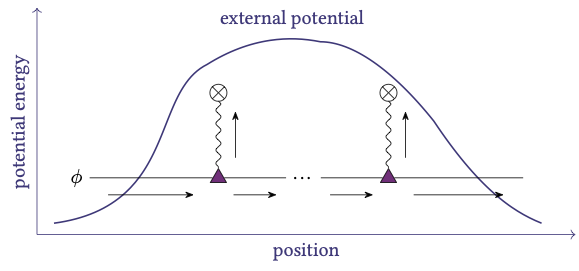
Quantum tunnelling of a particle through a potential barrier, while widely understood in quantum mechanics, has yet to receive a systematic treatment in quantum field theory (QFT) for particles coupled to an external field. Distinct QFT effects, such as the exchange of virtual particles and particle-antiparticle pair production and annihilation, can affect the dynamics of tunnelling in nontrivial ways, including transmission probabilities and tunnelling times. Our interest lies in determining the quantum corrections to particles tunnelling through an external (classical background) potential barrier. This is challenging as the interaction with the barrier is non-perturbative in the potential, requiring resummation of Feynman diagrams to all orders.
The first work by Zielinski et al. [1] aimed to reproduce relativistic quantum mechanics (RQM) using a field-theoretic approach for free scalar fields with a Dirac-delta barrier. Later, Zielinski et al. [2] suggested a more general approach for an interacting scalar theory with arbitrary potentials. However, the latter was left as an equation due to difficulty in analytical and numerical tractability. Recent developments by Fleming [3] on spinor fields highlighted a tractable approach by constructing a system of ordinary differential equations to obtain the transmission and reflection amplitudes. Yet this relied on spinor algebra and explicit expressions for the propagators to obtain the coupled equations.
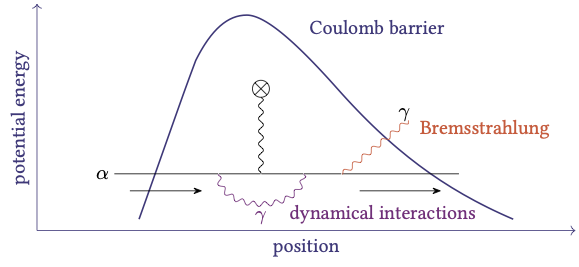
We generalise Fleming's core idea to present a general formulation based on self-consistent integral equations that can describe both scalar and spinor tunnelling through arbitrary scalar and vector potentials with finite support. This directly provides avenues for exploring barrier tunnelling in physically relevant theories such as scalar QED and QED in nuclear physics. The formulation can be reduced to a set of ordinary differential equations under certain conditions, further simplifying the numerical solution. Preliminary calculations were performed using a toy interacting scalar theory $A\phi^2$ with a light mediator (mass half that of the tunnelling particle) and the Dirac-delta potential. Results show $\sim 0.7-1.2\%$ quantum corrections to RQM at one-loop order, for unit dimensionless coupling to the mediator. As next steps, we aim to apply this formalism to scalar QED to explore $\alpha$-decay of nuclei and to address long-standing questions, including the effect of Bremsstrahlung during tunnelling [4] and, possibly, tunnelling times.
[1] R. Zielinski, C. Simenel, and P. McGlynn, Eur. Phys. J. C 84, 992 (2024).
[2] R. Zielinski, P. McGlynn, and C. Simenel, Eur. Phys. J. C 84, 967 (2024).
[3] M. Fleming, “Non-Perturbative Spinor Tunnelling in Interacting Quantum Fields”, Honours Thesis (The Australian National University, 2025).
[4] N. G. Kelkar and M. Nowakowski, Phys. Rev. C 89, 014602 (2014).