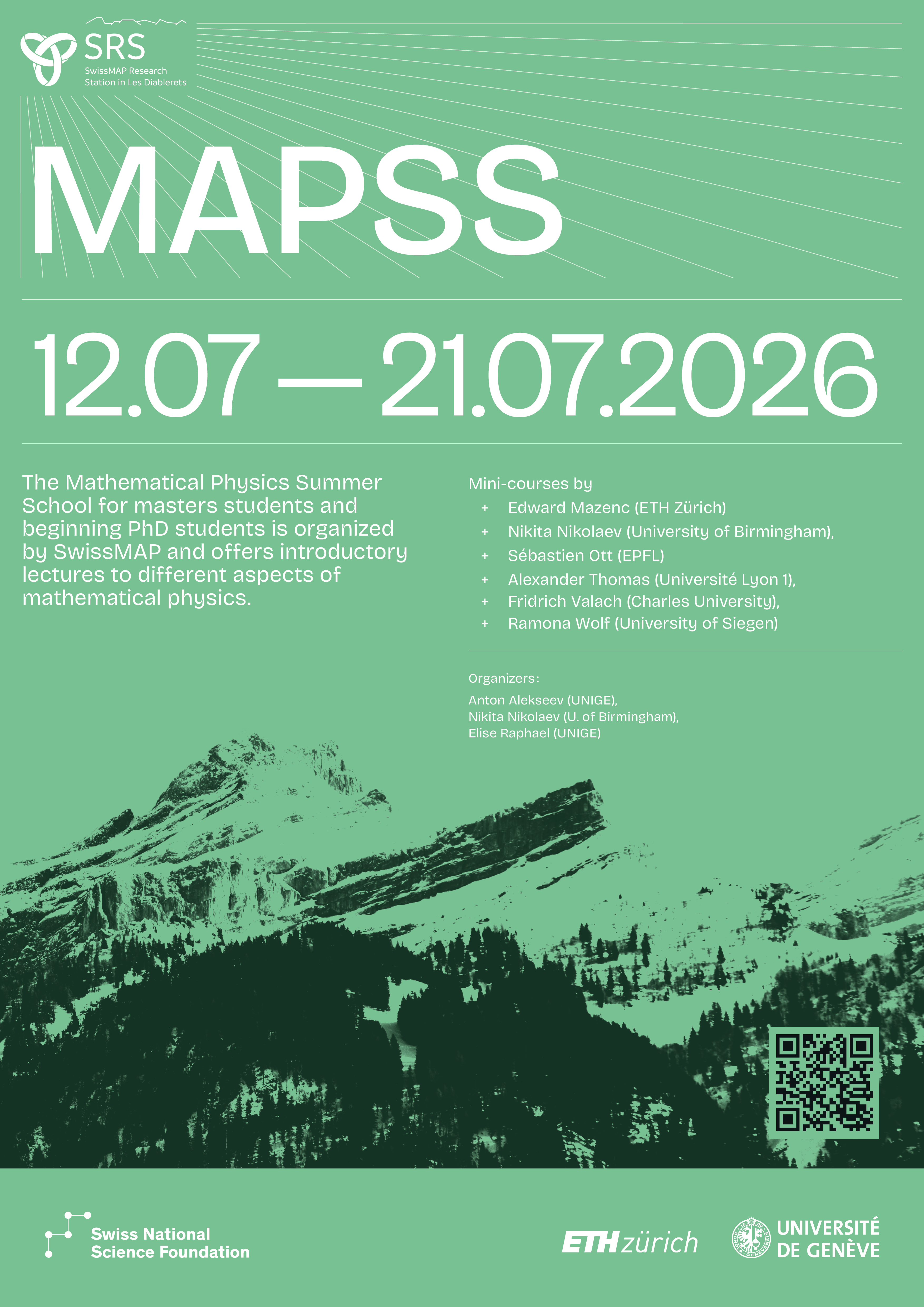
MAPSS
Hotel Les Sources
The Mathematical Physics Summer School for masters students and beginning PhD students is organized by SwissMAP and offers introductory lectures to different aspects of mathematical physics.
Mini-courses by:
- Edward Mazenc (ETH Zurich): Introduction to topological recursion
The ‘t Hooft expansion of large N matrix theories is remarkable in many ways. Unlike standard perturbation theory in quantum field theory, it is convergent (at each order in 1/N), and suggests a deep connection to string theory. However, Feynman diagram techniques quickly become cumbersome in actual calculations. Topological recursion was first introduced in the setting of the simplest large N theories, one-matrix models. It provides a powerful tool to resum infinitely many diagrams, by finding a universal recursion relation for observables. It turns out topological recursion is much more broadly applicable, solving a wide range of problems in mathematics and physics. These lectures will introduce the ‘t Hooft expansion in the original setting of matrix model, and show how topological recursion concretely operates.
- Nikita Nikolaev (University of Birmingham): Complex geometry
- Sébastien Ott (EPFL): Statistical mechanics
The course will start by introducing the basics of Statistical Mechanics formalism through the example of the Ising model/lattice gas (Gibbs measures, thermodynamic limit, thermodynamic functions). Then, we will review the different notions of phase transitions and their meaning, and show the occurrence of one in the Ising model. Finally, we will conclude by a short "guided tour" of what is a scaling limit, and the links between scaling limits of the critical 2D Ising model and Conformal Field Theory.
- Alexander Thomas (Université Lyon 1): Introduction to TQFTs
Topological quantum field theories are quantum field theories independent on the geometry of the spacetime (depending only on its topology). We will take a mathematical point of view, following the description of Atiyah, in which a TQFT can be seen as a "representation theory for manifolds with boundary". After the general definition, we will see in detail 1-dimensional TQFTs, which are tightly linked to knot theory, and 2-dimensional TQFTs, related to Frobenius algebras. If time allows, more examples with ideas from statistical physics will be discussed.
- Fridrich Valach (Charles University): Conformal Field Theory
Conformal field theory is an exciting area at the interface of mathematics and theoretical physics. It plays a central role in string theory and provides an invaluable description of statistical systems near their critical points; on the mathematical side it is (among other things) related to representation theory or the theory of special functions. After a brief physical motivation, this minicourse aims to introduce the basic concepts and lay foundations for this wide field, as well as explore connections to the above areas.
- Ramona Wolf (University of Innsbruck): Introduction to quantum information theory
Quantum information theory (QIT) extends the concepts and tools of classical information theory to quantum systems. By exploiting fundamental features of quantum mechanics, such as superposition and entanglement, quantum information processing enables tasks that are impossible in classical settings. This course introduces the mathematical framework of QIT, including quantum states, measurements, composite systems, and quantum operations. We will explore fundamental protocols such as quantum teleportation and superdense coding, and discuss how they exploit the distinctive properties of quantum mechanics.
The provisional registration deadline is April 30, 2026.