Choose timezone
Your profile timezone:
The experimental high energy physics in India was initiated by Dr. Homi Jahangir Bhabha (who is known for the Bhabha scattering) using the balloon flights as well as using GM counters in commercial flights. Then he has initiated a series of experiments at Kolar Gold field, which was the deepest underground laboratory during sixties to nineties as well as experiments based on the extensive air showers and cherenkov detectors. In absence of an accelerator in India, we are participating in different experiments in international laboratories, e.g., L3, D0, CMS, Belle(-II), but in parallel enhanced the infrastructures for home grown cosmic ray experiments. In the recent time, there are a few initiatives in neutrino physics using the atmospheric neutrino as well as reactor neutrino and also for the search of dark matter.
In his talk, I will give a brief overview of those experiments, with an emphasis of the instrumentation for the homegrown experiment as well as international participations and how mutually benefited from the participation from this national and international collaborations. I will end my talk with our future physics goals and possible new collaborations.
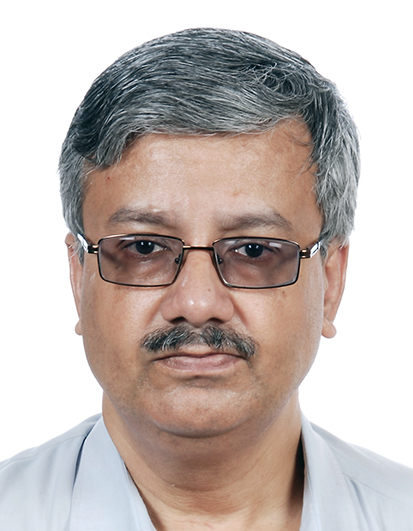.jpg)
In the year 1992 Prof. Gobinda Majumder obtained his M.Sc. (physics) degree from North Bengal University, WB, India and joined Tata Institute of Fundamental Research (TIFR), Mumbai as a graduate student. He worked in the L3 experiment at CERN, Geneva for his Ph.D thesis, ``Search for Supersymmetric particles in collisions at LEP''. But, his main contributions during that period were the searches for suitable scintillator detectors for the CMS electromagnetic calorimeter, its size, shape etc. The discovery of the Higgs boson in 2012 by the CMS experiment had come from that sub detector.
In March 1998, he joined Syracuse University, New York for his postdoctoral work, where he developed software for the CLEO-III Ring Imaging Cherenkov detector, Cornell Univ as well as did feasibility study for the proposed BTeV experiment at FNAL, Chicago, USA. In December 2000, he returned back to TIFR with a tenure track. Initially he had worked for the BELLE experiment at KEK, Japan for the discovery of new charmonium resonances. He had a crucial role for the design, construction, installation, calibration and physics of the CMS outer hadron calorimeter. He is contributing to the study of the Standard Model physics at the CMS experiment along with the development of software tools and new ideas to improve the performance of the CMS detector.
In parallel, starting from scratch, he has developed the complete simulation and reconstruction software for the proposed ICAL experiment at India-based Neutrino Observatory (INO), and developed the hardware components for it and later on he became the project director, INO.
At present he is a senior professor at TIFR. He has been elected as a fellow of all three science academies of India. Now, his primary focus is the detector development for the future collider experiments, particularly calorimeters using quantum sensors as well as pursuing for an underground facility for a multidisciplinary science in India.