The 1st EIC-phi collaboration meeting

Asia/Seoul
B15 (Room 5118) (Pukyong National University )

B15 (Room 5118)

Pukyong National University

Jong-Wan Lee (IBS-CTPU), Seung-il Nam (Pukyong National University)
Description

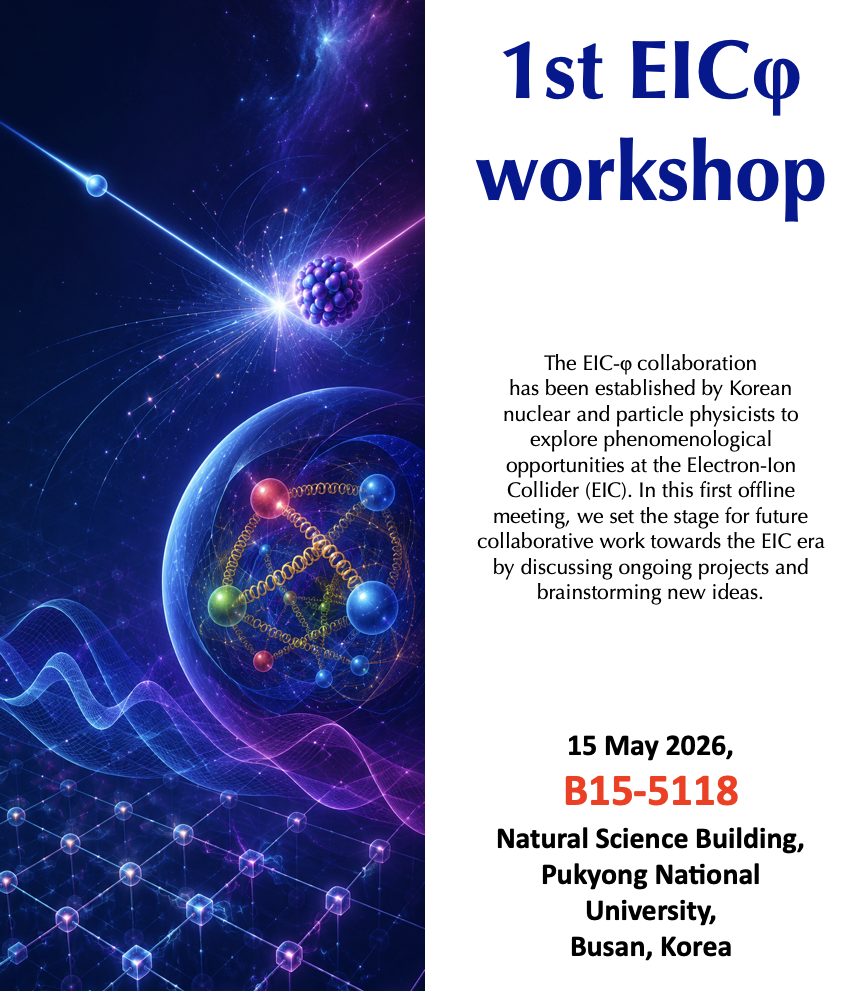
The EIC-phi collaboration has been established by Korean nuclear and particle physicists aiming to explore phenomenological opportunities at the Electron-Ion Collider (EIC). In this first off-line meeting, we set the stage for future collaborative work towards the EIC era by discussing on-going projects and brainstorming new ideas.


Registration
EIC-phi workshop registration
Participants
    • 1
      Registration

      Welcome and Registration for the Meeting

    • Morning session 1 - Jet physics
      • 2
        TBD
        Speaker: Prof. Daekyoung Kang (Sejong University)
    • Morning session 2 - QCD and nuclear structures
      • 3
        Introduction to GPD
        Speaker: Prof. June-Young Kim (Inha University)
      • 4
        Study of GPD using exclusive Drell-Yan process in p+$\pi^{-}$ collision
        Speaker: Prof. Yongsun Kim (Sejong University)
    • 12:00
      Lunch
    • Afternoon session 1 - Quankonium and Exotic Hadrons
      • 5
        TBD
        Speaker: Hee Sok Chung (Kangwon National University)
    • Afternoon session 2 - Lattice, AI and Quantum for EIC
      • 6
        Flowed Moments of Parton Distribution Functions
        Speaker: jangho kim (Seoul National University)
      • 7
        Flow-Based Global Proposals for Monte Carlo Sampling in SU(2) Lattice Gauge Theory

        We propose a formally valid machine-learning-assisted global proposal mechanism for Monte Carlo sampling in lattice gauge theory. The construction is based on a coupling-flow update on the SU(2) lattice-link manifold, in which active links are transformed conditionally on a frozen-link background. For fixed frozen links, the proposal is explicitly invertible and preserves the product Haar measure, so it can be embedded into a Metropolis-Hastings correction without requiring an explicit model of the full proposal density. We implement the method in two-dimensional pure SU(2) lattice gauge theory and benchmark it against a baseline local Metropolis algorithm used as a controlled reference kernel. In the present testbed, the learned proposal reproduces the target ensemble within statistical resolution across the tested configurations. In matched local-step comparisons, the learned proposal reproduces the target ensemble at a quality comparable to the baseline, but does not outperform the pure local baseline in the conservative matched-step case examined with seed-level statistics within this proof-of-principle setup. At the same time, a favorable mixed-step hybrid configuration yields a modest improvement in effective sample size per unit runtime. Because the learned transformation remains in a near-identity regime, the present results should be interpreted as a proof-of-principle demonstration of formal correctness and limited, configuration-dependent efficiency gain within a controlled comparison, rather than as evidence of superiority over optimized conventional update schemes. This work provides a concrete foundation for extending machine-learned nonlocal updates to larger lattices and non-Abelian gauge theories relevant to lattice QCD.

        Speaker: Seung-il Nam
    • 15:30
      Coffee Break
    • Open discussions
      • 8
        Hangang and EIC physics

        Hangang, the KISTI's 6th generation of national flagship supercomputer, is scheduled to begin operations at the end of this year. In this discussion, we brainstorm the potential applications of this powerful machine in EIC physics.

        Speaker: JONG-WAN LEE (IBS-CTPU)
    • 9
      Closing
    • 18:00
      Workshop Dinner (더금동)