
The scientific program will consist of a series of plenary and semi-plenary talks, mini-colloquia and special sessions. Mini-colloquia are an important part of the conference program that will gather specific scientific communities. Typically, a mini-colloquium should start with an introductory or overview talk on the subject at hand, followed by major advances in the last years by contributed talks. Young scientists, post-docs and PhD students are invited to give oral contributions, also poster contributions are possible. A mini-colloquium may comprise one or several sessions of 2 hours duration.
Program and Contributions CMD Mini-Colloquia (PDF)
Program and Contributions OePG Sections (PDF)
Full Scientific Program and Abstracts (PDF)
Plenary speakers:
Lyderic Bocquet (Ecole Normale Supérieure Paris)
Anna Coclite (University of Bari)
David Degerman (Stockholm University)
Edda Gschwendtner (CERN Schweiz)
Emanuel Gull (University of Warsaw)
Rupert Huber (University of Regensburg)
Reinhard Maurer (University of Vienna)
Michael Pepper (University College London
Harald Reichert (DESY Hamburg)
Heike Riel (IBM Zurich)
John M. Seddon (Imperial College London)
Alexander Shapiro (University of Graz)
Jairo Sinova (Johannes Gutenberg University Mainz)
Semi-plenary speakers:
Ana Akrap (University of Zagreb)
Yves Geerts (Université libre de Bruxelles)
Harald Giessen (University of Stuttgart)
Dominik Juraschek (Eindhoven University of Technology)
Pawel Kowalczyk (University of Warsaw)
Stefan Rotter (Vienna University of Technology)
$ $
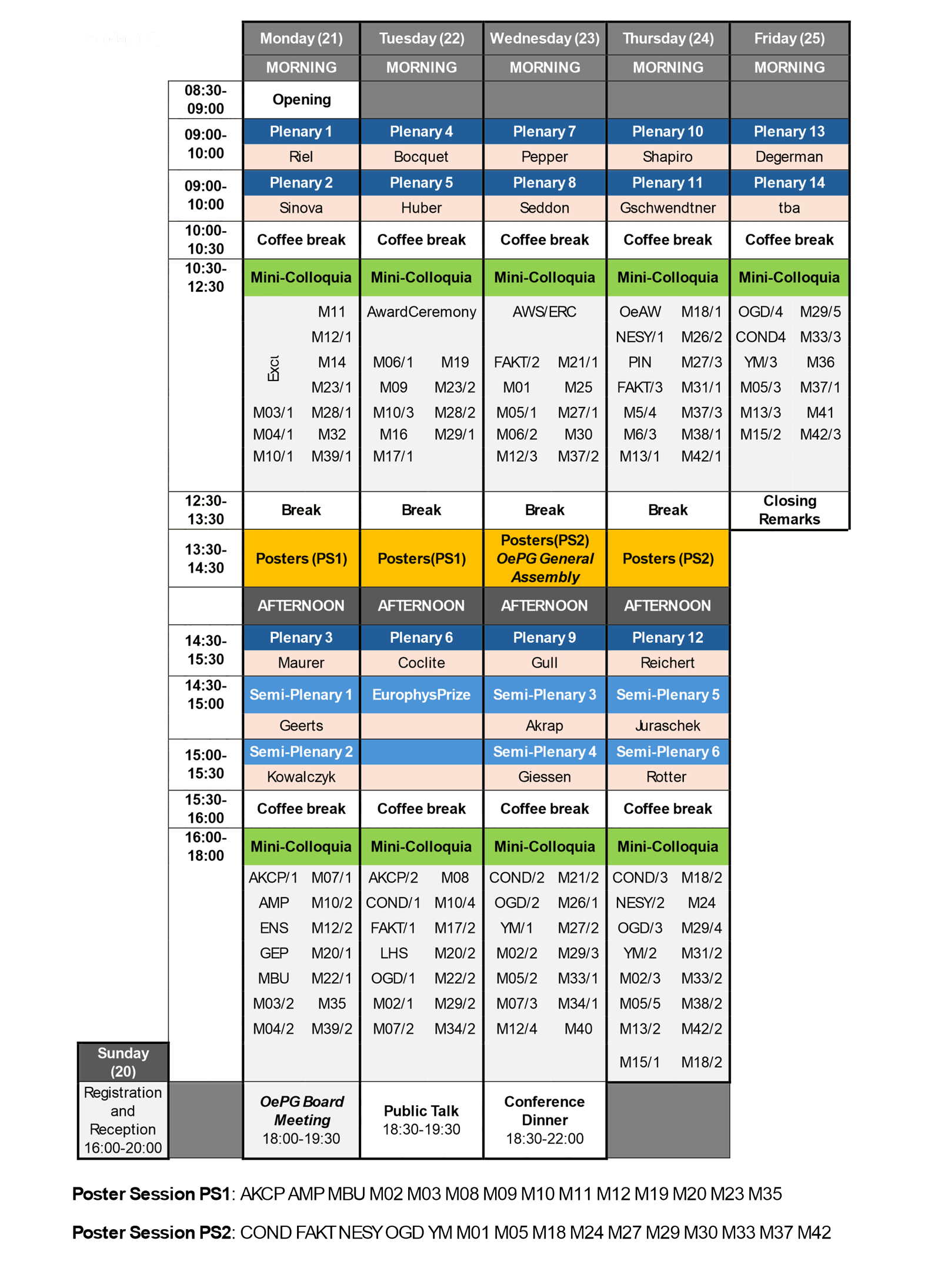
$ $
-
OePG
-
AKCP: Equal Opportunities in Physics
Chair: Andrea Navarro-Quezada (JKU Linz, Austria)
-
AKU: Acoustics
Chair: Holger Waubke (Austrian Academy of Sciences, Vienna, Austria)
-
AMP: Atoms, Molecules, Quantum Optics and Plasmas
Chair: Hanns-Christoph Nägerl (University of Innsbruck, Austria)
-
COND: Condensed Matter
Chair: Andrii Chumak (University of Vienna, Austria)
-
EnS: Energy and Sustainability
Chair: Robert Hauser (Carinthia University of Applied Sciences, Austria)
-
FAKT: Nuclear and Particle Physics
Chair: Florian Reindl (Austrian Academy of Sciences, Vienna, Austria)
-
GEP: History of Physics
Chair: Bruno Besser (Space Research Institute Graz, Austria)
-
LHS: Physics and School
Chair: Alexander Strahl (University of Salzburg, Austria)
-
MBU: Physics in Medicine, Biology and Environment
Chair: Rainer Leitgeb (Medical University of Vienna, Austria)
-
NESY: Physics of Neutron and Synchrotron Radiation Sources
Chair: Roland Resel (Technical University of Graz, Austria)
-
OGD: Surfaces, Interfaces and Thin Films
Chair: Margareta Wagner (Technical University of Vienna, Austria)
-
PIN: Physics - Industry
Chair: Peter Korczak
-
YM: Young Minds
Chair: David Steiner (University of Vienna, Austria)
-
-
OePG / CMD
-
Plenary / Semi-Plenary
Condensed Matter Division:
Chair:
Erich Runge (Technical University of Ilmenau, Germany)Board:
Laurence Ramos (CNRS-University of Montpellier, France)
Joaquim Agostinho Moreira (University of Porto, Portugal)
Christian Enss (University of Heidelberg, Germany)
Roberto Cerbino (University of Vienna, Austria)
Enrique Díez (University of Salamanca, Spain)
Amina Taleb (Synchrotron SOLEIL, Gif-sur Yvette, France)
Olivier Fruchart (EMA, Spintec CEA, Grenoble, France)
Julia Contreras García (Sorbonne Université, France)
Silke Bühler Paschen (University of Vienna, Austria)
María José Calderón (CSIC, Spain)
Venkata Kamalakar (Uppsala University, Sweden)
José Lado (Aalto University, Finland)
Laurence Noirez (CEA-Saclay, France)
Roberta Caruso (University of Naples, Italy)
Kees van der Beek (CNRS, Palaiseau, France)
Aleksandra Szkudlarek (University of Krakow, Poland)
Hannah Price (University of Birmingham, UK)
-
-
OeAW
-
ÖAW - Young Academy
-
-
Mini-Colloquia
More details about the mini-colloquia, especially the names of the invited speakers for each mini-colloquium, can be found under the following link:
https://oepg-cmd-jointmeeting2026.uni-graz.at/en/cmd-mini-colloquia/-
M01 - Electron correlations and phonons in quantum materials
Interactions among electrons and phonons, excitons and phonons, as well as between phonons themselves, play a crucial role in determining many technologically relevant material properties. These interactions significantly influence superconductivity, electrical and thermal transport, excitonic phenomena, polaron formation, and indirect optical absorption. This colloquium highlights both fundamental and computational research based on density functional theory for modeling strongly correlated systems in bulk and two-dimensional materials. Achieving a deeper understanding of these quasiparticles requires strengthened collaboration between theoretical and experimental research communities. A particular emphasis will be placed on integrating computational approaches into ongoing studies of strongly correlated electron systems. We will discuss general applications of scattering techniques using neutrons and photons, and how such approaches complement theoretical and computational studies of materials. Finally, we will provide an overview of the European Spallation Source (ESS) and its capabilities as a world-class neutron and light source facility, highlighting how these experimental tools can support research in material science and condensed matter physics. The program will include invited talks and oral presentations.
Organizers:
Christian Kenfack Sadem (University of Dschang, Cameroon)
Cornelius Lukong Fai (University of Dschang, Cameroon)
Jaures Diffo Tchinda (University of Maroua, Cameroon)
Christine Darve (IUPAP and European Spallation Source, Lund, Sweden) -
M02 - Heavy quasiparticles in heavy fermion compounds
Materials with heavy quasi-particles have rich phase diagrams with superconducting phases appearing next to ordered magnetic ones, as well as in close proximity to non-Fermi liquid behaviour and quantum criticality. The large effective masses in these materials enhance electron interactions, creating opportunities to develop unconventional phases of matter, such as superconductivity with complex order parameters, or phase transitions driven by Kondo physics. In this mini-colloquium at the CMD32 conference, we will highlight recent advances on establishing the underlying mechanisms driving such emergent behaviour in heavy fermion systems. Motivated by recent studies on the nature of the superconducting order parameter in Uranium and Cerium-based superconductors, this mini-colloquium will create a platform to discuss both experimental evidence and theoretical modelling in heavy-fermion materials. By linking measurements with theoretical investigations, this session aims at establishing a deeper understanding of emergent electron states and stimulate new directions for research in heavy fermion compounds.
Organizers:
Carolina de Almeida Marques (University of St Andrews, UK)
Markus Aichhorn (TU Graz, Austria)
Hermann Suderow (Universidad Autónoma de Madrid, Spain)
Gertrud Zwicknagl (TU Braunschweig, Germany) -
M03 - Correlated Materials Out of Equilibrium
Understanding correlated quantum materials far from equilibrium is a central challenge in condensed matter physics. Recent ultrafast optical, X-ray, and electron probes have uncovered hidden phases, light-induced superconductivity, and nonthermal electronic orders. On the theoretical side, new computational and analytical tools are providing crucial ways to predict and interpret these phenomena. With a focus on ultrafast processes, transient dynamics, and nonequilibrium steady states, this minicolloquium will bring together experimental and theoretical researchers to discuss correlated matter under nonequilibrium conditions. By connecting cutting-edge experiments with advanced modeling and theory, the session aims to identify common mechanisms that govern materials far from equilibrium and to discuss how controlled driving can be used to design new material functionalities.
Organizers:
Enrico Arrigoni (Graz University of Technology)
Gianluca Stefanucci (University of Rome Tor Vergata)
Denis Golez (Jozef Stefan Institute and University of Ljubljana)
Martin Eckstein (University of Hamburg) -
M04 - Non-crystalline quantum matter
Our understanding of the electronic properties of solid state systems heavily relies on Bloch’s theorem and the symmetry of ideal crystals under discrete translations. Disorder inevitably breaks this symmetry in real materials, but this is regarded as a weak perturbation in most cases. Anderson localization teaches us that the absence of translation invariance can have radical physical consequences. Localization can also occur in quasiperiodic systems, as illustrated by the Aubry-André model. The experimental observation of correlated phases in twisted graphene multilayers, which are quasiperiodic moiré systems, has lead to a renewed interest in quasiperiodic systems. On the theoretical front, it has been demonstrated that quasiperiodicity can stabilise new correlated phases. At the same time, the development of new numerical methods has enabled the modelling of systems exceeding billions of atoms. The goal of this mini-colloquium is to bring together experts working on different aspect of condensed matter systems which lack translational invariance, including: disordered systems, quasiperiodic systems, van der Waals and moiré materials, amorphous matter, and quasicrystals. Contributions covering the following topics are encouraged: Development of real-space computational methods; topological properties and correlations in non-crystalline matter; and phenomenology of non-crystalline matter.
Organizers:
Aires Ferreira (University of York, UK)
Bruno Amorim (Faculdade de Ciências da Universidade do Porto, Portugal)
Jose Lado (Aalto University, Finland)
Pedro Ribeiro (Instituto Superior Técnico, Universidade de Lisboa, Portugal) -
M05 - Transport in low-dimensional strongly correlated quantum systems
Recent advances in solid-state fabrication have pushed the field to a point where strong interactions along with quantum effects dominate and define new and yet unexplored states of matter. This breakthrough offers exciting opportunities for the development of both new fundamental physics and novel commercial applications. In the realm of solid-state quantum technologies, numerous challenges remain at both theoretical and experimental levels. To address these effectively, meetings and discussions on a platform that unites theorists and experimentalists are essential. The goal of this Mini-Colloquium is to unite experts from diverse fields of solid-state quantum physics, with a focus on quantum transport in low-dimensional systems (zero-, one-, and two-dimensional). It will serve as a platform to explore future opportunities in emerging solid-state quantum technologies and nanodevices, with particular emphasis on the role of quantum effects in strongly correlated low-dimensional systems. Additionally, the Mini-Cooloquium offers an excellent opportunity for young researchers and students to directly engage with leading experts in these areas.
Organizers:
Igor Yurkevich (Aston University UK)
Claire Marrache-Kikuchi (Paris Saclay University)
Vincent Humbert (Paris Saclay University)
Wolfgang Lang (University of Vienna) -
M06 - Interaction effects in correlated systems with higher-order Van Hove singularities and flat bands
Important advancements have recently been made in understanding of the role of Fermi surface topological transitions, van Hove singularities (VHs), and flat bands in correlated systems. Lifshitz transitions and VHs are known to have far-reaching consequences for strongly correlated systems. More recently, theoretical work has shown that even stronger singularities can be stabilized through higher-order VHs (HOVHs), raising the question of how such features drive electronic instabilities. The physics of VHs is important in a wide range of correlated electron materials, including ruthenates, heavy fermion compounds, bilayer graphene, and other moiré lattices where long-standing puzzles can be understood in the framework of higher-order VHSs (HOVHSs). Recent studies report new materials exhibiting unusual physics as a result of VHs and the emergence of flat bands, including twisted bilayer graphene, kagomé metals, and superconductors. When combined with strong correlations, flat bands can give rise to entirely new phenomena. This Mini-colloquium adresses how interaction effects are governed by HOVHSs and flat bands. Topics include (i) spectroscopies with ultra-high energy resolution to resolve VHs on the relevant energy scales, (ii) new experimental approaches to tune their energy and character, (iii) theoretical approaches combining ab-initio modelling with many-body techniques to determine the leading electronic instabilities, and (iv) synthesis of new compounds designed to realize the predicted ground states.
Organizers:
Joseph Betouras (Loughborough University, UK)
Peter Wahl (University of St-Andrews, UK)
Gertrud Zwicknagl (Technische Universität Braunschweig, Germany)
Silke Buehler-Paschen (Technische Universität Wien, Austria) -
M07 - Nickelate Superconductors: A New Platform for Unconventional Cooper-Pairing
A focused mini colloquia on superconducting nickelates is timely given the rapid pace of discoveries. Recent breakthroughs in Sm-based infinite-layer nickelates, showing superconductivity near 40 K, have reinvigorated the search for cuprate analogs and expanded the landscape of high-temperature superconductivity. These materials not only challenge existing theoretical frameworks but also call for new experimental approaches to probe their unconventional pairing mechanisms. Equally significant are reports of superconductivity in bilayer nickelates with Tc approaching 90 K under pressure, and 40–60 K with compressive strain at ambient pressure. Such results underscore the powerful role of structural engineering, extreme conditions, and epitaxial strain in enhancing superconductivity, pointing toward rational design strategies for nickelates at ambient pressure. Gathering experts in thin film growth, spectroscopy, and theory within a small symposium at the CMD conference would enable focused discussion on how layering and strain reshape electronic structures and elevate Tc. This Colloquium would also help shape the European research agenda at a pivotal stage, consolidating diverse results into a coherent framework. By concentrating on Sm-based infinite-layer and strain-engineered bilayer nickelates, the meeting could define scientific challenges, attract new researchers, and accelerate progress toward higher-temperature superconductors.
Organizers:
Ilya Eremin (Ruhr-University Bochum, Germany)
Karsten Held (TU Wien, Austria) -
M08 - Superconducting altermagnets - fundamentals and devices
Superconductivity and magnetism are often antagonistic orders, realizing competing states that rarely coexist. A fundamental reason is that in spin singlet superconductors, magnetism leads to depairing effects quenching superconductivity. Altermagnets are a novel type of magnetic materials featuring a net zero magnetic moment, yet a non-trivial spin splitting in momentum space. These features potentially allow the coexistence of superconductivity and altermagnetism either in bulk or in hybrid heterostructures, providing a new platform to leverage complex orders and functionality in superconducting materials. Ultimately, superconducting altermagnets provide a potential new strategy in superconducting spintronics and superconducting quantum technologies. This minicolloquium will bring the theoretical and experimental communities of superconductivity and altermagnetism, with the aim of exploring some of the potential new avenues in superconducting altermagnets, ranging from fundamental phenomena to new functional devices.
Organizers:
Jose L. Lado (Aalto University)
Aline Ramires (TU Wien) -
M09 - Magnetism and superconductivity in nanoscale 3D architectures
The symposium Magnetism and Superconductivity in 3D highlights recent experimental and computational advances in three-dimensional magnetic, superconducting, and hybrid nanoarchitectures, emphasizing phenomena that emerge beyond planar systems. Contributions will cover confinement effects in 3D superconductors, field-driven vortex pinning and flux quantization in complex W–C superconducting arrays, and reconfigurable superconducting architectures enabling local control of superconductivity. Additionally, curvature- and topology-induced effects in magnetization dynamics in curved and curvilinear nanostructures, and the emergence of effects like strong magnon-magnon coupling and new collective spin dynamics in 3D, will be discussed. Together with these new phenomena, the talks will cover recent technical advances for non-planar systems, including controlled 3D nano-printing of magnetic and superconducting materials, methods for engineering curvature and chirality, and advanced tomographic imaging and efficient computational methods in 3D. The symposium will thus provide a comprehensive overview of the state of the art in 3D magnetism and superconductivity and outline pathways for exploiting three-dimensional geometry, topology, and nanoscale design in next-generation quantum and spintronic devices.
Organizers:
Amalio Fernández-Pacheco (TU Wien)
Claas Abert (University of Vienna)
Naëmi Leo (University of Loughborough, UK) -
M10 - Mesoscopic superconductivity and quantum circuits
Mesoscopic superconductors are a natural choice in the quest to manipulate macroscopic coherent quantum states by electronic means. That is why superconducting devices are being investigated to realize novel quantum technologies for applications in quantum computation, simulation, and sensing. Therefore, understanding charge, spin, and heat transport in the coherent superconducting regime can help advance the second quantum revolution. Superconducting circuits have already led to beautiful quantum optics experiments in the microwave frequency domain and atomic physics experiments using superconducting qubits as artificial atoms. Still, while superconducting circuits are one of the most advanced platforms for the implementation of quantum information processing, more fundamental research is needed to improve the performance of qubits in terms of coherence time, gate time, reproducibility, and scalability, to the necessary level for practical use. Moreover, superconducting circuits can interact with electromagnetic, mechanical, and ferromagnetic degrees of freedom, thus representing a unique flexible platform to implement hybrid devices integrating different materials with complementary properties. The minicolloquium will bring together theorists and experimentalists to discussed topics including (but not limited to): coherence and dissipation in Josephson junctions and hybrid qubits and devices; quantum measurement and entanglement manipulation in superconducting circuits; hybrid quantum circuits and quantum memories.
Organizers:
Gianluigi Catelani (Juelich Research Center, Germany and Technology Innovation Institute, UAE)
Martin Weides (University of Glasgow, UK)
Gerhard Kirchmair (IQOQI Innsbruck, Austrian Academy of Sciences, Austria)
Johannes Fink (Institute of Science and Technology Austria, Austria) -
M11 - Electron-phonon coupling in correlated quantum matter
Correlatons in interacting quantum systems yield a variety of fascinatng new phases of mater, whose microscopic understanding and quanttatve predicton pose a tremendous challenge to many body theory. In partcular, the accurate descripton of the coupling between electronic and latce degrees of freedom, whose interplay with charge, spin, and orbital degrees of freedom can substantally afect the propertes of correlated quantum mater, is object of actve research. The Colloquium aims to advance the feld by gathering experts in many-body method developments to quanttatvely model electron-latce interactons in correlated electron systems both in ab-inito based model building and many-body methods for generic non-adiabatc and non local electron-phonon interactons, providing a descripton of electron-latce efects beyond the statc and semiclassical approach. We invite for contributons on the impact of phonons and latce distortons and their role in shaping phase diagrams, spectral and transport propertes, response functons, as well as the dynamics in correlated quantum matter. This Mini-Colloquium is supported by the speakers of the SFB QUAST - we declare the Mini-Colloquium as a joint event.
Organizers:
Sabine Andergassen (TU Wien)
Alessandro Toschi (TU Wien)
Thomas Schäfer (Università degli Studi di Trieste & MPI für Festkörperforschung)
Tim Wehling (Universität Hamburg) -
M12 - Recent Developments of the Polaron Theory
The polaron, as introduced by Landau, referred to the coupling of an electron with the lattice deformation it induces in a polar crystal. At present, the polaron concept has been greatly broadened to various contexts, for example, excitonic and ripplonic polarons, polarons in organic materials, in nanostructures, in quantum gases, and spin-orbit entangled polarons. Traditional theoretical frameworks of polaron physics were restricted on the linear-harmonic approximation for the phonon field and for the electron-phonon interaction. The inclusion of higher-order terms beyond the linear-harmonic approximation can markedly influence the optical response and kinetics of impurities embedded within crystals. In recent years, considerable effort in this direction resulted in the emergence of the concept of an anharmonic polaron. The present minicolloquium is partially focused on spin-orbit entangled anharmonic polarons, but it is not restricted to these areas. It aims to bring together experts in various aspects of polaron physics in different media (crystals, polymers, quantum gases, surfaces and layered structures) and to highlight recent developments in methodology and applications of the polaron concept.
Organizers:
Serghei Klimin (University of Antwerp, Belgium)
Jacques Tempere (University of Antwerp, Belgium)
Matthew Houtput (University of Antwerp, Belgium)
Cesare Franchini (University of Vienna, Austria) -
M13 - Localization Dynamics in Matter and Waves
Solitons are ubiquitous examples of spatial localization, often in movement. They include discrete breathers as envelope solitons. Striking examples in water are tsunamis and bores, but they appear in many other systems as optical waveguides, Josephson junction arrays, Bose-Einstein condensates, matter waves, and biological molecules, to name a few. Solitons appear both in theory, classical and ab-initio nonlinear dynamics, and experiments. They often have long lives, which may hinder heat evacuation in tokamak fusion reactors. Polarons and solectrons consist of a charge bounded to a local deformation and/or localized vibrational modes. They are often described using semi-classical models within the tight-binding approximation. Localization can also be in momentum as qbreathers, or in time, as rogue waves. Metamaterials allow for the engineering of especial properties including solitons. With time modulation, time crystals appear, as proposed by Nobel Laureate Frank Wilczek in 2012. Space-time metamaterials bring about new properties of localized excitations that appear within the frequency or momentum bandgaps. Electrons have also been described as topological solitons with Coulomb and Lorenz forces as a consequence, in this way, expanding the soliton concept to particle physics. This mini-colloquium intends to review recent advances and unify theories and approaches.
Organizers:
Juan F.R. Archilla (Universidad de Sevilla, Spain)
Manfried Faber (Technical University of Vienna, Austria)
Masayuki Kimura (Setsunan University, Japan)
Yusuke Doi (University of Osaka, Japan) -
M14 - Experimental Studies of Negatively Charged Ions
Negatively charged ions, or anions, play an important role in various scientific fields, including astrophysics, atmospheric chemistry and nuclear physics. Their properties, which are influenced by strong electron correlation and short-range polarisation potentials, present unique challenges for experimental and theoretical studies alike. This mini colloquium will highlight recent advancements in experimental results and techniques for studying anions. Topics covered will include electron affinities, detachment processes, laser-ion interactions, ion-ion collisions and applications in areas such as accelerator mass spectrometry, fusion energy and space exploration.
Organizers:
Robin Golser (University of Vienna)
Katrin Erath-Dulitz (University of Innsbruck)
Karin Hain (University of Vienna) -
M15 - Light-wave driven dynamics in quantum materials
Light plays a dual role in material science, acting as a probe of the lattice and electronic structure, but also as a powerful tool to control and design material properties. Driving quantum materials far from equilibrium with tailored light fields can induce new states of matter, including metastable phases such as light-induced superconductivity or charge-density waves, with intriguing prospects for technology. Beyond their potential applications, such light-induced phenomena raise fundamental questions about coherence, correlation, and collective excitations in strongly interacting systems. Recent advances in ultrafast light and terahertz (THz) sources enable experimental access to nonequilibrium quantum materials, ranging from Floquet engineering of electronic band structures to ultrafast spin and charge dynamics. In parallel, theoretical many-body and ab initio approaches matured to the point where quantitative simulations of complex materials out of equilibrium are becoming possible. In this mini-colloquium, we will bring together theorists and experimentalists to explore ultrafast light-matter interactions, nonequilibrium dynamics, and nonthermal phases of matter. We aim to foster scientific exchange, highlight synergies, and discuss future research in and applications of nonequilibrium quantum materials.
Organizers:
Anna Galler (TU Graz)
Alba De las Heras Muñoz (Max Planck Institute for the Structure and Dynamics of Matter, Hamburg)
Marcus Ossiander (TU Graz) -
M16 - Advances in Ultrafast Time-Resolved Ellipsometry
Uncovering the electronic structure dynamics of materials is essential both for the development of sophisticated devices as well as for fundamental physics understanding. In particular, optoelectronic devices operate under non-equilibrium conditions, where excited charge carriers cause changes in the electronic structure and lattice properties, and thus of optical properties, affecting their performance. Femtosecond time-resolved pump-probe ellipsometry or time domain ellipsometry are powerful tools to measures the transient complex dielectric function after excitation of charge carriers, providing vast knowledge about the electronic structure and spin dynamics of materials. Over the past decade this technique has matured and been applied to semiconductors, transition-metal dichalcogenides, correlated oxides, and organic materials. It has revealed hot carrier cooling, photoinduced phase transitions, ultrafast magneto-optical resonances, and interfacial charge transfer at solid–liquid boundaries, amongst other effects. This mini-colloquium will survey the state of the art in broadband implementations, imaging modalities, and analysis workflows, including models that connect Δε̃(ω,t) to microscopic processes. We will highlight results, discuss best practices, and map emerging directions. The goal is to consolidate a community across materials classes and define open challenges where time-resolved ellipsometry deliver unique insight.
Organizers:
Rüdiger Schmidt-Grund (Technische Universität Ilmenau, Germany)
Shirly Espinoza (The Extreme Light Infrastructure ERIC, ELI Beamlines Facility, Dolní Břežany, Czech Republic) -
M17 - Emerging trends in dielectric nanophotonics
Over the past decade, dielectric nanophotonics has emerged as a cornerstone of nano-optics. High index dielectric nanoparticles avoid the large ohmic losses of plasmonic ones, while supporting strong electric and magnetic Mie resonances that enable unprecedented control of light at the nanoscale. The drive of the field stemmed from the realization of optical metasurfaces, which are two dimensional arrays that can control the phase, amplitude and polarization of light with subwavelength resolution. However, the field has rapidly diversified: metasurfaces and metamaterials built from complex dielectric building blocks produce collective resonances that provide unprecedented spatial and temporal confinement of light, boosting light-matter interactions. In parallel, active dielectric platforms are enabling ultrafast tunability of optical functionalities. The interplay of nonlinear and chiral light–matter interactions is opening routes towards compact devices for frequency conversion and spin-selective responses, while concepts rooted in non-Hermitian physics are revealing new paradigms for loss, gain, and exceptional-point engineering. Novel platforms such as “Mie voids” and excitonic materials are broadening even further the design space, promising new exciting applications. In this context, the mini-colloquium will bring together experimentalists and theorists to map the current landscape, identify challenges and strengthen our ongoing European and international collaborations to explore next-generation dielectric nanophotonic devices.
Organizers:
Adrià Canós Valero (University of Graz and NAWI Graz, Austria)
Andreas Tittl (Nanoinstitute Munich and Ludwig-Maximilians-Universität München, Germany) -
M18 - Light-driven Processes at Interfaces
Light-driven processes at material surfaces are revolutionizing our understanding of non-equilibrium phenomena and catalysis at the nanoscale. Surface photocatalysis harnesses photon absorption in semiconductors to generate reactive charge carriers, while plasmonic catalysis leverages localized surface plasmon resonances to create hot electrons and modulates reaction pathways. Locally enhanced electromagnetic fields enhance sensing techniques, boost energy transfer, or even hybridize with other excitations – opening new fields in nanoscale polaritonics and lasing. This session will convene experts from catalysis, spectroscopy, plasmonics, and non-equilibrium physics to spark new impulses and foster the dialogue in this highly interdisciplinary field. Austrian research activities in these areas are currently being supported by the Cluster of Excellence MECS and the Special Research Area TACO.
Organizers:
Christian Schäfer (TU Wien)
Reinhard Maurer (University of Wien)
Stefano Corni (University of Padua)
Ilko Bald (University of Potsdam) -
M19 - Time-resolved photoemission orbital tomography
In their synergy project “Photoemission Orbital Cinematography: An ultrafast wave function lab” kicked-off in July 2023, the organizers of this mini-symposium have joined forces to enable ultrafast slow-motion imaging of molecular orbitals. With a resolution from femto- to attoseconds, the projects aims at videotaping the formation and breaking of bonds, watching charge transfer processes at surfaces or the motion of electronic wavepackets inside molecules. To date, the combinaton of photoemission orbital tomography (POT) with a momentum microscope, time resolved POT (trPOT) has already allowed for surface-based orbital videography capable of monitoring the charge-transfer dynamics across molecular interfaces. Moreover, by merging lightwave electronics with ultrafast photoelectron momentum imaging, sub-cycle band structure movies of lightwave-accelerated electrons on a surface have become possible. With this mini-symposium, we aim to provide a platform for the community working on timeresolved photoelectron momentum microscopy to exchange ideas, methods, and perspectives. At the same time, the symposium will serve as a milestone event for the “Orbital Cinema” consortium at about half-time of the project’s duration. We invite contributions from researchers pursuing related approaches and applications, both experimentally and theoretically, and we look forward to presenting and discussing the first major results of Orbital Cinema in the broader context of advancing ultrafast orbital imaging.
Organizers:
Peter Puschnig (Universität Graz)
Ulrich Höfer (Universität Regensburg)
Rupert Huber (Universität Regensburg) -
M20 - The new Frontiers of Angle-Resolved Photoemission spectroscopy: spin, time and spatial resolution
Angle-resolved photoemission spectroscopy (ARPES) is one of the most powerful tools for directly probing the electronic structure of materials, and it is rapidly evolving to meet the challenges of cutting-edge condensed matter research. Recent developments are expanding ARPES into new dimensions, combining spin, time, and spatial resolution to explore complex quantum systems. Spin-resolved ARPES reveals spin textures and topological states that are central to valley- and spintronics and quantum materials. Time-resolved ARPES captures ultrafast electron dynamics, providing insight into transient states that govern material properties. Spatially resolved ARPES allows the study of nanomaterials, nanoscale inhomogeneities and engineered structures, connecting local phenomena to macroscopic behaviour. This mini-colloquium will focus on the latest advances in integrating these capabilities into unified ARPES platforms, alongside theoretical progress in understanding spin and ultrafast photoemission processes. By bringing together experiments and theory, it will highlight how multidimensional ARPES is transforming our understanding of correlated materials, topological phases, nanostructures and quantum systems. The event aims to foster discussion and collaboration across the ARPES community, showcasing recent achievements and exploring the opportunities offered by the next generation of ARPES instrumentation.
Organizers:
Francesco Presel (University of Graz)
Giovanni Zamborlini (University of Graz)
Vitaliy Feyer (Forschungszentrum Jülich) -
M21 - Recent Developments in Machine Learned Interatomic Potentials
Machine learned interatomic potentials (MLIPs) have become essential tools for modeling condensed matter systems with near ab initio accuracy across extended length and time scales. This mini-colloquium will highlight recent developments that merge physical insight with advanced strategies for machine-learning inter-atomic interactions. Symmetry equivariant neural networks, transformer architectures, moment-tensor potentials, Gaussian-approximation potential-type approaches, and physically constrained graph based frameworks have expanded the applicability of MLIPs to complex crystalline, amorphous, and low dimensional materials. Increasingly, progress is defined less by raw accuracy, which often already surpasses the chemical accuracy threshold, than by advances in computational efficiency, stability, and generalizability. Additional topics include coupling ML force fields to electronic excited state dynamics and extending accessible time and length scales through coarse graining and adaptive resolution approaches. Discussion will address strategies for advanced MLIP parametrization, the choice of suitable benchmarks, uncertainty quantification, and the development of transferable, interpretable models for complex materials. A central topic of the symposium will also be, how MLIPs in the past years have lead to a true paradigm shift in the simulation of various physically relevant properties of both traditional as well as advanced materials systems. By bringing together experts from theory, machine learning, and computational materials physics, the colloquium aims to define the next directions in physically grounded and computationally efficient atomistic modeling.
Organizers:
Christian Dreßler (TU Ilmenau)
Egbert Zojer (TU Graz) -
M22 - Compressing complexity: machine learning in hard and soft condensed matter physics
Machine learning is becoming an integral part of condensed matter research, offering powerful new tools to model physical systems, uncover hidden patterns, and connect microscopic structure to macroscopic behavior. This mini-colloquium brings together experimental, theoretical, and computational researchers who apply machine learning across both soft and hard condensed matter. Topics of the mini-colloquium include ML-based phase identification, ML-supported trajectory analysis, reverse engineering of micro-and nano structures and generative data sampling. A special emphasis will be placed on physics-aware dimensionality reduction and data compression for classical and quantum many-body systems. In some systems, such physically informed compression enables us to reveal mechanisms that remain inaccessible to traditional experimental or simulation approaches; in others, multi-scale compression is essential simply to model the relevant processes with sufficient accuracy. By highlighting parallels between soft and hard condensed matter, the colloquium aims to foster exchange across communities and to identify general strategies for interpretable, transferable, and scalable modeling of materials.
Organizers:
Carina Karner (TU Wien)
Markus Wallerberger (TU Wien)
Emanuela Bianchi (TU Wien) -
M23 - Ab initio modeling and machine learning of crystal defects
Crystallographic defects play an important role to either enhancing desired properties of materials or to enable new functionalities not present in the ideal crystalline state. Point defects, for example, provide favourable electronic or optical properties of semiconductors or increase the strength of metallic alloys. Line defects, such as dislocations, are the origin for plastic deformation and play a decisive role for crystal growth phenomena. Grain boundaries control interfacial chemistry and are key for mechanical of metallic alloys or electronic properties of gas sensing materials. Introduction of a defect into a perfect crystal creates a challenge for ab initio modelling due to increase in the size of the system with lowered symmetry. This is where a combination of traditional methods with machine learning (ML) can make an impact. This mini-colloquium is devoted to achievements in using ab-initio and/or ML approaches for studying physical properties of crystallographic defects and their effect on material behavior. The investigated systems can vary from metals and semiconductors to 2D materials. Of particular relevance are electronic properties of point defects, e.g. dopants in semiconductors, including spin centers that can be used in quantum technologies. The symposium also welcomes submissions regarding correlation of defects with mechanical phenomena such as solute-solution strengthening or grain boundary segregation.
Organizers:
Oleg Peil (Materials Center Leoben Forschung GmbH, Austria)
Lorenz Romaner (Technical University of Leoben, Austria) -
M24 - Computational Frontiers in Structure Prediction, Lattice Dynamics, and Electron-Phonon Coupling
The computational study of materials - from predicting crystal structures to understanding lattice dynamics and electron-phonon (el-ph) coupling - has undergone a transformation in recent years. Problems that were once computationally prohibitive can now be tackled thanks to breakthrough methodologies. Machine learning interatomic potentials and Wannier function techniques, for example, have fundamentally expanded what is computationally feasible, enabling large-scale molecular dynamics, accurate phonon calculations in complex systems, and efficient el-ph coupling estimates. This mini-colloquium will showcase recent advances across this exciting frontier. We invite contributions on topics including: crystal structure prediction using modern computational methods; ML interatomic potentials for molecular dynamics and phonon properties; anharmonic lattice dynamics and finite-temperature effects; electron-phonon coupling and superconducting properties; scalable workflows combining density functional theory with surrogate models; and advances in Wannier interpolation and related techniques. Our goal is to bring together researchers pushing the boundaries of computational materials physics. We particularly welcome submissions showcasing applications of machine learning to these challenges, but also encourage contributions on complementary methodological advances. Early-career researchers are strongly encouraged to participate.
Organizers:
Christoph Heil (Graz University of Technology)
Lilia Boeri (Sapienza University of Rome) -
M25 - Magnetism Research in the Central Europe Region
Magnetism is entering a new regime where symmetry, topology, and ultrafast dynamics converge. This session spotlights altermagnetism, breakthroughs in novel magnetic platforms, van der Waals magnets, multiferroics, skyrmion-hosting chiral systems, and ferrimagnets. Talks will cover synthesis, band engineering, state-of-the-art probes, spin-orbit coupling, and topologically protected magnetic phenomena. By bridging between fundamental investigations, theory, and device concepts, the session will outline the path to spintronic devices.
Organizers:
Neven Barišić (TU Wien / Univ. Zagreb)
Wolfgang Lang (Uni Wien) -
M26 - 2D Material Research in the Central Europe Region
From atomically thin crystals to designer van der Waals stacks, two-dimensional materials are redefining how we build and investigate matter. This session gathers leading experts and young researchers from Central European countries to showcase their advances in synthesis, characterization, and theory–experiment feedback loops. By uniting fundamental insights with device-level demonstrations, the session aims to spark collaborations that accelerate the 2D materials ecosystem.
Organizers:
Neven Barišić (TU Wien / Univ. Zagreb)
Wolfgang Lang (Uni Wien) -
M27 - 2D Materials-Synthesis, Surfaces, Dynamics, Devices
Two-dimensional (2D) materials have exciting fundamental properties and a wide range of potential applications. This mini-colloquium will explore recent developments in the physics of 2D materials, across the physics, chemistry, and engineering of 2D systems. Contributions are invited on synthesis methods, structural characterization, theoretical modelling, and device-oriented implementation. Central themes include how growth conditions, substrate interactions, functionalisation, and interfacial structure influence the electronic, chemical, and morphological behaviour of 2D materials. The colloquium will further address dynamic processes such as lattice vibrations and charge dynamics, as well as interactions with the environment including molecular adsorption and ambient effects that shape the stability, performance and potential use of 2D materials. The colloquium aims to strengthen scientific exchange within the Austrian 2D materials community and beyond, offering a platform to discuss emerging concepts and theoretical-experimental synergies.
Organizers:
Anton Tamtögl (Graz University of Technology)
Anna Galler (Graz University of Technology)
Bernhard Bayer (TU Vienna)
Aleksander Matkovic (Montanuniversität Leoben)
Marco Sacchi (University of Surrey) -
M28 - Ultrafast and Topological Mechanisms of Ferroic Switching
The session addresses a timely and high-impact crossroads of materials physics and device-relevant functionality: switching of ferroic orders. Recent advances range from topologically protected switching processes in multiferroics, to ultrafast phononic control of magnetization, and to the dynamic manipulation of ferroic domain patterns. Rapid progress in high-resolution TEM, NV magnetometry, and synchrotron-based imaging is enabling unprecedented mapping of domain structures and switching dynamics on nanometre–picosecond scales. Ultrafast experiments have revealed non-thermal, sub-picosecond routes to reverse magnetic, structural, and polar orders, opening perspectives for energy-efficient memory and quantum devices. Complementary theoretical approaches and atomistic modelling predict complex switching pathways and reaction-like transformations that may reduce barriers and stabilize topologically protected channels. The invited contributions will span nonlinear optical probes, emergent nanoscale textures, phononic control, and topological mechanisms—reflecting the broad international expertise converging on this exciting frontier.
Organizers:
Andrei Pimenov (Vienna University of Technology)
Sergey Artyukhin (Istituto Italiano di Tecnologia, Genoa) -
M29 - Nanomechanical, Electromechanical, Optomechanical and Levitated Systems
Nano- and opto-mechanical systems have evolved from table-top demonstrations into versatile platforms for coherent control, precision sensing, and fundamental tests of quantum physics. The field has grown in a variety of fascinating directions. In the classical regime, micro- and nano-mechanical systems are highly valuable, serving as exceptional detectors and enabling seamless interfacing with quantum systems. In the quantum regime, levitated systems provide unparalleled isolation for ultrasensitive sensors and pioneering tests of quantum mechanics, while acoustic quantum systems offer flexible platforms for phonon manipulation and quantum transduction. Finally, hybrid systems that integrate mechanical resonators with superconducting qubits or other solid-state devices are opening new avenues for quantum state transfer and exploration of macroscopic quantum phenomena. This mini-colloquium aims to bring together leading experts and early-career researchers engaged in fundamental studies of these systems and other hybrid platforms coupled to phononic or nanoscale mechanical systems, including, among other topics: - dissipation, quality factor, noise-related effects and nonlinear dynamics; - quantum sensing and transduction; - cavity-induced backaction in electro- or optomechanical systems - hybrid coupling architectures, e.g. to electronic, magnonic, or excitonic excitations - etc. It will consist of 10 invited talks and several slots for contributed talks. We encourage submissions from junior scientists (graduate students, postdocs, and junior faculty).
Organizers:
Gianluca Rastelli (Pitaevskii BEC Center, CNR-INO, Trento)
Eva Weig (Technische Universität München TUM, Munich)
Silvan Schmid (Technische Universität, Wien) -
M30 - Focused Beam Technologies for Functional Nanodevices
The ability to modify, deposit, or remove matter with nanometer precision using focused electron and ion beams opens unique possibilities for the direct prototyping, tuning, and modification of functional devices. This mini-colloquium will provide an overview of the technological and scientific capabilities of focused beam technologies for creating and shaping materials toward the realization of functional nanodevices. With these technologies, a wide range of materials can be synthesized or tailored — from 3D nanomagnetic architectures and superconducting circuits to plasmonic nanostructures. Focused beams also enable the precise shaping and modification of existing materials, such as the etching and patterning of graphene and the local adjustment of optical or electronic properties. By showcasing these capabilities through selected examples and invited talks, the colloquium will highlight how focused beam technologies complement conventional fabrication methods and help to prototype functional devices for advanced studies, including those exploring quantum phenomena and emergent material properties.
Organizers:
Aleksandra Szkudlarek (AGH University of Science and Technology, Kraków, Poland)
Ivo Utke Empa (Swiss Federal Laboratories for Materials Science and Technology, Switzerland)
Katja Höflich (Helmholtz-Zentrum Berlin für Materialien und Energie, Germany)
Harald Plank (Functional Nanofabrication, Graz University of Technology, Austria) -
M31 - Metal and metal oxide particles for catalysis and sensorics
Nanoparticles as smallest portions of bulk material, form the basis for a whole range of new technologies. Due to the laws of quantum mechanics, such particles measuring only up to a few nanometers can behave completely different in terms of conductivity, optics or robustness than the same material on a macroscopic scale. In applications such as catalysis and sensorics, nanoparticles offer great advantages due to their large effective surface area compared to their volume. The development of synthesis methods with control over the composition, size and atomic structure of nanoparticles will be a key to prepare the desired materials. Several synthesis routes have been developed over the past years, from physical routes to fabricate well-defined ligand-free model catalysts by e.g. laser ablation or sputtering and helium droplet assisted aggregation of atoms or molecules of interest to chemical routes employing precursor molecules in solution yielding so-called ligand stabilized clusters, ultimately for the deposition of individual particles on model and technologically relevant supports. The created samples are typically studied by electron microscopies, X-ray spectroscopies, X-ray diffraction and scattering, electron energy loss spectroscopy, or photoemission electron microscopy. The proposed mini-colloquium will present lectures covering different aspects of the topic, both experimental and theoretical.
Organizers:
Wolfgang E. Ernst (TU Graz)
Günther Rupprechter (TU Wien)
Stefan Vajda (Heyrovsky Institute, Prague) -
M32 - Physical Vapor Deposition of Nitride Thin Films
The transition toward sustainable microelectronics is propelled by the need to reduce environmental footprint, minimize reliance on scarce or toxic elements, and ensure compatibility with established semiconductor manufacturing. Improving device efficiency and enabling material circularity are central to this transformation. Physical Vapor Deposition (PVD) represents an intrinsically eco-friendly thin-film synthesis method, offering low waste generation, the absence of hazardous chemical precursors, and safe, dry-process operation compared to conventional wet chemistry (MOCVD, MOVPE, ALD etc). Metal nitride thin films stand at the forefront of this movement due to their exceptional functional diversity and process versatility. They include metallic compounds such as TiN, superconducting NbN, semiconducting GaN and AlN, and advanced ferro- and piezoelectric such as AlScN, GaScN, AlBN. PVD techniquesm - including magnetron sputtering - enable precise, non-equilibrium control over stoichiometry, crystallinity, and nanoscale morphology, parameters that directly determine the electrical, mechanical, and piezoelectric properties of these materials. By advancing the understanding and application of these sustainable material systems, we aim to accelerate the development of high-efficiency, environmentally responsible semiconductors for next-generation sensing, resonator, and power electronic technologies. This symposium invites contributions on the synthesis, advanced characterization, and device integration of PVD-grown metal nitrides, including materials being developed under the umbrella of the "Wide Bandgap (WBG) Pilot Line." This colloquium will bring leading scientists and engineers together to discuss the critical challenges and the path toward achieving sustainable semiconductor materials manufacturing.
Organizers:
Sanjay Nayak (Silicon Austria Labs GmbH)
Marco Deluca (Silicon Austria Labs GmbH) -
M33 - Particle beams for material modification and analysis
Exploiting inelastic particle-surface interactions offers a powerful route to tailor material properties with precision, opening new opportunities across nanotechnology, catalysis, and quantum materials science. While particle beams are well-established methods for compositional analysis and imaging, impinging ions or electrons can also drive structural and compositional changes inaccessible to conventional processing, such as nanoscale perforation, implantation, or surface patterning. Inelastic surface interactions which drive electronic excitations enable modifications such as perforation in two dimensional membranes, define the ion implantation on the atomic scale in surfaces, and facilitate tailoring of optical or electronic devices. Unlocking the full potential of particle-induced material modifications requires detailed understanding of the complex electronic energy transfer between ions, electrons, and surfaces. The following defect dynamics can be understood through predictive ab-initio modelling, advanced microscopy of the defects and their migration, or in situ spectroscopy of surfaces and scattered particles. By combining fundamental studies with application-driven research this mini-symposium will showcase current experimental and theoretical research on particle-surface interactions and provide a platform for cross-disciplinary exchange among theoreticians and experimentalists to discuss a roadmap for controlled material modifications exploiting complex inelastic interactions and electronic surface excitations.
Organizers:
Milena Majkić (University of Pristina, Serbia)
Constance Toulouse (CRISMAT - Crystallography and Materials Science, University of Caen, CNRS, ENSICAEN, France)
Denise Erb (Helmholtz-Zentrum Dresden-Rossendorf - HZDR)
Anna Niggas (TU Wien, Austria) -
M34 - Soft meets hard – interfaces and interactions
Soft matter systems interacting with harder components, such as in nanocomposites or hybrid materials, are ubiquitous in biology and technology. For instance, mechanical properties of biological materials are strongly influenced by the interfaces between soft organics and mineral phases or crosslinked polymers. This enables fascinating functionalities such as considerable toughening, efficient actuation of motion, or even chemo-mechanical energy conversion and elastic energy storage. Similarly, confined soft matter systems can lead to significantly altered behaviour as compared to the bulk. Even simple liquids such as pure water or aqueous electrolytes can show emergent soft-matter like properties in nano-confinement, enabling new technologies for instance in sensorics, ionotronics, nanofluidics, or blue energy harvesting. This mini-colloquium aims at bringing together researchers from several different disciplines for a broad and interdisciplinary discussion of emerging new developments related to biological and soft matter at the interface to- or in confinement within hard matter. We welcome contributions (talks and posters) from (bio-) materials science, soft-matter physics, biophysics, nanotechnology and other related disciplines.
Organizers:
Helga Lichtenegger (BOKU University, Vienna)
Oskar Paris (Technical University of Leoben) -
M35 - Lipids, surfactants and polyelectrolytes
In aqueous solution, lipids, surfactants, and polyelectrolytes tend to self-organize into large scale superstructures. Lipids form diverse assemblies such as micelles, vesicles, and planar membranes, depending on environmental conditions. The curvature and elasticity of lipid membranes, dictated by their molecular composition, are crucial in regulating membrane functionality. In biology, these structural properties are essential for maintaining cellular integrity, controlling permeability, and regulating protein interactions. Surfactants strongly affect the surface tension and structural properties of aqueous interfaces. Additionally, many surfactant molecules give rise to a pH and ion dependent surface charge. Surfactant-induced modifications to lipid aggregates can alter membrane morphology, dynamics, and fluidity. Polyelectrolytes, including biological macromolecules such as polypeptides, DNA, RNA, and polysaccharides, modify the electrostatic environment at interfaces, affecting the stability and behavior of lipid and surfactant aggregates. Furthermore, self-assembling synthetic polyelectrolytes offer the ability to modulate the architectures and physiochemical characteristics of membranes at the molecular level. The formation, structure, and dynamics of lipids, surfactants and polyelectrolytes have important implications for drug delivery, protein functionality, colloidal stabilization, functional membranes, and much more. This mini colloquium will explore the role of lipids, surfactants, and polyelectrolytes in aqueous environments, focussing on their surface specific properties and interactions.
Organizers:
Douwe Jan Bonthuis (TU Graz, Austria)
Matej Kanduč (Institute Jožef Stefan, Ljubljana, Slovenia)
Georg Pabst (Uni Graz, Austria) -
M36 - Physics of cellulose based materials
This mini colloquium will provide a platform for researchers to discuss recent advances in the understanding and application of cellulose-based systems from a physical perspective. This perspective includes intriguing physical properties, physics-based methods to build cellulose based materials or to characterize complex processes therein. Contributions covering all forms of cellulose materials are highly welcome, ranging from traditional paper to modern cellulose foams, aerogels, and composites. Particular emphasis will be placed on porous and functionalized cellulose structures, where morphology and microstructure critically influence mechanical, optical, thermal, and acoustic properties. Studies that address the relationships between structure, processing, and performance, as well as modelling and characterization of cellulose-based materials across different length scales, are encouraged. The symposium aims to highlight both fundamental and applied aspects of cellulose physics, including topics such as deformation and failure mechanisms, transport phenomena, interactions with moisture, and the design of novel cellulose-derived functional materials. We seek to foster interdisciplinary exchange and to identify emerging trends and challenges in this rapidly evolving field. Through this mini colloquium, we hope to stimulate discussions that bridge the gap between traditional cellulose science and modern materials physics, and to inspire new collaborations exploring cellulose as a sustainable and multifunctional material platform.
Organizers:
Robert Schennach (TU Graz)
Karin Zojer (TU Graz)
Eduardo Machado (TU Graz) -
M37 - Emergent Behavior in Soft and Living Matter
Living systems, like cells, the cytoskeletal networks that actuate them, and the tissues that they form exhibit complex behavior, that arises from internal energy consumption and collective interactions far from equilibrium. Their non-living analogs, like suspensions of artificial micro swimmers, and swarms of micro robots offer conceptually elegant and engineered alternatives for understanding this physics, and its applications. Overall, recent years have witnessed remarkable progress in understanding the physical principles that govern organization and dynamics in soft and living matter systems. This mini-colloquium will bring together experimental, theoretical, and computational researchers to explore emergent phenomena in soft and living matter systems. Topics will span the collective dynamics of cytoskeletal filaments, self-assembling biomolecules, synthetic soft stimuli-responsive systems, active colloids, active and topological polymers, swimmers, and polymer networks. Emphasis will be on how complex behavior emerges from simple components under non-equilibrium conditions. Contributions from both biological and synthetic soft matter communities will foster cross-disciplinary dialogue and highlight common mechanisms underlying self-organization, pattern formation, and dynamic functionality in living and lifelike systems. The goal is to highlight cross-disciplinary advances, compare mechanisms across scales, and identify future directions where bio-inspired or biomimetic strategies intersect with non-equilibrium physics.
Organizers:
Emanuela Bianchi (TU Wien)
Sebastian Fürthauer (TU Wien)
Roberto Cerbino (University of Vienna)
Christoph Dellago (University of Vienna)
Sofia Kantorovich (University of Vienna)
Christos Likos (University of Vienna) -
M38 - Astronomy and Astrophysics across Austria
Austria hosts a wide variety of astrophysical research, spanning from our solar system to exoplanets that can hardly be resolved by telescopes. All this research is strongly supported by plasma theory, simulations on the fluid and particle scales, as well as direct and indirect observations. Often, magnetic fields and turbulent dynamics play a crucial role to understand new discoveries. In this session we aim to bring together Austrian astronomers and astrophysicists across their usual sub-disciplines to foster inter-disciplinary understanding and cooperation. Therefore, this session is open to all branches in the wide field of astronomy and astrophysics, including research from the largest structures in the universe, cosmological and galactic research, as well as down to the relatively small scales of the solar system, which includes the Sun and the planets, their magnetic field processes, and small bodies like comets and inter-planetary dust particle orbits. This session also targets all astronomers and astrophysicists that attend the ÖPG meeting 2026 because the Austrian Society for Astronomy and Astrophysics (ÖGAA) will hold its general assembly on the afternoon and evening of the 24th of October 2026 at University of Graz, too.
Organizers:
Philippe-A. Bourdin (University of Graz)
Manuela Stadlober-Temmer (University of Graz) -
M39 - Next generation gravitational wave observations
Gravitational waves have opened an entirely new window to the observation of our universe, both on their own, and in the context of multimessenger investigations. The next generation of gravitational wave detectors is in the preparatory stage, including the Einstein Telescope, in which Austria intends to participate, and the LISA space telescope. Both will provide unprecedented sensitivity and statistics, with event rates and types of events orders of magnitude beyond the current possibilities. This requires preparations from many angles. One is, of course, to fully exploit the provided data. Another one is to envision new avenues for exploring the data. The unprecedented precision will not only allow us to address astrophysical problems that are still open, but may, in fact, also allow us to explore quantum gravity for the very first time observationally. In many theories of quantum gravity, black holes are not structureless; thus, signals of their mergers may be modulated, akin to what happens for neutron stars. This symposium will bring together experts to prepare for these new stages in gravitational wave astronomy, discussing both efficient ways to acquire data and novel ways to utilize it, thereby preparing the Austrian community to play a significant role in this groundbreaking new area.
Organizers:
Gianluca Inguglia (Marietta Blau Institute, ÖAW, Vienna, Austria)
Ulyana Dupletsa (Marietta Blau Institute, ÖAW, Vienna, Austria)
Michela Mapelli (Universitaet Heidelberg)
Alessia Platania (University of Graz, Austria) -
M40 - Phenomenology and novel observables at future colliders
The FCC ee is the most likely option for a next flagship experiment of collider particle physics. Succeeding the High Luminosity upgrade of the Large Hadron Collider, the tandem of future colliders will deliver an unprecedented precision to explore the nature of the Higgs boson, the top quark, and electroweak symmetry breaking to shed further light onto fundamental interactions and their role in the the early Universe. Leveraging future colliders calls for novel observables and analysis techniques, and the most detailed understanding of the reaction’s final state. The aim of this mini colloquium is to bring together experts in all aspects of collider physics to take stock of a pathway to cutting-edge phenomenology at future colliders. Emphasis will be put on complex final states involving jets and multiple electroweak bosons, and how precision electroweak and jet physics can join forces with hadron physics and the insights from energy correlators to obtain the most reliable descriptions of hadronic final states. This colloquium will also provide a prime setting for meetings with our European partners within the COMETA or SHARP COST actions, or the MCnet collaboration, and we will promote the event as such.
Organizers:
Simon Plätzer (University of Graz and University of Vienna)
Lisa Benato (Marietta Blau Institute, ÖAW, Vienna)
Gernot Eichmann (University of Graz)
Richard Ruiz (Institute of Nuclear Physics, Polish Academy of Sciences) -
M41 - Hybrid Intelligence for the Quantum Era
The landscape of modern science and technology is being rapidly reshaped by artificial intelligence (AI) via the powerful tools for ab initio design, data analysis, optimization and control. Particularly, in the domain of quantum physics where experiments are rigorous and tend to generate highdimensional datasets and where device architectures are based on complex parameter spaces, AI offers new pathways to facilitate accelerated innovation and discovery. However, real progress can only arise from the integration of fundamental physical principles and AI and machine learning. This synergy is termed as the hybrid intelligence and leverages the strengths of both domains, namely the rigorous, interpretation and predictive characteristics of physics and the adaptability and pattern recognition features of AI. This mini colloquium aims to highlight the emerging role of hybrid intelligence in the advancements of quantum science and technology. Topics will include physics-informed machine learning, AI-driven quantum material discovery, autonomous laboratories for device fabrication and low-temperature measurements, and intelligent strategies for error mitigation and noise-resilient quantum sensing. By promoting interdisciplinary discussions between physicists, computer scientists, and engineers, the session aspires to pinpoint how hybrid strategies can unify theory and experimentation, strengthen reproducibility, and accelerate the innovation of next-generation quantum technologies. The event will delve into how the fusion of AI and physics can chart a transformative course for the quantum age.
Organizers:
Rajdeep Adhikari (Johannes Kepler University, Linz)
Alberta Bonanni (Johannes Kepler University, Linz) -
M42 - Advances in Magnonics
Spin waves are collective precessional oscillations of electron spins that propagate through ordered magnetic media. Their quantised excitations are magnons, bosonic quasiparticles that carry angular momentum and energy. Magnonics explores magnon dynamics for both practical applications—such as information processing, signal routing, and sensing—and for advancing fundamental physics in various platforms. It is an emergent, fast-growing area of solid-state physics that bridges condensed-matter physics, materials science, microwave engineering, and quantum technologies. This mini-colloquium will gather leading research groups in magnonics from Vienna, Linz, and Graz with invited guests from abroad to present recent results and outline current challenges. We will highlight progress in radio-frequency (RF) applied magnonics, AI-driven inverse-design magnonics, where machine-learning tools optimise complex magnonic circuits, and will cover quantum magnonics, focusing on the single-magnon regime. The colloquium aims to catalyse dialogue across subfields, foster collaborations, and map opportunities for magnon-based technologies in computing, communications, and precision sensing.
Organizers:
Andrii Chumak (University of Vienna)
Dieter Süss (University of Vienna )
-
-
Other
-
Other
-
OePG Awards and ERC
-