Speaker
Description
First-order phase transitions are known to be suppressed by arbitrarily weak quenched disorder in two-dimensional and lower systems, a phenomenon referred to as the rounding effect. In three-dimensional systems, numerical studies have reported similar behavior in discrete models, although a finite disorder strength is required. In contrast, evidence for this effect in three-dimensional continuous systems remains limited.
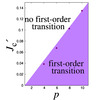
Motivated by experimental observations that the first-order isotropic–nematic (I–N) transition disappears in rod-like micellar systems under certain conditions, we investigate Lebwohl-Lasher liquid-crystal models with randomized interaction coefficients and extended higher-order orientational couplings, serving as representative three-dimensional continuous random-bond systems. The Hamiltonian is given by $-\sum_{<i,j>} J_{ij}(s_i\cdot s_j)^p$ , where $J_{ij} = J_i \times J_j$ with random variables $J_i$ drawn from $\mathcal{N}(J_0,\, J^2)$, and $p$ is an even positive integer. As a measure of the randomness, we use $J’^2 := \mathrm{Var} [J_{ij}]$. Using Metropolis and Wang-Landau algorithms, we examine the emergence of the rounding effect and characterize its properties.
We provide numerical evidence for the occurrence of the rounding effect in three-dimensional liquid-crystal systems and demonstrate the existence of a finite disorder threshold $J'_c$, consistent with previous results for discrete models. Furthermore, our results suggest that under sufficiently strong disorder, the system may enter a regime that cannot be straightforwardly described within the conventional second-order transition framework. We also discuss the influence of different probability distributions of random interactions on the I–N phase transition.