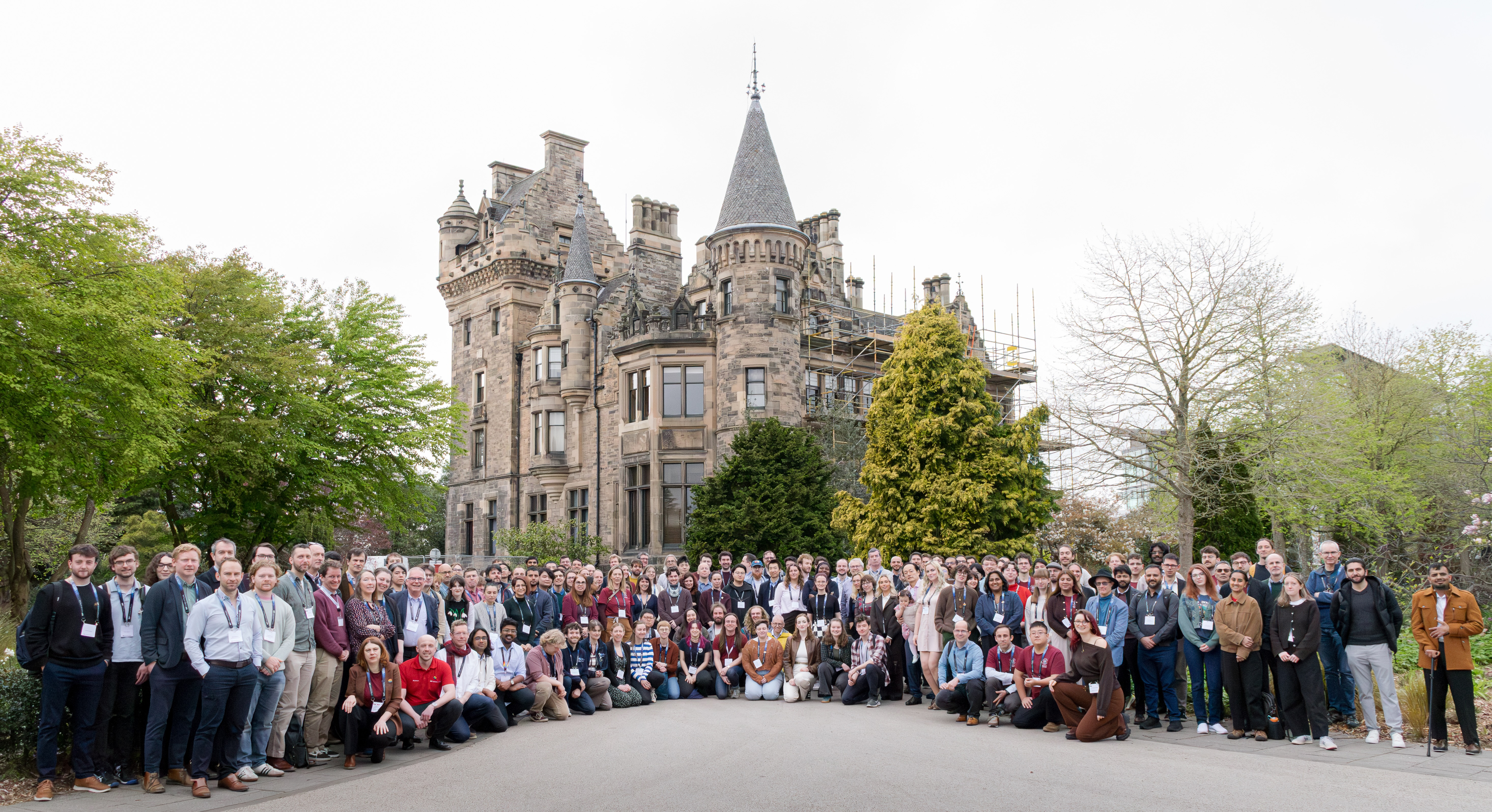
Conveners
Parallel - colliders: Wednesday Prestonfield
- Sara Alderweireldt (The University of Edinburgh (GB))
Parallel - colliders: Friday Pentland
- Daniel Foulds-Holt (University of Edinburgh (GB))
-
Sudev Pradhan (University of Sheffield (GB))08/04/2026, 15:45Collider physicsParallel talk
Precise modelling of hadronically decaying tau leptons is critical for many ATLAS measurements and searches, particularly in the top quark, electroweak, and Higgs sectors. The higher centre of mass energy and increased pile up conditions of Run~3 require updated, data driven calibrations of tau reconstruction and identification performance over an extended kinematic regime.
This talk...
Go to contribution page -
Betsy Cunnett (University of Sussex (GB))08/04/2026, 16:00Collider physicsParallel talk
A combined measurement of processes in which a top-quark is produced in association with additional particles using the full Run 2 dataset collected by the ATLAS experiment at the LHC is presented. The results are interpreted within the framework of the Standard Model Effective Field Theory (SMEFT), allowing constraints to be placed on dimension-six, top-sector operators.
ATLAS top-quark...
Go to contribution page -
Alberto Plebani (University of Cambridge (GB))08/04/2026, 16:15Collider physicsParallel talk
The $W^+W^−$ process is very interesting in that it can provide important tests of the electroweak gauge structure of the Standard Model. This contribution focuses on the opposite-sign opposite-charged $W^+W^-\to e\mu\nu\nu$ production, where a measurement with the partial Run3 dataset could provide insights on the CP nature of the anomalous triple gauge coupling.
Go to contribution page
In particular, this... -
Bhupesh Dixit (University of Liverpool (GB))08/04/2026, 16:30Collider physicsParallel talk
HH->bbtautau lies in the sweetspot for the study of di-Higgs owing to its relatively low background and significant branching ratio, making it the most sensitive channel according to the ATLAS Run2 results for the study of Higgs self-coupling. Using Run2+Run3 data collected by the ATLAS Experiment, a significant improvement is expected in the sensitivity to the signal strength. This is an...
Go to contribution page -
Rachel Ashby Pickering (University of Warwick (GB))08/04/2026, 16:45Neutrino PhysicsParallel talk
Two-Higgs-Doublet-Models are theoretical extensions of the standard model that are able to account for some of its unanswered questions, for example the source of the matter/antimatter asymmetry in the Universe. They predict 5 bosons, the scalar/pseudoscalar H/A and the charged H+ and H-, alongside the h (the standard model Higgs boson). This talk will present the (currently blind) search for...
Go to contribution page -
Snigdho Chakraborty (University of Warwick (GB))08/04/2026, 17:00Machine learning and reconstructionParallel talk
The High-Luminosity LHC (HL-LHC) will push the ATLAS experiment into an unprecedented regime of pile-up, data volume, and analysis complexity. In this environment, traditional calibration paradigms, while robust, face increasing pressure in terms of scalability and development effort.
For small-radius jets, the current Monte Carlo (MC) Jet Energy Scale (JES) calibration proceeds through...
Go to contribution page -
Ivo Young (University of Glasgow (GB))10/04/2026, 11:00Collider physicsParallel talk
Both the ATLAS Collaboration and the CMS Collaboration have recently observed quantum entanglement in top-quark pairs using Run 2 data; the highest energy scale at which quantum phenomena have ever been probed. I will present new measurements of quantum discord and related quantum observables in ttbar events, focusing on both the dileptonic and single-lepton decay channels. I will discuss the...
Go to contribution page -
Tom Elliot (Royal Holloway, University of London (GB))10/04/2026, 11:15Collider physicsParallel talk
Heavy Z' gauge bosons are predicted to exist by a number of promising theories of physics beyond the Standard Model, including GUTs. Many Z' models predict decay into a pair of oppositely charged electrons or muons. These decay channels offer clear, low-background signatures with fully reconstructed final states - ideal for discovery by a general purpose collider experiment like ATLAS. A...
Go to contribution page -
Juan Jose Juan Castella (University of Cambridge (GB))10/04/2026, 11:30Collider physicsParallel talk
Precision measurements of rare decays of b-mesons are excellent probes for indirect new physics searches. They are greatly suppressed in the standard model and thus are highly sensitive to contributions from new physics. Many observables serve as targets for these studies, allowing for a wide range of tests of the standard model (SM). For example, charge-parity (CP) asymmetries allow to test...
Go to contribution page -
Alex Veltman (The University of Edinburgh (GB))10/04/2026, 11:45Collider physicsParallel talk
Searches for new BSM physics at the ATLAS experiment typically target particles that decay promptly, very close to the collision point. New physics has so far evaded these searches. Multiple BSM models predict new long-lived particles (LLPs) with decay lengths ranging from millimetres to kilometres. In new physics scenarios where LLPs couple preferentially to heavy particles or to leptons, tau...
Go to contribution page -
George Hallett (University of Warwick (GB))10/04/2026, 12:00Collider physicsParallel talk
Following the recent first observation of baryonic CP violation in $\Lambda_b \rightarrow p K^- \pi^+ \pi^+$ with the Run 1 and 2 dataset, it is vital to study the pattern of CP asymmetries and branching fractions in a wide range of baryonic decay modes. These measurements form important inputs to theoretical approaches such as QCD factorisation.
The upgraded LHCb detector operates at an...
Go to contribution page -
Aidin Masouminia (IPPP, Durham University)Collider physicsParallel talk
Longitudinal electroweak gauge bosons are the most technically delicate ingredient of electroweak parton showers: in the broken Standard Model, the gauge component of a longitudinal polarisation does not cancel diagram by diagram, but is related by Ward identities to amplitudes with an insertion of the associated would-be Goldstone field. Building on the default \textsf{Herwig~7} treatment...
Go to contribution page