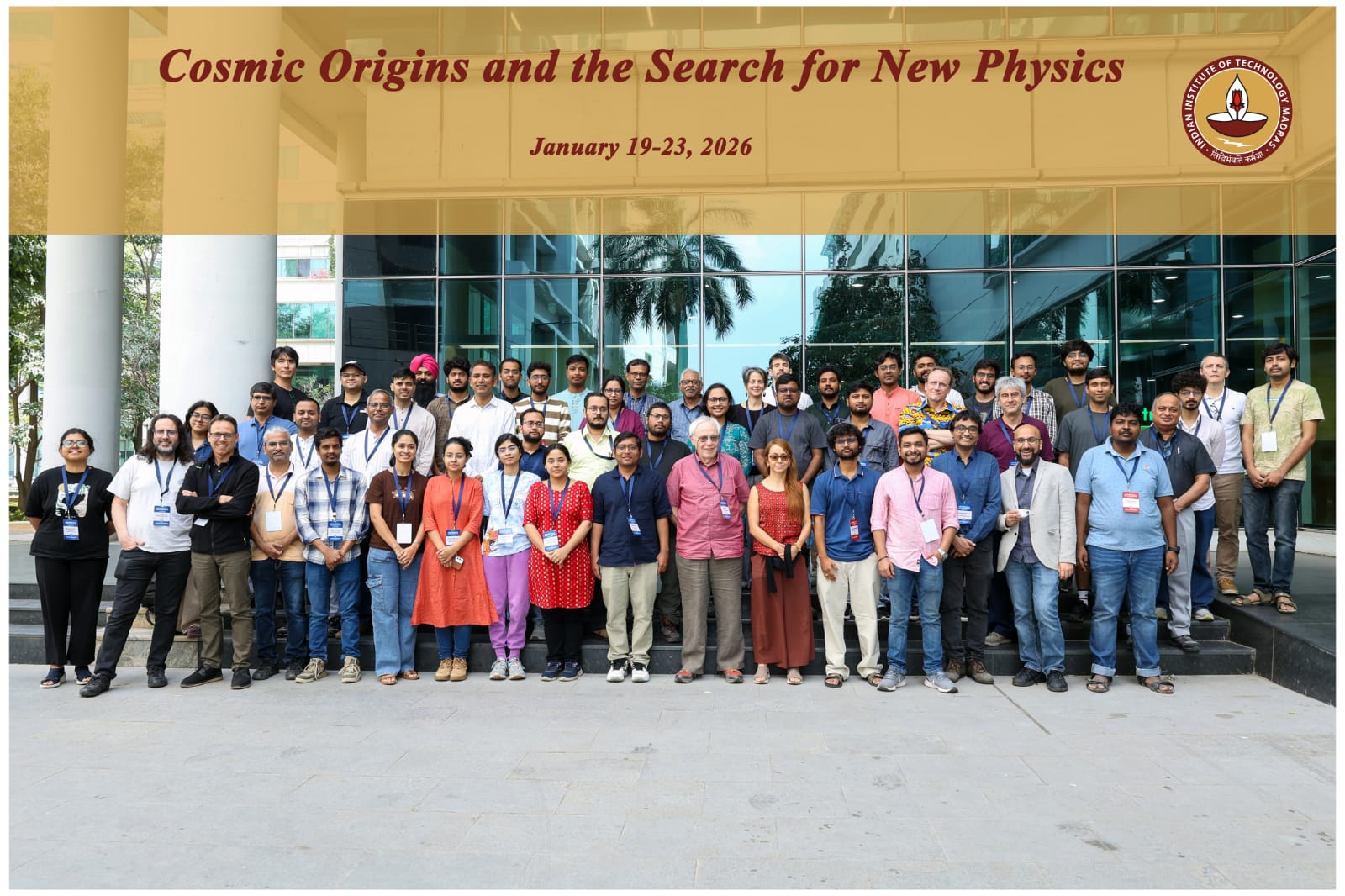
Cosmic Origins and the Search for New Physics
Saha and Sarabhai Auditoriums
Indian Institute of Technology Madras, Research Park
This Conference will focus on the physics related to the early universe. With the detection of gravitational waves by the LIGO-VIRGO collaboration and the hint of a stochastic gravitational wave background by the pulsar timing arrays, there has arisen a tremendous scope for constraining the primordial correlations over small scales. In the coming decades, primordial gravitational waves are expected to be constrained over a wide range of frequencies. It has been recognized that these observations will perfectly complement those involving anisotropies and spectral distortions in the cosmic microwave background, distribution of the large scale structure, and observations of neutral hydrogen, over larger scales. There has been significant theoretical and observational developments in these directions over the last few years, leading to a substantial gain in our understanding of the physics operating in the early universe. In particular, the observations have led to certain cosmic anomalies, which may require new physics to resolve. This Conference is aimed at bringing together experts on the origins of the primordial perturbations and their evolution through the history of the universe to examine if recent observations point to new physics. Broadly, the following topics will be covered:
- Origin and evolution of primordial perturbations
- Sources of primordial gravitational waves and their detection
- Primordial magnetic fields and their signatures
- Nature and origin of dark matter
- Masses of neutrinos and implications for cosmology
- Anomalies and tensions in cosmology
Scientific organizing committee
Fabio Finelli (INAF OAS, Bologna)
Dhiraj Hazra (IMSc, Chennai)
Raghuveer Garani (IITM, Chennai)
Laura Lopez-Honorez (ULB, Brussels)
L. Sriramkumar (IITM, Chennai)
Vincent Vennin (LPENS, Paris)
-
-
09:30
→
09:45
Welcome Saha and Sarabhai Auditoriums
Saha and Sarabhai Auditoriums
Indian Institute of Technology Madras, Research Park
IITM RESEARCH PARK Kanagam, Tharamani, Chennai, Tamil Nadu 600113 -
09:45
→
10:30
Loop corrections to inflationary power spectra: Matteo Braglia Saha and Sarabhai Auditoriums
Saha and Sarabhai Auditoriums
Indian Institute of Technology Madras, Research Park
IITM RESEARCH PARK Kanagam, Tharamani, Chennai, Tamil Nadu 600113 -
10:30
→
11:00
Coffee Break 30m Saha and Sarabhai Auditoriums
Saha and Sarabhai Auditoriums
Indian Institute of Technology Madras, Research Park
IITM RESEARCH PARK Kanagam, Tharamani, Chennai, Tamil Nadu 600113 -
11:00
→
11:45
Testing cosmic inflation with gravitational wave experiments: Gianmassimo Tasinato Saha and Sarabhai Auditoriums
Saha and Sarabhai Auditoriums
Indian Institute of Technology Madras, Research Park
IITM RESEARCH PARK Kanagam, Tharamani, Chennai, Tamil Nadu 600113 -
11:45
→
12:15
Gravitational Reheating: Debaprasad Maity Saha and Sarabhai Auditoriums
Saha and Sarabhai Auditoriums
Indian Institute of Technology Madras, Research Park
IITM RESEARCH PARK Kanagam, Tharamani, Chennai, Tamil Nadu 600113Our present understanding of the reheating phase is incomplete due to a
lack of observations. Apart from its cosmological implications, the reheating should
play a vital role in particle physics and inflation model building. Conventionally
reheating dynamics are modeled by invoking arbitrary coupling among the inflaton
and daughter fields. Such an approach lacks robust cosmological predictions due
to its arbitrary couplings and is difficult to verify through observation. In this talk, we
discuss reheating scenario where the inflaton is coupled with all the daughter fields
only gravitationally. Besides being successful in reheating the Universe, the
scenario offers a strong cosmological prediction of the primordial gravitational
wave spectrum and rich dark matter phenomenology. -
12:15
→
12:35
Route to Accurate Inference of Dark Energy using Gravitational Waves: Samsuzzaman Afroz Saha and Sarabhai Auditoriums
Saha and Sarabhai Auditoriums
Indian Institute of Technology Madras, Research Park
IITM RESEARCH PARK Kanagam, Tharamani, Chennai, Tamil Nadu 600113 -
12:35
→
14:00
Lunch 1h 25m Saha and Sarabhai Auditoriums
Saha and Sarabhai Auditoriums
Indian Institute of Technology Madras, Research Park
IITM RESEARCH PARK Kanagam, Tharamani, Chennai, Tamil Nadu 600113 -
14:00
→
14:30
21-cm cosmology - the global signal perspective: Mayuri Rao Saha and Sarabhai Auditoriums
Saha and Sarabhai Auditoriums
Indian Institute of Technology Madras, Research Park
IITM RESEARCH PARK Kanagam, Tharamani, Chennai, Tamil Nadu 600113 -
14:30
→
15:00
Primordial gravitational waves: Debika Chowdhury Saha and Sarabhai Auditoriums
Saha and Sarabhai Auditoriums
Indian Institute of Technology Madras, Research Park
IITM RESEARCH PARK Kanagam, Tharamani, Chennai, Tamil Nadu 600113Primordial Gravitational Waves (PGWs) provide us with an important
observable for studying a variety of early-universe phenomena. In this talk, I shall
discuss the properties of GW spectra generated in both standard as well as
non-standard cosmological scenarios. I shall discuss about possible synergies
between GW detectors, with the aim of a multi-band detection of a cosmological
stochastic GW background. Additionally, I shall talk about the effects of kinematic
anisotropies on the GW signal, and their detection prospects with the upcoming
Einstein Telescope. -
15:00
→
15:20
Production of Gravitational Waves from Preheating and Tachyonic Instabilities: Khursid Alam Saha and Sarabhai Auditoriums
Saha and Sarabhai Auditoriums
Indian Institute of Technology Madras, Research Park
IITM RESEARCH PARK Kanagam, Tharamani, Chennai, Tamil Nadu 600113We analyze GW production during preheating for an $\alpha$-attractor
potential terminating in the positive-curvature regime, with energy transfer via
$\phi\chi^{2}$. Linear Floquet analysis and nonlinear simulations show that $\phi$
fluctuations grow by parametric resonance, while $\chi$ undergoes tachyonic
bursts. The GW spectrum features two peaks: a dominant low-frequency peak
from the parametric channel and a subdominant high-frequency peak from the
tachyonic channel. Redshifted to today, the peak reaches $h^{2}\Omega_{\rm GW}^{(0)} \sim 10^{-11}$ at $f_{p} \sim 10^{7}$ Hz. This multi-peak structure is a
characteristic imprint of trilinear preheating in $\alpha$-attractors. -
15:20
→
16:00
Coffee Break 40m Saha and Sarabhai Auditoriums
Saha and Sarabhai Auditoriums
Indian Institute of Technology Madras, Research Park
IITM RESEARCH PARK Kanagam, Tharamani, Chennai, Tamil Nadu 600113 -
16:00
→
16:20
Primordial magnetism in the light of cosmic dawn and post-EoR observables: Arko Bhaumik Saha and Sarabhai Auditoriums
Saha and Sarabhai Auditoriums
Indian Institute of Technology Madras, Research Park
IITM RESEARCH PARK Kanagam, Tharamani, Chennai, Tamil Nadu 600113During the pre-reionization epoch, a primordial magnetic field (PMF) is
expected to influence 21-cm physics via two distinct physical pathways, namely
magnetic heating of the intergalactic medium through ambipolar diffusion and
decaying turbulence, and modification of the star formation rate through
small-scale enhancement of matter power. In this talk, I shall discuss a recent work
of ours where both effects have been integrated within a common analytic
framework, which has subsequently been used to provide upper bounds on the
PMF parameter space in the light of the global 21-cm signal reported by EDGES.
This leads to a typical upper limit of 10 pG on a nearly scale-invariant PMF, which
is strongly competitive with bounds obtained from other cosmological datasets
available at present. Our forecast analysis for the upcoming SKA-Low facility
sheds light on the prospect of further constraining the PMF window that is
consistent with the EDGES observation, projecting $1\sigma$ errors
$\lesssim10\%$ on the relevant PMF parameters and an associated
signal-to-noise ratio (SNR) $\gtrsim10$. During the post-reionization epoch, on the
other hand, the PMF-enhanced matter power on small scales is expected to
strongly affect the Lyman-$\alpha$ power spectrum and cross-correlations
between Lyman-$\alpha$ and 21-cm fluctuations, which may thus serve as
important probes of the PMF sector at late times. I shall conclude by briefly
discussing our ongoing work in this direction in the light of upcoming 21-cm and
large scale survey missions. -
16:20
→
16:40
Gravitational Wave Signature and the Nature of Neutrino Masses: Majorana, Dirac, or Pseudo-Dirac?: Sudip Manna Saha and Sarabhai Auditoriums
Saha and Sarabhai Auditoriums
Indian Institute of Technology Madras, Research Park
IITM RESEARCH PARK Kanagam, Tharamani, Chennai, Tamil Nadu 600113In this talk, I will explore how gravitational-wave (GW) signatures can
reveal the nature of neutrino masses—Dirac, Majorana, or pseudo-Dirac. Within
the minimal $B-L$ gauge extension of the Standard Model, I will show that
Majorana neutrinos with high-scale breaking produce flat GW spectra from cosmic
strings, Dirac neutrinos with low-scale breaking generate peaked spectra from
first-order phase transitions, and pseudo-Dirac scenarios lead to kink-like features
from domain wall annihilation. -
16:40
→
17:00
Role of Next Generation Cosmological Surveys in Identifying Primordial Features: Debabrata Chandra Saha and Sarabhai Auditoriums
Saha and Sarabhai Auditoriums
Indian Institute of Technology Madras, Research Park
IITM RESEARCH PARK Kanagam, Tharamani, Chennai, Tamil Nadu 600113Primordial features are specific model-dependent corrections on top of
the standard power-law inflationary power spectrum, where different functional
forms come from different inflationary scenarios. Signature of any significant
departure from the feature-less power spectrum will enable us to decipher the
intricacies of the inflationary Universe. Here, we delve into three major yet distinct
features, namely, Bump feature, Sharp feature signal, and Resonance feature
signal. To analyse the features, we adopt a specific template for each feature
model. We estimate the possible constraints on the feature parameters by
employing Fisher matrix forecast analysis for the upcoming CMB missions such as
CMB-S4, CORE-M5, LiteBIRD, PICO conjointly with DESI, and EUCLID galaxy
surveys and upcoming SKA surveys (wherein we explore SKA-Cosmic Shear and
SKA-Intensity Mapping surveys). Furthermore, the significance of combining
EUCLID-Galaxy surveys with the SKA-Intensity Mapping survey is also explored. A
comparative analysis of all three features has been done to estimate relative
capabilities of these upcoming observations in shedding light on this crucial aspect
of precision cosmology. This analysis will help us to understand quantitatively the
competence of forthcoming cosmological surveys in detecting primordial features
in the primordial power spectrum. -
19:00
→
20:00
Dinner 1h Saha and Sarabhai Auditoriums
Saha and Sarabhai Auditoriums
Indian Institute of Technology Madras, Research Park
IITM RESEARCH PARK Kanagam, Tharamani, Chennai, Tamil Nadu 600113
-
09:30
→
09:45
-
-
09:30
→
10:15
Entanglement and correlations between local observables in de Sitter spacetime: Ivan Agullo Saha and Sarabhai Auditoriums
Saha and Sarabhai Auditoriums
Indian Institute of Technology Madras, Research Park
IITM RESEARCH PARK Kanagam, Tharamani, Chennai, Tamil Nadu 600113de Sitter curvature enhances two-point correlations at super-Hubble
distances. Likewise, the von Neumann entropy of local patches is enhanced by
curvature, implying stronger entanglement between any compact region and its
complement. This talk will present a series of recent calculations of correlations
and entanglement between local observables (i.e. compactly supported) in bosonic
field theories in the cosmological patch of de Sitter space. We conclude that, when
restricting to local observables, curvature degrades entanglement. I will argue that
this result is compatible with previous studies based on entropy and correlation
measures, when properly interpreted. Our results reveal interesting features of how
entanglement in the de Sitter–invariant vacuum is spatially distributed. These
findings have implications for entanglement between observables generated
during cosmic inflation. -
10:15
→
11:00
The High-redshift Universe in the Era of JWST and 21 cm Cosmology: Tirthankar Roy Choudhury Saha and Sarabhai Auditoriums
Saha and Sarabhai Auditoriums
Indian Institute of Technology Madras, Research Park
IITM RESEARCH PARK Kanagam, Tharamani, Chennai, Tamil Nadu 600113The Epoch of Reionization and Cosmic Dawn, eras marked by the
emergence of the first galaxies, represent the final frontiers of observational
cosmology. This talk examines the immense potential of unifying a variety of
observational probes to reconstruct the evolutionary history of the early Universe. It
highlights the powerful synergy between the Cosmic Microwave Background,
quasar absorption spectra, the unprecedented high-redshift galaxy populations
revealed by JWST, and the anticipated 21 cm signal. Particular emphasis is placed
on the need for consistent modelling of galaxies and the intergalactic medium to
robustly interpret these multi-messenger datasets. The talk also explores the
critical role of advanced statistical frameworks, including machine-learning-driven
inference techniques, in breaking long-standing parameter degeneracies. Finally, it
discusses how these combined probes can not only constrain astrophysical
mechanisms but also provide sensitive tests of the standard Lambda-CDM
paradigm and potential new physics at high redshift. -
11:00
→
11:30
Coffee Break 30m Saha and Sarabhai Auditoriums
Saha and Sarabhai Auditoriums
Indian Institute of Technology Madras, Research Park
IITM RESEARCH PARK Kanagam, Tharamani, Chennai, Tamil Nadu 600113 -
11:30
→
12:00
Charting the unobservable -- The early-universe as an open quantum system: Suddhasattwa Brahma Saha and Sarabhai Auditoriums
Saha and Sarabhai Auditoriums
Indian Institute of Technology Madras, Research Park
IITM RESEARCH PARK Kanagam, Tharamani, Chennai, Tamil Nadu 600113 -
12:00
→
12:30
Scalaron dark matter dynamics in f(R) gravity: Koushik Dutta Saha and Sarabhai Auditoriums
Saha and Sarabhai Auditoriums
Indian Institute of Technology Madras, Research Park
IITM RESEARCH PARK Kanagam, Tharamani, Chennai, Tamil Nadu 600113 -
12:30
→
14:00
Lunch 1h 30m Saha and Sarabhai Auditoriums
Saha and Sarabhai Auditoriums
Indian Institute of Technology Madras, Research Park
IITM RESEARCH PARK Kanagam, Tharamani, Chennai, Tamil Nadu 600113 -
14:00
→
14:45
Exotic energy injection during cosmic dawn: Sergio Palomares-Ruiz Saha and Sarabhai Auditoriums
Saha and Sarabhai Auditoriums
Indian Institute of Technology Madras, Research Park
IITM RESEARCH PARK Kanagam, Tharamani, Chennai, Tamil Nadu 600113 -
14:45
→
15:15
Gravitational wave background from primordial magnetic field: Ramkishor Sharma Saha and Sarabhai Auditoriums
Saha and Sarabhai Auditoriums
Indian Institute of Technology Madras, Research Park
IITM RESEARCH PARK Kanagam, Tharamani, Chennai, Tamil Nadu 600113Magnetic fields have been observed in galaxies, galaxy clusters, and
even in the intergalactic medium. While astrophysical mechanisms can account for
the fields within galaxies and clusters, they do not fully explain the presence of
magnetic fields in the intergalactic medium. This motivates the study of the
generation of the magnetic fields in the early Universe, possibly during inflation or
a first-order phase transition. These primordial magnetic fields naturally source a
stochastic background of gravitational waves through their non-zero anisotropic
stresses. In this talk, I will discuss the resulting gravitational wave spectrum and its
characteristic shape. I will also highlight several spectral features that could help
distinguish this signal from other cosmological sources. -
15:15
→
15:35
Probing Extended Mass Distributions of Primordial Black Holes in NANOGrav and LVK: Nilanjandev Bhaumik Saha and Sarabhai Auditoriums
Saha and Sarabhai Auditoriums
Indian Institute of Technology Madras, Research Park
IITM RESEARCH PARK Kanagam, Tharamani, Chennai, Tamil Nadu 600113Primordial black holes (PBHs) serve as an interesting probe of the early
Universe and cosmic evolution. In this study, we explore the formation of PBHs
near the QCD phase transition, driven by a broadly peaked inflationary scalar
power spectrum. This mechanism naturally results in an extended PBH mass
distribution and generates two distinct stochastic gravitational-wave backgrounds
(SGWBs): a scalar-induced SGWB from second-order tensor perturbations at the
time of PBH formation, and a merger-driven SGWB arising from the evolution of
the PBH binary population. We analyze both SGWB components using Bayesian
methods, incorporating data from the NANOGrav 15-year dataset and the first
three observing runs of LVK. We also project the continuous-wave signals
expected from mini extreme–mass-ratio inspirals (mini-EMRIs), enabling direct
comparison with existing constraints from NANOGrav and LVK. Our
parameter-space analysis reveals regions where the combined SGWB signal may
be detectable by future ground- and space-based gravitational-wave
observatories. Notably, the extended PBH mass spectrum naturally leads to the
formation of mini-EMRIs, which are promising targets for next-generation
ground-based detectors such as upgraded versions of LVK, ET, and CE. In much
of the parameter space, the astrophysical SGWB masks the primordial contribution
in the frequency range accessible to ground-based detectors. As a result, in
scenarios with extended PBH mass functions, the detection of mini-EMRIs
provides a more reliable probe of the PBH landscape than SGWB measurements
alone. -
15:35
→
16:00
Coffee Break 25m Saha and Sarabhai Auditoriums
Saha and Sarabhai Auditoriums
Indian Institute of Technology Madras, Research Park
IITM RESEARCH PARK Kanagam, Tharamani, Chennai, Tamil Nadu 600113 -
16:00
→
16:20
Dark matters are completely dark, or WIMPy, or FIMPy : An Inflationary gravitational particle production: Ayan Chakraborty Saha and Sarabhai Auditoriums
Saha and Sarabhai Auditoriums
Indian Institute of Technology Madras, Research Park
IITM RESEARCH PARK Kanagam, Tharamani, Chennai, Tamil Nadu 600113The discovery of the gravitational production channel reveals the fact
that in any dark matter(DM) phenomenology, such a gravitational contribution
happens to be inescapable. In this work, we consider a novel gravity-mediated,
non-perturbative production channel, unveiling its potential implications in DM
phenomenology. The framework is the well-known gravitational particle production
in a time-dependent background. Inflation plays an instrumental role in this regard.
The inflationary epoch is well-known to be an ideal laboratory for gravitational
particle production. One of its most profound consequences is the late-time
structure formation, which can be traced back to the infrared fluctuations of the
inflaton field—interpretable as very low energy quantum inflaton particles produced
by the inflationary background. Due to its very gravitational nature, such production
of infrared fluctuation applies to any quantum field, such as DM, which is our
present topic of discussion. In this work, we indeed demonstrate that such
inescapable and universal gravitational production significantly alters the DM
phenomenology. -
16:20
→
16:40
Implications of self-interactions of ultralight dark matter at galactic scales: Bihag Dave Saha and Sarabhai Auditoriums
Saha and Sarabhai Auditoriums
Indian Institute of Technology Madras, Research Park
IITM RESEARCH PARK Kanagam, Tharamani, Chennai, Tamil Nadu 600113The fundamental physical properties of Dark Matter (DM) e.g. particle
mass, spin, couplings, etc. still remain a mystery. If DM particles are spinless and
ultralight ($m \sim 10^{-22}\ \text{eV}$), what are the observational implications of
properties like mass and in particular, self-couplings? We attempt to answer this
question by considering the following astrophysical scenarios: (a) requiring that
observed galactic rotation curves of dwarf galaxies as well as an empirical
soliton-halo relation have to be simultaneously satisfied allows one to probe
self-couplings as small as $\lambda \sim \mathcal{O}(10^{-90})$, and (b) survival
of dwarf satellite galaxies orbiting in the potential of larger halos on cosmological
timescales can be used to probe both attractive and repulsive self-couplings as
small as $\lambda \sim \pm 10^{-92}$. -
16:40
→
17:00
Loops in Cosmological Correlators: Supritha Bhowmick Saha and Sarabhai Auditoriums
Saha and Sarabhai Auditoriums
Indian Institute of Technology Madras, Research Park
IITM RESEARCH PARK Kanagam, Tharamani, Chennai, Tamil Nadu 600113In this talk, I will present our work (arXiv:2405.10374) on the Bispectrum
at 1-loop in the Effective Field Theory of Inflation (EFToI). Unlike the 1-loop power
spectrum (arXiv:0912.2734), we show that the unphysical logarithms of 1-loop
correction to the bispectrum, and more generally to higher point correlators, cancel
only after renormalization. I will then discuss our analysis of the singularity
structure of 1-loop inflationary correlators (arXiv:2503.21880). We formulate a set
of diagrammatic rules that allows extraction of the singularities of any two-site
one-loop diagram, without performing the integrals. These rules identify poles and
branch cuts directly from the energy flow through specific subgraphs. I will also
present new results on the effect of non-local interactions on loop-level correlators.
Such interactions naturally arise in realistic inflationary effective actions, but have
been largely unexplored. Finally, I will discuss the flat-space limit of the 1-loop
inflationary correlator and highlight some subtle aspects of this correspondence. -
19:00
→
20:00
Dinner 1h Saha and Sarabhai Auditoriums
Saha and Sarabhai Auditoriums
Indian Institute of Technology Madras, Research Park
IITM RESEARCH PARK Kanagam, Tharamani, Chennai, Tamil Nadu 600113
-
09:30
→
10:15
-
-
09:30
→
10:15
Warm and Noisy Cosmological Fields: Mustafa Amin Saha and Sarabhai Auditoriums
Saha and Sarabhai Auditoriums
Indian Institute of Technology Madras, Research Park
IITM RESEARCH PARK Kanagam, Tharamani, Chennai, Tamil Nadu 600113 -
10:15
→
11:00
Isocurvature bounds on PBHs and non-Gaussianity: Jinn-Ouk Gong Saha and Sarabhai Auditoriums
Saha and Sarabhai Auditoriums
Indian Institute of Technology Madras, Research Park
IITM RESEARCH PARK Kanagam, Tharamani, Chennai, Tamil Nadu 600113 -
11:00
→
11:30
Coffee Break 30m Saha and Sarabhai Auditoriums
Saha and Sarabhai Auditoriums
Indian Institute of Technology Madras, Research Park
IITM RESEARCH PARK Kanagam, Tharamani, Chennai, Tamil Nadu 600113 -
11:30
→
12:00
Understanding the Universe with the cosmic microwave background: Rishi Khatri Saha and Sarabhai Auditoriums
Saha and Sarabhai Auditoriums
Indian Institute of Technology Madras, Research Park
IITM RESEARCH PARK Kanagam, Tharamani, Chennai, Tamil Nadu 600113I will review some of the important aspects of the physics of the cosmic
microwave background. I will talk about some new ways to use the cosmic
microwave background to learn about our Universe focusing on the CMB
polarization and spectral distortions. -
12:00
→
12:30
Using the early universe as a quantum laboratory: Patrick Peter Saha and Sarabhai Auditoriums
Saha and Sarabhai Auditoriums
Indian Institute of Technology Madras, Research Park
IITM RESEARCH PARK Kanagam, Tharamani, Chennai, Tamil Nadu 600113Removing the primordial Big-Bang singularity by means of quantum
effects requires to quantize cosmology, resulting in possible superpositions. In the
framework of a specific example (FLRW and perfect fluid), we show that the
standard quantum treatment can produce non-gaussianities through one loop
effects over virtual Universes, while assuming a quantum trajectory can modify the
primordial power spectrum, thereby providing a way of testing this approach to
quantum mechanics. -
12:30
→
14:00
Lunch 1h 30m Saha and Sarabhai Auditoriums
Saha and Sarabhai Auditoriums
Indian Institute of Technology Madras, Research Park
IITM RESEARCH PARK Kanagam, Tharamani, Chennai, Tamil Nadu 600113 -
14:00
→
14:20
Reconstructing primordial features on large scales using machine learning: Alipriyo Hoory Saha and Sarabhai Auditoriums
Saha and Sarabhai Auditoriums
Indian Institute of Technology Madras, Research Park
IITM RESEARCH PARK Kanagam, Tharamani, Chennai, Tamil Nadu 600113Inflationary models involving a canonical, slowly rolling, scalar field
predict a nearly scale-invariant and featureless scalar power spectrum, which is
remarkably consistent with the observed anisotropies in the cosmic microwave
background (CMB) and the distribution of the large-scale structure. However, a
variety of model-dependent as well as model-independent approaches suggest
that certain localized features in the power spectrum can lead to a significantly
better fit to the CMB data. In this talk, I will present our recent work wherein, guided
by machine learning techniques, we have explored whether such features can
naturally arise in single-field inflation. After a brief introduction to inflation, I will first
describe three classes of features and outline the motivations for considering these
forms. Thereafter, I will introduce the genetic algorithm and describe the manner in
which it can be used to arrive at scalar power spectra containing features that
improve agreement with the recent Planck data. Lastly, I will also discuss how GA
points to other sets of background parameters and primordial features, which lead
to a similar level of improvement in fit to the data. Such alternative sets of
background parameters offer potential pathways to alleviate existing cosmological
tensions. I will conclude with a brief summary of our key findings. -
14:20
→
14:40
Primordial Magnetogenesis as a Unified Origin of PBHs, Dark Matter, and Gravitational Waves: Subhasis Maiti Saha and Sarabhai Auditoriums
Saha and Sarabhai Auditoriums
Indian Institute of Technology Madras, Research Park
IITM RESEARCH PARK Kanagam, Tharamani, Chennai, Tamil Nadu 600113Primordial black holes (PBHs) are a compelling dark matter candidate,
but their origin is still unclear. In this talk, I will present a scenario where PBHs are
produced from curvature perturbations sourced by primordial magnetic fields
generated in the early universe. The setup naturally explains both the observed
large-scale magnetic fields and the formation of PBHs in a mass range compatible
with the full dark matter abundance. I will show that this requires a reheating
temperature of 10^{5}–5\times10^{5}\,\mathrm{GeV}. The model also predicts a
secondary gravitational-wave background from magnetic anisotropies, with signals
potentially detectable by LISA, DECIGO, BBO, and SKA. This provides a testable
connection between magnetogenesis, PBH formation, and upcoming GW
observations. -
14:40
→
15:00
Asymmetries from Primordial Black Holes: Kousik Loho Saha and Sarabhai Auditoriums
Saha and Sarabhai Auditoriums
Indian Institute of Technology Madras, Research Park
IITM RESEARCH PARK Kanagam, Tharamani, Chennai, Tamil Nadu 600113We explore a gravitational origin of observed baryon asymmetry and
dark matter abundance from asymmetric Hawking radiation of light primordial black
holes (PBH) in presence of a non-zero chemical potential, originating from the
space-time curvature. We also obtain the parameter space beyond the
semiclassical approximation, taking into account the quantum effects on PBH
dynamics due to memory burden. -
15:00
→
15:20
Capturing the 21-cm signal in radio interferometers: Khandakar Md Asif Elahi Saha and Sarabhai Auditoriums
Saha and Sarabhai Auditoriums
Indian Institute of Technology Madras, Research Park
IITM RESEARCH PARK Kanagam, Tharamani, Chennai, Tamil Nadu 600113 -
15:20
→
16:30
Coffee Break 1h 10m Saha and Sarabhai Auditoriums
Saha and Sarabhai Auditoriums
Indian Institute of Technology Madras, Research Park
IITM RESEARCH PARK Kanagam, Tharamani, Chennai, Tamil Nadu 600113Move to department of Physics for Chandrasekhar lecture by Joseph Silk
-
16:30
→
18:00
Chandrasekhar Lecture: Current and Future Prospects for the CMB-- Joseph Silk HSB 209, Seminar hall (Department of Physics, Indian Institute of Technology Madras)
HSB 209, Seminar hall
Department of Physics, Indian Institute of Technology Madras
HSB 209, Department of Phyiscs, IITMThe cosmic microwave background provides a unique view of the beginning of the Universe, some 380,000 years after the Big Bang. I will review the successive improvements in studies of the tiny fluctuations that trace the seeds of structure, and how they have led to the emergent field of precision cosmology. The next decades are likely to lead to a transformative period in our pursuit of the frontiers of cosmology and the CMB will play a key role in this challenging future.
-
19:00
→
20:00
Dinner 1h Department of Physics (HSB133)
Department of Physics
HSB133
Humanities and sciences building, ground floor, room 133
-
09:30
→
10:15
-
-
09:30
→
10:15
Cosmic Hum of Gravitational Waves from the Early Universe: Suvodip Mukherjee Saha and Sarabhai Auditoriums
Saha and Sarabhai Auditoriums
Indian Institute of Technology Madras, Research Park
IITM RESEARCH PARK Kanagam, Tharamani, Chennai, Tamil Nadu 600113The discovery of primordial gravitational waves will play a key role in understanding early universe physics and strengthening the foundation of the standard model of cosmology. The quest for this gravitational wave signal has been ongoing for decades, and some recent measurements have imposed the strongest bound on the strength of the signal. In this talk, the speaker will cover avenues to probe this signal, key challenges, current status, and prospects of the discovery space in the near future.
-
10:15
→
11:00
Looking for new physics via CMB and Gravitational Waves: Nicola Bartolo Saha and Sarabhai Auditoriums
Saha and Sarabhai Auditoriums
Indian Institute of Technology Madras, Research Park
IITM RESEARCH PARK Kanagam, Tharamani, Chennai, Tamil Nadu 600113 -
11:00
→
11:30
Coffee Break 30m Saha and Sarabhai Auditoriums
Saha and Sarabhai Auditoriums
Indian Institute of Technology Madras, Research Park
IITM RESEARCH PARK Kanagam, Tharamani, Chennai, Tamil Nadu 600113 -
11:30
→
12:00
Warm Inflation 2.0--The resurgence story: Mayukh Raj Gangopadhyay Saha and Sarabhai Auditoriums
Saha and Sarabhai Auditoriums
Indian Institute of Technology Madras, Research Park
IITM RESEARCH PARK Kanagam, Tharamani, Chennai, Tamil Nadu 600113 -
12:00
→
12:30
From Poles to Branch Cuts--Analytic Structure of Cosmological Correlators: Diptimoy Ghosh Saha and Sarabhai Auditoriums
Saha and Sarabhai Auditoriums
Indian Institute of Technology Madras, Research Park
IITM RESEARCH PARK Kanagam, Tharamani, Chennai, Tamil Nadu 600113 -
12:30
→
14:00
Lunch 1h 30m Saha and Sarabhai Auditoriums
Saha and Sarabhai Auditoriums
Indian Institute of Technology Madras, Research Park
IITM RESEARCH PARK Kanagam, Tharamani, Chennai, Tamil Nadu 600113 -
14:00
→
14:30
Effects of dissipation during the accelerating epochs: Suratna Das Saha and Sarabhai Auditoriums
Saha and Sarabhai Auditoriums
Indian Institute of Technology Madras, Research Park
IITM RESEARCH PARK Kanagam, Tharamani, Chennai, Tamil Nadu 600113 -
14:30
→
15:00
Cosmological Dynamics of Scalar Fields in String-Motivated Models: Ivonne Zavala Saha and Sarabhai Auditoriums
Saha and Sarabhai Auditoriums
Indian Institute of Technology Madras, Research Park
IITM RESEARCH PARK Kanagam, Tharamani, Chennai, Tamil Nadu 600113Scalar fields are ubiquitous in string theory compactifications, arising
from geometric moduli and as descendants of higher-dimensional form fields. In
cosmology, they provide well-motivated frameworks for dynamical dark energy and
interacting dark sectors, allowing for time-varying equations of state and an
effective phantom behaviour, features that have recently attracted attention in
connection with late-time deviations from ΛCDM. In this talk I will present recent
progress on single- and multi-scalar dark-energy models, and their cosmological
implications within a theoretically consistent framework. I will highlight how
theoretical limitations may shape the space of viable models and where new
dynamics may remain possible. I will also comment on how reconstruction
approaches, including modern data-driven techniques, may help connect
theoretical constraints to emerging observational trends. -
15:00
→
15:20
Primordial Magnetogenesis with Dark Photons: Debottam Nandi Saha and Sarabhai Auditoriums
Saha and Sarabhai Auditoriums
Indian Institute of Technology Madras, Research Park
IITM RESEARCH PARK Kanagam, Tharamani, Chennai, Tamil Nadu 600113 -
15:20
→
16:00
Coffee Break 40m Saha and Sarabhai Auditoriums
Saha and Sarabhai Auditoriums
Indian Institute of Technology Madras, Research Park
IITM RESEARCH PARK Kanagam, Tharamani, Chennai, Tamil Nadu 600113 -
16:00
→
16:20
Power Suppression and Lensing Anomaly - A phenomenological investigation: Roshna K Saha and Sarabhai Auditoriums
Saha and Sarabhai Auditoriums
Indian Institute of Technology Madras, Research Park
IITM RESEARCH PARK Kanagam, Tharamani, Chennai, Tamil Nadu 600113Primordial power spectra with low power at long wavelengths can
alleviate lensing anomaly. However, the extent to which data favours such a
primordial spectra is not clear. In this work, we investigate power suppression and
related mitigation of lensing anomaly with the help of phenomenological models
which are valid over scales of interest. We consider simple extensions to nearly
scale invariant power spectra such as those which includes running and running of
running of spectral index. We perform Bayesian analysis of these models, which
are agnostic about power suppression, with Planck legacy data and show that data
tend to choose parameters which leads to power suppression at low multipoles.
We then investigate the connection between power suppression and alleviation of
lensing anomaly and show that lensing anomaly is mitigated the most in models
with maximum suppression of power at low multipoles. We also analyse the
significance of these findings using information criteria. These results are further
analyzed in the light of Planck Release 4 data using CamSpec, HiLLiPoP and
LoLLiPoP likelihoods in which departure of lensing parameter from one is
significantly reduced. Furthermore, we investigate the ability of near-ultimate future
CMB missions such as ECHO to put tighter constraints on these models and to
settle the issue. We conclude that we can make stronger conclusions about the
presence of power suppression in the future by studying such simple
phenomenological models. This talk is based on our recent paper
https://arxiv.org/abs/2504.21386 -
16:20
→
16:40
Constraining the early universe with NANOGrav 15-year data: Suvashis Maity Saha and Sarabhai Auditoriums
Saha and Sarabhai Auditoriums
Indian Institute of Technology Madras, Research Park
IITM RESEARCH PARK Kanagam, Tharamani, Chennai, Tamil Nadu 600113The recent detection of the stochastic gravitational wave background
(SGWB) by the pulsar timing arrays (PTAs) has opened up the possibility of
directly probing the very early universe. A possible source of the observed
background are the secondary GWs generated by excess scalar power on small
scales. However, when such scalar-induced secondary GWs are assumed to be
generated during the epoch of radiation domination to explain the PTA data, it has
been found that the process leads to the excessive production of primordial black
holes (PBHs). In this talk, I shall discuss the production of PBHs and the
scalar-induced secondary GWs during the phase of reheating, which precedes the
standard epoch of radiation domination. I shall consider an inflationary scalar
power spectrum with a broken power law form and construct scenarios wherein the
spectral densities of scalar-induced secondary GWs fit the NANOGrav 15-year
data quite well without leading to the overproduction of PBHs. I shall conclude with
a brief summary and outlook. -
16:40
→
17:00
Anomalies and tensions in cosmology: Purba Mukherjee Saha and Sarabhai Auditoriums
Saha and Sarabhai Auditoriums
Indian Institute of Technology Madras, Research Park
IITM RESEARCH PARK Kanagam, Tharamani, Chennai, Tamil Nadu 600113 -
19:00
→
20:00
Dinner 1h Saha and Sarabhai Auditoriums
Saha and Sarabhai Auditoriums
Indian Institute of Technology Madras, Research Park
IITM RESEARCH PARK Kanagam, Tharamani, Chennai, Tamil Nadu 600113
-
09:30
→
10:15
-
-
09:30
→
10:15
Gauge fields and parity violation in the early universe: Rajeev Jain Saha and Sarabhai Auditoriums
Saha and Sarabhai Auditoriums
Indian Institute of Technology Madras, Research Park
IITM RESEARCH PARK Kanagam, Tharamani, Chennai, Tamil Nadu 600113 -
10:15
→
11:00
Primary gravitational waves at high frequencies--Origin of suppression in the power spectrum: Jerome Martin Saha and Sarabhai Auditoriums
Saha and Sarabhai Auditoriums
Indian Institute of Technology Madras, Research Park
IITM RESEARCH PARK Kanagam, Tharamani, Chennai, Tamil Nadu 600113 -
11:00
→
11:30
Coffee Break 30m Saha and Sarabhai Auditoriums
Saha and Sarabhai Auditoriums
Indian Institute of Technology Madras, Research Park
IITM RESEARCH PARK Kanagam, Tharamani, Chennai, Tamil Nadu 600113 -
11:30
→
11:50
Bayesian optimisation for efficient cosmological model selection: Ameek Malhotra Saha and Sarabhai Auditoriums
Saha and Sarabhai Auditoriums
Indian Institute of Technology Madras, Research Park
IITM RESEARCH PARK Kanagam, Tharamani, Chennai, Tamil Nadu 600113Cosmological model selection, in the framework of Bayesian inference
requires the calculation of the Bayesian evidence. This can be challenging if the
underlying likelihood function is slow to evaluate, which often happens when
accurate modelling of cosmological observables requires complex and
time-consuming numerical calculations. I will discuss how a technique called
Bayesian Optimisation, based on Gaussian Process regression, can be used to
calculate this evidence as well as parameter posteriors in far fewer likelihood
evaluations, offering a much more efficient approach compared to traditional
methods for such likelihoods. Thus, inference tasks which would take days with
traditional methods can be done in a few hours using this approach, opening up
the possibility to search for new physics across a wider range of cosmological
models and datasets. -
11:50
→
12:10
The importance of being warm in the Early Universe: Dibya Chakraborty Saha and Sarabhai Auditoriums
Saha and Sarabhai Auditoriums
Indian Institute of Technology Madras, Research Park
IITM RESEARCH PARK Kanagam, Tharamani, Chennai, Tamil Nadu 600113 -
12:10
→
12:30
AI/ML Techniques for Model-Independent Cosmological Analysis: Rahul Shah Saha and Sarabhai Auditoriums
Saha and Sarabhai Auditoriums
Indian Institute of Technology Madras, Research Park
IITM RESEARCH PARK Kanagam, Tharamani, Chennai, Tamil Nadu 600113Machine learning is increasingly shaping cosmological analysis, though
its impact depends critically on careful validation and physically interpretable use.
In this talk, I will outline a few AI/ML approaches for model-independent
cosmological inference, with an emphasis on how data-driven methods can
complement more traditional techniques. I will discuss LADDER, a deep-learning
framework for reconstructing the cosmic distance ladder directly from Type Ia
supernovae (SNIa) data using full covariance information. Following extensive
robustness tests, LADDER provides reliable predictions that enable
model-independent applications such as BAO consistency checks, calibration of
high-redshift datasets (e.g., GRBs), and the construction of mock catalogues for
future SNIa and gravitational-wave (GW) missions. These examples illustrate how
well-validated deep-learning tools can assist cosmological analyses without
assuming specific parametric forms. I will also briefly mention
Gaussian-process-based reconstruction of the Hubble parameter and its use in
examining the possible cosmological implications of future GW observations.
Taken together, these methods aim to demonstrate both the potential, and the
necessary caution, in applying AI/ML techniques to cosmology, and show how
responsible non-parametric approaches may offer fresh perspectives on several
ongoing cosmological challenges. -
12:30
→
14:00
Lunch 1h 30m Saha and Sarabhai Auditoriums
Saha and Sarabhai Auditoriums
Indian Institute of Technology Madras, Research Park
IITM RESEARCH PARK Kanagam, Tharamani, Chennai, Tamil Nadu 600113 -
14:00
→
14:30
Anchoring The Universe at Characteristic Redshifts and Measurement of the Hubble Parameter.: Anjan Ananda Sen Saha and Sarabhai Auditoriums
Saha and Sarabhai Auditoriums
Indian Institute of Technology Madras, Research Park
IITM RESEARCH PARK Kanagam, Tharamani, Chennai, Tamil Nadu 600113We shall first discuss an Raychaudhury Equation Informed
Reconstruction Algorithm (REIERA) for model indepedent reconstriction of the
comiving distance from cosmological observations. Subsequently we shall define
certain characteristic redshifts where the Hubble Parameter can be directly and
accurately obtained from the comoving distances. We shall show such accurate
measurments of the Hubble parameter are in significant tensions with Planck-2018
ΛCDM predictions irrespective of early universe or late time anchors. -
14:30
→
14:50
Validity of separate-universe approach in transient ultraslow-roll inflation: Rathul Nath Raveendran Saha and Sarabhai Auditoriums
Saha and Sarabhai Auditoriums
Indian Institute of Technology Madras, Research Park
IITM RESEARCH PARK Kanagam, Tharamani, Chennai, Tamil Nadu 600113In this talk I will discuss the breakdown of the separate-universe
approximation during transitions in transient ultraslow-roll inflation by analyzing the
evolution of the comoving curvature perturbation and its conjugate momentum. -
14:50
→
15:10
Non-minimal coupling of scalar fields in the dark sector and generalization of the top-hat collapse: Priyanka Saha Saha and Sarabhai Auditoriums
Saha and Sarabhai Auditoriums
Indian Institute of Technology Madras, Research Park
IITM RESEARCH PARK Kanagam, Tharamani, Chennai, Tamil Nadu 600113We propose a new way to handle interactions between two scalar fields,
in the cosmological backdrop, where one scalar field oscillates rapidly in the
cosmological time scale while the other one evolves without showing any periodic
behavior. We have interpreted the rapidly oscillating scalar field as the dark matter
candidate while the other scalar field is the canonical quintessence field or the
non-canonical phantom field. A model of a generalized top-hat-like collapse is
developed where the dark sector is composed of the aforementioned scalar fields.
We show how the non-minimal coupling in the dark sector affects the gravitational
collapse of a slightly overdense spherical patch of the universe. The results show
that one can have both unclustered and clustered dark energy in such collapses,
the result depends upon the magnitude of the non-minimal coupling strength. -
15:10
→
15:30
Inflationary trispectrum of gauge fields from scalar and tensor exchanges: Jishnu Sai Saha and Sarabhai Auditoriums
Saha and Sarabhai Auditoriums
Indian Institute of Technology Madras, Research Park
IITM RESEARCH PARK Kanagam, Tharamani, Chennai, Tamil Nadu 600113In this paper, we compute the inflationary trispectrum of primordial
gauge fields generated through the scalar and tensor exchanges in models with
spectator U(1) gauge fields which are kinetically coupled to the inflaton. Focusing
on the connected four-point autocorrelation function of gauge fields, we derive
exact analytical expressions for the full trispectrum of both electric and magnetic
fields using the in-in formalism and cosmological diagrammatic rules, and explore
their respective contributions in specific momentum configurations. For the scalar
exchange, we find that the trispectrum signal in the equisided configuration grows
with the exchange momentum and reaches its maximum in the flattened limit.
However, in the counter collinear limit, we show that the non-linearity parameter
associated with the trispectrum scales quadratically with the corresponding
parameter of the cross-correlation bispectrum of magnetic fields and curvature
perturbations, thereby establishing a hierarchical relation between the higher- and
lower-order correlation functions. For the tensor exchange, the trispectrum
displays a richer angular dependence, reflecting the sensitivity to the orientation of
the momentum quadrilateral with respect to the tensor polarisation, producing
characteristic angular modulations in the trispectrum. Detecting such angular
signatures in future high-precision cosmological observations would provide a
novel window into tensor-mediated interactions in the early universe. -
15:30
→
15:50
Emergence of the exponential cut-off in the spectrum of PGWs at small scales: Arnab Paul Saha and Sarabhai Auditoriums
Saha and Sarabhai Auditoriums
Indian Institute of Technology Madras, Research Park
IITM RESEARCH PARK Kanagam, Tharamani, Chennai, Tamil Nadu 600113Primary gravitational waves (PGWs) generated during inflation exhibit a
steep rise in the spectrum at small scales. So the spectrum must be regularized to
remove this unphysical rise. For an instantaneous transition from inflation to
radiation domination epoch, adiabatic regularization is not sufficient to obtain a
finite generic two point function (2PF) in real space. We require a continuous
effective potential (a''/a), as well as adiabatic regularization, to get a decreasing
spectrum at small scales, hence a finite generic 2PF. In this talk, it will be
illustrated that introducing smoother effective potentials lead to stronger
suppressions in the spectrum at small scales. Using the Born approximation, we
will show how the behavior of the regularized spectrum of PGWs at small scales
change, when it is evolved through smoother and smoother transitions from
inflation to the epochs of radiation and matter domination. -
15:50
→
16:00
Closing remarks 10m Saha and Sarabhai Auditoriums
Saha and Sarabhai Auditoriums
Indian Institute of Technology Madras, Research Park
IITM RESEARCH PARK Kanagam, Tharamani, Chennai, Tamil Nadu 600113 -
16:00
→
16:30
Coffee Break 30m Saha and Sarabhai Auditoriums
Saha and Sarabhai Auditoriums
Indian Institute of Technology Madras, Research Park
IITM RESEARCH PARK Kanagam, Tharamani, Chennai, Tamil Nadu 600113 -
19:00
→
20:00
Dinner 1h Saha and Sarabhai Auditoriums
Saha and Sarabhai Auditoriums
Indian Institute of Technology Madras, Research Park
IITM RESEARCH PARK Kanagam, Tharamani, Chennai, Tamil Nadu 600113
-
09:30
→
10:15