Choose timezone
Your profile timezone:
The Nordic-Baltic Astronomy Days 2026 is the first large-scale gathering of Nordic and Baltic astronomy researchers in nearly 36 years, making it the spiritual successor of the 1990 Uppsala conference.
This conference will take place in Radisson Blu Marina Palace Hotel, in Turku, between May 26th and 29th, 2026. More details about the conference venue are found here.
The main theme of this conference is networking, with focuses on:
The highlight speakers are:
As of Feb 1st, normal registration is closed due to reaching the full capacity of the venue.
As of Feb 15th, abstract submission is closed.
An overview of the program is found here.
The fee is 100 EUR for junior researchers (i.e., Master and PhD students) and 150 EUR for senior researchers (i.e., postdoctoral researchers). This fee will include:
We have received several grants to partially reimburse the travel and accommodation costs of our participants, especially juniors. These are awarded as a Travel & Accommodation Aid, which the participants can request when registering.
Our recommended accommodation places are found here. For more details on transportation and how to get to Turku see here.
Scientific Organizing Committee:
Local Organizing Committee:
Any questions about the conference can be directed to: pouya.kouch@utu.fi
We are additionally happy to inform you that another major astronomy conference (the IAU Symposium 406: Future Landscape of Astrophysical Transients) is taking place in Turku just the week before our conference.
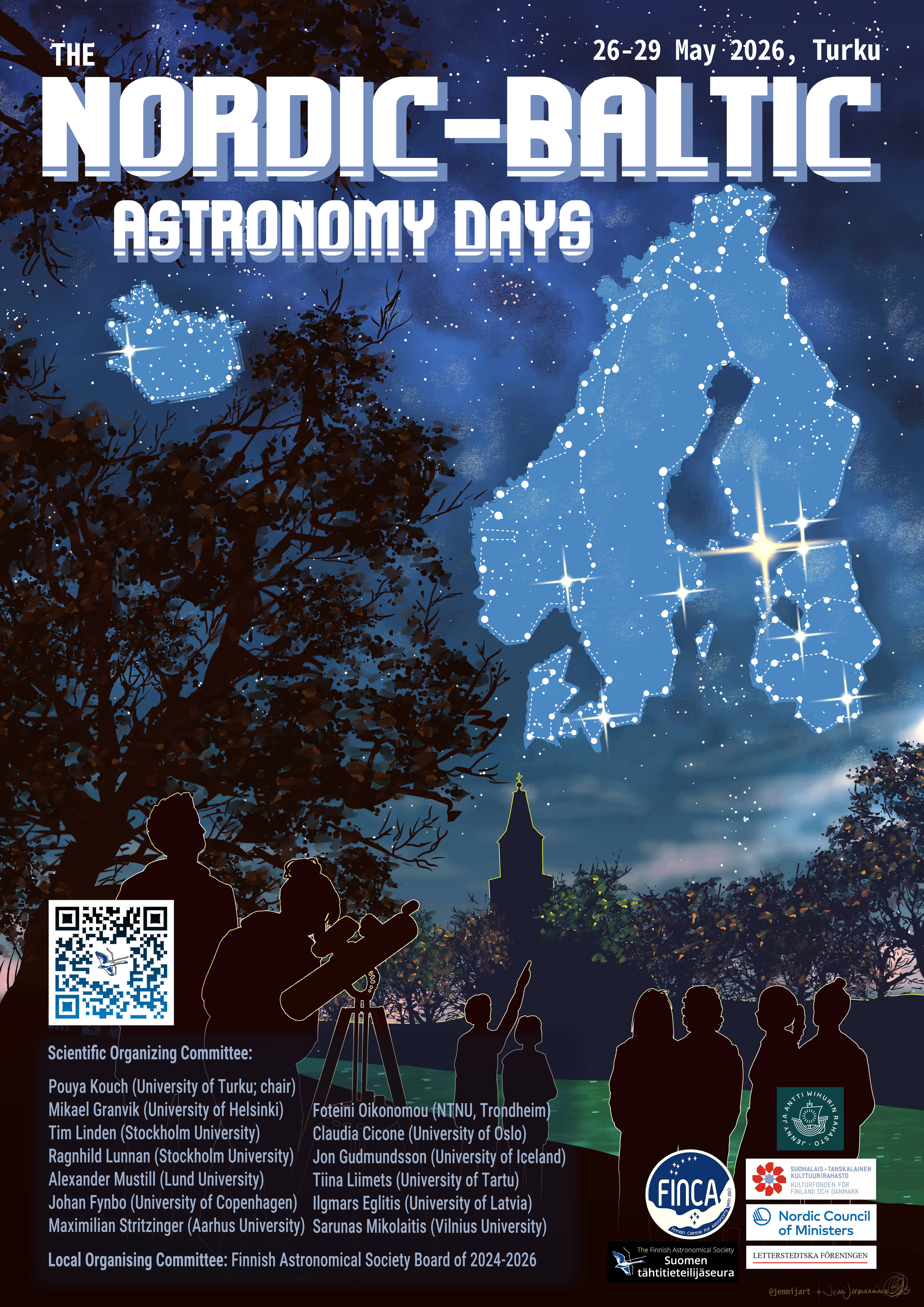
Conference poster (designed by Jenni Jormanainen @jennijart):
I present a brief motivation of the conference and practical information about the event.
Chair: Johan Fynbo
CANCELLED due to flight mishap
The Institute of Theoretical Astrophysics (ITA) at the University of Oslo is the only Norwegian institution that offers education in astrophysics at the bachelor, master, and PhD levels. ITA has about 70 employees including 15 (associate) professors. The main research activities are in the fields of solar physics, extragalactic astrophysics and cosmology. ITA hosts the Rosseland Centre for Solar Physics (RoCS), a centre of excellence funded by the Research Council of Norway (2017 - 2027). ITA has strong research activities in numerical simulations of the solar atmosphere, galaxy formation, and cosmological structure formation. ITA has active participation in ESA missions such as Planck, and the ongoing Solar Orbiter and Euclid missions, and participates in NASA solar physics missions such as IRIS and the upcoming MUSE. ITA has access to telescopes on La Palma: as the largest external user of the Swedish 1-m Solar Telescope (SST) and as partner in the Nordic Optical Telescope (NOT). ITA has a strong research activity in data analysis of the Cosmic Microwave Background (CMB) and participates in ground-based CMB experiments such as Simons Observatory and line intensity mapping experiments such as COMAP. ITA has a leading role in the development of the Atacama Large Aperture Submillimeter Telescope (AtLAST).
[This contribution has a poster also]
The National Science Platform (NSP) FOTONIKA-LV of the University of Latvia (https://fotonika-lv.eu/) was created in 2018 to serve as a centre of excellence and as a strong, welcome partner/coordinator in consortia for EU Research and Innovation Framework Programme projects. The platform's research focus is on photonics sciences and space research. NSP FOTONIKA-LV of the University of Latvia includes research units: the Quantum Optics Laboratory and the Laboratory of Atomic Physics, Atmospheric Physics and Photochemistry of the Institute of Atomic Physics and Spectroscopy, and the Institute of Astronomy with two observatories with worldwide visibility.
NSP FOTONIKA-LV is the successor to the Association FOTONIKA-LV that was founded on April 24, 2010, by three institutes of the University of Latvia – the Institute of Atomic Physics and Spectroscopy, the Institute of Astronomy, and the Institute of Geodesy and Geoinformatics. The Association FOTONIKA-LV realised several FP7 projects, the largest being FP7- REGPOT-2011-1 project No. 285912 “Unlocking and Boosting Research Potential for Photonic in Latvia – Towards Effective Integration in the European Research Area” (2012 – 2015, 3.8 million EUR). Thanks to the REGPOT project, the research capacity of FOTONIKA-LV was substantially strengthened – the research infrastructure was updated, many experienced researchers from abroad were recruited or repatriated and collaborations with industry intensified. Currently, NSP FOTONIKA-LV is a national-level player in the national ecosystem in relevant fields, holding the Seal of Excellence from the European Commission.
[This contribution has a poster also]
The Instrument Centre for Danish Astrophysics (IDA) is a national strategic coordination platform dedicated to strengthening Danish astrophysics and space science. Funded by the Danish Agency for Higher Education and Science, IDA provides the structural and strategic framework that enables Danish researchers and students to fully exploit international research infrastructures such as ESO, NOT, ESA and future global facilities.
IDA does not fund all scientific and technical activities directly; rather, it supports and coordinates national initiatives. Through strategic planning, working groups and national representation in international committees, IDA ensures coherent prioritization, rapid response to emerging opportunities and strong Danish visibility in global collaborations. IDA functions as the national coordination hub linking universities, researchers, students and international facilities.
By offering a national framework for collaboration and strategic alignment, IDA helps Danish astrophysics act collectively rather than in an institutionally fragmented manner.
Examples of IDA activities and opportunities include:
• Coordinating Danish access to the Nordic Optical Telescope (NOT): Travel support, service observing support and strategic development of NOT as a Nordic state-of-the-art facility.
• ELT and ANDES participation: Coordination of Danish involvement in next-generation instrumentation for the ESO Extremely Large Telescope.
• Rubin Observatory (LSST) Lite IDAC: Establishment of a national data access node to ensure Danish access to LSST data.
• National Observing School at NOT: Hands-on training for MSc and PhD students in modern observational astrophysics.
• Annual Danish Astronomy Meeting: National coordination forum connecting researchers and students across Denmark.
• Information and visibility: Monthly newsletter with a focus on opportunities and access to infrastructures.
• International relations and representation: Danish representation in the ESO Science Outreach Network (ESON), and coordination of activities related to the European Astronomical Society (EAS), and the International Astronomical Union (IAU) for the Danish astrophysics community.
• Focus on diversity and inclusion: Strategic commitment to strengthening diversity within Danish astrophysics.
The Finnish Centre for Astronomy with ESO, FINCA, is a national research entity, supported by four universities, established soon after Finland joined ESO. It's mandate is to promote astronomical research in the country, ESO-focused science in particular, and participate in both training and relevant technology projects: in short, to make sure Finland benefits from its ESO membership. I will briefly highlight FINCA's main activities, including current ESO/ELT projects we are involved in, and FINCA's role in Finnish astronomy.
The Nordic Optical Telescope, NOT, has been a key presence in observational astronomy of the Nordic countries for 35 years. It has had a significant role in training generations of Nordic astronomers, while doing world-class science. In this overview talk, I will briefly present some highlights, the current status of the telescope and operations, and also discuss its role and goals into the future, aligning with NOT's newly adopted strategy.
Chair: Kelley Hess
In this talk I will highlight a selection of science topics for which the SKA Observatory is expected to make major progress. The SKA telescopes, SKA-Low and SKA-Mid have been designed to be the largest radio inteferometers in each of their frequency ranges (50 - 350 MHz and 0.35 - 15.4 Ghz, respectively) and are expected to deliver transformational results in a broad range of topics, ranging from the distant era of the first stars to the nearby Sun, and from measuring the gravitational wave background with pulsar timing to discovering the building blocks of rocky plants. I will give special attention to the Cosmic Dawn/Epoch of Reionization where current facilities (JWST, LOFAR) are revealing tantalizing clues about the emergence of the first generations of stars and galaxies and which is one of the research areas SKA-Low is expected to have a major impact.
In this talk I will present the current status of the SKA Observatory as an intergovernmental organisation, building the two largest telescope arrays in the world, located in South Africa and Australia, made possible through a global collaboration of 15 countries worldwide. The presentation will give an overview of the current Membership picture and its activities around construction and operation and expanding the Membership, as well as some of the aspects that come with an international endeavour like this, such as "dark and quiet skies" and geo-politics.
Chair: Folkert Wierda
We present an overview of user-support activities carried out at the Onsala Space Observatory (OSO), highlighting its role in enabling radio astronomy research across multiple facilities. As the host of the Nordic ALMA Regional Centre, OSO provides support throughout the full lifecycle of interferometric projects, including proposal preparation, data reduction, and advanced analysis. This is complemented by the development of open-source software tools designed to enhance the analysis of radio interferometric data, including visibility-domain modelling, stacking techniques, data-quality diagnostics, and simulation of observations.
Beyond ALMA, OSO offers observational support and expertise for a range of facilities, including LOFAR, the Onsala 20 m telescope, and the European VLBI Network (EVN), addressing diverse scientific use cases and observing modes. The observatory also contributes to ongoing developments related to next-generation infrastructures, including activities connected to the SKA Regional Centre.
These combined efforts illustrate the role of OSO as a multi-facility support hub, integrating observational services, software development, and user support to facilitate efficient and robust scientific exploitation of radio interferometric data.
Our mission at the Nordic ARC node is to fully support all ALMA users, primarily in the Nordic and Baltic countries, from proposal development and submission, to observation preparation, and data reduction and analysis, as well as support of ALMA archival science. In addition to general support services we offer specialist scientific and technical expertise. This includes imaging techniques such as multi-frequency synthesis and polarimetric imaging, optimised self-calibration and astrometry, and the development of dedicated analysis software tools. The ultimate goals is to help and encourage the community to make the best use of ALMA.
With this poster we want to present the support work of the Nordic ARC node to the greater Nordic and Baltic astronomy community. We intend to use the poster as a meeting point for ALMA aficionados and newbies alike to discuss what kind of support people are interested in and how to best give it, and to exchange ideas on new software and analysis tools.
The Canary Island observatories, operated by the Instituto de Astrofísica de Canarias (IAC), constitute one of the leading astronomical observing sites worldwide. Located at the Observatorio del Roque de los Muchachos (La Palma) and the Observatorio del Teide (Tenerife) in Spain, the sites offer excellent atmospheric conditions, with stable seeing, and a high fraction of clear nights.
The observatories host a broad range of optical, infrared, and solar facilities, including the 10.4-m Gran Telescopio Canarias (GTC) along with smaller telescopes such as the William Herschel Telescope (WHT), Telescopio Nazionale Galileo (TNG), and the Nordic Optical Telescope (NOT), which has long played an important role for the Nordic astronomical community. In addition, the observatories support robotic and survey telescopes and advanced solar instruments, facilitating research from time-domain astrophysics and exoplanets to stellar, galactic, and solar physics.
Observing time is generally allocated by the national community or the consortium of countries that own or operate the telescope, as well as the International Time Programme (ITP), which promotes multinational collaboration and allows broader international access to the Canary Islands telescopes.
The La Palma Quantum Interferometer (LPQI) is an innovative project in optical intensity interferometry lead by Instituto de Astrofísica de Andalucía (IAA), designed to harness the exceptional observing conditions and infrastructure at the Observatorio del Roque de los Muchachos (ORM) on La Palma managed by the Instituto de Astrofísica de Canarias (IAC). In its first phase, the LPQI-Pathfinder will correlate photon detections between the Nordic Optical Telescope (NOT) and the Telescopio Nazionale Galileo (TNG) located 550 meters apart. The project overview is presented in this poster.
We present a new FAIR-compliant interface for accessing data from the Nordic Optical Telescope (NOT). The platform enables comprehensive FITS-level filtering, allowing researchers worldwide to query observations from the beginning of NOT operations up to the one-year proprietary period.
The system supports both simple and advanced queries, including filtering by file and target name substrings, wavelength range,resolving power, and additional observational metadata. This flexible search capability significantly optimizes data discovery and retrieval.
The project implements the IVOA SODA interface to ensure interoperability and scalability, enhanced by a redesigned user interface that improves usability and accessibility for both junior and senior researchers.
We present the design of the Binocular Large Area Survey Telescope (BLAST), which is designed to cover the whole sky with 10 sec time resolution. It consists of pairs of cameras covering 1.1% of the sky each. The design, manufacturing, operation and data analysis is discussed. The project is funded by a Villum Eksperiment grant to build the first few prototypes.
The AZT-12 1.5-m telescope at Tartu Observatory offers unique guaranteed access to objects in the Northern Hemisphere, facilitating long-term monitoring of various targets. This instrument has recently undergone significant upgrades, including the installation of a medium-resolution fibre-fed echelle spectrograph covering a wavelength range from 380 nm to 910 nm. This spectrograph offers flexibility with input options between two different fibre sizes, delivering spectral resolutions of R=33,000 and R=17,000.
Moreover, a custom-designed 4-channel instrument cube has been integrated, allowing attachment of two additional instruments. One of these is a high-speed CCD-photometer equipped with Johnson-Cousins BVRcIc, Sloan u'g’r’i’z’, and Hα filters, with a field of view of 3.7×3.7 arcminutes. A fourth port is currently available for custom compact instruments.
Complementing the main telescope, a remotely-controllable 31 cm telescope RAITS provides a CCD-photometer with Johnson-Cousins BVRcIc as well as an Hα and Luminance filters. This instrument is suitable for stellar photometry with a wide field of view of 38×38 arcminutes.
These upgrades expand our spectroscopic and photometric capabilities, particularly for long-term monitoring of massive stars, measuring exoplanet transits, estimating properties of exoplanet host stars, photometric studies of asteroids, and transients. In the presentation, we will provide a brief description of these instruments, their parameters, suitability for different types of observations, and the options for community access to these instruments.
Cosmic rays provide non-thermal pressure in the interstellar medium (ISM), affecting star formation and galactic winds, which in turn alter phase structure and pressure balance in the circumgalactic medium (CGM). Recent numerical studies have shown that these effects depend strongly on the diffusion of cosmic rays in the ISM, typically quantified by an effective diffusion coefficient. Methods for constraining the diffusion coefficient observationally often rely on one-dimensional correlations between the resolved radio and IR emission of galaxies. The radio emission traces cosmic ray electrons diffusing in the ISM, while the thermal IR emission is expected to trace the injection sites of cosmic rays.
We develop a new method to constrain the diffusion coefficient of cosmic rays based on the morphological similarity of radio and IR images. To test our method, we use numerical simulations where the diffusion coefficient is known. Specifically, we use cosmological zoom-in simulations of Milky-Way-type galaxies run as part of the FIRE suite of simulations. The simulations self-consistently evolve the transport of cosmic ray electron spectra from supernova injection through the ISM and CGM. We generate synthetic observations of radio and IR emission for simulations with varied treatments of cosmic ray transport and quantify the morphological similarity of images using spatial gradients of the intensity.
The method is tested for different spatial scales and wavelengths, and shows that models run with diffusion coefficient ~10^28 cm²/s show higher morphological similarity between radio and IR compared to cases with higher diffusion coefficients.
Our results show that comparing radio and IR morphology of Milky-Way-type galaxies can be used as a reliable probe of the cosmic ray diffusion coefficient.
We present a time-resolved spectral study of the gamma-ray burst GRB 241030A using joint observations from Swift and Fermi. The burst light curve shows two distinct emission episodes separated by a quiet interval. Our analysis indicates that the prompt emission is produced by synchrotron radiation and is best explained by internal shocks in a matter-dominated outflow. The first episode (0–45 s) is well described by a simple power-law spectrum, consistent with synchrotron emission from rapidly cooling electrons. The second episode (100–200 s) shows more complex spectral behavior, including two clear features: a low-energy break that remains nearly constant in time, and a spectral peak whose energy follows the brightness of individual pulses but shifts to lower energies between them. The overall spectral shapes match well with expectations from synchrotron radiation. We also find that the burst shows almost no measurable time delay between low- and high-energy gamma rays, which is unusual but informative. At later times, the spectrum becomes significantly softer, consistent with observing emission from higher-energy electrons after the main energy release has passed. These observational properties are difficult to explain with models in which the jet is dominated by strong, large-scale magnetic fields. Instead, they are naturally explained by internal shock models in which the magnetic field remains roughly steady, while the properties of the accelerated particles change with time. This scenario can simultaneously account for the stable low-energy break, the pulse-tracking spectral peak, the observed spectral slopes, and the near-zero time lag.
Chair: Maximilian Stritzinger
Nordic Optical Telescope (NOT) has been a success story of Nordic
collaboration in astronomy. Multi-messenger and
time-domain astronomy have been popular amongst our users. Examples
being nightly
monitoring of gravitational lens for two years; transient followups
from sky surveys such as ZTF, Gaia, SVOM etc. and monitoring of
TeV sources, jointly with MAGIC.
Recently NOT has been the most productive facility
at the Observatorio del Roque de los Muchachos (ORM), based on the
refereed publications, outperforming
the bigger facilities such as TNG, GTC and ING.
NOT is also an important training facility for young researchers.
The ongoing Johannes Andersen Student Programme
has trained more than 120 young researchers since 1990.
We present the current status of NOT with a brief historic perspective.
The Nordic Optical Telescope (NOT) is a 2.56-m optical telescope located at the Observatorio del Roque de los Muchachos on La Palma, Spain. This contribution gives a short overview of the observing modes of the telescope, including imaging, spectroscopy, and polarimetry, and highlights its rapid response mode (RRM) and non-sidereal tracking capabilities. The NOT’s versatility and efficiency make it a valuable facility for a broad range of astronomical research, with a particular emphasis on time-domain astronomy and the rapid follow-up of transient astronomical events.
I will present the status of the NOT Transient Explorer - the new instrument for the Nordic Optical Telescope that is under construction with contributions from several Nordic partners. I will describe the design of the instrument, its capabilities, and outline the main remaining challenges still ahead of us.
NOT has come to a mature age soon celebrating its 40 years in operation. Throughout the years NOT has remained as a highly competitive facility due to its advanced design, versatile instrument suite and control system, and flexible operations model. To ensure continued high level of competitiveness for the coming decades, it is time to consider technical updates and upgrades of the telescope. The strong points of NOTs design are presented to give a basis for a discussion on how to exploit the telescope the best in the future. The current maintenance and development projects taking place at the NOT, including the Telescope Control System (TCS) migration are described, projects to be pursued together with external partners in the future are suggested, and considerations on their practical execution are presented.
Chair: Tuomo Salmi
Ultraluminous X-ray sources (ULXs) are off-nuclear objects with apparent luminosities exceeding the Eddington limit for accreting stellar-mass black holes. Past this limit, radiation pressure dominates gravity, and the excess supply of matter would be ejected. To explain such high luminosities, the source emission is thought to be strongly collimated by the radiatively driven winds. Certain Galactic X-ray sources, such as SS 433 and Cygnus X-3, are suspected to be concealed ULXs viewed edge-on.
To better understand the observable properties of concealed super-Eddington accreting objects, we have made simulations of polarized scattering in the wind. We find that the collimation is less efficient than in purely geometrical models. Our model is capable of explaining the observed polarization degree variations in Cygnus X-3 and places constraints on the physical properties of the wind. Further development of the model should elucidate the connection between Galactic sources and face-on ULXs.
We perform a model-agnostic Bayesian analysis of the neutron-star-matter equation of state (EoS), using known ab-initio constraints and astrophysical observations to limit possible EoS behaviors at intermediate densities. Permitting explicit first-order phase transitions allows us to systematically search for twin-star solutions, i.e. the existence of stars degenerate in mass but differing in radius.
We find that current observational constraints exclude all but two classes of twin stars. The first is characterized by a first-order transition occurring at a very low density, with the material properties of the system either staying largely intact or moving away from the conformal limit upon entering the second branch.
In the second, more interesting class, the discontinuity in the mass-radius curve can either result from a rapid crossover transition or from a first order phase transition at a higher density, with the EoS again moving away from conformal behavior.
Given the very low Bayes factor for both types of solutions, we conclude that the standard scenario of twin stars, where one of the mass-degenerate pair contains a core of deconfined quark matter, can be reliably ruled out.
The soft state spectrum of X-ray binaries exhibits a high-energy tail extending beyond 500 keV that cannot be explained by standard thermal disk emission models alone. The launch of IXPE has enabled X-ray polarimetry, which is sensitive to system geometry and can therefore provide new constraints on viewing angle and corona configuration. We aim to develop a self-consistent spectro-polarimetric model of Cyg X-1's soft state that simultaneously describes the broadband spectrum and polarization properties, and to use polarimetric measurements to derive independent constraints for the system's geometry.
We adopt a hybrid Comptonization scenario with slab corona geometry, in which soft disk photons are up-scattered in a hot corona while hard X-ray photons irradiate the disk surface, increasing the soft photon supply. We fit the model to simultaneous observations from IXPE, NuSTAR, and INTEGRAL obtained in June 2023, supplemented by archival OSSE data from 1994, covering energy band from 2 keV to 1 MeV. Our model successfully reproduces the entire broadband spectrum, including the high-energy tail, as well as the observed polarization properties. By comparing model predictions of polarization degree as a function of orbital inclination angle with observations, we constrain the system's orbital inclination angle.
Magnetar giant flares are the most powerful non-cataclysmic neutron star outbursts, capable of releasing more than 1e46 ergs of magnetic energy within a fraction of a second. In recent work, we showed that giant flares can eject neutron-rich material from the magnetar crust and that radioactive decay in this ejecta produces delayed MeV gamma-ray emission consistent with a previously unexplained observation. This provides strong evidence that magnetar giant flares are a site of rapid neutron-capture process (r-process) nucleosynthesis. Motivated by this result and by the sub-second duration of the prompt gamma-ray spike of a giant flare, we consider a scenario in which magnetic energy dissipation injects energy near the magnetar surface over a few hundred milliseconds. This energy deposition ablates material from the neutron star surface and launches relativistic outflows. We will present our ongoing work based on two-dimensional relativistic hydrodynamic simulations. The simulations naturally produce a two-component structure: a fast, baryon-poor outflow directly above the energy injection region, capable of powering the prompt gamma-ray spike, and a slower, baryon-rich outflow in a surrounding conical region. Assuming steady-state conditions, we extract particle trajectories from the simulations and post-process them with a nuclear reaction network. We find that r-process nucleosynthesis produces material across all three r-process abundance peaks. Finally, adopting a simple phenomenological model for the energetics and occurrence rates of magnetar giant flares, we estimate their integrated contribution to Galactic r-process production. While uncertainties remain, our results suggest that magnetar giant flares are a robust secondary r-process site and provide a framework for improved modeling of the associated electromagnetic transients. The talk will emphasize open questions to encourage discussion and feedback.
Chair: Maret Einasto
In cosmology, N-body simulations are a fundamental computational tool used to track the non-linear growth of cosmic structures. While the global topology of our Universe is still an open question, cosmological N-body simulations are almost exclusively run in a non-trivial T^3 (3-torus) topology due to a mere numerical convenience. In this talk, I will demonstrate how the choice of a global topological manifold influences the results of cosmological simulations. Furthermore, I will show how the novel N-body code StePS enables the execution of simulations in alternative topologies - such as R^3 and S^1xR^2 - providing a more versatile framework for exploring the topological nature of our Universe.
We explore the relationships between the cosmic environments of galaxies and their own physical properties through large-scale statistics, with the ultimate goal of being able to predict a galaxy's most likely cosmic environment from its SED and properties alone. To do so, we are developing a tool to compare the SEDs of large samples of galaxies in order to find similarity between them. We present our method and preliminary results.
The thermal and kinetic Sunyaev-Zel'dovich effects (tSZ and kSZ, respectively) are the secondary anisotropies of the cosmic microwave background (CMB). Even though these effects are difficult to distinguish in CMB observations, they have been detected by Planck and the Atacama Cosmology Telescope (ACT).
tSZ and kSZ carry extensive information about the underlying cosmology and structure evolution, such as baryonic feedback processes and halo density and pressure profiles of ionized gas. However, their interpretation relies on uncertain astrophysical modelling, which directly affects the distribution of hot electrons in the Universe. Numerical simulations play an important role in modelling and interpreting the kSZ and tSZ maps.
In this work, the N-body HalfDome simulations have been used, together with Battaglia model for the tSZ and kSZ. The tSZ and kSZ maps have been painted over the HalfDome simulations, getting consistent agreement of power spectra between other simulations, such as Websky, and CMB missions such as Planck and ACT. Furthermore, the free parameters of the gas profiles were varied to investigate their impact on feedback processes and on the distribution of baryons within and beyond dark matter halos.
This work is a step towards a successful joint analysis between the large-scale structure observation surveys, such as Euclid, and CMB missions, such as Planck and ACT. tSZ and kSZ cross-analysis with galaxy clustering or lensing will be an essential tool to understand the evolution of our Universe, which is why an accurate modelling of these effects is needed. The modelling improvements presented here contribute to enabling such joint analyses.
During the Epoch of Reionization (EoR), the ultraviolet radiation from the first stars and galaxies ionized the neutral hydrogen in the intergalactic medium (IGM), which can emit radiation through the 21-cm hyperfine transition. Due to this, the 21-cm signal from the EoR is a direct probe of the IGM and the first ionizing sources, and its measurement is a key science priority of radio interferometers, such as the LOFAR, MWA, HERA, and the prospective SKA.
These observatories are actively placing valuable upper limits on the 21-cm power spectrum, giving us a first glimpse into how reionization has transpired. However, as the detection of the 21-cm signal approaches, thoroughly understanding its features becomes increasingly important.
In this talk, I will present the interpretation of the IGM-based framework pioneered by the LOFAR collaboration and how it can be applied to interpret its latest upper limits. I will discuss our latest advancements in the physical interpretation of the IGM framework and how we can adapt our model across the EoR redshift range. Our results showcase key relations between the 21 cm power spectrum and parameters such as the halo clustering bias, the effective bubble sizes of ionized regions, and the global neutral fraction.
Chair: Tuomas Savolainen
Metsähovi Compact Array (MCA, https://www.metsahovi.fi/mca) is a radio telescope system, comprising at least three 5.5-metre parabolic dish antennas and operating at frequencies from 4 to 8 GHz. It is being built at the Aalto University Metsähovi Radio Observatory in Kirkkonummi, Finland. In the past two years, major progress has been made on the project. The MCA's premier scientific programme has been started (as a direct consequence of the AD2024 meeting in Vaasa!). The interferometer is now fully operational with a 47-m baseline between antennas MCA-1 and MCA-2. A third antenna, MCA-3, has been assembled, fitted and is undergoing commissioning and its initial operations. When fully-integrated, it will extend the maximum interferometric baseline to 163m. Design work has also commenced on a new hybrid-mode correlator, which will provide a significant upgrade to the scientific capabilities. This presentation reports on the new science, current status, and describes the plans and capabilities of this new facility.
Young high mass stellar objects (HMYSOs, $M_* > 8 M_\odot$) contribute significantly to the energetics of the interstellar medium through radiation fields and supernovae. However, they are rare, and form in deeply embedded cores. Simulations suggest that they gain $\sim 50\%$ of their initial mass in short bursts of accretion in $\sim 3 \%$ of their formation time. A few accretion bursts in HMYSOs have been studied in detail through early warning with 6.7 GHz methanol maser monitoring. In order to increase the sample of detected and studied accretion bursts, novel observational methods are required to effectively monitor accretion burst tracers. In this talk, we will introduce the maser monitoring program with the Metsähovi Compact Array (MCA) at the Metsähovi Radio Observatory. Our program will be one of the first long term interferometric maser monitoring programs. We aim to demonstrate that interferometric monitoring with smaller dishes can function with the same capabilities as monitoring with large (> 25 m) single dishes at reduced cost. The MCA will consist of four 5.5 m parabolic antennas with receivers at 4$-$8 GHz. The MCA baselines will span 50 $-$ 150 m, giving an angular resolution of 1 arcmin in interferometric mode with a 34 arcmin field of view. The first three MCA antennas are operational in single dish and interferometric mode. The fourth MCA antenna will be commissioned in mid 2028. In single dish automated modes, with MCA1, MCA2 and MCA3, we have monitored more than sixty high mass star forming regions with short daily integrations since mid 2024. We will show how an automatic monitoring system, source-based averaging and automatic flare alerts can allow small facilities as the MCA as to operate as competitive accretion burst detectors. Lastly, we will outline the upcoming interferometric monitoring program and imaging with the MCA. The MCA maser monitoring project, if successful, can serve as a template for small-dish maser monitoring projects to improve the accretion burst detection rate so that we can investigate the role of episodic accretion on the formation of stars and planets.
Aalto University’s Metsähovi Radio Observatory in Kirkkonummi has been carrying out radio astronomical observations for 50 years. Its 14-meter telescope mainly operates at 37 GHz with a 1 GHz bandwidth, mostly in single-dish mode, but also supports VLBI observations at 22, 43, and 86 GHz. Metsähovi has recently ordered a new triple-band receiver from the Max-Planck-Institut für Radioastronomie (MPIfR) in Germany, capable of simultaneous operation at K (18–26 GHz), Q (34–50 GHz), W1 (80–96 GHz), and W2 (100–116 GHz) bands. The new receiver features simultaneous multi-band observations, full polarization capability, cryogenic cooling, and a major instantaneous bandwidth expansion from 1 GHz to up to 8 GHz for K and 16 GHz to Q, W1 and W2 bands, significantly improving the telescope’s sensitivity.
This abstract presents the development of a new radio polarimeter backend as part of the 14-meter telescope upgrade. The upgrade aims to enhance observation capabilities by increasing bandwidth and sensitivity, with a key focus on implementing real-time polarimetric signal processing. The full bandwidth to be processed simultaneously is 224 GHz when accounting for the bandwidth of each band, two polarizations, and two beams on the sky. This requires a novel design for the backend. We are building this digital backend using a Radio Frequency System on Chip (RFSoC) platform. In this presentation, we will introduce the new backend design and its current status.
SKA will be the first telescope to usher in a new era of how the astronomical community will interact with observational data. With data volumes approaching exabytes per year in the next decade, the SKA community is developing, through an international coordinated effort, a series of SKA Regional Centers (SRCs) in a global distributed SRC Network (SRCNet). At the Swedish SRCNet node we are working towards achieving the operational v0.2 milestone in mid 2026 which will support science commissioning efforts of SKA Low later this year. In this talk I will present the current state of development, and describe the services for accessing, processing, analyzing, and visualizing data remotely. The goal of SRCNet is to provide a seamless experience for users anywhere in the world, in order to make the most of this ambitious radio telescope for decades to come.
Chair: Dainis Dravins
The interiors of asteroids, that is, their bulk composition and structure, are largely unknown today except for a few special cases. Apart from drilling and radar sounding, both of which are techniques yet to be applied to asteroids, let alone applied to a large number of asteroids, our knowledge of asteroid interiors is based on indirect observations such as rotation rates as well as the compositions of members of asteroid families. In recent years, two destruction mechanisms have been shown to have non-negligible effect on the population of near-Earth asteroids (NEAs). First, asteroids are not falling all the way into the Sun (Farinella et al. 1994) but instead they are destroyed on orbits that bring them relatively close to the Sun (Granvik et al. 2016). The primary mechanism causing the destruction is still to be firmly determined, but one of the leading hypotheses at the moment is that solar irradiation is the main contributing factor, and an asteroid's composition affects the distance at which it is destroyed. Second, tidal disruptions during close and slow encounters with terrestrial planets have been proposed to affect NEAs, but the importance of tidal disruptions on the population level was discovered only recently (Granvik & Walsh 2024). Whereas the susceptibility to a destruction close to the Sun is likely to be primarily determined by an asteroid's bulk composition, the susceptability for tidal disruption is likely to be primarily determined by interior structure of the asteroid. The major benefit compared to all other destruction mechanisms affecting NEAs, apart from collisions with planets, is that the rate of close encounters with both the Sun and the planets can be readily estimated through dynamical simulations. We can thus carry out simulations to predict the rate of asteroid destruction close to the Sun and planets as a function of bulk composition and structure. The resulting effects on the NEA population, in practice changes in orbit, size, and compositional distributions, can then be compared with observations by telescopic surveys. The approach allows for testing different models of asteroid interiors by comparing to observational data obtained by telescopic surveys. I will summarize current and future efforts to understand the details of the destruction mechanisms and to utilize them for constraining the interior characteristics of asteroids including telescopic surveys, population models, laboratory experiments, and space missions.
Asteroids comprise of material left over from the early days of the formation of the Solar System. Studying their physical composition and dynamical evolution are among the best evidence for the initial conditions and dynamical evolution of the Solar System. Asteroids come in sizes from metres up to hundreds of kilometres. Currently, essentially no data exist on the very small asteroids originating from the outer belt. However, the flux of the asteroids from the main belt into the near-Earth asteroid (NEA) population gives a unique opportunity to probe this virtually unstudied population through close flybys of NEAs. The steady-state population of NEAs with large $a$ originate from the source regions in the outer main belt (Granvik et al. 2018), such as 2:1 and 5:2 mean-motion resonances with Jupiter, as well as objects on Jupiter-family-comet-like orbits. Advancements in the asteroid surveys, such as Catalina Sky Survey, Pan-STARRS and ATLAS as well as data from Hayabusa 1 and 2 and OSIRIS-ReX missions have recently brought the smallest asteroids, with diameters less than 50 m, within reach of feasible research. While many smallest asteroids have been characterised by the ongoing MANOS survey (Devogèle et al. 2019), their sample selection is constrained to mission-accessible asteroids, limiting their sample orbital space with relatively small $e$ and $i$, with higher probability to originate from the inner main belt.
Despite the scarce observations, there are several indications that the taxonomic distribution of smallest asteroids is different from that of the larger ones. By observing smallest asteroids we are characterising the undividable building blocks of larger asteroids, which are gravitational aggregates. The fast rotation periods of smallest asteroids (Warner et al. 2009) imply their monolithic structure. 1-20 metre-sized monolithic boulders are abundant on the surfaces of larger asteroids such as (162173) Ryugu (Hayabusa2 mission; Tatsumi et al. 2021) and (101955) Bennu (OSIRIS-ReX mission; DellaGiustina et al. 2021).
We present the preliminary results of an ongoing campaign with ALFOSC/NOT to provide a statistically significant sample of very small asteroids originating from the outer main asteroid belt.
The near-Earth asteroids having orbits completely interior to Earth's are referred to as Atira class, named after the first discovered member (163693) Atira. This asteroid is the only confirmed binary asteroid in the Atira class with a primary component size of nearly 5 km orbited by a smaller $\sim$1 km secondary. Radar imaging (Deleon et al. 2024) used to detect the secondary has been used to model the shape and spin characteristics of the two components. The rotation period of the primary is 3.398 hours and the orbital period of the secondary is 15.577 hours. The compositional properties of Atira are unknown.
Due to their orbital configuration, they are challenging to observe from ground based Earth facilities. Observing facilities that are located at near the equator can only target Atira class objects for at most a few hours after sunset or before sunrise. However, high-latitude locations can observe Atira asteroids throughout an entire night, provided that they are seen at a high declination. In this work, we present over 8 hours of uninterrupted photometric observations of Atira collected at the 60-cm Metsähovi Observatory (IAU code L08) in southern Finland on the night of March 5, 2024. The resulting lightcurve, taken in $V$ and $R$ filters, represents over 2 rotations of the primary and half of the secondary's orbit.
We also performed optical spectroscopy and polarimetry of Atira using the 2.56-m Nordic Optical Telescope (IAU code Z23) located in La Palma, Canary Islands, Spain. The reflectance spectrum required some modeling to correct for the effects of improper spectroscopic slit orientation. The corrected spectrum is consistent with a Cg or Cgh-type in the SMASS taxonomy. The relatively high linear polarization at a large phase angle of 74$^\circ$ is consistent with a low albedo, primitive composition. A spectrum acquired in 2026 is also consistent with a primitive composition. Yet follow-up polarimetric measurements at different phase angles with the NOT in 2025-2026 suggest surface heterogeneity across different latitudes of Atira.
These observations (MacLennan et al. in prep) highlight the need for Nordic and Baltic observers in the physical characterization of the growing number of Atira class objects.
The upcoming close encounter of asteroid 99942 Apophis with Earth in 2029 presents a once-in-7000-years opportunity to study the dynamics, bulk properties, and interior structure of a potential rubble-pile asteroid as it passes deeply through Earth’s gravitational field. Numerical modeling—including via Discrete Element Methods (DEMs)—has helped to develop our understanding of the dynamics and physical outcomes of the tidal encounter between Apophis and Earth, including the expected change in the bulk shape and spin of the body, and predictions of potentially measurable surface and seismic outcomes due to the short period of natural tidal forcing. These models have helped to design missions to Apophis to ensure that we can make the most of the natural experiment that the Apophis encounter provides.
In this talk, we will present new and ongoing DEM models of the full Apophis-Earth close encounter, making use of recent developments in modeling realistic particle shapes with a “glued-sphere” approach in the parallelized N-body gravity and soft-sphere DEM (SSDEM) code PKDGRAV. The glued-sphere method affords simple spherical gravity and collision detection calculations at the cost of small timesteps and stiff constituent particles [1]. Here, we compare the results and performance of this technique with previous spheres-only DEM models to get a clearer picture of the deformation, spin change, and seismic activity induced in Apophis during the close approach.
For the simulations presented here, we use PKDGRAV to model interparticle gravitational and contact forces between discrete, spherical particles [1]. The SSDEM in PKDGRAV allows particles to slightly interpenetrate at the point of contact, using a Hooke’s law restoring spring force to model the material’s stiffness and apply normal and tangential damping forces, interparticle friction, and cohesive forces for particles in contact [2].
Modeling with irregular particle shapes (rather than independent spheres) allows us to increase the macroporosity of the resultant rubble pile while also increasing the body’s shear strength. This occurs naturally when packing irregular shapes due to the void spaces created by interlocking grains, and the physical strength of those interlocked structures, which cannot be replicated by spheres alone [3]. The glued-sphere SSDEM approach allows us to create a high macroporosity regolith body—like those observed in recent missions to rubble-pile asteroids Bennu, Ryugu, and Itokawa—that is also more resistant to reshaping or disaggregation than previous spheres-only models.
Following the method of our previously published work [4], we represent Earth as a single, rigid sphere and Apophis as a cohesionless, self-gravitating, granular aggregate of irregular boulders several meters in radius. We also model the asteroid with different interior structure profiles: contact-binary (several configurations); single interior cores of varying sizes (ellipsoidal or spheroidal); and rubble throughout. We use the best-fit, radar-derived shape model [5] to carve the appropriate shape of Apophis from a random cloud of constituents allowed to collapse in free space under self-gravity, subject only to gravitational and contact forces.
The body is then placed under rotation. The primary source of uncertainty in the 2029 Apophis-Earth encounter is the orientation of Apophis at the time of close approach [6]. In one subset of our comparative simulations, we align the spin axis with the intermediate body axis of Apophis, and model the encounter in the plane defined with a normal vector parallel to that spin axis. In this way, we can construct encounters with either the long axis or the short axis of Apophis directly aligned with Earth at perigee, which should bracket the expected deformation as the strongest and weakest encounter geometries, respectively. For the models investigating change in rotation state and seismic influence, we implement a spin axis chosen from the uncertainties in the current lightcurve data [6,7]. In all cases, we choose the spin frequency to match the averaged effective spin period for its tumbling state and do not model the tumbling motion. The body is allowed to settle under its rotation until residual particle speeds in the body frame are much less than 1% of their expected peak values during the encounter simulations.
In addition to updates on the prior SSDEM results, and comparisons between different constituent particle geometries and interior structures, we have carried out an SSDEM analysis of the seismicity on Apophis in a high-resolution encounter simulation. Each PKDGRAV particle exhibiting elastic motion can be used as a seismic station in our models, with velocities measured at every timestep. By finding peaks in velocity magnitudes, we identify seismic sources in the body. Our analysis indicates that the quaking on Apophis will be shallow and that most sources begin ~2 h after closest approach and persist for a period of ~2 h. We also find that the seismic signals in our models would be measurable by an in-situ seismometer taking measurements on Apophis during and after the close Earth encounter.
Chair: Mika Juvela
The cold gas in galaxies shows continuous turbulent motions occurring at various spatial scales that exceed those associated with thermal motions, as inferred from the observed HI velocity dispersions, implying a need for a continuous source of energy input. Supernova (SN) feedback is considered to be one of the primary candidates for this, because of its substantial energy output, consistency, and widespreadness. However, past studies have shown that while SNe possibly contribute to the observed kinetic energies, it cannot account for all of the observed turbulent motions, especially in the regions with low star formation rate (SFR), such as the outskirts of spiral galaxies and dwarfs. Despite consideration of other energy injection mechanisms, the observed turbulence has remained unknown for a long time. Yet, a recent study of nearby spiral galaxies partially resolved this conundrum by considering the increase in gas disc thickness with radius (i.e. flaring of the galactic disc), slowing down the rate of dissipation. Consequently, less energy is needed from the SN feedback, allowing it to maintain turbulence in spirals with modest efficiencies.
In my talk, I present new results on the role of SN feedback in driving the neutral atomic gas (HI) turbulence in nearby dwarf galaxies. I use the HI distribution and kinematics of a sample of 14 dwarfs in the LITTLE-THINGS survey, and UV photometric data from GALEX to derive, respectively, the HI kinetic energy and the distribution of SNe across the galaxy discs. I use the HI disc thickness, calculated assuming the hydrostatic equilibrium, to derive the turbulence dissipation time. Using Bayesian hierarchical modeling, I show that a simple model of SN-driven turbulence can explain the observed HI kinetic energies with just $\sim 2 - 3\%$ of the total SN energy, while assuming some contribution from the warm HI thermal energies. My results hold even while considering a larger sample representative of galaxies on the star-forming main sequence, from dwarfs to massive spirals. In conclusion, my results provide: 1) empirical evidence that SNe alone can sustain the observed turbulence in regions of low SFR and 2) the first direct estimate of a potentially universal SN efficiency common to all main-sequence galaxies, offering particularly valuable constraints for sub-grid models of SN feedback in numerical simulations of galaxy evolution.
Cepheid variables serve as fundamental standard candles for calibrating the extragalactic distance scale. The high-precision parallaxes from Gaia now enable a sub-percent calibration of the Period-Luminosity (PL) relation for Milky Way (MW) Cepheids. However, interstellar extinction remains the main source of uncertainty, as the Cepheids’ variability complicates direct reddening measurements.
We present a novel approach to estimate extinction by leveraging non-variable field stars in the neighborhood of Cepheids. Using medium-high-resolution VLT/FLAMES spectroscopic observations, we determine the stellar parameters (Teff, log g, [M/H]) of these stars. Combining these parameters with multi-band photometry (e.g., Gaia, 2MASS) and atmospheric models, we derive their individual extinction, A(V). This results in a high-resolution 3D extinction map, from which we interpolate the Cepheid reddening.
By refining extinction corrections, we will enhance the calibration of the MW Cepheid PL relation, thereby contributing to more precise distance measurements.
Magnetic fields are a fundamental component of the interstellar medium (ISM), yet they cannot be observed directly and must instead be inferred through indirect tracers. Polarized thermal dust emission is a good tracer of magnetic fields in many ISM conditions, as dust grains are generally expected to be well aligned with the magnetic field. In this work, we investigate the leading theory of grain alignment, Radiative Torque Alignment (RAT), focusing on its prediction of enhanced grain alignment in the vicinity of embedded protostars. While this prediction has been explored through analytical models and magnetohydrodynamic simulations, observational evidence has remained limited. Using 214 μm SOFIA/HAWC+ polarimetric observations of the high-mass star-forming region DR21, we perform a statistical analysis of the polarization fraction, polarization angle dispersion, and grain alignment efficiency to examine this effect near embedded protostars. We find evidence of enhanced polarization near DR21(OH) at intensities where depolarization is typically observed. This conclusion is further strengthened by comparison with predictions from a simple analytical model of a centrally heated envelope surrounding a luminous protostar, which shows good agreement with the observed trends. Our results indicate that grain alignment via radiative torques remains efficient near embedded protostars and that polarized thermal dust emission can therefore be used to probe magnetic fields in the densest regions of star formation.
Diffuse ionized gas (DIG) is an important component of the interstellar medium that is strongly connected to both star formation and feedback. The primary ionization mechanism of DIG is thought to be hard radiation from midplane OB stars. However, the emission spectrum of DIG shows features (such as enhanced [OIII] line emission) that models including only photoionization by midplane OB stars are incapable of reproducing. In a sample of eight nearby low-mass edge-on disk galaxies observed with the MUSE integral field spectrograph, we found that the extraplanar DIG in the galaxy with the lowest star-forming-rate (SFR) in the sample (ESO 544-27) had significant contribution to its ionization from radiation from hot low-mass evolved stars (HOLMES; up to 20 percent). This suggests that HOLMES ionization of DIG may be inversely proportional to the host galaxy SFR. Here I present a new project expanding this study to four additional low-SFR galaxies, with the goal of constraining the relationship between DIG ionization by HOLMES and host galaxy SFR.
Chair: Heidi Korhonen
Studies of small bodies of the Solar System
Astronomers at the Baldone Observatory conduct extensive studies of small bodies in the Solar System using the Schmidt telescope. One major research direction involves measuring the positions and brightness of these objects in the U, B, V, R, and I photometric filters. Using this telescope, 149 new asteroids have been discovered, including a rare Centaur-type asteroid. At the suggestion of the observatory, 15 of these asteroids have been given names related to Latvia, helping to popularize the country’s name worldwide.
The observatory also investigates the physical properties of asteroids, including their rotation and composition. This research is particularly important for the future extraction of space resources, which is considered essential for continued technological development on Earth. In addition, the development and testing of a new, hopefull asteroid observation methodology known as synthetic tracking has begun. This technique will enable telescopes of various types to detect objects up to six times fainter (approximately two magnitudes) and to observe very fast-moving bodies, which is crucial for planetary defense against potential asteroid impacts.
Research on novae and relativistic objects
Over the past 40 years, systematic searches and photometric studies of novae in the Andromeda Galaxy have been carried out. As a result, 70 novae have been discovered, and it has been established that they are sources of supersoft X-ray emission during their post-explosion phase. Current research focuses on studying brightness variations in Active Galactic Nuclei (AGN) and blazars. These studies are essential for developing models of relativistic objects and contribute to addressing fundamental problems related to dark matter and black holes.
Research on carbon stars
Significant work has also been devoted to the study of carbon stars in our Galaxy. Approximately 400 carbon stars have been discovered and analyzed, five monographs have been published, and a comprehensive catalogue of Galactic carbon stars has been compiled and cited 132 times. This research is crucial for understanding the formation and evolution of carbon stars. Moreover, carbon stars are the primary contributors of carbon, the fundamental element of life, to the interstellar medium. Work is currently underway to prepare and publish an updated and improved version of the carbon star catalogue.
Baldone Schmidt Telescope Photographic Archive
Another major initiative is the creation of a Latvian Virtual Observatory based on the Baldone Schmidt Telescope Photographic Archive. The archive of direct photographic images has been fully digitized and includes 22,623 astronomical images containing data on approximately 40 million objects. At present, digital image processing is being performed to determine the equatorial coordinates and brightness of the recorded objects. These archival data will make a substantial contribution to studies of stellar position dynamics and brightness variability, as photographic observations at the Baldone Observatory were regularly conducted in specific regions of the sky over a 38-year period.
The research infrastructure and resources of the Baldone Observatory have enabled the successful acquisition and implementation of projects funded by FP7, the Framework Programme, Horizon 2020, Interreg, Erasmus+, and the Latvian Science Council.
BLAST is going to monitor the sky for transients at high time resolution. The core science cases are detecting: 1) short lived bright transients, 2) slower transients, like SNe, 3) Jupiter like transiting planets in Jupiter like orbits, 4) asteroids heading towards Earth. We are building prototypes of very wide field cameras, that in pairs monitor each 1.1% of the sky (450 sqr degrees) with a time resolution of 10 sec and a pixel scale of 10". 2 x 100 cameras will cover the entire sky. The limiting magnitude is r=14 for individual exposures and r=18 after 3 hours. By having pairs of cameras, spurious events can be filtered out. By separating the two cameras by 100 km, sources within 2 MKm from Earth will be rejected through their parallax. We invite partners to participate in BLAST by contributing financially or through manpower.
The advent of X-ray polarimetry has marked a major advancement in high-energy astrophysics, driven by the successful launch of IXPE and its groundbreaking measurements in the soft X-ray band (2–8 keV). Currently, several efforts are underway for getting more significant results in hard X-rays provided by previous missions like PoGo+. XL-Calibur is a balloon-borne hard X-ray polarimeter operating in the 19–64 keV band, employing a Be scatterer surrounded by CZT detectors enclosed inside an active BGO shield. We will present the results from the most recent XL-Calibur flight in July 2024. During an approximately week-long campaign, observations of the Crab Nebula and Cygnus X-1 were performed, yielding high-significance polarization measurements for both sources. For the Crab pulsar and Nebula, we measure phase-integrated polarization degree (PD = 25.1 ± 2.9) % with a polarization angle (PA= 129.8 ± 3.2)∘. Combining the data from XL-Calibur Crab observation with IXPE results reveals that PA approaches the pulsar spin axis at higher energies. Owing to the high sensitivity of XL-Calibur, we report the most precise pulse-phase–resolved hard X-ray polarization measurements of the Crab. Cygnus X-1 exhibits a low but significant polarization degree (PD = 5.0± 3.0) %, unexpectedly high for a black hole binary. The measured polarization angle (PA=− 28 ± 17)∘ is aligned with both the parsec-scale radio jet and previous soft X-ray polarization measurements by IXPE. We will discuss the details of these measurements along with their implications in the context of theoretical models and some problems which remains unresolved. Further, we will present the plans for the next next XL-Calibur flight.
The European Astronomical Society of Small Telescopes (EASST) is a non-profit organization dedicated to enabling high-quality astronomical research with small and medium aperture telescopes. Within this framework, the Black Hole Target and Observation Manager (BHTOM) has been developed as a robust, web-based observational coordination system designed to support both professional and amateur astronomers. BHTOM enables systematic, long-term, rapid-cadence photometric monitoring of diverse astrophysical targets, including gravitational microlensing events, variable stars, transients, quasars, exoplanets, and Solar system objects.
The BHTOM network currently integrates data from nearly 130 telescopes worldwide, many of which are operated by skilled amateur observers and professional astronomers. The platform provides tools for automated scheduling, data reduction, and centralized data sharing, thereby streamlining the production of science-ready photometric measurements. This infrastructure facilitates large-scale, distributed observing campaigns and significantly enhances the scientific return achievable with small-aperture instrumentation.
One of the scientific focuses of BHTOM is gravitational microlensing, a technique uniquely sensitive to compact, non-luminous objects such as stellar-mass black holes, neutron stars, and free-floating planets. Microlensing observations offer insights into the Galaxy’s dark or otherwise invisible population, including potential primordial black holes and candidates for dark matter. The Gaia mission, launched by ESA in 2013, has played a key role in identifying microlensing events, and forthcoming data releases (DR4 and DR5) are expected to increase the number of events substantially.
This presentation provides an overview of the BHTOM system and the crucial contribution of small telescopes, including those operated in Lithuania at the Moletai Astronomical Observatory, to the follow-up of Gaia-discovered microlensing events, including Gaia16aye, Gaia18cbf, Gaia19bld, Gaia19dke, AT2021uey, and Gaia20fnr. Coordinated observations from the BHTOM network have enabled precise characterization of lens masses and distances, demonstrating that collective efforts of small-telescope observers can deliver high-impact scientific results. The talk aims to highlight these achievements and encourage further participation from the global astronomy community. E.S., M.M., J.Z., E.P., V.C., and U.J. acknowledge funding from the Research Council of Lithuania (LMTLT, grant No. S-LL-24-1).
We present PyLongslit, a simple and transparent Python pipeline for processing astronomical long-slit spectroscopy data obtained with CCD detectors. The software is designed to prioritize manual execution, robustness, and pedagogical clarity, providing an accessible alternative to highly automated “black-box” reduction pipelines. The pipeline emphasizes visualization and quality assessment at each processing step, making it particularly well suited for teaching environments and for challenging datasets where automated methods may fail. Validation against established semi-automated reductions demonstrates good agreement in extracted spectra and noise estimates across multiple instruments. In this presentation, we will highlight several difficult and edge-case reductions where manual control and transparency provide clear advantages, and provide an overview of the scientific research in which the pipeline has already been applied.
Chair: Ulrike Heiter
Protoplanetary disks emerge as a consequence of the star formation process, and provide the foundational material for planets. The evolution of these disks is governed by a combination of internal processes linked to the central star, and external influences from the surrounding environment. Both pathways produce photoevaporative winds that drive disk dispersal from opposite directions. In massive star clusters, the UV radiation from massive OB stars irradiates disks externally, strongly affecting disk sizes, masses, and survival timescales. Until recently, the same emission lines were used for studying both internally and externally driven winds. However, their disentanglement is essential for building comprehensive models of disk evolution.
Here I present results based on the IFU data of 12 externally irradiated disks—proplyds, in the Orion Nebula Cluster acquired with VLT/MUSE in Narrow Field Mode. These observations allow us to pinpoint where emission lines of various species and ionization degrees arise from within the proplyd, and determine signatures unique to external photoevaporation. I will also show how these results serve as benchmarks for photoevaporation models. Characterizing the proplyds in relative proximity sets the precedent for future studies in more distant and massive star-forming regions.
Many exoplanets have been found, but still no Earth-like planet in a one-year orbit around a solar-type star. Limitations no longer stem from observations but from the physical variability of the host star, which greatly exceeds the radial-velocity modulation by an Earth-like planet. Current observational efforts are to find planets around our Sun, monitoring the Sun-as-a-star with extreme precision radial-velocity spectrometers. Theoretical hydrodynamic simulations produce time-variable solar spectral atlases, where radial-velocity jittering is followed in different spectral features. A step toward exoEarth detection will be to identify dissimilar spectral lines (strong or weak, neutral or ionized, high or low excitation, etc.) with disparate responses to stellar activity, to disentangle wavelength shifts induced by exoplanets from those originating in stellar atmospheres.
Exoplanet atmospheres provide a direct window into planetary physics, chemistry, and long-term evolution. Through their composition and structure, we can probe processes such as irradiation, circulation, and mass loss, which ultimately shape how planets form and survive. Close-in gas giants, particularly hot and ultra-hot Jupiters, represent some of the most extreme laboratories for these effects. Intense stellar flux heats and inflates their atmospheres, drives chemical dissociation and ionisation, and can trigger hydrodynamic escape. These processes often produce extended exospheres and comet-like tails of evaporating gas, modifying transit signatures and enabling direct studies of star–planet interaction. Owing to their low bulk densities and expanded radii, these highly irradiated planets resemble marshmallows, while their proximity to the host star causes continuous atmospheric heating and loss — effectively turning them into “burning marshmallows”.
In this work, I investigate the physics of atmospheric escape and tail formation using theoretical modelling of radiation-driven outflows, gas dynamics, and species-dependent transport. I explore how neutral and ionised species evolve within the escaping flow and whether part of the evaporated material can remain gravitationally bound and migrate towards the host star. Under favourable conditions, heavy elements may accrete onto the stellar surface, potentially producing detectable photospheric contamination and linking atmospheric escape with star–planet mass exchange.
Over 70% of stars in the local solar neighbourhood are M-dwarfs, and they are frequent hosts of exoplanets. However, their cool, complex atmospheres and intrinsic faintness present significant observational and modelling challenges. The upcoming PLATO mission is expected to observe over 5000 early- to mid-type M-dwarfs, providing high-precision light curves for exoplanet detection, along with extensive spectroscopic follow-up from ground-based facilities. We present a fast and reliable pipeline for deriving homogeneous stellar parameters and chemical abundances by combining photometric and spectroscopic data within a Bayesian framework. The spectroscopic module uses an artificial neural network (ANN) to determine effective temperatures, metallicity and abundances from H-band spectra, with log g being constrained by the photometric module to break degeneracy. We discuss the pipeline’s performance, recent and planned improvements, and validation using benchmark stars. The resulting catalogue of homogeneous M-dwarfs parameters from this pipeline will provide a vital foundation for PLATO’s stellar and exoplanet science for low-mass stars.
Resonant exoplanetary systems, in which the period ratio between consecutive planets is close to a natural number, are relatively rare in the universe. However, the fine-tuning required for these orbital configurations make resonant systems valuable for studying the early stages of planet formation and evolution. Additionally, the strong transit timing variations (TTVs) arising from the mutual planet-planet interactions allow for precise characterisation of masses and orbital parameters. We will present the analysis of HD110067, a bright K0V star hosting a resonant chain of 6 planets ranging 2-3 Earth radii with orbital periods between 9 and 55 days. Combining photometry from TESS and CHEOPS with HARPS-N spectroscopy, we perform a joint photo-dynamical and radial velocity (RV) analysis to derive precise planetary masses, radii, and orbital parameters. We explore the effect of different mass and eccentricity priors and stellar activity models, demonstrating the power of TTV-RV modelling for the characterization of compact resonant planetary systems.
Chair: Pasi Nurmi
Understandng the properties, formation and evolution of the cosmic web is one of the main tasks
in cosmology.
In my talk I introduce the largest structures in the cosmic web, and the compatibility
of these structures with the LCDM cosmolocigal model.
Namely, in the Local Universe the richest structures in the cosmic web are very rich galaxy superclusters
and their compelxes - the Sloan Great Wall and the BOSS Great Wall. Moreover,
rich galaxy clusters and superclusters form a quasiregular pattern with
two huge perpendicular planes with extent of several hundreds of megaparsecs,
the Local Supercluster plane and the Dominant supercluster plane.
The characteristic distance between superclusters in this pattern is 120 - 140 h(-1) Mpc
The origin of these patterns in the supercluster distribution
is not yet clear. I discuss whether the presence
of such structures can be explained within the LCDM cosmological model.
Strong gravitational lensing by galaxy clusters is a powerful tool to probe various properties of the Universe. It enables precise reconstructions of cluster mass distributions, detailed studies of high-redshift galaxies through lensing magnification, and measurements of cosmological parameters such as the Hubble constant, H0, using time-variable strongly lensed sources such as SN Refsdal in MACS J1149.5+2223. All of these applications critically rely on accurate cluster mass models, which currently constitute the dominant source of uncertainty in time-delay cosmography. While extended-image modeling has become standard for galaxy-scale lenses, cluster-scale mass models are normally constrained using the point-like positions of tens to hundreds of multiple images. In this talk, I present the first cluster-scale extended-image mass model of MACS J1149.5+2223, constructed using deep, high-resolution HST imaging combined with VLT/MUSE spectroscopy. The dramatic increase in observational constraints yields a two-order-of-magnitude reduction in statistical uncertainties, demoting them from the dominant error source to a sub-dominant contribution in the overall error budget. This marks a critical step toward a new generation of high-precision cluster mass models. I will discuss the impact of this enhanced mass model on time-delay cosmography and present the most precise measurement of H0 obtained from this cluster to date. I will then introduce the latest state-of-the-art mass model of the Sunburst arc, lensed by the galaxy cluster PSZ1 G311.65−18.48. This model is constrained by 54 multiple images corresponding to 14 distinct star-forming knots within a single lensed galaxy, as well as additional multiple-image systems at different redshifts securely identified through deep VLT/MUSE observations and HST/JWST imaging. First attempts at extended-image modeling of the Sunburst arc will also be presented, highlighting its exceptional suitability for such analyses and its potential to reveal detailed morphology, including extremely massive stars (>100 M_sun) at z=2.37. If time permits, I will briefly present the modeling challenge of the galaxy cluster MACS J0138.0−2155, which lenses the supernova siblings Requiem and Encore, and discuss the resulting H0 value obtained using state-of-the-art point-like mass models.
Cosmic voids are sensitive probes of galaxy formation and evolution, but their identification in photometric surveys is complicated by redshift uncertainties. In this work, we simulate the observational limitations of the J-PAS photometric survey by modelling photometric redshift errors based on the J-PAS Internal Data Release using the FLAMINGO hydrodynamical simulation. We construct two galaxy mocks: an ideal galaxy mock catalogue (without redshift errors) and perturbed mock catalogue (with modelled redshift errors).
To identify voids robustly in the presence of redshift errors, we compute gravitational potential fields from each galaxy sample, which provide a physically motivated smoothing of small-scale density fluctuations, and apply a watershed-based void-finding algorithm. We compare void properties, including sizes, shapes, and density profiles, and assess void recovery by computing the intersection-over-union of void volumes between the ideal and perturbed samples. Finally, we explore how galaxy properties—such as color, stellar mass, star formation rate (SFR), and specific SFR (sSFR)—depend on their location within low-potential regions and their distance from void centers.
Galaxy groups and clusters are some of the most massive gravitationally bound structures in the Universe. Located at the nodes of the cosmic web, these systems are laboratories for analysing theories of both galaxy evolution and cosmology. In such models, groups and clusters provide an excellent tool for constraining cosmological parameters through their mass functions. However, this approach is challenged by the models’ dependency on the dynamical state of these systems. Namely, to accurately estimate the mass profiles of groups and clusters, they are expected to be dynamically relaxed. Relaxation, however, fluctuates during evolution, and determining it is not well-defined observationally. One way to address this issue is to examine the brightest group and cluster galaxies (BCGs/BGGs) to infer the dynamical state of their host systems. Since BCGs and BGGs are closely linked to their hosts due to their unique formation histories, it is reasonable to expect correlations between BCG/BGG properties and relaxation. In my talk, I will present some observable proxies that have shown promising results for the dynamical state estimation in cosmological hydrodynamical simulations and discuss how these results can be applied to future observational surveys.
Finland has a long history of communicating astronomy to the public. Finland also (allegedly!) has the largest number of amateur astronomers per capita in the world. The nationally operating Ursa Astronomical Association is currently the most active and versatile it’s ever been during its over a hundred years of activities.
We must be doing something right! So what have we been doing?
The core of our activities is astronomy communication. Amateur astronomy in Finland is these days well established and quite visible. There is lots of accurate information about astronomy available in Finnish. There are many ways to be an “amateur astronomer”, even if you don’t care for telescopes. And the Nordic sky offers plenty of phenomena to observe all year round. The stars – and all celestial phenomena – truly belong to everyone.
We meet at 18:15 in front of the hotel to board the buses. Please grab something to eat between 17:30 and 18:15!
Chair: Mikael Granvik
The European Space Agency, ESA, celebrated its 50th anniversary in 2025. Over this time the agency has expanded considerably and taken on new programmes and functions to ensure European leadership in all aspects of Space for the next 50. The ESA Science programme has been an integral part of ESA from its inception and has delivered remarkable firsts in Space Science. In this talk I will give a brief overview of ESA, including where the Science programme fits into the wider work of the agency. I will also describe how the programme works, introduce our fleet of missions, and outline the exciting milestones are looking forward to delivering in the next year.
This talk will highlight key scientific results from recent ESA missions across astrophysics, planetary science, and heliophysics, showcasing how space-based observations advance fundamental research and technological innovation. It will also outline opportunities for scientists to engage with ESA missions, including participation in science teams, working groups, and advisory committees, as well as research fellowships and traineeships, providing practical guidance for researchers interested in contributing to Europe’s space science activities.
Chair: Gaitee Hussain
The operational phase of the Gaia mission is over and the fourth data release (DR4) covering the nominal 5 year mission will come out in December 2026. Work has also started for the final legacy archive covering the whole 10+ years of data (DR5). DR5 is planned for 2030. The mission, data processing and selected highlight science results will be shown together with information of what to expect in DR4 and DR5. A crucial element of the Gaia mission is the Data Processing and Analysis Consortium (DPAC). The establishment and working of DPAC is presented with the ESA viewpoint. The perspective is specifically chosen to provide information of participation to future missions for scientists from smaller (ESA member) countries.
Our Galaxy contains many different types of stars and planets, interstellar gas and dust, and dark matter. These components are widely distributed in age, reflecting their formation history, and in space, reflecting their birth place and subsequent motion. Objects in the Galaxy move in a variety of orbits that are determined by the gravitational force, and have complex distributions of different stellar types, reflecting star formation and gas-accretion history. Understanding all these aspects in one coherent picture is being partially achieved by the Gaia mission, which surveyed a sample of around 1% of the Galaxy. The Gaia mission focused on astrometry which makes precise angular measurements of stellar positions, parallaxes/distances and proper motions on the sky. This field dates back to antiquity with the work of Hipparchus (190-120 BC) and Ptolemy (100-170 AD).
Despite these significant advancements, much more can be achieved by harnessing Near InfraRed (NIR) light using new state-of-the-art detectors to peer through the dust and gas to reveal the hidden regions of the Galaxy. A new all-sky NIR astrometric mission will expand and improve on the science of Gaia using basic astrometry. NIR astrometry is crucial for penetrating obscured regions and for observing intrinsically red objects that are otherwise difficult to detect. The new mission is aimed at surveying around 25% (> 50 billion stars) of the Galaxy, revealing important new regions obscured by interstellar gas and dust while also significantly improving on the accuracy of the previous results from Gaia. The new mission would not launch until around 2045 but work on developing the concept has already begun. This mission promises to revolutionise our understanding of the dynamics of our Galaxy, offering new insights into its hidden ecosystems and generate the first comprehensive map of our Galactic quadrant.
Last year, ESA's governing body - the Council of Ministers, held a meeting where ESA's budget for the coming years was decided. ESA is now starting to make detailed plans for future space missions to fulfil the science themes outlined in Voyage 2050. We are now preparing to submit our proposal for a future L-class mission and are beginning to develop a GaiaNIR consortium. The new consortium will initially be focused on preparing the proposal but will eventually evolve into a structure similar to Gaia’s DPAC. I will briefly outline our plans for this.
Chair: Grigori Fedorets
The main aim for the next generation of Cosmic Microwave Background (CMB) experiments is the detection of B-mode polarisation; a discovery that will serve as a smoking gun for the theory of inflation. While these experiments are well optimized for observing polarized emission, they must also mitigate the effects of numerous systematics to be able to achieve their target sensitivities. One such effect is gain uncertainty, which can make it difficult to calibrate the instruments with the required precision if it is not handled correctly. In this work, I develop a simulated pipeline to explore the effects of instrumental scanning strategies on gain estimation. The scanning strategy is developed from extracting Euler angles from rotation matrices. I create simulated time ordered data, using several scan strategies and including the effects of correlated noise. Then, using the Commander codebase (Galloway et al. 2023), I create maps of the sky signal and measure the resulting calibration factors to quantify their uncertainty and better quantify the effects of scanning strategy on gain estimation.
Magnetic fields are thought to play a crucial role in both launching and collimation of blazar jets. 3C273 is our nearest high-power radio-loud quasar, and as such it has been extensively studied since the 1960s. ALMA has opened a new window for studying the jet of 3C273 at millimeter wavelengths. I will present results from a recent study where we have observed both the nucleus and the kpc-scale jet of 3C273 with ALMA at 2mm, 1.3mm and 0.8mm wavelengths. Through modeling the core polarization observations, we identify multiple polarized components contributing to the Faraday rotation in the source. We also detect variability in the Faraday rotation when compared to observations conducted 2 years earlier. Our observations also resolve the kpc-scale magnetic field structure in the mm-wavelenghts for the first time, revealing a complex magnetic field structure around the hotspot region, similar to previous centimeter wavelength observations.
Despite decades of study of the (variable) nuclear emission from active galactic nuclei, we still do not fully understand the nature of the accretion flow around supermassive black holes and its impact on its immediate surroundings. Objects that vary dramatically on ultra-short timescales of months to years, such as changing-look/changing-state AGN, offer a new means to gain valuable insight on the physics of the central accretion flow. In this poster we will describe our long-term multi-wavelength monitoring campaign of a nearby AGN with dramatic variations and some of the interesting results obtained so far.
I present a new spectral decomposition software and framework designed for user-friendly modelling of low-to-intermediate redshift quasar spectra. The Python-based framework is specifically designed for use in the 4MOST AGN survey (S6) to serve as an initial quick and robust spectral modelling tool. The framework is founded on statistically-motivated simplifications, such as fitting different spectral components separately, masking-out automatically identified narrow absorption lines, and tying velocity components of some prominent emission lines, to name a few, thereby optimising the computational performance of the code. In addition, the code is modular, allowing the user to define custom pipelines which best fit their use case, and includes features within uncertainty estimation (bootstrapping, MCMC, nested sampling), special-interest flagging (e.g. BAL labelling), and plotting.
Superluminous supernovae (SLSNe) are extraordinary stellar explosions that dwarf normal supernovae (SNe). Their extreme luminosity and (in most cases) longevity requires an energy budget that far exceeds that of normal SNe and power sources. So-called SLSNe II are H-rich, broad-lined events that show signs of interaction with their circumstellar medium (CSM) despite the lack of strong narrow emission lines; but in the most luminous cases this interaction is not enough to fully power these SNe, and a central engine seems necessary to explain them. Here I examine the properties of the CSM in the literature sample of SLSNe II through various methods, including studying the mass-loss rates through interaction signatures in the UV and signs of asymmetry in late-time spectra. I will summarize the similarities and differences in CSM between those SLSNe II that require a central engine and those that may be the high-luminosity end of the normal (interacting) SN distribution; with implications on their respective progenitor stars and their final evolutionary stages.
Type Ic supernovae (SNe) are explosive deaths of massive stars that have lost their
hydrogen and helium layers before explosion. In almost all cases this H-rich material is not found near SNe Ic, presumably swept away by the progenitor's strong stellar winds. SN 2017dio is a type Ic SN interacting with hydrogen-rich circumstellar material (CSM), challenging the models of massive-star evolution in how to create an SN of this kind.
We present late-time spectroscopy and photometry of the Type Ic SN 2017dio, whose light
curve and spectral evolution are dominated by strong ejecta-CSM interaction. Modeling the
optical emission and an infrared (IR) echo reveals two distinct CSM components: an inner CSM produced by a mass-loss rate of $\sim 0.2 ~\mathrm{yr}^{-1}$ over the 4–65 years before explosion, and a more distant dusty CSM at $\sim 0.1$ pc, corresponding to a mass-loss phase approximately 1000 years before explosion. The dust evaporation radius ($\sim$ 0.017 pc) lies interior to the observed IR-emitting region, implying a low-density gap between the inner and outer CSM.
The combination of a helium-stripped progenitor and hydrogen-rich CSM, together with the timing of the final mass-loss event, suggests that the CSM was created by a binary companion rather than the progenitor itself.
This exploratory study investigates the optimisation of Earth-departure inclination angle for low-energy Earth-Moon transfer in the context of Danish-led Máni mission which is in the ongoing process of Phase A/B1. Using ESA MIDAS-SALTO, the ballistic Earth-Moon flyby leg under the three body dynamics of Sun, Earth and Moon in the ICRF. Initial states are generated via SALTO Lunar-Lambert guess strategy to minimise the delta-V budget ($\Delta v$). In order to emphasise the inclination effect of the transfer, we take the range of the inclination angle between $0^\circ$ and $70^\circ$ having a step of $5^\circ$ with the constant of RAAN and argument of periapsis at $0^\circ$ and assume that the satellite has an electric propulsion with an impulsive-equivalent model. Results show two distinctive regimes, firstly, from the inclination range from $5^\circ$ to $40^\circ$ , the optimised $\Delta v$ decreases smoothly as the inclination increases having a mean of $0.447 \text{km/s}$ and slope of $-1.8\text{m/s/deg}$ indicating predictable launch-window selections. On the other hand, from $40^\circ$ to $70^\circ$, the $\Delta v$ of the transfer becomes non-monotomic and high-variance with the mean $\Delta v$ of $0.338\text{km/s}$ despite an increasing number of geometric alternatives from $100$ at $40^\circ$ to $150$ at $70^\circ$. Following this result, this gives a transition to a fully three-dimensional, Kozai-Lidov-like regime which phase-space windows increase dynamical accessibility with the increasing number of geometrical alternatives while decreasing optimisation robutness with a high-variance of the delta-V within the range between $40^\circ$ and $70^\circ$. Conclusively, this implies that more alternatives for the launch window introduce the decreasing trend of the optimisation robustness, and the $<40^\circ$ inclination regime gives us stable launch-window to balance the geometrical accessibility with the operational and optimised feasibility for the mission.
Evidence of the CNO cycle can be observed in the atmospheres of K and M giant stars through their surface carbon isotope ratios. For the isotopes standard stellar evolution models predict a decrease in the C12/ C13 ratio to drop from values of about 70 to roughly 20 after first dredge-up. However, observations reveal ratios as low as 5, close to the CNO-cycle equilibrium value, providing strong evidence for non-canonical mixing processes in red giants. In addition, the carbon isotopic ratio is a powerful diagnostic of the evolutionary stage of cool giant stars.
In this work, we analyze high-resolution near-infrared spectra obtained with IGRINS for a sample of field red giants in the solar neighborhood. We determine the ratio using well-defined CO molecular features and perform the spectral analysis with pySME. Our sample spans a range in effective temperature and metallicity, allowing us to investigate potential correlations between the carbon isotopic ratio and other stellar parameters. Ultimately, we aim to combine our isotopic ratio measurements with asteroseismic constraints from Kepler for a subset of the sample, in order to better link surface mixing signatures with precise evolutionary states.
Luminous and ultra-luminous infrared galaxies (LIRGs and ULIRGs) play a crucial role in our understanding of galaxy evolution, as they represent phases of intense star formation and rapid supermassive black hole (SMBH) growth. A subset with 21 (38) per cent of the nearby (U)LIRGs shown to contain a highly obscured central galactic engine, a Compact Obscured Nuclei (CON), representing a crucial and unique phase of galaxy evolution, yet poorly constrained. The CON abundance in nearby (U)LIRGs points to a missing component in models of massive star-forming galaxies. To make matters worse, observations still are unable to exclude the origins of the warm dust these present through an abnormal mode of star-formation or through a rapidly accreting nuclear black hole.
With the unprecedented sensitivity in the infrareds capable of penetrating the high obscurations of CONs, the James Webb Space Telescope (JWST) now offers a unique chance to characterize the very smallest dust grains, the polycyclic aromatic hydrocarbons (PAHs). By spatially comparing the PAH feature ratios using JWST/NIRSpec IFU and JWST/MIRI MRS observations towards CONs IC 860 and NGC 4418 we are able to provides key constraints on both the dust grain composition and their grain size distribution in these targets. Folding in the diagnostics from ice-features such as H2O, CO2 and CO furthermore reveals dust processing effects, notably highlighting any potential shielding from the central CON. Also exploiting molecular species such as the P and Q-branches of HCN and C2H2 provides a clear view of the obscuration, all contributing to finding the nature of the still unknown powersource of the CONs.
Chair: Henrik Jönsson
Stars form mainly in filamentary molecular clouds. This makes it important to determine, how these cloud filaments form, accrete matter, and fragment into pre-stellar cores. Accretion will continue even in later stages, associated with the protostars that are born in the cores. During the star formation, also the properties of the interstellar gas and dust evolve. This affects the cloud physics and give direct evidence on the star-formation timescales.
We have studied Taurus and Orion molecular clouds that are, respectively, prototypical regions of low-mass and high-mass star formation. Far-infrared data are analysed to quantify and compare the density structures of Taurus and Orion filaments. Measurements with the Herschel satellite indicate clear evolution of the dust, with average grain sizes 0.1 µm or even larger. This is associated with changes in the dust extinction curve and result in increased dust opacity especially at sub-millimetre wavelengths. In the Orion Molecular Cloud 3 the grains may have reached sizes up to 0.3-0.5 µm. This upper limit is set partly by the fact that the colour excesses of background stars do still trace the cloud structure.
In addition to the main results on the filament structure and dust properties, I will discuss how radiative transfer modelling is used to interpret the data from near-infrared to millimetre wavelengths. I will conclude by describing plans for future studies with the James Webb Space Telescope.
The star formation process is at the center of the baryonic cycle, dictating galaxy evolution and setting the stage for planet formation. Feedback from massive stars injects momentum, energy and metals into the natal cloud, kickstarting the emergence process of young star clusters. JWST can pierce through the dusty interstellar medium and reveal the feedback-driving emerging young star clusters (eYSCs).
I will present the initial analysis of a portion of our pilot NIRSpec/MOS observations in NGC628, as part of the FEAST (Feedback in Emerging extrAgalactic Star clusTers) program. With spectroscopy in the 1-5um range, we can probe the ionization and stellar content of eYSCs (He and H recombination lines), the properties of photodissociation regions (PDRs) with H2 and polycyclic aromatic hydrocarbon (PAH) emission, and single out the active stellar feedback mechanisms via line diagnostics. We find that the eYSCs are indeed at a young, energetic evolutionary stage, powered by hot, massive stars (O8.5V-O8V). The H2 and PAH emission are highly correlated, with both decreasing as a function of eYSC age, indicating that PDR morphology evolves along the cluster emergence process. Using multiple independent line diagnostics, we find that radiative stellar feedback (i.e., photoionization) is dominant, with little contributions from supernovae-driven shocks. This highlights the importance of pre-supernovae feedback in regulating star formation, in line with recent literature.
For the first time, we can reveal the resolved spectral properties of eYSCs, their PDR, and single out stellar feedback mechanisms outside of the Local Group, showcasing the potential of the JWST/MOS mode for nearby galaxies.
The interplay between massive stars and the interstellar medium (ISM) during the embedded phase of star formation is a key driver of the physical, chemical, and morphological evolution of galaxies. As young star clusters emerge from dense, dusty gas clouds due to feedback from their massive stars, they inject large amounts of energy and momentum into their surroundings, shaping the local ISM and setting the local star formation efficiency.
The timescales over which star clusters emerge are essential for determining the star formation efficiency in molecular clouds, and constraining models of escaping radiation and chemical enrichment in the galactic medium, as well as theories of planet formation across extreme environments. I will present a census of thousands of young star clusters (younger than 10 Myr) identified with HST and JWST at 4–8 parsec resolution in four nearby galaxies (M51, M83, NGC628, and NGC4449) as part of the FEAST (Feedback in Emerging extrAgalactic Star clusTers) survey. Narrow and medium NIRCam filters allow us to detect clusters that exhibit prominent emission from HII regions and polycyclic aromatic hydrocarbons (PAHs) in photo-dissociation regions, probing diverse phases of emergence: from the moment massive stars begin ionizing their surroundings gas to the explosion of supernovae that disperse their birth clouds. A statistical analysis of the emergence timescales reveals a trend with star cluster mass: massive clusters emerge more rapidly than their lower mass counterparts. At lower metallicities, we observe faster clearing of PAHs, offering new insights into PAH grain composition and evolution in different environments. A complementary study of the ISM around star clusters highlights the complex morphology of PAH features, whose appearance is regulated by the properties of the clusters that power their emission. Our findings represent one of the first comprehensive views of the full emerging phase of star formation at the scales necessary to resolve star cluster feedback.
How old is the Universe? What happened to the Milky Way at the very beginning of its formation? To answer these questions, we analyze a sample of 28 extremely metal-poor field stars in the solar vicinity. We determine their ages and kinematical properties, and combine these together with their chemical composition to study their origin. The mean age of the sample is 13.8 ± 0.5 Gyr, suggesting that many of these stars formed at the very beginning of Milky Way assembly. Moreover, the detailed analysis of their orbital parameters reveals that the oldest of these stars are most probably associated with the pristine bulge of the Milky Way. Other metal-poor stars in the sample belong to Gaia-Enceladus-Sausage and Thamnos accreted events and the Milky Way in-situ population. Based on our findings, the first component to form in the Milky Way was the bulge through rapid collapse; the other components have grown later on, with a significant contribution of accreted structures.
Open clusters provide robust constraints on Galactic chemical evolution because their member stars have well defined ages, Galactic birth radii, and a shared chemical baseline. This homogeneity enables high precision constraints by averaging abundances across multiple stars within the same cluster, reducing the impact of star to star scatter and measurement uncertainties. However, the distribution of many key elements across the Galactic disc remains insufficiently characterised due to limitations of optical spectroscopy. High resolution infrared observations address this challenge by enabling access to diagnostics such as F and K, facilitating a more comprehensive and physically complete understanding of chemical enrichment.
In this talk, results will be presented from three recent papers in which stellar parameters and abundances were derived with PySME using an extensive diagnostic set of spectral lines, including OH, CN, and CO molecular features and atomic transitions such as Mg I, Si I, Ti I and Ti II, C I, and Fe I, ensuring internal consistency. Abundances for up to 23 elements, C, N, F, Na, Mg, Al, Si, S, K, Ca, Ti, V, Cr, Mn, Fe, Co, Ni, Cu, Zn, Y, Ce, Nd, and Yb, were measured in 114 stars across 41 open clusters. NLTE corrections were applied to many key species and results were cross compared with literature where available. Trends in [X/Fe] and [X/H] versus metallicity, age, and Galactocentric radius show clear radial structure, with [X/Fe] gradients spanning −0.061 to +0.065 dex/kpc, supporting inside out disc growth and enrichment timescales that vary with radius. A major new result is the first infrared open cluster determination of radial abundance gradients for the heavy neutron capture elements Nd and Yb, providing new empirical leverage on neutron capture sources and heavy element enrichment across the Galactic disc.
Chair: Palli Jakobsson
In 2021, I established a new ERC-funded research group on neutron star astrophysics in Trondheim, Norway. Our main focus has been on compact binary millisecond pulsars: a growing class of Galactic neutron stars nicknamed "spiders". Only one spider pulsar was known in 1990 when the Uppsala Nordic-Baltic conference took place (the original "black widow") and only four were known in 2008 when Fermi was launched. Today, we know more than 100 spider pulsars and candidates, as listed in our 2025 SpiderCAT catalog.
I will present a selection of the most important results we have found in these five years from Trondheim, including i) new super-massive neutron star candidates; ii) new clues on how low-level accretion interacts with the pulsar wind, and iii) the discovery of a universal gamma-ray orbital modulation that defies existing models. I will argue that spider pulsars are key to finding the most massive neutron stars in our Galaxy, and thus to constrain their innermost properties and composition.
Compact binary millisecond pulsars, commonly known as "spiders", are fast‑spinning neutron stars locked in tight orbits that gradually strip their low‑mass companions. These extreme systems are powerful probes of pulsar evolution and key to measuring the most massive neutron stars, providing vital constraints on the physics of ultra‑dense matter. The surge in discoveries since the launch of the Fermi Large Area Telescope has transformed the field and created a pressing need for a unified resource.
In this talk, I introduce SpiderCat, a comprehensive catalogue of all known Galactic field spider pulsars currently comprising 122 systems: 32 redbacks, 52 black widows, 2 huntsmans and 36 candidates. SpiderCat brings together multi‑wavelength data from radio to gamma rays in an interactive web platform that enables visualization, comparison, and population‑level analysis. I will demonstrate its key features and highlight emerging trends that illuminate how these fascinating binaries form, evolve, and test the limits of neutron star physics.
Neutron star X-ray binaries exhibit complex phenomena that require multiwavelength polarimetric data to understand. Among them, Scorpius X-1 displays particularly remarkable behaviour across wavelengths. X-ray polarimetry has revealed an intricate geometry of the inner accretion region, while optical photometry has shown a bimodal flux distribution with a 12.5 h lag behind the X-ray state transitions, consistent with thermal reprocessing within the disk. This suggests that the optical emission traces changes in the inner flow, yet no time-resolved optical polarimetry has tested this link. We conducted a high-precision polarimetric campaign using the DIPol-UF instrument at the Nordic Optical Telescope and the DIPol-2 instrument at the T60 telescope to better constrain the geometry of the system and track the evolution of the polarization degree and angle across optical state changes. Here, we present the results of this campaign and discuss its implications.
Radiative plasma processes in neutron-star magnetospheres play a central role in shaping radio pulsar emission and high-energy variability. In particular, magnetospheric gaps—regions of unscreened electric field near pulsar polar caps—provide natural sites for extreme particle acceleration, radiation, and electron–positron pair creation. These gaps are believed to be key to triggering pair cascades and regulating pulsar magnetospheric activity, yet their time-dependent plasma physics remains poorly understood.
In this talk, I will present our recent work on the radiative plasma physics of polar-cap gaps in radio pulsars. We develop analytical theory to describe the coupled evolution of electric fields, particle acceleration, radiation, and pair creation in these extreme environments. We complement this with first-principles radiative particle-in-cell simulations that include exact QED processes and realistic plasma parameters to test and validate the theoretical predictions.
Radio-wave emissions originating from pulsar plasmas have been investigated for
decades. Still, there exists a mismatch between the observations and theory. On top of the
polar gap of a neutron star, a plasma cloud is created due to the pair-production process.
Due to the short synchrotron radiation time, only parallel currents, with respect to the
background magnetic field, are present in the plasma cloud. Hence, the cloud can only
sustain emission of the O-mode. The problem arises because the observations are matched to
both O- and X-modes. The production of the X-mode has been studied extensively.
Regardless, the production mechanism remains unknown.
In the nonlinear theory, a current arises. We find two reasons why the nonlinear
current cannot act as a source for the X-mode. Firstly, the current is along the external
magnetic field, meaning that the X-mode is not affected by the current. Secondly, the current
is proportional to an odd power of charge. Hence, in a pair plasma with the same background
distribution for each species, the current vanishes. In other words, the production
mechanism of the X-mode remains a mystery
Chair: Antti Penttilä
In light of the renewed interest in landed missions to the Moon, here we empirically evaluate the effect of meter-scale rock-related roughness on radar backscatter by combining monostatic S-band (13 cm) radar measurements by the Lunar Reconnaissance Orbiter's (LRO) Miniature Radio Frequency (Mini-RF) instrument with Diviner-derived meter-scale rock abundance (RA) [1] over the lunar surface, and use numerical simulations to infer the physical properties of regolith in more detail. Polarimetric radar backscatter provides a wealth of knowledge that informs geologic studies and hazard assessment, including wavelength-scale topographic roughness, scatterer size and morphology, and dielectric properties within the radar penetration depth. Nevertheless, the multiple contributors to backscatter motivate a quantitative assessment of its use as a diagnostic of surface properties.
In detail, we investigate the backscattered Stoker parameters (I, Q, U, V) (for details on processing, see [2]) as a function of RA. The parameters Q and U describe the echo power in different orientations of linear polarization and the parameter V in linear polarization. We identified three scattering regimes over which backscattered I, -V/I, and Q/I are (1) insensitive to RA when RA < 0.3 %, (2) increase strongly over 0.3 % ≤ RA ≤ 1 %, and (3) plateau or decrease for RA > 1 %. In category 1, the lunar regolith is assumed to be dominantly fine-grained with few cm-to-dm scale particles, where geometric optics provides a sufficient approximation for surface scattering. In category 2, the regolith has a volumetric balance between fine-grained regolith and cm-to-dm scale rubble, where the resonance-regime scattering must be included. In category 3, the high RA enables significant multiple scattering between cm-to-dm scale rubble and increased dihedral scattering between larger rocks. Further, because Diviner derives the rock abundance using thermal observations, i.e., only through the thermal skin depth, whereas radar observes the subsurface through several decimeters, we also assess possible discrepancies between the visible surface RA and invisible but radar-observable subsurface RA. This approach, which requires using both empirical and numerical modeling, allows us to advance the interpretation of radar polarimetry of different types of planetary surfaces.
We use Advanced Discrete-Dipole Approximation (ADDA) code [3] to simulate radar scattering by realistic cm-to-dm scale rocky particles with the goal to infer the Diviner-derived RA with respect to the cm-to-dm scale particles. This is a crucial step to more general interpretation of radar scattering in terms of regolith size distribution and observation geometry, as both parameters play a significant role in the scattering properties as can be shown both empirically and theoretically. In this presentation, the most recent advances of this work are discussed.
A theoretical fractional-Brownian-motion particulate-medium scattering model (fBm-PM; see Björn et al., PSJ 5, 260, 2024) is used to interpret space-based and ground-based observations of Mercury regolith in the ultraviolet--visible--near-infrared spectral range of photometric and polarimetric observations. The fBm-PM model is based on radiative transfer and coherent backscattering (RT-CB) and incorporates a densely packed regolith geometry. The overall geometry depends on three parameters. First, the packing density describes the volume fraction of material. Second, the regolith interface to free space follows fBm statistics that are described by the Hurst exponent for horizontal roughness (related to the fractal dimension) and the standard deviation for vertical roughness.
The RT-CB solution for multiple scattering is based on ensemble-averaged scattering and absorption properties of single regolith particles (Muinonen et al., JQSRT 330, 109226, 2025), giving rise to efficient numerical computations. As input for single particles, both experimentally measured and numerically computed scattering characteristics are used. Furthermore, both shadowing and coherent backscattering effects are duly incorporated into the model.
As to observational data, first, we use spectrophotometry from the Mercury Dual Imaging System instrument (MDIS; Domingue et al., Icarus 257, 477, 2015) of NASA’s MErcury Surface, Space ENvironment, GEochemistry and Ranging mission (MESSENGER). Second, we use ground-based photometric and polarimetric phase curves (Mallama et al., Icarus 155, 253, 2002; Dollfus et al., Icarus 23, 465, 1974). The MDIS data come in eight colors in wavelengths of 433.2–996.2 nm, with phase angles of 20-125 degrees, whereas the ground-based phase curves cover the phase angles of 4.7-137.2 degrees and 6.0-131.7 degrees for photometry and polarimetry, respectively. We compare our results to those from the earlier study using the MDIS data (Björn et al., PSJ 5:260, 2024).
The present fBm-PM study prepares us for the interpretation of Mercury spectrophotometry and X-ray fluorescent emission spectroscopy to be provided by the ESA/JAXA BepiColombo mission with its SIMBIO-SYS (Spectrometer and Imagers for MPO BepiColombo Integrated Observatory SYStem) and MIXS/SIXS instruments (Mercury Imaging X-ray Spectrometer/Solar Intensity X-ray and particle Spectrometer). Finally, the work aligns with the scattering modelling for asteroids (e.g., Virkki et al., Kolehmainen et al.), the Moon, and the Galilean satellite Europa (Leppälä et al.).
Airless Solar System objects’ photometric phase curves exhibit a distinctive opposition effect, marked by nonlinear brightening as phase angles approach the backscattering direction. In addition to phase angles below approximately 20 degrees, polarimetric phase curves predominantly show a negative degree of linear polarization, with scattered light polarized parallel to the Sun-object-observer plane of scattering. These phenomena arise from electromagnetic wave scattering in discrete media composed of small particles, due to the interference between reciprocal rays that traverse identical optical paths in opposite directions. As such, this coherent backscattering effect makes the opposition phenomena dependent on specific properties of the medium, particularly the particle size, refractive index, shape, and the packing density of the medium. Incorporating coherent backscattering (CB) into radiative transfer (RT) models provides a comprehensive modeling solution. In addition to coherent backscattering, nonspherical particles contribute to the negative degree of linear polarization.
In prior research, we modeled polarimetric phase curves for Jupiter’s satellites Europa, Ganymede, and Io [1,2]. We employ radiative-transfer coherent-backscattering (RT-CB, [3,4]) modeling with an ensemble-averaged scattering matrix. This approach utilizes parameterized matrix elements to replicate the observed small-phase-angle polarimetric phase curves for these objects [1]. Decomposing the ensemble-averaged scattering matrix into polarization-conserving Mueller matrices [4] enables RT-CB computations for discrete random media with nonspherical particles [5]. This decomposition facilitates conclusions about near-surface structure and composition by comparing the RT-CB model results with observations [6].
In our ongoing work we replace the previously used ensemble-averaged scattering matrices with those derived from a near-surface composition model characterized by physically described properties, including a size distribution of randomly shaped and oriented particles. These particle geometries are generated using a 3-D Voronoi diagram, with monomers of effective sizes ranging from 0.1 to 0.5 microns. These geometries are then used as inputs for Advanced Discrete Dipole Approximation (ADDA) [7] simulations and complemented by larger Gaussian particles created with the SIRIS-4 [8,9] code, resulting in an ensemble-averaged scattering matrix that reflects a physically motivated near-surface composition.
By simulating light scattering from a near-surface composition model with specified physical properties and comparing the results with an ensemble-averaged scattering matrix, we can gain insight into the compositional characteristics of icy satellites—such as particle size distribution, packing density, and mineral composition. The RT-CB model, when combined with photometric and polarimetric measurements, thus provides a valuable tool for characterizing icy satellites and other airless bodies based on both ground-based observations and in-situ measurement.
References:
[1] N. Kiselev et al., ”New Polarimetric Data for the Galilean Satellites: Europa Observations and Modeling” Planet. Sci. J. 3, 134 (2022)
[2] N. Kiselev et al., ”New Polarimetric Data for the Galilean Satellites: Io and Ganymede Observations and Modeling,” Planet. Sci. J. 5, 10 (2024)
[3] K. Muinonen et al., ”Coherent Backscattering Verified Numerically for a Finite Volume of Spherical Particles,” ApJ 760, 118 (2012)
[4] K. Muinonen, A. Penttilä, ”Scattering matrices of particle ensembles analytically decomposed into pure Mueller matrices,” JQSRT 324, (2024)
[5] K. Muinonen et al., ”Coherent backscattering in discrete random media of particle ensembles,” JQSRT 330, (2025)
[6] A. Leppälä et al., in preparation, (2026)
[7] M. A. Yurkin, A. G. Hoekstra, ”The discrete-dipole-approximation code ADDA: Capabilities and known limitations,”JQSRT 112, 13 (2011)
[8] K. Muinonen et al., ”Light scattering by Gaussian particles with internal inclusions and roughened surfaces using ray optics,” JQSRT 110 (2012)
[9] H. Lindqvist et al., ”Ray optics for absorbing particles with application to ice crystals at near-infrared wavelengths,” JQSRT 217, 118 (2018)
The irregular particulate surfaces of asteroids lead to complex light-scattering processes affected by multiple surface properties, such as particle size, shape, refractive index, and spatial distribution. When modelling the scattering processes, the single scatterers can be described with the scattering matrix, a 4x4 Mueller matrix [1]. However, inverse modelling of the surface properties remains an open problem due to the complexity of the underlying scattering processes.
Muinonen and Leppälä [2] precented recently a parametrized version of scattering matrix guaranteed to fulfil all symmetry relations for a physically valid Mueller matrix. Furthermore, a decomposition of such matrices into so-called pure Mueller matrices was developed, making it possible to incorporate such matrices in geometric optics code with correct coherent backscattering treatment [3]. However, finding an optimal parametrized scattering matrix to represent laboratory measurements of particle scattering properties is not straightforward.
Machine learning has emerged as an aid in complex modelling and simulation of physical processes and in recent years development of methods, such as physics-informed neural networks (PINN) [4], brings new ways of incorporating known physical constraints into data-driven machine learning. We study if a neural network model can be developed to find optimal parametrized scattering matrix. The target is to train a transformer-based PINN to independently find the best fitting empirical parameters for an experimentally measured sample scattering phase matrix. Neural networks have been recently used in studies in a similar field [5], showing the method to have potential.
[1] Bohren, C. F., & Huffman, D. R. (1998). Absorption and scattering of light by small particles (1st ed.). Wiley. https://doi.org/10.1002/9783527618156
[2] Muinonen, K., & Leppälä, A. S. (2025). Scattering of light by cosmic dust: Parameterized Mueller matrix. Astronomy & Astrophysics, 704, A106 https://doi.org/10.1051/0004-6361/202555555
[3] Muinonen, K., & Penttilä, A. (2024). Scattering matrices of particle ensembles analytically decomposed into pure Mueller matrices. Journal of Quantitative Spectroscopy and Radiative Transfer, 324, https://doi.org/10.1016/j.jqsrt.2024.109058
[4] Raissi, M., Perdikaris, P., & Karniadakis, G. E. (2019). Physics-informed neural networks: A deep learning framework for solving forward and inverse problems involving nonlinear partial differential equations. Journal of Computational Physics, 378, 686–707. https://doi.org/10.1016/j.jcp.2018.10.045
[5] Tang, Y., Jiang, Y., Feng, Y., Zhang, X., & Jiang, X. (2025). Transformer-based Approach for Accurate Asteroid Spectra Taxonomy and Albedo Estimation. The Astronomical Journal, 169(4), 201. https://doi.org/10.3847/1538-3881/adb710
Sunlight that is scattered by a planetary surface is altered, meaning that asteroid regolith surfaces can be studied via light scattering.
The regolith surface properties that contribute to light scattering are its material, particle shape, particle size, and size distribution. As an inverse problem, the same properties can be derived for the surface from scattered light. If one of the properties is to be derived, the others need to be known. To tackle the inverse problem, the surface can be simulated in light scattering simulations, and parameters are adjusted until a match between the simulations and the observations is found.
The ultimate goal of the study is to create methods and a pipeline to invert the surface properties of atmosphereless planetary bodies. The study focuses on the near-Earth asteroid (3200) Phaethon and the derivation of its surface properties. Phaethon is shown to have regolith heterogeneity between its northern and southern hemispheres. If an accurate model for Phaethons surface can be constructed, a parameter space of surface properties can be found that explains whether the heterogeneity is caused by either surface material or size, thus shedding light on the processes that have caused it.
To construct a model for Phaethon, new research results are utilized, in which rare CY-meteorites have been proposed to have originated from Phaethon. CY-meteorites are borrowed from the Natural History Museum of London and measured at University of Helsinki light scattering laboratory. The idea is to create a model for the meteorite samples that replicates both spectral and polarization measurements. A presumption is then made that Phaethons surface material matches the CY-meteorites. Phaethons surface is then modeled using the meteorites as input for material, and from the models, the size of the regolith is derived.
The main minerals contributing to CY-meteorites light scattering are olivine and troilite. Olivine being abundant in the Earth's mantle it is well characterized, but troilite is commonly found only in meteorites. To simulate the meteorite samples, the optical properties of troilite need to be derived first. The spectra and polarization of crushed and sieved synthetic troilite samples are measured. Simulations are then done with varying refractive indices, and the correct values are interpreted from the best fit results between measurements and simulations.
Chair: Oleg Kochukhov
Knowing ages of stars is essential for many fields in astronomy where we want to study the evolution of different astronomical systems. Examples of such fields are planet system evolution, planetary evolution, and galactic archaeology. However, estimating the age of a star is not as straightforward as one might think. In fact, stars undergo very few evolutionary stages where their observed properties uniquely reflect their age. For subgiant field stars, stellar ages can be estimated with a probabilistic comparison between stellar properties and evolution models. I am testing a code that utilises this method on Gaia data from well-studied samples of stars such as star clusters to characterise the range of stellar age, metallicity and evolutionary stage for which we derive precise ages. In the future, we plan to use this code to understand the ages of accreted Milky Way halo populations using new data from the upcoming 4MOST survey.
Microlensing provides a unique way to detect and constrain the masses of isolated, non-luminous objects, including dark stellar remnants. Under favorable conditions, lens masses can be measured using photometric data alone, typically through the detection of finite-source (FS) effects in highly magnified events.
I will present unusual microlensing events identified in Gaia Alerts and Gaia Data Release 3. Despite their high magnifications, these events do not exhibit discernible FS signatures, which can indicate large Einstein radii and, consequently, massive lenses. While direct mass measurements are not possible in these cases, I derive lower limits on the lens masses and use them to constrain the nature of the lensing objects.
The inferred mass limits, reaching ~0.3-0.7 M$_{\odot}$, combined with a high probability of the lenses being non-luminous, identify them as strong candidates for compact remnants such as white dwarfs or neutron stars. As full Gaia astrometric data become available, further study of these events may confirm the inferred masses and the nature of these objects.
The population of known white dwarfs (WDs) has expanded rapidly with Gaia observations, the number of WDs and their candidates have exceeded beyond one million. High-resolution surveys like the ESO SN Ia Progenitor Survey (SPY) provided gold-standard parameters for ~1,000 WDs using UVES/VLT spectra. However, precious observations with such precision and high resolution are not meant for the ordinary high population of existing WDs and their candidates. The spectral data of vast majority of WDs are only accessible through smaller-calibre telescopes, lower resolution spectrographs, and with a generally lower signal-to-noise ratio spectra from surveys such as SDSS and LAMOST.
Traditional template-fitting methods often struggle with these noisy spectra, as the uncertainty in the fundimental parameters of a WD, such as effective temperature (T_eff) and surface gravity gravity (log_G), would grow rapidly with decreasing spectral quality, and is thus more suitable for higher-resolution spectra than the vast majority of WD spectra from survey telescopes. In this study, we present an alternative method in characterizing WDs, especially the ones with lower-resolution spectra available only. We focus on the basic spectral features of DA (the most common, hydrogen-rich) WDs, by utilizing the equivalent widths (EWs) of the Balmer absorption lines and their respective ratios as primary indicators, we derived a relation between the basic WD parameters and the behavior of their Balmer absorption lines. And we further established a specialized method to determine their atmospheric parameters through these features.
Cataclysmic variables (CVs) are a type of interacting binary stars with a white dwarf primary and a low-mass donor star. In weakly magnetic systems, an accretion disk is formed around the primary star. Current evolutionary models predict the orbital period of CVs to shorten, until the donor has lost enough mass to become a degenerate brown dwarf. This happens at orbital periods of around ~70-80 minutes. Now the donor star responds to mass loss by expanding its radius, and the orbital periods start to lengthen again. Objects at the period minimum or evolved beyond it are called period bouncers, and they are classified as WZ Sge-type CVs.
The evolutionary status of WZ Sge, the prototype of WZ Sge-type CVs, has been a topic of discussion for over the past two decades. Its donor is extremely faint and thus determining its mass and spectral type has proven to be a difficult task. However, we observed it in June 2025 with ESO VLT/X-SHOOTER and received the best available near-infrared observations of WZ Sge. We present our observations and findings on the question of whether WZ Sge is a period bouncer or not.
We present a detailed study of V627 Pegasi, a short-period dwarf nova of the WZ Sge-type exhibiting some peculiar behavior. Our analysis is based on multi-epoch time-resolved spectroscopy complemented by photometric observations. The dataset includes observations from the Hubble Space Telescope, the Very Large Telescope of the European Southern Observatory, and the Nordic Optical Telescope. The combination of archival and newly obtained data provides a comprehensive, long-term view of this system. Although it has been previously studied, its fundamental parameters and physical properties remain poorly constrained, and its accretion disk displays behavior not fully explained by current theoretical models. The system has exhibited several outbursts reported in the literature, and we compile all available observations to present its long-term evolution, introduce new measurements, and discuss its evolutionary state.
Chair: Talvikki Hovatta
Periodic collisions between a star on an inclined orbit around a supermassive black hole and its accretion disk offers a promising explanation for the recently discovered X-ray quasi-periodic eruptions (QPEs) from galactic nuclei. Each passage through the disk midplane shocks and compresses gas ahead of the star, which subsequently re-expands above the disk as a quasi-spherical cloud. We present Monte Carlo radiation transport simulations which follow the production of photons behind the radiation-mediated shock, Comptonization by hot electrons, and the eventual escape of the radiation through the expanding debris. For collision speeds v ≳ 0.15c and disk surface densities $\Sigma \sim 10^3$ g cm$^{−2}$ characteristic of those encountered by stellar orbits consistent with QPE recurrence times, the predicted transient light curves exhibit peak luminosities $\gtrsim 10^{42}$ erg s$^{−1}$ and Comptonized quasi-thermal spectra which peak at energies $h\nu \sim 100$ eV, consistent with QPE properties. For these conditions, gas and radiation are out of equilibrium, rendering the emission temperature harder than the blackbody value due to ineffcient photon production behind the radiation-mediated shock. The predicted eruptions execute counterclockwise loops in hardness-luminosity space, qualitatively similar to QPE observations. Reproducing the observed eruption properties (duration, luminosity, temperature) requires the star to have a large radius $R_{\star} \gtrsim 10R_{\odot}$, which may point to inflation of the star’s atmosphere from repeated collisions.
Supermassive binary black holes in galactic nuclei evolve in three stages: (1) The binary contracts by ejecting stars from its neighbourhood by the slingshot process, (2) The binary loses angular momentum via slingshot ejections and becomes very eccentric, and (3) The binary enters the strong gravitational wave regime and quickly contracts and becomes circularized again. Aarseth (2006) observed all three regimes in his N-body simulations. Ignoring stage (2) evolution leads to what has been called the ”final parsec problem”. We show that the stage (2) evolution follows from the work of Sundman (1907). Had the work of Sundman and the follow-up paper by Szebehely (1973) been more widely known, there would have been no reason to propose the final parsec problem, and Aarseth’s discovery of the stage (2) evolution would not have come as a surprise.
Changing-look Active Galactic Nuclei (CLAGN) have dramatically altered our understanding of the astrophysical processes governing supermassive black hole accretion. Determining the phenomena that drive accretion state transitions in CLAGN, e.g., Seyfert Type I to Type II or vice versa, remains an open question in contemporary studies. An important factor to consider in theoretical models driving these transitions is dynamic magnetic fields occurring at the accretion disk scale, which has direct consequences on the black hole's ability to launch and maintain a jet. In this talk, I discuss the results of VLBI monitoring of two CLAGNs, Mrk 590 and Mrk 1018, and place these in context of theories invoking dynamic magnetic fields down to the SMBH scale itself. I also present arguments for a diverse population of processes driving CLAGN phenomena and conclude by presenting future programs that will harness the full power of VLBI to ascertain how the characteristics of the accretion flow in CLAGN evolve with time, and thus directly constrain the processes driving transient accretion events in these fascinating objects.
Although active galactic nuclei (AGN) have been studied extensively for more than six decades, the physical origin of their powerful luminosities and the structure and geometry of their central regions remain a mystery. The aim of this study is to interpret UV and optical spectroscopic observations by combining reverberation mapping with photoionization modeling. Reverberation mapping has been highly successful in measuring the mass of black holes in AGN through time delays between continuum and emission-line light curves. At the same time, the photoionization models (e.g., the CLOUDY code) provide reliable predictions of emission-line strengths over a wide range of physical conditions of gas exposed to ionizing radiation. By combining these two approaches, we seek to constrain the geometry of the Broad-Line Region (BLR) and thereby gain insight into the structure and physical conditions of the central engine in AGN. In this talk, I will present our methodology and some of the first results from applying this method to UV-optical observations of a nearby AGN.
The intricate structure of the most luminous objects in the universe - Active Galactic Nuclei (AGN) - cannot be spatially resolved with current telescopes. Instead, we can probe the inner regions of AGN indirectly by exploiting their highly variable, multi-wavelength nature through the powerful technique of Reverberation Mapping (RM). Ionizing photons in the vicinity of the central black hole illuminate the surrounding optically thick accretion disc, driving correlated but time-lagged variability across the UV and optical continuum. These time-delays provide indirect measurements of the size and temperature profile of the AGN accretion flow, allowing us to put to the test AGN disc and light-reprocessing models. Here I present results from an RM analysis of the highly variable Seyfert I galaxy NGC 3783, using three years of observations from our intensive broadband RM campaign with the Las Cumbres Observatory. While the accretion flow is generally consistent with a standard, geometrically thin thermal disc model, exceptions arise when analysing the variability on different timescales. We see evidence for contamination from an extended reprocessing component on the outskirts of the disc, which may be biasing disc-size measurements in many current AGN RM studies.
Chair: Sabine König
Unsupervised Machine Learning can create classifications by learning from data features and has the capacity to process the vast number of galaxies observed by contemporary large sky telescopes. We designed an Unsupervised ML technique that performs a dimensionality reduction with UMAP and then applies clustering methods such as GMM and HDBSCAN to the resulting 2D embedding. It was implemented on KiDS + VIKING galaxies with GAMA spectroscopy, selecting various mass limited samples and using k-corrected fluxes estimated with TOPz. We present a proof of concept: we test how to mitigate the UMAP stochasticity, examine the cluster's populations within narrow redshift bins, and study how well the resulting ML-based clusters conserve properties when compared with other classifications. We highlight the potential of the technique, its strengths, and some aspects for refinement prior to broader application.
Galaxy clusters and groups are powerful tools for investigating the properties of the Universe. However, the identification of low-redshift X-ray groups remains challenging, requiring deep optical catalogs with reliable redshift estimates over large sky areas. In this work, we aim to detect and characterize galaxy groups through their outskirts by applying an optimized technique that enables the matching of X-ray emission contours with optically identified cluster member galaxies. Taking advantage of the unique characteristics of the S-PLUS survey, we construct tailored volume-limited galaxy group catalogs and explore the population of galaxy groups detected in eROSITA data on spatial scales ranging from 2 to 16 arcminutes. Our preliminary results demonstrate the power of the overlap of more than 2400 square degrees between the two surveys, yielding a catalog of 4618 detections at redshifts z < 0.25. The resulting X-ray luminosity functions illustrate how different matching schemes lead to cluster catalogs with distinct properties, indicating that incompleteness becomes significant below $L_x < 2.5 \times 10^{42}$ erg s$^{-1}$. We find no evidence for matching-induced biases in the luminosity or richness distributions. A comparison of the logN-logS relation with extended X-ray sources reveals an increase of at least a factor of two in the number of matched structures relative to previous studies. This study highlights the potential of S-PLUS, in combination with eROSITA, and the adopted methodologies to provide robust characterizations of galaxy clusters and groups down to low-mass scales, delivering catalogs that will serve as a key reference for systematic studies of galaxy systems and their large-scale environments.
The existence of cuspy or cored centers of dark matter halos is a crucial discriminant between different dark matter models. It has recently been claimed that perfectly cored stellar systems cannot survive inside cuspy dark matter halos, which would make the observation of stellar cores in ultra-faint dwarf galaxies, where dark matter cores cannot form through baryonic processes, a direct falsification of the cold dark matter paradigm. We use idealized simulations to show explicitly that cored stellar systems like those observed in dwarf galaxies can be stable within cuspy dark matter halos over at least several Hubble times. We also demonstrate that observations of ultra-faint dwarf galaxies cannot distinguish mildly positive, flat, or negative inner density slopes, further precluding the dynamical inference of the gravitational potential from the stellar configuration.
The position of the Earth in the Milky Way galaxy allows detailed study of stellar and gas processes inside the Galaxy. On the other hand, Earth's position inside the Milky Way disk inhibits vision of the entirety of the Galaxy, complicating studies of the Galaxy in its entirety. One solution is to study stellar populations of other galaxies with similar properties to the Milky Way. These so-called Milky Way Analogues (MWAs) are likely to have a similar formation history to our own galaxy.
The search for MWA-s has been based mainly on the compatibility of the Milky Way's own properties, such as morphology, mass, and star formation rate. It is also reasonable to consider the structure of the Local Group, which is a trace of the formation history of the Milky Way's environment. Studying the MWA-s also gives us an idea of how unique our home galaxy is and whether this may be the reason why life has been able to arise and develop here.
The goal of this project is to improve the sample of MWA-s using data from the Javalambre Physics of the Accelerating Universe Astrophysical Survey (J-PAS). The unique 56 filter system of J-PAS covers the entire optical range with narrow band filters. J-PAS opens up an excellent opportunity to consider both the internal structure of MWA-s and their surroundings. Here I present a selection of the most Milky Way-like galaxies in the current J-PAS survey footprint and preliminary analysis of their internal structure.
Planetary nebulae (PNe) are post-AGB shells around stars from main sequence progenitors of 1- 8 solar masses. PNe typically emit a strong emission line of [OIII]5007, making them observable in distant galaxies. Narrow band [OIII]5007 photometry of galaxies has been used to identify the PN candidates within and construct the corresponding planetary nebula luminosity function (PNLF). With the photometric and spectroscopic capabilities of the MUSE instrument at the VLT, we have measured PNLF distances up to 40 Mpc; twice the distance accessible to the classical narrow-band technique. To measure the distances, the method relies on the absolute magnitude of the bright-end cutoff of the PNLF (M). In the spirit of measuring the Hubble Constant using the PNLF of early-type galaxies (ETGs), it is crucial to identify possible systematics that might affect the distance measurements; the underlying stellar population is one of them. To address this, we analyzed the correlation between the stellar population (age, [M/H], [a/Fe]) and the M in five ETGs. We also investigated the progenitor population of the observed PNe. I will explain the methodology, key findings, and the remaining open questions for future studies.
Chair: Šarūnas Mikolaitis
Obtaining detailed information on the active regions, i.e. spots, on stellar surfaces based on photometry is challenging. This is because retrieving two-dimensional information based on one-dimensional time-series data corresponds to an ill-posed inverse problem.
However, there are ways around the ill-posedness and it is possible to study stellar spot configurations in detail in a variety of situations with different methods.
We discuss three such ways. The first one is a statistical one that takes advantage of long-term photometry and variations caused by a number of large spots. The second is modelling of high-precision photometry of a star with known inclination. The third one is determining spot properties based on their occultations by transiting objects.
Asteroseismology is the study of oscillations in stars. Stars can sustain standing waves, meaning that the star is oscillating. These oscillations can be excited by different mechanisms. The opacity mechanism, acting in ionization zones, converts thermal energy into mechanical oscillations, whereas solar-like oscillations are stochastically excited and damped by turbulent convection in the outer layers, producing a broad spectrum of oscillation modes.
Observationally, oscillations manifest as small variations in stellar brightness and radial velocity, producing characteristic patterns of peaks in Fourier spectra. The oscillation frequencies are highly sensitive to the internal sound speed, density and temperature profiles of the star, as well as to rotation and magnetic fields. Asteroseismology therefore provides detailed tests of stellar structure and evolution models, constrains transport processes and energy generation under extreme conditions, and delivers precise stellar ages for galactic archaeology.
In this talk, I will present new and highly precise measurements of the G8 subgiant Beta Aql. The study is based on time-series radial velocities from the Danish-led SONG network, including SONG-Tenerife and, for the first time, SONG-Australia, combined with overlapping TESS photometry. The power spectrum reveals clear solar-like oscillations centered at 430 microhertz, with the TESS data showing lower signal-to-noise due to granulation. These simultaneous velocity and photometric observations are among the most precise ever obtained for a solar-type star.
Frequencies of 22 oscillation modes were extracted and modelled, yielding accurate estimates of Beta Aql’s mass and age and placing strong constraints on the mixing-length parameter. We determined a mass of 1.24 +/- 0.02 solar masses, and the asteroseismic age is consistent with classical estimates but with significantly higher precision.
I will also present new extended time-series observations of another solar-type subgiant, Mu Herculis, which we have monitored for 12 years with SONG. These data constitute one of the longest and most precise asteroseismic radial-velocity series ever obtained for a star other than the Sun. I will discuss what can be learned from such long-term monitoring and how future datasets from the ESA PLATO mission, scheduled for launch in the first part of 2027, will expand the reach of ground-based networks such as SONG.
The surface magnetic fields of cool stars are inherently multi-scale, dominated by small-scale structures while also hosting weaker large-scale components. Historically, these two aspects of stellar magnetism have been studied in isolation, using distinct diagnostic techniques—Zeeman broadening for small-scale fields and spectropolarimetry for large-scale fields. This separation has led to a fragmented understanding of stellar magnetism, with these methods often producing highly discordant field strength measurements. We present our ongoing research aimed at bridging this divide by unifying small- and large-scale magnetic field measurements within a single modelling framework. Achieving this requires both higher-quality observations, particularly in the near-infrared, and the development of advanced computational techniques capable of capturing the inherently multi-scale nature of stellar magnetic fields. We demonstrate the first results of applying this integrated approach to active solar-type stars and M dwarfs. These results reveal significantly revised perspectives on the geometry and structure of cool-star magnetic fields, offering a more complete and coherent observational picture of stellar magnetism. Our findings underscore the importance of a unified methodology for advancing our understanding of stellar magnetic phenomena and their broader astrophysical implications.
Following the success of missions like CoRoT, Kepler, and TESS, asteroseismic modelling is poised to play a key role in upcoming space-based missions such as PLATO, CubeSpec, and Roman. Despite remarkable achievements, the era of high-precision asteroseismology has also revealed significant discrepancies between observed data and theoretical stellar models, leading to non-negligible biases in stellar characterisation. Historically, magnetic activity effects were typically overlooked in asteroseismic modelling of solar-type stars, assuming that these effects could be accounted for in the parametrisation of the so-called ‘surface effects’. However, recent studies have challenged this view, demonstrating that magnetic activity significantly impacts asteroseismic characterisation using both forward and inverse methods.
In this context, we showed that magnetic activity effects cannot be suppressed with standard methods employed to mitigate surface effects (Bétrisey et al. 2025b). When these methods are applied, most stellar parameters correlate with the activity cycle, introducing systematic uncertainties of 4.7%, 2.9%, and 1.0% for the stellar age, mass, and radius, respectively. These biases are significant given the precision demands of future space-based photometry missions. It therefore becomes essential to enhance our theoretical understanding of these effects and develop a modelling procedure capable of accounting for or efficiently suppressing them. In this context, frequency separation ratios may play a crucial role, as they allow for the disentanglement of surface and magnetic activity effects.
M dwarfs are the most common stars in the Galaxy and prime targets in the search for potentially habitable exoplanets. Their strong magnetic fields shape stellar atmospheres, drive winds, and critically influence the environments of orbiting planets. A reliable characterisation of these fields is therefore essential for both stellar astrophysics and planetary habitability studies.
We investigate the magnetic field properties of M dwarfs using Zeeman broadening in high-resolution spectra. By comparing commonly used diagnostic techniques with synthetic spectra generated from magnetohydrodynamic simulations, we assess their ability to recover known magnetic field strengths. We show that widely adopted methods can underestimate the total magnetic field by up to 50%, whereas an alternative approach tested in this work provides a significantly more accurate recovery of the true field strength.
These results establish quantitative benchmarks for the interpretation of M-dwarf magnetic measurements from intensity spectra and highlight important limitations of standard diagnostic assumptions. Building on this, we are applying the best-performing magnetic diagnostic methods to a sample of M dwarfs, including prominent rocky exoplanet hosts, observed with the CRIRES+ near-infrared spectrograph at the ESO Very Large Telescope.
Eclipsing binaries with a spotted giant component are exceptional laboratories for the study of stellar magnetism. Although magnetic activity in such systems has long been recognised, detailed photometric analyses were historically limited by incomplete ground based data. High precision space photometry now enables eclipse mapping, a technique which allows us to infer starspot properties from modulations in the eclipse light curves of binaries.
Using Transiting Exoplanet Survey Satellite (TESS) data, we compile and analyse a sample of 29 eclipsing binaries consisting of a magnetically active (sub)giant primary and a main sequence secondary (so called RS CVn systems). We apply a set of inversion techniques, including eclipse mapping, and perform a detailed study of a representative system. We derive precise spot properties for the primaries, detect latitudinal drifts as well as longitudinal and radial differential rotation, and trace the evolution of spot groups on yearly timescales. These results represent one of the most detailed studies of magnetic activity in RS CVn systems to date.
Chair: (TBD)
Blazars and radio galaxies are famously known to be variable sources across the entire electromagnetic spectrum due to the rather close alignment of their jet with our line of sight and relativistic jet speeds. In the very high-energy (E > 100 GeV) gamma rays, the fastest flares reach hour-to-minute timescales that cannot be explained by the typical shock acceleration scenario. Magnetic reconnection has been proposed as a prospective mechanism on several blazar cases, and models have been applied successfully via a simulated light curve comparison. We build on the past work by using particle-in-cell simulations of plasmoids generated in a relativistic reconnection event in combination with radiative transfer to describe an extremely fast flaring event of the radio galaxy IC 310. Using literature values to restrict our initial simulation priors and by varying the unknowns, we obtain 360 simulated reconnection scenarios. Via a statistical comparison adapted from our previous work, we search for models that reproduce the observed light curves. The results of our analysis show that simulations that produce realistic light curves and spectra are necessary in gaining a better understanding of the parameters that describe the jet physics.
Magnetic fields are known to be involved in the launching of relativistic jets from supermassive black holes. While there is lack of knowledge on the precise jet launching mechanisms, both observations and simulations have recently provided us new information on the expected magnetic field structure at the jet launching region. Our work focuses on the polarization observations in the millimeter regime which show wavelength-dependence in the jet polarization properties, and thus give us information to map magnetic field structures near the jet base.
We present our work on ALMA observations of 3C120 for which spectro-polarimetric observations were conducted at 1.3mm and 2mm wavelengths. We have detected Faraday rotation measures of 170 000 radians per square meter in frequency range 137-153 GHz and 3 600 000 radians per square meter in frequency range 223-243 GHz. These data are used as input in Faraday rotation models which aim to identify both the Faraday dispersion mechanism(s) and the number of Faraday components in the source. We will present the results and conclusions of the study in the Nordic-Baltic Astronomy Days in May 2026.
The acceleration of relativistic jets launched by active galactic nuclei (AGN) is expected to be driven by magnetic fields. However, the exact acceleration mechanism is still uncertain, with several magnetic jet acceleration models having been proposed. In order to potentially constrain such models, measuring the magnetic field strength near the base of AGN jets is essential. With multifrequency very long baseline interferometry (VLBI) observations, the strength of the magnetic field at a distance of 1 parsec from the jet central engine can be estimated, by measuring shifts in the observation frequency dependent position of the optically thick VLBI core. We measure core-shifts and estimate magnetic field strengths for 25 AGN jets, which have been observed using the Very Long Baseline Array as part of the two-year MOJAVE multifrequency survey at 15, 24 and 43 GHz.
Compact obscured nuclei (CONs) represent one of the most extreme and least understood phases of nuclear activity in nearby luminous infrared galaxies. Powered by either deeply buried active galactic nuclei or extremely compact starbursts, these systems provide a unique laboratory for studying the simultaneous onset of nuclear fueling and feedback during rapid galaxy evolution. Their high column densities render them opaque at optical and near-infrared wavelengths, but their submillimetre emission offers a direct window into their embedded central regions.
We present high-resolution multi-band ALMA observations of the CON IRAS 17578-0400, combining continuum and molecular line data in Bands 3, 5, 6, and 7 to resolve the nuclear region on parsec scales. The data reveal a compact, dense structure consistent with a rotating molecular dusty disk or torus, supported by the continuum morphology and the kinematics of the 13CO1-0 emission. By comparing continuum properties across ALMA bands, we constrain the radiative characteristics and extreme physical conditions of the parsec-scale nucleus. Using multiple molecular tracers, we further probe the nuclear dynamics and search for signatures of molecular outflows, enabling an estimate of the central dynamical mass and an assessment of whether a deeply embedded supermassive black hole is present.
These observations provide new insight into the structure, kinematics, and feedback processes operating in compact obscured nuclei, highlighting IRAS 17578-0400 as a key example of nuclear activity hidden within dense, dust-enshrouded galaxy cores.
AGN-driven galactic outflows are a central ingredient of galaxy evolution models, yet quantitative comparisons between simulations and observations remain challenging because key observables - most notably the mass outflow rate - are not uniquely defined. In this project, we investigate how inferred relationships between outflow properties and host-galaxy/AGN characteristics depend on the methodological choices used to identify outflowing gas and to compute the mass outflow rate.
We analyze high-resolution hydrodynamical simulations, focusing on the IllustrisTNG50 framework, and complement this with controlled, idealized experiments based on GADGET-3 snapshots to isolate systematic effects. Outflows are selected using kinematic criteria combined with thermodynamic information, motivated by an analysis of the density–temperature phase structure, in order to reduce contamination from turbulent ambient gas. We then quantify the sensitivity of mass outflow rate estimates to commonly adopted measurement paradigms, including Eulerian shell-based approaches, Lagrangian crossing methods, and observationally motivated line-of-sight/projection-based estimators. Particular attention is paid to “hyperparameters” such as radial aperture, velocity thresholds, time sampling between snapshots and projection direction, which can drive substantial variation even for the same physical outflow.
By mapping how these methodological degrees of freedom propagate into inferred scaling relations with stellar mass, star formation rate, and AGN luminosity, we aim to establish which trends are robust and which are measurement-dependent. The broader goal is to provide a practical, simulation-to-observation consistent framework for reporting mass outflow rates and for interpreting discrepancies between theoretical predictions and observational constraints, including comparisons to semi-analytic outflow models.
For low-redshift quasars, growing observational evidence supports secular processes and minor mergers as the dominant mechanisms for nuclear triggering. We present results from a recently accepted paper based on the GAMA spectroscopic survey, in which we investigate the star formation histories of quasar host galaxies using SED fitting. We also present preliminary results from a companion paper in preparation that examines the host-galaxy morphologies of the same quasar sample. Galaxy morphologies were visually classified following the Hubble sequence, and structural properties were quantified using Sérsic indices derived from GALFIT modeling. In all analyses, the GAMA data enable the construction of a control sample of inactive galaxies matched in redshift and stellar mass, allowing for a robust comparison between active and inactive systems.
Chair: Greg Marcel
Coherent radio emission is observed from a variety of compact astrophysical objects with relatively weak magnetic fields, including white dwarfs, millisecond pulsars, and possibly long-period radio transients and black hole magnetospheres. In such environments, the standard pair discharge mechanism—driven by synchrotron radiation and one-photon pair production—fails because the low magnetic field strength suppresses photon conversion. I will present a discharge mechanism that operates efficiently in weak-field magnetospheres: inverse Compton up-scattering of background photons followed by either two-photon or one-photon pair creation. I will also show particle-in-cell simulations, which demonstrate that these mechanisms robustly generate pair cascades. The resulting system generates electromagnetic field fluctuations capable of producing coherent radio emission, providing a natural explanation for radio activity in low-field compact objects.
In the magnetospheres of magnetars, strongly magnetized neutron stars, the magnetic field can be tens of times the critical Schwinger field $B_Q = m^2/e \approx 4.41\cdot 10^{13}$ G. In this strong field regime quantum electrodynamics (QED) becomes nonlinear, which has profound effects on the plasma dynamics of the magnetosphere. Most notably the energies of electrons and positrons become quantized into Landau levels and scattering cross sections obtain resonances, i.e., specific energies where the interaction probability is strongly amplified. In this talk, I will present a new formalism for calculating QED scattering cross sections in strong background magnetic fields. The obtained cross sections can be used in simulations of magnetar magnetospheres with the goal of explaining the double peak structure of magnetar emission spectra.
In this talk, I’ll present the results of a comprehensive, 3-year-long multiwavelength polarimetric campaign on the prototypical black hole X-ray binary Cygnus X-1, conducted between 2022 and 2024. Using data from the Imaging X-ray Polarimetry Explorer (IXPE), we measured X-ray polarization 13 times across both hard and soft spectral states. We found that the polarization degree in the hard state is significantly higher — about 4% compared to 2.2% in the soft state — and increases with energy in both cases. At the same time, being on average well-aligned with the radio-jet orientation, as well as with optical and radio polarizaiton angle (PA), the X-ray PA showed long-term variations with amplitude of about 5 deg. By combining hard state observations, we find indications of orbital variability of the X-ray polarization. This variability may arise from the scattering of the central source X-ray emission by the circumstellar medium. The orbital profile of these variations requires the presence of asymmetry of scattering/emitting medium. Future high-precision X-ray polarimetric observations of Cyg X-1 with high temporal resolution are encouraged to shed light on the nature of this variability.
Weakly magnetized neutron stars are among the brightest objects in the X-ray sky. Unlike pulsars, in these systems, magnetic field is not strong enough to affect the accretion flow, so the accreted matter falls directly onto the neutron star surface. The exact geometry of the accretion flow in these systems is still unknown, and until recently, we did not have an appropriate tool to study this open question. Since December 2021, Imaging X-ray Polarimetry Explorer (IXPE), the first satellite dedicated to X-ray polarimetry, is in operation. In the last four years, IXPE has extensively observed weakly magnetized neutron stars, allowing us to put constraints on the accretion flow geometry in these systems.
In this talk, I introduce weakly magnetized neutron stars, briefly discuss theoretical expectations for their emission’s polarimetric properties, and highlight the most significant results of the IXPE observations of these systems.
We report the first detection of X-ray polarization with the Imaging X-ray Polarimetry Explorer (IXPE) from the X-ray pulsar (XRP) 4U 1954+319. The source belongs to an extremely rare class of systems in which a slowly rotating neutron star accretes from the dense wind of a red supergiant companion. Coherent pulsations are detected at $P_{\rm spin}=5.49\pm0.05$ h, which is one of the longest spin periods known among XRPs.
While the phase-averaged analysis shows no significant polarization, with a 99% confidence minimum detectable polarization (MDP$_{99}$) of 4.9% in the 2$-$8 keV band, the phase-resolved analysis shows one interval at pulse maximum in which the polarization degree (PD) exceeds its MDP$_{99}$, giving ${\rm PD}=10.2_{-3.0}^{+3.1}$%. The polarization angle (PA) exhibits a smooth $\approx150^{\circ}$ rotation over the pulse, and a joint evaluation of all phase bins yields an overall detection significance of $3.3\sigma$. Using the rotating vector model, we identify a geometric solution that reproduces the observed PA variation and measure a phase-independent ${\rm PD}$ of $6.1\pm1.1$% in the 2$-$8 keV band, corresponding to a $5.5\sigma$ detection.
Observations of accreting X-ray pulsars (XRPs) carried out by the Imaging X-ray Polarimetry Explorer (IXPE) have provided completely new insight into these fascinating objects, thanks to the indispensable information embedded in their linear X-ray polarization. X-ray polarimetry enables us to measure the polarization angle (PA) and degree (PD) as a function of pulse phase for XRPs, which allows for the system geometry to be determined. Additionally, the radiation from XRPs was expected to be highly polarized, with estimates for a PD of up to 80% for favorable orientations.
About a dozen XRPs have been observed by IXPE so far, and pulsar geometries have largely been determined by successful modeling of the pulse phase dependence of the PA with the Rotating Vector Model (RVM). Interestingly, IXPE observations of XRPs have unveiled surprisingly low polarization degrees consistently across the board, significantly lower than theoretical expectations.
Several individual XRPs have demonstrated particularly peculiar polarization properties, which adds to the pool of new questions raised as a result of the polarimetric information. Overall, the XRPs observed with IXPE show little energy-dependence of their polarization properties. However, a couple of XRPs display clear energy dependence of their polarization, with unique swings in the PA between low and high energies, and complex energy dependencies over pulse phase as well. Some XRPs require additional polarized components in order to explain their energy-dependent polarization properties, with possible origins outside the adiabatic radius.
I will discuss the energy dependent polarization properties of these sources, which vary in complexity and require different approaches in order to properly explain their behavior. I will also address unresolved questions and discuss the proposed solutions.
Speaker: Mikael Granvik
Asteroidit ja komeetat sisältävät valtaosan siitä informaatiosta, jota meidän on mahdollista saada Aurinkokunnan synnystä noin 4,57 miljardia vuotta sitten sekä sen kehityksestä vuosimiljardien kuluessa aina meidän päiviimme saakka. Miten asteroideja ja komeettoja tutkitaan, ja mitä ne tarkalleen ottaen kertovat Aurinkokunnan historiasta?
Chair: Petri Väisänen
The European Southern Observatory (ESO) has been a cornerstone of European astronomy for more than five decades and is today the leading ground-based observatory on the planet. It manages the Paranal and La Silla observatories and is the European partner in the ALMA observatory, and in a few years the Extremely Large Telescope (ELT) and Cherenkov Telescope Array Observatory (CTAO) will become operational also in the Paranal region.
In this talk, I will give a brief overview of where ESO is today, some examples of the high-impact science enabled by ESO before looking towards the future with an overview of the 39m Extremely Large Telescope (ELT) and Expanding Horizons, the process to identify the next major ESO programme after the completion of the ELT.
ESO operates the world’s leading ground-based optical and
infrared observatories. The groundbreaking science they deliver relies
on an ambitious suite of instruments developed by ESO and international
consortia. In this talk, I will provide an overview of the current
instrumentation at ESO’s La Silla Paranal Observatory, as well as the
new facilities that will come online in the near future. These plans
include ongoing instrument upgrades such as GRAVITY+ and FORS-Up, as
well as entirely new instruments like MOONS and SOXS. I will conclude
with a look at the instrumentation for the “biggest eye on the sky,” the
ELT, focusing on the two first-light instruments that are most advanced
in construction: METIS and MICADO.
Chair: Jarle Brinchmann
ALMA has been a tremendous success, opening up sub/mm science to a wide range of science topics. I will give an overview of the current ALMA system and the planned Wideband Sensitivity Upgrade, which will quadruple the instantaneous spectral bandwidth and increase the sensitivity. Although the demand for ALMA time is high, I will try to give some hints on how to be successful in applying for observing time. I will also introduce the ALMA archive, which is now the origin of more than a third of all ALMA publications.
The Cherenkov Telescope Array Observatory (CTAO) will be the next-generation facility for very-high-energy gamma-ray astronomy, covering the energy range from ~20 GeV to 300 TeV and improving sensitivity by at least an order of magnitude over current instruments. It will be the first gamma-ray open, proposal-driven observatory. With observation stations in La Palma (North) and near ESO Paranal (South), CTAO will provide full-sky coverage and unprecedented capabilities for the study of cosmic accelerators, transient phenomena, and extreme astrophysical environments.
In this contribution, I will present an overview of CTAO, its key scientific goals, expected performance, and the current status of construction and preparation for initial operations, including prospects for the start of early science within the next two or three years. I will then highlight its strong scientific connections with the ESO facilities. Joint observation programmes will enable transformative studies of cosmic rays, star-forming regions, the Galactic Centre, relativistic jets, and explosive transients. In the evolving multi-wavelength and multi-messenger landscape, this synergy will be essential to fully realise the shared scientific potential of CTAO and ESO.
Chair: Melina Poulain
When stars evolve, their expanding radii should destroy all planets, asteroids and comets within a few astronomical units. However, many white dwarfs show evidence of planetary material on very short-period (<~1 day) orbits, or deposited into the stellar atmosphere, giving insight into the end states of planetary systems like our own. I will present an overview of our understanding of such systems, and some recent results on photometric monitoring of transits of the WD1054-226 system which shows complex light curves suggesting a resonant disc-asteroid interaction (Farihi et al., 2022; Korth, Mustill et al., submitted).
The origin of multiple populations in globular clusters is very much an open question today. In part, this is an issue of observational data: Small studies vary strongly in method, making it difficult to compare their results, while large-scale spectroscopic survey pipelines are unreliable for chemically peculiar stars. Thus, there is simply not enough reliable data to check theories against. We aim to solve this by performing a homogeneous re-analysis of more than 5000 APOGEE spectra of globular cluster stars with the high precision and accuracy of a "manual" approach. We derive stellar parameters and chemical abundances through spectral synthesis fitting using PySME and individually inspect each spectrum to ensure reliable results. We will present our work-in-progress results, showing preliminary stellar parameters and abundance trends for some representative globular clusters.
Virtually nothing is known about the stellar wind in post-AGB phase despite it contributing to evolutionary rate of the star and formation of the subsequent planetary nebula. Near-infrared region of post-AGB star spectra remains unexplored in high-resolution. Of particular interest are CO molecular lines that probe outer atmospheric layers where outflows are expected to form. I will present near-infrared high-resolution spectra up to 1.7 microns of multiple post-AGB stars. Variability of CO second overtone lines and other spectral features will be analysed.
We present timing and spectral analysis of XMM-Newton observations of the Be/X-ray pulsar 4U 0115+63 following its 2023 giant outburst. In the quiescent state, we detect coherent X-ray pulsations with a high pulsed fraction (>50%) but no significant low-frequency red noise, indicating the absence of active accretion. The spectrum is well described by a single blackbody with a small emitting area, which supports this interpretation. These results provide strong evidence that the source has entered the propeller regime, where accretion onto the neutron star surface is inhibited. We discuss possible origins of the pulsations, including anisotropic cooling of a neutron star. This work is a key step towards understanding emission mechanisms in highly magnetized neutron stars in quiescence.
In this contribution, we present a project specifically dedicated to conducting a comprehensive, homogeneous, and precise analysis of the abundances of carbon, nitrogen, and oxygen (CNO) in a large set of stars belonging to all main Galactic stellar populations. We are using the results to investigate the chemical enrichment history of these elements and explore the effects of evolutionary mixing processes on their abundances in stellar atmospheres. These three elements are essential for life as we know it, being part of all the main molecules currently considered biomarkers in exoplanetary atmospheres (e.g., CO2, H2O, CH4, and N2O). Therefore, understanding the origin and history of CNO also has implications for the quest to find life in the Universe.
To achieve our goal, we have started an ambitious analysis strategy based on our previous experience and recent methodological developments. Our sample consists of a combination of spectra from new observations and publicly available data from several stellar surveys. We are using a set of reference stars with accurate stellar parameters to ensure the accuracy of the results obtained from the new spectra. Moreover, the same set of reference stars is used to improve the accuracy of the stellar parameters and the precision of the abundances available from large surveys, following calibration methods that we developed in previous work.
Combining abundances, ages, and stellar orbits, we are performing among other things a stellar population and radial migration analysis to pinpoint the Galactic region of origin of the stars in the sample. In this way, we can investigate for the first time the local details of the CNO enrichment as a function of the Galactic radius in a large volume of the Milky Way. In this contribution we aim to present the main idea and first results of the study.
We present results from an ongoing high-resolution spectroscopic survey of hot subdwarf stars observed with the Vilnius University Echelle Spectrograph (VUES) mounted on the 1.65 m telescope at Molėtai Astronomical Observatory in Lithuania. Building on our previous large-scale study of ~20,000 Gaia XP spectra, we use medium-high-resolution (R≈36,000) optical spectra to derive atmospheric parameters and assess binarity through detailed line-profile analysis. This data enable us to validate and refine classifications obtained from low-resolution surveys such as Gaia XP (R≈50) and LAMOST (R≈1800). We compare effective temperatures, helium abundances, and spectral subtypes (sdB vs. hot/He-rich) across different resolutions, quantifying systematic biases and degeneracies inherent to low-resolution spectra. Our results demonstrate the diagnostic power of high-resolution follow-up to calibrate machine-learning classifications and to better constrain the evolutionary channels of hot subdwarfs.
Deuterium (D) was primarily produced during Big Bang Nucleosynthesis, with a primordial abundance of [D/H] = (2.58 ± 0.13) × 10⁻⁵ (Cyburt et al. 2016). Deuterium is easily destroyed in stellar interiors through nuclear fusion making its detection in stellar atmospheres unlikely unless external processes, such as planetary engulfment, temporarily enhance surface abundances. A-type stars, with radiative envelopes, provide a favourable environment for the survival of accreted deuterium. In this study, we explore the detectability of deuterium in A-type stars, which possess radiative envelopes that can delay the mixing and destruction of accreted material. We generated synthetic spectra for stars with effective temperatures between 7500 and 12500 K and a surface gravity of log g = 4.0 using the ZEEMAN spectrum synthesis code and a grid of ATLAS9 model atmospheres. The linelist was modified by manually inserting the deuterium lines, focusing on the optical wavelength region. We applied a Markov Chain Monte Carlo (MCMC) analysis to estimate upper limits for deuterium detection across varying signal-to-noise ratios (SNRs) and temperatures. Our results show that the Hα region provides a significantly more sensitive diagnostic of deuterium than Hβ. We provide upper limits on detectable deuterium abundances as a function of SNR.
In the field of asteroseismology, solar-like oscillations are mostly observed using either photometry or radial velocity (RV) from high-resolution stellar spectra. A third option is to measure variations in flux in stellar absorption lines in the spectrum that are sensitive to changes in temperature at the surface of the star.
The first detection of solar-like oscillations in any star other than the Sun was based on this principle, where equivalent width changes were measured in just a few stellar absorption lines.
In my master's thesis, I have developed a method that measures changes across the full spectrum in a way that is noise-optimised such that the absorption lines that are most temperature sensitive are weighted highest. Using this method, I have analysed a five-day series of solar spectra taken at the SONG telescope on Tenerife.
The results of this analysis went well above expectations, yielding measurements of temperature variations from spectra with a statistical uncertainty of 0.14 K per 2-second exposure. This allows for strong detections of solar oscillations. With this new tool, we will be able to observe the same physical phenomenon, the solar-like oscillations, from the same data in two different ways: RV and temperature. This will allow us to perform completely new studies of the physics of these oscillations by comparing the two measurements, e.g., in their phase differences or the ratio of oscillation amplitudes.
Stellar ages remain one of the most difficult parameters to determine in astrophysics. Chemical clocks based on s-process–to–α element abundance ratios offer a promising alternative, but require a robust calibration. We derived asteroseismic ages for 218 F–K giant stars observed in and around the TESS Northern Continuous Viewing Zone using the PARAM and BASTA codes. High-resolution spectra obtained with the Vilnius University Echelle Spectrograph (VUES) mounted at the 1.65 m telescope of the Molėtai Astronomical Observatory (MAO) in Lithuania were used to determine Mg and Y abundances, including non-local thermodynamic equilibrium (NLTE) corrections.
We found that the [Y/Mg]–age relation shows a clear radial dependence across the Galactic disc. The outer disc exhibited the steepest trend and a systematically higher zero point, while progressively flatter relations were observed toward the inner disc and the thick disc. Thick-disc stars displayed an almost flat relation, confirming that [Y/Mg] is not a reliable age indicator for this population. These results robustly confirm that the [Y/Mg] clock is environment-dependent, reflects differences in star-formation efficiency and chemical enrichment histories, and establishes it as a valuable probe of Galactic chemical evolution.
We present 283 surviving solar photographs obtained during the second half of the 19th century with the Vilnius Dallmeyer photoheliograph, the second built worldwide and the first constructed by John Henry Dallmeyer. We briefly outline the historical context of the instrument, its technical characteristics, and the observational program carried out at Vilnius Observatory, which became one of the earliest centers of systematic solar photography. The best-preserved series provides a rare and nearly continuous record of sunspot activity in the Nordic-Baltic region. We present the cataloguing and preliminary assessment of this material and discuss its relevance for historical solar research and for ongoing efforts to reconstruct long-term solar variability through the integration of early photographic datasets.
Chair: Johanna Hartke
VCC 1249 is dwarf irregular galaxy located within the halo of Messier 49 (M49), the brightest galaxy in the Virgo galaxy cluster. The gravitational interaction between the two galaxies leads to accretion of matter, including globular clusters, from VCC 1249 into the intracluster light of the Virgo cluster and the halo of M49. Understanding galactic interactions like these can improve our knowledge of galaxy formation and life cycles of galaxies.
In my contribution, I will present new data from the ESO MUSE integral-field spectrograph that allowed us to measure the kinematics of VCC 1249 and the surrounding material with spectral fitting. The data also allowed for the identification of globular clusters in the vicinity of VCC 1249, where we found two new putative globular clusters. Some of the globular clusters were found to trace the accreted material, while others were bound to VCC 1249.
I will present new JWST/NIRCam observations of the interacting dwarf galaxies NGC 4485/NGC 4490 (a.k.a. Arp 269), obtained as part of the Cycle 1 Feedback in Emerging extrAgalactic Star clusTers (FEAST) program. NGC 4485 and NGC 4490 form the closest known pair of interacting late-type dwarf galaxies (at ~8 Mpc), excluding the Magellanic Clouds. This system offers a unique opportunity to study how interactions and mergers shape the star formation and chemical evolution of dwarf galaxies at high spatial resolution. Such studies are fundamental to understanding how interactions and mergers sculpt the stellar content and regulate the star-formation activity of galaxies.
Thanks to the exquisite sensitivity and resolution of JWST, we resolved for the first time the individual stars in these galaxies and constructed their deep color–magnitude diagrams (CMDs). We identified a broad range of stellar populations in both galaxies, allowing us to probe all epochs of their evolutionary history. In particular, we found a very young and massive population (age < 30 Myr, M > 8 M⊙) of red supergiant stars forming a striking tidal bridge extending from NGC 4485 toward the disk of NGC 4490. We also detected a well-populated intermediate-age population of oxygen- and carbon-rich AGB stars, as well as an old (age > 1 Gyr) red giant branch population.
Using the state-of-the-art stellar population synthesis code SFERA2.0 (Bortolini et al. 2024), we derived the star formation histories of both galaxies and of the tidal bridge, and compared them with previous n-body simulations (Pearson et al. 2018). We find two synchronized peaks in the star formation activity in both galaxies: one very recent episode occurring 10–30 Myr ago, and another between 100 Myr and 1 Gyr ago. Our findings suggest that during the last pericenter passage (likely happened around 250 Myr ago), gas was stripped from NGC 4485 via tidal stripping, accreted by NGC 4490 and mixed with in-situ material, fueling the ongoing star formation.
These results highlight how JWST’s superior resolution and near-infrared sensitivity open new windows onto the star-formation processes of nearby dwarf galaxies, which can also help us shed light on galaxy formation and evolution at high redshift.
Galaxies do not form in isolation, but rather evolve symbiotically with the wider cosmic web. At the interface between a galaxy's Interstellar Medium (ISM) and the Inter-Galactic Medium (IGM) is the Circum-Galactic Medium (CGM) in which all matter flowing in from the IGM or out of the galaxy must travel. This halo of gas is therefore sensitive to both the evolutionary processes occurring within the central galaxy, and its environment. Conversely, the physical properties of the CGM impact the transport and timescales of gas flows, thus regulating the growth and evolution of the galaxy. At high redshift, where feedback and fuelling are expected to be most extreme due to rapid galaxy evolution, the CGM is of particular interest; however, detecting the faint signatures of gas in this extended and diffuse reservoir is extremely difficult. Particular observational success has been made targeting molecular absorption lines ($\rm OH^+$, $\rm CH^+$, $\rm H_2O^+$, ect.) towards dusty high-z galaxies in combination with strong gravitational lensing. Current samples reach almost 100% detection rates in such galaxies, with high rates of inflowing and outflowing gas (red and blue-shifted absorption. With such success, higher spatial resolution observations have been taken to explore in greater detail the properties of the neutral CGM and gas flows in high-z dusty galaxies. In this talk, I will present OH+ absorption observations in a sample of high-z dusty star-forming galaxies that allow comparison with the underlying kinematic structure of the galaxy. Our results build on existing evidence that OH+ absorption traces diffuse neutral gas in the CGM; however, we also find new evidence that some fraction likely originates from the ISM. We additionally find that current in/outflow detection rates estimated from low S/N or unresolved observations, particularly in gravitationally lensed galaxies, are likely overestimated due to blended spectral features and differential lensing effects.
In this talk, we will assess what can drive a chemical bimodality in the [α/Fe]-[Fe/H] plane of disc stars in a simulated Milky Way-mass galaxy which has had no major mergers and negligible radial migration. We will first identify disc components via Gaussian Mixture Modeling and then interpret them based on chemical evolutionary tracks, gas flows across the disc and their interaction with the hot galactic corona, and the galaxy’s star formation and merger history. Finally, we will demonstrate that a temporary decrease in the star formation rate, followed by the dilution of the corona and an increase in star formation—both induced by minor mergers—are key to generating distinct chemical sequences.
(Ultra-) Luminous Infrared Galaxies ((U)LIRGs) host some of the most intense star formation in the local universe and serve as nearby analogues of high-redshift starbursts. High–resolution near-infrared adaptive optics imaging of nearby (U)LIRGs reveals two key results: a substantial fraction of core-collapse supernovae (CCSNe- the death of massive stars) occur in faint, apparently isolated regions rather than the dust obscured star forming region, and Young Massive Clusters (YMC- birth of massive stars) luminosity and mass functions differ systematically from those in normal spiral galaxies, indicating environment-dependent formation and disruption.
Using the Very Large Telescope's, Multi Unit Spectroscopic Explorer (VLT/MUSE) integral field spectroscopy (further extending to a multiwavelength study using NIR and sub-mm data) of a representative (U)LIRG sample to obtain spatially resolved maps of dust extinction, star formation rate, stellar ages, metallicity, and gas/stellar kinematics and other physical properties. These data will test whether CCSNe trace heavily obscured star formation undetected in the near-infrared, link YMCs (the star birthplaces), to CCSNe (the explosion sites), and identify the dynamical drivers fueling extreme starbursts. This study will provide a unified view of the star formation ecosystem in LIRGs and improve constraints on obscured supernova populations in dense, dusty environments and link them to the starburst events in the galaxies, further providing insights on the overall galaxy evolution of U/LIRGs.
Chair: Marianne Vestergaard
The Astroparticle Physics European Consortium (APPEC) is an international organisation bringing together the European scientific community active in astroparticle physics. Its mission is to promote and coordinate research in this field by fostering transnational collaboration, developing common strategies, and supporting the construction and operation of large-scale research infrastructures. APPEC regularly defines and updates the European Strategy for Astroparticle Physics and associated roadmaps, which provide a coherent framework for scientific, technological, and organisational priorities at the European level. Covering topics from neutrino and cosmic-ray observations to multi-messenger astronomy, APPEC plays a key role in strengthening scientific excellence, training early-career researchers, and enhancing interdisciplinary synergies across Europe.
Within this strategic framework, the Astrophysics Centre for Multi-messenger studies in Europe (ACME) is a Horizon Europe–funded initiative aimed at establishing a coordinated infrastructure to facilitate access to key resources, data, and expertise from major astrophysics and astroparticle observatories across Europe. Fully aligned with the APPEC and ASTRONET roadmaps, ACME provides harmonised transnational and virtual access to research facilities, develops centres of expertise, improves data management and real-time alert systems, and delivers dedicated training programmes for the next generation of scientists. By promoting data interoperability, collaboration across communities, and broader engagement with society, ACME significantly contributes to strengthening Europe’s leadership in the emerging era of multi-messenger astrophysics.
Since two decades ago the IceCube Neutrino Observatory has been detecting ~TeV-PeV neutrinos from mostly unidentified extraterrestrial sources. So far, active galactic nuclei (AGN), powered by supermassive black holes (SMBH), are theoretically and observationally the most likely source candidates. The hottest spot in the diffuse ~TeV neutrino sky is a weakly jetted Seyfert-II AGN, while the most promising associations with individual ≳100 TeV neutrinos were made with jetted AGN pointing at Earth (a.k.a. blazars). To definitively answer if jetted AGN systematically emit ≳100 TeV neutrinos, we compiled the largest catalog of 7918 blazars to date and obtained decade-long optical light curves for most of them. We then searched for a spatio-temporal correlation between these blazar light curves and IceCube's first catalog of a few hundred of ≳100 TeV neutrino events, while assuming that neutrinos are expected at the brightest optical outbursts. Under this phenomenological assumption, we found that a global blazar-neutrino correlation cannot be confidently established, inline with the result of our previous study in the radio band. We estimated that fewer than ~8% of ≳100TeV neutrinos are from major blazar outbursts, alluding to substantial contribution from other (SM)BH-powered systems. In my talk, I will present our state-of-the-art correlation study and its surprising results, which are of interest to all SMBH and AGN researchers.
Blazars, a subclass of active galactic nuclei with relativistic jets aligned close to the line of sight, exhibit strong, rapidly variable emission across the electromagnetic spectrum due to Doppler boosting. Their double-peaked spectral energy distributions (SEDs) are attributed to synchrotron emission at lower frequencies and inverse Compton scattering at higher frequencies, providing key insights into particle acceleration, jet dynamics, and accretion physics around supermassive black holes. Despite decades of study, fundamental questions remain about the composition of the relativistic plasma, jet acceleration mechanisms, and the validity of the blazar sequence, motivating deeper analysis of stochastic variability properties.We characterise long-term optical flux variations in a sample of ten well-observed blazars using light curves spanning up to 130 years.
We focus on temporal variability in the optical band, performing power spectral density (PSD) analysis to search for breaks from red noise to white noise at low frequencies. Using artificial light curves generated via the Timmer–König and Emmanoulopoulos methods, we test and compare three descriptive models: simple power-law noise, broken power-law PSDs, and the Ornstein–Uhlenbeck (OU) process, which naturally produces low‑frequency flattening.
We will relate our findings on PSD slope and break frequency with other observables, notably the accretion disk luminosity and the Doppler factors of the jets.
From sources with presumably no significant radio emission to sources capable of forming and maintaining relativistic jets, narrow-line Seyfert 1 galaxies (NLS1s) have challenged paradigms. These sources are identified by their distinct spectral line features: the full width at half maximum being a maximum of 2000 km/s for the broad Hb component and S[O III]/S(Hb) < 3. However, due to the spectral profile of NLS1s being very similar to other sources when using low- to moderate-quality spectra, i.e., the majority of data currently available, the true characteristics of these sources as well as their parent population remain mostly unknown. Prior studies have suggested a possible connection between peaked sources (PS) and NLS1s. I am here to report on the preliminary results of a 5 GHz Very Long Baseline Array (VLBA) study on six NLS1s that have been identified as potential PS candidates in earlier studies. These results are the first radio maps of these sources at such a scale and resolution as obtained with 5 GHz VLBA. With the results obtained in this study, it is possible to take another step in understanding the NLS1 parent population and, in general, the unification of kinematically young jetted AGN.
Active galactic nuclei (AGN) are powered by accretion onto a supermassive black hole (SMBH), but the structure of this flow is not well understood. Standard accretion disc models match to zeroth order in predicting substantial energy dissipated in optically-thick material, producing a strong blue/UV continuum. More detailed comparisons to the observed spectral shapes fail, along with a complete failure in reproducing their variable nature. In this talk I will present ongoing work aimed at addressing these issues. I will demonstrate that the data currently suggest a highly turbulent accretion disc in AGN on short (weeks-months) timescales, in contrast to standard theory. Using detailed physically motivated modelling, I will further demonstrate how multiwavelength variability data can be used to unveil the physical structure and conditions of this turbulent accretion flow, looking ahead to upcoming monitoring campaigns and LSST. Finally, I will show recent results which suggest an evolution in the structure of the inner flow on short (~50 day) time-scales, significantly challenging our current picture of accretion in AGN.
Chair: Tiina Liimets
Yellow Supergiants (YSGs) and Yellow Hypergaints (YHGs) represent brief and unstable phases in the lives of massive stars. They provide a link between the Red Supergiant and evolved Blue Supergiant stages, but their evolutionary pathways remain poorly constrained. Some luminous yellow stars have also been identified as Supernova progenitors. Accurate stellar parameters for YSGs and YHGs in the Milky Way are difficult to obtain due to uncertain distances caused by unreliable Gaia parallaxes for these bright, variable stars.
We present improved distance estimates for 35 of the most luminous YSGs and YHGs in the Galaxy using two independent methods: (1) Gaia astrometry combined with memberships in open clusters or OB associations, and (2) comparing stellar radial velocities with a three‑dimensional H I kinematic map of the Galaxy. The methods show good agreement, allowing us to refine distances for 28 stars. For six stars, we obtained only H I–based distances, while one object remains unconstrained.
By combining our distance estimates with literature angular diameters and effective temperatures, we derived homogeneous luminosities for a subset of 20 stars. This work is a step toward homogeneous population-level studies of YSGs and YHGs in the Milky Way.
The post-main-sequence evolution of massive stars remains a challenging area of study, with many aspects still poorly understood. By investigating the pulsational behavior of evolved massive blue supergiants (BSGs), which hold place in instability region at the top of the HR diagram, we can
gain insights into their internal structure and verify existing evolutionary models. We combine various methods of frequency analysis to investigate the variability of the BSG rho Leonis. We leverage long-term spectroscopic monitoring data collected at the Tartu Observatory, complemented by space photometry obtained from the K2 and TESS missions.
Symbiotic stars (SySts) are interacting binary systems composed of a cold, dust-producing red giant, losing material to a hot white dwarf (WD), and embedded in a surrounding nebula as a result. Interactions between the stellar components, such as mass transfer via Bondi–Hoyle–Lyttleton accretion or Roche-lobe overflow, can trigger outbursts, jet formation, and nova-like explosions. Such events can significantly affect the circumstellar environment. As a result, dusty filaments can form in the immediate vicinity of the system or on a larger scale. To date, BI Cru, R Aquarii, and Omi Ceti are the only known symbiotic systems clearly exhibiting these dusty features.
While large-scale gaseous nebulae around SySts have extensively been studied, the dusty material surrounding these systems has not yet been systematically investigated. In this oral contribution, we present new results on the detection of extended dust emission from all Galactic symbiotic stars (284 sources) using archival imaging data from various IR telescopes. Our initial results reveal only a small number of detection of extended dust emission. The identified systems will be studied in more detail using hydrodynamic simulations to explore the role of binary interaction and outburst evolution. In addition, we discuss possible reasons for the apparent lack of detectable dust nebulae around the majority of symbiotic stars.
Hot subdwarfs are compact, core helium-burning stars located on or near the extreme horizontal branch, with temperatures of 20,000–50,000 K and very thin hydrogen envelopes. They are widely regarded as products of binary interaction and are important contributors to the ultraviolet emission of old stellar populations. In this talk, we present our classification of 20,061 hot subdwarfs into single and binary systems. We analysed low-resolution Gaia XP spectra of our sample objecs with several machine learning methods. To explore structure in the high-dimensional spectral data, we applied Uniform Manifold Approximation and Projection for dimensionality reduction, and then used an ensemble of convolutional neural networks, trained on literature-labelled systems, to assign binary probabilities while accounting for class imbalance. The similarity mapping revealed distinct substructures associated with composite systems and enabled the identification of likely contaminants. Our classification showed a strong increase in the inferred binary fraction among stars with astrometric and photometric variability. These results demonstrated the potential of Gaia low-resolution spectroscopy combined with machine learning for population-scale studies of hot subdwarf evolution.
The asymptotic giant branch (AGB) is a late evolutionary stage of stars with masses between 0.8-8 solar masses. AGB stars have grown to radii of around 300 times their original sizes, have non-spherically symmetric surfaces, immense convection zones, and strong dust-driven winds that are initiated when dense dust clouds form in regions close to the stellar surface. These winds are important for the transport of newly formed elements from the stellar interior to the interstellar medium.
We translate models of a 1 solar mass oxygen-rich AGB star, and its dust-driven wind, from time dependent 3D radiation-hydrodynamical simulations with CO5BOLD, into the input for radiative transfer computations with RADMC-3D, to create time dependent synthetic observables. A major goal is to simulate observable effects due to non-spherical structures and clumpy dust formation, primarily at the visual and near-infrared wavelength regimes. Here, we prioritise images at 10um to capture emission from Mg2SiO4 dust.
We find that optical interferometry with VLTI/MATISSE, would be able to detect emission from dust clouds in the vicinity of O-rich AGB stars within distances of around 500 pc. Dust formation is common, but sporadic, and one can expect observable dust clouds to appear within 5 Rstar above the stellar surface with a periodicity of as low as 2 yrs, or as long as several decades. This period and the detection probability depend on the dust formation efficiency of the star, which is also connected to the star's mass loss rate. Finally, we find that low mass-loss rate stars, where almost no dust-driven wind is expected, can still produce temporary and localised gusts of such winds that, in large spatial and time scales, appear as a spherically symmetric and sustained wind.
Chair: Seppo Mattila
High-redshift ($z \gtrsim 2$) massive quiescent (MQ) galaxies offer a unique window into the physical processes that fuel and quench star formation in the early Universe. Observational evidence suggests a potential evolutionary link between MQs and dusty star-forming galaxies (DSFGs), another extreme population at high redshift. However, galaxy formation models have historically struggled to reproduce both populations simultaneously, limiting our understanding of their formation pathways—particularly in light of recent JWST results. In this talk, I will present results from an MCMC-based recalibration of the L-Galaxies semi-analytic model aimed at resolving this tension. I identified a model configuration that reasonably matches the number density of DSFGs while remaining consistent with observationally-derived lower limits on the number density of high-redshift MQs, though limitations remain. Using this model, I explored the potential evolutionary connection between these populations, focusing on predictions for the progenitors of MQs at $z > 2$, including the key physical mechanisms responsible for their quenching.
To understand the galaxies of today, we must understand the galaxies of the past. The cosmic star formation activity peaked around z~2, a time known as the cosmic noon. At this time galaxies look quite different than today. More than 50% of the star formation activities were obscured by dust and reemitted in far-infrared/submillimetre. Galaxies dominated by submillimetre emission (> 1 mJy at 870 um) are called submillimetre galaxies (SMGs) and have been observed in both isolated and over-dense envisionments. (e.g. protoclusters). Understanding the nature of these galaxies could reveal how the environment impacts the evolution of galaxies.
In this talk, I will present our analysis of ALMA Band 5 and 6 follow-up observations from the Radio Galaxy Environment Reference Survey (RAGERS, PI: T. Greve), a large James Clark Maxwell Telescope survey. We will discuss the physical properties of the line ratio of the CO (7-6) and [CI] (2-1) lines compared to isolated galaxies and the implication of ALMA non-detections.
The evolution of galaxies in their mutual gravitational potentials is a recurrent problem in extragalactic astrophysics. It is commonly modeled under several simplifying assumptions, which break down when more than one galaxy is extended and massive, when galaxies are overlapping, or when the interaction involves more than two objects. I will review the usual methods for orbital integration, and show that their underlying assumptions are violated in a range of scenarios to which they are frequently applied. I offer a simple implementation of a more accurate scheme, and show systematic differences in the evolution of the Local Group of galaxies, and of the Milky Way satellite galaxies. I argue that, as observational data is rapidly improving, the effects of inaccurate orbital integration should no longer be ignored.
The COSMOS-Web survey, with its unparalleled combination of multiband data, notably, near-infrared imaging from \textit{JWST}'s NIRCam (F115W, F150W, F277W, and F444W), provides a transformative dataset down to $\sim28$ mag (F444W) for studying galaxy evolution. In this work, we employ Self-Organizing Maps (SOMs), an unsupervised machine learning method, to estimate key physical parameters of galaxies---redshift, stellar mass, star formation rate (SFR), specific SFR (sSFR), and age---directly from photometric data out to $z=3.5$. SOMs efficiently project high-dimensional galaxy color information onto 2D maps, showing how physical properties vary among galaxies with similar spectral energy distributions.
We first validate our approach using mock galaxy catalogs from the HORIZON-AGN simulation, where the SOM accurately recovers the true parameters, demonstrating its robustness. Applying the method to COSMOS-Web observations, we find that the SOM delivers robust estimates despite the increased complexity of real galaxy populations. Performance metrics ($\sigma_{\mathrm{NMAD}}$ typically between $0.1$--$0.3$, and Pearson correlation between $0.7$ and $0.9$) confirm the precision of the method, with $\sim$ $70\%$ of predictions within 1$\sigma$ dex of reference values. Although redshift estimation in COSMOS-Web remains challenging (median $\sigma_{\mathrm{NMAD}} = 0.04$), the overall success of the highlights its potential as a powerful and interpretable tool for galaxy parameter estimation. A key advance of this work is the use of JWST/NIRCam photometry, particularly the F444W band, which enhances SOM training and allows more accurate estimation of stellar mass, SFR, and age compared to previous studies using IRAC/Spitzer filters.
Traditional numerical simulations employing gravitational softening are unable to resolve the small-scale dynamics and gravitational wave emission from supermassive black hole binaries. Instead, the parsec-scale dynamics is typically modelled by post-processing the simulations using semi-analytic methods based on orbit-averaged equations. An alternative is to use a hybrid approach, such as the KETJU code, recently developed in our group. The KETJU code includes algorithmically regularised regions around every supermassive black hole (SMBH) and post-Newtonian terms in the equations of motion of the SMBHs. This approach allows for simultaneously following global galactic-scale dynamical and astrophysical processes while accurately solving the dynamics of SMBHs at sub-parsec scales and directly calculating the expected gravitational wave signal and the resulting recoil. Using the KETJU code, we study the evolution of recoiling SMBHs in both isolated merger and full cosmological simulations and provide predictions for their observability in ongoing large-scale photometric surveys such as Euclid.
Chair: Joni Tammi
Jets launched by accreting supermassive black holes (SMBHs) are key to understanding how energy is extracted from compact objects and fed into their environments. How these jets form and where high-energy $\gamma$-rays are produced, in the so-called blazar zone, remain open questions. Competing scenarios place the $\gamma$-ray emission either close to the SMBH, within the broad-line region, or further downstream at parsec scales. Pinpointing the blazar zone is essential to link jet energetics to the accretion process and to establish conditions for multimessenger emission. Very long baseline interferometry (VLBI) offers a unique window into these inner-most jet regions, providing milliarcsecond resolution capable of tracing shocks, polarisation changes, and structural evolution. When combined with optical and X-ray polarimetry (utilising the Imaging X-ray Polarimetry Explorer; IXPE), $\gamma$-ray monitoring, and neutrino observations, VLBI enables directly connecting jet dynamics to high-energy phenomena. I will discuss using such synergistic observations between VLBI, neutrinos, and multiwavelength polarisation of selected blazars, which exhibited multimessenger flares and polarisation angle rotations. Our results unveil shock–shock interactions, the conditions suitable for hadronic emission, as well as the location of the $\gamma$-ray emission being at parsec scales away from the central engine. I will place these results in the broader context of our forthcoming Event Horizon Telescope studies, which will further probe high-energy emission from relativistic jets from supermassive black holes.
Relativistic Jets from AGN are prime sources for cosmic neutrinos and other high energy particles, and likely act as a main force to regulate star formation and evolution in their host galaxies. The precise details of the jet launching mechanism, particle content, and energetics of the emitting electrons are still poorly understood. These questions can be tackled by investigating the polarized properties of the jet across frequencies, preferably as close to the jet base as possible. I will briefly describe the ongoing efforts to produce resolved rotation measure maps of the blazer 3C273 at the highest resolutions possible using 230 GHz EHT observations from 2021. The EHT allows for high SNR measurements of polarization properties in AGN at resolutions approaching 10 muas, providing an unprecedented window to analyze the formation and structure of relativistic jets.
Blazars, which are active galactic nuclei with relativistic jets pointing towards us, are among the most energetic phenomena in the universe. The radiation observed from blazars covers the entire electromagnetic spectrum, sometimes all the way up to the very-high-energy (VHE) gamma-rays, with energies over 100 GeV. Their VHE gamma-ray flux can vary by orders of magnitude on timescales as short as minutes, as such VHE emission can provide a direct view of the most extreme, rapidly evolving regions of relativistic jets. Interestingly, a subset of blazars appears to show no variability in the VHE regime. This could be an observational bias, or it could point to intrinsic physical differences between the sources. VHE gamma-rays can be detected with ground-based imaging air Cherenkov telescopes that image the Cherenkov light of particle showers triggered by a gamma-ray entering the atmosphere. For my project, I collected all the available VHE gamma-ray light curves of blazars from the literature and classified them into variable and non-variable sources. In this talk, I present the results of the differences between these two groups by comparing their fractional variability (in the optical, high-energy gamma-ray and VHE gamma-ray bands) as well as the peak frequencies of their Spectral Energy Distribution (SED).
It has long been known that supermassive black hole (SMBH) mass correlates with host galaxy properties; the most fundamental of these is the M-sigma relation between SMBH mass and bulge velocity dispersion. In the framework of active galactic nucleus (AGN) wind-driven feedback, AGN luminosity is communicated to the surrounding gas via a quasi-relativistic wind emanating from the accretion disc. The wind shocks the gas with post-shock temperatures reaching 10^10 K. The pressure in the shocked region is significantly higher than that of the interstellar medium (ISM), so the bubble begins to expand. Depending on which of the two processes - expansion or cooling - operates on a shorter timescale, the resulting outflow can be either momentum- or energy-driven. Momentum-driven outflows provide a natural explanation of the observed relation, while energy driving predicts a steeper relation and massive, large-scale outflows. However, it is still unclear if this picture holds in a less idealized multiphase bulge, where cooling likely dominates only in the densest clumps and large-scale energy-driven outflows could escape through the paths in between.
Here we test this with Gadget-3 simulations of a turbulent multiphase bulge. We adopt an initial SMBH mass of 10^8 solar masses and a total gas mass within 1 kpc of 9.4x10^8 solar masses, corresponding to a gas fraction of 0.1, and use an external potential consistent with the M-sigma relation. We perform simulations at several fixed luminosities between 0 and 2.5 times Eddington with AGN phase lasting 1 Myr, with multiple stochastic turbulence realizations producing different distributions of gas clumps at each luminosity.
We find a clear transition near 0.7 times Eddington: above this luminosity, inflow to the black hole is strongly suppressed. Cold dense clumps are pushed with near-pure momentum driving (typical momentum loading around 0.3, far below energy-driven wind prediction of about 30), while the hot energy-driven outflow escapes through low-density channels. This demonstrates that the M-sigma relation can arise from momentum-driven regulation of black hole growth while energy-driven outflows occur simultaneously.
X-ray emission from the hot gaseous atmospheres of galaxy groups and clusters is a sensitive tracer of the non-gravitational processes that redistribute the matter within and around dark matter halos. In particular, energetic processes associated with accreting matter onto supermassive black holes, known as active galactic nuclei (AGN) feedback, are currently the favoured scenario for ejecting gas outside the virial regions of groups and clusters of galaxies, ultimately reshaping the matter distribution of the Universe on small scales. At $R_{\mathrm{200}}$, gas fraction measurements are scarce due to the limited sensitivity of X-ray instruments. Cosmological hydrodynamical simulations, on the other hand, provide insights on large scales (several $R_{\mathrm{500}}$), but they reveal notable discrepancies that can be traced to their different AGN feedback implementations. We confront this picture by using state-of-the-art eROSITA X-ray data to study the properties of hot gas outside $R_{\mathrm{500}}$ of an X-ray selected sample of 25 galaxy groups, detected through their large-scale X-ray emission in eRASS1 and confirmed in the 2MRS spectroscopic catalogue. In doing so, we take into account, for the first time, the aperture-covariance effect between quantities with a shared integration radius. We put our results in context by comparing them to recent X-ray observations and numerical simulations with various AGN feedback recipes. We find a gas fraction at the median mass of the sample $M_{\mathrm{500}} = 2.5 \times 10^{13}M_{\odot}$ of $4.5 \pm 0.42 \%$. Similarly, at $R_{\mathrm{200c}}$ and the median mass $M_{\mathrm{200}} = 3.8 \times 10^{13}M_{\odot}$, we get a sub-cosmic $f_{\mathrm{gas,200}}$ of $6.1 \pm 0.7 \%$. Our $f_{\mathrm{gas}}−M$ relation comes in excellent agreement with the predictions of BAHAMAS, SIMBA, and the fiducial FLAMINGO simulation runs, while our $f_{\mathrm{gas}} − M$ and $L_{\mathrm{X}} − M$ relations deviate significantly from the predictions of the strong feedback simulation variations. Our work fills an important gap in our knowledge of low-mass galaxy groups and demonstrates the strengths of using eROSITA in tracing the hot gas budget with large-scale X-ray emission outside the virial regions.
Chair: Karri Muinonen
Asteroids exhibit special features in the way they scatter unpolarised incident sunlight: the nonlinear increase in brightness at small phase angles (the angle between the Sun and the observer seen from the object, α) and the negative degree of linear polarisation at α < 30°. Furthermore, there is a linear dependence of brightness on the phase angle in the magnitude scale at α > 10° due to shadowing and multiple scattering in the regolith. The linear behaviour is characterised by the photometric slope determined at α = 20°. The shape of the photometric and polarimetric phase curves provide information about the surface properties of asteroids (Muinonen et al., Light Scattering Reviews 5, 477, 2010).
With the aim of finding the phase functions that describe the intrinsic surface properties of individual asteroids, we retrieved opposition amplitudes and widths from photometric observations of asteroids that have detailed shape models and spin parameters determined by Vernazza et al (A&A 654, A56, 2021). Subsequently, the photometric slopes were optimised by including the shape models, spin parameters, fitted opposition effect values, and Gaia DR3 observations, which contain high-precision photometry at around 10° < α < 30°. The resulting slope values categorised by asteroid class agree with classification results by Pentikäinen et al. (A&A, in press) using photometric slopes obtained from lightcurve inversion by MacLennan et al (A&A, in press).
Next, light scattering from the asteroid surfaces is modelled with the radiative-transfer coherent-backscattering (RT-CB) algorithm developed by Muinonen et al. (JQSRT 330, 109226, 2025) using empirical scattering matrices from the Granada-Amsterdam Light Scattering Database (Muñoz et al., JQSRT 331, 109252, 2025) for which the matrix elements have been parametrized (Muinonen and Leppälä, A&A 704, A106, 2025). The photometric and polarimetric phase curves are fitted by tuning the parameters of the RT-CB modelling.
Camera systems and their operations need to be planned and tested beforehand in space missions. Furthermore, pipelines producing data products from instruments need to be in place and operating when actual observations start. With this in mind, we are developing a suite of tools for imaging simulation tools for small solar system objects. The immediate use cases are the ESA Hera and Comet Interceptor missions and the VTT hyperspectral camera instrument onboard the missions. The design for our tool is that the direct imaging part is integrated into Blender 3D software and can be used via its integrated Python console. SPICE kernels can be used to give shapes, positions, and attitudes of targets and cameras at a given time. Target materials follow typical reflectance models in planetary sciences. Gas and dust coma can be modeled around the target and its effect on imaging is simulated with volume scattering. Finally, an external Python package can process the images into physical units and simulate a given instrument noise on top including losses from optics and spectral filters and noise components from detector electronics. Therefore, a simulated raw data stream mimicking the one from the actual instrument can be produced for testing with data pipelines. The suite is under active development, and we present some highlighted use cases with Hera and Comet Interceptor missions.
The orbital changes during a close encounter between a perturber asteroid and a test asteroid can be analyzed to estimate the mass of the perturber. The changes are constrained with astrometric observations, making precise astrometry vital for asteroid-mass estimation. Currently, the best astrometry for the purpose of mass estimation comes from ESA’s Gaia mission, which provides astrometry of asteroids at an unprecedented accuracy measured, at best, in sub-milliarcseconds. Gaia’s third data release (DR3) [1] did not yet contain enough data to alone constrain asteroid masses, but Focused Product Release (FPR) [2] and the upcoming DR4 nearly doubles the available data and could be enough. Combining FPR data with ground-based astrometry has already been investigated and it increased the number of asteroids with meaningful mass estimates [4]. In turn, we investigate the extent to which only FPR can be utilized in mass estimation, without the addition of ground-based astrometry.
However, in order to best utilize Gaia astrometry, we have to consider Gaia’s decrease in accuracy for larger asteroids, typical mass-estimation targets, due to shape and size effects, such as the photocenter-barycenter offset. The misalignment of the apparent photocenter and true barycenter becomes an issue when attempting to derive an orbit for a target, or making any subsequent deductions based on orbits, because the orbit tracks the barycenter. Previous studies [1],[3] show that correcting for the offset improves orbital fitting in terms of residuals in Gaia’s along-scan direction.
Here, our focus is discussing mass estimation for DR3 and FPR data with Markov chain Monte Carlo methods (see, e.g., [7]) as well as a new mass estimation method, the mass marching inverse method, which is implemented as part of the open-source orbital-computation software, OpenOrb [5]. We also present results of work we have done on photocenter-barycenter offset correction (for the method see, e.g., [6]), which are in line with previous studies: residuals in Gaia’s along-scan direction improve and the number of outliers rejected from orbital fitting is reduced.
[1] Gaia collaboration, P. Tanga et al. 2023, Astronomy and astrophysics, 674, A12
[2] Gaia collaboration, P. David et al. 2023, Astronomy and astrophysics, 680, A37
[3] O. Fuentes-Muñoz et al. 2024, The Astronomical journal, 167, 290
[4] O. Fuentes-Muñoz et al. 2025, The Astronomical journal, 170, 353
[5] M. Granvik et al. 2009, Meteoritics and Planetary Science, 44, 1853
[6] K. Muinonen and K. Lumme 2015, Astronomy and astrophysics, 584, A23
[7] L. Siltala and M. Granvik 2020, Astronomy and astrophysics, 633, A46
We present the first polarimetric observations of the third discovered interstellar object (ISO), 3I/ATLAS (C/2025 N1, or 3I), obtained pre- and post-perihelion with FORS2 at the Very Large Telescope, ALFOSC at the Nordic Optical Telescope, and FoReRo2 at the 2 m Ritchey-Chrétien-Coudé telescope, over a phase angle range of 7.7–22.4°. This marks the second-ever polarimetric study of an ISO, the first distinguishing 2I/Borisov from most solar system comets by its higher positive polarisation. Our polarimetric measurements as a function of phase angle reveal that 3I is characterised by a deep and narrow negative polarisation branch, reaching a minimum value of −2.7% at phase angle 6.8°, and an inversion angle of 17°—a combination unprecedented among asteroids and comets, including 2I/Borisov. At very small phase angles, the extrapolated slope of the polarisation phase curve is consistent with that of certain small trans-Neptunian objects and Centaur Pholus,consistent with independent spectroscopic evidence for a red, possibly water-ice-bearing object. Imaging confirms a diffuse coma present from our earliest observations, though no strong polarimetric features are spatial resolved. These findings may demonstrate that 3I represents a distinct type of comet, expanding the diversity of known interstellar bodies.
The Legacy Survey of Space and Time (LSST) is expected to begin survey operations in 2026, and the resulting dataset will revolutionise our understanding of the Solar System. Its large on-sky footprint, fast cadence and deep limiting magnitude will probe small body populations to smaller sizes and larger distances than current ground based facilities, which will provide a fresh perspective on current population models.
LSST will be particularly beneficial for understanding small body populations in the inner Solar System, such as near-Earth objects (NEOs) and interstellar objects (ISOs). NEOs are objects which occupy orbits similar to the Earth’s and originate from perturbed main belt orbits, displaying heritage size distributions and signatures of thermal processing from the Sun. In contrast, ISOs are planetesimals which have been ejected from their original planetary system, macroscopic clues of exo-planetary formation processes which are observed as they pass through the Solar System. Both populations are predicted to increase in number by an order of magnitude from LSST discoveries alone, providing a higher level of detail for modeling the dynamical and physical evolution of Solar System objects and planetesimals from other planetary systems in the Galaxy.
Despite their distinct origins, NEOs and ISOs share similar observational biases in moving object discovery surveys: their apparent motion on-sky can be very large and their sizes are typically small, making discovery difficult for certain orbit or object types. Therefore, even though LSST will discover many new objects, it will also miss some. Information on these missed discoveries is equally important for understanding the intrinsic populations, so the careful debiasing of the LSST dataset will be crucial.
In this talk, I will describe ongoing efforts to develop debiasing tools at a larger scale and in a higher resolution than previously achieved. These tools can be used for any type of small body population and are model agnostic, meaning they are independent of current population theories. This approach will be especially critical for understanding the ISO discoveries expected from LSST, which will be the first self-consistent sample of ISOs.
Chair: Diane Feuillet
Massive galaxies are crucial for understanding how matter is assembled in the Universe as they contain more than half of the stars in today’s Universe and are also the birthplace of many chemical elements. A few billion years after the Big Bang, intense star formation episodes created so-called red nuggets: ultra-compact massive galaxies that grew into the massive early-type galaxies that we observe today through mergers and accretion. To understand the earliest phases of massive galaxy formation, relic galaxies are great laboratories. They are ultra-compact massive galaxies that formed very early on when the Universe was very young, but then slipped through cosmic time completely undisturbed, retaining the fossil records of their formation.
In my talk, I will present the first spatially resolved spectroscopic observations of a relic galaxy beyond the local universe: MUSE narrow-field mode observations of J1447-0149. From integrated spectroscopy, the galaxy is known to have an intermediate degree of relicness, making it a prime candidate to spatially resolve in-situ versus ex-situ stellar populations. I will present first results on its matter content, internal structure, assembly path, and also discuss observational challenges.
Massive early-type galaxies (ETGs) represent the final stages of galaxy evolution in the hierarchical formation framework. They typically host central supermassive black holes (SMBHs), which co-evolve with their galaxies and provide an excellent opportunity to investigate the linked growth of black holes and ETGs. Using integral-field spectroscopic data (MUSE, SINFONI) and triaxial Schwarzschild orbit-based modelling, we investigate the BH masses and stellar orbital structures of four massive ETGs. Our models incorporate radially varying stellar mass-to-light ratios, driven by gradients in the initial mass function (IMF). From stellar population modelling, we detect super-Salpeter IMFs in galaxy centers, suggesting that core regions of ETGs are dominated by low mass stars. We find that IMF variations can alter SMBHs mass estimates by 10–30% compared to models assuming a constant IMF. In this talk, I will present results on the stellar populations and SMBHs of our modelled ETGs, showing how they are linked. I will also show how different orbital families shape the observed kinematics, encode the assembly histories of massive ETGs, and reflect the dynamical influence of their central black holes.
Recent mass models of massive early-type galaxies (ETGs) have revealed compact, central mass-to-light (M/L) gradients, potentially indicating variations in the stellar populations and/or initial stellar mass function. These gradients may be linked to in-situ and ex-situ stellar components, as supported by the two-phase formation scenario. Such multiple-component systems challenge "classical" dynamical modelling techniques that assume a single stellar population. We have developed a new multi-component Schwarzschild orbit-superposition dynamical code to study the superposition of distinct stellar populations.
Our new framework is designed to simultaneously fit the observed luminosity density and distinct kinematics (LOSVDs) of multiple stellar subcomponents derived via the non-parametric spectral decomposition code WINGFIT. Having successfully validated the framework's capability to recover intrinsic properties, such as mass gradients and kinematics, using mock N-body simulations, we present how this framework performs on real IFU data. The goal of this analysis is to dynamically disentangle the galaxy's different stellar subpopulations to measure improved stellar M/L ratios. This approach provides a direct test of whether stellar population variations can explain the observed M/L gradients or if additional physical processes are required.
Observations using the JWST have shown that high-redshift massive quiescent galaxies (MQGs) are both more numerous and form earlier than previously thought. Owing to their high stellar masses and extreme central densities early on in cosmic history (z > 3), they are likely progenitors of the so-called red nugget galaxies at z~2, which in turn are thought to evolve into the cored, massive early-type galaxies that are observed in the present-day universe.
In my talk, I will present initial results from a simulation suite of isolated minor merger series between a MQG and gas-rich and gas-poor satellite galaxies. The simulations utilize the KETJU code in conjunction with a modified version of the GADGET-3 code, enabling fully resolved supermassive black hole (SMBH) dynamics in addition to subgrid recipes for AGN feedback, stellar feedback, star formation, and gas cooling. With KETJU, we are able to track the SMBH mergers down to the gravitational-wave-driven regime and closely follow the central stellar density evolution driven by binary scouring. Using JWST observations, the initial conditions are calibrated to match observed high-redshift galaxies. The MQG host is then evolved from z~5 down to z~2 using multiple merger histories and AGN feedback recipes, with the final merger remnants being in good agreement with observed z~2 red nuggets.
Some recent cosmological simulations have started to model the dynamics of supermassive black holes (SMBHs) with dynamical friction subgrid models instead of repositioning. Such simulations predict a population of wandering black holes in massive galaxies, with the most massive systems including more than a thousand wandering black holes. We run a series of cosmological zoom-in simulations with different halo mass thresholds for black hole seeding, and study how the population of black holes is affected. A dynamical friction subgrid model is used for seed-mass SMBHs. Larger SMBHs are modelled using the algorithmic regularization code KETJU, which is able to model SMBH binaries down to separations where gravitational wave emission drives binaries to coalescence. The effect of seeding threshold on central SMBHs is small, with all grown central SMBHs following an observed SMBH mass - galaxy stellar mass relation. The seeding criteria heavily affects the population of wandering black holes, as the number of black holes in the most massive galaxies varies by an order of magnitude between the simulations. The number of SMBH mergers also changes by a significant amount, highlighting the need of accurate seeding prescription for constraining the merger rate prediction for the LISA space mission.
When a star passes too close to a supermassive black hole, it gets disrupted and torn apart by the tidal forces in an event known as a tidal disruption event (TDE). The emission from TDEs is observed across the electromagnetic spectrum, with the majority discovered in ultraviolet and optical wavelengths. However, an increasing number of TDEs have been observed to exhibit long-lasting infrared (IR) echoes. These echoes arise when dust residing in the nuclear regions of a galaxy absorbs the ultraviolet and optical radiation and reprocesses it into the infrared. Studying these IR echoes can reveal intricate properties of the dust residing in nuclear regions of quiescent galaxies and gives us a chance to observe TDEs otherwise fully or partially obscured by dust.
We present an ongoing systematic study of IR echoes from a sample of young TDEs observed with the Nordic Optical Telescope (NOT) and the Wide-field Infrared Survey Explorer (WISE). Near- and mid-IR photometry from NOT and WISE, respectively, combined with ultraviolet and optical data, allows us to trace the temporal evolution of the dust emission. We do this by using modified blackbody and IR echo models to constrain dust temperatures and geometries of the emitting regions, including the distance of such dust. These measurements enable a detailed view of the IR echoes and provide insight into the properties of the TDEs themselves, as we can assess if the optical to infrared spectral energy distribution exhibits longer-lived emission at longer wavelengths consistent with a dust echo, or bluer and fast declining emission caused by the free-free processes in the dense reprocessing envelope of the TDE.
Chair: Alexander Mustill
Black holes provide unique laboratories for testing gravity in the strong-field regime. The ringdown phase of a merger is particularly valuable, as it encodes the quasi-normal modes (QNMs) of the remnant black hole. In general relativity, these modes depend only on the mass and spin, making them powerful probes of the no-hair theorem. Modified gravity can alter this spectrum, offering potential observational signatures of new physics. Among such theories, Einstein–scalar–Gauss–Bonnet (EsGB) gravity is especially interesting: it predicts the spontaneous scalarization of black holes and the breaking of isospectrality, leading to a characteristic mode doublet in the ringdown.
In this seminar, I will present my master’s thesis project on the quasi-normal modes of black holes in EsGB gravity. Using axisymmetric numerical simulations of perturbed black holes, I extract the ringdown signal and disentangle the contributing modes. This setup, while simpler than a full binary merger, captures the essential physics of the ringdown and allows for high-resolution studies that are necessary to resolve subtle effects such as the mode doublet. By comparing numerical results with perturbative predictions, I also investigate the role of nonlinear phenomena such as quadratic modes, and assess where perturbation theory begins to break down in the small-coupling limit of the theory.
Fast Radio Bursts (FRBs) are short, intense bursts of radio waves (100 MHz-10 GHz) lasting between 4 μs - 10 ms. These bursts, with typical luminosities of order 10^41 erg/s, have been detected at cosmological distances up to redshift z=2.1. Their extreme energetics and great brevity lead to unphysically high brightness temperatures (around 10^37 K), which implies a coherent emission mechanism.
A lot more has become known about these mysterious FRBs since their discovery in 2007. Thanks to tremendous efforts on improved instrumentation, some ~5000 FRBs have been detected by now. A further breakthrough came with the discovery of an FRB-like burst from the Milky Way magnetar SGR 1935+2154, thus firmly establishing the FRB-magnetar connection.
Despite these advances in observational knowledge, a theoretical consensus on how FRBs are generated is still far away. Generation models can generally be grouped into two groups: those where the radio waves are generated within the inner magnetosphere (r < 10^10 cm), and those were radio waves are released further away in the magnetar wind and beyond [1,2]. Both types of models face problems: the 'far-field' models struggle to explain the short timescales (< 100 ns) displayed by FRBs, whereas 'near-field' models have to explain how the radio waves can escape the obstructing inner regions of the magnetar magnetosphere. [3]
In this talk we zoom into this so-called "Fast Radio Burst Escape Problem". At first we give a general discussion of the FRB escape problem, and then present a novel set of simulations of the interaction between magnetised particles and strong electromagnetic waves. We argue that the stochastic acceleration processes which can kill an FRB still occur under a wide range of magnetic field obliqueness angles. Finally, we demonstrate that the parameter space of strong electromagnetic waves under which stochastic acceleration processes can occur exhibits unexpected fractal properties.
[1] "Emission Mechanisms of Fast Radio Bursts", Y. Lyubarsky (2021).
[2] "Solving the Mystery of Fast Radio Bursts: A Detective's Approach", B. Zhang (2023).
[3] "Scattering of Ultrastrong Electromagnetic Waves by Magnetized Particles", A.M. Beloborodov (2022).
Accurate stellar parameters are essential for interpreting exoplanetary systems and, in particular, for exploiting the atmospheric survey that will be carried out by ESA’s Ariel mission. Ariel will observe the atmospheres of roughly one thousand exoplanets using a tiered survey strategy, and requires a precise and homogeneous characterisation of host stars across a broad parameter range before launch in 2029. Previous Ariel stellar characterisation efforts have focused on FGK-type stars; methods optimised for these cooler stars are not directly applicable to hotter, rapidly rotating A–F stars because of severe line broadening and blending.
This work presents a uniform determination of fundamental parameters for 18 hot stars (6800 K ≲ Teff ≲ 9560 K) in the Ariel Tier 1 Mission Candidate Sample, all hosting close-in giant planets.
The new sample occupies the upper main sequence (M⋆ ≈ 1.4–2.3 M⊙) and exhibits thin‑disc kinematics and predominantly solar or super‑solar metallicities. Combining these results with previous FGK analyses demonstrates that correlations between stellar mass, metallicity, and planetary density and radius identified for solar‑type stars also extend into the A–F regime, reinforcing the role of host-star properties in shaping close-in giant planets.
Magnetic reconnections play a crucial role in shaping the dynamics of active regions in the solar atmosphere. It is a fundamental physical process where the reconfiguration of the magnetic field converts magnetic energy into kinetic and thermal energy. Magnetic reconnection events occur on different spatial scales, often associated with solar flares
and coronal mass ejections. At the smallest observable scale, magnetic reconnection manifests as Ellerman Bombs (EBs). These are small-scale, short-lived brightness enhancements on the outer
wings of optical lines, particularly the Balmer H$\alpha$ line at 6563 Å. Observations from the Swedish 1-m Solar Telescope (SST) have been widely used to study Ellerman bombs due to its high spatial resolution capabilities. Recent SST observations of Ellerman bombs have arguably provided some of the most detailed views on magnetic reconnection in astrophysical
plasmas. This work aims to gather high-quality statistics on Ellerman bombs, thereby enabling us to better characterize the conditions of magnetic reconnection in the deep solar atmosphere.
Few planetary systems form in isolation. With both internal and external processes sculpting their orbital architectures over time, quantifying the extent of dynamical processing planets undergo in their birth environments is essential for mapping their present-day demographics to their primordial populations. Hot Jupiters – giant planets with orbital periods under ten days – provide a particularly powerful probe of this processing, given their likely origin at wider separations. In this talk, I will investigate the role of environmental perturbations in triggering dynamical instabilities – leading to the formation of hot Jupiters or free-floating planets – in dense cluster environments. I will present an efficient hybrid approach for modelling the long-term secular and tidal evolution of planetary systems under the influence of stochastic perturbations from passing stars using a combination of analytic and numerical approaches. This framework is applied to the open cluster M67 where an excess of hot Jupiters relative to the Galactic field has been previously reported. Through different sets of initial conditions, I will explore the role of the stellar environment in shaping the observed planetary demographics and discuss how further modelling efforts, in conjunction with future missions such as PLATO, can shed light on the formation and evolution of planets in the Galactic context.
Lunar swirls are bright-albedo areas on the surface of the Moon that appear to twist and turn across the surface. Multiple swirl formation processes have been hypothesized, including shielding from space weathering, i.e., small meteoroid impacts and charged particles from the Sun (e.g., Hood & Schubert, Sci 208, 49, 1980), dust accumulation and lofting (e.g., Garrick-Bethell et al., Icar 212, 480, 2011), and comet impacts (e.g., Bruck Syal & Schultz, Icar 257, 194, 2015). One approach to distinguish between the processes is to examine the structure of the regolith--the top layer of the surface--using photometric data, i.e., measuring the brightness of the surface at different viewing angles.
The current study focuses on two swirls: Reiner Gamma, centered at the lunar coordinates (7.5 degrees North, 301.0 degrees East), and Mare Ingenii, at (33.7 degrees South, 163.5 degrees East). Reiner Gamma is perhaps the best known of lunar swirls, whereas Mare Ingenii represents a multitude of swirls because it is located within both the darker maria and the brighter highlands. Studying Reiner Gamma and Mare Ingenii is useful not only for learning more about swirls and swirl formation processes but also for increasing understanding of the Moon as an atmosphereless object.
In the study presented here, we applied the fractional-Brownian-motion particulate-medium (fBm-PM) model (Parviainen & Muinonen, JQSRT 110, 1418, 2009; Wilkman et al. P&SS 118, 250, 2015) to photometric data of the swirls to infer the physical properties of their regolith. The fBm-PM model describes a regolith with an fBm surface (Peitgen & Saupe, 1988), which accurately characterizes the surface roughness of an atmosphereless Solar System body. The model has three geometry parameters: the packing density, v, with values between 0.15 and 0.55; the fractal Hurst exponent, H, with values between 0.20 and 0.80; and the amplitude of height variation, sigma, with values between 0.00 and 0.10. The fBm-PM model was compared to photometric observations of Reiner Gamma, using the same data as Weirich et al. (PSJ 4:212, 2023). By varying the geometry parameters we were able to determine the parameter values that agreed best with the observations.
The preliminary results suggest that the regolith within the Reiner Gamma swirl is moderately densely packed (v=0.44) and has moderate horizontal surface roughness (H=0.60) and large vertical surface roughness (sigma=0.10). A recent study using the same methods derived a similar surface roughness but a higher packing density (v=0.55) for the average regolith of Mercury (Björn et al., PSJ 5:260, 2024). Our ongoing analysis of Mare Ingenii, which uses the same photometric data as Domingue et al. (GeoRL 49, e95285, 2022), allows to thoroughly examine two different swirls to infer which swirl formation processes are likely, and to compare lunar swirl regolith to the regolith of Mercury. Future studies of atmosphereless Solar System objects can utilize the fBm-PM model for regolith modeling, either instead of or with the commonly used Hapke model (e.g., Hapke, 2012).
Chair: Ragnhild Lunnan
We present the photometric analysis of 39 Type Ibn supernovae discovered by the Zwicky Transient Facility (ZTF). While the majority of events exhibit the canonical fast evolution with short rise times of 5-10 days and rapid post-peak decline rates of about 0.1 mag day⁻¹, we identify a significant subset (roughly ten objects) with slower declines and noticeable light-curve undulations, suggesting varying CSM density or prolonged interaction. The constructed absolute-magnitude template yields an average Mr = –19.246 ± 0.495, placing Type Ibn SNe at the brighter end of the interacting supernova population.
We find no systematic correlation between peak brightness and colour, indicating that Ibn explosions span a broad intrinsic colour range rather than being governed by a single physical parameter. Spectral analysis separates the two class of events as P-cygni and emission sub-class. The spectral Equivalent Widths showed correlations with g-i colors separating the two sub-population. The analysis suggests that Type Ibn supernovae occupy a wider physical parameter space than implied by their defining spectroscopic classification.
Supernova remnants (SNRs) are the nebulous phase of supernovae before they dissipate and merge into the interstellar medium. Oxygen-rich (O-rich) SNRs are a rare subtype of which only $\sim$20 have been discovered out of thousands of SNRs in the Milky Way and nearby galaxies. They are dominated by strong forbidden emissions of oxygen in visible light and typically complemented with X-rays and infrared emissions. They are also relatively young with estimates ranging from decades to hundreds of years, bridging the gap between supernovae and regular SNRs.
We will present our results from our recent observation campaign into extragalactic O-rich SNRs with VLT/MUSE and XSHOOTER, and compare them to other such objects in the literature, such as Cas A, SNR 4449-1 and WB92-26. We will discuss on their structure and powering mechanisms. We will also present current state of computer models on these objects.
We will present our most recent O-rich SNR discovery in the nearby galaxy NGC 253 and discuss the strategies to find them with future observations. Finally, We will discuss the potentials of deeper observations with new instruments such as JWST and ELT/HARMONI and how we can understand supernova dust formation and retention through these objects.
Mass loss during the late phases in the lives of massive stars is mostly unknown. Progenitors of stripped-envelope supernovae (SN) experience extensive mass-loss episodes, during which they lose part or all of their hydrogen (H) envelope, and sometimes their helium (He) layer. The loss of the H envelope is generally thought to be caused by interaction with a close binary companion. The stripping mechanism of the He-layer is still unknown.
On rare occasions, these H-poor stars explode during a mass-loss period. When this happens, the material ejected in the explosion collides with the surrounding circumstellar material (CSM), producing observable features caused by the interaction with the CSM. These SNe can be used as probes into the late-stage evolution of these stars.
In this talk, we discuss the mass-loss histories of H-poor interacting SNe. We present our analysis of SN 2021efd, a Type Ib with a remarkable three-peaked light curve, and more recent similar objects. Our analysis suggests that the SN 2021efd exploded whilst losing mass from its He layer. We derive the mass loss rate of 1e-1 to 1e-3 M_sun/yr. We find that the observed interaction features are inconsistent with mass loss driven by stellar winds or binary interaction, and instead point to a series of mass ejections on relatively short timescales, producing clumpy CSM structure around the progenitor.
Finally, we will discuss the implications of these peculiar objects to the evolution of stripped stars, and the prospect of studying objects like these with future large transient surveys such as the Vera Rubin Observatory’s LSST.
Long-lived Type II supernovae (SNe) represent a rare subset of hydrogen-rich stellar explosions, whose origins remain relatively unconstrained. Their prolonged light curves suggest additional powering beyond the neutrino-driven core-collapse mechanism, which is typically used to describe Type II SNe. I will present an extensive photometric and spectroscopic dataset of two such events from the Zwicky Transient Facility. With rise times longer than 80 days, light curve durations exceeding 350 days, and peak absolute magnitudes below -19, these two SNe fall substantially outside the normal range of Type II events. At the same time, their spectra are consistent with typical Type II or II-P SNe, exhibiting normal P-cygni profiles rather than the narrow lines seen in interacting SNe. I will discuss the two objects in the context of other long-lived Type II SNe and explore what powering mechanisms could be responsible for their longevity.
Core-collapse supernovae (CCSNe) in luminous infrared galaxies (LIRGs) can have extreme line-of-sight host galaxy dust extinctions, which leads to a large fraction of the events to remain undetected by optical and infrared surveys. This population of undetected CCSNe is important to constrain in order to determine the cosmic CCSN rates, which can be used to estimate the cosmic star formation history independently from methods based on galaxy luminosities. Our aim is to confirm and refine our estimates for the undetectable fraction of CCSNe in LIRGs in the local Universe. Our study is based on near-infrared K-band adaptive optics surveys. We determine the limiting magnitudes for CCSN detection for each epoch in our dataset with artificial SN injection and image subtraction methods. Subsequently, we used a Monte Carlo method to determine the combined effects of limiting magnitudes, survey cadence, CCSN subtype distribution, and their light curve evolution diversity. The intrinsic CCSN rates of the sample galaxies were estimated based on detailed modelling of their spectral energy distribution. Finally, we combined the resulting CCSN detection probabilities with the intrinsic CCSN rates for the dataset, and compare that against the real CCSN detections over the survey period. We find that, assuming optical or near-infrared example surveys with capabilities to detect CCSNe in local LIRGs with host extinctions of A_V = 3 or 16 mag, respectively, the resulting total undetectable fractions are 88.3+2.6-3.2% and 61.4+8.5-10.6%, respectively.
Core-collapse supernova (SN) rates hold important information on the evolution of galaxies over cosmic time. In this study, we examine the connection between core-collapse SNe and star formation rates (SFRs) using newly derived SN rates from the JWST Advanced Deep Extragalactic Survey (JADES) extending to redshift z ≈ 5. We compare the observed SN rates with the expected rates based on different cosmic star formation histories, employing a Markov Chain Monte Carlo analysis. We explore the effects of dust obscuration of SNe in luminous and ultraluminous infrared galaxies and of failed SNe that collapse to black holes, and use the POSYDON binary population-synthesis framework to model binary evolution and fallback channels and quantify their impact on the predicted SN rates. We also test how different choices of the initial mass function (IMF) affect the results. We find that corrections for dust-obscured and/or failed SNe are particularly important at redshifts z ≳ 1.0. Additionally, our results imply that, within reasonable bounds, the choice of IMF has an insignificant impact on the CCSN rate predictions.
Chair: Elina Lindfors
I will discuss recent highlights from the world's largest neutrino telescope: the IceCube Neutrino Observatory, with particular emphasis on activities in the Nordic countries.
The KM3NeT multi-site detector is designed to detect and study cosmic neutrinos and their sources in the Universe, as well as to improve the intrinsic neutrino properties knowledge. Comprising two underwater Cherenkov neutrino telescopes located at two deep-sea sites in the Mediterranean, the KM3NeT infrastructure includes KM3NeT-ARCA, offshore Portopalo di Capo Passero (Sicily, Italy), which started to study high-energy astrophysical neutrinos, and KM3NeT-ORCA, offshore Toulon (France), designed to measure atmospheric neutrinos at a few GeV and investigate their oscillations within the Earth.
Despite being in a partial configuration, both telescopes have already yielded groundbreaking physics results, including the detection of an ultra-high-energy astrophysical neutrino, KM3-230213A. This significant observation highlights the remarkable capabilities of deep-sea neutrino telescopes and underscores their potential to uncover novel astrophysical phenomena. This contribution will review the key physics results achieved so far with ARCA and ORCA in the field of neutrino (astro)physics, demonstrating the promise of the KM3NeT detector in shaping the future of neutrino research.
Results of the poll regarding the next Nordic-Baltic Astronomy Days is found here:
https://livepoll.io/results/S5YD6R
Closing the conference and looking into the prospects of the next Nordic-Baltic conference.
Chair: Peter Johansson
The judge (Hannu Karttunen) announced the winner to be Alexander Rawlings.
The judge (Hannu Karttunen) announced the winner to be Alexander Rawlings.
Almost all massive galaxies host a supermassive black hole (SMBH) at their centres. As galaxies dynamically interact with each other, so too will their SMBHs: the loss of orbital energy that results in two SMBHs merging culminates in a final burst of gravitational waves (GWs) that are the focus of experiments such as pulsar timing arrays and the Laser Interferometer Space Antenna (LISA). To investigate the behaviour of SMBHs before and after GW-driven coalescence, we use the Ketju code to accurately simulate the dynamics of merging massive galaxies hosting SMBHs. Focus is given to the sensitivity of SMBH dynamics to numerical phase space discretisation, and the impact of GW-driven recoiling SMBHs on their host galaxies. An understanding of both aspects is essential as we move into the GW multi-messenger era of astronomy for SMBHs.
Chair: Pouya Kouch