Choose timezone
Your profile timezone:
The focus of the conference is the theory of the Standard Model and beyond at finite temperature and density and in and out of equilibrium, including applications to cosmology, astrophysics and relativistic heavy-ion collision experiments. Among the topics to be discussed are:
Be aware of fake emails: we have been informed that some participants are receiving suspicious emails regarding accommodation bookings for SEWM26. These messages are not sent by the conference organizers. We recommend that you do not share personal or payment information with third parties and only use accommodation information provided through official conference channels.
SEWM 2026 group photo:
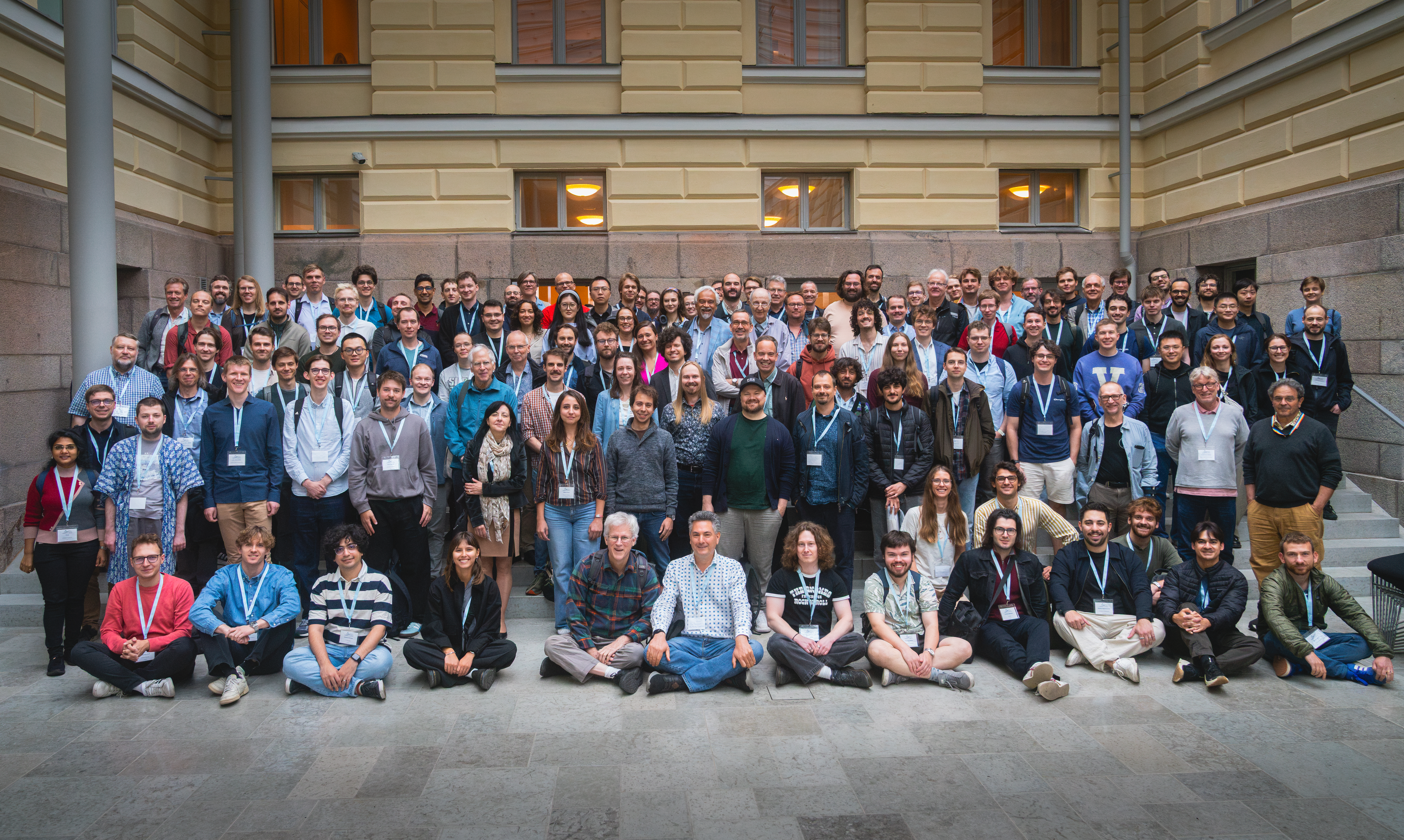
(click for full resolution)
Previous editions of SEWM took place in:
|
|
|
Jet quenching - the modification of high-energy jets in the quark-gluon plasma - has been extensively studied through weakly coupled scattering amplitudes embedded in parton-shower frameworks. These models, often combined with bulk hydrodynamic evolution, successfully describe a wide range of observables, though they typically rely on assumptions of rapid thermalization and simplified treatments of medium response. Parallel to these developments, jet thermalization has been investigated within the finite-temperature QCD effective kinetic theory, which provides our best microscopic understanding of equilibration in heavy-ion collisions. Early studies of linearized perturbations have highlighted both the promise and the limitations of current approaches, as existing MC implementations face challenges - particularly in the treatment of recoils and particle merging. Building on this foundation, we introduce a new parton-shower algorithm that exactly reproduces the dynamics of the linearized EKT, enabling a first-principles description of jet thermalization with proper inclusion of recoils, holes, quantum statistics, and merging processes.
One of the central open questions in heavy-ion collisions is how the initially far-from-equilibrium plasma of deconfined quarks and gluons evolves toward local thermal equilibrium, a process known as hydrodynamization. Despite its importance, direct experimental signatures of this early pre-equilibrium stage remain elusive. Hard probes, such as jets, produced at very early times, offer a promising window into these dynamics. In this talk, I present results for the medium-induced gluon radiation from an energetic parton traversing the quark-gluon plasma, whose nonequilibrium time evolution is simulated within QCD kinetic theory. I show that the resulting radiation pattern deviates significantly from expectations based solely on thermal emission, providing new insights into the non-equilibrium nature of the medium. These differences can be linked to the underlying bottom-up equilibration process of the plasma, which consists of under- and overoccupied stages, and whose imprints are visible in the spectrum.
High-energy partons traversing the quark-gluon plasma (QGP) lose energy primarily through splittings induced by interactions with the medium. These processes have been studied extensively in different approximations, often assuming a near-equilibrium medium background. However, in realistic heavy-ion collisions, the QGP starts far from equilibrium and undergoes an expansion and thermalization process. Understanding how out-of-equilibrium dynamics influence medium-induced radiation is crucial for accurate modeling of jet quenching phenomena.
We employ an effective kinetic description of QCD plasma thermalization to extract the elastic broadening kernel $C(q_\perp)$ which describes transverse momentum exchange between hard probes and the medium. Using this kernel, we compute the medium-induced splitting rates in out-of-equilibrium plasma to understand how non-equilibrium dynamics affect parton energy loss mechanisms. Our results provide insights into the role of medium anisotropies and time-dependent properties of the QGP on jet quenching phenomena observed in heavy-ion collisions. We discuss the implication of our findings for understanding early-time jet-medium interactions which are crucial for studying jet quenching in small systems such as $p$-$A$ and high-multiplicity $pp$ collisions.
Heavy quarks are usually modeled as Brownian probes of the quark-gluon plasma, with momentum exchange encoded by drag and Gaussian diffusion. Recent weak- and strong-coupling results show that this diffusion truncation misses a robust feature of real-time heavy-quark dynamics: the longitudinal momentum-transfer distribution has a Gaussian core but asymmetric exponential tails. These tails are fixed by the analytic structure of the heavy-quark momentum-transfer kernel and encode rare, large kicks absent from a Gaussian description. Crucially, once the exponential tails are included, equilibration is controlled by a generalized kernel-level condition rather than by the ordinary Gaussian Einstein relation between drag and diffusion.
I will discuss the non-Gaussian structure found in arXiv:2604.21895 and present its first implementation in heavy-ion phenomenology, obtained by modifying the heavy-quark extension of the Hybrid Model of jet quenching introduced in arXiv:2510.24847. This provides a concrete way to test how exponential tails affect equilibration, heavy-flavor observables, and the extraction of transport coefficients such as the heavy-quark diffusion coefficient.
We describe recent results obtained from numerical simulations
of stochastic fluid dynamics near a QCD critical point. We
discuss results for the dynamic critical exponent, the
critical behavior of transport coefficients, and the relaxation
rate of equal-time correlation functions. We also discuss
some exploratory studies of stochastic relativistic fluid
dynamics.
We study universal aspects of critical dynamics in QCD matter within our real-time formulation of the functional renormalization group (FRG) for dynamical systems with reversible mode couplings. The two most relevant ones for QCD describe the dynamics across the chiral transition and that near the QCD critical point, in the dynamical universality classes of Models G and H, respectively. We use non-perturbative FRG flow equations to compute the dynamic critical exponents of the corresponding kinetic coefficients and their universal dynamic scaling functions with special emphasis on commonalities and differences between the two dynamic models such as strong versus weak dynamic scaling relations. The real-time FRG for critical dynamics is shown to describe the universal behavior of pion damping and iso-(axial-)vector charge diffusion in the chiral transition, and that of thermal diffusivity and shear viscosity in the vicinity of the QCD critical point.
In this talk, we use the Boltzmann Equation in the Diffusion
Approximation (BEDA) as a tool to understand how the initial state
azimuthal anisotropies are washed out because of the final state
interactions. The interplay of $1\leftrightarrow 2$ and
$2\leftrightarrow 2$ interactions relax the initial anisotropies in a
characteristic manner. We observe how, for an initial anisotropy characterized by a single harmonic coefficient $v_n$, higher order harmonic coefficients can be produced. Also, for a peaked shape around
$p_T\approx Q_s$, as predicted by initial state calculations, the final
state interactions can shift the maximum towards the UV, as it has been
observed in experimental measurements. We also show how we can use this
approach to mimic the experimental data with a more phenomenological
simulation.
So far a major source of uncertainty in the study of heavy-ion collisions arises from the early time dynamics which includes initial state and pre-equilibrium dynamics. The state-of-the-art framework, \kompost~\cite{Kurkela:2018vqr,Kurkela:2018wud}, employs non-equilibrium Green's functions to propagate the initial energy-momentum tensor to the hydrodynamic phase, yet currently only treats transverse plane dynamics under boost-invariant conditions.
In this work, we extend \kompost\ to include non-boost-invariant responses to initial conditions, essential for accurately capturing the longitudinal structures observed in heavy-ion collisions.
Non-boost-invariant fluctuations on top of a homogeneous background are evolved using (3+1)D response functions calculated in kinetic theory.
To assess kinetic theory's transition towards hydrodynamic evolution, we systematically compare the out-of-equilibrium shear-stress tensor from \kompost-3D with estimates based on Navier-Stokes hydrodynamics.
Subsequently, a comprehensive (3+1)D framework, \Dipper+\kompost-3D+CLVisc+SMASH, is utilized to simulate the complete spacetime evolution of heavy-ion collisions.
The sensitivity of key observables, including longitudinal structure of anisotropic flow, to variations in the hydrodynamic initialization time is thoroughly investigated.
We study the classical chaoticity of the glasma, the far-from-equilibrium gluonic state formed in the early stages of heavy-ion collisions, using 2+1D real-time lattice simulations within the McLerran-Venugopalan model. By monitoring the evolution of small perturbations in boost-invariant color fields, we demonstrate that fluctuations grow exponentially as $\sim \exp(\lambda \sqrt{g^2\mu\tau})$, where $g^2\mu$ is proportional to the saturation scale, $Q_s$, of the system. Hence, we extract a universal leading Lyapunov exponent of $\lambda \approx 0.39 \pm 0.02$. This growth rate is remarkably robust across various initial momentum-space filters, including Gaussian, power-law, and shell kernels. In particular, the unstable mode couples to all momentum scales present in the initial perturbation. Next, the dominant unstable mode couples both longitudinal electric and magnetic field sectors, which are independent in a purely linearized approximation. Our results suggest that chaos is a collective property of non-linear Yang-Mills dynamics, independent of numerical regulators such as lattice volume and spacing. Moreover, we extend this chaotic analysis to the transport of hard probes, studying their trajectories as they propagate through the evolving non-Abelian fields using Wong's equations.
Many model descriptions of the evolution of a heavy ion collision in Bjorken flow feature hydrodynamic attractor behaviour, referring to a quick memory loss mechanism and decay towards a universal time evolution curve that will itself converge to hydrodynamic behaviour. This has so far been observed in kinetic theory and in transient hydrodynamics. In both cases, at very early times, it is not the decay of transients but the strong longitudinal expansion that facilitates memory loss. However, this early time regime of heavy ion collisions features large gluonic occupation numbers and is best modeled by the semiclassical evolution of Yang-Mills fields, i.e. the Glasma. In this talk, I discuss to what extent hydrodynamic attractor behaviour is present in classical Yang-Mills dynamics.
Bayesian global analysis of measured observables is nowadays a standard method for determining the properties and initial conditions of the hot QCD-matter produced in ultrarelativistic heavy-ion collisions. However, even with surrogate models like Gaussian process emulators (GPEs) reducing the amount of simulations, it can be computationally prohibitively expensive to produce sufficient training data for statistics-hungry rare observables. To overcome this, we introduce [1] a novel deep convolutional neural network (NN) -enhanced Bayesian global analysis of heavy-ion observables. We employ relativistic 2+1 D second-order viscous hydrodynamics with a dynamical freeze-out and initial conditions computed from the pQCD\&saturation -based event-by-event (EbyE) EKRT-model [2]. As constraints, we exploit data from $\sqrt{s_{NN}}=200$ GeV Au+Au collisions at RHIC, and from $2.76$ and $5.02$ TeV Pb+Pb and $5.44$ TeV Xe+Xe collisions at the LHC. We replace the slow hydrodynamical simulations by the fast NNs, which predict bulk observables directly from the initial energy density profiles EbyE [3], accounting for the QCD-matter properties [4]. With the NN output, we train the GPEs for obtaining the studied centrality-class averaged observables and their uncertainties. The NNs reduce the computing time by orders of magnitude. Our analysis results in a specific shear viscosity $\eta/s$ with a minimum-value plateau at temperatures $150\lesssim T \lesssim 230$ MeV with $0.12 \lesssim (\eta/s)_{\mathrm{min}} \lesssim 0.18$, and in a non-zero bulk viscous coefficient $\zeta/s$ at $200\lesssim T \lesssim 300$ MeV. At the freeze-out, the Knudsen number is $0.8-2.3$ and the ratio of the mean-free-path to the system size $0.3-1.2$, the data thus implying that the freeze-out indeed happens at the expected applicability limit of hydrodynamics.
[1] J. Auvinen, K. J. Eskola, H. Hirvonen and H. Niemi, arXiv:2603.26413 [hep-ph].
[2] H. Hirvonen, K. J. Eskola and H. Niemi, Phys. Rev. C 106, 044913 (2022).
[3] H. Hirvonen, K. J. Eskola and H. Niemi, Phys. Rev. C 108, 034905 (2023).
[4] H. Hirvonen, K. J. Eskola and H. Niemi, EPJ Web Conf. 296, 02002 (2024).
Quarks and gluons within a proton are confined within a volume in which the energy density and pressure are comparable to those of quark-gluon plasma (QGP) at or just above the QCD transition temperature. With this as motivation, I will investigate the interplay between the thermodynamic (Gibbs) entropy of QGP and the entanglement entropy of confined hadronic states across the quark-hadron phase transition. Upon hadronization, the Gibbs entropy of the droplet of QGP that becomes a proton must be reorganized into the entanglement entropy of quantum correlations with said proton. This entanglement entropy is a repository for the converted thermodynamic entropy. Three different arguments, each qualitative but with quite different sources of uncertainty, yield estimates of the magnitude of the entanglement entry carried by a proton that are similar in magnitude to the Gibbs entropy of the QGP from which a proton forms at the phase boundary. This provides a new lends on the microscopic mechanism of confinement and the nature of the QCD phase transition. A principal lesson from recreating droplets of such QGP in heavy ion collisions is that it is a strongly coupled liquid, not a plasma of partons. Given this, a central question for the future Electron-Ion Collider (EIC) will be the investigation of correlations between nearby partons within a proton. I will present an observable involving measurements of a jet and a pion as well as the scattered electron via which EIC measurements can seek and quantify the existence of short-range correlations (SRCs) between $ud$ quark pairs within a proton and differentiate a strongly coupled interior of a proton from a picture in which the proton can be understood one parton at a time via (generalized) parton distribution functions.
I will outline a systematic description of medium induced modifications to quarkonium in a quark gluon plasma by making use of the Open Quantum Systems framework and effective field theories such as pNRQCD. These medium effects are encoded in a finite set of transport coefficients defined through real-time thermal chromoelectric correlators, which can be associated with analytically continued counterparts in Euclidean space.
I will present NLO spectral functions for these correlators, emphasizing the asymmetric contributions arising from Matsubara zero modes, and report the corresponding NLO values of the transport coefficients. Importantly, I present a new, general method of extracting the transport coefficient governing the in-medium mass shift, γ directly from its Euclidean correlator without spectral reconstruction even for correlators lacking symmetry. This method provides a novel prospect for extracting quarkonium mass shifts, directly from Euclidean lattice data in a clear and robust manner. Time permitting, I also outline our strategy for extending the computation to order O(g^6).
The open quantum system framework allows one to compute quarkonium's evolution in a medium, keeping track of the needed quantum features. However, computing this evolution is a computationally demanding task. QTRAJ is an efficient code that allows one to simulate the behavior of quarkonium in a medium in the case in which the medium sees quarkonium as a small color dipole $rT\ll 1$. While this limit is accurate for $\Upsilon(1S)$, its applicability to other quarkonium states is unclear. In this talk, wwe present a generalization of this code that incorporates the regime where $rT \sim 1$ in the one-gluon exchange approximation. In its new version, QTRAJ implements new jump operators connecting different states, which are then expanded in plane waves, giving rise to a variation of the algorithm present in QTRAJ 1.0 where jumps with $\Delta \ell > 1$ are allowed. We will show a review of this approach comparing the $rT\ll 1$ and $rT\sim 1$ cases, and we present preliminary phenomenological results.
Colour decoherence in jet quenching has been the subject of intense theoretical activity and is actively searched for at RHIC and the LHC. However, it has so far lacked a systematic foundation from the perspective of open quantum systems, where the notion of decoherence is naturally formulated. In this talk (based on [1]), the open quantum systems framework is used to investigate the real-time propagation of a quark-antiquark pair through a dense QCD plasma, deriving the Lindblad evolution for the pair’s density matrix within the Markovian approximation.
Focusing on the boosted regime with a narrow dipole opening angle, we further explore the limit where the relative transverse momentum of the pair is much larger than both the momentum imbalance and the medium scale $Q_s=\sqrt{\hat qL}$. The resulting Wigner distribution displays quasi-factorisation between a hard factor describing the hard splitting producing the $q\bar q$ pair and the transverse momentum imbalance distribution encoding the broadening induced by the medium. The factorisation is only violated by a "colour decoherence factor" depending on the ratio between the dipole opening angle and the medium critical angle $\theta_c \sim (\hat qL^3)^{-1/2}$.
The open quantum systems formalism clarifies the role of the associated critical time $t_c$ in suppressing off-diagonal density matrix elements and controlling transitions between singlet and octet colour configurations. We further quantify corrections arising from quantum diffusion in $p_\perp$, highlighting the robustness of the quasi-factorised picture to describe the transverse momentum spectrum of colour dipoles and providing a perturbative scheme to systematically go beyond this approximation.
This framework is applied to the phenomenology of processes involving a boosted $q\bar q$ pair in heavy ion collisions, providing a first step towards a quantum-consistent description of such hard probes of the quark-gluon plasma.
[1] F. Arleo, P. Benzoni, P. Caucal, P. B. Gossiaux, Open quantum system approach to the transverse momentum broadening of a colour dipole, arXiv:2606.xxxx
Spin polarization has become a sensitive probe of vorticity and shear structures in the quark-gluon plasma. While global hyperon polarization can be largely understood from spin-vorticity coupling, the tensor polarization, or spin alignment, of vector mesons remains a challenging observable whose magnitude and sign depend strongly on collision energy, momentum, and meson species.
In this talk, I will present a quantum-statistical formulation of vector-meson spin alignment at local thermodynamic equilibrium based on 2412.19416. Starting from the Proca field with canonical stress-energy and spin tensors, we derive Cooper-Frye-type expressions for the vector and tensor spin polarization using the local equilibrium density operator and Wigner-function formalism. The calculation shows that, unlike the vector polarization of spin-1/2 particles, the leading purely hydrodynamic contribution arises at second order of derivative expansion and provides a controlled baseline involving thermal vorticity, thermal shear, spin potential, and their gradients.
I will then discuss how the geometry of the freeze-out hypersurface modifies this baseline based on 2509.20200. A curved space-like freeze-out surface generates an additional tensor polarization at the first order of derivative expansion induced by its curvature tensor. Analytic estimates in Bjorken and Gubser flows indicate a negative contribution to the spin alignment in gold-gold collisions, typically at the $10^{-4} -10^{-3}$ level. Further study of the Gubser flow shows that the magnitude depends largely on the transverse size of the collision system. A rough estimation shows that in O-O collisions, the magnitude of the geometry effect would reach $10^{-2}$, making spin alignment in small systems a cleaner probe of freeze-out geometry effects.
If axions exist, thermal axions are in equilibrium at high temperatures and freeze out at a temperature which depends on their coupling.
If the freezeout temperature is at or below the QCD crossover temperature range, thermal axions may be detectable in the cosmic radiation budget.
But evaluating the thermal axion-QGP coupling requires nonperturbative tools.
We show how to use lattice simulations WITHOUT analytic continuation to compute integral moments of the $k$-dependent thermal axion production rate,
and we explore the feasibility of the technique in the quenched approximation, with promising results.
In this talk, I will present our recent non-perturbative determination of the Equation of State of QCD with three flavours, using the lattice regularization of the theory. Our primary observable is the entropy density, that we determine in the temperature range between 3 GeV and 165 GeV with final sub-percent statistical precision on the continuum-extrapolated results. The entropy density shows a linear behaviour in the strong coupling squared pointing to the Stefan-Boltzmann limit at infinite temperature. It is also compatible with the known perturbative expansion supplemented by higher order terms, accounting for non-perturbative contributions. This parametrization describes well our data and those available in the literature at lower temperatures, down to 500 MeV. Pressure and energy density can be derived as well using standard thermodynamic relations. The strategy for this calculation can be extended to QCD with four or five flavours, opening the way to a non-perturbative determination of the Equation of State in full QCD.
A very simple question, with an unusually nuanced answer. In this talk, we will explore some of its most surprising aspects. From the search for causality in quasi-normal-mode spectra, to violations of causality in heavy-ion collision simulations, we will follow the question wherever it leads. Particular attention will be devoted to causality as a mathematical property of partial differential equations, highlighting recent attempts both to enforce it and to avoid relying on it altogether.
The QCD topological susceptibility $ \chi $ gives the mass of the hypothetical QCD axion. Understanding its behavior at high temperatures $ T $ is important for the axion’s cosmological history and possible role as the dark matter. In this work, we measure $ \chi $ directly from unquenched 2+1+1 flavor Lattice QCD in a temperature range of 435 MeV to 1020 MeV. To resolve the problem of insufficient sampling of topology and to traverse the barrier between topological sectors, we use reweighting in terms of a combination of the topological charge and the peak action density. Additionally, we reweight in terms of the caloron radius.
A proper understanding of QCD under extreme conditions such as high temperature and densities is of fundamental importance for the theoretical description of, e.g., heavy-ion collisions, neutron stars, and the early universe. However, the non-perturbative study of QCD at non-zero baryon density from the point of view of lattice field theory is hampered by the infamous sign problem, preventing the straightforward application of established importance-sampling techniques. A possible way out is provided by the complex Langevin approach, which is based on the stochastic evolution of complexified degrees of freedom in an auxiliary time dimension. We present continuum-extrapolated results of the first complex Langevin simulations of QCD with physical pion masses, reaching high baryon densities but restricting to temperatures above the crossover. In particular, we have computed the QCD equation of state including the pressure, energy density, and various derived quantities. Moreover, we report on our recent efforts to better understand the problem of wrong convergence that complex Langevin simulations sometimes face and how existing correctness criteria compare against one another.
We will review recent progress towards the understanding of chiral and $U(1)_A$ symmetry restoration within the QCD phase diagram, arising from our results on effective theories, Ward Identities (WI) and resonances at finite temperature and chemical potentials. Our approach allows to control in a systematic and consistent way the dependence on relevant variables such as quark masses, strangeness or the number of colors.
For isospin channels $I=0,1,1/2$ we provide results for the $f_0(500) (\sigma)$, $K_0^* (700) (\kappa)$, $\rho (770)$ and $K^* (892)$ thermal resonance poles generated respectively from $\pi\pi$ and $\pi K$ scattering at finite temperature in unitarized Chiral Perturbation Theory, and their nature around the transition region. Those resonances provide useful insight for chiral and $U(1)_A$ symmetry restoration consistently with lattice analyses, mainly through scalar susceptibilities obtained within the so called saturation approach.
On the other hand, WI provide results for scalar-pseudoscalar partner degeneration around chiral restoration consistent with lattice and with our effective theory analysis. In turn, based on WI, one can derive scaling laws around $T_c$ in agreement with lattice screening masses.
We will also review novel results for effective theories and thermal resonances including nonzero isospin density or nonzero chiral imbalance.
There has been quite some activity in finding methods to evaluate cold+dense vacuum integrals that emerge in perturbative treatments of dense (but deconfined) quark matter, conjectured to play a role in neutron star cores and hence potentially relevant to the gravitational-wave physics of colliding compact stars.
The purpose of this rather technical talk is to report on progress about bringing some order into these methods, by exploiting IBP methods at strictly zero temperature, and leveraging an integrand canonicalization algorithm that had already been successfully applied in the hot QCD case.
The equation of state of deconfined strongly interacting matter at high densities remains an open question, with effects from quark pairing in the preferred color-flavor-locked (CFL) ground state possibly playing an important role. Recent studies suggest that at least large pairing gaps in the CFL phase are incompatible with current astrophysical observations of neutron stars. At the same time, it has recently been shown that in two-flavor quark matter, subleading corrections from pairing effects can be much larger than would be naively expected, even for comparatively small gaps. Here, I present next-to-leading-order corrections to the pressure of quark matter in the CFL phase arising from the gap and the strong coupling constant, incorporating neutron-star equilibrium conditions and current state-of-the-art perturbative QCD results. The corrections are again quite sizable, and they allow one to constrain the CFL gap in the quark energy spectrum to $\Delta_\mathrm{CFL} \lesssim 140\,\mathrm{MeV}$ at a baryon chemical potential $\mu_\mathrm{B} = 2.6\,\mathrm{GeV}$, even when allowing for a wide range of possible behaviors for the dependence of the gap on the chemical potential.
Anisotropic phases are hypothesised to play a role in the small temperature and large chemical potential regime of the QCD phase diagram, making their existence in the core of neutron stars a concrete possibility. I will present the study of such a phase, the chiral density wave (CDW), defined as an anistropic chiral condensate. The nuclear CDW is firstly studied within a nucleon-meson model, where the nucleonic vacuum fluctuations are taken into account and the parameters of which are fitted using low-density properties of nuclear matter. Imposing beta equilibrium and charge neutrality, stable neutron stars are constructed, and the parameter region is studied to check where the CDW is preferred. Even though stars that meet astrophysical constraints do exist for certain parameter choices, a CDW core results in stars that are too light. Additionally, I will compare these results with a calculation in the strong-coupling limit using holography and the Witten-Sakai-Sugimoto model.
We investigate the possibility of a crystalline phase of dense nuclear matter as a constituent of neutron star cores. Performing a stability analysis of the most stable homogeneous ground state, we first show that symmetric nuclear matter is unlikely to manifest instabilities, however, its phase diagram is extremely likely to be almost completely embedded in a moat-regime, where the ground-state is homogeneous but correlation functions show non-trivial oscillatory patterns, reminiscent of inhomogeneous phases. Finally, we present results in beta-equilibrium and show that once hyperons are permitted to populate the system, an instability develops in the pion channel, signaling the preference of a spatially non-trivial pion condensate.
We study the low-energy QCD phase diagram under a magnetic field and at finite density. Both baryon chemical potential and isospin chemical potential are taken into account. The former is responsible for a domain wall configuration of the neutral pion, dubbed the chiral soliton lattice (CSL), originating from the chiral anomaly. The latter induces the charged pion condensate that can accommodate Abrikosov vortex lattice (AVL). Either phenomenon requires the magnetic field above a certain critical value. Our findings show that an interplay between the two structures, which we call "CSL-AVL intersection", lowers the demanded critical magnetic field and therefore alters the phase diagram. The result is phenomenologically relevant to neutron stars, particularly in regions with proton superconductors. The common mechanism applies to broader physical contexts that feature coexisting vortices and domain walls, e. g., H meson vortices intersected by eta meson domain walls.
The Gell-Mann-Low relation forms the foundation of all perturbative approaches to QFT. In order to establish how perturbation theory can be consistently generalised to finite-temperature systems it is therefore necessary to understand how this relation is modified by thermal effects. In this talk I will introduce a new proposal for how this relation should be generalised, based on the non-perturbative spectral characteristics of thermal correlation functions. I will outline why the perturbative expansion in this framework resolves the two major problems of the standard real-time approach, namely the appearance of products of on-shell components, and infrared divergences in massless theories. Moreover, by using numerical lattice simulations in massive $\phi^{4}$ theory I will demonstrate that this framework provides precise finite-temperature predictions of the lattice data, in contrast to the standard perturbative approach.
Over the past decade, relativistic hydrodynamics has been pushed into increasingly extreme regimes—from hydrodynamic attractors in theory to small-system dynamics at Relativistic Heavy Ion Collider and Large Hadron Collider. Yet these approaches ultimately remain anchored to local thermal equilibrium. In this talk, based on 2504.18754 with Berges, Denicol, and Preis, I present a fundamentally different framework: a hydrodynamic description defined entirely far from equilibrium, using nonthermal fixed points as the reference state. I discuss implications for fluid classification via shear viscosity, early-time dynamics in high-energy nuclear collisions—where nonthermal fixed points emerge as attractors—and cold atomic gases, where they are realized experimentally.
Attractors are a generic feature of far-from-equilibrium systems in which much of the memory of a system’s initial condition is lost long before local thermal equilibration. There has been recent interest in leveraging the existence of attractors to extend hydrodynamic descriptions to earlier times in the formation of QGP, largely focused on isotropic attractors. However, highly anisotropic non-thermal attractors are present in QCD kinetic theory at early times, motivating developing approaches more similar to anisotropic hydrodynamics (aHydro). In this talk, we propose “attractodynamics”: a hydrodynamic-like effective theory of excitations about a generic far-from-equilibrium anisotropic attractor. Unlike aHydro, here the underlying generalized Romatschke-Strickland distribution function is an attractor rather than phenomenologically chosen, allowing greater theoretical control. We present the attractodynamic framework and derive attractodynamic equations of motion for a simple 0+1D theory with a known analytic attractor solution.
Contemporary understanding of thermalization in quantum field theory (QFT) stems largely from understanding properties of transient excitations of equilibria. These nonhydrodynamic excitations are known to structurally differ between weakly- and strongly-coupled QFTs with no known results at intermediate values of the interaction strength. We demonstrate that all the known behaviors of transient excitations can be understood as a consequence of different realizations of a symmetry principle, the shift symmetry, applied at the level of the far from equilibrium generalization of the hydrodynamic effective action that we explicitly construct. Our approach naturally includes the effects of stochastic fluctuations outside the hydrodynamic regime and allows to explicitly construct hybrid models interpolating between weak- and strong-coupling behavior. We study properties of one such model motivated by thermalization in nuclear collisions in light of the QCD running coupling.
Based on XA, Brants, Heller, and Yin, arXiv:2511.11555 and work in progress.
Ultra-relativistic electrons passing through ordinary matter initiate electromagnetic showers that evolve through bremsstrahlung and pair production. At very high energy, the quantum mechanical duration of bremsstrahlung becomes longer than the mean free time to elastically scatter from the medium, leading to a significant suppression known as the Landau-Pomeranchuk-Migdal (LPM) effect. The basic qualitative and quantitative understanding of these processes was seemingly settled in the 1950s, with detailed experimental confirmation in the 1990s. But we find drastic modifications to the LPM bremsstrahlung rate for some regions of extremely high energy bremsstrahlung and electron energies (k, E) where the duration of bremsstrahlung becomes so long that it overlaps subsequent (medium-induced) pair production by the bremsstrahlung photon. Our analysis uses methods originally developed for parton showers in quark-gluon plasmas.
The out-of-equilibrium evolution of the early universe plays a central role in addressing some of the most pressing outstanding puzzles of particle physics, such as the matter-antimatter asymmetry and the production of dark matter. A consistent description of the non-equilibrium dynamics of the system requires systematically incorporating quantum and thermal effects, which can be achieved via the Schwinger-Keldysh formalism together with the two-particle-irreducible (2PI) effective action.
In this talk, I show how this first-principles approach can be used to study the real-time dynamics of an expanding bubble during a cosmological first-order phase transition. In particular, I demonstrate how this framework naturally accounts for the impact of particle production onto the bubble wall, which the conventional kinetic picture misses.
I will discuss dynamical effects during critical bubble nucleation in thermal first-order phase transitions. These effects arise due to lack of local thermal equilibrium and affect the parameters of the transition including the nucleation rate. I will present a general method of calculating the thermal nucleation rate that accounts both for statistical and dynamical effects. I will also present results from real-time classical lattice simulations showing non-equilibrium features (such as oscillons) during the nucleation process. These results can be important in many areas, from cosmological phase transitions to studies of false vacuum decay in quantum simulators.
Domain walls are two-dimensional topological defects generated when a discrete symmetry is broken during phase transitions in the early universe. The collapse of domain walls can emit gravitational waves that can be observed by interferometers. The simplest and most well-studied domain walls are from $Z_2$ symmetry breaking. However, the breaking of larger non-Abelian discrete symmetries can also lead to domain wall formation. These domain walls from non-Abelian discrete symmetries are called the non-Abelian domain walls. By discussing $A_4$ and $S_4$ breaking as examples, we study the variety, property and dynamics of non-Abelian domain walls.
Skyrmions were originally proposed in QCD as topological solitons of the pion field, providing an emergent description of baryons without introducing additional degrees of freedom. Their topological nature and possible role as dark matter candidates have since motivated the search for analogous configurations in other theories. A common expectation, however, is that stabilizing skyrmions requires intrinsically non-perturbative physics.
In this talk, we challenge this expectation. Using toy models that capture different limits of the electroweak sector of the Standard Model, we show that skyrmions which are not classically stable at zero temperature can instead be stabilized by thermal effects arising perturbatively at loop level. This motivates a broader investigation of skyrmions within the quantum effective action of the Standard Model.
Classically scale-invariant (and perturbative) theories provide a way to understand large hierarchies, as scales are generated through dimensional transmutation. They always lead to first-order phase transitions, since symmetries are radiatively broken, and they generically feature quasi-flat potentials, which are suitable for inflation. I will discuss a simple but fully realistic model of this kind that accounts for all observational evidence of new physics and is remarkably compatible with the most recent constraints on inflationary observables from both the Planck/BICEP/Keck and the Atacama Cosmology Telescope (ACT) collaborations. This model illustrates how classical scale invariance generically leads to a non-standard cosmology in which inflation occurs in two stages: a slow-roll stage and a thermal stage, separated by a radiation-dominated era.
Baryon number violation at the electroweak (EW) phase transition has typically been associated with thermal sphalerons in the Standard Model (SM). We showed in [2508.21825, to appear in PRL] that B-violation can also occur at zero temperature from a supercooled first-order electroweak phase transition.
In this talk, I will review the work done on B-violation from the production of EW textures in quenched tachyonic EW phase transitions and present our new mechanism in which baryon number violation can occur at zero temperature from Higgs bubble collisions, showing that this can be of the same order as that from thermal sphalerons in the symmetric phase at EW temperatures. I will highlight the dependence of the rate of Chern–Simons number transitions on the shape of the scalar potential and on the Lorentz factor of the bubble walls at collision, as calculated via large-scale $(3+1)D$ lattice simulations of the Higgs doublet and $SU(2)$ gauge fields.
Preheating refers to a well-known set of phenomena, such as tachyonic instability and parametric resonance, associated with the dynamics of a scalar field, typically in the context of post-inflationary reheating. In this talk, I will explore the possibility of preheating-like amplification of fluctuations of a scalar field following a strongly supercooled electroweak first-order phase transition, which, unlike inflation, does not involve a homogeneous inflaton background but instead occurs through nucleation and growth of true-vacuum bubbles against a false vacuum background. I will also discuss the impact of such effects on the evolution of the true vacuum bubbles and their cosmological consequences.
Gravitational waves from an electroweak phase transition, expected to be visible to the next generation of detectors, offer a novel probe of particle physics by encoding information about the fields that drove the transition. Calculations of the gravitational wave power spectrum often adopt simplified equations of state to describe the relativistic hydrodynamics of the phase transition. These simplifications rely on the assumption that the universe is radiation dominated during the phase transition, which breaks down in the true vacuum phase. Moreover, fitting formulas used to determine the gravitational wave spectrum from the hydrodynamic solution are not easily generalised to a generic equation of state. We develop a self-consistent method for evaluating the gravitational wave spectrum using the equation of state derived from a particle physics model and without fitting formulas. We perform these calculations across the parameter space of a simple extension of the Standard Model. In this talk, I will demonstrate (i) the importance of a precise hydrodynamic description of cosmological phase transitions; and (ii) the degree to which this impacts the resulting gravitational wave spectra.
We investigate the gravitational wave signatures of a supercooled cosmic phase transition within a classically conformal Standard Model extension, where quark condensation can trigger symmetry breaking via spinodal decomposition instead of conventional bubble nucleation. By studying the amplification of scalar fluctuations in the linear regime, we estimate the associated scalar-induced stochastic gravitational wave background from the thermal inflation period preceding the phase transition. Lastly, we assess the prospects for their detection by comparing the predicted signals with the sensitivities of future gravitational wave experiments.
First-order phase transitions in a dark sector can produce an observable stochastic gravitational-wave background, and many models predicting such signals have been studied in the context of current and future gravitational-wave experiments. For moderately strong transitions, hydrodynamical simulations suggest that sound waves generated by the expansion and collisions of true-vacuum bubbles are the dominant source of gravitational waves. It is often assumed that these sound waves propagate only within the dark-sector fluid, while the possible impact of the visible sector is usually neglected. In this talk, we consider a linear hydrodynamical setup that includes the coupling between the dark and visible fluids. We show that, even if the bubble expansion initially affects only the dark fluid, sound waves can later be induced in the visible sector as well. Using the sound-shell model, we find that this transfer of acoustic energy suppresses the gravitational-wave signal compared to the case of a completely decoupled dark sector.
Gravitational waves from cosmological first-order phase transitions provide a probe of physics beyond the Standard Model that complements laboratory experiments. The gravitational wave spectrum can be computed in an effective theory of a relativistic fluid coupled to a scalar field, the order parameter of the phase transition. The coupling is effected through the effective potential and the damping coefficient, from which key thermodynamic quantities can be extracted.
For transitions with moderate supercooling, the key quantities can be converted to an observable gravitational wave spectrum in a semi-analytic framework called the Sound Shell Model. We have implemented the model in the simulation library PTtools, which has been matched to numerical simulations, and extended to account for additional key physical effects. We consider selected extensions of the Standard Model, and compute the signal-to-noise ratio for the upcoming Laser Interferometer Space Antenna (LISA). These developments provide more accurate predictions of the detectability of phase transition signals at LISA, improving on the connection between the gravitational wave spectrum and the underlying particle physics.
We present a study of dimensional reduction as a tool for a precise and systematic description of thermally driven electroweak phase transitions (EWPT) in the early universe. Focusing on strong first-order transitions, which are relevant for gravitational wave cosmology, we examine higher-order dimensional reduction, the running of effective parameters within the effective field theory (EFT), and the impact of higher-dimensional operators. This allows us to assess the range of validity and theoretical uncertainties of the EFT approach.
We further demonstrate these results with applications to the Standard Model Effective Field Theory (SMEFT) and singlet extensions of the Standard Model, both of which can realize electroweak phase transitions.
Our current understanding of the Universe's history, based on the standard models of particle physics and cosmology, can successfully reproduce a wide variety of experimental results. Key issues like the nature of dark matter (DM) or the baryon asymmetry of the Universe (BAU) need new physics beyond the Standard Model (BSM), with most solutions invoking the existence of new particle degrees of freedom in the early Universe. Studying the dynamics of those BSM particles throughout cosmological history involves intricate Thermal Field Theory (TFT) computations; those computations should also be as precise as possible, so as to be able to test the viability of BSM models. For example, determining the current-day abundance of a DM candidate for comparison with the expected quantity of DM in the Universe often requires computing the thermal production rate of this particle. The multiplication of BSM models makes it desirable to be able to perform such tasks automatically, to both save time and reduce the risk of errors.
In this talk, I present the first release of the AUTOTHERM code: a framework to automatically compute (i.e. with minimal user intervention) the thermal production rate of a particle, using only the Lagrangian as an input. AUTOTHERM differs from other already available codes by its automated implementation of Hard Thermal Loop (HTL) resummation; this is necessary to properly account for finite-temperature collective effects in the medium and avoid infrared (IR) divergences in the naive computation due to massless mediators. AUTOTHERM uses three different leading-order-equivalent schemes to describe the collective effects, allowing users to quantify the uncertainty inherent to the theoretical computation. In the HTL theory, the model dependence of the collective effects is contained entirely within the thermal masses of the mediators, which are computed automatically by AUTOTHERM.
During this talk I will use the example of the gravitino, the massive superpartner of the graviton and a popular DM candidate, as a common thread. I will present new results for the thermal gravitino production rate and also compare those results to the previous state of the art from the literature, highlighting how its gauge-dependent resummation yields a pathologically divergent result.
This talk is based on the upcoming 26XX.XXXX and 26XX.XXXX by Jacopo Ghiglieri, Greg Jackson, and myself.
Thermal production of hot axions in the early universe has attracted much attention recently, owing to the fact that
it will be sensitive to upcoming precision constraints on $N_{\mathrm{eff}}$. The theoretical uncertainty associated with
such calculations is known to come primarily from the axion production rate, which has been
studied across a broad range temperatures and axion momenta using perturbative methods [1,2,3]. Coupled
with existing measurements of $N_{\mathrm{eff}}$, these
calculations seem to suggest that the hot axions freeze out from the primordial plasma around or above the QCD crossover, where
the application of perturbative QCD is not well-justified. This motivates the study of the
axion production rate using strong-coupling methods.
In this talk, I will present a first determination of the axion production
rate from a strongly coupled plasma, using the AdS/CFT correspondence.
Our calculation extends the well-known strong-coupling computation of the sphaleron rate [4] to finite axion momenta,
and is hence under control for all momenta, unlike its perturbative counterpart. I will argue how,
from our result of the corresponding correlation function in $\mathcal{N}=4\,\text{SYM}$, we can estimate the
strongly coupled QCD axion production rate. Finally, I will discuss
the impact of strong-coupling effects on $N_{\mathrm{eff}}$.
Relativistic hydrodynamics successfully provides an effective field theory description for the low energy regime of many out-of-equilibrium systems. On the other hand, we proved that any stand-alone hydrodynamic EFT is inherently acausal and therefore requires the addition of transient UV modes in order to restore causality. This is made possible by the exponential decay of dissipative hydrodynamics in a majority of the lightcone, allowing the possibility of a causal description that still reduces to the hydrodynamic one at late timescales. It furthermore allows learning about the emergence and possible restrictions of the non-hydrodynamic modes in these causal UV completions.
Any viable inflationary model must account for reheating of the universe prior to the onset of primordial nucleosynthesis. In this work, we study the (p)reheating mechanism for an inflaton field with a quartic minimum of the T-model kind with coupling $\lambda$, prior to and post fragmentation, making a clear distinction between the two regimes. We assume that the main particle production channel corresponds to the decay into a pair of spin 1/2 fermions via Yukawa-like interactions. On top of its decays, we also consider the self-interaction of the inflaton, which sources the resonant growth of inflaton inhomogeneities, possibly leading to its eventual fragmentation. By means of a combination of non-perturbative (Heisenberg/Bogoliubov) and perturbative (Boltzmann) methods, we find that for Yukawa couplings that seemed to be intuitively perturbative, such as $y\gtrsim 10^{-8}$ ($y^2/\lambda\gtrsim 3\times10^{-5}$), parametric resonance, kinematic blocking, and Pauli suppression effects cannot be ignored. Additionally, we show that achieving $\rho_\phi \sim \rho_\psi$ prior to fragmentation requires large couplings, $y\gtrsim 0.2$ ($y^2/\lambda\gtrsim 10^{10}$), which needs a detailed study of backreaction and radiative corrections. Thus the rest of our work constitutes studying post-fragmentation fermion production where we conclude that, in general, reheating in this setup is not possible and thus we conclude that in order to successfully reheat, one must invoke a coupling to a integer- and/or 0-spin particle like a scalar boson.
Completing the N$^3$LO Yang-Mills pressure, as well as understanding the microphysics of cosmological phase transitions is currently hindered by the challenging evaluation of multi-loop finite temperature sum-integrals.
Tree-Loop Duality is a framework for the numerical evaluation of multi-loop integrals. Recently, this approach was extended to finite temperature in the case of infrared finite integrals. However, frequent infrared divergences associated with bosonic Matsubara modes render the method incomplete for generic finite temperature sum-integrals.
In this talk, I will introduce finite temperature Tree-Loop Duality and discuss a newly developed algorithm that systematically generates the missing infrared counterterms. This finally brings the N$^3$LO Yang-Mills pressure, as well as the automation of finite temperature sum-integrals within reach.
Entanglement is a defining property of quantum physics and provides a natural way to characterize correlations. Despite some inherent difficulties, there has been considerable advancement in lattice evaluations of entanglement measures, such as entanglement entropy (EE), in QFTs.
In my poster, I will present our argument that, in certain attainable limits, a derivative of EE approaches the thermal entropy density for general QFTs. We provide validation for these claims from our lattice computations in 3d O(4) scalar field theory by showing that in the corresponding limits, the EE derivative satisfies the same Maxwell relation as the thermal entropy density. These results represent a first step towards extracting thermodynamics from lattice evaluations of EE in QCD and other more complicated QFTs.
Motivated by the recent small systems collisions at the LHC, we present exact first principles results for the finite-system-size corrections to the pressure in both massless and massive non-interacting scalar field theories, highlighting the deviations from the Stefan-Boltzmann limit. The methods used to derive this result rely on a rigorous formulation of the path integral partition function on a finite discrete lattice, with particular focus on ensuring absolute analytical control over every step of the derivation. Finally, we discuss the extension of this rigorous framework toward interacting theories, outlining the path toward computing next-to-leading order (NLO) corrections in a massive $\phi^4$ theory.
QCD kinetic theory is an established method for modeling the time evolution of deconfined QCD matter and is also applicable out of equilibrium. It has been used to study how an initially far-from-equilibrium QCD plasma thermalizes and hydrodynamizes. However, numerical implementations employ simplified assumptions in evaluating the high-dimensional phase-space integral, such as a simplified treatment of the in-medium resummed propagators, or the assumption of local isotropy (isotropic screening). In this talk, I will show that including the hard thermal loop propagators leads to a reduction of the specific shear viscosity and reduces the maximum anisotropy reached in Bjorken expanding plasmas. Furthermore, I will present results for the gluon splitting rates in an anisotropic plasma, which are needed as input for the inelastic collision kernel. In Bjorken expanding plasmas, these gluon splitting rates drastically differ from those using the approximations employed in current implementations. This highlights the need for a better treatment of anisotropies in kinetic theory simulations.
Based on:
[1] Phys.Rev.D 110 (2024) 7, 7 (Boguslavski, Lindenbauer)
[2] arXiv:2509.03868 (Altenburger, Boguslavski, Lindenbauer)
[3] arXiv:2509.09897 (Lindenbauer)
We attempt to reformulate the problem of the microscopic friction force exerted on a bubble wall, focusing on strongly interacting plasmas. Across the confinement transition, the loss of a quasiparticle description renders a conventional kinetic theory approach challenging, so that assuming local thermal equilibrium (LTE) can provide an upper bound on the wall velocity by neglecting the additional friction from out-of-equilibrium effects. In this talk, we suggest a hydrodynamic framework for computing the friction force exerted on the bubble wall, grounded in viscous hydrodynamics, circumventing microphysical scattering calculations. We demonstrate the utility of this approach by applying it to a secluded pure SU(N) Yang-Mills sector undergoing the confinement FOPT, obtaining self-consistent estimates of the terminal bubble wall velocity.
Stochastic hydrodynamics provides a dynamical framework for the evolution of fluctuations in heavy-ion collisions, but poses significant challenges in numerical simulations. We present an algorithm for the simulation of non-relativistic stochastic hydrodynamics in two spatial dimensions in a box, both in the cases of compressible and incompressible fluids. We use the robust Metropolis algorithm, handling fluctuations and dissipation at once by systematically replacing dissipative terms in the hydrodynamic equations by random forces. The algorithm can easily be modified for numerical simulations of other hydrodynamic theories. We present test cases as well as numerical calculations of the renormalization of shear viscosity, and give an outlook to critical dynamics and relativistic theories.
At high densities and low temperatures, hadronic matter is expected to undergo a first-order phase transition into a color-superconducting state. While such conditions occur in neutron stars, studies focusing only on cold neutron stars are not fully conclusive because they neglect the evolutionary processes that may influence the appearance of color-superconducting phases. A proto–neutron star, however, describes the earliest evolutionary stages during the first seconds to minutes after core collapse and therefore has different thermodynamic properties compared to a cold neutron star — in particular higher temperatures and trapped neutrinos. To address this, we incorporate proto–neutron star conditions into the equation of state. Since the total baryon number of a neutron star is conserved during its early evolution, tracking stellar configurations from the maximum mass of the hot proto–neutron star to the final cold neutron star allows us to investigate whether color-superconducting phases can form at any point along this trajectory.
In the magnetospheres of magnetars, strongly magnetized neutron stars, the magnetic field can be tens of times the critical Schwinger field $B_Q = m^2/e \approx 4.41\cdot 10^{13}$ G. In this strong field regime quantum electrodynamics (QED) becomes nonlinear, which has profound effects on the plasma dynamics of the magnetosphere. Most notably the energies of electrons and positrons become quantized into Landau levels and scattering cross sections obtain resonances, i.e., specific energies where the interaction probability is strongly amplified. In this talk, I will present a new formalism for calculating QED scattering cross sections in strong background magnetic fields. The obtained cross sections can be used in simulations of magnetar magnetospheres with the goal of explaining the double peak structure of magnetar emission spectra.
A first-order phase transition in the early universe acts as a potential source of primordial gravitational waves (GWs). For a wide range of scenarios, the dominant GW contribution is believed to arise from sound waves, whose decay through acoustic turbulence plays a vital role in determining the intensity of the ensuing GW signal. To study this decay, we have developed a relativistic hydrodynamic simulation code based on the first-order viscous BDNK formulation, which is causal and stable across a range of hydrodynamic frames. The relativistic hyperbolic conservation laws are solved numerically using a finite volume scheme with shock-capturing methods to ensure accurate conservation and shock resolution.
Quantum chromodynamics (QCD) at finite baryon chemical potential remains hard to access by first-principles methods, making effective models an essential tool for exploring this region of the phase diagram. The quark–meson (QM) model provides a viable alternative to more established approaches such as the Nambu–Jona-Lasinio model, with the advantage that it can be matched to physical observables and yields reasonable agreement with lattice QCD where comparisons are possible. The quark–meson–diquark (QMD) model extends the QM framework by incorporating diquark degrees of freedom while remaining renormalizable.
In this talk, I examine the impact of diquark and vector meson degree of freedoms on the equation of state of dense matter and demonstrate how their inclusion can lead to neutron star equations of state consistent with current astrophysical observations. I also discuss the general features of the resulting equation of state, including the behavior of the speed of sound, and highlight the physical intuition that can be gained from studying this effective model for dense QCD matter.
In the last years the non-perturbative predictions of QCD at temperatures up to the Electroweak scale have become accessible, thanks to a novel computational strategy that allows to define and efficiently simulate the thermal lattice theory at very high temperatures. The length scales over which the strong force is screened in the thermal medium are observables of primary interest in this context: they characterize the spatial structure of the quark-gluon plasma and are encoded in the screening masses. In this contribution we report a precise and in-depth study of the screening spectrum of QCD in multiple hadronic channels and Matsubara sectors for temperatures between 1 and 165 GeV, with particular emphasis on non-static mesonic modes which are studied for the first time. Comparison between the non-perturbative results and the known terms of the perturbative expansion, valid at asymptotically high temperature, reveals that higher-order terms (some of which of non-perturbative origin) remain relevant over the whole temperature range. These results directly highlight the importance of a non-perturbative treatment of non-static observables in thermal QCD up to Electroweak scale temperatures.
High-temperature QCD can be described, through dimensional reduction,
by a series of 3D effective field theories. Electrostatic QCD consists
of a gauged-scalar theory, while magnetostatic QCD (MQCD) of a pure 3D
gauge theory. The use of dimensionally reduced effective theories to
predict 4D observables relies on the matching between the 3D and 4D
theories, which, at present, is only known perturbatively. We have
devised a strategy to perform a fully non-perturbative matching of QCD
and MQCD via lattice simulations. This allows us to assess the
accuracy and validity of the effective theory without perturbative
uncertainties coming from the matching. In this talk I will explain
how the matching is performed over a wide range of temperatures with
high precision, while keeping all lattice systematics under control.
As a first step in this study, we investigate the matching between the
finite temperature pure gauge theory and its 3D counterpart, for which
I report some results.
Axion-like particles (ALPs) are among the most promising dark matter candidates. Yet a large part of parameter space, in particular the regime of large decay constants where ALPs become effectively invisible, remains difficult to probe experimentally. In the supercooled audible axion mechanism, invisible ALPs can generate a sizable primordial gravitational wave (GW) background via a tachyonic resonance induced by their coupling to photons. I will discuss the conditions under which this resonance develops, the resulting GW spectrum, and the associated production of large-scale magnetic fields. Remarkably, parameter regions that yield pronounced GW signals in the $\mu$Hz band can simultaneously account for the intergalactic magnetic fields suggested by recent blazar observations.
QCD with a real chemical potential suffers from a sign problem in numerical calculations of Euclidean space path integrals. A novel approach exploits the fact that an imaginary chemical potential avoids the sign-problem and can be interpreted as a real Lagrange multiplier enforcing a current density rather than a number density. At zero temperature, Lorentz symmetry then allows rigorous upper and lower bounds on the equation of state (EoS) $ \epsilon ( n ) $ (where $ \epsilon $ is the energy density and $ n $ the baryon number density) to be inferred from sign-problem-free current-density calculations alone.
This talk presents this novel approach and its first application to an interacting quantum field theory, namely the massive Thirring / sine-Gordon model. Using the exact Bethe ansatz solution, the derived bounds are compared directly with the exact zero-temperature EoS across a wide range of couplings and densities. The constraints remain quantitatively useful throughout, becoming exact in the low-density limit and constraining the EoS within a factor of two at high density.
Gauge invariance requires physical states to be composite, even in the weak sector of the SM. The Fröhlich-Morchio-Strocchi (FMS) mechanism resolves this subtlety by predicting a one-to-one mapping between gauge and global degrees of freedom. Following the FMS framework, gauge-invariant composite operators for the Higgs, W/Z bosons, and weakly charged leptons are constructed by dressing the elementary fields with additional Higgs contributions. At leading order, these operators reduce to their perturbative expressions; beyond that, deviations due to the additional contributions are expected.
In this talk, we give an introduction to the FMS mechanism and discuss its consequences for the SM and beyond. We then investigate this mechanism on the lattice by simulating a proxy theory for the weak SM with vectorial leptons. Within this manifestly gauge-invariant setup, we show results in support of the FMS picture, including the physical spectrum of the theory and corresponding spectral densities. Finally, we present a first exploratory finite-temperature study of the theory with dynamical fermions, searching for signatures of a possible electroweak phase transition in an unquenched setting.
Nonthermal fixed points are universal, attractive stages in the far-from-equilibrium dynamics of quantum many-body systems. Static Nonthermal Fixed points are well understood and have been experimentally observed in cold-atom experiments. They have been theoretically predicted in models of early-universe cosmology and ultra-relativistic heavy-ion collisions. In these set-ups, expansion plays an important role. In this talk I will present results that show how Nonthermal Fixed Points in expanding backgrounds can be understood as ideal hydrodynamic manifestations of their non-expanding counterparts. In Bjorken flow, we find that deviations from the ideal behavior can be described by viscous hydrodynamic corrections. This constitutes a clear example of far-from-equilibrium hydrodynamic behavior. A consequence of this finding is that we can study the anisotropic expanding NTFP, relevant for the first stage of BMSS bottom-up thermalization scenario for heavy-ion collisions, by considering an anisotropic non-expanding NTFP. I will discuss how this could be studied in cold-atom experiments.
In extensions of the Standard Model, symmetry breaking or confinement of new gauge groups can give rise to first order phase transitions. The phase transition creates expanding bubbles of the stable phase that grow and merge until they fill the entire universe, leaving behind pressure and velocity perturbations. This process creates gravitational waves. The Laser Interferometer Space Antenna (LISA) is expected to be able to detect the gravitational waves from a first-order electroweak-scale phase transition.
The validity of the picture depends on the bubbles being stable to aspherical perturbations: an instability would lead to crumpling of the phase boundary and greatly reduce the amplitude of the gravitational waves. So far, the stability of the bubbles has only been calculated assuming planar symmetry and constant pressure and velocity away from the phase boundary. The results of this approximation predict that the bubbles should not grow as large as they do in simulations.
We study for the first time the hydrodynamic stability of spherical bubbles with the correct radial profiles of pressure and velocity. We map out the complex frequencies of the perturbations and show how the stability is modified by the more physical geometry and boundary conditions.
Baryon number can be efficiently violated at low temperatures, from Higgs bubble collisions in a strongly first-order electroweak phase transition, based on the dynamics of electroweak textures [2508.21825]. This may open up new possibilities of realizing electroweak baryogenesis in models with a low reheat temperature and large bubble wall velocity.
In this talk, I will propose a novel mechanism of cold electroweak baryogenesis from Higgs bubble collisions, which extends our first work [2508.21825] by including a dynamical CP-violating source, namely $\frac{1}{\Lambda^2}\phi^\dagger \phi \text{Tr}[W \tilde{W}]$, in (3+1)D real-time lattice simulations of the Higgs and SU(2)-gauge bosons, where true vacuum critical bubbles are nucleated at initial time. In particular, I will discuss the lattice techniques implemented to treat the fields’ evolution, as well as the CP-violating term.
This work can be extended to compute the resulting primordial magnetic field, by embedding the $U(1)_Y$-gauge boson in the simulations.
Hydrodynamic simulations of neutron star mergers rely on the clear separation between the strong-interaction, weak-interaction, and hydrodynamic timescales. In this effective framework, weak Urca interactions are typically the slowest microscopic processes, and therefore the Urca rate determines the bulk-viscous dissipation. This assumed hierarchy of dissipative mechanisms can be decisively altered, without invalidating hydrodynamics, if the trajectory of the matter in a neutron star merger passes through the vicinity of a possible low temperature QCD critical point. The enhanced density fluctuations lead to critical slowing down and rapid growth of transport coefficients including bulk viscosity. While this growth is regulated by finite-time effects, finite-size effects, and the breakdown of hydrodynamic scale separation, which bound the correlation length, we demonstrate that the QCD contribution to bulk viscosity can rival the electroweak contribution in realistic conditions. Thus, critical dynamics could leave observable imprints on the hydrodynamic evolution of neutron star mergers.
We calculate the cross section for the heavy quark $(Q)$ production through gluon $(g)$ fusion process $g+g\to Q+\bar{Q}$ in the presence of a weak external magnetic field $(B)$. Several studies have estimated the $B$ field strength in non-central heavy-ion collisions to be $eB\sim m_\pi^2\sim 10^{18},\text{G}$. Thus, for heavy flavour mass $m_Q$, the inequality $m_Q^2 \gg eB$ is largely satisfied, justifying the weak field approximation. The fermion propagator in a weak magnetic field is treated using Schwinger’s proper-time formalism. Owing to the hierarchy of scales ($m_Q^2 \gg eB$), we neglect the effects of the magnetic field on the quark and antiquark spinors. Since the magnetic field breaks rotational invariance, the cross section becomes anisotropic and depends on the relative orientation between the magnetic field and the incoming gluons and the outgoing heavy quarks. This has interesting signatures on heavy quark observables, carrying information about the initial stage B fields produced in relativistic heavy ion collisions.
Relativistic hydrodynamics is the universal long-wavelength framework for many-body systems near local equilibrium. Motivated by spin hydrodynamics and by the approximate scale symmetry of high-temperature QCD matter, I will discuss a relativistic hydrodynamic theory in which spin and intrinsic dilation are treated as quasi-hydrodynamic degrees of freedom. This talk will be based on our recent work, available as arXiv:2603.17794.
The theory is constructed phenomenologically from the conservation laws associated with the Weyl-Poincaré group, together with the local second law of thermodynamics. The resulting constitutive relations contain, in addition to shear and rotational viscosities, a bulk-viscosity-like coefficient controlling the relaxation of intrinsic dilation and a dilation conductivity governing its diffusion. This bulk-like response does not represent explicit breaking of scale invariance; rather, it describes how microscopic stretching or compression of fluid elements relaxes toward the macroscopic expansion.
The linearized theory contains a gapped dilation mode and exhibits freeze-out of long-wavelength sound perturbations in an expanding or contracting background. In the nonrelativistic limit, it reduces to microstretch-fluid dynamics, where spin and intrinsic dilation correspond to microrotation and microstretch, respectively.
I will also discuss how the scale anomaly modifies this hydrodynamic structure when the fluid is coupled to electromagnetic fields. The anomaly induces a nondissipative electric current, but local thermodynamic consistency requires this current to be accompanied by additional nondissipative corrections to the energy-momentum tensor and the dilation density.
We investigate the out-of-equilibrium dynamics of a $Z_2$-symmetric scalar field theory with Langevin dynamics under linear driving protocols across magnetic first-order phase transitions, close to and far below the critical temperature $T_c$.
Using classical-statistical lattice simulations, we find that if the driving timescale is sufficiently fast, the system exhibits finite-time scaling behavior independent of temperature and dimensionality, identical to that observed in mean-field simulations. In slow quenches near $T_c$ this mean-field scaling crosses over to critical Kibble-Zurek scaling behavior for which we compute universal scaling functions.
These smoothly extend the well-known Widom-Griffiths form by an additional finite-time scaling variable to describe the universal out-of-equilibrium modifications.
For temperatures $T \ll T_c$ nucleation and growth dominate the transition dynamics, resulting in corrections to scaling. Near the transition point where the order parameter changes sign, the crossover between mean-field and critical out-of-equilibrium dynamics is found to be well described by the leading algebraic correction to Kibble-Zurek scaling.
L. J. Sieke, J. Fuchs, L. von Smekal. (2026). Non-equilibrium scaling across first-order transitions with relativistic scalar fields. arXiv preprint arXiv:2605.10346.
In this work, we calculate the eigenvalues of the probe (overlap) Dirac operator on thermal gauge ensembles of $2+1$ flavor QCD generated using domain wall fermions as well as pure $SU(3)$ gauge theory on the lattice. Focusing on the infrared part of the eigenspectrum that lies within the non-perturbative magnetic scale, we propose suitable observables that allow us to categorize different regions of the eigenspectrum unambiguously. While most of these eigenmodes are completely delocalized and chaotic, i.e. their nearest-neighbor level spacing fluctuations are similar to random matrices of a Gaussian unitary ensemble (GUE), we show that a classical non-thermal state of SU(3) gauge theory consisting of magnetic gluons is also chaotic, thus a non-trivial realization of the Bohigas-Giannoni-Schmit conjecture. This allows us to estimate an upper bound on the thermalization time $\sim 1.44$ fm/c of magnetic gluons by matching the magnetic scales in these two regimes. Furthermore we also observe the appearance of a few eigenmodes in the deep-infrared part of the spectrum having level spacing ratios that are intermediate between Poissonian ensemble and the GUE. Whereas close to the chiral crossover transition, their fractal dimensions carry information about the universality class, at higher temperatures when $U_A(1)$ is effectively restored their origin is due to the disorder present in gauge fields.
Hadronic stars and strange quark stars could coexist within the two-families scenario, where hadronic and strange quark matter correspond to two distinct equilibrium phases described by separate equations of state (EOS). This work explores the EOS of dense matter through both statistical inference and microscopic modeling. First, we perform a detailed Bayesian analysis utilizing astrophysical and laboratory data to constrain the parameterized EOS models adopted within the two-families framework, accounting for hyperon and $\Delta$-resonance formation in the hadronic phase and a color-superconducting phase in the quark matter. The Bayesian model comparison indicates that the two-families scenario is favored over the standard one-family scenario. Second, to advance the microscopic description of the hadronic phase, we present a EOS for strongly interacting matter valid across a wide range of temperatures and densities. This EOS is based on an effective Lagrangian with broken chiral symmetry that includes contributions from the baryon and meson ($\sigma, \pi, \omega, \rho$) sectors. In this framework, scale-invariance breaking is regulated by a dilaton field mimicking QCD gluon condensate dynamics, and thermal field fluctuations are incorporated beyond standard mean-field approximations.
While cooling down, the early universe is believed to have undergone symmetry breaking phase transitions. One attractive possibility for extending the Standard Model is that these phase transitions are of the first order, as they might be able to produce observable gravitational waves. We consider a dark matter freeze-out mechanism, filtering, where dark matter particles become massive in a first order phase transition. Since the mass of the dark matter increases at the phase boundary, only sufficiently energetic particles are able to enter the bubbles of the new phase, while others are reflected and will be annihilated. We focus specifically on a subset of phase transitions, deflagrations, during which the bubble walls are subsonic and slowed down as they expand. As the transition proceeds, this causes heated droplets of metastable vacuum to be formed. We have found that different amounts of dark matter are produced during the initial expansion and the final slowed down droplet stage. Taking this into account, we calculate a realistic estimate for the dark matter relic abundance produced by filtering in deflagration scenarios.
Cosmological phase transitions remain an enticing prospect for future gravitational wave observations but second order phase transitions have been relatively untouched in the literature. To remedy this, we study the gravitational waves produced from a potential second order cosmological phase transition. We compute the anisotropic stress correlation function within multiple models of critical dynamics (listed in the Hohenberg-Halperin catalogue) using dynamic perturbation theory, and access the critical theories using Wilson's epsilon expansion. We find that the models studied produce distinct sub-Hubble spectra which rather generically dominate over the spectrum produced by hydrodynamic fluctuations in the Standard Model, and in particular, Model H, the model describing the dynamic universality class of the QCD phase transition, produces a strong signal which may be detected by future high-frequency gravitational wave detectors.
.
We investigate the dynamics of first-order phase transitions by studying the impact of both soft fluctuations and higher-dimensional operators on bubble wall velocities. Focusing on Higgs–gauge theories, we compute the bubble wall velocity using a finite-temperature effective theory with a cubic scalar potential supplemented by a dimension-six operator. We further incorporate next-to-leading-order corrections from soft fluctuations through the scalar-field Green’s function and connect our results to ultraviolet completions such as $\mathrm{SU}(2)$ + Higgs theory. Finally, we compare the quantitative importance of higher-order corrections in the soft sector with that of hard-scale-induced higher-dimensional operators, clarifying their respective roles in determining bubble wall dynamics.
In the two-flavor chiral limit, the chiral phase transition of QCD is expected to be continuous and in the $O(4)$ universality class. Its real-time dynamics is expected to fall into the dynamic universality class of Model G, i.e., the one of a Heisenberg antiferromagnet. At larger baryon chemical potential, the $O(4)$ line is expected to end in a tricritical point, beyond which the transition becomes first order. In contrast to the $O(4)$ line, at the tricritical point the specific heat diverges, which potentially affects the dynamic universality class. We supplement the equations of motion of Model G by an energy-like density, and study the resulting dynamic critical behavior using the real-time functional renormalization group. We find that the order parameter still satisfies the strong dynamic scaling of Model G, but the diffusion coefficient of the energy-like density vanishes as $D \sim \xi^{-\alpha_t/\nu_t}$ with $\alpha_t/\nu_t=1$. We discuss the similarity of the tricritical point in QCD to the tricritical point in superfluid $\mathrm{^3He}$–$\mathrm{^4He}$ mixtures.
Recent observations of neutron stars provide insights into the equation of state of matter at high densities, where exotic phases may emerge. One candidate is color superconductivity, in which quarks form diquark pairs that condense. A first-principles understanding of diquark dynamics is therefore essential for interpreting astrophysical data. In this work, we present a self-consistent, first-principles study of the vacuum properties of scalar diquarks within QCD. Using the functional renormalization group, we demonstrate how high-energy quark and gluon degrees of freedom can be integrated out, yielding an effective low-energy description in terms of mesons and diquarks. Our approach predicts properties of a scalar diquark bound state, consistent with the quark-diquark picture of the nucleon. We further show how these results can be used to constrain low-energy models of color superconductivity, providing new insights into the equation of state of cold and dense quark matter.
Transport coefficients play an important role for hydrodynamical simulations of the Quark-Gluon Plasma which is used for e.g. Heavy-Ion Collisions. Especially the Vorticity is a second-order transport coefficient of interest, as it can be calculated directly for Lattice QCD via time-averaged correlation functions of the energy-momentum tensor. In this poster, we present an advanced approach in calculating these correlation functions from Lattice QCD. It involves a decomposition of the correlation functions in terms of their fundamental tensorial structures, considering the implications of energy-momentum conservation in position space and utilizing these implications for a spectral representation of the correlation functions.
Gravitational wave detection has revived primordial black holes (PBHs) as a compelling dark matter candidate. While their existence remains uncertain, we look for a physically motivated PBH extended mass distribution. We compute the cosmic trajectories generated by the baryon $b$ and lepton asymmetries $l_\alpha$ and their associated cosmic Equation of State (EoS) from 10 GeV to 1 keV; through the QCD transition and the neutrino oscillation. Using state-of-the-art models, we scan the parameter space of $b$ and $l_\alpha$ and search for potential observational consequences through the associated EoS and PBH mass distribution. It remains unclear whether the current constraints on PBHs can apply to such extended distributions. These compelling objects could be messengers of the pre-Big Bang Nucleosynthesis era through their induced Gravitational Waves Background for instance. Their signature could be hinting at the fundamental asymmetries encoded in the cosmos.
The late stage of inflation and reheating may be captured by a two-component approach, in which a self-interacting plasma has already attained local equilibrium, while the inflaton field is still far from equilibrium. We describe the foundations of such an approach and present a gauge-invariant numerical implementation in the linear regime. As a particular example, we obtain the power spectrum and spectral tilt for a Standard Model-based scenario.
A longstanding obstacle to mapping the phase diagram of quantum chromodynamics (QCD) in the temperature–baryon density plane is the Sign Problem of lattice Monte Carlo—the only reliable nonperturbative, first-principles approach to QCD. However, it is known that nonperturbative inequalities bound the thermodynamic pressure of QCD matter by that of its phase-quenched (PQ) version—a Sign-Problem-free theory amenable to lattice treatment.
In the high-density regime, the leading perturbative difference between the pressures of the QCD and PQ theories reduces to a single four-loop Feynman diagram. This makes it possible to determine the thermodynamics of QCD from PQ lattice simulations with high precision in the regime where this difference is small.
In this talk, we report on the evaluation of this perturbative difference at finite temperature and density, discuss the role played by quark pairing, and examine the general structure of the weak-coupling expansion, enabling to determine the QCD pressure to unprecedented orders in the strong coupling constant.
In this talk, I will review the recent progress in formulating precise predictions for cosmological phase transitions and the resulting gravitational waves. I will focus on the thermal corrections to the effective action and on the treatment of the bubble nucleation rate. I will highlight the results for supercooled phase transitions, which generically yield strong gravitational-wave signals. I will also discuss how the theoretical uncertainties propagate to gravitational-wave predictions.
The bubble wall velocity is a key parameter controlling the phenomenology of first-order phase transitions, including the emission of gravitational waves. In this talk, I will discuss how the heating of the primordial plasma around the time of percolation can strongly reduce the velocity of the bubble walls that are still expanding. Such slow-down, first observed in numerical simulations, has been shown to induce a large suppression of the gravitational-wave emission, highlighting the need for incorporating it in the theoretical framework. By modeling the late-time evolution of the bubbles as shrinking droplets of false vacuum, I will show how the terminal wall velocity can actually be predicted from first principles, finding remarkable agreement with all available numerical simulations. This opens the way to a novel characterization of the gravitational waves from first order phase transitions that combines such heating effects with other geometrical inputs such as the size of the shocks in the fluid.
Cosmological first-order phase transitions may have generated a gravitational wave background detectable by LISA, offering a unique window into physics beyond the Standard Model. A crucial step in predicting this background is the reliable computation of bubble nucleation rates. In this talk, we overview the current state of perturbative calculations based on effective field theories and Boltzmann equations. We also introduce a recent approach to nucleation based on Wigner functions, which provides a solid quantum-mechanical foundation for these existing frameworks. In addition, it allows for including further quantum effects to the rate, thereby extending the validity to lower temperatures, and enabling higher precision. We conclude by discussing remaining open questions in perturbative approaches, highlighting directions for future developments.
Cosmological first-order phase transitions are of great phenomenological interest: they can generate a detectable stochastic gravitational wave background, source the baryon asymmetry of the Universe, and seed primordial magnetic fields. A key parameter governing all of these phenomena is the bubble wall velocity $v_w$, which controls the efficiency of each process.
Computing $v_w$ from first principles, however, remains a difficult problem. Existing analytic approaches either assume local thermal equilibrium (LTE) or work in the ballistic limit, each providing only a bound on the true velocity. More complete methods based on solving the Boltzmann equation can capture the intermediate out-of-equilibrium regime, but are numerically involved and offer limited physical intuition.
In this talk, I present a new framework for computing $v_w$ based on the entropy produced as the bubble wall sweeps through the plasma. I show that the entropy production directly encodes the frictional force on the wall and can be used to interpolate systematically between the LTE and ballistic limits in a physically transparent way, without the complexity of a full Boltzmann treatment.
I will present an overview of the calculation of the thermal bubble nucleation rate in the context of supercooled cosmological phase transitions. Focusing on the case of “gauge+Higgs” theories, I will discuss the framework of “high-temperature dimensional reduction”. This perturbative approach can be understood as an effective field theory (EFT) at finite temperature. I will present next-to-leading order results and discuss the limitations, such as the use of derivative expansion or the impact of higher-order operators.
I will also show how the NLO nucleation rate gives a phenomenological lower bound on the transition time scale for conformal models.
Baryon number can be efficiently violated at low temperatures, from Higgs bubble collisions in a strongly first-order electroweak phase transition, based on the dynamics of electroweak textures [2508.21825]. This may open up new possibilities of realizing electroweak baryogenesis in models with a low reheat temperature and large bubble wall velocity.
In this talk, I will propose a novel mechanism of cold electroweak baryogenesis from Higgs bubble collisions, which extends our first work [2508.21825] by including a dynamical CP-violating source, namely $\frac{1}{\Lambda^2}\phi^\dagger \phi \text{Tr}[W \tilde{W}]$, in (3+1)D real-time lattice simulations of the Higgs and SU(2)-gauge bosons, where true vacuum critical bubbles are nucleated at initial time. In particular, I will discuss the lattice techniques implemented to treat the fields’ evolution, as well as the CP-violating term.
This work can be extended to compute the resulting primordial magnetic field, by embedding the $U(1)_Y$-gauge boson in the simulations.
The observed baryon asymmetry of the Universe provides a fundamental probe of high-scale physics and the thermal history of the electroweak plasma. Within the Standard Model, sphaleron processes partially convert a primordial $B-L$ asymmetry into baryon number, and the corresponding sphaleron conversion factor is a key ingredient in quantitative predictions of baryogenesis scenarios.
In this talk, I go beyond the equilibrium treatment and solve a Boltzmann equation describing the evolution of baryon number through the electroweak crossover. By incorporating higher-order corrections to the grand canonical partition function, as well as the temperature dependence of the Higgs expectation value and the sphaleron rate, I present a precision determination of the sphaleron conversion factor and assess the impact of flavor effects.
The weak-isospin conductivity determines the rate of baryon number violating sphaleron processes in the high temperature phase of the Standard Model and is thus an important input for predictions of the primordial Baryon asymmetry. So far, only electroweak interactions were included in the computation of the conductivity. Presenting work published in 2510.20594, we for the first time also include strong interactions at leading-log accuracy. They decrease the quark contribution to the conductivity and therefore increase the electroweak sphaleron rate.
The origin of the observed baryon asymmetry of our universe remains a mystery. Electroweak baryogenesis (EWBG) scenarios remain viable candidates which can be constrained by ongoing particle physics and upcoming gravitational wave experiments. The Standard Model has baryon number violating processes, the sphalerons. However, EWBG models have to introduce beyond the Standard Model physics at the electroweak scale to address the lack of a first-order phase transition (and notable CP/P violation) in the electroweak sector. The viability of these models hinges on the sphaleron rate freezing out fast enough as one transitions from the confinement-like phase to the Higgs phase. The computation of this rate in the increasingly complex BSM landscape can become untractable. Luckily, most of BSM models at high temperatures can be mapped perturbatively into an effective dimensionally reduced 3D Higgs+SU(2) theory. We can thus constrain many BSM models by studying the sphaleron rate in the parameter space of the simpler EFT. In this talk I will present a non-perturbative lattice determination of the sphaleron rate in the full parameter space relevant for first-order phase transitions. With these results we can obtain a robust model independent constraint for the strength of the transition that lead to viable baryogenesis scenario.
Sphalerons are processes which are able to violate individually the conservation of the $B+L$ number. Consequently, in the presence of a source, like a chemical potential, the sphalerons can produce a baryon number. This is the case of the traditional electroweak baryogenesis scenario where a chiral asymmetry produced by the bubble wall biases the sphalerons in the symmetric phase. If the wall is too fast or too thin, this mechanism fails. However sphalerons can still be biased if the thin higgs wall contain a axion profile coupled to the $SU(2)$ sector. In the regime in which the bubble wall is thinner than the size of the sphalerons, the effect of the wall on the sphalerons is non-adiabatic. In this paper, we study this source of baryon number.
The Standard Model predicts baryon number violation through the anomalous U(1) B+L symmetry, but in vacuum this process is exponentially suppressed by the sphaleron energy barrier and therefore it has never been observed. The suppression disappears in the high temperatures of the early Universe, making this an important ingredient for explaining the observed matter-antimatter asymmetry in the Universe. In this talk, I demonstrate that strong magnetic fields would also catalyse the process, to the extent that the sphaleron barrier disappears completely above the upper Ambjorn-Olesen field strength of around 10^20 tesla. Magnetic fields of this strength are currently beyond our reach but could be produced for a very short time with a heavy ion collider encircling the whole Moon. I discuss whether this could allow us to achieve electroweak baryon number violation in the lab.
As our understanding of cold, extremely dense matter grows, a multidisciplinary approach that combines recent progress in multimessenger neutron-star observations with theoretical knowledge of the equation of state (EoS) becomes increasingly essential. In this talk, I present a new physically motivated framework for encoding prior knowledge about dense matter arising from chiral effective field theory and perturbative quantum chromodynamics.
The new method generates model-agnostic, nonparametric priors for neutron-star EoS inference that are stable, causal, and thermodynamically consistent by construction. It is based on constructing constrained Gaussian-process bridges, whose correlation properties can be tuned at will, allowing flexibility between conservative priors and theory-informed priors. Unlike existing nonparametric approaches, it does not rely on shooting procedures, intermediate likelihoods, or ad hoc switching between EoS representations.
Tentative evidence suggests that the cores of massive neutron stars consist of deconfined quark matter. In this talk, I argue that the formation of such a quark matter core during a galactic supernova could be accompanied by the emission of gravitational waves in the MHz band, and I discuss the computation of the signal. Gravitational wave signals from phase transitions in supernovae constitute a new target for high-frequency gravitational wave detectors, demonstrating that such detectors may offer unique opportunities for testing quantum chromodynamics in an otherwise inaccessible regime.
As the number of unexplained mass–radius measurements of compact objects in the neutron star regime grows, systematically comparing scenarios beyond standard neutron star — i.e., assuming strongly interacting matter and general relativity — becomes increasingly important. In this work, we perform a Bayesian analysis of different scenarios capable of explaining current and future measurements that are in tension with purely standard neutron star configurations.
Among the scenarios considered, we focus on configurations with gravitationally coupled dark matter. In particular, adopting a general ansatz for bosonic dark matter, we map the regions of the mass–radius diagram that are inaccessible to standard neutron stars. We identify the range of mass–radius measurements that would provide strong evidence for the presence of a dark matter halo or a dark matter core.
Understanding the equation of state (EOS) of dense matter inside neutron stars remains an important topic in modern nuclear physics and astrophysics. Recent multimessenger observations, especially gravitational-wave measurements from binary neutron-star mergers, together with X-ray timing and radio pulsar observations, have opened new opportunities for probing matter at supranuclear densities. In this talk, I will discuss recent progress in constraining the EOS of dense neutron-star matter through model-insensitive approaches based on relativistic stellar structure, including scaling properties associated with neutron-star mass, radius, and compactness. Particular attention will be given to the connection between astrophysical observables and the microscopic properties of dense matter in neutron-star cores, including the pressure, energy density, and sound-speed behavior at supranuclear densities. Possible implications for the maximum-mass configuration, the approach to the conformal limit, and the properties of matter in the innermost neutron-star core will also be briefly discussed.
The equation of state of dense nuclear matter remains one of the main uncertainties in modelling neutron star interiors. Holographic QCD provides a useful strongly coupled framework for this problem, but descriptions based on homogeneous baryonic matter generally lead to equations of state that are too stiff and struggle to reproduce realistic nuclear matter properties around saturation. In this talk, I will present a top-down holographic construction of nuclear matter beyond the approximation of homogeneity, based on localized interacting holographic baryons. This change of perspective leads to equations of state that are significantly softer than those obtained in homogeneous approaches and that better reproduce key properties of symmetric nuclear matter, including the saturation density, the chemical potential at onset, the binding energy per nucleon, the incompressibility, and the baryon mass. After extending the construction to beta-equilibrated matter, the resulting equations of state lead to neutron star mass–radius relations compatible with current NICER constraints.
As the weak interaction involves only left-handed electrons, beta-equilibration in neutron stars can generate an imbalance between left- and right-handed electrons. This imbalance is counteracted by chirality-flipping Coulomb scattering of the electrons, which occurs in proportion to the mass of the electron. When two neutron stars collide, matter is pushed far out of beta equilibrium and matter is shock-heated to many tens of MeV. I will discuss the chiral imbalance generated in the hot, dense, out-of-beta-equilibrium environment of neutron stars mergers and the potential chiral plasma instability that may arise.
We investigate the impact of a stiff dark matter equation of state (EoS) on the structure and stability of neutron stars. For dark matter, we use bosonic, self-interacting scalar fields that generate ultra-compact boson stars with compactness exceeding 1/3. Varying the dark matter particle mass and stiffness shifts stellar configurations across distinct regions of the mass–radius diagram, including regimes inaccessible to normal hadronic matter. We further examine the impact of a phase transition to quark matter and identify features that distinguish these hybrid configurations from stars without a quark core. In both scenarios, stability is assessed within a two-fluid framework by analyzing the onset of unstable radial modes.
Observations of neutron star collisions have brought about a plethora of ways to access novel properties of compact stars. Amongst them are transport phenomena: The dynamic nature of a neutron star collision probes the transport properties of extremely dense matter. Bulk viscosity is of particular importance, and is thought to leave an imprint on the gravitational wave signal emanating from the collision.
I will discuss the complex problem of understanding the physics of bulk viscosity in the quark matter phase. This requires not only a good grasp of the equation of state of the system under general conditions---in addition to density, mass and temperature also play a vital role---but also of the hydrodynamics of relativistic viscous systems.
While the simplest possible description of viscous dense matter is possible with the so-called Israel--Stewart equation of hydrodynamics, it turns out that a more accurate description requires a generalisation of the system to a two-component fluid. I will explain both the relevant equations as well as their implications in 2+1-flavour quark matter, and lastly show how the hydrodynamic framework extends elegantly to arbitrarily many components, relevant for systems with additional degrees of freedom.