-
Patrick Le Dû19/07/2016, 10:40
The lectures start with a definition of Real Time , its terminology and its applications in the different technical worlds from fundamental physiscs to the day to days life illustrated by typical examples.
Go to contribution page
Moving to the experimental Physics world, a short description of the basic fundamental detectors for vertexing, tracking, and calorimetry will be giving with their main electronics and read... -
Martin Lothar Purschke (Brookhaven National Laboratory (US))19/07/2016, 13:30
I will give an introduction to the DAQ system which we will use frequently during the school. I will talk about the designs (and some of the design features of a DAQ system in general that I find essential), and teach you about the setup, use, and analysis of the data.
Go to contribution page -
Stefan Ritt (Paul Scherrer Institut (CH))19/07/2016, 15:10
-
Stefan Ritt (Paul Scherrer Institut (CH))20/07/2016, 09:00
This tutorial teaches modern web technologies for real time visualization and control of processes and experiments. The course starts from basic HTML elements, and then covers modern HTML5 technologies and their usage to display any graphical data. An embedded web server on a Raspberry Pi computer is written from scratch, which can be controlled from any browser using the above technologies to...
Go to contribution page -
Christian Bohm (Stockholm University (SE))22/07/2016, 09:00
-
Stefan Ritt (Paul Scherrer Institut (CH))25/07/2016, 09:00
-
Martin Lothar Purschke (Brookhaven National Laboratory (US))25/07/2016, 10:40
Based on questions from the students, I will explain a number of sensors that can easily be used with the Raspberry Pi. I will show how to control GPIO pins, connect an infrared sensor, and to connect a DS180B20 temperature sensor.
Go to contribution page -
Martin Lothar Purschke (Brookhaven National Laboratory (US))25/07/2016, 11:00
I will give a brief introduction to the basics of the networking setups we will be using during the exercises of the school. I will explain IP address, netmasks and broadcast addresses, gateways, and explain the concepts of networks to the extent that we will need them during the school.
Go to contribution page -
Martin Lothar Purschke (Brookhaven National Laboratory (US))
The world of frontier physics experiments challenges system design in all its aspects from the definition of the architecture, to data structures and general technology choices, all the way down to the the electronics components. The control and readout are based on very large and complex systems composed of many different technologies which are developed in different environments and...
Go to contribution page -
Martin Lothar Purschke (Brookhaven National Laboratory (US))
At the start of the school I will give a very brief introduction to the Unix shell. Most of the exercises during the school will make use of the shell in one way or another, so it is important to be comfortable with it. I will explain why the shell is so powerful, and give some every-day use examples so it is easier for novices to get around on the system.
Go to contribution page -
Stefan Ritt (Paul Scherrer Institut (CH))
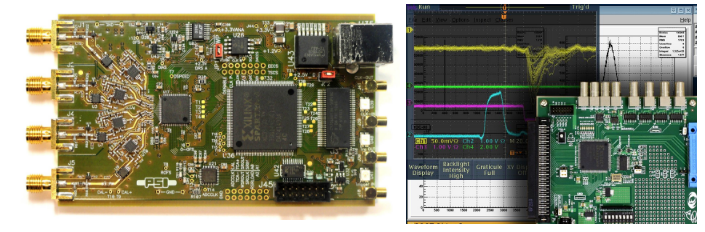
Data acquisition in nuclear and particle physics requires the precise measurement of signal amplitudes and time from detectors. This lecture first gives an overview of traditional methods using signal shaping, various discriminators and analog-to-digital converters (ADC) and time-to-digital converters (TDC). It then moves over to high speed waveform digitizing, a field which recently made...
Go to contribution page
Choose timezone
Your profile timezone: