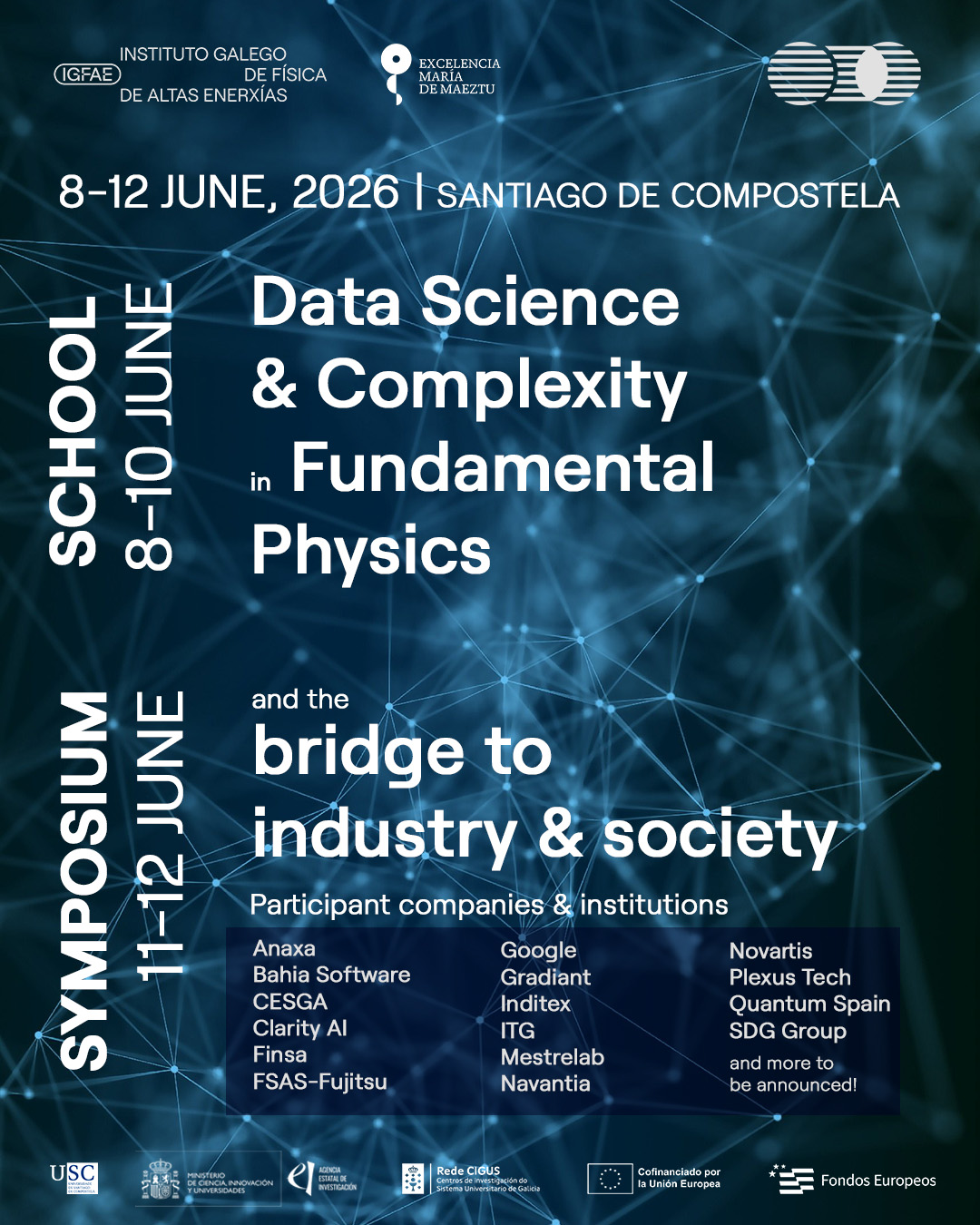
Data Science & Complexity in Fundamental Physics and the bridge to industry & society

Europe/Zurich
Instituto Galego de Física De Altas Enerxías (IGFAE)

Instituto Galego de Física De Altas Enerxías (IGFAE)

Instituto Galego de Física de Altas Enerxías (IGFAE) Rúa de Xoaquín Díaz de Rábago, S/N 15705 Santiago de Compostela A Coruña (SPAIN)
ALBA MARTINEZ MIRAS, Cristina Cabo, Lorenzo Cazon (IGFAE-USC), MANUEL REY PAN (IGFAE)
Description

An event that explores the highly demanded field of Data Science in modern society, and creates links with the industry

The conference will take place from 8 to 12 June, 2026, in Santiago de Compostela (Galicia, Spain)

School (8-10 June): Intensive course on Probability, Statistics, Machine Learning and Complexity, focused on PhD students and postdoctoral research staff. The sessions will be led by Glen Cowan (Professor of Physics at the Royal Holloway in London) and Eddie Lee (researcher at the Complexity Science Hub in Vienna).

Symposium (11-12 June): The school will be followed by a symposium focusing on the relationship between fundamental physics and industry, with data science as the nexus.


Confirmed companies: Anaxa, Bahia Software, CESGA, Clarity AI, Finsa, ITG, FSAS - Fujitsu, Google, Gradiant, Inditex, ITG, Mestrelab, Meta, Navantia, Novartis, Plexus Tech, Quantum Spain, SDG Group.


During these days, more than 20 representatives from companies and research centres will discuss and share knowledge about the latest trends in the sector, the demands, and practical applications of data science in everyday life.

The event aims to demonstrate the career opportunities within fundamental physics and its synergies with the job market and modern society’s needs. It will include a school covering Data Science techniques used in High Energy Physics (HEP), Nuclear, Astroparticle, and Fundamental Physics, alongside a symposium where companies present their current trends, needs, and daily work related to Data Science.

Additionally, the event intends to establish communication channels with the industry to explore partnerships, joint projects, and international grant opportunities. It will also highlight IGFAE’s research capabilities in Nuclear, High Energy, AstroParticle, and Fundamental Physics in the field of Data Science. By bringing together both sides, this event will create a framework for mutual knowledge exchange and enable the development of practical synergies from Data Science in fundamental physics to Data Science in the industry.
 

Instituto Galego de Física de Altas Enerxías (IGFAE)
Participants
    • Day 1: Probability & Statistics (Glen Cowan)
    • 11:15
      Coffee break
    • Day 1: Complexity (Eddie Lee)
    • 13:30
      Lunch break
    • Day 1: Hands-on
    • Day 2: Probability & Statistics (Glen Cowan)
    • 11:15
      Coffee break
    • Day 2: Complexity (Eddie Lee)
    • 13:30
      Lunch break
    • Day 2: Hands-on
    • Day 3: Probability & Statistics (Glen Cowan)
    • 11:15
      Coffee break
    • Day 3: Complexity (Eddie Lee)
    • 13:30
      Lunch break
    • Day 3: Hands-on
    • 1
      Welcome by USC & IGFAE representatives
      Speakers: Prof. Almudena Hospido (USC), Carlos Albert Salgado Lopez (Universidade de Santiago de Compostela (ES))
    • 2
      An Overflight of Statistical Methods in High Energy Physics

      Statistical methods have for many years played a crucial role in fundamental research such as High Energy Physics, and in the recent Big Data era their importance has continued to increase. I will give a bird's-eye view of the most important tools used to compare theory and experiment in a way that extracts the maximum information from the hard-won data. The talk will touch on foundational questions of statistics and the scientific method, standard tools for used in searches for new phenomena, and the path to the future with modern methods from Machine Learning and Artificial Intelligence.

      Speaker: Glen Cowan (Royal Holloway, University of London)
    • 3
      When physics meet life

      What are complex systems and why do we care about them? The greatest open problems in physics are life at the mesoscale, an understanding of ourselves and the world in which we live. These include the ecosystems in which we are embedded to the higher-order complexities of global society, and such contemplation raises questions about ramifications of such a science and about the role of physicists in its development.

      Speaker: Dr Eddie Lee (Complexity Science Hub)
    • 10:30
      Coffee break
    • 4
      FINSA: From Physics Lab to the Factory Floor: Leveraging Machine Learning and CFD in the Wood Industry at FINSA

      Physicists are naturally equipped with a versatile toolkit for solving complex, non-linear problems. However, the connection between academic research and industrial engineering is not always explicitly highlighted. This presentation explores how FINSA (Financiera Maderera, S.A.), a relevant and well-established company in the wood manufacturing sector, translates these analytical and computational skills into real-world industrial value.

      The talk will focus primarily on the deployment of Machine Learning (ML) algorithms on the factory floor, demonstrating how data-driven models are used to predict material properties, and control variables in real-time. In addition, we will look at how these predictive models are complemented by physics-based tools like Computational Fluid Dynamics (CFD) to refine complex thermal and aerodynamic processes. By bridging the gap between theoretical modeling and industrial reality, this presentation aims to prove that the analytical skills developed during a physics degree are highly valuable, transferable, and critical for the future of smart manufacturing.

      Speaker: Gregorio González Saavedra (Finsa (Financiera Maderera S.A.))
    • 5
      FUJITSU: Solving Real-World Optimization Problems with Quantum Computing: The Quantum4Health Project and Pauli Correlation Encoding Algorithm

      Quantum computing promises new approaches to combinatorial optimization problems that are ubiquitous in industry. In this talk, we present the RED.ES project, an initiative to apply quantum technologies across the Spanish health, energy, and telecommunications sectors, focusing on real use cases. We review the standard pipeline for tackling these problems: the QUBO formulation, its mapping to the Ising Hamiltonian, and its solution via quantum annealing, digital annealers, and gate-based quantum computers. We then introduce Pauli Correlation Encoding (PCE), a novel variational algorithm that encodes binary variables into expectation values of Pauli operators, achieving a subpolynomial qubit scaling with the number of variables. This approach allows us to work directly with the QUBO loss function and is particularly well-suited for near-term hardware. Using PCE, we have solved RED.ES use cases with up to 100 variables on only 6 qubits. We close with a broader perspective on the role of physicists in this field.

      Speaker: Jacobo Padin Martinez (Fsas Technologies - a Fujitsu company)
    • 6
      ITG TECHNOLOGY: Using tools for solving problems

      Generating knowledge from data involves more than simply using specific tools such as statistics, machine learning, or simulation. Its true value lies in the ability to transform data into useful information: formulating relevant questions, developing models, assessing uncertainties, and making evidence-based decisions.

      Speaker: Dr Ana Garbayo Peon (ITG Technology)
    • 7
      INDITEX: Inditex AI Multi-Agent Ecosystem

      Inditex’s multi-agent system is a next-generation AI platform designed to deliver smarter, faster, and more specialized support across the business. By combining multiple expert agents instead of relying on a single model, it turns every request into a more precise, scalable, and high-value interaction. I’m part of that ecosystem, orchestrating each conversation so the right capability is activated at the right moment.

      Speaker: Dr Javier Diaz Cortes (Inditex)
    • 13:00
      Lunch break
    • 8
      ANAXA: From Scientific Foundations to Production AI: Knowledge Extraction in Practice at Anaxa

      Anaxa is a Swiss AI consulting firm founded by scientists and engineers from CERN, EPFL, Oxford, and UNIGE. We build data pipelines and AI-powered applications operating under strict data sovereignty and privacy constraints.
      This talk presents two production cases, each illustrating a different approach to knowledge extraction: a natural language interface over athlete data that mediates between an LLM and a structured database through a semantic layer with role-based access control; and an agentic workflow that drafts statutory care plans from unstructured medical and social records, with human-in-the-loop validation and full source traceability.

      Zoom link

      Speaker: Albert Puig Navarro (Anaxa)
    • 9
      IGFAE: Machine Learning in Experimental HEP

      The complexity of modern High Energy Physics experiments and the large volumes of data they produce have made Machine Learning and Data Science essential tools in many areas of experimental research. In this talk, I will present some examples of ML applications in experimental HEP, covering problems ranging from data reconstruction and analysis to detector simulation and optimization, focusing on examples from IGFAE collaborations.

      Speaker: Maria Pereira Martinez (IGFAE)
    • 10
      SDG GROUP: Why me?

      The whys of a physicist in a Data & AI career. How AI is changing the game, and why, more than ever, Humans are critical for Admissible AI

      Speaker: Antonio Torrado Gonzalez (SDG Group Iberia)
    • 16:00
      Coffee break
    • 11
      Modeling Human Uncertainty: Predictive Attrition Risk and Pay Equity Through Applied People Analytics

      "People Analytics has emerged as a pragmatic application of data science to socio-technical systems in which human behavior, incentives, and organizational structures interact in complex ways. This talk presents two applied modeling problems that illustrate both the potential and the limitations of quantitative approaches when the subjects of analysis are people rather than physical or purely transactional systems.

      The first case explores the probabilistic estimation of voluntary attrition risk among high-potential employees over a six-month horizon. Rather than treating attrition as a deterministic outcome, the problem is framed as probability estimation intended to support decision-making under uncertainty. The discussion focuses on problem formulation, data considerations, model choice, and the practical interpretation of predicted probabilities in organizational contexts.

      The second case examines the use of multivariate linear regression models for pay equity analysis. Although methodologically simple, this application raises important questions around model specification, interpretation of coefficients, and the communication of results to non-technical stakeholders. The talk emphasizes how statistical outputs are translated into actionable insights while operating under legal, ethical, and organizational constraints.

      Taken together, these two use cases position People Analytics as a domain where standard statistical and machine learning tools are embedded in complex adaptive systems. The models are not presented as definitive answers, but as decision-support instruments whose value depends on context, governance, and an explicit acknowledgment of uncertainty and human agency."

      Speaker: Dr Miguel Escalona-Moran
    • 12
      CLARITY AI: The Scientific Mindset in Industrial Data Science: From Fundamental Research to Societal Impact

      A PhD in physics provides a unique and powerful foundation for industrial data science, reaching far beyond technical expertise alone. The core competencies developed during fundamental research—critical thinking, self-directed learning, and a deep-seated intellectual rigor—translate directly to high-stakes environments where problems are rarely well-defined.

      In the current AI landscape, technical proficiency has become a baseline expectation rather than a differentiator. The true value of a scientific background now lies in the ability to apply a scientific mindset to elusive questions that must be navigated with imperfect data. At Clarity AI, this manifests as a commitment to innovation, leveraging advanced modeling architectures to transform noisy, unstructured data into reliable insights that drive societal impact.

      Speaker: Luis Reyes Navarrete (Clarity AI)
    • 13
      QUANTUM SPAIN: Quantum Data Encodings: Opportunities for High Energy Physics in the NISQ Era

      High Energy Physics experiments generate increasingly large and complex datasets, ranging from detector hits and particle tracks to reconstructed particles and full collision events. In the current NISQ era, quantum computing is not yet expected to outperform classical approaches for most practical applications; however, it offers novel methods for representing and processing high-dimensional information through quantum data encodings.
      This talk presents several High Energy Physics use cases to illustrate how quantum encoding techniques can capture correlations and geometric structures present in experimental data while providing compact representations of complex feature spaces.
      The discussion will focus on the opportunities and challenges of quantum data encodings for scientific machine learning, highlighting their potential role in future quantum algorithms for increasingly complex High Energy Physics analyses. Particular attention will be given to how quantum representations may contribute to addressing scalability challenges as detector complexity and data volumes continue to grow.

      Speaker: Irais Bautista Guzman (CESGA)
    • 14
      NOVARTIS: Reimagine Business Finance with AI

      " Artificial intelligence is transforming the role of Finance from a function focused on reporting, planning cycles, and negotiation-heavy processes into a strategic partner capable of generating faster, more objective, and more actionable business insights.
      This session explores how AI can be applied to reimagine business finance, using practical examples from digital finance transformation in the pharmaceutical industry. It will show how traditional financial planning processes (often highly iterative and resource-intensive) can be transformed into data-driven planning, multi-scenario forecasting or advanced resource allocation."

      Speaker: Marc Grabalosa Gandara (Novartis)
    • 19:00
      Social event / Dinner
    • 15
      MESTRELAB: From Particle Physics to Mass Spectrometry Software Development

      This talk presents my transition from particle physics (LHCb at CERN) to software development at Mestrelab Research. I will briefly introduce the mass spectrometry workflow and the role of software in data analysis, as well as Mestrelab’s products. I will also share what my work as a developer looks like in practice, including agile sprints and day‑to‑day tasks. Finally, I reflect on how skills from particle physics transfer to industry and scientific software development.

      Speaker: Dr Sara Sellam (Mestrelab)
    • 16
      BAHIA SOFTWARE: Quantum Machine Learning: How Quantum Computing can enhance classical Machine Learning

      Quantum computing has the potential to improve machine learning approaches and unlock new solutions that go beyond the capabilities of classical ML systems. However, fully leveraging this potential requires a clear understanding of the complexities of these models, as well as the adaptation of software so that it can be natively integrated into HPC centers.

      Speaker: Diego Beltran Fernandez Prada (Bahia Software)
    • 17
      PLEXUS TECHNOLOGIES: Fundamental science applied to business: Driving innovation in IT companies

      In this talk, we will explore how fundamental science—particularly mathematics and physics—has shaped the evolution of the IT industry, from the early days of computing to today's advances in Data, Artificial Intelligence, and Quantum Technologies. Through historical examples and current industry developments, we will examine the connections between fundamental research and business innovation, highlighting how scientific principles have repeatedly enabled breakthrough technologies and competitive advantage. The talk will discuss key bridge points between fundamental and applied science, and why IT companies should continue investing in scientific thinking to drive innovation, solve complex challenges, and create long-term business value.

      Speaker: Yago Gonzalez Rozas (Plexus Technologies)
    • 18
      IGFAE: Data science applied to astrophysics: a view within IGFAE

      Astrophysical phenomena are rich in information, and increasingly advanced statistical methods are required to extract the relevant data from the noise. The area of Theoretical Astrophysics and Cosmology at IGFAE has a leader contribution in the main observatories across the world, and is actively developing and applying data science techniques in a variety of contexts. In this talk I will present four different examples from our recent work, with an emphasis on the techniques used.

      Speaker: Dr Marta Reina (IGFAE)
    • 11:00
      Coffee break
    • 19
      NAVANTIA: From data to ship: AI and Digital Twins

      " This presentation addresses how Data Science and Artificial Intelligence are transforming the naval industry, using the development of Digital Twins as the connecting thread and enabling infrastructure. Real-world cases developed at Navantia will be presented, connecting them to the mathematical and statistical foundations of Data Science. The topics covered will be:

          The industrial data challenge in complex naval platforms: Characteristics of operational data in ships and naval systems (non-sensitive).
          AI-oriented Digital Twin architecture: Technology stack (OPC-UA, Node-RED, InfluxDB, MLflow, ONNX Runtime) and DT-Ready architecture for making ML models deployable in OT environments. Digital twin of a cooling system (Unit Cooler).
          Physics-Informed data-driven models: Strategies for incorporating domain knowledge (heat transfer equations, vibration dynamics) into neural networks, reducing data requirements."
      
      Speaker: Dr Ruben Ferreiroa Garcia (Navantia)
    • 20
      GRADIANT: Data-Driven Quantum Sensing: Modelling Complexity and Optimal Signal Recovery

      Quantum sensing exploits quantum systems to measure physical signals with exceptional sensitivity, often producing complex and noise-corrupted datasets in which the quantities of interest must be inferred from subtle changes in quantum optical spectra. Understanding and modelling light–matter interactions through a combination of computationally-expensive physics-based simulations and data-driven techniques is essential for the development of novel sensor architectures, new applications, and the optimisation of sensor operation.
      This talk will provide an overview of how data-driven modelling, machine learning, and statistical inference can enhance signal recovery, improve parameter estimation, and optimise sensor performance. Particular emphasis will be placed on methodologies that combine physical models with AI-based signal processing to extract information from noisy, high-dimensional measurements. Examples will include radio-frequency sensing with Rydberg atoms and advanced magnetometry using colour defects in diamond.

      Speaker: Dr Miguel Ferreira Cao (Gradiant)
    • 21
      GOOGLE: Transitioning from a PhD to a Google Sales Account Executive

      This presentation explores the non-traditional career paths available to Physics PhDs in the corporate world, specifically focusing on the transition into Google Sales. Drawing from the principle that one should maximize career happiness, the speaker details his personal journey from academic research to roles at Google as an Analytical Consultant and, later, an Account Executive.

      The presentation highlights how a PhD serves as a competitive advantage outside academia. It outlines the complex scientific and data-driven challenges faced in digital marketing—such as media mix modeling, causal impact, and reinforcement learning—and maps out where PhDs can thrive across technical and business roles. Finally, it emphasizes that while core analytical abilities provide a strong foundation from day one, success in the corporate tech sector heavily relies on a commitment to continuous learning, navigating corporate ambiguity, and mastering interpersonal skills like communication, collaboration, and thinking customer-first.

      Zoom link

      Speaker: Miquel Trias Cornellana (Google)
    • 22
      META: Statistics in the software industry: bridging the gap between science and applications

      We will discuss the challenges of applying statistics concepts in the software development industry, connecting them to science and reports from other disciplines. Using real-life examples, we will analyze the statistician's role as a product owner, as a service provider and as a "pure stats developer." We will focus on when the data scientist should adopt each role to achieve a fruitful and productive interaction with colleagues.

      Speaker: Pablo Alcain