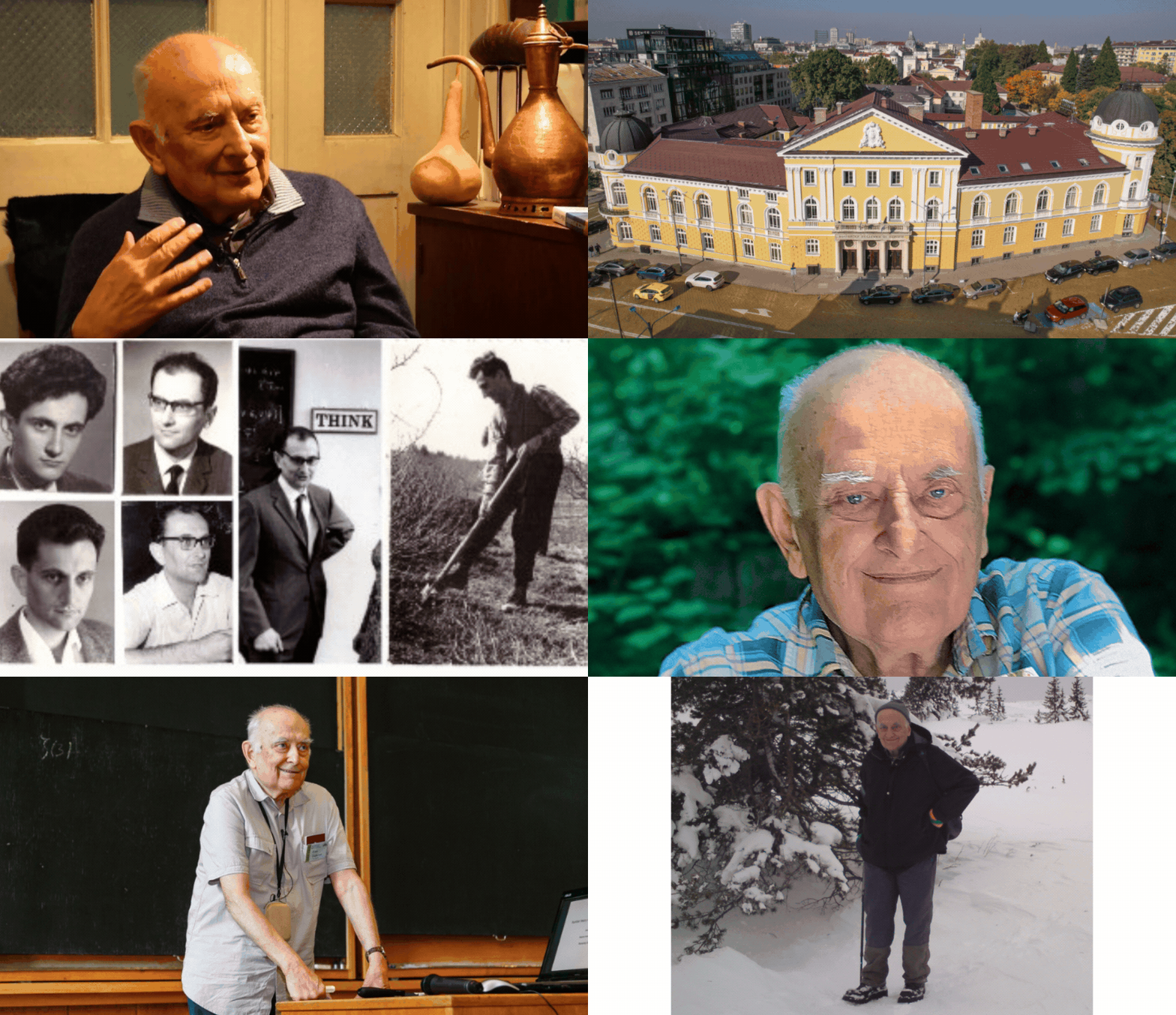
Mathematical Quantum Field Theory

Europe/Sofia
Hall "Prof. Marin Drinov" (Bulgarian Academy of Sciences)

Hall "Prof. Marin Drinov"

Bulgarian Academy of Sciences

Description

This is a conference in memory of the prominent Bulgarian theoretical physicist Ivan Todorov, organized by the Institute for Nuclear Research and Nuclear Energy (INRNE) and the International Center for Mathematical Sciences at the Institute of Mathematics and Informatics (ICMS-IMI) of the Bulgarian Academy of Sciences (BAS).

Ivan Todorov has had many fruitful collaborations with prominent mathematicians and mathematical physicists. His numerous accomplishments - in the areas of quantum field theory, elementary particle physics and quantum symmetries - have achieved international recognition.

The conference aims to encompass a wide range of modern topics at the intersection of physics and mathematics, as well as to bring together close collaborators of Ivan Todorov and scientists whose research has been particularly influenced by him.

Speakers include:

Anton Alekseev (Univ. Geneva, Switzerland)
Bojko Bakalov (NC State Univ., USA)
Loriano Bonora (SISSA, Trieste, Italy)
Latham Boyle (Univ. Edinbourgh, UK)
Sultan Catto (City Univ. of New York, USA)
Tekin Dereli (Koc Univ., Turkey)
Vladimir Dobrev (INRNE-BAS, Bulgaria)
Michel Dubois-Violette (CNRS, France)
Nichol Furey (Humbolt-Univ. Berlin, Germany) *
Jean Pierre Gazeau (Univ. Paris Cite, France)
Ludmil Hadjiivanov (INRNE-BAS, Bulgaria)
Stefan Hollands (Univ. Leipzig, Germany) *
Alexey Isaev (JINR, Dubna, RF)
Victor Kac (MIT, USA)
Dmitri Kazakov (JINR, Dubna, RF)
Richard Kerner (LPTMC, Sorbonne Univ., France)
Maxim Kontsevich (IHES, Bures-sur-Yvette, France)
Ivan Kostov (IPhT, Saclay, France)
Nikolay Nikolov (INRNE-BAS, Bulgaria)
Hamed Pejhan (IMI-BAS, Bulgaria)
Ivan Penkov (Constructor Univ., Bremen, Germany)
Serguey Petcov (SISSA, Trieste, Italy)
Valentina Petkova (INRNE-BAS, Bulgaria)
Karl-Henning Rehren (Univ. Gottingen, Germany)
Dimitar Sasselov (Harvard Univ., USA) *
Stoytcho Yazadjiev (IMI-BAS, Sofia Univ., Bulgaria)
George Zoupanos (Nat. Tech. Univ. Athens, Greece)
Jean-Bernard Zuber (LPTHE, Sorbonne Univ., France)
 

* To be confirmed.

Registration
Registration
Participants
    • Registration Location: Lobby (Bulgarian Academy of Sciences (BAS))

      Location: Lobby

      Bulgarian Academy of Sciences (BAS)

    • Opening Location: Hall "Prof. Marin Drinov" (BAS)

      Location: Hall "Prof. Marin Drinov"

      BAS

    • 1
      Modular invariant vertex operator algebras Chair: TBA , Location: Hall "Prof. Marin Drinov", BAS

      Chair: TBA , Location: Hall "Prof. Marin Drinov", BAS

      A vertex operator algebra (VOA) V is called modular invariant if its character $tr_V e^{2\pi iz(L_0-c/24)}$ converges to a modular function in the complex upper half-plane. In my talk I will report on a joint work with Minoru Wakimoto, where we pose a few conjectures on modular invariant VOA and discuss for which k, the simple affine VOA $V_k(g)$ and simple affine W-algebras $W_k(g,s)$ are modular invariant. Quasi-modular invariance of VOA will be also discussed. The talk will be essentially self-contained.

      Speaker: Victor Kac
    • Coffee break Location: Lobby (BAS)

      Location: Lobby

      BAS

    • 2
      A very general notion of QFT Chair: TBA , Location: Hall "Prof. Marin Drinov", BAS

      Chair: TBA , Location: Hall "Prof. Marin Drinov", BAS

      Ivan Todorov was deeply interested in the axiomatic approach to Quantum Field Theory, and in particular to Conformal Field Theory. In my talk I will try to push this to maximal generality, discarding even rotational invariance and positivity (and generalizing the approach with complex metrics developed by G. Segal and myself). Conjecturally, in each dimension there exists a canonical — though not yet fully characterized — moduli space of theories in real affine space, covariant only under translations and scaling. One can place such a theory on a general manifold using a universal OPE formalism.

      Speaker: Maxim Kontsevich
    • 11:40
      Short break
    • 3
      Todorov - scientist, teacher, personality Chair: TBA , Location: Hall "Prof. Marin Drinov", BAS

      Chair: TBA , Location: Hall "Prof. Marin Drinov", BAS

      TBA

      Speaker: Valentina Petkova, Boriana Todorova, Dimitar Nedanovski
    • Lunch
    • 4
      A Z3-graded approach to quark color dynamics Chair: TBA , Location: Hall "Prof. Marin Drinov", BAS

      Chair: TBA , Location: Hall "Prof. Marin Drinov", BAS

      We propose a description of colour triplets of quarks by entangled $Z_3$-graded Lee-Wick type fields, one with real mass and the two remaining ones with mutually conjugate complex masses. This is obtained by attributing colour degrees of freedom to six Pauli spinors, three endowed with colours and three with anti-colours, which are united into one $12$-component generalized "coloured Dirac spinor".

      The so entangled triplet of quark fields satisfies a generalized Dirac equation, with generalized $\gamma$-matrices acting on $12$-component coloured spinors. The characteristic sixth order equation satisfied by each component, results from the diagonalization of the system. The sixth-order dispersion relations lead to solutions suitably vanishing
      in asymptotic region, exhibiting the well established confinement property of coloured quarks 'degrees of freedom.

      We show how one can construct certain cubic combinations of those solutions in a way that cancels the damping factors, producing freely propagating functions.

      Speaker: Richard Kerner
    • 14:50
      Short break
    • 5
      On a CFT construction of quantum gates by braiding Fibonacci anyons Chair: TBA , Location: Hall "Prof. Marin Drinov", BAS

      Chair: TBA , Location: Hall "Prof. Marin Drinov", BAS

      This talk is based on joint work with Lachesar Georgiev and Grigory Matein, see especially JHEP 08 (2024) 084.

      Fibonacci anyons provide the simplest possible model of two-sector non-Abelian fusion rules where the only non-trivial one is [1] × [1] = [0] ⊕ [1].

      A conformal field theory construction of topological quantum registers and quantum gates is proposed which is based on Fibonacci anyons realized as quasi-hole excitations in a particular fractional quantum Hall state. To this end, earlier results of Ardonne and Schoutens for the correlation function of four Fibonacci fields in a $Z_3$ parafermion setting are extended to the case of arbitrary number $n$ of quasi-holes in a background of $N = 3r$ electrons.

      The focus is on the braiding properties of the obtained correlators. The construction of a monodromy representation of the Artin braid group $B_n$ acting on $n$-point conformal blocks of Fibonacci anyons is explained in details. A simple recursion formula makes it possible to derive explicitly the matrices of braid group generators in block form.

      Finally, we construct N qubit computational spaces in terms of conformal blocks of $2N+2$ Fibonacci anyons.

      Speaker: Ludmil Hadjiivanov
    • Coffee Break Location: Lobby (BAS)

      Location: Lobby

      BAS

    • 6
      Residue calculus for vertex algebras in higher dimensions Chair: TBA , Location: Hall "Prof. Marin Drinov", BAS

      Chair: TBA , Location: Hall "Prof. Marin Drinov", BAS

      We study generalized residues associated with the homology of certain configuration spaces. The latter carries a natural operad structure that provides additional tools for the structural theory of vertex algebras in higher dimensions.

      Speaker: Nikolay Nikolov
    • Poster session Location: Lobby (BAS)

      Location: Lobby

      BAS

    • Reception Location: Lobby (BAS)

      Location: Lobby

      BAS

    • 7
      How the failure of Ward identities determines particle interactions: The Standard Model interactions without indefinite state spaces Chair: TBA , Location: Hall "Prof. Marin Drinov", BAS

      Chair: TBA , Location: Hall "Prof. Marin Drinov", BAS

      When particles are quantized with their physical masses in the Fock space over their unitary Wigner representations, one can find renormalizable interaction densities $L_{\rm int}(x)$ with a "tiny" but potentially disastrous flaw: they are only localized along a "string" extending from $x$ to infinity. Naively, this flaw should be ineffective because it changes local interactions only by a total derivative, but the failure of Ward identities in perturbation theory causes obstructions. The condition that all obstructions can be cancelled, strongly constrains the admissible interactions. The outcome are precisely the Standard Model interactions.

      This selection criterion is "purely quantum", based on the Hilbert space axiom: classical Lagrangians and canonical quantization are not used. "Gauge symmetry" is neither invoked, nor spontaneously broken.

      Speaker: Karl-Henning Rehren
    • Coffee Break Location: Lobby (BAS)

      Location: Lobby

      BAS

    • 8
      Modular Invariance Approach to Flavor, CP Violation and Fermion Mass Hierarchies Chair: TBA , Location: Hall "Prof. Marin Drinov", BAS

      Chair: TBA , Location: Hall "Prof. Marin Drinov", BAS

      In modular-invariant models of favour, hierarchical fermion mass matrices may arise solely (without fine-tuning) due to the proximity of the VEV of the modulus $\tau$ to the fixed point of the modular group i) $\tau = \exp{(i2\pi/3)}$ preserving the $Z^{ST}_3$ residual symmetry, or ii) $\tau = i\infty$, preserving the $Z^T_N$ symmetry, $N=3,4,5$. This mechanism does not require flavon fields. The fermion mass hierarchies thus generated depend on the decomposition of field representations under the residual symmetry group. We present lepton flavour models in which the charged-lepton mass hierarchies are naturally obtained. We consider also the problem of modulus stabilisation in the framework of the modular symmetry approach to the flavour problem. By analysing simple UV-motivated CP-invariant potentials for the modulus $\tau$ we find that a class of these potentials has (non-fine-tuned) CP-breaking minima in the vicinity of the point of the $Z^{ST}_3$ residual symmetry, $\tau ≃ \exp{(i2\pi/3)}$. Stabilising the modulus at these novel minima breaks spontaneously the CP symmetry and can naturally explain the mass hierarchies of charged leptons and possibly of quarks.

      Speaker: Serguey Petcov
    • 11:10
      Short break
    • 9
      From the QCD Vacuum to Galactic Halos: An Infrared Spectral Gap as the Origin of the Galactic Acceleration Scale Chair: TBA , Location: Hall "Prof. Marin Drinov", BAS

      Chair: TBA , Location: Hall "Prof. Marin Drinov", BAS

      The radial acceleration relation (RAR) revealed by the SPARC survey - a tight, nearly galaxy-independent correlation between observed and baryonic accelerations, controlled by a single scale $g_\dagger\sim 10^{-10}\ \mathrm{m\,s^{-2}}$ - remains unexplained within standard $\Lambda$CDM. We propose that this scale is the gravitational imprint of a representation-theoretically protected infrared spectral gap in a coherent gluonic dark sector. The argument follows a single logical chain. At the QCD epoch, colour confinement freezes a long-lived population of colour-singlet (scalar di-gluonic) bound states into a sector decoupled from the baryonic plasma. The QCD trace anomaly, through dimensional transmutation, generates a dynamical infrared scale in this sector. Requiring Lorentz covariance together with a positive-energy lowest-weight unitary realization then selects $\mathrm{SO}(2,3)$ - the isometry group of Anti-de Sitter space - as the natural symmetry of the infrared dynamics. The associated discrete Fronsdal spectrum carries a gap that is representation-theoretically protected, and its lowest scalar mode (conformally coupled, $\zeta=2$) undergoes Bose-Einstein condensation without any external trap. The resulting condensate halo has a finite total mass, a cored density profile $\rho\propto(1+r^2/r_c^2)^{-2}$, and an intrinsic acceleration scale $g_\star = GM_h/r_c^2$ naturally of order $g_\dagger$ - without fine-tuning and without modifying gravity.

      Reference: Gilles Cohen-Tannoudji, Jean-Pierre Gazeau, Hamed Pejhan, and Jean-Pierre Treuil, Infrared Spectral Gap in a Gluonic Dark Sector as the Origin of the Galactic Acceleration Scale, arXiv:2604.12910v1 [hep-th]

      Speaker: Jean-Pierre Gazeau
    • Lunch
    • 10
      A short trip to Cumuland Chair: TBA , Location: Hall "Prof. Marin Drinov", BAS

      Chair: TBA , Location: Hall "Prof. Marin Drinov", BAS

      After reviewing the definition of classical and of free cumulants, and how the latter appear in the limit of large random matrices, I introduce precursors of free cumulants. These precursors have a natural definition, constitute a new family of invariants of Hermitian matrices of finite-size $N$, converge to free cumulants as $N$ tends to infinity, and exhibit several interesting properties that anticipate those of free cumulants. Work in collaboration with Sylvain Lacroix.

      Speaker: Jean-Bernard Zuber
    • 14:50
      Short break
    • 11
      No-Hair Theorems for Black Holes with Multiple Scalar Fields: Mathematical and Physical Aspects Chair: TBA , Location: Hall "Marin Drinov", BAS

      Chair: TBA , Location: Hall "Marin Drinov", BAS

      In this talk, I will discuss no-hair theorems for black holes in the presence of multiple scalar fields, both in General Relativity and in scalar–tensor theories. Unlike the simpler vacuum case, the presence of additional scalar fields makes the classification of black holes much more complicated due to the richer and more involved structure of the field equations. I will illustrate the main ideas with some explicit examples and outline the key mathematical results, and I will also briefly discuss possible astrophysical implications of scalar hair when it exists.

      Speaker: Stoytcho Yazadjiev
    • Coffee Break Location: Lobby (BAS)

      Location: Lobby

      BAS

    • 12
      Unification of Gravities with Internal Interactions Chair: TBA , Location: Hall "Prof. Marin Drinov", BAS

      Chair: TBA , Location: Hall "Prof. Marin Drinov", BAS

      Reviving the old proposal of describing gravity as a gauge theory first we will describe the construction of the Einstein, Conformal and the Noncommutative (Fuzzy) Gravities in a gauge-theoretic manner. Then stressing the fact that the tangent group of a curved manifold and the manifold itself do not necessarily have the same dimensions, we show how the above Gravities can be unified with the Internal Interactions,the latter based on the GUT SO(10).

      Speaker: George Zoupanos
    • 13
      Virasoro coadjoint orbits and Jackiw-Teitelboim gravity Chair: TBA , Location: Hall "Prof. Marin Drinov", BAS

      Chair: TBA , Location: Hall "Prof. Marin Drinov", BAS

      Virasoro coadjoint orbits are infinite dimensional symplectic spaces which admit classification due to Lazutkin-Pankratova, Segal, Kirillov, Witten etc. Inspired by works on Jackiw-Teitelboim gravity, we consider elliptic and exceptional Virasoro orbits, and we establish their relation to moduli spaces of singular hyperbolic metrics on the disk.

      Speaker: Anton Alekseev
    • Coffee Break Location: Lobby (BAS)

      Location: Lobby

      BAS

    • 14
      Weyl semi-simplicity taken to infinity Chair: TBA , Location: Hall "Prof. Marin Drinov", BAS

      Chair: TBA , Location: Hall "Prof. Marin Drinov", BAS

      Given the scientific diversity of the audience, I will give a relatively elementary talk. My hope is that participants will be able to remember the main ideas, and that this will be in the spirit of Ivan Todorov who very much appreciated lectures with an educational emphasis.

      Hermann Weyl's famous semisimplicity theorem is a basic tool when studying finite-dimensional representations of the Lie algebra $sl(n)$. However, this theorem applies to each n separately. When one puts together all $n$, and considers the direct limit Lie algebra $sl(\infty)$, the theorem no longer holds. The main purpose of the talk will be to show that the somewhat boring semisimplicity gets replaced by the appearance of an non-semisimple category having the nicest possible properties. These include finite-dimensional Homs and Exts, Koszulity, and Koszul self-duality. The talk will be concluded by taking to infinity
      another icon in representation theory: the Pieri rule.

      Speaker: Ivan Penkov
    • 11:10
      Short break
    • 15
      Vogel universality and beyond Chair: TBA , Location: Hall "Prof. Marin Drinov", BAS

      Chair: TBA , Location: Hall "Prof. Marin Drinov", BAS

      For simple Lie algebras we construct characteristic identities for split (polarized) Casimir operators in representations $T\otimes Y_n$ and $T \otimes Y_n'$, where $T$ -- defining (minimal fundamental for exceptional Lie algebras) representation, $Y_n$ -- $n$-Cartan powers of the adjoint representations ad = $Y_1$ and $Y_n'$ -- special representations appeared in the Clebsch-Gordan decomposition of symmetric part of $ad^{\otimes n}$. By means of these characteristic identities, we derive (for all simple Lie algebras, except $\mathfrak{e}_8$) explicit formulae for invariant projectors onto irreducible subrepresentations arose in the decomposition of $T \otimes Y_n$. These projectors and characteristic identities are written in the universal form for all simple Lie algebras (except $\mathfrak{e}_8$) in terms of Vogel parameters. Universal formulas for the dimensions of the Casimir subrepresentations appeared in the decompositions of $T \otimes Y_n$ are found.

      Speaker: Alexey Isaev
    • Lunch
    • Conference Dinner
    • 16
      Standard Model and Gravity: the role of anomalies and conformal symmetry Chair: TBA , Location: Hall "Prof. Marin Drinov", BAS

      Chair: TBA , Location: Hall "Prof. Marin Drinov", BAS

      An accurate study of anomalies shows that, when the Standard Model and General Relativty are minimally coupled and merged into a unique quantum field theory, the cancelation of gauge and gravity anomalies dictate very important restrictions. In this talk I discuss a proposal for the overall anomaly free theory. The basic structure of the latter consists of two sectors, left and right, with chirally mirror fermions and scalars,as well as $SU(3)$ and $U(1)$ gauge fields, while the $SU(2)$ gauge fields as well as the metric are in common to both sectors. This structure is dictated by the request to cancel all dangerous anomalies. The left sector consists of the fermion, gauge and scalar fields of the SM, now minimally coupled to gravity. The right sector is a mirror image of the left, with distinct fields, except the metric and the $SU(2)$ gauge potentials. We propose and motivate the interpretation of the right sector as the dark matter one. Another topic covered here is the role of Weyl symmetry and its possible applications to cosmology and its theoretical fallouts on renormalization and unitarity of the model. In particular a background solution of the Weyl invariant theory is shown, which may apply to the very early stages of the universe. This solution also suggests interesting applications to the cosmological constant problem. On the quantum field theory side the subject of Weyl symmetry and Weyl anomalies is reviewed and, among other things, an application of the WZ terms is illustrated to the problem of one-loop quantization of the model which may avoid negative norm states.

      Speaker: Loriano Bonora
    • Coffee Break Location: Lobby (BAS)

      Location: Lobby

      BAS

    • 17
      The general approach to the renormalization group equations in local quantum field theory Chair: TBA , Location: Hall "Prof. Marin Drinov", BAS

      Chair: TBA , Location: Hall "Prof. Marin Drinov", BAS

      The Bogoliubov-Parasiuk theorem guarantees locality of counter-terms in arbitrary local quantum field theory. This requirement provides obtaining equations, connecting leading and subleading ultraviolet divergences in every order of perturbation theory. The key feature of these equations is their universality: they are valid for any QFT regardless whether it is renormalizable or not. Thus, in a particular case, the generalized RG equations we have found reproduce the perturbative behaviour of renormalizable theories without direct referring to the multiplicative property. The general approach developed also allows us to study non-renormalizable interactions in various fields of modern theoretical physics: from elementary particle physics to cosmology.

      Speaker: Dmitry Kazakov
    • 11:10
      Short break
    • 18
      Jordan Algebraic Formulation of the Landau Problem with a Non-commutative Parameter Chair: TBA , Location: Hall "Prof. Marin Drinov", BAS

      Chair: TBA , Location: Hall "Prof. Marin Drinov", BAS

      We provide a Jordan algebraic, non-associative formulation of the Landau problem with a non-commutative parameter coupled to a harmonic potential as an inclusive example. To achieve this, we further extend a recent work of Schupp and Szabo (2024) to infinite dimensional Jordan algebras and the Landau problem. In particular, we present an alternative formulation of the Hilbert space version of quantum mechanics in order to obtain the Hilbert space corresponding to this problem.Choosing the coordinates as the center of the cyclotron motion, one obtains a non-commutative parameter. That parameter is then described in terms of an associator in the Jordan algebraic setting by obtaining results which are potentially applicable to other non-associative formulations as well. Moreover, pure states and density matrices arising from our construction are characterized. This in turn leads us to the explicit description of split operators for the corresponding Hamiltonian and the Jordan-Schrodinger time-evolution equation for the state vectors in this specific problem.

      Speaker: Tekin Dereli
    • Lunch Hall "Prof. Marin Drinov"

      Hall "Prof. Marin Drinov"

      Bulgarian Academy of Sciences

    • 19
      Langlands Duality and Invariant Differential Operators Chair: TBA , Location: Hall "Marin Drinov", BAS

      Chair: TBA , Location: Hall "Marin Drinov", BAS

      Langlands duality is one of the most influential topics in mathematical research. It has many different appearances and influential subtopics. Yet there is a topic that until now seems unrelated to the Langlands program. That is the topic of invariant differential operators. That is strange since both items are deeply rooted in Harish-Chandra’s representation theory of semisimple Lie groups. In this paper we start building the bridge between the two programs.

      Speaker: Vladimir Dobrev
    • 14:50
      Short break
    • 20
      Is the standard model exceptional? Chair: TBA , Location: Hall "Prof. Marin Drinov", BAS

      Chair: TBA , Location: Hall "Prof. Marin Drinov", BAS

      When mathematical objects are classified, they often fall into two types: regular and exceptional. Do the the laws of physics governing our universe hail from the ocean of regular mathematics, or the island of exceptionality? During the past decade, Todorov and collaborators pointed out striking and intriguing connections between the standard model of particle physics, and the exceptional Jordan algebra. I will review this work, as well as some possible ideas for how we might build upon it, taking the chiral structure of the standard model as a crucial clue.

      Speaker: Latham Boyle
    • Coffee Break Location: Lobby (BAS)

      Location: Lobby

      BAS

    • 21
      New algebras relating superstrings and Galois Fields Chair: TBA , Location: Hall "Prof. Marin Drinov", BAS

      Chair: TBA , Location: Hall "Prof. Marin Drinov", BAS

      The development of the group $E_{10}$ interpreted as the dark halo group of the visible $(9+1)$ dimensional space-time, allowing it to be integrated with the internal symmetry groups of $E_8\!\times \!E_8$ , $O(32)$ , and $O(16)\!\times \!O(16)$ of the heterotic string, is demonstrated. The representation of the Lorentzian root lattice of $E_{10}$ by integer $2\!\times \!2$ octonionic Jordan matrices that also represent quantized momenta in periodic space-time will be demonstrated as well as the root system of the Conway-Sloane lattice as an integer $3\!\times \!3$ exceptional Jordan matrix, which has $E_{10}\!\times \!E_8\!\times \!E_8$ as sublattices, including their associated root diagrams, also giving the expression of the Weyl reflections for $E_{10}$ and the Conway-Sloane lattice by means of Jordan products. We comment on the prospects of writing right-moving string and left-moving superstring Lagrangians by means of Jordan matrices $J_{L,R}(z)$ in $\bf{27}$ and $\bf{\overline{27}}$ representations of $E_{6,-26}$ and as cosets $G/H$ conformal fields, where $G=E_7$ and $H=E_6\!\times \!U(1)$.

      Speaker: Sultan Catto
    • 22
      Higher-Genus Fuss-Catalan Numbers Chair: TBA , Location: Hall "Marin Drinov", BAS

      Chair: TBA , Location: Hall "Marin Drinov", BAS

      We study a two-matrix model which generates the higher-genus Fuss--Catalan numbers as the coefficients of its $1/N$-expansion. The genus-$g$ Fuss-Catalan number counts the number of ways to obtain a genus-$g$ surface by identifying the edges of a $pn$-gone via $p$-valent hyperedges. For $p=2$ our model reduces to the the Gaussian matrix model which generates the higher genus Catalan numbers. We obtain an explicit formula for the higher genus $p$-Fuss-Catalan numbers which generalises the Harer-Zagier formula for $p>2$.

      Speaker: Ivan Kostov
    • Coffee Break Location: Lobby (BAS)

      Location: Lobby

      BAS

    • 23
      Massless Representations, Conformal Symmetry, and the Legacy of Ivan Todorov Chair: TBA , Location: Hall "Marin Drinov", BAS

      Chair: TBA , Location: Hall "Marin Drinov", BAS

      Wigner’s paradigm identifies elementary systems with unitary irreducible representations (UIRs) of spacetime symmetry groups. In constant-curvature spacetimes, however, the notion of masslessness is no longer intrinsic. This motivates the search for a framework in which massless systems can be characterized in a geometrically and representation-theoretically coherent way across flat, de Sitter ($dS$), and anti-de Sitter ($AdS$) settings.

      In four spacetime dimensions, massless systems admit conformal extensions governed by $U(2,2)$, whose positive-energy ladder representations encode fields of arbitrary helicity. In this talk, we develop a concrete realization of these representations within the conformal Clifford algebra $cl(4,2)$, based on a canonical real (Majorana) spinor structure arising from the split-octonion algebra. This yields a unified algebraic setting in which Poincaré, $(A)dS$, and conformal symmetries are realized within the same framework, with spinorial carriers, symmetry generators, and group actions emerging from a common structure.

      Within this setting, the ladder representations can be analyzed directly, together with their restrictions to the Poincaré and $(A)dS$ symmetry algebras, leading to a coherent description of massless systems of arbitrary helicity in flat and constant-curvature spacetimes.

      Speaker: Hamed Pejhan
    • 11:10
      Short break
    • 24
      Variational quantum algorithms and dynamical Lie algebras Chair: TBA , Location: Hall "Prof. Marin Drinov", BAS

      Chair: TBA , Location: Hall "Prof. Marin Drinov", BAS

      One of the main obstacles to the trainability of variational quantum algorithms and quantum machine learning models are barren plateaus, where the cost function (and its gradients) exponentially concentrates in parameter space as the size of the problem increases. We derive a formula for the variance of the cost function in terms of the dynamical Lie algebra (DLA) of the parametrized quantum circuit, i.e., the Lie algebra generated by the Hamiltonians in the circuit. We present a classification of DLAs generated by 1- and 2-local Pauli operators acting on a spin chain or more generally placed on the edges of an arbitrary interaction graph. Finally, we explicitly determine the DLA associated with the Quantum Approximate Optimization Algorithm with a Grover mixer. We prove that the dimension of the DLA grows polynomially with the number of qubits, and as a consequence, barren plateaus are avoided.

      Speaker: Bojko Bakalov
    • Closing Location: Hall "Prof. Marin Drinov", BAS

      Location: Hall "Prof. Marin Drinov", BAS