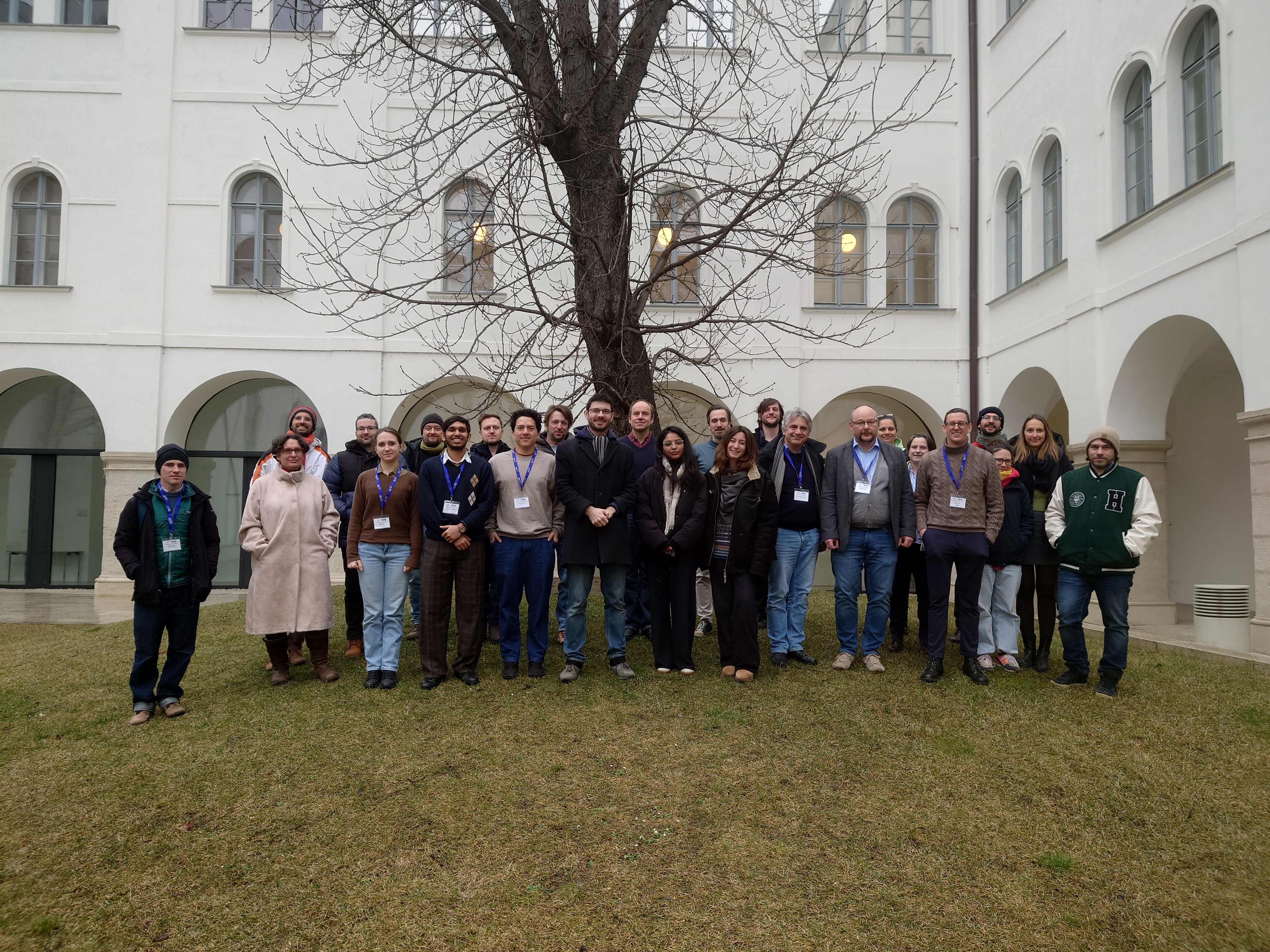
ÖAW AI Winter School 2026

Europe/Zurich
Seminar room 1 + 2 (Campus Akademie, Bäckerstraße 13, 1010 Wien)

Seminar room 1 + 2

Campus Akademie, Bäckerstraße 13, 1010 Wien

Claudius Krause (MBI Vienna (ÖAW))
Description

Welcome to the 5th AI winter school of the Austrian Academy of Sciences (ÖAW) and the Machine Learning Thematic Platform MLA²S, which is held on February 16 – 20, 2026 in Vienna. Here you can find some general information about the event.

The detailed program is currently under construction, but confirmed topics and speakers are already listed under the "Lecturers and Courses" tab.

This time, the winter school is aimed in particular at people who do not yet have in-depth knowledge of ML or AI, but serves to impart basic knowledge, especially for humanities scholars.

The school will be open primarily to people affiliated with or working closely with institutes of the Austrian Academy of Sciences. All levels of seniority are welcome: students (MSc, PhD), PostDocs, faculty and staff. External participants will also be permitted if spaces are available.

Registration will be possible between the end of December 2025 and January 25th, 2026.

The participation fee is 50€.  

The language of the school will be English.


We offer a zoom connection to stream the lectures at 

Join Zoom Meeting
https://oeaw-ac-at.zoom.us/j/69816146446?pwd=5jMIIU0BLNQYZl9aekuR1pMqBrUASf.1

Meeting ID: 698 1614 6446
Passcode: 8zxrp8


Local organizers:

  • Kati Heinrich (IGF)
  • Nicki Holighaus (ARI)
  • Elisabeth Königshofer (ACDH)
  • Claudius Krause (MBI)
  • Jan Odstrčilík (IMAFO)
  • Claus Trost (ESI)
  • Brigitte DeMonte (HEPHY)
Participants
    • 11:30 12:00
      Registration 30m Seminar room 1 + 2

      Seminar room 1 + 2

      Campus Akademie, Bäckerstraße 13, 1010 Wien

    • 12:00 12:30
      Welcome 30m Seminar room 1 + 2

      Seminar room 1 + 2

      Campus Akademie, Bäckerstraße 13, 1010 Wien

      Speakers: Dr Claudius Krause (MBI Vienna (ÖAW)), Claus Trost (Erich Schmid Institute of Materials Science of theAustrian Academy of Sciences), Jan Odstrčilík (Institut für Mittelalterforschung, ÖAW), Kati Heinrich (IGF | ÖAW), Nicki Holighaus (Acoustics Research Institute, Austrian Academy of Sciences)
    • 12:30 14:00
      What is AI? Overview lecture: Part I 1h 30m Seminar room 1 + 2

      Seminar room 1 + 2

      Campus Akademie, Bäckerstraße 13, 1010 Wien

      1) This lecture introduces what “AI” means today and how it relates to machine learning, with an emphasis on large language models (LLMs) and AI agents. We’ll build intuition for core ML ideas—supervised vs. self-supervised learning, loss functions, optimization, and generalization.

      regression, classification, generation, language models, etc.

      Speaker: Michal Hradiš (Brno University of Technology)
    • 14:00 14:30
      Coffeebreak 30m Seminar room 1 + 2

      Seminar room 1 + 2

      Campus Akademie, Bäckerstraße 13, 1010 Wien

    • 14:30 15:30
      AI and ML at the Austrian Academy of Sciences 1h Seminar room 1 + 2

      Seminar room 1 + 2

      Campus Akademie, Bäckerstraße 13, 1010 Wien

      Speaker: Dr Claudius Krause (MBI Vienna (ÖAW))
    • 15:30 16:00
      Coffeebreak 30m Seminar room 1 + 2

      Seminar room 1 + 2

      Campus Akademie, Bäckerstraße 13, 1010 Wien

    • 16:00 18:00
      Overview lecture: Part II 2h Seminar room 1 + 2

      Seminar room 1 + 2

      Campus Akademie, Bäckerstraße 13, 1010 Wien

      2) This lecture explains how today’s language models work at a high level: key building blocks, typical training stages, and the resulting capabilities and limitations. We’ll finish with a brief Python demo using the OpenAI API and a local model via Ollama.

      LLMs and LLM architecture, transformers, supervised and unsupervised training in more detail

      Speaker: Michal Hradiš (Brno University of Technology)
    • 09:00 10:30
      Vibe Coding & „Promptotyping”: Part I 1h 30m Seminar room 1 + 2

      Seminar room 1 + 2

      Campus Akademie, Bäckerstraße 13, 1010 Wien

      Speaker: Christopher Pollin (DH Craft Graz)
    • 10:30 11:00
      Coffeebreak 30m Seminar room 1 + 2

      Seminar room 1 + 2

      Campus Akademie, Bäckerstraße 13, 1010 Wien

    • 11:00 12:30
      Vibe Coding & „Promptotyping”: Part II 1h 30m Seminar room 1 + 2

      Seminar room 1 + 2

      Campus Akademie, Bäckerstraße 13, 1010 Wien

      Speaker: Christopher Pollin (DH Craft Graz)
    • 12:30 14:00
      Lunchbreak 1h 30m Seminar room 1 + 2

      Seminar room 1 + 2

      Campus Akademie, Bäckerstraße 13, 1010 Wien

    • 14:00 15:30
      Vibe Coding & „Promptotyping”: Part II 1h 30m Seminar room 1 + 2

      Seminar room 1 + 2

      Campus Akademie, Bäckerstraße 13, 1010 Wien

      Speaker: Christopher Pollin (DH Craft Graz)
    • 15:30 16:00
      Coffeebreak 30m Seminar room 1 + 2

      Seminar room 1 + 2

      Campus Akademie, Bäckerstraße 13, 1010 Wien

    • 16:00 18:00
      Vibe Coding & „Promptotyping”: Part III 2h Seminar room 1 + 2

      Seminar room 1 + 2

      Campus Akademie, Bäckerstraße 13, 1010 Wien

      Speaker: Christopher Pollin (DH Craft Graz)
    • 09:30 11:00
      Bias in Machine Learning 1h 30m Seminar room 1 + 2

      Seminar room 1 + 2

      Campus Akademie, Bäckerstraße 13, 1010 Wien

      Speaker: Philip Winter (VRVis)
    • 11:00 11:30
      Coffeebreak 30m Seminar room 1 + 2

      Seminar room 1 + 2

      Campus Akademie, Bäckerstraße 13, 1010 Wien

    • 11:30 12:30
      OpenEuroLLM and other developments on AI infrastructures 1h Seminar room 1 + 2

      Seminar room 1 + 2

      Campus Akademie, Bäckerstraße 13, 1010 Wien

      Speaker: Patrick Rarivoson
    • 12:30 14:00
      Lunchbreak 1h 30m Seminar room 1 + 2

      Seminar room 1 + 2

      Campus Akademie, Bäckerstraße 13, 1010 Wien

    • 14:00 14:45
      AI Strategy at the Austrian Academy of Sciences (ÖAW) 45m Seminar room 1 + 2

      Seminar room 1 + 2

      Campus Akademie, Bäckerstraße 13, 1010 Wien

      Speaker: Bernd Wachmann (ÖAW)
    • 14:45 15:45
      Governing Machines: From Moderation to Alignment 1h Seminar room 1 + 2

      Seminar room 1 + 2

      Campus Akademie, Bäckerstraße 13, 1010 Wien

      Speaker: Charlotte Spencer-Smith (CMC)
    • 15:45 16:15
      Coffeebreak 30m Seminar room 1 + 2

      Seminar room 1 + 2

      Campus Akademie, Bäckerstraße 13, 1010 Wien

    • 16:15 17:15
      AI Policy at the Vienna University 1h Seminar room 1 + 2

      Seminar room 1 + 2

      Campus Akademie, Bäckerstraße 13, 1010 Wien

      Speaker: Laura Gandlgruber (Vienna University)
    • 19:00 22:00
      Dinner at Stöckl im Park 3h Stöckl im Park

      Stöckl im Park

      1030 Wien, Prinz Eugen-Straße 25
    • 09:00 11:00
      From idea to final project: Part I - Data & Code Management 2h Seminar room 1 + 2

      Seminar room 1 + 2

      Campus Akademie, Bäckerstraße 13, 1010 Wien

      Delving into the world of data-driven research presents exciting possibilities. However, there are a few topics that need to be addressed before one can jump right in.
      Research data management (RDM) planning, software version control, automation, and data cleaning might appear dry at first glance, and they might indeed be to many. Despite these topics and practices seeming like ‘checkbox’ activities, expending some time actively thinking about them, and setting them up can save a lot of time and set you up for success in your research endeavour.

      This workshop aims to introduce you to these topics. By the end of the workshop you will be prepared to independently self-teach these topics.
      We will begin by exploring some academic research project examples and how RDM and RDM planning could be approached.
      Moving on, I will introduce software version control via Git, with remotes on the developer platform, GitHub, and touching on working as a team on GitHub. This exercise will also explore automation via GitHub Actions and Docker.
      We finish with data cleaning and wrangling concepts, and a practical demonstration in Python.
      Participation by following along is encouraged but not expected.

      Github management, workflows, exercises

      Speaker: Stavrina Dimosthenous (University of Manchester)
    • 11:00 11:30
      Coffeebreak 30m Seminar room 1 + 2

      Seminar room 1 + 2

      Campus Akademie, Bäckerstraße 13, 1010 Wien

    • 11:30 12:30
      From idea to final project: Part II - Data & Code Management 1h Seminar room 1 + 2

      Seminar room 1 + 2

      Campus Akademie, Bäckerstraße 13, 1010 Wien

      Delving into the world of data-driven research presents exciting possibilities. However, there are a few topics that need to be addressed before one can jump right in.
      Research data management (RDM) planning, software version control, automation, and data cleaning might appear dry at first glance, and they might indeed be to many. Despite these topics and practices seeming like ‘checkbox’ activities, expending some time actively thinking about them, and setting them up can save a lot of time and set you up for success in your research endeavour.

      This workshop aims to introduce you to these topics. By the end of the workshop you will be prepared to independently self-teach these topics.
      We will begin by exploring some academic research project examples and how RDM and RDM planning could be approached.
      Moving on, I will introduce software version control via Git, with remotes on the developer platform, GitHub, and touching on working as a team on GitHub. This exercise will also explore automation via GitHub Actions and Docker.
      We finish with data cleaning and wrangling concepts, and a practical demonstration in Python.
      Participation by following along is encouraged but not expected.

      Github management, workflows, exercises

      Speaker: Stavrina Dimosthenous (University of Manchester)
    • 12:30 14:00
      Lunchbreak 1h 30m Seminar room 1 + 2

      Seminar room 1 + 2

      Campus Akademie, Bäckerstraße 13, 1010 Wien

    • 14:00 15:30
      From idea to final project: Part III - Data cleaning, reproducability 1h 30m Seminar room 1 + 2

      Seminar room 1 + 2

      Campus Akademie, Bäckerstraße 13, 1010 Wien

      Delving into the world of data-driven research presents exciting possibilities. However, there are a few topics that need to be addressed before one can jump right in.
      Research data management (RDM) planning, software version control, automation, and data cleaning might appear dry at first glance, and they might indeed be to many. Despite these topics and practices seeming like ‘checkbox’ activities, expending some time actively thinking about them, and setting them up can save a lot of time and set you up for success in your research endeavour.

      This workshop aims to introduce you to these topics. By the end of the workshop you will be prepared to independently self-teach these topics.
      We will begin by exploring some academic research project examples and how RDM and RDM planning could be approached.
      Moving on, I will introduce software version control via Git, with remotes on the developer platform, GitHub, and touching on working as a team on GitHub. This exercise will also explore automation via GitHub Actions and Docker.
      We finish with data cleaning and wrangling concepts, and a practical demonstration in Python.
      Participation by following along is encouraged but not expected.

      Speaker: Stavrina Dimosthenous (University of Manchester)
    • 15:30 16:00
      Coffeebreak 30m Seminar room 1 + 2

      Seminar room 1 + 2

      Campus Akademie, Bäckerstraße 13, 1010 Wien

    • 16:00 17:30
      Introduction to CLIP 1h 30m Seminar room 1 + 2

      Seminar room 1 + 2

      Campus Akademie, Bäckerstraße 13, 1010 Wien

      Speaker: Felix Schmitt (ÖAW | CLIP)
    • 09:00 11:00
      Explainability of Neural Networks in STEM fields 2h Seminar room 1 + 2

      Seminar room 1 + 2

      Campus Akademie, Bäckerstraße 13, 1010 Wien

      Due to their predictive accuracy, machine learning models are
      increasingly employed in high-stakes decision making and in scientific
      contexts. These predictive capabilities often come at the price of
      interpretability: The models are too complex to be inherently
      intelligible by their human users.
      In an attempt to restore this interpretability, a broad range of methods
      have been developed, often subsumed under the umbrella of the term
      Explainable AI (XAI). In this session, we will give the attendees an
      introduction to the field. We will start by mapping the different
      approaches using the standard taxonomies, before we formally introduce
      some of the most popular explanation methods.
      Over the course of the session we will focus on the core challenges that
      practitioners face: (1) Translating the outputs of XAI methods into
      concise statements about model and data, and (2) choosing the
      explanation technique that is most suitable for a given task. We will
      tackle these questions with a particular focus on the task of learning
      about feature target associations, thereby preparing attendees to employ
      XAI methods in their own work.

      Speaker: Gunnar König
    • 11:00 11:30
      Coffeebreak 30m Seminar room 1 + 2

      Seminar room 1 + 2

      Campus Akademie, Bäckerstraße 13, 1010 Wien

    • 11:30 12:30
      Explainability of Neural Networks in STEM fields 1h Seminar room 1 + 2

      Seminar room 1 + 2

      Campus Akademie, Bäckerstraße 13, 1010 Wien

      Machine learning (ML) models are increasingly deployed in high-stakes
      environments, e.g., in the health domain, where ethical and legal
      considerations require models to be interpretable. Despite substantial
      progress in interpretable ML (IML), several key challenges remain. These
      include distinguishing between interpreting the model and using the
      model to interpret the data-generating process, dealing with
      heterogeneous data, and providing meaningful recourse recommendations. I
      argue that we can address these challenges by adopting a causal
      perspective on IML. In particular, I demonstrate how the causal
      structures of the model and the data-generating process jointly affect
      model interpretation techniques. I then provide an overview of our
      recent work on leveraging causal techniques to improve model
      interpretation and render recourse recommendations more meaningful.

      Speaker: Moritz Grosse-Wentrup
    • 12:30 13:30
      Lunchbreak 1h Seminar room 1 + 2

      Seminar room 1 + 2

      Campus Akademie, Bäckerstraße 13, 1010 Wien

    • 13:30 15:00
      Evaluation and Interpretability of NLP systems 1h 30m Seminar room 1 + 2

      Seminar room 1 + 2

      Campus Akademie, Bäckerstraße 13, 1010 Wien

      Speaker: Pia Sommerauer (Vrije Universiteit Amsterdam)
    • 15:00 16:00
      Wrapup & Networking 1h Seminar room 1 + 2

      Seminar room 1 + 2

      Campus Akademie, Bäckerstraße 13, 1010 Wien