Indo-Italian Workshop in Physics 2026

Asia/Kolkata
Seminar Hall (IIT Delhi)

Seminar Hall

IIT Delhi

Description

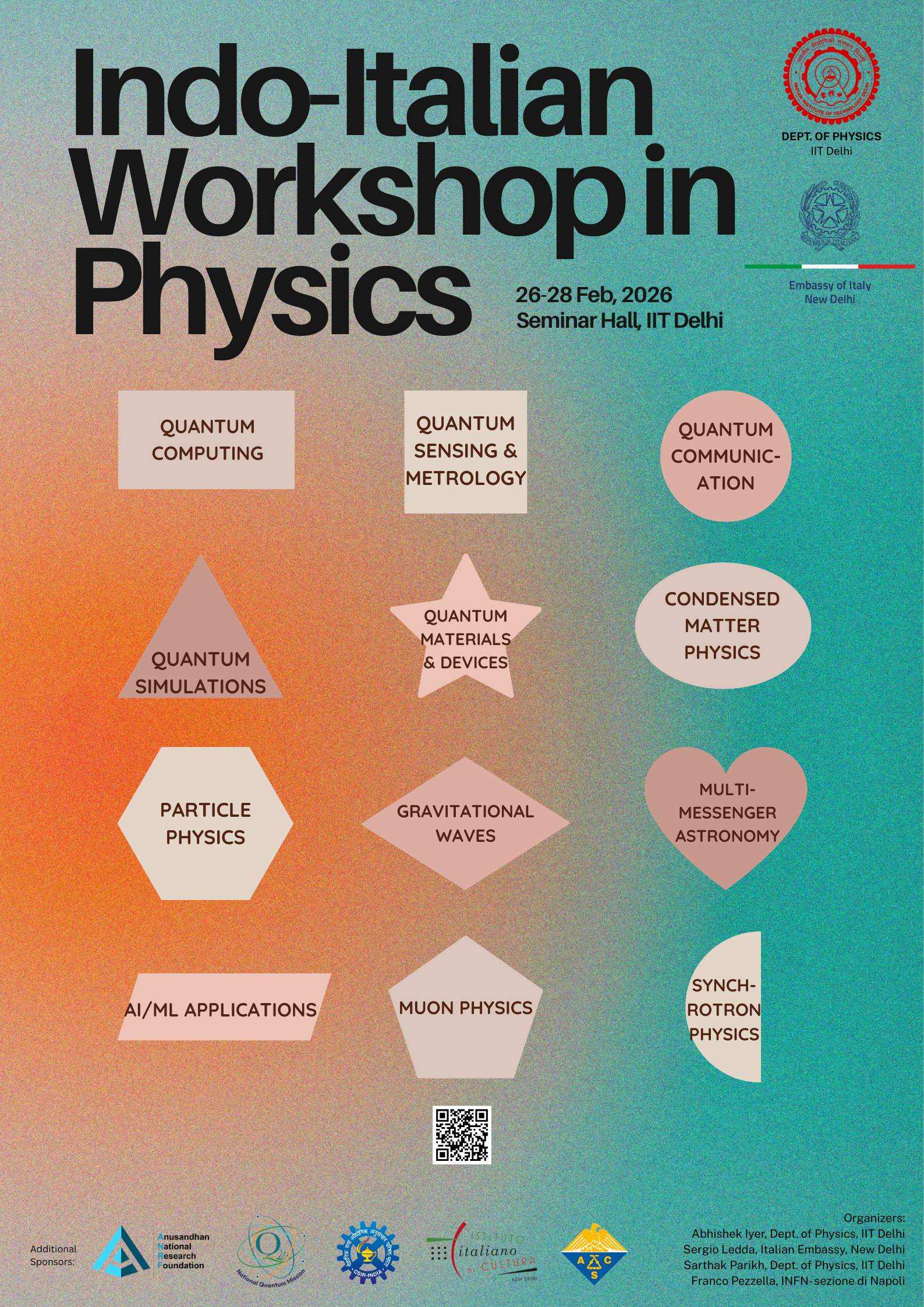
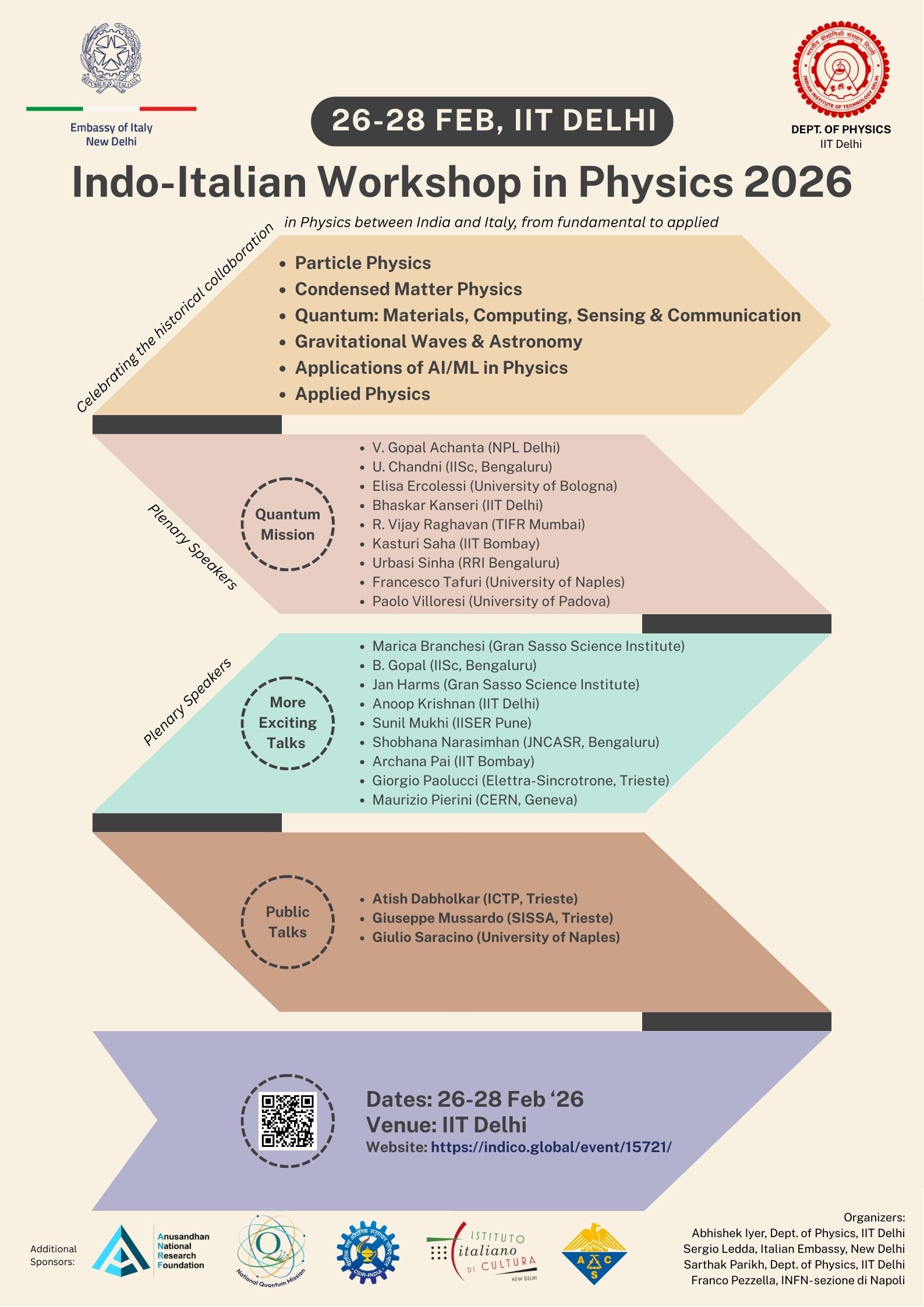
The workshop aims to celebrate the rich scientific collaborations between scientists from India and Italy in various areas of physics, from fundamental to applied. It will host plenary talks, aimed at a broader audience, while identifying new areas of INDO-ITALIAN collaboration in these fields.

This workshop is being organized by IIT Delhi in collaboration with the Italian Embassy, New Delhi.

Local Organising Committee:

  • Abhishek Iyer, Department of Physics, IIT Delhi
  • Sergio Ledda, Scientific Attache', Italian Embassy, New Delhi
  • Sarthak Parikh, Department of Physics, IIT Delhi
  • Franco Pezzella, Istituto Nazionale di Fisica Nucleare (INFN - sezione di Napoli)


Sponsors:


Download a printable PDF of the poster.


    • ANRF+IITD Seminar Series: Joining Forces: to Unify Nature and to Unite the World Seminar Hall

      Seminar Hall

      IIT Delhi

      The lecture will crisscross between two themes of unification of fundamental interactions and global collaboration for science with the following focus:

      Unification of Forces: The remarkably simple and precise current understanding of all fundamental forces of nature from gravity to nuclear interactions. The powerful idea of joining all forces to describe diverse phenomena from electricity, magnetism, light, or radioactivity in a unified framework.

      Science without Borders: The importance of fundamental science for development and the role of centers like the Abdus Salam International Centre for Theoretical Physics (ICTP) in Trieste to make advanced science globally available and to promote international cooperation through science. The complementary visions of Homi Bhabha and Abdus Salam for building strong scientific communities in the developing world.

      Vistas from a Science Frontier: The ongoing quest towards unification of quantum mechanics and general relativity within string theory with fascinating connections with duality, black holes, holography and quantum information.

      Joining Forces for Global Action: The global challenges ahead from climate to computing where science-based, inclusive, collaborative approach will be increasingly important. ICTP’s strategic priorities for an 'International Science Alliance' and an 'International Consortium for Scientific Computing' forging new collaborations in equal partnerships between ICTP, foundations, corporations, countries, national agencies and scientific institutions.

      Satellite event: Inaugural talk of the ANRF+IITD seminar series
      Convener: Prof. Atish Dabholkar (ICTP, Trieste)
    • Welcome address Seminar Hall

      Seminar Hall

      IIT Delhi

      Director, Embassy, other dignitaries

    • 1
      Activities on Quantum Computation in Italy and the Superconducting Quantum Computer@UNINA Seminar Hall

      Seminar Hall

      IIT Delhi

      Italy has designed a national strategy on quantum technologies including quantum computation within the more general European framework. Superconducting circuits have been up to now the most successful platform worldwide to build a quantum computer, being developed and used by major international companies since early stages. University of Napoli (UNINA) has a long-standing experience on superconducting electronics and on its key device i.e. the Josephson junction, and in 2024 has assembled the first quantum computer in Italy “Partenope” based on a 25-qubits processor produced by Quantware recently expanded with a 64-qubits QPU. Partenope has been the platform where to create a solid expertise for the characterization, calibration, benchmarking and implementation of subregisters of QPUs and to focus on all hardware aspects including control and read out. A full control of Partenope also due to a comprehensive handling of the physics behind including its noise issues, such as decoherence, error in the gate implementation, readout error, has allowed the run of various algorithms, paving the way more and more towards an open-source quantum computing platform. A profound understating of all the physics of the hardware, including material science issues, has promoted progress in developing independent pathways with innovative solutions for novel quantum components. These range from a new type of qubit based on ferromagnetic Josephson junctions and a novel tunable qubits coupler to qubit readout based on Josephson digital phase detectors and to novel schemes of microwave demultiplexer.

      Speaker: Prof. Francesco Tafuri (Universita di Napoli Federico II)
    • 10:10
      Coffee Seminar Hall

      Seminar Hall

      IIT Delhi

    • 2
      Metrology for Quantum Technologies Seminar Hall

      Seminar Hall

      IIT Delhi

      There is an enhanced global activity since 2019 to implement the redefined SI units in terms of the fundamental constants. While this area is known as Quantum Metrology, another area has gained prominence as quantum technologies mature across various domains. In areas such as communications, computing, and sensing, there is a need for calibration, testing, and certification facilities to support emerging industries. Single photon metrology is one such area that encompasses non-classical light sources, single-photon detectors, quantum random numbers, among others. Another important area is quantum sensors, such as magnetometers, electrometers, and gyroscopes. In this talk, after introducing quantum metrology, I will present recent work at CSIR-NPL in these areas.

      Speaker: Prof. Venu Gopal Achanta (NPL, Delhi)
    • 3
      Quantum at the Speed of Light: Exotic Photonic States, Certified Randomness, and Quantum-Secure Technologies Seminar Hall

      Seminar Hall

      IIT Delhi

      Quantum mechanics is at its most striking when it produces states that have no classical counterpart, superpositions that refuse to behave like “either/or,” correlations that outlive distance, and measurement outcomes that cannot be explained by any classical hidden-variable story. Photons are the ideal stage for this drama: they propagate at the speed of light, preserve coherence over long distances, and can be sculpted into high-dimensional and multi-photon quantum states that are both experimentally accessible and technologically actionable. In this talk, I will trace a “discovery-to-deployment” arc for photonic quantum technologies, grounded in our experience across fundamental experiments and translational engineering. Starting from core quantum resources in light, such as superposition, interference, and entanglement, I will discuss how foundational tests of nonclassicality and measurement can be repurposed into practical capabilities within quantum communications: trustworthy entropy generation, certified key material, and protocols whose security rests on experimentally verifiable quantum behaviour rather than assumptions about computational hardness. I will highlight the role of certified quantum randomness as a central primitive for quantum communications. Nonclassical correlations enable certification of unpredictability, including device-independent approaches based on Bell nonlocality and single-system certification using temporal inequalities (Leggett–Garg). These tools illustrate a broader theme: “exotic” quantum behaviour can be engineered into an operational guarantee, and then used directly in communication and cryptographic stacks. Building on this, I will discuss progress in quantum-secure communication, including quantum key distribution and its evolution from controlled laboratory demonstrations to field-relevant implementations. I will touch on atmospheric free-space links, pointing-acquisition-tracking for moving platforms, and the pathway toward satellite-based quantum communication. Finally, I will look ahead to scalable quantum networks, where multi-node entanglement distribution, quantum repeaters, and photon–matter interfaces (quantum memories) become essential. The talk will close with lessons from translating photonic quantum prototypes into products, including reliability engineering, validation standards, and the practical constraints that determine whether an exotic quantum state remains a beautiful experiment or becomes a working technology.

      Speaker: Prof. Urbasi Sinha (Raman Research Institute, Bengaluru)
    • 12:00
      Lunch Seminar Hall

      Seminar Hall

      IIT Delhi

    • 4
      Quantum Simulations: from Condensed Matter to Particle Physics Models Seminar Hall

      Seminar Hall

      IIT Delhi

      Building on Richard Feynman’s seminal insight that quantum systems can efficiently simulate other quantum systems, this talk reviews recent advances in the quantum simulation of fundamental models across condensed matter and particle physics. After introducing the core concepts and motivations of quantum simulation, I will discuss representative examples implemented on different experimental platforms, highlighting both their capabilities and current limitations.

      Speaker: Prof. Elisa Ercolessi (University of Bologna)
    • 5
      Quantum Sensing and Imaging with NV Centers in Diamond Seminar Hall

      Seminar Hall

      IIT Delhi

      There is a global surge in research aimed at leveraging the unique features of quantum physics to advance technologies in metrology, computing, and communication—an initiative broadly known as the development of “engineered quantum systems.” Among the promising platforms are color centers in diamond, particularly nitrogen-vacancy (NV) centers, which offer a pathway to high-precision magnetometry and could enable nanoscale magnetic resonance imaging (MRI) of individual complex molecules. In this talk, I will present our ongoing work toward building an imaging system capable of mapping magnetic fields with spatial resolution of 1 um. I will also discuss our progress on creating localized sensors for detecting biomolecular signals.

      Speaker: Prof. Kasturi Saha (IIT Bombay)
    • 15:00
      Coffee Seminar Hall

      Seminar Hall

      IIT Delhi

    • 6
      Quantum Communications for Space and Ground: Moving Forward with Basic Science and Pushing the Applications Seminar Hall

      Seminar Hall

      IIT Delhi

      The most fundamental level of communications is realized with the exchange of quantum states, which is the essence of quantum communications. In this way, it is possible to connect different systems but also to analyse the changes introduced by communication channels. These possibilities are useful tools for the investigation of the basic principles of quantum mechanics. Quantum communication is also a useful tool for countering cyber attacks, through the secure exchange of cryptographic keys and the generation of genuine random numbers. The talk will present current aspects of ongoing research, in particular at the Res. Center for Quantum Technologies of the University of Padua and the QuantumFuture Research group.

      Speaker: Prof. Paolo Villoresi (University of Padova)
    • 7
      Towards Practical Quantum Secure Communication Networks Seminar Hall

      Seminar Hall

      IIT Delhi

      Contrary to classical networks, quantum networks use the principles of quantum physics to transmit and process information offering immense potential in several areas including secure communication, powerful computing, advanced sensing capabilities and many upcoming domains. Quantum entanglement, an essential trait of quantum physics, offers an extra layer of security in distributing keys and also simplifies their analysis. In addition, it is useful in computing, imaging and sensing applications. This talk will highlight the development of quantum network elements in our lab for both free-space and fibre based applications. These include entangled photon sources, both for free-space and fibre based communication and characterization of their quantum features. Efforts of our group so far in realizing quantum key distribution using hybrid schemes for lab scale and for long distance including real field environment would also be detailed. The need of multi-node quantum networks for realizing quantum internet would also be discussed focussing on applications related to security. Specifically, the practical aspects of entanglement enabled hybrid networks will be emphasized, focussing on the need of coexistence of classical and quantum signal on the same fibre, and use of photon number resolving detectors for enhanced security, which are primitives for realizing such practical intercity quantum communication networks.

      Speaker: Prof. Bhaskar Kanseri (IIT Delhi)
    • 8
      Two-dimensional Materials: Moire and Beyond Seminar Hall

      Seminar Hall

      IIT Delhi

      Our current technological platforms are grounded in a thorough understanding of material band structures and their direct implications for electronic and optoelectronic properties. Modifying the band structure of naturally occurring materials is a complex endeavor, and commonly used experimental techniques such as strain, pressure, and crystal structure engineering often results in only minor adjustments to band gaps, effective masses, and other key material parameters. One of the recent platforms in this respect is the field of moire materials, where two dimensional (2D) materials twisted or hetero-stacked can lead to a variety of exotic properties including superconductivity and other exotic states such as Chern insulators, orbital ferromagnets, and nematic phases.

      In this talk, I shall highlight various facets of many body correlations that we have explored using a combination of transport techniques in moire graphene. I will also touch upon an alternative experiment to develop a new metamaterials platform using Bernal bilayer graphene, where external, modulated electrostatic gate potentials can be used as a tunable knob to engineer superlattices and flat electronic bands. The results highlight new routes to band engineering, potentially extendable to complex periodic structures that are untenable in natural materials.

      Speaker: Prof. Chandni U (IISc, Bengaluru)
    • 9
      Key Highlights and Future Projections of Gravitational-Wave Astronomy with LIGO-India Seminar Hall

      Seminar Hall

      IIT Delhi

      Speaker: Prof. Archana Pai (IIT Bombay)
    • 10:40
      Coffee Seminar Hall

      Seminar Hall

      IIT Delhi

    • 10
      Condensed Matter Seminar Hall

      Seminar Hall

      IIT Delhi

      Speaker: Prof. Shobhana Narasimhan (JNCASR, Bengaluru)
    • 11
      Particles & AI/ML Seminar Hall

      Seminar Hall

      IIT Delhi

      Speaker: Maurizio Pierini (CERN)
    • 12:20
      Lunch Seminar Hall

      Seminar Hall

      IIT Delhi

    • 12
      Quantum Computing Seminar Hall

      Seminar Hall

      IIT Delhi

      Speaker: Prof. Rajamani Vijayraghavan (TIFR Mumbai)
    • 13
      AI/ML in Physics Seminar Hall

      Seminar Hall

      IIT Delhi

      Speaker: Prof. Anoop Krishnan (IIT Delhi)
    • 15:20
      Coffee Seminar Hall

      Seminar Hall

      IIT Delhi

    • 14
      Gender in STEM Seminar Hall

      Seminar Hall

      IIT Delhi

    • Public Talk: Chandra - The Journey of a Star Italian Embassy Cultural Centre, New Delhi

      Italian Embassy Cultural Centre, New Delhi

      The Italian Embassy Cultural Centre is pleased to present the screening of the documentary Chandra - The Journey of a Star directed by Enrico Agapito & written by Giuseppe Mussardo.

      This 2009 film delves into the life and scientific contributions of Subrahmanyan Chandrasekhar, the Nobel Prize-winning astrophysicist renowned for his work on stellar structure and evolution. The documentary traces his journey from his early days in India to his groundbreaking research at Cambridge University, highlighting his development of the Chandrasekhar limit, a pivotal concept in understanding the life cycles of stars.

      The film will be introduced by its writer Giuseppe Mussardo and will be followed by a Q&A session.

      Synopsis
      On the morning of 1st August 1930 in Bombay, the wharf of the P&O -- Peninsular and Oriental Lines -- was fully crowded and there was the usual confusion of any departure: porters were loading luggage and big crates, officers were busy in giving the last orders and sailors were climbing up and down from the decks among ropes and shrouds. Foreigners walked around looking with open admiration at the Gateway of India, considered the quintessence of colonial India, a monument erected by England in the Twenties to be the symbol of its entry in the Raj, but that was going to become soon the sad witness of its leaving. Till a few hours before, the rain carried by the monsoon had swept the docks with strong gusts, but after a brief pause of relief, a suffocating heat had reappeared; the heavy humidity soaked the dresses that, almost transparent, stuck to the bodies. Near the pier of the steamer Pilsna, a liner of Lloyd Triestino travelling from Bombay to Venice, a small crowd was gathering there were friends and relatives come to bid farewell to a young man heading for Europe.

      Convener: Prof. Giuseppe Mussardo (SISSA, Trieste)
    • 15
      The Theory Formerly Known as Strings Seminar Hall

      Seminar Hall

      IIT Delhi

      I will give a short survey of how the landscape of formal theoretical physics has evolved in recent decades. Today, "String Theory" has become a terminology for a wide-ranging set of techniques rooted in special and general relativity and quantum mechanics, with applications across High Energy Physics, Gravitation, Quantum Information and Condensed Matter Physics.

      Speaker: Prof. Sunil Mukhi (IISER Pune)
    • 10:40
      Coffee Seminar Hall

      Seminar Hall

      IIT Delhi

    • 16
      Gravitational-Wave Detectors: Breakthrough Science and Opportunities for Indo-Italian Collaborations Seminar Hall

      Seminar Hall

      IIT Delhi

      Observations with the gravitational-wave detectors Virgo and LIGO opened a new window to our Universe and have led to breakthrough discoveries revolutionizing our understanding of spacetime and matter under extreme conditions. Meanwhile, the science communities around the world are preparing for the construction of a new generation of detectors including LIGO India and the Einstein Telescope in Europe. The exquisite technological challenges require us to work together across countries and continents. In this talk, we highlight the importance and opportunities of cooperation in this new field especially in the context of a possible Indo-Italian collaboration.

      Speaker: Prof. Jan Harms (Gran Sasso Science Institute)
    • 17
      Multi-Messenger Astronomy: Present Status and Future Perspectives of the Italy-India Collaboration Seminar Hall

      Seminar Hall

      IIT Delhi

      Multi-messenger astronomy has opened a new window on the Universe by combining gravitational waves with electromagnetic and particle observations. What began as the detection of rare and exceptional events is now evolving toward a routine exploration of the cosmos, enabled by increasingly sensitive observatories. In this talk, I will review the current status and future prospects of multi-messenger astronomy, highlighting the key role of global networks of gravitational-wave detectors and the coordinated operation of ground-based and space-borne observatories. Particular emphasis will be placed on the Italy-India collaboration, including the contributions of the Virgo detector, the development of LIGO-India, the prospects offered by the Einstein Telescope, and the synergy with satellite missions. Multi-messenger observations have a profound impact on relativistic astrophysics, the study of compact objects and fundamental physics, the origin of heavy elements, nuclear physics under extreme conditions, and cosmology. Looking to the future, the Italy-India partnership has the potential to become a strategic contributor to this field, strengthening global efforts toward the next generation of multi-messenger discoveries.

      Speaker: Prof. Marica Branchesi (Gran Sasso Science Institute)
    • 12:20
      Lunch Seminar Hall

      Seminar Hall

      IIT Delhi

    • 18
      X-Rays for Indian Researchers: the Collaboration between Elettra and Indian Research Institutions Seminar Hall

      Seminar Hall

      IIT Delhi

      Synchrotron radiation serves as a potent instrument for elucidating the structural and electronic characteristics of matter. Elettra, the Italian Synchrotron radiation laboratory, has a longstanding history of collaboration with Indian scientists. Presently, the Indian research community constitutes the second-largest community at Elettra, following the Italian one. Two of the instruments (beamlines) installed at Elettra are co-financed by the Department of Science and Technology (DST) through the Indian Institute of Science (IISc). As Elettra undergoes a significant upgrade, new avenues for the Indian community are anticipated in the forthcoming years.

      Speaker: Prof. Giorgio Paolucci (Elettra-Sincrotone, Trieste)
    • 19
      The XRD2 and XPRESS Beamlines at Elettra Sincrotone Trieste Seminar Hall

      Seminar Hall

      IIT Delhi

      In this presentation we would describe the genesis, design and operations at the two Indo-Italian beamlines- XRD2 and XPRESS - at the Elettra Sincrotrone Trieste. Representative projects will be described that highlight the impact of access to these facilities on Indian researchers.

      Speaker: Prof. B Gopal (IISc, Bengaluru)
    • 15:20
      Coffee Seminar Hall

      Seminar Hall

      IIT Delhi

    • Public Talk: Seeing the Invisible: Muography Applied to Archeology Humayun's Tomb Museum

      Humayun's Tomb Museum

      Traditional archaeological investigation combines surface surveys with geophysical prospecting techniques to identify and characterize archaeological sites. Methods such as magnetometry, ground-penetrating radar, and electrical resistivity are commonly used to detect buried structures and subsurface anomalies. In recent years, a new approach based on the measurement of cosmic-ray muons has emerged alongside these techniques. This method, known as muon radiography or muography, exploits the exceptional penetrating power of muons—elementary particles produced in the atmosphere by the interaction of cosmic radiation with the Earth’s atmosphere.

      Muography is conceptually similar to X-ray imaging, but far more powerful, as muons can penetrate hundreds of meters of rock, allowing the detection of density anomalies within the crossed volumes, such as those caused by hidden cavities.

      The presentation will introduce the basic principles of muon radiography, the main experimental techniques, and its potential applications. Some case studies in archaeology will then be presented, such as the fascinating study of the Egyptian pyramids and the Greco-Roman underground of the city of Naples (Italy).

      Public talk at Humayun's Tomb Museum*

      Convener: Prof. Giulio Saracino (Università Napoli Federico II and INFN Napoli)