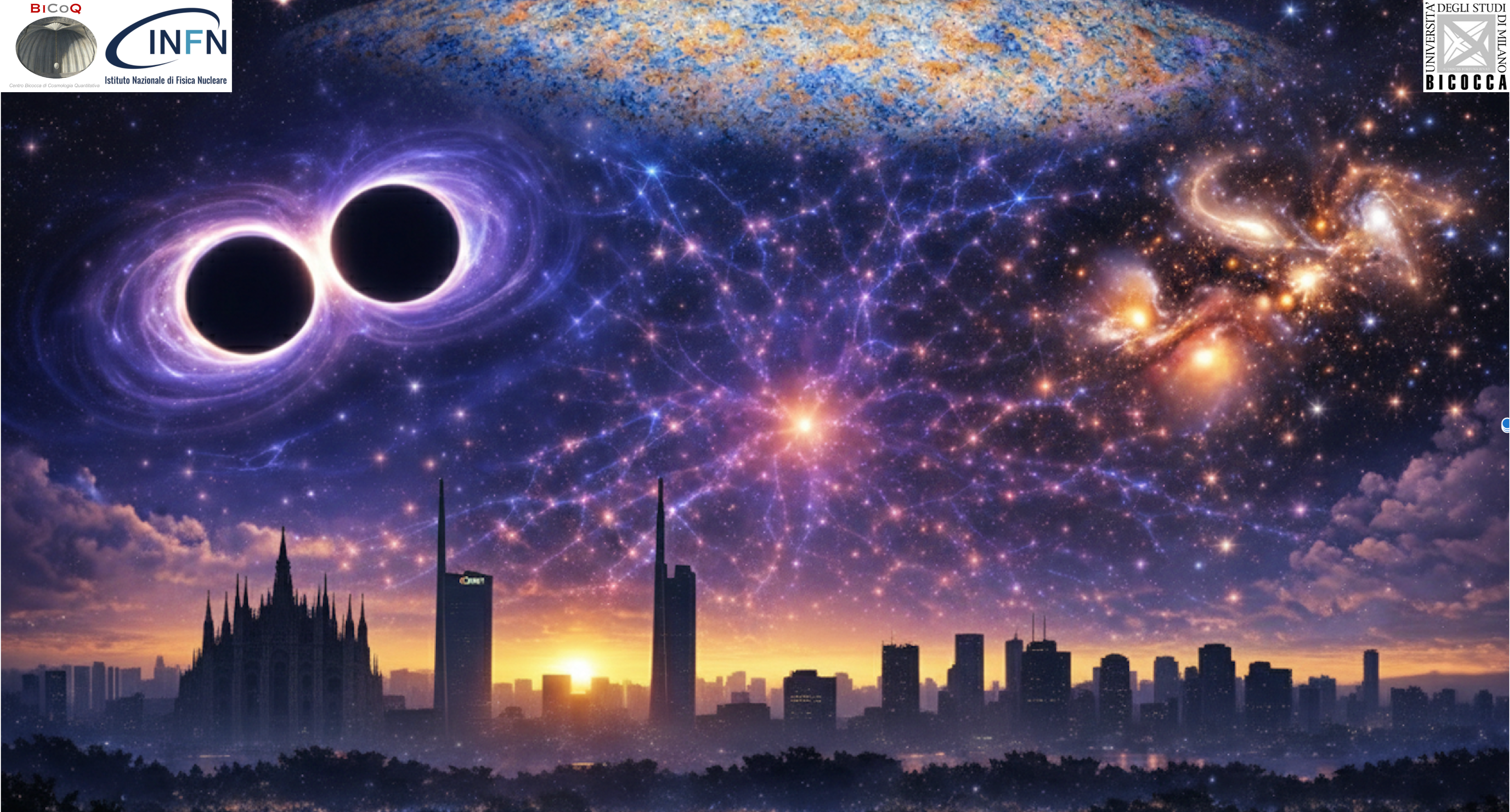
Overview
The "BiCoQ Conference: from gravity to particles" aims at bringing together a broad community of scientists working at the intersection of gravitational-wave astronomy, dark matter physics, and experimental cosmology.
This interdisciplinary workshop is organized by the Bicocca Centre for Quantitative Cosmology (BiCoQ), and it seeks to discuss and explore the latest advancements in the study of the nature of gravity and matter across disciplines and scales, including:
- astrophysical tests of dark matter on cosmological scales
- direct detections of dark matter candidates
- probes of gravity across a wide frequency domain.
Plenary sessions will review the state-of-the-art in our view of the fundamental constituents of the universe. Three focused parallel sessions will discuss ongoing efforts and the next steps in constraining dark matter and dark energy with astrophysical observations, the physics of gravitational waves from binary systems, and the search for new physics with detections of dark matter candidates beyond the standard model or ultra-high frequency gravitational waves.
Current invited speakers for the conference include:
- N. Fornengo (Universita' di Torino, Italy)
- S. Vegetti (Max Planck Insitute for Astrophysics, Germany)
- S. Simon (Fermi National Accelerator Laboratory, USA)
- A. Newman (Carnegie Science, USA)
- U. Sperhake (University of Cambridge, UK)
- N. Aggarwal (UC Davis, USA)
- N. Luetzgendorf (ESA-ESTEC, Noordwijk, NL)
- S. Fairhurst (University of Cardiff, UK)
The conference will be held on the main campus of the University of Milano-Bicocca.
Participants are required to pay a registration fee of 150 EUR, which covers lunches, coffee breaks, and the Welcome reception on Monday 15/06.