The 2nd Joint Summer School on Theoretical High-Energy Physics is a continuation of two series of summer schools hosted by the Kavli Institute for Theoretical Sciences in Beijing (2021 in Liyang, 2023 in Shanghai, and 2024 in Beijing) and by the Yau Center in Southeast University (2020 online, 2021 online, 2023 in Nanjing, and 2024 in Nanjing). Since 2025 in Hangzhou, we have merged these two series and will hold the summer school annually in China.
For 2026, the summer school will be co-hosted by the University of Chinese Academy of Sciences and Southeast University at the UCAS Zhongguancun Campus. The goal of this series of summer schools is to expose students and postdocs in China to the frontiers in theoretical high-energy physics and introduce to them to the basic research techniques in various subfields. To cover both the basics and the cutting-edge research in various subfields, the summer school will have a few mini-lectures and invited research talks.
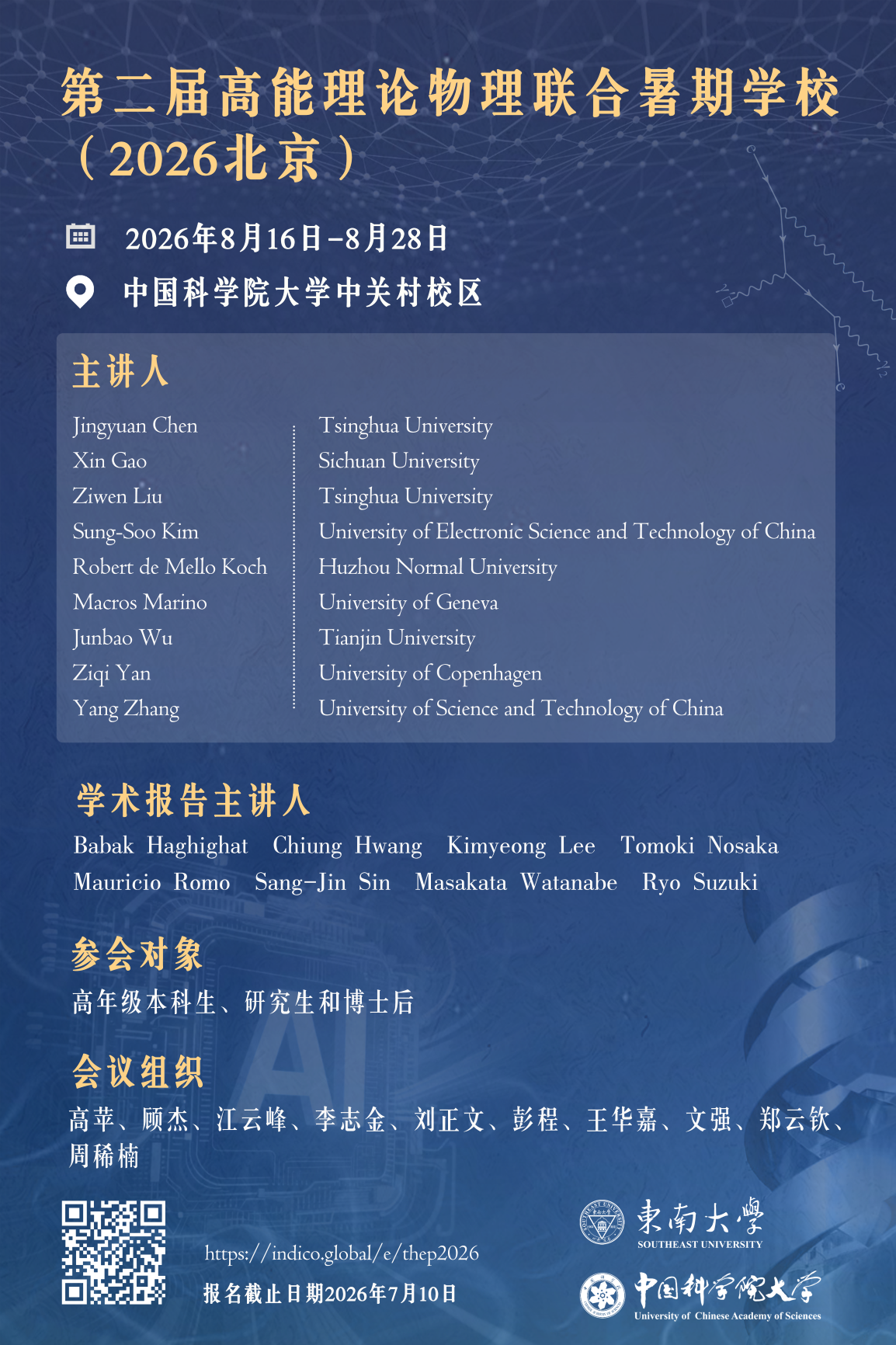
Lecturers
Jingyuan Chen (Tsinghua University)
Xin Gao (Sichuan University)
Ziwen Liu (Tsinghua University)
Sung-Soo Kim (University of Electronic Science and Technology of China)
Robert de Mello Koch (Huzhou Normal University)
Marcos Mariño (University of Geneva)
Junbao Wu (Tianjin University)
Ziqi Yan (University of Copenhagen)
Yang Zhang (University of Science and Technology of China)
Research Talk Speakers
Babak Haghighat (Tsinghua University)
Chiung Hwang (University of Science and Technology of China)
Kimyeong Lee (Beijing Institute of Mathematical Sciences and Applications)
Tomoki Nosaka (Shanghai Institute for Mathematics
and Interdisciplinary Sciences)
Mauricio Romo (Shanghai Institute for Mathematics
and Interdisciplinary Sciences)
Sang-Jin Sin (Hanyang University)
Masataka Watanabe (Tokyo University)
Ryo Suzuki (Southeast University)
Organizing Committee
Ping Gao (School of Quantum & KITS, UCAS)
Jie Gu (Yau Center, Southeast University)
Yunfeng Jiang (Yau Center, Southeast University)
Zhijin Li (Yau Center, Southeast University)
Zhengwen Liu (Yau Center, Southeast University)
Cheng Peng (School of Quantum & KITS, UCAS)
Huajia Wang (School of Quantum & KITS, UCAS)
Qiang Wen (Yau Center, Southeast University)
Yunqin Zheng (School of Quantum & KITS, UCAS)
Xinan Zhou (School of Quantum & KITS, UCAS)
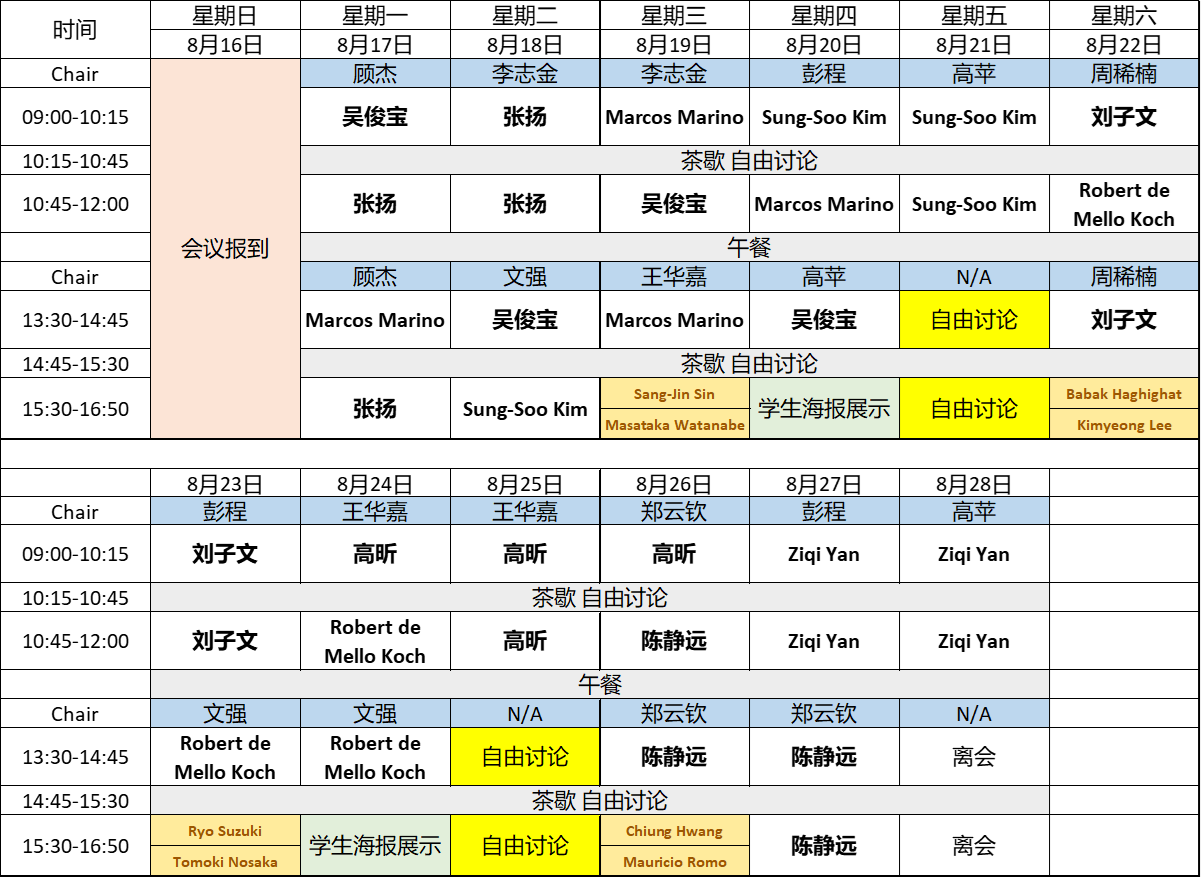
The tentative schedule is as follows.