Winter School: HTR of Historical Sources, 2026

→ Europe/Vienna
Virtual

Virtual

Description
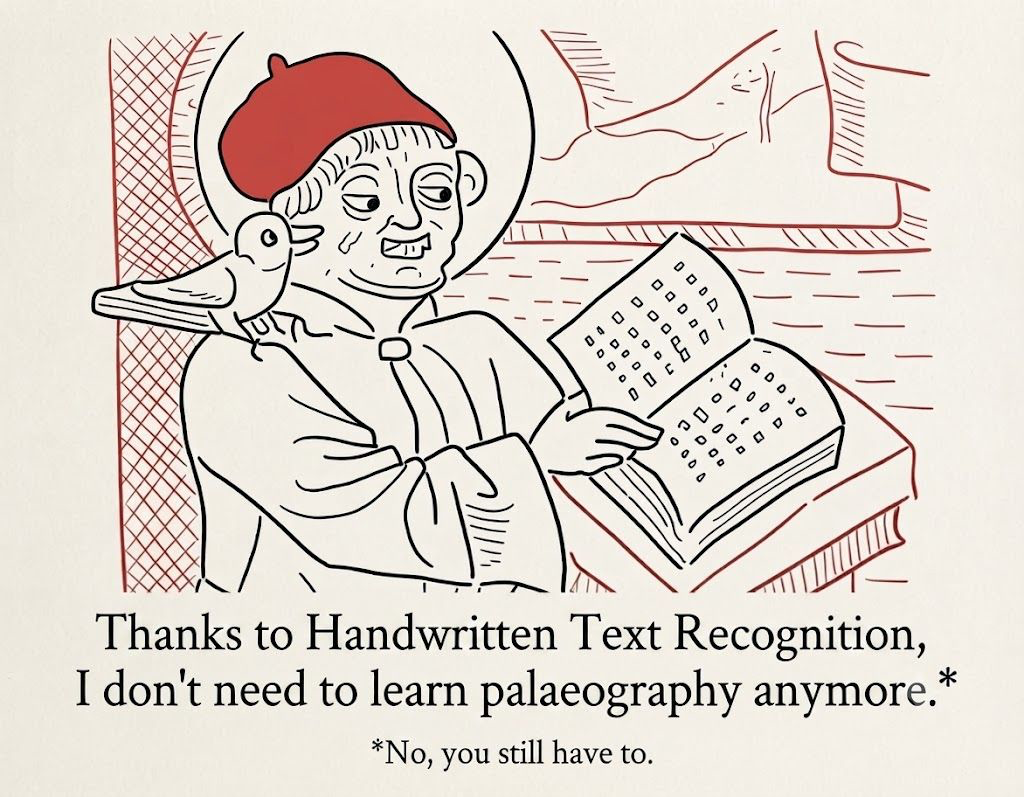
The use of AI for reading historical sources (known as Automated or Handwritten Text Recognition) is becoming an expected and necessary part of many DH projects. Nevertheless, there are still many challenges, from choosing between a growing number of options for HTR, to learning how to prepare ground truth and train models, and to navigating new methodological issues.
 
 
The Winter School: HTR of Historical Sources, 2026 (further as HTR Winter School) started in 2022 and has evolved along with technological developments and the current state of research. Most importantly: Its participants learn not only the basics of HTR, but contribute to growing datasets for particular languages and scripts. 
 

Transcription tools

We will be using mainly Transkribus, however, we will learn also eScriptorium together. 

Working groups

This year, there will be working groups for the following languages/scripts:
  • Carolingian Latin
  • Late Medieval Latin
  • Early Modern German
  • Byzantine Greek
  • Syriac
  • Church Slavonic
  • Old Icelandic
 
Each of these groups will work on its own materials and has its own requirements for participation. Please check them before registering.
 
Only participants who fulfill their tasks in the language/script groups will receive the final digital certificate. 

Timetable

This year, the Winter School will take place online only (with the exception of the Old Icelandic group that will have an additional in-person meeting), resuming in-person participation in 2027. 
 

There are five virtual sessions, always on Friday from 2PM to 5PM, Central European Time:

  • 2nd October
  • 16th October
  • 30th October
  • 13th November
  • 27th November

Each session consists of a plenary part (lecture) and a working group part. For all sessions except the last one, the plenary part will be 45 minutes long and the group part 2 hours long. 

The last session will be dedicated to presenting the results.

Call for applications

Call for application is open until 15th September 2026. 

You will be notified on 18th September, whether you have been accepted.


    • 14:00 → 14:05
      Welcome 5m
      Speaker: Jan Odstrčilík (Institut für Mittelalterforschung, ÖAW)
    • 14:05 → 14:15
      What ATR/HTR Solutions are out there? 10m
      Speaker: Jan Odstrčilík (Institut für Mittelalterforschung, ÖAW)
    • 14:15 → 14:45
      Transkribus 1 (uploading documents, layout recognition, simple transcription) 30m
      Speaker: Anna Michalcová (Czech Language Institute, Czech Academy of Sciences; Institute for Medieval Research, Austrian Academy of Sciences)
    • 14:45 → 15:00
      Break 15m
    • 15:00 → 17:00
      Working in Groups
    • 14:00 → 14:30
      Transkribus 2 (introduction to models, CER, learning curve) 30m
      Speaker: Anna Michalcová (Czech Language Institute, Czech Academy of Sciences; Institute for Medieval Research, Austrian Academy of Sciences)
    • 14:30 → 14:45
      What Is Character Error Rate And How To Calculate It Independently? 15m
      Speaker: Jan Odstrčilík (Institut für Mittelalterforschung, ÖAW)
    • 14:45 → 15:00
      Break 15m
    • 15:00 → 17:00
      Working in Groups: Working in groups
    • 14:00 → 14:45
      Introduction into eScriptorium 45m
      Speaker: Christine Roughan
    • 14:45 → 15:00
      Break 15m
    • 15:00 → 17:00
      Working in Groups: Working in groups
    • 14:00 → 14:45
      Exporting and Sharing - Zenodo, HTR-United and Github 45m
      Speaker: Dr Martin Roček (Faculty of Arts, Charles University | Digital Lab, IMAFO, Austrian Academy of Sciences)
    • 14:45 → 15:00
      Break 15m
    • 15:00 → 17:00
      Working in Groups: Working in groups
    • 14:00 → 14:45
      Working in Groups: Working in groups
    • 14:45 → 15:00
      Break 15m
    • 15:00 → 17:00
      Plenary Session - Presentation of the results and discussion: Plenary session