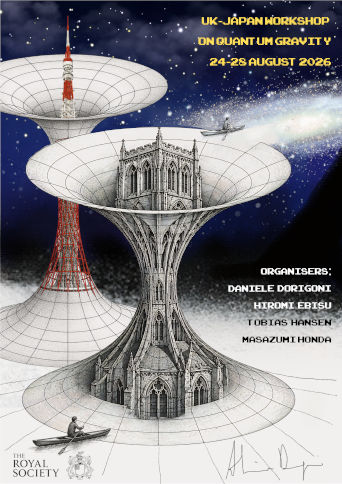
UK-Japan Workshop on Quantum Gravity 2026

→ Europe/London
Scott Logic Lecture Theatre - MCS0001 (Durham University, Department of Mathematical Sciences)

Scott Logic Lecture Theatre - MCS0001

Durham University, Department of Mathematical Sciences

Mathematical Sciences & Computer Science Building Durham University Upper Mountjoy Campus Stockton Road Durham University DH1 3LE
Daniele Dorigoni, Hiromi Ebisu (Riken, iTHEMS), Tobias Hansen (Durham University), Masazumi Honda (RIKEN iTHEMS / Saitama University)
Description

The universe at extremely early times is expected to be described by some theory of quantum gravity, although we still do not know precisely what quantum gravity actually is.

In modern approaches to quantum gravity, the path integral point of view provides a fundamental framework towards answering this pressing question. However, an evaluation or even just a precise definition of the path-integral for a full-fledged quantum gravity is one of the most important open problems in modern theoretical physics. 

With the "UK-Japan Workshop on Quantum Gravity 2026" we want to bring together experts working on different aspects of the gravitational path-integral, such as

  • Gravitational Scattering Amplitudes;
  • Complex Geometries and Exact WKB;
  • Quantum Cosmology;
  • Exact Methods and Resurgence Analysis;

with the long-term goal of providing innovative ways of tackling modern problems in quantum gravity.

This workshop is the second event sponsored by the Royal Society International Collaboration Award Grant "Re-PaInt: A Resurgence Path-Integral approach to quantum gravity" shared between Masazumi Honda at Riken iTHEMS and Daniele Dorigoni at Durham University, and aimed at fostering and developing an international partnership between the two institutes, as well as the greater Japan and UK theoretical physics communities working on quantum gravity, broadly intended. The page for the 2025 meeting held at the Riken campus in Kobe can be found here .

Poster Image Credit: Alessia Dorigoni & Andrea Degasperi


Confirmed Speakers:

  • Francesco Aprile (Universidad Complutense Madrid)
  • David Broadhurst 
  • Ioana Coman (University of Edinburgh)
  • Hiromi Ebisu (Riken)
  • Laura Engelbrecht (Scuola Normale Superiore di Pisa)
  • Yasuyuki Hatsuda (Rikkyo U.)
  • Adolfo Holguin (Trinity College Dublin)
  • Kohtaro Kato (Nagoya U.)
  • Paul McFadden (Durham U.)
  • Tatsuhiro Misumi (Kindai U.)
  • Masamichi Miyaji (Riken)
  • Yuya Murakami (Riken)
  • Silvia Nagy (Durham U.)
  • Ana-Maria Raclariu (King's College)
  • Rodolfo Russo (QMUL)
  • Yuya Tanizaki (Kyoto U.)
  • Congkao Wen (QMUL)
  • Han Yan (Tokyou U.)

Registration:

Registration is open to anyone (not just researchers from Japan or UK). There will be a poster session and we encourage students and early career researchers to present a poster.

The registration deadline is July 16, 2026.


Organisers:

  • Daniele Dorigoni (Durham University);
  • Hiromi Ebisu (Riken, iTHEMS);
  • Tobias Hansen (Durham University);
  • Masazumi Honda (Riken, iTHEMS);

Venue:

Durham University, Department of Mathematical Sciences
Scott Logic Lecture Theatre - MCS0001
 

Acknowledgements:

We would be grateful if you could acknowledge this workshop in a paper which is initiated or conducted during this workshop. Here are the samples of acknowledgments:

  • The authors thank the Royal Society under the International Collaboration Award Grant \R2\242058 and the RIKEN Interdisciplinary Theoretical and Mathematical Sciences Program where this work was initiated [completed] during the "UK-Japan Workshop on Quantum Gravity".
  • The authors thank the Royal Society under the International Collaboration Award Grant \R2\242058 and the RIKEN Interdisciplinary Theoretical and Mathematical Sciences Program. Discussions during the "UK-Japan Workshop on Quantum Gravity" were useful in completing this work.

Supporting Organisations:

This workshop is supported by the Royal Society International Collaboration Award Grant \R2\242058 "Re-PaInt: A Resurgence Path-Integral approach to quantum gravity".

 
Participants
    • 09:00 → 09:30
      Welcome 30m
    • 09:30 → 10:30
      Monopole versus center vortex through the lens of twisted partition functions 1h

      Proliferation of magnetic objects, such as monopoles and center vortices, provides intuitive explanations for color confinement. However, there does not exist local gauge-invariant definition of those objects in general, and the precise characterization of these confinement criteria is missing. In this talk, we propose the gauge-invariant characterization that distinguishes monopole and center-vortex condensation using the twisted partition functions with 1-form symmetry. After justifying why our proposal is reasonable, we then show that the gapped center-vortex condensed phase necessarily satisfies the monopole condensation using the technique of topological field theories. The talk is based on the recent work in collaboration with Yui Hayashi, https://arxiv.org/abs/2606.17708.

      Speaker: Yuya Tanizaki
    • 10:30 → 11:00
      Coffee Break 30m
    • 11:00 → 12:00
      Energy-energy correlators at strong coupling 1h

      In this talk, I will describe energy-energy correlators (EEC) in N=4 super Yang-Mills theory at strong coupling. We will show that the EECs are deeply connected to the AdS Virasoro-Shapiro amplitude, a link that allows us to explicitly compute its strong-coupling expansion. We will present these explicit results and also discuss properties of the EECs at strong coupling.

      Speaker: Congkao Wen (Queen Mary University of London)
    • 12:00 → 13:30
      Lunch Break 1h 30m
    • 13:30 → 14:30
      Free Discussion 1h
    • 14:30 → 15:30
      Imaginary pseudo entropy as a temporal-orientation record 1h

      Pseudo entropy is a complex-valued generalization of entanglement entropy defined from a transition matrix between two quantum states. In this talk, I will discuss the physical meaning of its imaginary part for real-time quantum evolution. I will first show that its short-time response is governed by a correlation between the physical Hamiltonian and the modular Hamiltonian of a subsystem. In particular, the imaginary part is controlled by a symmetrized modular covariance, which provides a microscopic measure of temporal orientation. I will then explain how this quantity acquires an operational meaning through a calibrated replica interferometer: the pseudo-Rényi phase, together with the interference visibility, determines the optimal distinguishability between opposite transition orientations. Finally, I will discuss many-body examples, coarse graining, and the relation between temporal orientation and irreversibility.

      Speaker: Tatsuhiro Misumi (Kindai University)
    • 15:30 → 16:00
      Coffee Break 30m
    • 16:00 → 17:00
      On bulk reconstruction in Lorentzian AdS and its flat space limit 1h

      We revisit the reconstruction of a free scalar in 4-dimensional Lorentzian Anti-de-Sitter spacetime in terms of primary operators in the boundary 3d CFT. We show that the positive and negative energy subspaces of solutions to the Klein–Gordon equation in AdS can be spanned with bulk-to-boundary propagators with appropriate time orderings. As a result, free scalar fields on a codimension-1 bulk hypersurface can be expressed in terms of operators integrated over boundary regions in the past or future of the hypersurface with kernels given by time-ordered or anti-time-ordered propagators. We will explain how to obtain a similar decomposition of the free field in terms of boundary operators transforming in representations of an so(3,1) subalgebra of the 4d AdS isometry algebra by constructing the appropriate wavefunctions. We conclude by showing that the expansion of a free scalar in Minkowski space in plane wave, Carrollian and conformal primary bases follow from these results in various flat space limits.

      Speaker: Ana-Maria Raclariu
    • 17:00 → 19:00
      Poster Session 2h
    • 09:30 → 10:30
      Exact WKB for Extremal Black Hole QNMs 1h
      Speaker: Yasuyuki Hatsuda
    • 10:30 → 11:00
      Coffee Break 30m
    • 11:00 → 12:00
      New lessons from the self-dual sector 1h
      Speaker: Silvia Nagy
    • 12:00 → 13:30
      Lunch Break 1h 30m
    • 13:30 → 14:30
      Free Discussion 1h
    • 14:30 → 15:30
      Learning in Modulated Quantum Codes 1h

      Lieb–Schultz–Mattis anomalies and gauging connect anomalous lattice systems to topologically ordered quantum codes with position-dependent symmetries. Motivated by this connection, we study what weak measurements can reveal about the information stored in such codes. The measurement outcomes are treated as data for inferring hidden error configurations, translating the quantum problem into a classical statistical model. At a higher Nishimori condition, an enlarged symmetry gives exact relations between information inferred from the measurement outcomes and correlations in the unmeasured system. For the rank-2 toric code and X-cube model, these relations show that measurements can reveal dipole and subsystem order, respectively, rather than ordinary local order.

      Speaker: Hiromi Ebisu (Riken, iTHEMS)
    • 15:30 → 16:00
      Coffee Break 30m
    • 16:00 → 17:00
      Bootstrapping Quantum Gravity on AdS3×S3 and the String Lamppost 1h

      I will consider the theory of n tensor multiplets on AdS3×S3 coupled to six-dimensional (2,0) supergravity. Through the AdS/CFT correspondence, this theory is known to arise from a top-down string construction, which fixes the number of tensor multiplets to n=21. The same value can also be inferred from six-dimensional gravitational anomaly cancellation. In this talk, I will derive n=21 from a different perspective, taking the viewpoint of a low-energy observer in AdS3 who has access, from the bootstrap, to the four-point scattering amplitudes of the lightest Kaluza–Klein mode of the tensor multiplets. Remarkably, requiring this data to be consistent with crossing symmetry singles out n=21, manifesting the string lamppost.

      Speaker: Francesco Aprile (Complutense University of Madrid)
    • 09:30 → 10:30
      Information-Theoretic Formulation of Topological Order 1h

      Topologically ordered phases in two-dimensional gapped quantum systems provide a fundamental example of quantum phases that cannot be understood within the conventional framework of symmetry breaking. Their universal properties are widely believed to be described by topological quantum field theories (TQFTs). However, establishing this description directly from the microscopic properties of quantum many-body states remains a challenging problem. In this talk, I will discuss an information-theoretic approach to this problem based on the entanglement bootstrap. The basic idea is to characterize a gapped quantum state through universal constraints on its local reduced density matrices, motivated by the area law of entanglement. Remarkably, these local entropic constraints are already sufficient to derive nontrivial global structures associated with topological order. In particular, one can identify superselection sectors and derive the fusion rules of anyonic excitations without assuming an underlying TQFT or microscopic quasiparticle description.
      I will explain the basic framework and illustrate how topological data emerge from purely quantum-information-theoretic properties of the ground state. I will also discuss what is currently known about the scope and limitations of this approach, including the issue of spurious topological entanglement entropy. Finally, I will briefly discuss ongoing work toward connecting the entanglement-bootstrap framework with operator-algebraic approaches to infinite quantum systems, with the aim of developing a unified formulation of topological order in the thermodynamic limit.

      Speaker: Kohtaro Kato
    • 10:30 → 11:00
      Coffee Break 30m
    • 11:00 → 12:00
      Finite N integrated correlators and Large N Universality 1h

      Recently techniques for integrated four-point functions in N=4 SYM have been extended to cases where two of the operators are determinant-like operators and two O_2 operators. These HHLL correlators have dual descriptions in terms of scattering of closed strings off giant graviton branes in the bulk. One unusual feature of these correlators is that their strong coupling asymptotics contain a universal tower of stringy corrections which are independent of the precise details of the heavy operator at leading order in the large N expansion. One of the challenges in studying such correlators is the apparent complexity of the combinatorics in their matrix model description. I will propose a dual complex matrix model description for this family of correlators which computes their whole perturbative expansion in g_YM at finite N. This leads to a simple master formula for the spectral density of all HHLL integrated correlators on the conformal manifold for the U(N) theory. As a result I will explain the origin and breakdown of the universality in giant correlators to all orders in the 1/N expansion. I will also comment on how these techniques generalize to heavy operators describing bubbling geometries.

      Speaker: Adolfo Holguin
    • 12:00 → 13:30
      Lunch Break 1h 30m
    • 13:30 → 14:30
      Free Discussion 1h
    • 14:30 → 15:30
      Hilbert Space of Jackiw–Teitelboim Gravity in a Closed Universe 1h

      In this talk, I will present a path-integral derivation of the Hilbert space of Jackiw–Teitelboim (JT) gravity in closed universes, in both de Sitter and anti-de Sitter spacetime. Through a careful analysis of the gravitational path integral, we evaluate the inner products exactly and show that the physical Hilbert space is naturally described as a space of coinvariant states equipped with a group-averaged inner product. Our results also have implications for the path-integral measure in configuration space. Furthermore, we propose a nonperturbative completion of this model that incorporates topology-changing processes and possesses a nontrivial finite-dimensional Hilbert space.

      Speaker: Masamichi Miyaji
    • 15:30 → 16:00
      Coffee Break 30m
    • 16:00 → 17:00
      What to Make of Divergent EFTs in de Sitter? 1h

      In this work, we show that effective field theories (EFTs) in de Sitter spacetime generically give rise to divergent series as higher-order terms in the EFT expansion are included, resulting in a progressive loss of precision. We demonstrate how this behavior can be understood within the framework of resurgence theory, and how the information encoded in these divergent series can be systematically exploited to recover precise and non-perturbative physical predictions from the EFT.

      Speaker: Laura Engelbrecht
    • 09:30 → 10:30
      Quantum modularity of false theta functions and asymptotics of Witten–Reshetikhin–Turaev invariants 1h

      Quantum modularity is a fascinating phenomenon connecting mathematical physics, topology, and number theory.
      Among its most important expected examples are quantum invariants of knots and 3-manifolds. These invariants originate from Chern–Simons theory, a 3-dimensional topological quantum field theory. A fundamental problem in Chern–Simons theory is to understand their asymptotic behavior in the large-level limit. Quantum modularity provides a number-theoretic structure related to such asymptotic phenomena.

      In this talk, I will establish asymptotic expansions of the Witten–Reshetikhin–Turaev invariants for a broad class of non-hyperbolic 3-manifolds. A key step is to derive explicit quantum modular transformation formulas for general false theta functions, in analogy with the classical modular transformation of theta functions. I will explain how these number-theoretic structures lead to the asymptotic behavior of quantum invariants.

      This talk is based on arXiv:2508.21710.

      Speaker: Yuya Murakami
    • 10:30 → 11:00
      Coffee Break 30m
    • 11:00 → 12:00
      3D N=4 SQFTs, VOAs and chiralization of Higgs branches 1h

      Vertex operator algebras are powerful and increasingly familiar algebraic invariant structures embedded into 4- and 3-dimensional SQFTs, where they encode distinguished algebras of local operators and capture exact information about the quantum field theories—such as symmetries, defects, protected spectra, and dualities—while making VOA representation-theoretic tools available. In particular, topologically twisted 3D N=4 SQFTs can support a vertex algebra on a 2D boundary, which provides a new, interesting analogue of established 3D/2D correspondences. [2312.13363], [2606.23807] have initiated a systematic construction and analysis of such vertex algebras for a rich class of 3D N=4 SQFTs, which are realised by intersecting brane systems in Type IIB string theory and which have holographic dual solutions in Type IIB supergravity. The approach in [2312.13363], [2606.23807] is geometric, constructing vertex algebras from the chiralization of corresponding Higgs branches. This talk will highlight the key insights revealed by chiral quantization, along with broader implications and expectations for the corresponding SQFTs.

      Speaker: Ioana Coman
    • 12:00 → 13:30
      Lunch Break 1h 30m
    • 13:30 → 14:30
      Free Discussion 1h
    • 14:30 → 15:30
      3+1D lattice gauge theory without string or self-similar fractal logical operators 1h

      Extended operators provide a useful probe of nonperturbative phases in lattice systems. I will introduce a family of (3+1)-dimensional qutrit models obtained by adding constrained spatial randomness to Haah’s cubic code. I prove that these models retain the absence of string logical operators, while numerical evidence shows that the self-similar fractal structure of the translation-invariant model is also lost. Instead, the logical sectors are generated by membrane-like operators. These results demonstrate that translation symmetry plays an essential role in organizing fractal operator structure and suggest a class of spatially nonuniform phases beyond conventional topological and fracton order.

      Speaker: Han Yan
    • 15:30 → 16:00
      Coffee Break 30m
    • 16:00 → 17:00
      Feynman integrals, black holes, resurgent structure and the cosmohedron 1h

      I discuss a family of massive Feynman integrals whose algebraic geometry involves an elliptic curve at two loops, a K3 surface at three loops, and a Calabi-Yau manifold at four loops. They were originally studied in the context of the magnetic moment of the electron. Remarkably, 4-loop integrals yield the areas of black holes in compactifications of 10-dimensional supergravity. At 2 and 3 loops, quasi-modularity leads to resurgence of structure at large and small momenta, which Daniele Dorigoni and I have extended to encompass large and small couplings in topological string theory. As a grace-note, I conclude with a simple example of resurgence that arises from an asymptotic study of combinatorics of the cosmohedron.

      Speaker: David Broadhurst
    • 09:30 → 10:30
      The renormalisation of IR divergences in de Sitter 1h

      Cosmological correlators in de Sitter spacetime exhibit infrared divergences in many cases of interest including massless and conformally coupled scalars. These divergences are due to the infinite volume of spacetime, and are analogous to the IR divergences in AdS dealt with by holographic renormalisation. In this talk, we present a renormalisation procedure for cosmological correlators in dS. We show how all tree-level IR divergences in the Schwinger-Keldysh path integral can be removed by the addition of local counterterms at the future boundary of dS. We contrast this procedure with holographic renormalisation in AdS, and discuss the implications for holography.

      Speaker: Paul McFadden
    • 10:30 → 11:00
      Coffee Break 30m
    • 11:00 → 12:00
      Holographic correlators with 1/2-BPS bound states 1h

      In holographic CFT's, such as N=4 SYM, it is natural to organise
      the spectrum in single and multi particle states. By now we have a wealth
      of information about 4-point correlators with BPS single particle states,
      but much less is known about 4-point correlators involving multi particle
      states. I will discuss how we can calculate such correlators at strong
      coupling by using various techniques: bootstrap, OPE's of higher point
      functions and a bulk approach based on 1/2-BPS asymptotically AdS
      supergravity solutions. I will provide explicit results for various
      families of 4-point correlators with one or two 1/2-BPS multi particle
      states in the context of the AdS5/N=4 SYM duality.

      Speaker: Rodolfo Russo
    • 12:00 → 12:10
      Concluding Remarks 10m
    • 12:10 → 13:30
      Lunch Break 1h 20m
    • 13:30 → 17:00
      Free Afternoon 3h 30m